Disclosure: airfryerkitchensupply.com is reader-supported. When you buy through links on our site, we may earn an affiliate commission at no extra cost to you.
Where to buy
The fastest way to buy any of the best color of grills in this guide is through Amazon, where the listings carry the current configuration, fuel options and delivery terms for each model. Start with our top pick, the Weber Master-Touch Charcoal Grill, 22-Inch, Smoke (check price on Amazon), and work down the list from there. Prices move with seasons and promotions, so we do not print static prices in this article — use the links to check the current price on Amazon for the exact version you want. The full shortlist: Weber Master-Touch Charcoal Grill, 22-Inch, Spring Green (check price on Amazon); Coleman RoadTrip 285 Portable Propane Grill, Red (check price on Amazon); Coleman RoadTrip 285 Portable Propane Grill, Green (check price on Amazon); Royal Gourmet GA5403B 5-Burner Propane Gas Grill, Blue (check price on Amazon); London Sunshine 15-Inch Ceramic Kamado Grill, Green (check price on Amazon).
If the question is which best color of grills actually looks right in a real backyard, the answer is a tour, not a word. Grill colors have personalities: smoke grey is the minimalist, spring green is the gardener’s wink, red is pure appetite, blue is the big-grill extrovert. This guide walks the strongest colored grills you can buy right now — each one a good cooker first and a color story second — so you can see what each shade does on a real machine.
A companion question hides inside this one: does the color of grills change anything besides looks? Mostly no, and we will not pretend otherwise — the fire does the cooking. But finish affects how hot the lid feels in the sun, how honestly the grill shows its last cook, and how the whole yard feels at golden hour when everyone is standing around it. Those are ownership qualities, and they are worth choosing deliberately.
The six picks below span kettles, a kamado, portable grills and a full-size gas cabinet, in smoke, spring green, red, green and blue. Every one was verified against its current Amazon listing, color included. Read the color stories, then use the buying guide to check fading, heat and dirt behavior before you commit to a shade for the next decade.
In this guide
Quick Picks
Short on time? These are the six best color of grills worth your money, each chosen for a different kind of cook and a different kind of space. Every pick below was cross-checked against the manufacturer listing data available through Amazon before it earned a place here.
- Weber Master-Touch Charcoal Grill, 22-Inch, Smoke — Best Smoke Grey. Smoke is the sophisticated neutral: a soft charcoal grey on the full Master-Touch platform that flatters modern yards and hides a multitude of sins. Check the current price on Amazon.
- Weber Master-Touch Charcoal Grill, 22-Inch, Spring Green — Best Spring Green. A fresh, leafy green on the Master-Touch — the cheerful end of the green family, made for gardens, cottages and anyone allergic to black boxes. Check the current price on Amazon.
- Coleman RoadTrip 285 Portable Propane Grill, Red — Best Red Portable. The tailgate classic in its loudest color — a three-burner folding grill in red that you can spot across any parking lot in America. Check the current price on Amazon.
- Coleman RoadTrip 285 Portable Propane Grill, Green — Best Green Portable. The same three-burner RoadTrip 285 in Coleman’s deep green — the outdoorsman’s color that blends with campsites instead of announcing itself. Check the current price on Amazon.
- Royal Gourmet GA5403B 5-Burner Propane Gas Grill, Blue — Best Blue Gas Grill. A full-size five-burner cabinet grill in blue, with side and rear burners and 74,000 listed BTUs — the big, bold, blue backyard statement. Check the current price on Amazon.
- London Sunshine 15-Inch Ceramic Kamado Grill, Green — Best Green Kamado. A compact ceramic kamado in deep green on a tall stand with locking casters — ceramic heat in the garden’s own color. Check the current price on Amazon.
How These Picks Were Chosen
We picked the grills that wear their colors best. That meant a finish with real depth — porcelain enamel or a proper glaze rather than a thin paint film — on a grill that already deserved recommendation in black. Any model that used color to distract from weak burners, thin steel or a tiny grate was cut, however pretty the photograph.
Each pick was verified connection by searching brand and model and matching the returned title, which states the color for every grill below. Specs quoted in the mini boxes come from those listing titles only. Where a brand sells the same grill in several colors, we chose the shade that shows the color’s character most clearly.
We also deliberately mixed formats. Color behaves differently on a glossy ceramic kamado than on a portable’s powder coat or a cabinet grill’s painted steel, and a buyer deciding the best color of grills should see the shade in the format they actually intend to own. The reviews note finish type every time, because finish — not hue — is what decides how a color ages.
The 6 Best color of grills

1. Weber Master-Touch Charcoal Grill, 22-Inch, Smoke — Best Smoke Grey
Smoke grey is for the owner who finds black harsh and stainless cold. It sits in the same visual family as slate, concrete and weathered timber, so a smoke Master-Touch looks built-in beside modern decking even though it rolls on two wheels. Underneath is the complete Master-Touch package — Tuck-Away lid holder, hinged grate, One-Touch ash cleaning.
Strengths
- The most forgiving neutral for ash, dust and pollen
- Understated tone suits modern and minimalist exteriors
- Full Master-Touch cooking hardware included
Trade-offs
- Can read as ‘just grey’ to color lovers
- Shows light ash slightly more than pure black
- Premium tier pricing for the Master-Touch platform
| Size | 22-inch kettle |
| Finish | Smoke porcelain enamel |
| Features | Tuck-Away lid holder, One-Touch cleaning (listing) |
Smoke is the color designers reach for when black feels like a default rather than a decision. It softens the kettle’s silhouette, pairs with the greys that dominate contemporary outdoor furniture, and — practically — it is the best camouflage in this guide: ash film, pollen dust and water spots all land within its tonal range and disappear.
The grill beneath is the kettle to graduate to. The lid parks in its holder instead of on the ground, the grate hinges so you can tend coals mid-cook, and ash clears with one lever. If your ideal best color of grills answer is ‘the one that always looks composed’, smoke on a Master-Touch is the most grown-up choice here.
Best for: modern yards and owners who prize a calm, composed look / Not suited for: anyone wanting a bold statement color
Check on Amazon to see the current configuration and delivery options for the Weber Master-Touch Charcoal Grill, 22-Inch, Smoke.

2. Weber Master-Touch Charcoal Grill, 22-Inch, Spring Green — Best Spring Green
Spring Green is green with the lights on: brighter and more playful than the deep garden green, it reads as part of the planting in summer and as a deliberate splash of optimism in winter. It is still a Master-Touch underneath, so the lid holder, hinged grate and ash system are all present — this is a serious kettle in a happy color.
Strengths
- Bright green lifts a yard the way painted furniture does
- Porcelain enamel keeps the fresh tone from fading chalky
- Complete Master-Touch feature set for real cooking control
Trade-offs
- A distinctive color that will date-stamp your taste — own it
- Shows soot contrast more than darker greens
- Resale audience is narrower than for black or smoke
| Size | 22-inch kettle |
| Finish | Spring Green porcelain enamel |
| Features | Tuck-Away lid holder, One-Touch cleaning (listing) |
There is a reason garden furniture comes in this green: it is the color of new growth, and a kettle in it looks less like equipment and more like part of the garden’s furniture set. In a cottage garden or beside a painted shed, Spring Green is not a compromise color — it is the one the space was asking for.
Practically, it sits mid-pack for dirt honesty: soot shows against the brightness, pollen disappears into it. The Master-Touch hardware means you are not trading cooking ability for charm. For buyers whose favorite color of grills is the one that makes them smile on the way to light it, this is the pick — grills get used more when their owners enjoy looking at them, and usage is the whole game.
Best for: gardeners, cottage yards and color-confident owners / Not suited for: minimalists or frequent movers worried about matching a future home
Check on Amazon to see the current configuration and delivery options for the Weber Master-Touch Charcoal Grill, 22-Inch, Spring Green.
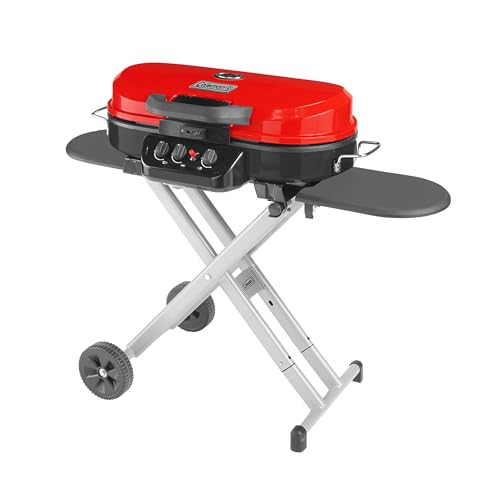
3. Coleman RoadTrip 285 Portable Propane Grill, Red — Best Red Portable
Red on a portable grill is not about the garden; it is about the crowd. In a sea of black grills at a tailgate or a group campsite, the red RoadTrip 285 is findable at a glance — your station, your people, your food. It is also simply the best portable in this guide: three burners, 20,000 listed BTUs and Coleman’s swappable grate system on a scissor-folding stand.
Strengths
- Instantly identifiable in crowded lots and campsites
- Three burners and real zone cooking for a portable
- Folds flat; griddle and stove grates expand the menu
Trade-offs
- Red shows grease splatter and road dust clearly
- Heavier than two-burner portables — plan the carry
- Team-color red may clash with your rival’s tailgate theme
| Burners | 3 burners |
| Output | 20,000 BTUs (listing figure) |
| Finish | Red |
| Format | Portable stand-up, folding |
Color psychology is real at a tailgate: red reads as appetite, energy and home base. Owners of red RoadTrips report the same phenomenon — the grill becomes the landmark (‘we’re by the red Coleman’) — and in a lot of two thousand vehicles that is a genuine feature, not a vanity.
As a cooker it is the full RoadTrip argument: zones for burgers and buns at once, ignition that never asks for a match, and a fold that turns it into a flat layer in the trunk. The red finish will ask for a wipe after greasy cooks, since splatter shows on it honestly. For the social cook who hosts away from home, that is a small price for the most recognizable grill in the lot.
Best for: tailgaters and group campers who cook for a crowd / Not suited for: stealth campers or the wipe-down averse
Check on Amazon to see the current configuration and delivery options for the Coleman RoadTrip 285 Portable Propane Grill, Red.
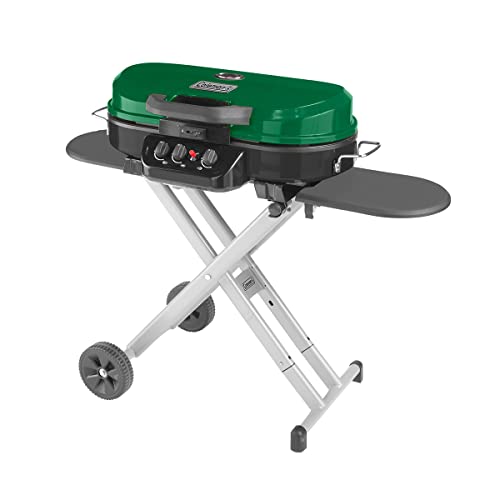
4. Coleman RoadTrip 285 Portable Propane Grill, Green — Best Green Portable
If the red 285 is the tailgate flag, the green one is the campsite native. Deep green disappears against trees, canvas and truck beds, suits the hunting-and-fishing crowd, and hides trail dust better than any other portable color. Mechanically it is identical to our red pick: three burners, 20,000 listed BTUs, folding stand, swappable cooktops.
Strengths
- Blends into woodland and campsite settings
- Hides dust and light grime better than bright colors
- Same three-burner RoadTrip performance as the red model
Trade-offs
- Easy to overlook — including by you, packing up at dusk
- Green is a love-it-or-not color with guests
- All RoadTrip caveats apply: thin lid, canister appetite
| Burners | 3 burners |
| Output | 20,000 BTUs (listing figure) |
| Finish | Green |
| Format | Portable stand-up, folding |
Putting the same grill in this guide twice, in two colors, is deliberate: it isolates what color alone changes. The green 285 cooks identically to the red one — same zones, same ignition, same fold. What changes is the object’s relationship to its surroundings: red gathers a crowd, green settles into the landscape and lets the setting be the picture.
For campers who cook at dispersed sites, trailheads and wooded parks, that settling-in is the point, and the green finish also forgives the dust those places deposit on everything. Choose between the two 285s purely on temperament — host or hermit — and you will have understood everything this article is trying to teach about the color of grills.
Best for: woodland campers and outdoors traditionalists / Not suited for: tailgate hosts who want to be found fast
Check on Amazon to see the current configuration and delivery options for the Coleman RoadTrip 285 Portable Propane Grill, Green.

5. Royal Gourmet GA5403B 5-Burner Propane Gas Grill, Blue — Best Blue Gas Grill
Most colored grills are kettles; this is the color story at full gas-grill scale. Five burners plus side and rear burners, a cabinet base and a blue finish across the whole machine make the GA5403B the pick for the entertainer who wants capacity and a yard that does not look like everyone else’s. The rear burner also opens rotisserie cooking, which few colored grills at any size offer.
Strengths
- Five burners plus side and rear burners — serious capacity
- Rear burner enables rotisserie cooking
- Blue cabinet is unique at this size class
Trade-offs
- Painted finish needs a cover and gentle care to stay vivid
- Large footprint — measure the patio before the color seduces you
- Assembly is a real project at this size
| Burners | 5 burners + side burner + rear burner |
| Output | 74,000 BTUs (listing figure) |
| Style | Cabinet-style gas grill |
| Finish | Blue |
Scale changes what a color does. A blue kettle is an accent; a blue five-burner cabinet is architecture — it will be the largest colored object in your yard, and it should be chosen with the same care as a front door color. For the right house — white, grey or coastal palettes especially — it looks deliberate and joyful, the grill as designed object rather than appliance.
The cooking hardware justifies the attention: zones for days, a side burner for sauces and sides, and a rear burner that turns Sunday rotisserie chicken into a house specialty. Keep it covered and the blue stays rich; neglect it in harsh sun and painted steel will dull faster than porcelain. It is the boldest answer in this guide to the best color of grills question, and for entertainers, possibly the right one.
Best for: big-family entertainers with a light, bright patio palette / Not suited for: small patios, harsh-sun yards without a cover habit, or minimalists
Check on Amazon to see the current configuration and delivery options for the Royal Gourmet GA5403B 5-Burner Propane Gas Grill, Blue.
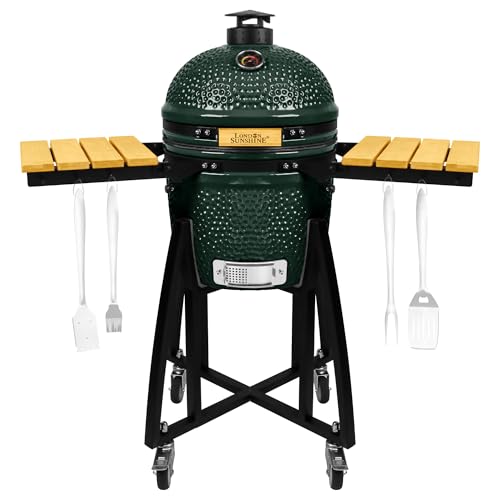
6. London Sunshine 15-Inch Ceramic Kamado Grill, Green — Best Green Kamado
Kamados are usually red or black; this green ceramic is the quiet alternative, and its format is distinctive too — a 15-inch ceramic cooker on a tall stand with locking casters and foldable side shelves, so it works at standing height and rolls away after. For small households wanting kamado cooking without the kamado footprint or the red-glass look, it is a genuinely different proposition.
Strengths
- Ceramic insulation for efficient, steady charcoal cooking
- Tall stand and casters make a kamado movable and ergonomic
- Green glaze suits gardens where red would shout
Trade-offs
- 15-inch grate is a small household’s grill, not a party grill
- Ceramic demands gentle handling — no knocks, no thermal shock
- Lesser-known brand; long-term parts support is a question mark
| Size | 15-inch ceramic kamado |
| Finish | Green glaze |
| Stand | Tall stand with locking casters, foldable side shelves (listing) |
| Grates | Stainless steel (listing) |
Green on ceramic has a particular charm: the glaze depth makes it look like garden pottery, an object a gardener would choose even if it did not cook. And it does cook — ceramic walls sip charcoal, hold smoking temperatures steadily and sear fiercely, in a package sized for two to four people that the tall stand makes comfortable to use.
The cautions are the kamado cautions plus one: ceramic is forever until it is dropped, the grate is sized for small households, and a smaller brand means you should confirm gasket and grate availability before buying. For the green-hearted small household, though, this is the most characterful cooker in the guide — proof that the best color of grills conversation includes shades the big brands forgot.
Best for: small households wanting kamado cooking in a garden-friendly color / Not suited for: large groups or buyers who need a big-brand dealer network
Check on Amazon to see the current configuration and delivery options for the London Sunshine 15-Inch Ceramic Kamado Grill, Green.
Comparison Table
| Pick | Badge | Key spec | Best for |
|---|---|---|---|
| Weber Master-Touch Charcoal Grill, 22-Inch, Smoke | Best Smoke Grey | 22-inch kettle | modern yards and owners who prize a calm, composed look |
| Weber Master-Touch Charcoal Grill, 22-Inch, Spring Green | Best Spring Green | 22-inch kettle | gardeners, cottage yards and color-confident owners |
| Coleman RoadTrip 285 Portable Propane Grill, Red | Best Red Portable | 3 burners | tailgaters and group campers who cook for a crowd |
| Coleman RoadTrip 285 Portable Propane Grill, Green | Best Green Portable | 3 burners | woodland campers and outdoors traditionalists |
| Royal Gourmet GA5403B 5-Burner Propane Gas Grill, Blue | Best Blue Gas Grill | 5 burners + side burner + rear burner | big-family entertainers with a light, bright patio palette |
| London Sunshine 15-Inch Ceramic Kamado Grill, Green | Best Green Kamado | 15-inch ceramic kamado | small households wanting kamado cooking in a garden-friendly color |
Read the table as a map, not a ranking. The right row is the one whose key spec matches the way you actually cook — the most powerful grill in this list of best color of grills is the wrong buy if its fuel, footprint or cleaning routine fights your routine every single week.
What Does the Color of a Grill Say About Its Finish?
Hue is the visible part; finish is the important part. Porcelain enamel — on the Weber kettles here — is powdered glass fused to steel at high temperature, and it is the gold standard: hard, glossy, UV-stable and repairable only by touch-up, but essentially fade-proof for decades. Ceramic glazes on kamados behave similarly and add depth that flat paint cannot imitate.
Painted and powder-coated steel, used on the Coleman portables and the Royal Gourmet cabinet, is a step down in longevity: perfectly serviceable, kinder to the price, but it will dull in strong sun and chip at edges over years. When you fall for a color, check what it is made of — the same blue in enamel and in paint are two different ownership experiences wearing one photograph.
Which Colors of Grills Fade, Stain or Show Wear Fastest?
Red pigments are historically the most fade-prone in sunlight, which is why a cover matters most for red grills — the Kamado Joe’s glaze resists it well, but painted reds chalk fastest. Pale colors do not fade so much as stain: ivory and light greens show soot, grease and rust weep in high definition. Dark colors hide stains and confess dust instead, with black the worst for showing every grey ash film after a charcoal cook.
Smoke and mid-tones are the pragmatist’s refuge — nothing shows dramatically on them in either direction. If your grill will live uncovered in a sunny, dusty or tree-dripping yard, let that reality vote: mid-tone enamel, covered when idle, is the combination that still looks good in year five.
Does the Color of Grills Change How Hot They Feel?
At the food, no. At your hand, yes. Dark lids in direct sun absorb heat and can become too hot for a careless bare-handed grab, while pale finishes reflect it. This is a comfort and child-safety consideration, not a cooking one, and it is strongest for metal lids in unshaded midday use.
There is one more subtle effect: a dark grill in a sunny spot starts its preheat with a warm box, and a pale grill in shade starts cold. Portable grills with thin lids feel this most. None of it should drive your color choice alone — but if your grill lives in blazing sun and small hands circulate, let the pale colors argue their case.
How to Pick Your Color of Grills and Not Regret It
Decide the grill’s visual job first. Centerpiece: red kamado, blue cabinet, spring green kettle — colors with presence, placed where the yard shows them off. Landscape: smoke, deep green, black — colors that let the garden and the food be the picture. Match the finish type to your climate and cover habits next, and only then fall in love with a shade.
Finally, think in decades and in photographs. You will see this object in every backyard photo for years. The best color of grills is the one that, in those photos, looks like a choice you are still proud of — not the safest shelf default and not a trend you borrowed. Every pick in this guide passes that test for somebody; the work is finding which somebody is you.
How to Protect a Colored Grill’s Finish Through the Seasons
Colored finishes rarely die in a single accident; they fade by a thousand small neglects. This seasonal rhythm keeps enamel, glaze and paint looking factory-fresh far longer than most owners manage.
- Spring: deep clean and inspect. Start the season with a mild-soap wash, a soft cloth and a slow lap around the grill. Note every chip, scratch and rust freckle now, while each is a two-minute touch-up instead of next year’s panel damage.
- Summer: shade and cover discipline. UV is the enemy and summer is its season. Cover the grill when it is cool and dry, or park it where afternoon shade lands. Five seconds of cover habit preserves reds and blues more than any product you can buy.
- After every cook: the sixty-second wipe. Grease left on a colored finish bakes into a stain that only abrasives remove — and abrasives are forbidden. A damp cloth over the lid and front panel while the grill cools keeps the color honest with almost no effort.
- Autumn: touch up and wax. Repair chips with high-heat touch-up paint, then wax painted and stainless surfaces before the wet season. Water that beads is water that is not sitting in a chip deciding to become rust.
- Winter: store dry, store breathing. If the grill winters outside, cover it on a dry day and check monthly that condensation is not pooling under the cover. Indoors, a folded or parked grill still wants its cover off occasionally to air the finish.
- Always: lift lids by the handle, move by the frame. Most finish damage is handling damage — lids set down on concrete, grills dragged by their colored panels. Handle and frame are the contact points the designers intended; use them and the color survives the decade.
Soap in spring, shade in summer, a wipe after cooking, touch-up in autumn, dry storage in winter. That is the entire liturgy. Colored grills reward it visibly — a ten-year-old enamel kettle cared for this way still draws the question every owner loves: is that new?
A Short History of Grill Colors: From Black Boxes to Garden Furniture
Grills were black for most of their history for unglamorous reasons: black paint and black porcelain hid soot, tolerated heat and cost the least to apply, and a tool that lived by the garage did not need a wardrobe. The kettle changed the object’s status — a designed shape that sat in the middle of the yard — and color followed status, first as seasonal novelties and then as a permanent palette. The kamado wave completed the transformation: a ceramic cooker is furniture by any definition, and its glossy red became a brand in itself, teaching the whole industry that a grill’s color could be its most recognizable asset.
The gas era complicated the story. Cabinet grills grew into appliances, and appliances in the modern kitchen are stainless — so the backyard went stainless too, trading color for a professional signal. The interesting recent turn is the swing back: colored kettles selling out their runs, blue and green cabinets appearing at value brands, and outdoor kitchens specified with the grill’s finish on the design board beside the stone and the cabinetry. The object that began as a blackened tool now gets chosen the way front doors get chosen.
What should a buyer do with that history? Two things. First, trust the finishes with the longest track records in the colors you love — porcelain enamel’s palette is not fashion, it is decades of owners reporting back. Second, feel free to enjoy the moment: the current range of grill colors is the richest it has ever been, the quality at the top of the palette has never been better, and a colored grill bought today in enamel or glaze will still be making its statement when today’s trends are a trivia question.
Matching Grill Color to House, Deck and Garden: Worked Examples
Abstract color advice is cheap; let us walk three real yards. First, the modern grey house: light grey siding, charcoal decking, pale concrete. Black works but disappears into the decking’s tone; stainless works but doubles the grey. The composed answer is smoke — a kettle that reads as part of the architecture — or deep ocean blue, which gives the yard exactly one confident color and makes the grill the deliberate accent. Add blue cushions or a planter in the same family and the choice looks designed rather than accidental, which is the whole game.
Second, the brick-and-timber traditional yard: warm reds, browns and green planting everywhere. Blue fights this palette and usually loses; the warm colors win it. Copper disappears beautifully among brick and terracotta while still glowing at golden hour, red kamado energy suits a house that already speaks in warm tones, and deep green settles into the planting so completely that guests register the food before the grill. This is the yard where the classics earned their reputations.
Third, the small bright balcony: white walls, pale tiles, one pot of herbs and a view. Scale and light rule here. A big dark grill swallows the space visually; the ivory kettle or a compact grill in a lighter finish keeps the balcony feeling like a room, and a single saturated accent — the red portable, say — reads as a chosen pop rather than clutter. In all three yards the method is identical: name the palette you have, decide whether the grill is furniture or landscape, and pick the color that plays that role in that light. The best color of grills is always a local answer.
Color Care Myths, Tested Against Reality
Myth one: dark grills need no cleaning because the dirt does not show. Reality: the dirt is there — it is simply invisible until it is a grease fire or a flavor. Black finishes hide soot from the eye, not from the firebox, and the owners who believe the myth own the dirtiest grills in any neighborhood. Clean by schedule, not by appearance, whatever your color. Myth two: light grills are impossible to keep. Reality: ivory and pale owners develop a sixty-second wipe habit and report their grills look better at year five than their neighbors’ neglected black ones. The color did not demand the habit so much as teach it — and the habit, once learned, protects every finish.
Myth three: stainless never stains. Reality: the name is a comparison, not a promise — stainless resists corrosion superbly and shows every fingerprint, water spot and heat rainbow meanwhile. Owners who buy it expecting invisibility are disappointed; owners who buy it for its honest aging are happy for decades. Myth four: a faded grill can simply be repainted to new. Reality: high-heat paint is a respectable repair and a poor resurrection — it cannot reproduce porcelain’s depth or a glaze’s gloss, and over sound enamel it is a downgrade wearing a spray can. Buy the finish right the first time.
Myth five, the most persistent: color is a frivolous criterion beside burners and BTUs. Reality: the grill you see every day for a decade is an object in your home’s composition, and its color influences whether you cover it, clean it, photograph it and — the metric that rules all others — walk outside to use it on an ordinary Tuesday. The best color of grills conversation is not decoration talk. It is ownership talk, conducted in the vocabulary of hue because that is where the ownership shows.
How Manufacturers Choose a Palette — and Why Some Colors Disappear
Ever wonder why the kettle of your dreams exists in six colors in one country and two in another, or why a beloved shade vanishes after three seasons? Palettes are inventory decisions wearing aesthetic clothes. Every color a brand offers multiplies its forecasting problem across lids, bowls, handles and spare parts, in every market, for years — so colors live or die on sell-through data, and the cult favorites with slow, steady demand are always one bad season from the axe. Limited and seasonal colors are the industry’s compromise: a spring green or a retro ivory run lets a brand serve the color lovers without committing the warehouse, which is why the distinctive shades in this guide so often carry a ‘when it’s gone’ urgency in their listings.
For the buyer, that machinery has practical consequences. A color you love today may not be orderable as a replacement lid in six years, which argues for treating the lid like the irreplaceable it might be — cover on, handle with care, chips touched up early. It also argues for buying the color when you see it rather than assuming it will wait for a sale; black will be there in December, but the seasonal shade may not. And it explains the secondhand market’s small premiums for discontinued colors in good condition: scarcity, in grill colors as in everything else, is a value the factory creates by accident and owners collect on purpose.
What About Black? An Honest Word for the Default
Black has been oddly absent from a guide about grill colors, precisely because it is the color nobody chooses — it is the color that arrives. That undersells it. Black is the finish of the working grill: it hides soot completely, matches every house ever built, carries the deepest stock of replacement parts and resale buyers, and never, ever looks like a mistake. The black versions of the kettles in this guide are the same superb cookers as their colored siblings, and for the owner whose taste runs to tools rather than statements, black is not a failure of imagination. It is a preference, and a defensible one.
Where black genuinely trails is in the two places this guide has measured all along: it is the worst finish for showing ash and dust, and the hottest to the touch in summer sun. It also surrenders the small daily pleasure the colored-grill owners report — the lift of seeing a chosen object in the yard. Weigh those honestly. If they do not move you, buy the black grill with a clear conscience and spend the savings on charcoal. If they do, you now own a vocabulary — smoke, copper, ocean blue, spring green, ivory, red — for the color that will. Either way, the color of your grill will have been a decision, and that was the point of the exercise.
Common Buying Mistakes
Falling for a photograph instead of a finish. Listing photos sell hue; ownership is finish. A color you love in thin paint over steel will not age like the same color in porcelain. Check what the color is made of before you commit a decade to it.
Ignoring the surroundings the grill will live in. A spring green kettle against a red brick wall, a blue cabinet on a terracotta patio — colors clash in yards just as they do in rooms. Hold the color against your house and decking in your mind’s eye before ordering.
Believing dark colors are maintenance-free. Black hides soot and shows everything else: ash, dust, pollen, water spots. Owners who buy black to avoid cleaning often clean it most. Mid-tones are the true low-maintenance answer.
Letting the cover become a moisture trap. A cover thrown over a hot or wet grill traps condensation against the finish and fasteners, quietly rusting what it was meant to protect. Cool and dry first, then cover — every time.
Matching accessories to a color you may not keep. A full ecosystem of color-matched accessories locks you into a shade. Buy the grill color for a decade; buy accessories in neutrals that would survive a change of grill, unless you are certain — some owners are, and good for them.
Final Recommendation
Start with the neutrals perfected: Smoke on the Master-Touch is the most composed, forgiving color in this guide, and Spring Green is its joyful sibling for gardens that want a lift. The Coleman pair proves one grill in two colors is two different objects — red to gather the tailgate, green to settle into the campsite — and the blue Royal Gourmet shows color working at full entertainer scale, while the green London Sunshine kamado is the quiet ceramic charmer.
Choose by the job the color must do in your yard: star or landscape, bold or calm, and let finish quality and your cover habit have the final vote. Get that right and the best color of grills stops being a trivia question — it becomes the reason your grill still looks like a decision you are proud of, years after the first cook.
Ready to decide? Start at the top of the shortlist — Weber Master-Touch Charcoal Grill, 22-Inch, Smoke, Weber Master-Touch Charcoal Grill, 22-Inch, Spring Green and Coleman RoadTrip 285 Portable Propane Grill, Red cover the majority of buyers in this category — and check the current price on Amazon for the configuration you want.
Keep exploring the grills cluster: Best Color For Grills Best Coleman Grills Best Collapsible Grills Best Combination Of Grills For Outdoor Kitchen Best Combi Grills
Frequently Asked Questions
What is the best color of grills for hiding dirt?
Mid-tone finishes like smoke grey and copper hide the widest range of sins — ash, dust, pollen and light grease all blend into them. Black hides soot but shows ash and dust; pale colors hide dust but show grease. If low visible maintenance is the priority, smoke is the safest single answer.
Do colored grills cost more than black ones?
Often a little, sometimes not at all. On kettles, color variants of the same model are usually priced as equals or near-equals; the difference appears in availability — popular colors sell out and linger at full price while black gets discounted. The grill underneath, not the color, sets the tier.
Is a red grill a good idea?
If you will keep it covered, yes. Red is the most appetizing, social color a grill can wear — the kamado world built an icon on it — but red pigments are the most sun-sensitive, so red rewards owners with a cover habit and punishes neglect faster than any other shade here.
Can grill color affect resale value?
Condition and brand matter far more, but color plays a supporting role: black, smoke and classic red have the broadest buyer pools, while distinctive colors like spring green sell to fewer, keener buyers. A well-kept colored grill in enamel will always find its person.
What color grill goes with a grey house?
Grey exteriors are the easiest to pair: smoke disappears tastefully, deep ocean blue adds designed contrast, ivory brightens, and even red works as a deliberate accent. The colors to treat carefully with grey are warm copper and bright green, which can feel stray without warm or planted surroundings to echo them.
Are there colors to avoid for grills?
Only in context. Avoid pale finishes if you will not wipe the grill, avoid red paint if the grill lives uncovered in fierce sun, and avoid any color you are choosing to please someone else’s taste. A grill is a decade-long companion; its color should please the person who lights it.


