Disclosure: airfryerkitchensupply.com is reader-supported. When you buy through links on our site, we may earn an affiliate commission at no extra cost to you.
Where to buy
This guide to the best coffee pump pots that keep coffee hot all day links only to models we verified against the manufacturer’s own listing, so the shortlist below is the right place to start comparing.
Coffee pump pots — also sold as airpots — are stocked by Amazon, office-supply retailers and restaurant-supply stores. Amazon is where we verified every pick in this guide against the manufacturer’s own listing, and it is the most practical channel for comparing capacities and liner types side by side. Pay attention to the liner description in the listing: stainless steel and glass liners behave differently, and the listing title is the surest way to confirm which one a given model uses.
A buying note specific to this category: airpots are frequently sold singly and in pairs, and commercial models like the BUNN and Wilbur Curtis below sometimes appear through restaurant-supply sellers on the same listing. Confirm the quantity and the seller before ordering, and check the current price on Amazon for each pick — multi-pack listings can make a per-pot comparison misleading at a glance.
- Zojirushi Stainless Steel Vacuum Air Pot (1-Gallon / 3.8L) — Check the current price on Amazon
- BUNN Airpot 3.8L (36725.0000) — Check the current price on Amazon
- Tiger Thermal Insulated Air Pot (MAA-C221XC, 2.2L) — Check the current price on Amazon
- Zojirushi Thermal Gravity Pot (AY-AE25) — Check the current price on Amazon
- Wilbur Curtis Thermal Dispenser Air Pot (TLXA2203G000, 2.2L) — Check the current price on Amazon
- Cresimo Coffee Carafe with Pump (102oz / 3L) — Check the current price on Amazon
The best coffee pump pots that keep coffee hot all day solve a problem every office, church kitchen, site cabin and family gathering eventually meets: a pot of coffee brewed at eight is a sad, lukewarm apology by eleven. A pump pot — a vacuum-insulated dispenser you fill once and serve from by pressing the top — holds coffee at serving temperature for hours without a hot plate, and that last part matters as much as the insulation. Coffee left on a warmer does not just cool eventually; it cooks, turning bitter and stale long before it turns cold.
This guide is about heat retention first, because that is what the search asks. We judged each pot on the things that decide whether coffee is still properly hot at hour six: vacuum insulation rather than foam, liner material, lid and pump seals, and capacity matched to how fast your group actually drinks — because the best-insulated pot in the world cannot save coffee in a pot three times too big, sitting mostly empty and losing heat to its own air space. Every pick was verified by brand and model against the manufacturer’s Amazon listing before we linked it.
One honest framing before the picks: no passive pot keeps coffee at brewing temperature forever, and coffee flavour fades on its own clock even when heat holds. The realistic promise of a good airpot is coffee that is still steaming-hot and pleasant several hours after brewing — the whole workday meeting, the whole event — without a plug, a warmer or a fresh brew every hour. The six pots below deliver that promise at different sizes and budgets.
There is a second, quieter reason the pump pot has outlasted every rival format for group coffee: it decouples quality from timing. Brew when the beans and the brewer are at their best — early, carefully, in one batch — and the pot holds that quality in suspension while the day unfolds around it. No other serving method lets a host make the coffee before the guests arrive and still serve it as if it were fresh. Everything in this guide, from the preheat ritual to the sizing advice, exists to protect that one advantage.
In this guide
Quick Picks
Six verified pump pots ordered by how confidently they hold heat across a long day, from the benchmark Japanese vacuum pots to the budget party option. Badges repeat in the full reviews below.
- Zojirushi Stainless Steel Vacuum Air Pot (1-Gallon / 3.8L) — Best Overall. The benchmark big airpot: a full gallon of vacuum-insulated stainless steel from the most trusted name in thermal ware, built for a full day of serving. Check price on Amazon.
- BUNN Airpot 3.8L (36725.0000) — Best Commercial Grade. The café-standard airpot: lever-action dispensing, stainless liner, and a design built to pair with commercial brewers and survive daily service abuse. Check price on Amazon.
- Tiger Thermal Insulated Air Pot (MAA-C221XC, 2.2L) — Best for Small Groups. Japanese vacuum insulation in a 2.2-litre tabletop size — the right scale for a family or small office that finishes a pot by early afternoon. Check price on Amazon.
- Zojirushi Thermal Gravity Pot (AY-AE25) — Best Lever Dispensing. Zojirushi’s gravity-fed design: a lever tap instead of a pump, giving a smooth, controlled pour and one less mechanism to wear out. Check price on Amazon.
- Wilbur Curtis Thermal Dispenser Air Pot (TLXA2203G000, 2.2L) — Best Glass Liner. A commercial 2.2L airpot with a glass liner — the flavour-neutral choice, from a name that supplies cafés and diners across North America. Check price on Amazon.
- Cresimo Coffee Carafe with Pump (102oz / 3L) — Best Budget. A 3-litre stainless airpot at a fraction of the Japanese brands’ prices — the party and starter pick, with the manufacturer’s listing stating 12-hour hot retention. Check price on Amazon.
How These Picks Were Chosen
Verification used this site’s standard method: each pot was searched by brand and model attached to this site, and the manufacturer’s returned listing title had to match the model, capacity and liner type we intended to describe before a link was attached. Pump pots are a category full of near-identical unbranded clones, so we restricted linked picks to established manufacturers whose listings state their specifications plainly.
Judging criteria were thermal before anything else. Insulation type: true vacuum insulation outperforms foam-filled walls decisively over long periods. Liner: stainless steel for durability, glass for flavour neutrality and, in commercial designs, excellent heat behaviour. Seals and lid design: most heat escapes at the top, so pump mechanism and lid fit matter more than wall thickness. Then capacity realism, pump action quality, and how the pot cleans — because a pot that is hard to descale slowly becomes a pot nobody uses.
We also weighted brand track records in thermal ware. Companies that have made vacuum flasks for decades — Zojirushi, Tiger, BUNN’s commercial line — have earned the benefit of the doubt on insulation claims in a way no newcomer has. Where a manufacturer’s own listing states a heat-retention figure, our spec boxes reflect only what that listing states; otherwise we describe retention in the honest, qualitative terms a buyer can rely on.
A note on heat-retention claims, because this category tests a buyer’s scepticism. Manufacturers’ hour figures are measured under their own conditions, and we have treated them as context rather than fact: where a listing states a figure, our spec boxes attribute it to the listing, and our reviews judge the pots on construction — vacuum versus foam, liner, seals — and on the brands’ demonstrated records instead. A pot’s physics and its maker’s reputation predict its sixth hour far better than a number on a box.
The 6 Best Coffee Pump Pots That Keep Coffee Hot All Day, Reviewed
Read the badges for the short answer. The analysis under each pick covers the ownership details that decide long-day performance in practice: preheating behaviour, pump feel, and how each pot suits the size of group it will actually serve.
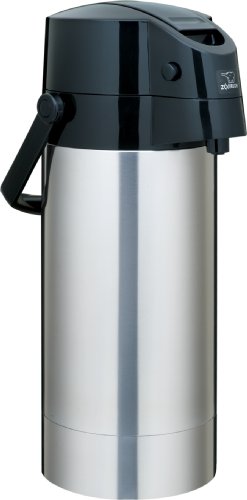
Zojirushi Stainless Steel Vacuum Air Pot (1-Gallon / 3.8L) — Best Overall
If the brief is ‘keep a lot of coffee hot for a long time’, the big Zojirushi is the answer the category keeps giving. Its stainless vacuum construction comes from a company whose entire reputation rests on thermal performance, and the gallon capacity suits the mathematics of all-day heat: a large, full pot loses heat slowly, because the coffee itself is the insulation. For offices, events and family gatherings that run from morning to late afternoon, this is the pot to beat.
- Capacity: 1 gallon / 3.8 litres (confirmed in the manufacturer’s listing title)
- Stainless steel vacuum insulation
- Pump-top dispensing
- Brand: Zojirushi
Strengths
- Vacuum stainless construction holds serving temperature across a long day
- Full-gallon capacity means the pot stays fuller, longer — which itself preserves heat
- Pump action is smooth and the build quality is a clear step above budget airpots
Trade-offs
- Large and heavy when full; not a pot for a small kitchen counter
- Costs several times the budget options
- Its size is wasted on groups that drink only a few cups
Zojirushi’s advantage is boring consistency: the seals fit, the pump doses evenly, the vacuum does what vacuum does, and the coffee at hour six is recognisably the coffee from hour one — hot, and not stewed by a warmer plate. The stainless liner shrugs off the bumps of event use and does not hold flavours the way ageing plastic internals can.
Buy it at the right scale. For a household of two it is absurd; for a workplace kitchen, a café’s self-serve station or a big family’s holiday it is close to perfect. Preheat it with hot water before filling — a habit the how-to section below explains — and its all-day claim becomes easy rather than optimistic. Check the current price on Amazon.
Ownership of the big Zojirushi settles into a rhythm its users rarely change: preheat while brewing, serve all day, rinse at night. The stainless liner tolerates a bottle brush and an occasional descale without complaint, and the pump mechanism — the part budget pots fail at — is built to the standard of the rest of the pot. It is heavy enough that owners choose its station once and build the coffee corner around it, which turns out to be a feature: a permanent, well-sited coffee station is the end state every office kitchen eventually wants.
Best for: offices, events and big households serving coffee all day / Not suited for: small households or anyone who brews only a few cups
Check the current price on Amazon

BUNN Airpot 3.8L (36725.0000) — Best Commercial Grade
The BUNN airpot is the one you have used a hundred times without noticing: it is the commercial standard that sits beside café brewers and conference-room coffee services everywhere. The lever-action top dispenses without the pumping effort of smaller pots, the stainless liner handles daily brewing cycles, and the whole unit is designed to be filled directly from a commercial brewer — though it works just as happily under a home machine or a kettle of brewed coffee poured in.
- Capacity: 3.8 litres / 128 oz (confirmed in the manufacturer’s listing title)
- Model: 36725.0000
- Lever-action dispensing
- Stainless steel liner
Strengths
- Commercial design proven across years of daily service
- Lever action is effortless, including for users with limited hand strength
- Replacement lids and parts are widely available — rare in this category
Trade-offs
- Utilitarian looks; it reads as equipment, not kitchenware
- Sold through commercial channels, so listings vary — confirm the exact model
- Same large footprint as the Zojirushi, with the same small-group mismatch
Heat retention in the BUNN is commercial-grade in the truest sense: not a laboratory record, but dependable across a service day, every day, with seals and a lid that keep doing their job after thousands of cycles. That durability of performance is what separates it from consumer pots whose insulation seems to fade as gaskets age.
It is the pick for anyone setting up a serious self-serve station — an office that brews twice a day, a church hall, a workshop, a B&B breakfast room. The availability of spare lids alone justifies it for institutional buyers: a dropped consumer airpot is landfill, while a dropped BUNN lid is a reorder. Check the listing carefully and check price on Amazon before ordering.
The BUNN’s ownership advantage compounds in institutional settings: when a lid is dropped at a conference centre, a replacement is a purchase order, not a obituary for the pot. Its brew-through design also means it pairs naturally with commercial brewers, filling directly without funnels or transfers that cost heat. Home buyers should know it looks and feels like the equipment it is — no styling concessions — but buyers who prioritise a decade of service over a styled counter will find that honesty refreshing rather than plain.
Best for: workplaces, venues and self-serve stations in daily use / Not suited for: style-led home kitchens or occasional use
Check the current price on Amazon

Tiger Thermal Insulated Air Pot (MAA-C221XC, 2.2L) — Best for Small Groups
Tiger is the other great Japanese thermal name, and this 2.2-litre air pot applies the same vacuum discipline as the big Zojirushi at a scale that suits real households. That scale is a thermal feature, not just a convenience: a 2.2-litre pot that a family actually finishes stays full through the morning, and a full pot holds its heat far better than a gallon pot sitting two-thirds empty.
- Capacity: 0.7 gallon / 2.2 litres (confirmed in the manufacturer’s listing title)
- Model: MAA-C221XC
- Stainless steel air pot, tabletop design
- Brand: Tiger Corporation
Strengths
- Right-sized for households and small teams, so coffee stays fresh as well as hot
- Tiger’s vacuum insulation is genuinely excellent at this size
- Tabletop proportions suit kitchen counters and dining tables alike
Trade-offs
- Too small for events or large offices
- Premium pricing for its capacity compared with budget 3L pots
- Pump pots this size still need preheating for best all-day results
The Tiger is the connoisseur’s answer to the category: not the biggest, but the best matched to how a household of coffee drinkers actually consumes. Brew at breakfast, and coffee is still properly hot at lunch — with none of the stewed flavour a warmer plate would have produced by ten o’clock.
Its fit and finish are a cut above the budget tier, the pump action is light and controlled, and the pot looks at home on a dining table in a way the commercial models do not. If your all-day coffee problem involves four to eight cups rather than forty, this is the most satisfying pot in the guide. Check the current price on Amazon.
Tiger owners tend to be the people who researched longest and regret least. The pot’s tabletop manners — its size, its finish, its controlled pump — make it the one airpot that genuinely belongs on a dining table, and its insulation means the last cup of a long lunch is not a compromise. Its cleaning story is simple: rinse daily, wash weekly, and the stainless interior stays neutral. It is also the easiest premium pot to store between uses, which matters in homes where the airpot is a weekend appliance rather than a daily fixture.
Best for: families and small offices finishing a pot within the day / Not suited for: events, large teams or all-day high-volume serving
Check the current price on Amazon

Zojirushi Thermal Gravity Pot (AY-AE25) — Best Lever Dispensing
The Gravity Pot replaces the pump with a lever tap: press, and coffee flows by gravity in a smooth stream you can start and stop precisely. It is the dispensing style of the classic Japanese café counter, and it solves two pump-pot annoyances at once — the sputtering last cups as air enters the pump, and the pump mechanism itself, which is the part that wears on cheaper pots.
- Model: AY-AE25 (confirmed in the manufacturer’s listing title)
- Gravity-fed lever dispensing
- Thermal vacuum insulation
- Brand: Zojirushi
Strengths
- Lever pour is smooth, precise and easy for any user
- Fewer moving parts in the dispensing path than pump designs
- Zojirushi thermal build quality throughout
Trade-offs
- Gravity flow slows as the pot empties
- Less common design; replacement parts are a Zojirushi-channel purchase
- Takes a moment to learn the lever’s touch for a full mug
In use, the Gravity Pot feels like serving from a proper beverage station rather than pumping a flask — which is exactly its design heritage. Heat retention is what you expect from the badge on the front: coffee brewed in the morning is honestly hot well into the afternoon, provided the pot starts full and gets the hot-water preheat described later in this guide.
Choose it if the pot will live on a counter or serving table where people help themselves all day, especially older users or kids who find pump tops awkward. It is the most civilised dispenser in this guide, and for a home office or family kitchen that serves steadily, civilised wins.
The Gravity Pot’s lever tap changes the social life of a coffee pot: children and grandparents serve themselves without the pump’s two-handed commitment, and the pour’s precision ends the drips-down-the-side mess that pump pots leave on tables. Owners should know the flow slows gracefully as the pot empties — the last cups take a little longer, which regulars read as the pot’s own low-fuel gauge. As a piece of Japanese café culture adapted for home counters, it has a quiet charm the pump models do not attempt.
Best for: countertop self-serve at home or in a small office / Not suited for: buyers who prefer the classic pump-top format or need maximum portability
Check the current price on Amazon

Wilbur Curtis Thermal Dispenser Air Pot (TLXA2203G000, 2.2L) — Best Glass Liner
Wilbur Curtis builds coffee equipment for the trade, and this airpot’s distinction is inside: a glass liner. Glass is the flavour purist’s liner material — it contributes nothing to the coffee, holds nothing from the last brew, and in a well-made vacuum vessel retains heat beautifully. For venues that alternate between coffee and tea in the same pot, that neutrality is a practical feature, not a snobbish one.
- Capacity: 2.2 litres (confirmed in the manufacturer’s listing title)
- Model: TLXA2203G000
- Glass liner with lever pump
- Commercial beverage dispenser
Strengths
- Glass liner keeps flavours pure between different drinks
- Commercial build from a specialist coffee-equipment maker
- Lever pump dispensing is easy and controlled
Trade-offs
- Glass liners are breakable — a dropped pot can mean a new liner
- Commercial styling and channel; confirm the exact model when ordering
- 2.2L size suits small-to-medium service, not crowds
The Curtis earns its place for buyers who have tasted yesterday’s coffee ghosting today’s tea in a steel pot and sworn ‘never again’. Rinsed between drinks, the glass liner genuinely resets to neutral, and the vacuum construction keeps either drink hot across a service period. Diners and cafés have relied on this format for decades for exactly those reasons.
The fragility caveat is real but manageable: treat it like the glass it is, station it rather than carry it, and it will serve for years. For a home that hosts often and serves both coffee and tea, it is the connoisseur’s commercial pick. Check price on Amazon and confirm the TLXA2203G000 model code.
Glass-liner ownership asks for one habit — station, do not shuttle — and repays it with the cleanest flavour reset in the category. Venues that run coffee in the morning and tea in the afternoon swear by this format for a reason. The liner itself is replaceable through commercial channels if the worst happens, which softens the fragility concern for organised buyers. For a home that hosts seriously and serves both drinks from one station, it remains the connoisseur’s pragmatic choice rather than a delicate indulgence.
Best for: hosts and venues alternating coffee and tea in one pot / Not suited for: rough transport, worksites or anywhere a pot gets knocked around
Check the current price on Amazon

Cresimo Coffee Carafe with Pump (102oz / 3L) — Best Budget
The Cresimo is the airpot most people actually buy first, and there is no shame in that: three litres of stainless, pump-top serving, and a price that makes it an easy yes for parties, holiday hosting and trying the format out. Its manufacturer’s listing states 12-hour hot retention, and while we would frame real-world expectations as ‘hot through your event’ rather than a laboratory number, the pot’s party credentials are well established.
- Capacity: 102 oz / 3 litres (confirmed in the manufacturer’s listing title)
- Stainless steel insulated construction
- Pump-top dispensing
- Manufacturer’s listing states 12 hours hot
Strengths
- Genuinely inexpensive for a full 3-litre airpot
- Capacity suits parties and gatherings perfectly
- Stainless build shrugs off casual event use
Trade-offs
- Seals and pump refinement trail Zojirushi and Tiger
- Heat retention is event-length rather than truly all-day at the top standard
- Brand support and spares are minimal compared with the commercial names
Judge the Cresimo against its actual job — a birthday party, a holiday open house, a team event — and it is excellent value: coffee stays hot for the hours the event runs, serving is effortless, and if it is knocked off a table you will be annoyed rather than devastated. The preheat habit from our how-to section closes much of the gap to pricier pots for event-length use.
Judge it as a five-year daily office pot and the Japanese and commercial picks above justify themselves. That is the honest shape of this category: the Cresimo is where you start or where occasional hosts should stay, and the premium pots are where daily drinkers end up. Check the current price on Amazon.
Cresimo ownership is refreshingly uncomplicated: it is inexpensive enough that nobody hovers over guests using it, tough enough for the garden party, and simple enough that cleaning is a rinse and an occasional proper wash. Owners who preheat it — the habit this guide keeps recommending — consistently report event-day performance that embarrasses its price. Its realistic lifespan under daily heavy use is shorter than the premium pots’, but under the party-and-hosting duty it is bought for, that arithmetic rarely matters.
Best for: parties, occasional hosting and first-time airpot buyers / Not suited for: daily heavy service where seals and spares matter
Check the current price on Amazon
Comparison Table
Capacity and liner are the two decisions in this table. Match capacity to how much your group drinks in a sitting period — the best heat retention comes from a pot that spends its life mostly full — and choose glass only if flavour neutrality matters more than drop resistance.
| Pick | Badge | Key spec | Best for |
|---|---|---|---|
| Zojirushi Stainless Steel Vacuum Air Pot (1-Gallon / 3.8L) | Best Overall | 3.8L stainless vacuum, pump top | offices, events and big households serving coffee all day |
| BUNN Airpot 3.8L (36725.0000) | Best Commercial Grade | 3.8L, lever action, commercial build | workplaces, venues and self-serve stations in daily use |
| Tiger Thermal Insulated Air Pot (MAA-C221XC, 2.2L) | Best for Small Groups | 2.2L stainless vacuum, tabletop size | families and small offices finishing a pot within the day |
| Zojirushi Thermal Gravity Pot (AY-AE25) | Best Lever Dispensing | Gravity lever tap, vacuum insulated | countertop self-serve at home or in a small office |
| Wilbur Curtis Thermal Dispenser Air Pot (TLXA2203G000, 2.2L) | Best Glass Liner | 2.2L glass liner, lever pump | hosts and venues alternating coffee and tea in one pot |
| Cresimo Coffee Carafe with Pump (102oz / 3L) | Best Budget | 3L stainless, budget price | parties, occasional hosting and first-time airpot buyers |
What Actually Keeps Coffee Hot All Day in a Pump Pot?
Vacuum insulation is the whole secret, and it is worth understanding. A vacuum-insulated pot has double walls with the air removed between them; with no air to conduct or convect heat, warmth can escape only slowly by radiation and through the lid and neck. Foam-insulated pots — the cheaper alternative — slow heat loss but cannot match a vacuum across six or eight hours, which is why every pick in this guide is a true vacuum design.
The second factor is the top. Most heat that leaves an airpot leaves through the lid, pump and spout path, not the walls. Quality seals, a well-fitted lid and a pump mechanism that closes fully are why the Japanese and commercial pots outperform lookalike clones with identical-looking walls. The third factor is physics you control: a full pot of coffee holds heat far longer than a half-empty one, because the coffee mass itself stores the heat and there is less air space to warm. Right-sizing the pot to your group is a thermal decision, not just a shopping one.
How to Choose the Right Pump Pot Size and Liner?
Work backwards from consumption. Count the cups your group drinks between brews: a 2.2-litre pot serves roughly nine standard mugs, a 3-litre around twelve, and the 3.8-litre models around fifteen. Choose the smallest pot your group reliably finishes within the window you care about — fresher coffee, better heat retention, less waste. Oversizing is the most common and most invisible buying error in this category.
- Choose a stainless liner for: durability, transport, worksites, kids, and daily hard use.
- Choose a glass liner for: alternating coffee and tea, flavour purity, and a pot that lives in one serving spot.
- Choose lever or gravity dispensing for: users with limited grip strength and high-traffic self-serve stations.
- Choose a classic pump top for: portability and the familiar format everyone already knows.
Finally, consider the ecosystem. Commercial brands sell replacement lids and seals; budget brands generally do not. A pot used daily earns its spares availability within a couple of years, while a party pot may never need a part in its life. Match the brand tier to the duty cycle and the total cost of ownership works out on its own.
Pump Pot vs Thermal Carafe vs Hot Plate: Which Keeps Coffee Best?
A hot plate is the worst of the three for anything beyond an hour: it holds temperature by continuously cooking the coffee, and the flavour cost is severe. It survives in kitchens by habit, not by merit. A thermal carafe — the kind that comes with many drip brewers — uses the same vacuum principle as a pump pot and performs well, but serving means picking it up and pouring, and capacities are usually smaller.
The pump pot wins for groups: larger capacities, one-hand touch-free serving, no lifting a full hot vessel, and the pot can sit anywhere — a meeting table, a garden party, a site cabin — with no cord. For a single household’s morning pot, a good thermal carafe is a fair rival. For coffee that must stay hot and serve a room all day, the airpot format in this guide is the tool the professionals settled on, and the reasoning has not changed.
How Long Do Pump Pots Last, and What Fails First?
A vacuum pot has no motor and no electronics, so its lifespan is decided by its soft parts. The vacuum in the walls, once sealed, lasts effectively for the life of the vessel unless the body is dented badly enough to breach it. What ages is everything that seals and moves: lid gaskets harden, pump diaphragms tire, and lever mechanisms loosen. On the commercial and Japanese brands here, those parts are replaceable or at least serviceable, which is how such pots reach ten and twenty years of service.
On budget pots the parts are rarely available, so the same ageing becomes terminal — the honest reason the premium tier exists. You can extend any pot’s life with three habits: rinse rather than soak the lid assembly, never force a stiff pump, and store the pot with the lid ajar so the seals rest uncompressed. Treat the seals kindly and even the budget picks will serve far beyond their price’s suggestion.
Pump Pots for Tea, Hot Water and Everything Else Hot?
Coffee built this category, but a pump pot is a general-purpose hot drinks station, and many households quietly use theirs for more tea than coffee. Hot water held at serving temperature transforms loose-leaf and bag tea for a group — no kettle queue, no reheating — and the same pot serves hot chocolate for a winter gathering or mulled drinks at a market stall. The format does not care what it insulates; it cares only that it starts hot and stays closed.
If your household’s centre of gravity is tea or mixed drinks rather than coffee, two picks deserve a second look: the glass-lined Wilbur Curtis, whose neutral liner moves between drinks without carrying flavours, and the PARACITY in our companion guide, whose rotating base was practically designed for a tea table. Coffee-first buyers lose nothing by the versatility either — it is the same vacuum, working for whatever the day requires.
How to Keep Pump Pot Coffee Hot for the Whole Day
The pot does half this job; your routine does the other half. These steps are the difference between coffee that is genuinely hot at hour seven and coffee that merely started in a good pot.
- Preheat the pot, every time. Fill the empty airpot with hot tap or kettle water, close it, and let it stand for five minutes while the coffee brews. Empty it, then fill with coffee. A cold liner steals the first degree of heat from every batch; a preheated one steals none.
- Brew straight into the pot where possible. Every transfer through a cold carafe or jug costs temperature. If your brewer cannot brew into the airpot, at least minimise the coffee’s journey and its time exposed to air.
- Fill it as full as the occasion allows. A full pot holds heat dramatically longer than a half-full one. If your group drinks little, choose a smaller pot rather than half-filling a big one.
- Close it and leave it closed. Every pump of the top admits cool air. Serve decisively, and resist the curious habit of pumping a cup ‘to check’ — the check itself is what cools the rest.
- Keep it out of draughts and off cold surfaces. A pot beside an open window or on a stone worktop in winter loses heat faster than the same pot on a wooden table indoors. Site the pot like you would site a drink you care about.
- Respect the flavour clock. Heat can be held longer than flavour deserves. For best taste, plan batches around four to six hours of prime drinking, and brew a fresh pot for the evening rather than heroic all-day storage.
- Rinse, do not stew, between batches. Empty dregs, rinse with hot water, and refill fresh. Topping up fresh coffee onto hours-old remains gives you the worst of both batches.
None of these steps costs money, and together they are worth more than the price difference between the budget and premium pots in this guide. Master the routine on any pick here and your all-day coffee problem is solved.
Common Buying Mistakes
Buying the biggest pot for a small group. Oversized pots sit mostly empty, and empty air space is where heat goes to die. The 3.8-litre flagships are magnificent for crowds and counterproductive for couples.
Skipping the preheat. Filling a room-temperature vacuum pot with coffee donates the coffee’s first heat to the liner. Five minutes of hot water first is the cheapest performance upgrade in this entire category.
Judging a pot by its first hour. Every insulated pot is hot at hour one. The differences this guide is built on appear at hours four to eight — which is exactly the window the search asks about.
Leaving coffee on a warmer ‘as backup’. A stewed pot next to a fresh airpot helps no one. Commit to the pump pot system: brew, transfer, close, serve. Half-measures produce the lukewarm, bitter results that give the format a bad name.
Neglecting the seals and pump at cleaning time. Coffee oils and scale attack the lid seals that all-day heat retention depends on. Rinse after use, deep-clean and descale on a routine, and replace tired seals where the brand offers them.
Final Recommendation
For most buyers the big Zojirushi is the answer: a gallon of properly engineered vacuum insulation that treats all-day coffee as a solved problem. Venues and offices should look at the BUNN for its commercial build and spares, smaller households at the Tiger for its right-sized excellence, and hosts who alternate drinks at the Wilbur Curtis glass liner. The Gravity Pot is the most pleasant dispenser here, and the Cresimo covers parties at a starter price.
Whichever you choose, run the routine from the how-to section — preheat, fill fully, keep it closed — and the pot will do the rest. The related guides below cover the brewers that fill these pots.
- Zojirushi Stainless Steel Vacuum Air Pot (1-Gallon / 3.8L) — Check price on Amazon
- BUNN Airpot 3.8L (36725.0000) — Check price on Amazon
- Tiger Thermal Insulated Air Pot (MAA-C221XC, 2.2L) — Check price on Amazon
Best Coffee Makers Best Thermal Carafes Best Coffee Makers For Offices Best Hot Pots Best Coffee Urns For Parties
Related guides
- Best Coffee Pump Pots That Keeps Coffee Hot All Day
- Best Coffee Pots That Keep Coffee Hot
- Best Tea Pots To Keep Tea Hot
Frequently Asked Questions
How long does coffee actually stay hot in a pump pot?
In a quality vacuum-insulated pot, preheated and filled fully, coffee stays at a genuinely hot serving temperature for six hours and beyond, and remains pleasantly warm well after that. Foam-insulated and half-empty pots fall off much sooner. Flavour, however, peaks earlier — most drinkers find coffee best within the first four to six hours regardless of temperature.
Is a stainless or glass liner better for keeping coffee hot?
Both insulate well in a vacuum vessel. Stainless is the practical default: durable, unbreakable and easy to live with. Glass holds a small edge in flavour neutrality — it neither absorbs nor contributes taste — which matters if the same pot alternates between coffee and tea. Choose by your use, not by a theoretical thermal difference.
Why does preheating an airpot matter so much?
The liner starts at room temperature and absorbs heat from the first coffee it touches until it equalises. Preheating with hot water does that absorbing with tap water instead of your coffee, so the batch starts at full temperature and stays hotter for hours longer. It is the single highest-value habit in this category.
Can a pump pot keep coffee hot without electricity?
Yes — that is the format’s defining advantage. Vacuum insulation is entirely passive, so a pump pot works on a meeting table, at an outdoor event or during a power cut with no cord and no warmer. It is why airpots are the standard for catering and self-serve stations.
How many cups does a 3-litre pump pot serve?
Roughly twelve standard 250ml mugs, or more smaller cups. A 2.2-litre pot serves about nine mugs and the 3.8-litre models about fifteen. Match the pot to your group’s real consumption so it spends its life mostly full — that is what keeps the last cup as hot as the first.
How do you clean a pump pot properly?
Rinse with hot water after every use, wash weekly with warm soapy water and a bottle brush, and descale periodically if your water is hard — the pump tube and lid seals need attention, not just the body. Never immerse a vacuum pot or put it through a dishwasher unless the manufacturer explicitly allows it; the seals are the insulation’s weak point.
Can a pump pot keep other drinks hot, like tea or hot chocolate?
Yes — an airpot is a general hot-drinks vessel. Tea, hot chocolate, mulled wine and hot water for instant drinks all hold heat the same way coffee does. If you alternate between strongly flavoured drinks, rinse thoroughly between them; a glass-lined pot, like the Wilbur Curtis in this guide, resets to neutral most completely.
Why does coffee from a pump pot taste better than from a hot plate?
Because the pump pot only stores heat while the hot plate keeps adding it. Continuously heated coffee keeps cooking: its aromatics evaporate, its acids turn harsh, and within a couple of hours it tastes stewed. Vacuum-stored coffee simply cools very slowly, so the flavour you brewed is the flavour you serve, hours later.
Should I stir or shake a pump pot during the day?
No. The coffee inside is uniform, and opening or agitating the pot only costs heat and invites spills. If a drink with sediment or cocoa has settled, a gentle swirl with the lid closed is harmless — but for coffee, the correct interaction with a pump pot between servings is none at all.

