Disclosure: airfryerkitchensupply.com is reader-supported. When you buy through links on our site, we may earn an affiliate commission at no extra cost to you.
Where to buy
Every verified pick below is sold on Amazon: start with the top pick, the runner-up, the third pick, the fourth pick, the fifth pick, the final pick, and check price on Amazon the day you buy, since prices and stock move.
Here is the honest starting point for the best coffee makers for truck drivers: the classic picture of a full-size drip machine that plugs straight into a 12V socket basically does not exist, and understanding why will save you money. A household drip brewer draws far more power heating water than a cigarette-lighter socket can safely supply, so true 12V coffee making lives in two smaller formats — compact 12V drip machines built for vehicles, and battery-powered portable espresso-style makers that sip power instead of gulping it. Everything in this guide is one of those, or a tool-battery machine, and each was verified as a real, listable product before it earned a place.
The third route — running a household 120V machine from an inverter or a power station — is real, and many drivers do it, but it is a system decision, not a coffee maker purchase: the inverter must be sized well above the brewer’s draw, wired properly, and treated with respect for what it pulls from the truck’s batteries. The buying guide below walks through that maths honestly, because a cheap undersized inverter paired with a big brewer is the most common and most disappointing purchase in this category.
What ‘good’ looks like in a cab: a machine that works parked without idling, survives vibration and temperature swings, cleans up in a truck-stop sink, and makes coffee at 4 a.m. in a rest area without a generator soundtrack. The six picks cover the realistic spread — a genuine 12V drip machine, two battery espresso makers, a battery drip-and-pod unit, a 12V single-serve, and a tool-battery brewer for drivers already carrying power-tool batteries.
A word about who this guide is not for: drivers with a factory-fitted inverter system and a household brewer already mounted and working do not need it — you have solved the problem the expensive way, and solved is solved. This guide is for everyone still buying coffee at truck stops and doing the maths on what that costs per month, per year, per career. Against that baseline, even the slowest machine below pays for itself quickly, and pays again every time the only alternative was a fluorescent-lit counter at mile marker whatever.
In this guide
Quick Picks
Six verified machines that respect how a truck actually provides power: native 12V where it exists, self-contained batteries where it does not, and no fictional plug-in drip machines anywhere.
- Dometic PerfectCoffee MC 052 Five Cup Coffee Maker, 12 V — Best True 12V Drip Machine. A genuine 12V drip coffee maker from an RV and trucking equipment maker, brewing a small five-cup pot directly from vehicle power. Check price on Amazon
- CONQUECO Portable Coffee Machine Travel 12V Car Espresso Maker — Best 12V Espresso-Style Maker. Battery portable espresso-style maker with 12V car charging, heating its own water in about three minutes for a fresh shot-style coffee anywhere you park. Check price on Amazon
- Vagizm Portable Espresso Machine, Self-Heating, 12V/24V Car Ready — Best for Team Cabs and 24V Systems. Self-heating portable espresso maker with a large 15000mAh battery and explicit 12V/24V car readiness — built for vehicle electrical systems, trucks included. Check price on Amazon
- BougeRV 144Wh Portable Coffee Maker for K-Cup & Ground Coffee — Best Battery Drip and Pod Maker. A cordless coffee maker with a real 144Wh battery system that brews K-Cup pods or ground coffee — proper mug-sized coffee with no vehicle power needed at the moment of brewing. Check price on Amazon
- Portable Single Serve 12V Car Coffee Maker for Pods & Ground Coffee — Best Budget Native 12V Single Serve. A straightforward 12V single-serve machine for pods or ground coffee with a reusable filter, brewing in roughly six to eight minutes from vehicle power. Check price on Amazon
- Makita DCM501Z 18V LXT / 12V max CXT Cordless Coffee Maker (Tool Only) — Best for Drivers Already on Makita Batteries. A drip coffee maker that runs on Makita tool batteries — if your cab or your other work already carries 18V LXT packs, your coffee power is already on board. Check price on Amazon
How These Picks Were Chosen
Every pick was verified against Amazon’s catalog — brand, model, listing title, and ASIN matched — and then filtered through truck-specific criteria. Power honesty came first: the machine’s stated power source had to be one a truck can actually provide, meaning 12V/24V vehicle power, an internal battery, or a tool-battery platform. Cab practicality came second: compact size, tolerance for being used on a fold-down table or bunk, and cleanup that works with bottled water and a paper towel. Third was brew honesty — espresso-style makers are described as espresso-style, drip as drip, with no format pretending to be the other.
We deliberately excluded household machines from the picks themselves, even popular ones, because recommending a 120V brewer to a driver without an inverter setup would be exactly the misleading move this category suffers from. The inverter route is covered as guidance, with the numbers, in the buying guide.
Excluded, with reasons: household drip machines appear nowhere as picks, because recommending one without its power system would mislead; the inverter route is handled as guidance instead, with its real requirements stated. Hand-press manual brewers were also left to the van-life guide, not because they cannot work in a cab — a kettle changes that maths — but because this guide’s readers asked specifically about powered machines, and the six here are the powered answers that survive contact with a truck’s electrical reality.
The 6 Best Coffee Makers for Truck Drivers
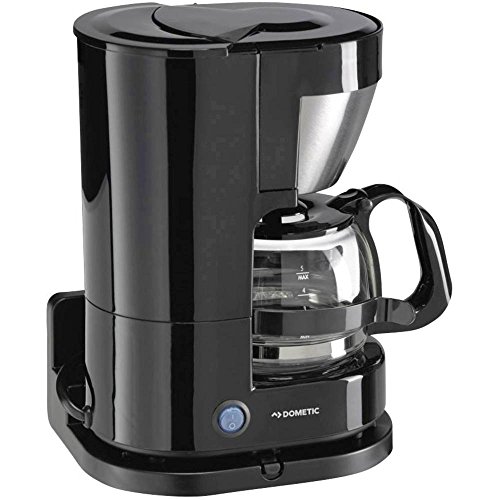
1. Dometic PerfectCoffee MC 052 Five Cup Coffee Maker, 12 V — Best True 12V Drip Machine
The MC 052 is the unicorn this category is named for: an actual drip coffee maker designed to run on 12V vehicle power, from Dometic, a company whose business is equipment for trucks and RVs rather than kitchens. It brews a small pot — five cups in maker terms — which suits a solo driver or a team pair far better than a household twelve. If your requirement is literally ‘drip coffee, from the truck’s power, no inverter’, this is the machine the sentence describes.
Strengths
- True native 12V drip brewing — no inverter, no battery management
- From a vehicle-equipment maker, designed for mobile use rather than adapted to it
- Small pot size matches solo-driver consumption and wastes less
Trade-offs
- 12V heating is slow compared with a household machine — plan the brew into your break
- Five small cups is a modest pot; heavy drinkers will brew twice
- Drip format only — no espresso-style drinks
Key specs
- Power: 12 V vehicle power
- Capacity: Five-cup drip pot
- Format: Drip coffee maker built for vehicles
- Maker: Dometic — vehicle and RV equipment specialist
The slowness deserves context rather than apology. Heating water is the most power-hungry job in coffee making, and a 12V supply delivers a fraction of household power, so the physics sets the pace. Drivers who love this machine build it into the routine: set it going at the start of a break or while doing the walk-around inspection, and the pot is ready when the paperwork is. Judged as a kettle-speed appliance it disappoints; judged as coffee that exists where no café does, it earns its shelf space in the cab.
Dometic’s vehicle focus also shows in the details that matter on the road — a design meant to be secured and used in a moving vehicle’s living space, sold through the same channels as truck fridges and cab equipment. It is the least glamorous pick here and the most literally correct answer to the search that brought you to this page.
Winter deserves a specific note for the Dometic: cold-soaked water in a cold cab takes longer to brew, and a machine stored in an unheated cab overnight starts every morning at ambient temperature. Drivers in northern routes learn to keep the machine and its water inside the cab’s warmed space rather than in an external box, and to treat the first winter brew as a patience exercise. The coffee at the end of it, in a frozen rest area, is reportedly worth every second.
If a fleet manager asked which single machine to standardise on for drip drinkers, the Dometic is the answer that requires the least explanation and the least infrastructure.
Best for: Drivers who want real drip coffee from 12V power with no inverter / Not suited for: Anyone in a hurry or brewing for a crowd

2. CONQUECO Portable Coffee Machine Travel 12V Car Espresso Maker — Best 12V Espresso-Style Maker
The CONQUECO takes the opposite approach to the Dometic: instead of sipping vehicle power continuously, it carries its own battery, heats a small amount of water fast, and makes an espresso-style coffee wherever the truck happens to be — cab, bunk, picnic table at a rest area. The 12V connection is for recharging from the truck, which is the right division of labour: the truck refills the battery over miles, the battery makes coffee in minutes.
Strengths
- Makes coffee parked, engine off, anywhere — battery does the work
- Heats its own water quickly for a single serving
- Grounds or capsules, so you can run cheap or convenient by the day
Trade-offs
- Espresso-style servings are small — this is shots, not mugs
- Battery capacity means a limited number of brews between charges
- Small water capacity suits one driver, not a crew
Key specs
- Power: Rechargeable battery, 12V car charging, USB charging
- Heating: Self-heating, around 3 minutes
- Formats: Ground coffee and compatible capsules
- Format: Portable espresso-style maker
For drivers whose coffee habit is a strong small coffee rather than a big mug, this format is arguably better than drip: fresher per serving, no pot sitting, and the machine stores in a fraction of the space. The recharge-while-driving rhythm fits trucking naturally — the battery tops up during the hours you are already rolling, and the coffee happens during the breaks you are already taking.
Honesty about the word espresso: portable battery makers produce an espresso-style extraction — concentrated, intense, crema-ish — rather than café-pump espresso in the strictest sense. In a cab at dawn, that distinction matters far less than the fact that the coffee is hot, strong, and yours. Judge it as the best coffee available at a rest area, and it wins easily.
Battery care on the road is simpler than folklore suggests: these packs prefer being used and recharged regularly over being stored flat or stored full for weeks, and a working driver’s rhythm — charge on driving days, brew on breaks — is almost exactly the duty cycle the batteries would choose for themselves. The cab’s temperature swings are the one real enemy; a battery stored against a frozen wall in January ages faster than one kept in the cab’s living space.
The CONQUECO’s real competition is not other machines — it is the truck-stop espresso-priced drink, against which it pays for itself on a calendar drivers can feel.
Best for: Solo drivers who drink small, strong coffee and value total portability / Not suited for: Mug-fillers or team drivers sharing one machine

3. Vagizm Portable Espresso Machine, Self-Heating, 12V/24V Car Ready — Best for Team Cabs and 24V Systems
The Vagizm’s listing says the quiet part out loud: 12V/24V car ready. That dual-voltage readiness matters in trucking, where cab electrical systems and accessory circuits vary, and its large battery is sized for multiple brews rather than a single demonstration shot. With an LCD showing status instead of a guessing game of lights, it is the most vehicle-native of the battery espresso makers here.
Strengths
- Explicit 12V/24V vehicle compatibility — no voltage guesswork
- Large battery supports several brews between charges
- Self-heating with USB-C charging for maximum flexibility
Trade-offs
- Still an espresso-style format — small servings by design
- Bigger battery means a bigger, heavier unit than minimalist portables
- Premium portable pricing compared with basic drip
Key specs
- Power: 15000mAh rechargeable battery, 12V/24V vehicle ready
- Charging: USB-C plus vehicle charging
- Display: LCD screen
- Format: Portable self-heating espresso-style maker
The practical truck workflow is identical to the CONQUECO’s but with more margin: charge on the move, brew on the break, and the larger battery means a long day with several coffee stops does not end with a flat machine at the worst moment. For team drivers sharing a cab, that margin is the difference between a shared appliance and a source of arguments.
The LCD is a small feature with real value in a cab — battery state and heating status at a glance, in the dark, without interpreting blink codes. Portable espresso makers live or die on whether drivers trust them at 4 a.m.; legibility is trust.
The Vagizm’s dual-voltage readiness also future-proofs it across a driver’s career in a way single-voltage gadgets are not: trucks change, fleets change, and the accessory that survives is the one that does not care which electrical system it wakes up in. Drivers who buy gear for the truck they have, in the job they hold, with an eye on the next one, tend to land on exactly this kind of specification.
For drivers who split the week between truck and home, the Vagizm’s USB-C charging means the same cable discipline as your phone — one less proprietary charger to lose.
Best for: Team drivers and anyone wanting the largest battery in a vehicle-ready espresso maker / Not suited for: Drip drinkers or minimalists counting every ounce

4. BougeRV 144Wh Portable Coffee Maker for K-Cup & Ground Coffee — Best Battery Drip and Pod Maker
BougeRV builds power gear for vehicles and RVs, and this machine applies that thinking to coffee: a substantial 144Wh battery that brews mug-sized coffee from pods or grounds, cordless, wherever you stop. Where the espresso portables make shots, this makes a cup — the format most drivers actually drink — and the battery capacity is stated in watt-hours, the honest unit, so you can plan brews per charge like you plan fuel.
Strengths
- Mug-sized drip-style coffee, not just espresso shots
- Pods or grounds — cost and convenience both available
- Battery capacity stated in Wh, from a vehicle-power brand
Trade-offs
- Bigger and heavier than the espresso portables — it is a small appliance, not a gadget
- Brews per charge are finite; heavy drinkers plan charging into the day
- Pod use adds pod cost; grounds use adds cleanup
Key specs
- Power: 144Wh battery system (18V 8Ah class), AC/DC options
- Formats: K-Cup compatible pods or ground coffee
- Format: Cordless portable drip-style maker
- Brand: BougeRV — vehicle and RV power specialist
The watt-hour framing deserves emphasis because it is how a driver should shop this whole category. Heating water costs a fixed amount of energy per cup; a battery’s Wh tells you roughly how many cups live inside it. The BougeRV’s 144Wh is a serious budget by portable standards, which is why it can offer drip-format coffee where smaller batteries can only offer shots.
Charging flexibility closes the loop: top it up from the truck while rolling or from shore power at a depot, then brew silently at a rest stop without idling the engine — a courtesy your neighbours in the next parking spot will appreciate at dawn, and a fuel saving your logbook will too.
One charging nuance for the BougeRV: because its battery is substantial, a full recharge is a driving-hours activity rather than a coffee-break one, and the machine rewards drivers who plug it in as part of the departure routine rather than when the battery is already empty. Treated like fuel — topped up habitually, never run to dry — it simply always works, which is the highest praise truck equipment can earn.
The BougeRV is also the natural choice for drivers whose trucks already carry BougeRV power gear; one brand’s batteries and support across fridge and coffee is a simpler cab to maintain.
Best for: Drivers who want real mug-sized coffee without running an inverter / Not suited for: Ultralight packers or espresso purists

5. Portable Single Serve 12V Car Coffee Maker for Pods & Ground Coffee — Best Budget Native 12V Single Serve
Not every driver wants a battery ecosystem; some want a machine that plugs into the truck and makes one cup. This is that machine, with its trade-off printed in its own listing: six to eight minutes a cup, because that is what 12V power can do. It takes pods for speed or grounds through the reusable filter for cost, and its compact single-serve format suits a cab far better than a household brewer ever will.
Strengths
- Genuinely native 12V — plugs into the vehicle, no inverter maths
- Pods or grounds, with the filter included for the cheap route
- Compact single-serve size fits cab storage realities
Trade-offs
- Six to eight minutes per cup is the physics of 12V — no way around it
- One cup at a time; team drivers queue
- Basic build and feature set at a budget tier
Key specs
- Power: 12 V vehicle power
- Formats: Pods or ground coffee, reusable filter included
- Brew time: Around 6 to 8 minutes per cup
- Format: Single-serve, compact
The right mental model is a kettle, not a café machine: start the brew when you park, do your checks, and the cup is ready when you are. Drivers who try to use it as an instant machine while impatient will hate it; drivers who fold it into the break routine find it completely satisfactory. That expectation-setting is most of what separates the happy owners of 12V gear from the angry reviewers.
Running costs favour the grounds route heavily — the included reusable filter means the machine’s lifetime consumable can be a bag of coffee and nothing else. For an owner-operator watching every recurring cost, that arithmetic beats pods within the first month.
The single-serve’s six-to-eight minutes also has a safety framing worth stating: it enforces a real stop. Coffee that takes eight minutes is coffee you drink parked, on a break, out of the driver’s seat — which is where coffee in a working truck belongs. Machines that promise instant gratification in motion are solving a problem that should not be solved.
Treat the budget single-serve’s brew time as a feature in winter: while it perks, the cab warms, the windows clear, and the day starts at human speed.
Best for: Solo drivers who want simple native-12V single cups on a budget / Not suited for: Anyone expecting household-machine speed

6. Makita DCM501Z 18V LXT / 12V max CXT Cordless Coffee Maker (Tool Only) — Best for Drivers Already on Makita Batteries
The Makita is the lateral-thinking pick. Plenty of drivers — owner-operators who maintain their own rigs, drivers who do site work at delivery points — already carry Makita tool batteries for drills and lights. This drip maker runs on those same packs, which means the expensive part of a battery coffee system, the batteries and charger, may already be in your cab. It brews drip coffee, in a mug-under-spout format, with jobsite build quality.
Strengths
- Uses batteries many drivers already own — no new ecosystem to buy
- Drip format in proper servings, with Makita’s jobsite durability
- One battery platform for tools, lights, and now coffee
Trade-offs
- Tool only: worthless purchase if you do not own Makita packs
- Brews per battery are modest — heating water is hungry work
- No vehicle charging included; charging follows your tool routine
Key specs
- Power: Makita 18V LXT or 12V max CXT batteries (sold separately)
- Format: Cordless drip coffee maker
- Sale format: Tool only — battery and charger not included
- Design: Jobsite-grade Makita build
The economics are binary and worth stating plainly. If you own two or more LXT batteries, this is one of the cheapest routes in the guide to cordless drip coffee in the cab, and the machine itself is built to be knocked around. If you own none, the battery-plus-charger cost makes the BougeRV or the native 12V picks better value, and you should walk past this one without regret.
There is also a resilience argument drivers appreciate: tool batteries are swappable, widely sold at every hardware stop on the interstate, and shared with the flashlight you actually need at a dark delivery point. A coffee system built on the same packs as your other gear is one less charger, one less cable, one less thing.
Finally, the Makita’s place in trucking culture is broader than coffee: the same platform runs the work light used at dark delivery points and the blower that clears a step of snow. A coffee maker that joins an existing kit bag rather than founding a new one fits how drivers actually accumulate gear — one trusted system at a time. Judge it as part of that system, and its value is obvious; judge it alone, and you will underrate it.
And if you already run Makita at home for the yard and the house, the DCM501Z quietly becomes the home-workshop coffee maker too — one machine, two lives, same batteries.
Best for: Drivers already carrying Makita LXT or CXT batteries / Not suited for: Anyone who would be buying the battery platform from scratch
Short on time? Go straight to the Dometic PerfectCoffee MC 052 for the headline pick, the CONQUECO Portable as the alternative most buyers weigh against it, and the Vagizm Portable Espresso for the specialist option — then come back for the reasoning when the coffee is on.
Comparison Table
| Pick | Badge | Key spec | Best for |
|---|---|---|---|
| Dometic PerfectCoffee MC 052 Five Cup Coffee Maker, 12 V | Best True 12V Drip Machine | Native 12 V power, five-cup drip format | Drivers who want real drip coffee from 12V power with no inverter |
| CONQUECO Portable Coffee Machine Travel 12V Car Espresso Maker | Best 12V Espresso-Style Maker | Self-heating, 12V car charging, rechargeable battery, ground coffee and capsules | Solo drivers who drink small, strong coffee and value total portability |
| Vagizm Portable Espresso Machine, Self-Heating, 12V/24V Car Ready | Best for Team Cabs and 24V Systems | 15000mAh battery, 12V/24V car ready, USB-C, 20 bar class | Team drivers and anyone wanting the largest battery in a vehicle-ready espresso maker |
| BougeRV 144Wh Portable Coffee Maker for K-Cup & Ground Coffee | Best Battery Drip and Pod Maker | 144Wh battery, AC/DC power options, K-Cup and ground coffee | Drivers who want real mug-sized coffee without running an inverter |
| Portable Single Serve 12V Car Coffee Maker for Pods & Ground Coffee | Best Budget Native 12V Single Serve | Native 12V, pods or grounds, reusable filter, 6–8 minute brew | Solo drivers who want simple native-12V single cups on a budget |
| Makita DCM501Z 18V LXT / 12V max CXT Cordless Coffee Maker (Tool Only) | Best for Drivers Already on Makita Batteries | Runs on 18V LXT or 12V max CXT tool batteries, tool only | Drivers already carrying Makita LXT or CXT batteries |
How to Choose a Coffee Maker for Truck Driving
Start with your power reality, not your coffee preference, because in a truck the power decides what coffee is possible. Native 12V machines like the Dometic and the budget single-serve draw modest power continuously and brew slowly — fine for one driver folding the brew into a break. Battery machines like the CONQUECO, Vagizm, and BougeRV separate charging from brewing: the truck’s system refills them over miles, and they brew at full speed parked. Tool-battery machines make sense only inside an existing battery ecosystem. Choose the architecture first; the brand second.
The inverter route, with honest numbers
Running a household brewer in a truck requires an inverter, and the maths is unforgiving. A typical drip machine’s heating element draws well over a thousand watts; the inverter must be rated comfortably above the brewer’s draw, be a pure sine wave unit for anything with electronics, and be wired to the batteries with proper cable — not clipped to a lighter socket, which cannot carry anything close to that load. Done properly with a sized inverter or a substantial power station, it works and many drivers do it. Done cheaply, it produces error beeps, flat batteries, and a brewer that never reaches temperature. If you go this route, budget for the power system first and the brewer second — the reverse order is the classic mistake.
Cab practicalities that outrank features
Secure storage matters more than brew settings: a machine that rides in a cabinet or netted shelf survives; one that rides loose on the bunk becomes a projectile story. Cleanup must work with bottled water — machines with many small parts lose to machines that rinse. And consider your neighbours: a solution that brews without idling or a generator is not just cheaper, it is better manners at a crowded rest area at 4 a.m.
Coffee Routines That Work on the Road
The drivers who stay happy with cab coffee treat it as a routine, not an event. Charging happens while rolling — battery machines and tool packs top up during driving hours as a matter of habit, like fuel. Brewing happens at the start of a break, so the machine’s pace overlaps with inspections, paperwork, and stretching rather than competing with them. Water lives in a dedicated bottle that gets refilled at the same stops as everything else, so a brew never fails for want of the one ingredient nobody packed.
Keep the coffee itself simple: one grounds you like, measured with the same scoop every time, stored sealed away from cab heat. Fancy variety packs and delicate beans are wasted on a machine whose job is reliability. The road version of coffee quality is a cup that tastes the same at every stop — and that consistency is a routine achievement, not a shopping one.
The Real Cost of Truck-Stop Coffee Versus Cab Coffee
Run the numbers the way an owner-operator would. A purchased coffee at a truck stop is a small daily cost that compounds into a serious annual one — hundreds of stops a year, often two coffees a stop-day, at prices that have never once gone down. A cab setup inverts the economics: one machine purchase, then coffee at grounds prices, which is to say pennies per cup, plus the filters you mostly do not need because half the picks here are pod-optional and all of them can run on reusable filtration. Most drivers who make the switch describe the machine as free by spring and profitable thereafter.
The non-money costs argue the same way. Truck-stop coffee quality varies by location and by hour in a way your own machine never does; the 4 a.m. departure from a rest area has no truck stop in it at all; and the walk for coffee in bad weather at the end of a long shift is its own small misery. Cab coffee is not really about connoisseurship. It is about a known cup, at your hour, in your cab, for nearly nothing — which is why drivers who convert rarely convert back.
There is one honest cost on the cab side: space and routine. The machine takes a cabinet, the water takes a bottle, and the habit takes a week to build. Drivers who set the system up properly once — machine secured, water bottle dedicated, coffee and scoop in one pouch — report that the routine disappears into the driving day. Drivers who leave it loose report a mess. The difference is setup, not equipment.
Water, Beans, and the Cab Coffee Kit
The machine is only the centre of a cab coffee system; the rest is a kit that fits in one pouch and one bottle. The bottle: a dedicated water container, filled at the same stops as your drinking water, sized to your machine’s daily appetite so a brew never fails for the dumbest reason in trucking. The pouch: coffee in a sealed container, the machine’s scoop or filters, a small cloth, and — for grounds users — a spare filter, because the middle of nowhere is where single points of failure introduce themselves.
Beans and grounds should be chosen for forgiveness. Cab conditions — heat swings, vibration, variable water — punish delicate, expensive coffee and reward a sturdy medium roast bought in quantities you will finish within a few weeks. Pre-ground is a legitimate choice on the road despite every coffee guide’s instincts, because a stale-proof routine beats a fresh-bean fantasy that requires a grinder, a scale, and counter space a cab does not have. Drivers who do grind usually do it at home time, in batches, for the trip ahead.
Finally, keep the kit’s hygiene boring: rinse at the stop, dry before the cabinet, descale at home time on the calendar. A cab coffee system that smells clean is one you will use daily for years; one that develops the old-machine smell gets quietly abandoned, and the truck-stop receipts creep back. The routine is the product.
How to Set Up Cab Coffee Without Draining Your Batteries
- Audit your power first. Know which circuits are live with the engine off, what your accessory sockets are fused for, and whether your truck has an auxiliary battery setup. Every recommendation in this guide assumes you brew within those limits.
- Charge while rolling. Battery machines and tool packs charge during driving hours. Make it part of the departure checklist, like mirrors and lights.
- Brew at the start of breaks. Start the machine, then do your walk-around and paperwork. Even the slowest 12V brew fits inside a proper break.
- Never brew a big load off a starter battery with the engine off for long. Heating water is the hungriest job in the cab. If your setup uses an inverter, it belongs on a proper auxiliary system sized for it — or keep the engine policy your fleet sets.
- Store the machine secured and dry. A cabinet, a net, or a box that cannot slide. Rinse parts at the stop, dry before storing, and descale on your home-time schedule, not ‘someday’.
Common Buying Mistakes
- Buying a household brewer and a cheap inverter. The inverter must be sized well above the brewer’s draw and properly wired; the bargain version of this plan fails in week one.
- Expecting 12V to be fast. Native 12V heating is slow by physics. Fold it into breaks or choose a battery machine.
- Running heating loads off the starter battery. Coffee is not worth a jump start. Brew within your auxiliary power budget.
- Ignoring brews-per-charge. Battery machines state capacity for a reason. Count your daily cups against it before buying.
- Loose storage. An unsecured machine in a moving cab is a hazard and a short-lived appliance.
- Pods-only economics. On the road, pod costs compound daily. Machines with a grounds option pay for themselves in savings.
Final Recommendation
If you want the literal answer — drip coffee from 12V — buy the Dometic PerfectCoffee MC 052. If your coffee is small and strong, take the CONQUECO or the larger-batteried Vagizm. For real mug-sized coffee without an inverter, the BougeRV 144Wh is the strongest pick here, and Makita owners should not overlook the DCM501Z running on batteries already in the cab. The budget 12V single-serve covers the simplest version of the job for the least money.
Keep exploring the mobile-coffee shelf with Best 12 Volt Coffee Maker For Truckers, Best 12 Volt Coffee Maker and Best Coffee Makers For Van Life. If you do go the inverter route, read Best 12 Volt Inverter To Run Coffee Maker before spending anything, and the home counter shortlist is at Best Coffee Makers.
The road summary: match the machine to your power, not your wishes. Native 12V for the purist drip drinker, batteries for everyone who wants speed or size, tool packs for the already-equipped, and an inverter only as a properly built system. Do that, and the truck-stop coffee line becomes a place you visit for fuel and a stretch — with a better cup already in your hand, made in your cab, for pennies.
Frequently Asked Questions
Is there a coffee maker that plugs into a truck’s 12V socket and brews like a home machine?
Not at household speed or size, no. Heating water takes a lot of power, and a 12V socket supplies a fraction of a household circuit. True 12V machines — the Dometic and the single-serve in this guide — are compact and slow by design. Anything promising a full-size, full-speed pot from a lighter socket is promising physics it cannot deliver; the realistic fast routes are battery machines or a properly installed inverter system.
Can I run a normal coffee maker on an inverter in my truck?
Yes, with the right system: an inverter rated comfortably above the brewer’s wattage, pure sine wave for machines with electronics, wired to the batteries with proper cable rather than a socket adapter, and a battery setup that can afford the draw. It is a power project first and a coffee purchase second. The buying guide above walks through the reasoning, and our inverter-specific guide covers product selection.
How many cups can a battery coffee maker make per charge?
It depends on the battery size and the serving. Espresso-style portables make several small servings per charge; drip-format battery machines like the BougeRV, with 144Wh on board, make fewer but larger cups. Watt-hours are the honest comparison unit: heating a mug of water costs a predictable amount of energy, so bigger Wh genuinely means more cups. Match the stated capacity to your daily cup count with margin to spare.
Is portable espresso as good as café espresso?
It is espresso-style: concentrated and intense, made by compact systems rather than a café pump and boiler. In a cab, at a rest area, at dawn, it is dramatically better than the available alternatives, which is the comparison that matters. Drivers who want true café shots at home should keep a home espresso setup for home time — this guide is about the road.
What is the cheapest way to have coffee in the cab long-term?
A native 12V machine or a battery machine used with ground coffee. The reusable-filter route makes your only consumable the coffee itself. Pod-based road coffee is convenient but its cost per cup, multiplied by every driving day of the year, quietly exceeds the price of the machines in this guide.
Will brewing coffee drain my truck’s batteries?
Native 12V machines draw modest power and are designed for vehicle use, but any heating load deserves respect: brew during breaks rather than across a long engine-off stretch, and charge battery machines while rolling. The dangerous pattern is a large inverter load left running against a starter battery — that is a jump-start looking for somewhere to happen.
Can I leave a 12V coffee maker plugged in overnight?
Native 12V machines are designed for vehicle circuits, but any heating appliance deserves supervision norms: brew during your breaks, and unplug or switch off when the coffee is made rather than leaving a heating element live in a sleeping cab. Battery machines are the safer overnight citizens — charge them while rolling, use them while stopped, and let everything rest when you do.
What about coffee for a co-driver or trainer cab?
Scale the format, not the power. Team cabs do well with the larger-battery Vagizm for espresso-style drinking or the BougeRV for mug-sized cups, because both separate the energy budget from the truck and recharge on the move. A native 12V drip pot like the Dometic also serves two honestly — its five-cup pot is roughly a two-mug reality, which matches a team cab’s morning better than its name suggests.
What do I need besides the machine itself?
A dedicated water bottle sized to your daily brewing, your coffee in a sealed container, the machine’s own scoop or a supply of its filters, and a small cloth for the inevitable drips. Battery-machine drivers add one habit — the charge cable living on the driving circuit. That is the complete kit; everything else sold as a truck coffee accessory is optional in the honest sense of the word.


