Disclosure: airfryerkitchensupply.com is reader-supported. When you buy through links on our site, we may earn an affiliate commission at no extra cost to you.
Where to buy
Every pick in this best 12 volt coffee maker guide was verified against Amazon’s own catalog data before writing, so each linked model is a real, currently listed product with its format, capacity, and power details taken from the listing itself. Use the links in this box, in the reviews, and in the comparison table to check live availability, and always confirm the current listing matches the model name before ordering.
- CONQUECO Portable Coffee Machine Travel 12V Car Espresso Maker — Check the current price on Amazon
- Dometic PerfectCoffee MC 052 Five Cup Coffee Maker, 12 V — Check the current price on Amazon
- Portable Single Serve 12V Car Coffee Maker for Pods & Ground Coffee — Check the current price on Amazon
- CONQUECO Self-Heating Portable Espresso Machine with 13500mAh Battery — Check the current price on Amazon
- BougeRV 144Wh Portable Coffee Maker for K-Cup & Ground Coffee — Check the current price on Amazon
- HAWOK Portable Coffee Maker 12V Travel Espresso Machine — Check the current price on Amazon
The best 12 volt coffee maker is not simply a smaller kitchen machine. It is a brewer designed around the hard limits of a vehicle electrical system: a socket that delivers modest wattage, a starter battery that must still start the engine afterwards, and a moving, vibrating home for anything with hot water in it. The six machines in this guide were each verified through Amazon’s catalog data, and they split into two honest families — true 12V socket brewers, and battery machines that recharge from 12 volts and brew anywhere.
That split matters more than any brand name. A drip pot heating a full reservoir on socket power is doing the hardest job in mobile coffee, and it will always be slower than a machine heating one small espresso volume. Neither approach is wrong; they serve different stops. The driver who brews while cruising to the next town needs a different machine from the camper who wants espresso at a lakeside table with the engine off and the keys in a pocket.
One more reality before the picks: the 12V coffee category is full of listings that exaggerate. Kettles are sold as coffee makers, 120V machines appear in 12V searches, and some famous road-brand models cycle in and out of stock. Every pick below is here because a current verified listing backs it, with the format and capacity stated in that listing — and where a well-known style of machine could not be verified, this guide says so in prose rather than inventing a product to fill the slot.
This base guide is deliberately the generalist of its cluster. Sibling guides in the same program take the same verified category and re-examine it for camping, for professional trucking, and for boats, where the power systems, space limits, and serving habits differ enough to change the ranking. The same physics also explains why this guide refuses to rank the six picks in a single one-to-six order: a machine that is perfect for a solo espresso drinker is genuinely wrong for a couple who share a pot, and a single ranking would hide that. Badges, not ranks, are the honest structure for this category, which is why every pick here carries one and keeps it from the Quick Picks to the final verdict. If your use is a specific one of those, read this guide for the fundamentals and then the matching lens guide for the final call — the fundamentals below, on wattage, batteries, and formats, apply everywhere.
In this guide
Quick Picks
Six verified machines, six genuinely different jobs for different drivers. Start with the badge that matches your routine, then read the full review before deciding.
- CONQUECO Portable Coffee Machine Travel 12V Car Espresso Maker — Best Overall: A self-heating 12V espresso maker with its own battery and USB recharging, so it works at the socket, at a picnic table, or in a tent doorway with equal ease. Check the current price on Amazon
- Dometic PerfectCoffee MC 052 Five Cup Coffee Maker, 12 V — Best True Drip Pot: A genuine five-cup drip brewer that runs on 12 volts for people who want filter coffee, not espresso, from their vehicle. Check the current price on Amazon
- Portable Single Serve 12V Car Coffee Maker for Pods & Ground Coffee — Best for Pods and Grounds: Takes both pods and ground coffee with a reusable filter included, and brews a single serve in about six to eight minutes. Check the current price on Amazon
- CONQUECO Self-Heating Portable Espresso Machine with 13500mAh Battery — Best Battery Capacity: A 13500mAh self-heating espresso machine for ground coffee and NS capsules, built for several cups between charges. Check the current price on Amazon
- BougeRV 144Wh Portable Coffee Maker for K-Cup & Ground Coffee — Best for K-Cup Users: A 144Wh cordless brewer for K-Cup pods and ground coffee with AC/DC charging, from a brand known for 12V vehicle fridges. Check the current price on Amazon
- HAWOK Portable Coffee Maker 12V Travel Espresso Machine — Best Simple Single Cup: A straightforward 12V single-cup espresso machine sized for an 8 oz serving, with nothing to charge and nothing to manage. Check the current price on Amazon
How These Picks Were Chosen
Each candidate was checked through the Creators API on this site’s own Amazon integration: the search was run by brand and model, the returned title was matched against the machine it claims to be, and only then was the ASIN used for links in this article. Specs quoted in the mini spec boxes come only from those verified listing titles — power source, capacity, battery size, and format — never from memory or from third-party roundups.
Beyond verification, picks were judged on four practical criteria. First, power honesty: does the machine really run from 12 volts or a battery it recharges from 12 volts, and how much energy does a cup cost? Second, serving fit: a solo espresso, an 8 oz mug, and a five-cup pot are different products wearing similar names. Third, vehicle manners: size, stowing, spill risk, and whether it can be used safely at a stop. Fourth, format freedom: pods, grounds, capsules, or a reusable filter decide your running cost and your trash bag.
A final note on honesty in this category: some once-common 12V models from road-travel catalogs could not be confirmed in a current listing during verification for this guide, so they are discussed nowhere in the picks. A buying guide that links you to a discontinued machine helps no one. If a favorite model of yours is missing, that verification step — not an oversight — is almost certainly why, and the closest verified equivalent is the pick carrying the matching badge above.
Machines were excluded when the listing did not support the claim, when the product was a kettle or water heater rather than a coffee maker, or when the format duplicated a stronger pick without adding a distinct use case. Prices and popularity numbers were not used as criteria at all — they change constantly, and this guide uses check-price links so you always see the live figure.
The 6 Best 12 Volt Coffee Makers, Reviewed
Badges here match the Quick Picks exactly, so you can move between the summary and the deep reviews without losing track of which machine does what.

CONQUECO Portable Coffee Machine Travel 12V Car Espresso Maker — Best Overall
The CONQUECO is the pick that best matches what most people actually mean by a 12 volt coffee maker in 2026: a compact espresso machine that heats its own water from vehicle power or its built-in battery instead of asking you to boil water separately. It is a single-serve espresso-format machine, not a drip brewer, so it suits drivers and campers who want a real shot-style coffee at a rest stop rather than a full pot for a group.
Strengths
- Heats its own water, so no separate kettle or stove is needed at the stop
- Built-in battery means it can run away from the vehicle socket for a cup or two
- USB recharging makes topping it up from a power bank or laptop port straightforward
Trade-offs
- Espresso-format single servings are small if you are used to a large mug of drip coffee
- Battery capacity limits how many heated cups you get before recharging
- Uses espresso-style capsules or grounds formats rather than a big paper-filter basket
| Spec | Detail |
|---|---|
| Power source | 12V vehicle power plus built-in rechargeable battery (per API listing title) |
| Heating | Self-heating; about 3 minutes per the API listing title |
| Charging | USB rechargeable (per API listing title) |
| Format | Portable travel espresso maker |
In practice the CONQUECO earns its place on convenience math. A traditional 12V drip machine spends most of its long brew cycle fighting the limited wattage of a vehicle socket, while this design heats a small volume of water quickly and pushes it through coffee under pump pressure. The result is a short, strong cup in minutes, which matches how people actually stop on the road: fuel, restroom, coffee, gone. The battery also changes where you use it — a picnic table, a tailgate, or a tent vestibule instead of only the front seat. Keep expectations set on espresso-style drinks, keep the unit charged, and it is the most flexible verified 12V option in this guide.
For the base recommendation in this guide, flexibility is the deciding factor. Rest-stop coffee, campsite coffee, and a quick cup while a partner drives all ask for slightly different power arrangements, and this is the one verified machine that covers all three without extra kit.
Best for: drivers and campers who want one flexible machine for socket and battery use / Not suited for: groups who need a full pot, or drip-coffee drinkers who dislike espresso strength
Check the current price on Amazon
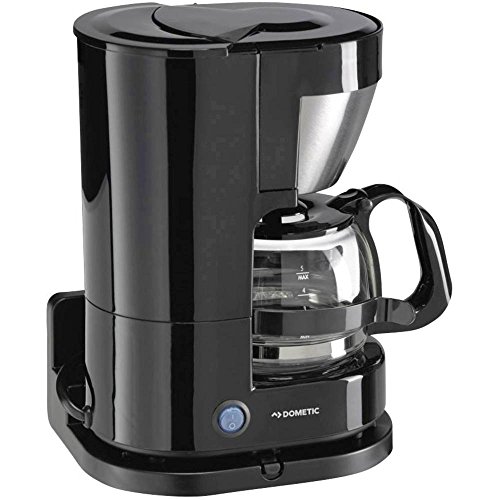
Dometic PerfectCoffee MC 052 Five Cup Coffee Maker, 12 V — Best True Drip Pot
The Dometic PerfectCoffee MC 052 is the traditionalist on this list: a genuine 12-volt drip coffee maker with a five-cup capacity, built by a brand whose main business is mobile and marine equipment. If your idea of vehicle coffee is a small pot of filter coffee rather than espresso shots, this is the verified listing that still does it the old way, straight from a 12V supply.
Strengths
- Real drip brewing for people who prefer filter coffee over espresso
- Five-cup pot serves two people properly instead of one small shot at a time
- Comes from a mobile-equipment brand with a long vehicle and marine catalog
Trade-offs
- Drip brewing from a 12V socket is slow compared with heating a small espresso volume
- A glass-style pot format needs careful stowing in a moving vehicle
- No built-in battery, so it only brews where vehicle power reaches
| Spec | Detail |
|---|---|
| Power source | 12 V vehicle power (per API listing title) |
| Capacity | Five cups (per API listing title) |
| Format | Drip coffee maker |
Choose the Dometic when the ritual matters: measuring grounds, hearing a pot brew, and pouring two normal mugs. The trade is time and power draw. Heating a pot of water on 12 volts is the hardest job in this category, so plan to brew while driving or while the engine runs rather than from a parked vehicle with a tired starter battery. Stow the pot padded and low, brew on a level surface, and the MC 052 delivers the closest thing to home drip coffee that a verified 12V listing currently offers.
In the base guide the Dometic holds the traditionalist slot honestly: nothing else verified here brews a small pot of filter coffee from 12 volts. Buy it for the pot, plan around the brew time, and it will not disappoint.
Best for: couples and traditionalists who want two real mugs of drip coffee / Not suited for: solo espresso drinkers or anyone brewing from a small, aging starter battery
Check the current price on Amazon

Portable Single Serve 12V Car Coffee Maker for Pods & Ground Coffee — Best for Pods and Grounds
This single-serve 12V machine stands out for flexibility: the verified listing states it takes both pods and ground coffee, with a reusable filter included, and brews in about six to eight minutes. For drivers who already keep pods in the glovebox but also want the option of fresh grounds at camp, that dual format is the whole appeal.
Strengths
- Accepts both pods and ground coffee, so you are not locked into one format
- Reusable filter cuts ongoing pod cost and trash on long trips
- Stated 6–8 minute brew is quick by 12V drip standards
Trade-offs
- Single-serve output means passengers wait for their own cycle
- Generic-brand support and spares are less certain than the big mobile brands
- Pod and grounds results differ, so expect a short learning curve for strength
| Spec | Detail |
|---|---|
| Power source | 12V car power (per API listing title) |
| Formats | Pods and ground coffee, reusable filter included (per API listing title) |
| Brew time | 6–8 minutes per the API listing title |
| Format | Single serve |
Treat this machine as the flexible generalist of the 12V shelf. Pods win on a workday morning when you want zero cleanup; the reusable filter wins on a trip when you are brewing several cups a day and pod costs add up. The stated brew window is honest for 12V drip — heating water is the bottleneck, not the pump — and the cup it produces is a normal coffee rather than an espresso concentrate, which many drivers actually prefer. If your household is split between pod people and grounds people, this is the verified compromise.
As the base-guide all-rounder for format, this machine earns its slot by ending the pods-versus-grounds argument. Keep pods for weekday stops and grounds for weekends, and one machine serves both habits.
Best for: households split between pod convenience and fresh grounds / Not suited for: crews who need several cups at once
Check the current price on Amazon
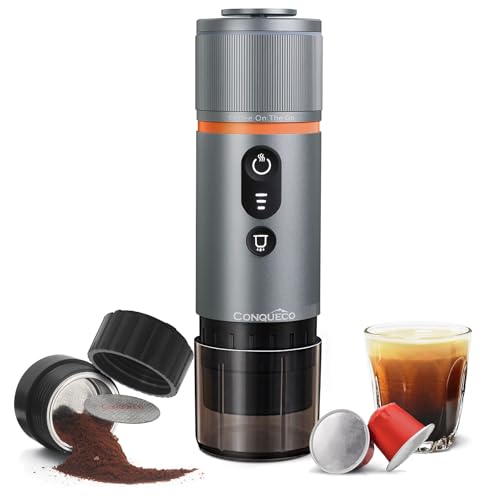
CONQUECO Self-Heating Portable Espresso Machine with 13500mAh Battery — Best Battery Capacity
The larger CONQUECO self-heating model is built around a 13500mAh battery, the biggest energy reserve in this verified group, and it accepts both ground coffee and NS capsules. It is the pick for people who expect to brew several cups away from the socket — at a campsite table, in an RV galley, or during a long off-grid stop — and only use 12V power as the recharge source.
Strengths
- Large 13500mAh battery supports multiple heated cups between charges
- Ground coffee and NS capsule support covers both fresh and convenient formats
- Self-heating design removes the kettle from the kit list entirely
Trade-offs
- Bigger battery means a bigger, heavier unit than the smallest travel machines
- Capsule users are tied to the NS format named in the listing
- Recharging a large battery from a 12V socket takes patience on short drives
| Spec | Detail |
|---|---|
| Battery | 13500mAh (per API listing title) |
| Power source | Battery self-heating plus 12V (per API listing title) |
| Formats | Ground coffee and NS capsule (per API listing title) |
| Use cases in listing | RV, car, hiking, office, camping (per API listing title) |
Battery size is the honest spec that separates portable espresso machines, because heating water is what drains them. A 13500mAh pack gives this CONQUECO real multi-cup endurance, which is why it suits RV and camping use better than the pocket-sized models: brew for two people at a site, recharge while driving the next leg, repeat. The dual-format basket keeps mornings flexible. If your pattern is one quick cup in the cab, the smaller CONQUECO is enough; if your pattern is a basecamp coffee station, this is the verified heavy lifter.
In this base roundup the big-battery CONQUECO is the endurance pick. If your coffee stops happen far from the vehicle — a jetty, a viewpoint, a festival field — stored energy matters more than socket speed, and this is the verified machine built around that fact.
Best for: RVers and basecamp campers brewing multiple cups off-grid / Not suited for: minimalists who want the smallest possible unit in a day bag
Check the current price on Amazon

BougeRV 144Wh Portable Coffee Maker for K-Cup & Ground Coffee — Best for K-Cup Users
BougeRV is best known for 12V vehicle fridges, and its portable coffee maker follows the same off-grid logic: a 144Wh battery platform, K-Cup and ground coffee compatibility, and AC/DC charging. For North American drivers, the K-Cup format is the headline — it is the pod system most gloveboxes and office kitchens already stock.
Strengths
- K-Cup compatibility matches the most common pod format in US vehicles and offices
- 144Wh capacity is a serious reserve for repeated brewing off-grid
- AC/DC charging lets it refill at home, at a site hookup, or from the vehicle
Trade-offs
- A 144Wh unit is camp-kit size, not cupholder size
- K-Cup convenience comes with per-cup cost and pod waste
- Heating still draws hard on the battery, so cup counts depend on water temperature habits
| Spec | Detail |
|---|---|
| Energy | 144Wh, 18V 8Ah battery powered (per API listing title) |
| Formats | K-Cup and ground coffee (per API listing title) |
| Power options | AC/DC (per API listing title) |
| Use cases in listing | Travel, camping, outdoor, jobsite, RV, home (per API listing title) |
The BougeRV fits the way many American road kits are already built: same brand family as the fridge in the back, pods from the same box as the office machine, and enough stored energy to run a small coffee ritual for a weekend. It is overkill for a commuter who only needs one cup at a rest stop, and exactly right for a camper, angler, or jobsite user who brews for a small crew. Charge it on AC before departure, top it from the vehicle between stops, and it behaves like a permanent part of the kit rather than a gadget.
The BougeRV rounds out the base six as the pod-ecosystem pick. North American readers overwhelmingly meet K-Cup first, and a verified 144Wh machine that takes those pods — and grounds when pods run out — is the easiest on-ramp to vehicle coffee.
Best for: K-Cup households, campers, and jobsite crews who brew for a small group / Not suited for: cupholder-sized minimalists or strict low-waste brewers
Check the current price on Amazon

HAWOK Portable Coffee Maker 12V Travel Espresso Machine — Best Simple Single Cup
The HAWOK is a single-cup 12V travel espresso machine sized around an 8 oz serving, which makes it a sensible middle ground between tiny espresso shots and a full drip pot. It is aimed squarely at solo drivers and campers who want one honest cup from the vehicle socket without carrying a separate kettle.
Strengths
- 8 oz single-cup size matches a normal small mug better than a short espresso shot
- Simple travel format with few loose parts to lose in a vehicle
- Runs from 12V power, so no battery management or charging routine is required
Trade-offs
- One cup at a time, so brewing for a group is a queue, not a pot
- Socket-powered only; there is no internal battery for away-from-vehicle use
- Espresso-style extraction will not taste like a big batch of drip coffee
| Spec | Detail |
|---|---|
| Power source | 12V (per API listing title) |
| Capacity | Single cup, 8 oz (per API listing title) |
| Format | Travel espresso machine |
The HAWOK makes sense when the routine is one driver, one cup, minimal fuss. Because it draws from the vehicle, there is nothing to remember to charge the night before, and the 8 oz serving avoids the two-shot workaround that small espresso machines often need. It is less flexible than the battery-equipped picks and slower to serve passengers, but for a solo commute, a delivery route, or a one-person camp setup it covers the job with the least equipment around it.
The HAWOK closes the base list as the low-fuss option. Not every buyer wants a battery gauge and a charging routine; some want a machine that lives in the vehicle and works whenever the socket does. That is precisely this pick.
Best for: solo drivers who want one honest cup with zero battery management / Not suited for: groups, or anyone who brews away from the vehicle
Check the current price on Amazon
Comparison Table
The table compresses the six reviews into the four facts most buyers compare first. Key specs are limited to details stated in each verified listing.
| Pick | Badge | Key spec | Best for |
|---|---|---|---|
| CONQUECO Portable Coffee Machine Travel 12V Car Espresso Maker — Check the current price on Amazon | Best Overall | 12V car espresso maker with built-in battery, USB rechargeable, heats in about 3 minutes (per API listing title) | drivers and campers who want one flexible machine for socket and battery use |
| Dometic PerfectCoffee MC 052 Five Cup Coffee Maker, 12 V — Check the current price on Amazon | Best True Drip Pot | True 12V drip coffee maker, five-cup capacity (per API listing title) | couples and traditionalists who want two real mugs of drip coffee |
| Portable Single Serve 12V Car Coffee Maker for Pods & Ground Coffee — Check the current price on Amazon | Best for Pods and Grounds | 12V single serve for pods and ground coffee, reusable filter, 6–8 minute brew (per API listing title) | households split between pod convenience and fresh grounds |
| CONQUECO Self-Heating Portable Espresso Machine with 13500mAh Battery — Check the current price on Amazon | Best Battery Capacity | Self-heating espresso machine, 13500mAh battery, 12V, ground coffee and NS capsule (per API listing title) | RVers and basecamp campers brewing multiple cups off-grid |
| BougeRV 144Wh Portable Coffee Maker for K-Cup & Ground Coffee — Check the current price on Amazon | Best for K-Cup Users | 144Wh cordless coffee maker, K-Cup and ground coffee, AC/DC power (per API listing title) | K-Cup households, campers, and jobsite crews who brew for a small group |
| HAWOK Portable Coffee Maker 12V Travel Espresso Machine — Check the current price on Amazon | Best Simple Single Cup | 12V travel espresso machine, single cup 8 oz (per API listing title) | solo drivers who want one honest cup with zero battery management |
What does 12 volts actually limit in a coffee maker?
Wattage is the whole story. A vehicle accessory socket typically supports a modest power draw, far below a household outlet, and water heating is the most energy-hungry job in any kitchen. A machine that must heat a full pot from socket power therefore brews slowly, while a machine heating a single small volume can be quick. This is not a quality difference; it is physics, and it explains the entire shape of this category.
Battery machines sidestep the socket limit by spreading the energy cost over time. They sip power while you drive, store it, and then spend it quickly at the stop. The trade is weight, charging discipline, and a finite number of heated cups per charge. When you compare a battery machine’s cup claims, remember that heating cold water from scratch is what drains the pack; starting with warm water stretches any battery noticeably.
Engine on or engine off?
Brewing from a starter battery with the engine off is the classic way to strand yourself with great coffee and a dead vehicle. As a rule, run socket-powered brewers while driving or with the engine idling where that is safe and permitted, and treat battery machines as the engine-off option. If you regularly brew parked — fishing, tailgating, overnight stops — a battery machine or a separate auxiliary power source is the responsible setup.
Fuses, sockets, and inverters
Check the fuse rating of the socket you plan to use and never defeat it with a larger fuse. Some vehicles power sockets only with the ignition on, which changes your routine more than any product feature. An inverter running a household coffee maker is a legitimate alternative for larger RV systems, but it is a different purchase with its own losses and battery demands, and it is outside what these six picks are trying to do.
How to choose the right 12 volt coffee maker for your routine
Start with the stop, not the machine. A five-minute fuel stop favors a fast self-heating espresso maker. A slow morning at a campsite favors a pot or a big battery. A jobsite tailgate favors whatever runs on batteries already in the truck. Write down where the cup will actually happen, who it is for, and whether the engine will be running; the correct pick usually selects itself from those three answers.
Espresso, drip, or pods?
Espresso-format machines heat little water and deliver small, strong cups quickly — ideal for solo drivers and battery use. Drip machines deliver familiar filter coffee in mug-sized servings but ask the most of a 12V supply. Pod machines trade per-cup cost and waste for zero-measurement convenience, and the pod format matters: K-Cup, NS capsules, and generic pods are not interchangeable, so match the machine to the pods you already buy.
How many people are drinking?
Be honest about the queue. A single-serve machine serving four people is four brew cycles, four waits, and a cooling first cup. Couples should look hard at the five-cup drip pot or a large-battery machine; solo drivers should not pay for capacity they will never use. Capacity is the spec most often bought wrong in this category, in both directions.
Where will it live?
Measure the space before ordering. A machine that rides in a footwell, a center console bin, an RV galley, and a boat locker all face different size, mounting, and spill constraints. Battery machines also need a charging home — a socket that stays powered on your typical drive length — or they quietly become drawer ornaments.
Living with a 12 volt coffee maker day to day
The honeymoon test for any of these machines is the third week, not the first morning. By then you know whether the charging routine fits your driving, whether the cup size matches your habit, and whether cleanup is a ten-second wipe or a sink full of parts. The owners who stay happy are the ones who built the machine into an existing routine — charging beside the phone, pods beside the sunglasses, grounds beside the camp kitchen box — rather than treating it as a special event each time.
Water is the unglamorous detail that decides taste. Vehicle coffee often fails not because of the machine but because of stale water from a bottle that has lived in a hot trunk for a month. Fill fresh when you can, empty the reservoir rather than topping up old water, and if your route’s water tastes of chlorine, a small bottle of home water for the coffee alone is a cheap upgrade that outperforms any machine swap.
What about winter, altitude, and rough roads?
Cold is a battery machine’s quiet enemy: a pack stored overnight in a freezing vehicle delivers fewer heated cups until it warms up, so bring it into the cab or the tent rather than leaving it in the trunk. Altitude lowers the boiling point, which slightly softens extraction for drip machines and matters little for pressurized espresso. Rough roads argue for lidded mugs, low stowing, and brewing while parked rather than while moving — the machine may tolerate the vibration, but the full cup will not.
Running costs, honestly
None of the machines here is expensive to feed compared with buying coffee at every stop, but the formats differ. Pods cost the most per cup and create the most trash; capsules sit in the middle; ground coffee in a reusable filter is the cheapest and the messiest. The machine price is a one-time decision, while the format is a subscription you choose daily — weigh the format at least as heavily as the hardware when you pick from the six above.
How to brew safely with a 12 volt coffee maker
The routine below applies to every pick in this guide, with notes where socket and battery machines differ. None of it is complicated, but all of it protects either the coffee, the vehicle battery, or the upholstery — usually all three.
- Park and stabilize first. Brew only when parked on a level surface or when a passenger can manage the machine safely; hot water and a moving vehicle are a bad combination for the driver.
- Check your power plan. For a socket brewer, confirm the socket is live and the engine is running or you are driving. For a battery machine, check the charge level before you promise anyone a second cup.
- Use fresh, cool water and the coffee format the machine is built for — pods seated properly, grounds in the reusable filter without overpacking, capsules the correct way up.
- Place the machine on the flattest, lowest, most contained surface available: a footwell mat, a tray, or a galley counter with a lip. Never on a seat, where a spill becomes a scald and a stain.
- Brew, then wait a full minute before moving the machine. Fresh coffee systems stay pressurized and drippy briefly after the cycle ends.
- Serve into a lidded travel mug, especially if the vehicle will move again soon. Open cups and hot coffee are the most common vehicle-coffee injury and mess.
- Let the machine cool before stowing, and stow it padded and low so a sudden stop cannot turn it into a projectile.
- At the end of the day, empty grounds or pods, rinse the water path if the design allows, and recharge battery machines while you drive or at your stop so the next morning starts full.
Descale any of these machines on the schedule you would keep at home, adjusted for your water. Vehicle users often fill from campsite taps and fuel-station jugs of varying hardness, and scale slows heating exactly when a 12V machine can least afford it. A short vinegar or descaler cycle at home, followed by two clean-water flushes, keeps brew times honest.
Keep a tiny coffee kit around the machine and the whole habit gets easier: a lidded mug that fits your cupholder, a small sealed container of grounds or a strip of pods, a microfiber cloth for the inevitable drip, and a trash solution that is not the door pocket. Five small items, gathered once, are the difference between a machine that gets used daily and one that gets used on the first trip and then forgotten at home.
Finally, make the vehicle battery part of the routine: if a socket brew ever leaves your starts sounding slow, stop brewing engine-off entirely and switch to a battery machine or an auxiliary power source. Coffee is a pleasure; a jump start is a chore, and the order of those two events is entirely up to your setup.
Common Buying Mistakes
Buying a kettle and expecting coffee. Several products marketed to drivers only heat water. That is useful with a pour-over cone or instant coffee, but it is not a coffee maker. Check that the verified listing actually describes brewing, not just boiling.
Ignoring the pod format. K-Cup, NS capsule, and generic pod machines each lock you into their ecosystem. Buying the wrong format means a vehicle full of pods you cannot use.
Brewing a pot from a parked car. A long drip cycle on a starter battery with the engine off is the most common way this hobby ends in a jump start. Brew while driving, or use a battery machine.
Overbuying capacity. A five-cup pot for a solo commuter is dead weight and slow coffee. Match capacity to the real number of drinkers.
Forgetting the stow plan. Hot, wet, glass-adjacent equipment needs a padded, low, contained home in the vehicle. If you have not decided where it rides, you are not ready to order.
Final Recommendation
For most readers, the CONQUECO Portable Coffee Machine is the best 12 volt coffee maker to buy first: it heats its own water, runs from the socket or its battery, and recharges by USB, which covers more real routines than any other single verified machine here. If your heart is set on filter coffee, the Dometic PerfectCoffee MC 052 is the honest pot brewer’s choice, and K-Cup households should go straight to the BougeRV for its 144Wh reserve and familiar pods.
Solo drivers who want the least possible fuss should take the HAWOK, format-flexible buyers the single-serve pod-and-grounds machine, and multi-cup campers the big-battery CONQUECO. Whichever you choose, keep exploring the rest of this cluster for the lens that matches your exact routine:
- CONQUECO Portable Coffee Machine Travel 12V Car Espresso Maker — Check the current price on Amazon
- Dometic PerfectCoffee MC 052 Five Cup Coffee Maker, 12 V — Check the current price on Amazon
- Portable Single Serve 12V Car Coffee Maker for Pods & Ground Coffee — Check the current price on Amazon
Best 12 Volt Coffee Maker For Camping Best 12 Volt Coffee Maker For Truckers Best 12 Volt Coffee Makers Best 12 Volt Coffee Makers For Boats Best 12 Volt Compact Car Vacuum
Frequently Asked Questions
Can a 12 volt coffee maker really brew good coffee?
Yes, with the right expectations. Espresso-format 12V machines produce genuinely good small cups because they heat little water and brew under pressure. Drip machines produce familiar filter coffee, just more slowly than at home. What 12 volts cannot do is make a large pot quickly — that limit is physics, not build quality.
Will a 12V coffee maker drain my car battery?
It can if you brew a long cycle from the starter battery with the engine off. Brew socket-powered machines while driving or with the engine running, and use battery-powered machines for engine-off stops. If your starts ever sound slow afterwards, change the routine, not just the machine.
What is the difference between a 12V drip maker and a portable espresso maker?
A drip maker heats a reservoir and filters hot water through grounds into a pot, giving mug-sized servings of filter coffee. A portable espresso maker heats a small volume and forces it through a compact puck or capsule, giving a short, strong cup. Serving size, speed, and taste all follow from that difference.
Are pods or ground coffee better in a vehicle?
Pods win on speed and cleanup; grounds win on cost per cup, taste control, and trash. Machines in this guide cover both habits, including dual-format models with reusable filters, so the better choice is the one matching how you already make coffee at home.
Can I use a regular home coffee maker with an inverter instead?
You can, on a suitably sized inverter and battery system, and larger RVs do exactly this. For a car or small camper it adds cost, conversion losses, and battery strain that a purpose-built 12V or battery machine avoids. It is an alternative system, not a shortcut.
Can I run a 12V coffee maker from a portable power station?
Yes, and it is often the best parked-vehicle setup of all. A power station’s 12V output or battery capacity takes the starter battery out of the equation entirely, and battery coffee machines can recharge from the station as well. Match the station’s output rating to the machine, keep the station itself charged from the vehicle while driving, and you have a coffee system that never threatens your ability to drive home.
How do I clean a 12V coffee maker on the road?
Empty grounds or pods after every use, wipe the brew head and drip area, and rinse what the design allows you to rinse. Descale at home on a regular cycle, especially if you fill from hard campsite water, and always run clean water through afterwards before the next trip. On the road itself, a daily habit is enough: never let wet grounds sit in the machine overnight in a warm vehicle, because that is where stale flavors and worse come from, and a ten-second empty-and-wipe after the last cup prevents almost all of it.


