Disclosure: airfryerkitchensupply.com is reader-supported. When you buy through links on our site, we may earn an affiliate commission at no extra cost to you.
Where to buy
This guide is about drip machines that make the most of coffee you grind at home with a separate grinder — every brewer below was verified against Amazon’s catalog data, and the grinders recommended in the how-to section were verified the same way. Check each listing for the current price before buying; grinder and brewer are separate purchases, and both matter.
- Bonavita BV1900TS 8-Cup Coffee Maker — Best Overall with Home-Ground Coffee: check price on Amazon
- Technivorm Moccamaster KBGV Select — Best for Grind Purists: check price on Amazon
- OXO Brew 8-Cup Coffee Maker — Best for Small Fresh-Ground Batches: check price on Amazon
- Breville Precision Brewer BDC400 — Best for Dialing In Your Grind: check price on Amazon
- Cuisinart DCC-3200 PerfecTemp 14-Cup — Best for Households: check price on Amazon
- BLACK+DECKER 12-Cup Drip Coffee Maker with Vortex Brewing — Best Budget for Fresh Grounds: check price on Amazon
The best coffee makers for home ground beans start from a decision you have already made: you grind your coffee at home, with your own grinder, and you want a drip brewer worthy of that effort. That choice — a separate grinder plus a dedicated brewer — is the connoisseur’s architecture, because it lets each tool be excellent at one job and lets you upgrade either half independently. This guide covers the brewer half: six drip machines whose temperature stability, shower design and basket geometry reward fresh home-ground coffee instead of wasting it. The grinder half gets its own full treatment in the how-to section below.
Fresh-ground coffee behaves differently from the pre-ground kind, and the differences dictate what a brewer must do. Fresh grounds release gas when hot water hits them, so a bloom phase matters. Home grinding gives you control of particle size, so a brewer with a forgiving, evenly-wetting basket lets you dial in instead of fighting channeling. And because home-ground coffee tastes most alive in the first minutes, a brewer that extracts efficiently — proper temperature, full saturation — is the difference between your grinder looking brilliant and looking pointless.
A note on scope: this guide deliberately excludes grind-and-brew machines with built-in grinders — those are covered in the companion guide to coffee makers that grind beans, linked at the end. Here, the grinder is separate, the brewer is dedicated, and the combination is greater than either. Every brewer was verified against Amazon’s catalog data in the configuration described.
In this guide
Quick Picks
Best Overall with Home-Ground Coffee — Bonavita BV1900TS 8-Cup Coffee Maker: an SCA-certified brewer with a powerful heater, a wide shower head and a pre-infusion bloom mode — the feature fresh home-ground coffee needs most.
Best for Grind Purists — Technivorm Moccamaster KBGV Select: the benchmark brewer with a copper element and a manual brew basket that lets you bloom, slow or speed the flow by hand — total partnership with your grinder.
Best for Small Fresh-Ground Batches — OXO Brew 8-Cup Coffee Maker: an SCA-certified compact brewer with a rainmaker shower head and a dedicated single-serve basket — fresh-ground coffee in one mug or eight cups, both done properly.
Best for Dialing In Your Grind — Breville Precision Brewer BDC400: six brew modes plus a fully custom My Brew setting for bloom, temperature and flow — the brewer that lets you build a recipe around each grind and bean.
Best for Households — Cuisinart DCC-3200 PerfecTemp 14-Cup: a 14-cup programmable family brewer with PerfecTemp hotter water, brew-strength control and a 1–4 cup setting — fresh-ground coffee at family scale.
Best Budget for Fresh Grounds — BLACK+DECKER 12-Cup Drip Coffee Maker with Vortex Brewing: a budget 12-cup programmable brewer whose Vortex shower head spreads water across fresh grounds instead of drilling through them — fresh-ground flavor on a budget.
How These Picks Were Chosen
Candidates were judged as partners for a home grinder. The tests: temperature stability worthy of fresh beans; a shower head that wets a fresh, gassy bed of grounds without channeling it; basket geometry — flat-bottom or cone — that home grinders can feed consistently; and small-batch competence, because home-ground coffee is often brewed in thoughtful small quantities rather than office volumes. Each machine was then verified in Amazon’s catalog data for model and carafe configuration.
We also considered the upgrade path. A separate-grinder setup is a system, and systems get tuned: the brewers here span from a budget machine whose Vortex shower head punches above its price with fresh grounds, to the Moccamaster and Breville Precision Brewer, which expose enough control to keep pace with a serious grinder for years. Two SCA-certified machines anchor the middle. What none of them does is grind — that is the point, and the how-to section explains how to choose the grinder that completes the setup.
One clarification of scope, because the two guides are siblings and the boundary matters: a machine was eligible here only if it does not grind — its excellence had to be entirely in brewing, so that the quality of the grind remains yours to choose, upgrade and control. That is why no grind-and-brew model appears above despite several being excellent appliances. The boundary is philosophical as much as technical: this guide serves the reader who has decided that grinding is a craft they keep, and brewing is a craft they delegate to a machine that respects it.
The 6 Best Coffee Makers for Home Ground Beans

Bonavita BV1900TS 8-Cup Coffee Maker — Best Overall with Home-Ground Coffee
Fresh grounds bloom: they swell and release gas when the first water lands, and a brewer that powers straight through that moment channels water around the gassy bed and under-extracts it. The BV1900TS answers with an optional pre-infusion mode — a measured wetting, a pause, then the main pour — the exact sequence a pour-over barista performs by hand. Combined with a heater that holds proper temperature and a flat-bottom basket that home grinders feed beautifully, it is the most complete partner for a separate grinder at its price.
Strengths
- Pre-infusion bloom mode built for fresh-ground coffee
- Full-power heater holds extraction temperature through the whole brew
- Flat-bottom basket is forgiving of home-grind variation
Trade-offs
- No timer — your morning routine is the schedule
- 8-cup capacity suits small households, not crowds
- Thermal carafe lid needs a rinse routine to stay fresh
| Capacity | 8 cups |
| Carafe | Stainless steel double-wall thermal |
| Certification | SCA Certified |
| Key feature | Pre-infusion (bloom) mode |
The Bonavita’s genius with home-ground coffee is that it forgives and rewards at the same time. It forgives the slight inconsistency every home grinder produces — the flat bed and wide shower even out minor variation — and it rewards the freshness only home grinding provides, because the bloom mode and the hot, stable water extract what pre-ground coffee has already lost to the air.
If you own or are buying a decent burr grinder and want one machine that completes the setup without a second mortgage, this is it. The Moccamaster below is the upgrade in build and longevity; the Bonavita is the value peak of the entire separate-grinder philosophy.
A note on pairing: the BV1900TS’s flat-bottom basket is at its best with the medium grind a home burr grinder produces most consistently, and its pre-infusion particularly flatters beans in their first week off roast — precisely the beans home grinders buy. If your grinder is an entry model with some inconsistency, this brewer hides it better than any other here; if your grinder is excellent, the Bonavita reveals that too. It is the rare machine that meets a setup at both ends of its owner’s journey.
Best for: home grinders who want certified brewing and a bloom mode at a sane price / Not suited for: households needing a wake-up timer or more than 8 cups
Check on Amazon — check the current price on Amazon before you decide.

Technivorm Moccamaster KBGV Select — Best for Grind Purists
Purists choose the Moccamaster because it returns control to the human. The manual drip-stop basket is a flow valve: close it to bloom fresh grounds for thirty seconds, open it fully for the main extraction, half-close it to stretch contact time on a coarse grind. Paired with a home grinder — where you control the other great variable, particle size — you hold every lever that matters, on a machine whose copper element removes temperature from the list of things that can go wrong.
Strengths
- Manual basket control turns grind experiments into repeatable recipes
- Copper element delivers the most stable temperature in this guide
- Built and supported for a decade-plus of daily service
Trade-offs
- Premium price, and no automation of any kind
- Manual control means your technique is part of the result
- Glass carafe on a hot plate — pour promptly or transfer
| Capacity | 10 cups / 40 oz (1.25 L) |
| Model | 53941 KBGV Select |
| Basket | Manual-adjust brew basket |
| Heating | Copper element |
There is a specific pleasure this machine offers grinder owners: attribution. When a cup improves, you know whether the finer grind or the longer bloom did it, because nothing in the machine changed behind your back. That feedback loop is how home coffee people actually get good, and no automatic machine teaches it as cleanly.
Buy the KBGV Select as the permanent half of your setup. Grinders will come and go — an entry burr mill now, a serious one later — and the Moccamaster will extract the best from each of them, unchanged, for years.
The Moccamaster also protects a home grinder’s reputation in a way worth naming: because its temperature never sags, it never produces the sour cup that owners misattribute to their grind. Half the ‘grinder problems’ reported in home coffee are actually brewer temperature problems wearing a disguise. Remove the disguise and the grinder’s real character — good or bad — becomes legible, which is what a purist is actually paying for: the truth, in the cup, every morning.
Best for: hands-on coffee people who treat grind and bloom as a craft / Not suited for: anyone who wants the machine to handle everything
Check on Amazon — check the current price on Amazon before you decide.

OXO Brew 8-Cup Coffee Maker — Best for Small Fresh-Ground Batches
Home-ground coffee is often a small-batch ritual — one person’s careful mug, not a family pot — and most brewers punish small batches. The OXO answers with two honest paths: a full 8-cup thermal carafe for the weekend, and a dedicated single-serve basket that slows the water for one mug of fresh grounds. Its rainmaker shower head distributes water in a gentle, even pattern that fresh, gassy grounds need — a hard single stream would blast a channel straight through them.
Strengths
- Single-serve basket brews one mug of fresh grounds properly
- Rainmaker shower head is gentle and even on fresh beds
- SCA-certified full-pot performance in a compact body
Trade-offs
- Single-serve insert is another part to rinse and store
- 8-cup maximum for guests
- Back-mounted reservoir is awkward under low cabinets
| Capacity | 8 cups plus single-serve mode |
| Carafe | Stainless steel thermal |
| Certification | SCA Certified Home Brewer |
| Shower | Rainmaker distribution |
The OXO is the setup-completer for solo and duo households: grind fresh for one in the morning with the single-serve basket, grind fresh for two on Sunday into the carafe, and never brew a wasteful or watery compromise batch in between. The thermal carafe protects the weekend pot the way fresh coffee deserves.
It is also the most kitchen-friendly design here — compact, tidy, and clearly tested by people who cook. If your grinder lives in a small kitchen, this is its natural partner.
The OXO’s single-serve basket has a second use its manual understates: dialing in. When a new bag arrives, brew a single mug through the insert at your standard settings and taste before committing a full pot and a full dose. The insert becomes a low-cost laboratory — one mug per experiment — and households that adopt the habit waste noticeably less good coffee on calibration. Small feature, large economy, in a hobby where the raw material is the expensive part.
Best for: solo and duo households grinding fresh in small, varying amounts / Not suited for: households brewing for four or more daily
Check on Amazon — check the current price on Amazon before you decide.
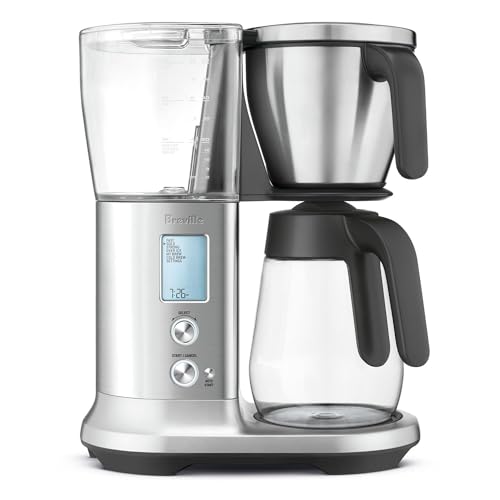
Breville Precision Brewer BDC400 — Best for Dialing In Your Grind
A home grinder gives you variables; the Precision Brewer gives you the matching variables on the water side. Its My Brew mode lets you set bloom time, brew temperature and flow rate, and save the result — so the recipe for your light roast at a medium-fine grind is a button, not a memory. The Gold mode covers days when you want standards-compliant coffee without thinking, and the pour-over adapter support means the same machine can run a dripper when you want that extraction character instead.
Strengths
- Custom mode controls bloom, temperature and flow to match your grind
- Gold mode delivers certified-standard coffee with zero thought
- Pour-over adapter support widens the recipe range further
Trade-offs
- Big footprint and a menu system to learn
- Glass carafe in this configuration
- More machine than set-and-forget households will ever use
| Capacity | 12 cups (60 oz class) |
| Carafe | Glass |
| Modes | Gold, Fast, Strong, Iced, Cold Brew, My Brew |
| Body | Brushed stainless steel |
The Precision Brewer is for the grinder owner who keeps notes. When a new bag arrives, you have levers on both sides of the extraction — grind size from your mill, temperature and flow from the Breville — and the discipline of changing one at a time turns a kitchen counter into a small, delicious laboratory. Cold brew and iced modes extend the lab into summer.
The caveat is honest: most owners live in Gold mode, and Gold mode alone does not justify the machine over the Bonavita. Buy it if the dialing-in is the hobby, not the chore.
Breville’s temperature control has a specific home-ground virtue: freshly roasted beans from small roasters vary in density far more than supermarket beans, and density is what temperature compensates for. A hard, high-grown lot that tastes tight and sour at a fixed temperature opens up two degrees hotter; the Precision Brewer lets you find that point and save it. Owners who buy adventurous beans get more adventure per bag — which, at specialty prices, is arithmetic as much as aesthetics.
Best for: methodical coffee hobbyists who log grind and recipe per bag / Not suited for: set-and-forget drinkers
Check on Amazon — check the current price on Amazon before you decide.

Cuisinart DCC-3200 PerfecTemp 14-Cup — Best for Households
Not every home-ground household is a hobbyist duo. Some are families: a grinder on the counter, beans ground fresh each morning, and four people expecting coffee. The DCC-3200 is built for that scale — a genuine 14-cup capacity, hotter PerfecTemp brewing that fresh grounds reward, regular/bold strength control, and a 1–4 cup setting for the evenings when only one person wants a small fresh pot. Programmability covers the school-run mornings when grinding happens the night before out of necessity.
Strengths
- Family-size 14-cup capacity with fresh-ground-friendly hot brewing
- 1–4 cup setting protects small evening batches
- Strength control and full programmability suit mixed households
Trade-offs
- Glass carafe and warming plate — transfer the pot for slow drinking
- Its shower head is good, not in the Bonavita/Moccamaster class
- Large footprint
| Capacity | 14 cups |
| Carafe | Glass |
| Brewing | PerfecTemp hotter brewing |
| Settings | Brew strength, 1–4 cup, programmable |
The DCC-3200’s case is about not making a family choose between freshness and scale. The grinder feeds the morning pot; the machine’s job is to extract a big batch evenly and keep the routine programmable — and on those jobs it is thoroughly competent, with the strength control giving the household a shared dial between the bold drinkers and the mild ones.
It is the least ‘hobbyist’ machine here and the most domestic, in the good sense. If your grinder serves a household rather than a hobby, this is its partner.
The DCC-3200 also handles the grinder’s day off gracefully. Every home-ground household has the morning the grinder is empty, broken or simply too loud for a sleeping house — and on that morning the Cuisinart brews the emergency pre-ground bag without complaint, its strength control rescuing a decent cup from a mediocre input. A setup’s quality is measured on its worst mornings too, and this machine’s worst morning is still a hot, scheduled, respectable pot.
Best for: families grinding fresh daily who need real capacity and a timer / Not suited for: solo hobbyists or small counters
Check on Amazon — check the current price on Amazon before you decide.




BLACK+DECKER 12-Cup Drip Coffee Maker with Vortex Brewing — Best Budget for Fresh Grounds
Fresh-ground coffee in a bad budget machine is a tragedy in one act: the grounds are alive with gas, the shower head is a single dribble, the water tunnels through one spot, and the cup tastes like the grinder was wasted. BLACK+DECKER’s Vortex head is the budget fix — a shower design that spreads water across the basket, giving a fresh bed an even chance. Around it is a simple programmable 12-cup machine that costs less than a few bags of the beans you are grinding.
Strengths
- Vortex shower head makes fresh grounds viable at a budget price
- Programmable 12-cup capacity covers household basics
- Lets a tight budget go to the grinder and beans, where it matters more
Trade-offs
- Budget build, plastics and warming plate
- No bloom mode — fresh beans get a standard fast wetting
- Extraction ceiling is real; it is an honest budget brewer, not a giant-killer
| Capacity | 12 cups |
| Carafe | Glass |
| Shower | Vortex brewing technology |
| Controls | Programmable |
There is sound strategy in this pick: in a separate-grinder setup, the grinder and the beans influence the cup more than the brewer does, once the brewer clears a basic competence bar — hot enough, even enough. The Vortex clears that bar at the lowest price here, which frees budget for the Baratza-class grinder that will actually transform your coffee.
Buy it as the brewer half of a starter setup, or as the big-pot backup beside a single-serve ritual. It will not embarrass your fresh grounds, and that is the whole job at this price.
Finally, the budget pick’s role in a growing setup deserves respect: it is the machine that lets a household start now. Grinder this month, Vortex on the counter, beans from a real roaster — and the coffee is already transformed, months before any premium brewer enters the picture. When the upgrade eventually comes, the BLACK+DECKER retires to guest duty with honor. Every serious coffee setup we know started with a version of this pragmatism.
Best for: starter setups where the budget belongs in the grinder and beans / Not suited for: anyone seeking a decade machine or bloom control
Check on Amazon — check the current price on Amazon before you decide.
Comparison Table
| Pick | Badge | Key spec | Best for |
|---|---|---|---|
| Bonavita BV1900TS 8-Cup Coffee Maker | Best Overall with Home-Ground Coffee | 8-cup thermal, SCA Certified, pre-infusion mode | home grinders who want certified brewing and a bloom mode at a sane price |
| Technivorm Moccamaster KBGV Select | Best for Grind Purists | 10-cup / 40 oz, manual basket, copper element | hands-on coffee people who treat grind and bloom as a craft |
| OXO Brew 8-Cup Coffee Maker | Best for Small Fresh-Ground Batches | 8-cup thermal plus single-serve basket, SCA Certified | solo and duo households grinding fresh in small, varying amounts |
| Breville Precision Brewer BDC400 | Best for Dialing In Your Grind | Custom My Brew mode with bloom/temp/flow control | methodical coffee hobbyists who log grind and recipe per bag |
| Cuisinart DCC-3200 PerfecTemp 14-Cup | Best for Households | 14-cup glass, PerfecTemp, 1–4 cup setting | families grinding fresh daily who need real capacity and a timer |
| BLACK+DECKER 12-Cup Drip Coffee Maker with Vortex Brewing | Best Budget for Fresh Grounds | 12-cup glass, Vortex shower head | starter setups where the budget belongs in the grinder and beans |
How to Choose a Coffee Maker for Home Ground Beans
Choosing the brewer half of a separate-grinder setup means judging how a machine treats grounds it did not grind. Three traits matter most. First, bloom handling: fresh grounds degas violently compared with pre-ground, so a pre-infusion mode, a manual basket, or at minimum a gentle pulsed delivery is worth real money. Second, shower design: fresh beds channel easily, so wide, multi-point water distribution is non-negotiable. Third, temperature stability, because fresh-ground coffee’s whole advantage is delicate aromatics that a sagging heater leaves behind in the grounds.
Basket shape deserves a thought too. Flat-bottom baskets are forgiving partners for home grinders — the bed is even, the extraction tolerant of small grind inconsistencies. Cone baskets concentrate flow and can produce brilliant cups with a dialed-in grind, but they punish inconsistency harder. Beginners with an entry grinder usually progress faster with a flat-bottom machine; experienced hands can choose either by taste.
Finally, think in systems. Your grinder’s quality sets the ceiling of the whole setup, and your brewer should be chosen to be ready for the grinder you will own next year, not just the one on the counter today. That is why the list pairs naturally: an entry grinder with the BLACK+DECKER or Bonavita now, a serious grinder with the Moccamaster or Breville later — with the brewer never being the reason to start over.
- Bloom handling is the fresh-ground feature — pre-infusion or manual basket
- Wide shower distribution prevents channeling in gassy fresh beds
- Flat-bottom baskets forgive entry grinders; cones reward dialed-in ones
- Choose the brewer for the grinder you will own next, not just today
- Temperature stability protects the aromatics home grinding exists for
Separate Grinder vs Built-In Grinder: Why This Setup Wins on Quality
A combined grind-and-brew machine shares one budget, one footprint and one point of failure between two jobs. A separate setup lets each job have its own budget and its own upgrade cycle — and grinding is the job where money shows most clearly in the cup. A quality burr grinder produces uniform particles; uniform particles extract evenly; even extraction is the difference between sweetness and the bitter-sour muddle of mixed extraction. No built-in grinder at a sane price matches a dedicated burr mill, which is why cafés, and serious homes, separate the tools.
The separate setup also survives failure gracefully: a dead grinder is replaced without touching the brewer, and a brewer upgrade does not orphan a working grinder. The costs are real — more counter space, a two-step morning, one more thing to clean — and the companion guide to grind-and-brew machines exists for households that weigh those costs higher. But on cup quality per dollar over five years, the separate architecture is the connoisseur’s answer, and this guide assumes you have already chosen it.
Grind Size by Basket: A Starting Map
Use this as a starting map, then adjust by taste. Flat-bottom drip baskets (Bonavita, most family machines): medium grind, like raw sugar. Cone baskets: medium-fine, like table salt’s coarser cousin. Single-serve baskets (OXO’s insert): medium, with a level bed tamped by nothing more than a shake. Cold brew and French-press coarseness have no place in these drip machines — the water passes too fast and the cup comes out thin no matter the dose.
The adjustment rule never changes: sour and thin means extract more — grind finer or dose higher. Bitter and harsh means extract less — grind coarser or cool the water if your machine allows. One change per pot, written on the bag, and your home-ground setup will converge on excellent within a week.
The Morning Routine of a Separate-Grinder Household
Watch a practiced home-ground household at 7 a.m. and the routine is choreography, not effort. Water goes into the brewer first — because while it heats or waits, the beans are weighed or scooped, the grinder runs for twenty seconds, and the basket is filled and leveled. The brew starts; the grinder is tapped out and brushed on its weekly day; the mug is warmed under the tap. Total added time over a pre-ground routine: about ninety seconds, most of it overlapping with tasks that exist anyway. The freshness bought with those ninety seconds is the entire argument of this guide, and it is cheaper in time than it sounds in prose.
The routine scales down as gracefully as up: the solo drinker’s version is a single mug through a small-batch basket, beans ground while the kettle-side of life happens. What never changes is the order — beans stay whole until the last responsible moment. Households new to the setup should protect that order for two weeks until it is muscle memory; after that, the routine maintains itself, and pre-ground coffee starts to taste like what it is: a compromise you used to make.
When to Upgrade Which Half of the Setup
Separate setups invite a pleasant question: which half deserves the next upgrade dollar? Use the cup as the diagnostic. If your coffee tastes inconsistent — brilliant one morning, muddled the next, with the same beans and routine — the grinder is the limit; particle consistency is its department. If the coffee is consistent but consistently underwhelming — always a bit sour, a bit thin, however you grind — the brewer’s temperature is the limit. If both are consistent and delicious, the beans are the limit, and the upgrade is a better roaster, which is the happiest diagnosis in coffee.
Upgrade one half at a time and live with it for a month before judging the other half again; simultaneous upgrades teach nothing and can mask a mistake. The architecture’s deepest virtue is this patience: a setup assembled over two years, each piece chosen against experience, will out-brew a flagship purchase made in a weekend — and the owner will understand exactly why it tastes the way it does.
How to Build the Grinder Half of Your Setup, Step by Step
The brewer is half the system. This guide completes it: choosing and using a separate home grinder that feeds the brewers above. The three grinders named here were verified against Amazon’s catalog data like everything else in this guide.
Step 1: Choose burrs, always. Blade grinders chop beans into dust and boulders that extract at different rates — the original sin of home coffee. A burr grinder crushes between two abrasive surfaces into far more uniform particles. The entry point of the serious category is the Baratza Encore, a conical burr grinder famous as the home drip grinder standard: straightforward, repairable, and consistent enough for every brewer in this guide.
Step 2: Match the grinder tier to your brewer. Pair sensibly: the BLACK+DECKER or Bonavita with an Encore-class mill; the Moccamaster or Breville with a step up such as the OXO Brew Conical Burr Grinder, whose 43 settings and one-touch dosing suit households that switch between batch sizes. The budget-honest option is the Cuisinart Supreme Grind DBM-8P1, an 18-setting burr mill that covers drip duties at the lowest cost of the three — a fine starter while you learn what your palate wants.
Step 3: Grind immediately before brewing. Ground coffee’s aromatics fade measurably within the hour and noticeably within fifteen minutes. The entire separate-grinder philosophy lives in this step: beans whole until the water is measured, then ground, then brewed. If your mornings cannot hold the two minutes, grind the night before into a sealed container — a compromise, but still ahead of week-old pre-ground.
Step 4: Dose by weight once, then by eye. Weigh your dose for the first week — roughly 1 part coffee to 16 parts water — and note what that looks like in your scoop or your grinder’s timer. After a week your eye and the timer will be calibrated, and the scale can retire to the drawer for new-bag days.
Step 5: Purge and maintain the mill. A few stale grounds hide in every grinder’s chute. When switching coffees, grind and discard a small handful to clear the old beans. Brush the burrs monthly, and never let oily dark roasts sit in the hopper for weeks — oils go rancid in the hopper and season everything after them.
Step 6: Log the pairings that work. Write the winning grind setting for each coffee on its bag. Grinder dials differ, beans differ, and memory lies; the bag never does. Within a few months you will have a personal map from bean to setting that makes every new bag a one-pot dial-in instead of three.
Brewer plus grinder, each chosen for its own job and maintained like it matters — that is the whole philosophy of this guide. The machines above will not waste what your grinder gives them, and now the grinder half has a map too.
Build the routine, keep the beans whole until the moment, and let each half of the setup do the one job it was chosen for. That is the whole secret, and it scales from a first apartment to a lifetime kitchen.
Common Buying Mistakes
Buying the brewer first and the grinder ‘eventually’. Eventually becomes never, and the fresh-ground setup becomes a pre-ground routine with an expensive brewer. The grinder is not the accessory in this architecture — sequence the purchases together, or buy the grinder first.
Feeding a precision brewer with a blade grinder. A Moccamaster cannot un-chop uneven particles. Blade-ground coffee in a great brewer tastes like blade-ground coffee. If the budget forces a choice, balance it: mid brewer, real burr grinder.
Grinding a week ahead ‘to save time’. This quietly converts your home-ground setup into a pre-ground setup with extra steps. Grind per brew, or per day at the outside, and keep the beans whole the rest of the time.
Storing beans in the grinder hopper. Hoppers are not storage — they are light-exposed, air-exposed staging areas. Keep beans in a sealed container and load the hopper with a few days’ worth at most.
Never adjusting the grind. The dial is not decorative. Beans change as they age — a bag often wants a slightly finer grind in week two than week one — and seasons change too. A setup with this much control deserves an owner who uses it.
Final Recommendation
If you build one setup from this guide, pair the Bonavita BV1900TS with a solid burr grinder: its bloom mode, hot stable water and forgiving flat basket are the best value partnership for home-ground coffee anywhere in this list. Purists should take the Moccamaster and its manual basket; small households the OXO and its single-serve basket; experimenters the Breville and its recipe memory; families the Cuisinart; and starter budgets the BLACK+DECKER, with the savings spent where they belong — on the grinder.
If instead you would rather have the grinder built into the machine and the counter kept clear, that is a legitimate different answer, and it has its own guide: the coffee makers that grind beans for you, linked below. But for those who grind at home on purpose, this is the brewer list that respects the ritual.
A final word on sequencing the purchase, since many readers will buy the brewer and grinder in the same cart. If the combined budget forces a compromise, compromise on the brewer’s features, never on the grinder’s burrs: the BLACK+DECKER or Bonavita paired with a real burr mill will out-brew a flagship machine fed by a blade chopper, every morning, without exception. Then let the setup grow the way good kitchens do — a better grinder when the palate asks, a finer brewer when the routine settles, beans from better roasters as the system earns them. The six brewers in this guide were chosen to be worth growing into; start where your budget starts, and let the coffee lead.
Short on time? Start with these three: Bonavita BV1900TS 8-Cup Coffee Maker · Technivorm Moccamaster KBGV Select · OXO Brew 8-Cup Coffee Maker.
Best Coffee Makers For Home That Grind Beans
Best Coffee Makers For Ground Coffee
Best Coffee Makers For Drip Brewing
Best Coffee Makers For Hard Water
Best Coffee Makers For Home Use
Frequently Asked Questions
What grind size should I use for drip coffee makers?
Start at medium — like raw sugar — for flat-bottom baskets, and a touch finer for cone baskets. Then adjust by taste: sour and thin means go finer or dose more; bitter and harsh means go coarser. Your home grinder’s dial numbers are relative, so calibrate against the cup, not the printed scale, and note the winning setting on the bag.
Is a separate grinder really better than a grind-and-brew machine?
For cup quality and long-term value, yes. A dedicated burr grinder produces more uniform particles than the grinder fitted inside a combo machine at a similar total price, and uniform particles extract more evenly. Separates also upgrade and fail independently. Combos win on counter space and one-button simplicity — a fair trade for some households, covered in our companion grind-and-brew guide.
Which grinder should I buy first for drip coffee?
A conical burr grinder is the drip standard. The Baratza Encore is the classic recommendation — consistent, repairable and simple. The OXO Brew Conical Burr Grinder adds more settings and one-touch dosing for households that vary batch sizes. The Cuisinart Supreme Grind DBM-8P1 is the budget entry that still uses real burrs. All three were verified in Amazon’s catalog data for this guide.
How long does home-ground coffee stay fresh?
Minutes matter, hours count, days disappoint. Ground coffee loses aromatics fastest in the first hour after grinding, which is the entire point of grinding at home. Brew immediately when you can; if you must grind ahead, seal the grounds airtight and use them the same day. Whole beans, stored sealed and dark, hold their quality for weeks by comparison.
Why does my fresh-ground coffee taste sour in a good machine?
Usually under-extraction from channeling: fresh grounds release gas, the water finds one path, and part of the bed never brews. Fixes: use a bloom or pre-infusion mode if your brewer has one, level the bed before brewing, grind slightly finer, and check that your dose is a full 1:16 ratio. Fresh coffee is more demanding than pre-ground — and more rewarding once the routine is set.
Can I use home-ground coffee in a single-serve machine?
Yes, in machines with a proper grounds basket — the OXO in this guide has a dedicated single-serve basket, and several single-serve brewers take grounds in a reusable basket. Dose a full measure for one mug and level the bed; single cups of fresh-ground coffee are where the home grinder shines brightest, because nothing is wasted.
How fine should I grind for a flat-bottom drip basket?
Medium — the texture of raw sugar — is the reliable starting point for flat-bottom baskets like the Bonavita’s. If the cup is sour and thin, go one step finer; if bitter and heavy, one step coarser. Change one notch at a time and taste the next pot before moving again. Your grinder’s numbers are a private language; the cup is the dictionary.
Can I grind beans the night before for a timed brew?
You can, and on schedule-critical mornings it is the pragmatic choice — freshly-ground-last-night still beats commercially pre-ground by a wide margin. Seal the grounds in the basket with the machine set, or in a small airtight container. Just know you are spending some of the freshness you bought the grinder for; make it the exception that serves the routine, not the routine itself.
Should I buy the grinder or the brewer first?
The grinder, if you must sequence: a good grinder improves even a modest brewer immediately, because it also improves every other method you own — French press, pour-over, cold brew. A great brewer fed by a poor grinder, by contrast, mostly reveals the grinder. The exception is a brewer that is actively broken or cannot reach temperature; replace a failed tool before upgrading a working one.

