Disclosure: airfryerkitchensupply.com is reader-supported. When you buy through links on our site, we may earn an affiliate commission at no extra cost to you.
Where to buy
Shoppers comparing the best coffee makers brewers grinders combinations can find every model below in the makers’ current ranges. Decide integrated versus separate first, then check price on Amazon for your finalists.
- Breville Grind Control Coffee Maker BDC650 — Check price on Amazon
- Cuisinart Burr Grind & Brew DGB-800 — Check price on Amazon
- Cuisinart Burr Grind & Brew Thermal DGB-950 — Check price on Amazon
- Breville Smart Grinder Pro BCG820 — Check price on Amazon
- OXO Brew Conical Burr Grinder — Check price on Amazon
- Cuisinart Supreme Grind Burr Grinder DBM-8 — Check price on Amazon
Prices and availability change often, so check price on Amazon before you decide rather than relying on any number quoted elsewhere.
Introduction: Why Grinding Changes Everything
The best coffee makers brewers grinders combinations exist because of one unforgiving fact: coffee stales fastest the moment it is ground. Whole beans hold their aromatics for weeks; ground coffee loses them in days, and no brewer — however precise — can restore what has already evaporated. So the freshest cup at home comes from grinding seconds before brewing, and this guide covers the two honest ways to do it: integrated grind-and-brew machines that handle everything in one appliance, and standalone burr grinders that upgrade any brewer you already own.
Choose integration if counter space, simplicity or a wake-up timer tops your list — the Cuisinart pair and Breville Grind Control grind and brew while you sleep. Choose a separate grinder if you already love your brewer, want the highest grind consistency, or expect your coffee habits to evolve toward press or espresso; the Breville and OXO grinders will outlive several brewers. The budget Cuisinart grinder, finally, is the experiment that converts households: one month of fresh grounds and pre-ground coffee tastes flat forever after. Every product below was verified as a current model before inclusion; specs in the mini boxes come from the verified listings, and we say check price on Amazon throughout rather than printing numbers that stale faster than ground coffee.
In this guide
Quick Picks
- Breville Grind Control Coffee Maker BDC650 — Best Overall Grind & Brew: A built-in burr grinder with adjustable grind and strength, brewing a single cup or a full thermal carafe straight from whole beans. — Check on Amazon
- Cuisinart Burr Grind & Brew DGB-800 — Best Value Grind & Brew: A 12-cup glass-carafe grind-and-brew with a burr grinder, full programmability and Cuisinart’s straightforward controls. — Check on Amazon
- Cuisinart Burr Grind & Brew Thermal DGB-950 — Best Thermal Grind & Brew: Ten cups into a thermal carafe, a burr grinder, a carbon water filter and full programmability — the set-and-forget flagship. — Check on Amazon
- Breville Smart Grinder Pro BCG820 — Best Standalone Grinder: A programmable conical burr grinder with dosing intelligence — the grinder to pair with any brewer, press or portafilter you own. — Check on Amazon
- OXO Brew Conical Burr Grinder — Best Simple Grinder: Stainless conical burrs, one-touch automatic operation and dozens of settings — the grinder for people who hate dials-within-dials. — Check on Amazon
- Cuisinart Supreme Grind Burr Grinder DBM-8 — Best Budget Grinder: An 18-setting burr grinder with a 4–18 cup selector — the affordable first step from pre-ground to fresh. — Check on Amazon
How These Picks Were Chosen
We limited the field to verified current products in two families — grind-and-brew machines and standalone burr grinders — and excluded blade grinders entirely, because their inconsistent particle size cannot produce the extraction this category promises. Within the field we scored grind consistency and adjustability, brew quality on the integrated machines, carafe type, programmability, cleaning burden and footprint. Brand balance was deliberate: Breville, Cuisinart and OXO each appear where they are genuinely strongest rather than by quota. Ratings and review counts were ignored as evidence — they shift constantly and say nothing about whether a given household needs integration, capacity or a standalone upgrade path.
The 6 Best Coffee Makers Brewers Grinders Combinations

Breville Grind Control Coffee Maker BDC650 — Best Overall Grind & Brew
Among the best coffee makers brewers grinders combinations, the Grind Control is the connoisseur’s answer: a proper burr grinder feeds a brewer with adjustable grind size and strength, and it can brew one cup or a thermal carafe without changing machines.
Strengths
- Real burr grinder with grind-size control, not a token blade
- Brews single cup through full carafe from the same hopper
- Thermal carafe keeps the pot fresh without a hot plate
Trade-offs
- Most expensive route in this guide
- Grinder needs regular brushing to keep the chute clear
- Larger and heavier than a plain drip machine
| Detail | What to know |
|---|---|
| Format | Grind and brew drip (Amazon title) |
| Carafe | Thermal (Amazon title) |
| Adjustments | Grind and strength settings (Amazon title) |
| Finish | Brushed stainless steel (Amazon title) |
The Grind Control’s advantage is control at the exact point other grind-and-brews surrender it. Its burr grinder adjusts by size, not just by time, so you can fine the grind for a light roast that needs more extraction or coarsen it for a dark roast that turns bitter when over-worked — and the strength control then trims the brew around that choice. Brewing a single cup through the same system means weekday singles get the same fresh-ground treatment as the weekend carafe, a trick almost no rival manages. The thermal carafe completes the picture by holding the pot without cooking it. Ownership demands respect for the grinder: brush the chute weekly, because compacted fines are the one known route to inconsistency, and descale the brewer on schedule. Do that and this is the closest a drip appliance comes to a café’s grind-fresh discipline — the benchmark every other pick in this guide is measured against, and the machine we recommend when the budget allows exactly one premium purchase.
In daily service the Grind Control rewards a small ritual: beans in the hopper for two or three days at a time rather than a month, so the grounds are always grinding fresh stock; a brush through the chute on Sundays; and the strength dial used actively — up for a bright light roast, down for a heavy dark one. Owners who treat it that way report the rare thing in appliances: coffee that keeps getting compliments from guests who assume a café was involved. It is also the only machine here that makes the single weekday cup feel like no compromise at all.
Consider also how the Grind Control ages. Its grinder and brewer are both serviceable, wear parts are standard, and because it sits at the premium end, owners tend to maintain it — which is precisely why well-kept examples brew beautifully for many years. If you entertain, the carafe mode with a fresh grind is a dinner-party weapon: coffee that smells like a café because, mechanically, it was made like one. And if your tastes later drift to espresso, this machine remains the household’s drip answer rather than becoming redundant, because drip and espresso are different drinks that happily coexist in serious coffee kitchens.
Best for: whole-bean households wanting one premium appliance / Not suited for: budget buyers or pre-ground coffee users
Check the current price on Amazon

Cuisinart Burr Grind & Brew DGB-800 — Best Value Grind & Brew
The DGB-800 is the mainstream grind-and-brew: whole beans in the hopper at night, a programmed 12-cup pot in the morning, and a price of entry far below the Breville. For families, it is the easiest upgrade from pre-ground coffee there is.
Strengths
- Wake-up-to-fresh-ground convenience with a real burr grinder
- Full Cuisinart programmability and Brew Pause
- 12-cup glass carafe suits family pots
Trade-offs
- Glass carafe on a plate — drink within the hour
- Grinder is louder than a standalone unit at dawn
- More parts to wash than a plain brewer
| Detail | What to know |
|---|---|
| Capacity | 12-cup glass (Amazon title) |
| Grinder | Burr Grind & Brew (Amazon title) |
| Finish | Silver (Amazon title) |
The DGB-800 understands its buyer’s actual desire: not a hobby, just better coffee with no extra morning steps. Beans go in the hopper, the timer is set once, and the machine grinds and brews a 12-cup pot before the household wakes. That single change — fresh grounds instead of a tin of pre-ground — is the largest flavour upgrade most families will ever make, larger than any brewer swap. The burr grinder is workmanlike rather than exquisite, and it is not quiet, which dawn brewers in small homes should weigh honestly. The glass carafe and warming plate set the familiar rule: drink within the hour, or brew a smaller pot. Cleaning is the grind-and-brew tax — basket, carafe and a grinder chamber that wants a weekly wipe — repaid daily in flavour. As the value entry to fresh-ground coffee for a whole household, nothing in this guide competes with it.
A practical note for DGB-800 households: set the timer to finish five minutes before the alarm, not at it, so the first pour is ready when you are — and run the grinder’s chamber brush-out while the Sunday kettle boils, a two-minute habit that keeps the grind consistent for months. Families also find the 12-cup pot honestly sized for weekend guests, removing the second-brew shuffle entirely. It is the grind-and-brew most likely to be recommended by owners to their siblings, which in this category is the metric that counts.
One under-sold DGB-800 virtue is repairability by simplicity: its parts — carafe, basket, grinder chamber — are standard Cuisinart fare, widely available and cheap, so a dropped carafe is an errand, not a write-off. Households also report the timer routine becoming a genuine household rhythm: the grinder’s brief morning chorus is, for many families, simply the sound of the day starting. Keep a spare pack of basket filters and the descale on the calendar, and the machine’s whole personality is reliability — the quality that matters most at 6 a.m. in February.
Best for: families upgrading from pre-ground coffee / Not suited for: light sleepers brewing at 5 a.m. or thermal loyalists
Check the current price on Amazon

Cuisinart Burr Grind & Brew Thermal DGB-950 — Best Thermal Grind & Brew
The DGB-950 fixes the DGB-800’s one structural compromise: instead of glass on a plate, the pot lands in a thermal carafe, so a programmed morning pot still tastes fresh at mid-morning. Add the carbon filter and this is Cuisinart’s most complete grind-and-brew.
Strengths
- Thermal carafe protects a programmed pot for hours
- Burr grinder plus full timer equals true wake-up coffee
- Carbon water filter helps chlorinated tap supplies
Trade-offs
- Thermal carafe pours more slowly than glass
- Grinder and chute need a weekly clean-out
- 10 cups is a step down from the 800’s twelve
| Detail | What to know |
|---|---|
| Capacity | 10 cups (Amazon title) |
| Carafe | Thermal (Amazon title) |
| Water | Carbon water filter (Amazon title) |
| Controls | Programmable (Amazon title) |
The DGB-950 is built around a schedule: grind and brew by timer into a thermal carafe, then let a household drink on its own timetable. Thermal holding is what makes programmability honest — a pot brewed at six for drinkers at six, seven and eight is only a pleasure if the eight o’clock cup has not been cooking for two hours, and here it has not. The carbon water filter is a quiet asset in chlorinated districts, where tap taste otherwise prints through every pot. Against its glass sibling you trade two cups of capacity and a slower thermal pour; against the Breville you trade grind-size finesse for Cuisinart simplicity and price. The weekly grinder clean-out applies here as everywhere in this category. For the household whose mornings are staggered — most households, honestly — this is the most liveable grind-and-brew on the list.
The DGB-950’s thermal carafe changes hosting, too: brew before guests arrive, carry the carafe to the table, and there is no plate keeping coffee hostage in the kitchen. The carbon filter earns a specific mention for tea-adjacent households — water that tastes neutral makes better coffee and better everything else the reservoir feeds. Keep the grinder chute brushed and the carafe soaked monthly, and this machine will run a staggered household’s mornings for years without a single negotiation about who makes the coffee.
The DGB-950 also suits households that work from home in shifts of attention: brew once at seven, and the thermal carafe serves the nine o’clock break and the eleven o’clock call without a second production. Its carbon filter deserves repeating for renters with heavily treated city water — the difference in the cup is immediate and costs almost nothing to maintain. And because the carafe is thermal rather than glass, the machine travels to a table, a desk or a garden without a cable, which quietly changes where coffee gets drunk in the house.
Best for: program-it-tonight households who sip all morning / Not suited for: households needing maximum pot size
Check the current price on Amazon
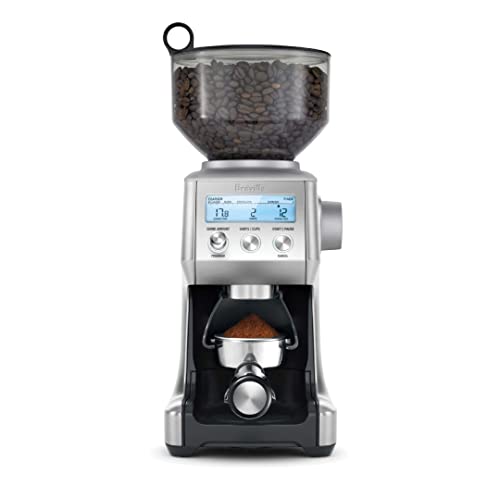
Breville Smart Grinder Pro BCG820 — Best Standalone Grinder
If you already own a brewer you like, the best upgrade in this entire guide is not a new brewer — it is this grinder. The Smart Grinder Pro’s conical burrs and programmable dosing deliver consistent grounds for drip, press and espresso alike.
Strengths
- Consistent conical-burr grind across the full range of brew methods
- Programmable dose by time keeps mornings repeatable
- Works with every brewer you own now or buy next
Trade-offs
- It is a second appliance on the counter
- Costs as much as a mid-range brewer on its own
- Burrs need periodic cleaning to stay consistent
| Detail | What to know |
|---|---|
| Burrs | Conical burr (Amazon title) |
| Controls | Programmable dosing (Amazon title) |
| Use | Drip, espresso and French press (range) |
A standalone grinder is the connoisseur’s cheat code: it upgrades every brewer you will ever own. The Smart Grinder Pro earns its place with consistency — the even particle size that lets water extract uniformly — plus dosing memory, so once you dial in your drip dose, every morning repeats it at a button press. Its range covers coarse press grinds through fine espresso territory, which means it survives brewer upgrades that strand lesser grinders. Paired with a simple, good drip machine — including several in our other guides — it produces coffee that shames grind-and-brew machines costing far more in total. The costs are counter space, a second plug and periodic burr cleaning. But judged purely on cup quality per appliance, this is the strongest single purchase in the entire brewers-and-grinders category, and the one enthusiasts keep when everything else gets upgraded around it.
Smart Grinder Pro owners develop one habit worth copying: dose by the brewer, not by the clock. Once your drip dose is dialled, note the time setting for a half pot and a full pot on a card by the machine, and every brew starts from a known-good place. The grinder also future-proofs a household’s coffee — the day a press, a moka pot or an espresso machine arrives, it is already equipped. That longevity across appliances is why, paradoxically, the standalone grinder is often the best long-term value in this entire guide.
A note on pairing: the Smart Grinder Pro flatters humble brewers embarrassingly well. Put it in front of a basic drip machine and the improvement embarrasses grind-and-brew machines at twice the combined price, because grind consistency is that powerful. It also disciplines buying: with dosing memory set, a bag of beans lasts a predictable number of mornings, so subscriptions and purchases can be planned instead of guessed. Enthusiasts call this class of grinder a ‘keeper’ — the appliance still on the counter after two brewer upgrades — and the Pro is the keeper most households can justify.
Best for: owners of good brewers who grind pre-ground today / Not suited for: one-appliance minimalists
Check the current price on Amazon

OXO Brew Conical Burr Grinder — Best Simple Grinder
OXO’s grinder strips the category to its essentials: load beans, pick one of the settings, press once. The stainless conical burrs do the serious work — consistency — while the interface refuses to intimidate anyone.
Strengths
- Genuinely simple one-touch operation
- Consistent stainless burrs suit drip and press perfectly
- Compact footprint next to any brewer
Trade-offs
- Less dosing automation than the Breville
- Hopper is smaller than the Smart Grinder Pro’s
- Not the last word for demanding espresso work
| Detail | What to know |
|---|---|
| Burrs | Stainless steel conical (Amazon title) |
| Settings | 43 grind settings (Amazon title) |
| Operation | One-touch automatic (Amazon title) |
| Hopper | 12 oz (Amazon title) |
OXO’s design philosophy — make the right thing the easy thing — suits grinders perfectly, because the right thing is consistency and the easy thing is one button. The stainless conical burrs deliver the even grind that drip and French press reward, the settings span the useful range without theatre, and the one-touch operation means the grinder actually gets used at 6 a.m., which is the whole point. In blind home use, drip coffee from the OXO and from grinders costing far more is separated by less than the bean quality most households buy. It concedes dosing automation and espresso finesse to the Breville, and its hopper suits a household rather than an office. For the enormous middle of the market — people who want fresh grounds, not a new hobby — it is the sweet spot of this guide, and the grinder we hand to friends who ask for one recommendation and no lecture.
The OXO’s one-touch simplicity has a social benefit: everyone in the house will use it, including the teenager and the technophobe grandparent, so fresh grinding becomes the household default rather than one person’s ritual. Keep the hopper two-thirds full or less so beans feed evenly, and run a grinder-cleaning tablet or a brush through monthly. Paired with any competent drip brewer, it closes ninety percent of the gap to café coffee at home — the remaining ten percent is beans, and that is a shopping choice, not an appliance one.
The OXO has one more virtue worth naming: it is quiet for a grinder, or at least as quiet as crushing beans can be, which matters in open-plan homes and early mornings. Its hopper size quietly enforces freshness, too — you refill every few days, so beans never sit for a month. And its footprint is small enough to live beside the brewer permanently rather than in a cupboard, which is the difference between a grinder that gets used daily and one that gets used on Sundays. In product design, placement is destiny; OXO understood that.
Best for: households wanting fresh grounds without a hobby / Not suited for: espresso perfectionists
Check the current price on Amazon

Cuisinart Supreme Grind Burr Grinder DBM-8 — Best Budget Grinder
The Supreme Grind is the grinder that starts households on fresh coffee: an honest burr mechanism, a cup selector that doses by quantity, and an entry cost low enough to be an experiment rather than a commitment.
Strengths
- Lowest-cost route to real burr-ground freshness
- Cup selector makes dosing thoughtless
- Compact and simple to clean
Trade-offs
- Grind consistency trails the Breville and OXO
- Static and mess are more noticeable
- Plastic-heavy build versus the premium grinders
| Detail | What to know |
|---|---|
| Settings | 18 grind settings (Amazon title) |
| Selector | 4–18 cup (Amazon title) |
| Hopper | 8 oz bean hopper (Amazon title) |
Every category needs an honest entry point, and the Supreme Grind is this one’s. Its burr mechanism will not match the consistency of the Breville or OXO — at the extremes of its range the particle spread widens, and very fine or very coarse work exposes it — but across the drip and press middle, where most households live, it grinds fresh, evenly enough, and vastly better than any blade grinder or pre-ground tin. The cup selector is its quiet genius: dose by the pot you are making, not by weighing, which keeps the morning friction at zero. Static mess around the bin is the known annoyance; a quick tap and a weekly wipe manage it. Buy it as the first step, enjoy the step-change in flavour, and upgrade later only if coffee becomes a hobby — many households discover it is all the grinder they ever needed.
Supreme Grind households get the most from the middle of its dial: settings in the drip heartland are where its consistency is best, and that happens to be where most coffee is made. A small anti-static trick helps — a drop of water stirred into the beans before grinding calms the mess noticeably. Treat it as the gateway it is, and it pays for itself in better mornings within weeks; the households that outgrow it do so because it taught them what fresh grinding tastes like.
The Supreme Grind’s cup selector also makes it the best teaching grinder: a new coffee drinker learns dose by pot size, sees the flavour change against pre-ground within one brew, and starts forming the preferences that later justify — or permanently foreclose — an upgrade. Hosts keep it as a second grinder for decaf, a genuinely thoughtful use: separate beans, no cross-contamination, no re-dialling the main grinder. Few budget appliances earn two distinct roles in a kitchen; this one does.
Best for: first-time fresh-grind households on a budget / Not suited for: enthusiasts chasing café consistency
Check the current price on Amazon
Comparison Table
| Pick | Badge | Key detail | Best for |
|---|---|---|---|
| Breville Grind Control Coffee Maker BDC650 | Best Overall Grind & Brew | Grind & brew, thermal carafe, adjustable grind | whole-bean households wanting one premium appliance |
| Cuisinart Burr Grind & Brew DGB-800 | Best Value Grind & Brew | 12-cup, burr grinder, glass carafe | families upgrading from pre-ground coffee |
| Cuisinart Burr Grind & Brew Thermal DGB-950 | Best Thermal Grind & Brew | 10-cup thermal, burr grinder, water filter | program-it-tonight households who sip all morning |
| Breville Smart Grinder Pro BCG820 | Best Standalone Grinder | Conical burr, programmable dosing | owners of good brewers who grind pre-ground today |
| OXO Brew Conical Burr Grinder | Best Simple Grinder | Conical burr, one-touch, 43 settings | households wanting fresh grounds without a hobby |
| Cuisinart Supreme Grind Burr Grinder DBM-8 | Best Budget Grinder | Burr grinder, 18 settings, cup selector | first-time fresh-grind households on a budget |
How to Choose Between Integrated and Separate
Count your mornings honestly. If coffee must simply exist when you wake, an integrated machine with a timer — the DGB-950 above all — is the only architecture that delivers fresh-ground coffee to a sleeping household. If you brew awake and enjoy the minute it takes, a separate grinder gives better grounds, a better upgrade path and a lower lifetime cost, because halves of the system are replaced independently. Counter space cuts the other way: integration is one footprint, separates are two. Households in transition — pre-ground today, curious about fresh — should start with the Cuisinart Supreme Grind or the OXO, keep their current brewer, and discover within a month whether coffee is becoming a hobby worth the Breville pair.
What Grind Size Does Drip Coffee Need?
Drip brewing wants a medium grind, roughly the texture of coarse sand: fine enough for water to extract in a four-to-six-minute pass, coarse enough not to clog the filter or over-extract into bitterness. French press wants coarse, espresso wants fine — which is why adjustable burr grinders matter and why the Smart Grinder Pro’s range is a genuine feature rather than a spec-sheet flourish. Within drip, adjust by taste in small steps: sour and thin, go finer; bitter and drying, go coarser. Change one variable at a time and write down what worked. Every grinder in this guide holds its setting repeatably, which is what makes that tuning possible at all — a blade grinder’s randomness makes it a lottery.
How to Brew Your First Fresh-Ground Pot
One: fill the hopper or dose the grinder with beans for this brew — about one heaped tablespoon per cup line. Two: set a medium grind; on the integrated machines, choose your strength. Three: fill the reservoir with fresh, filtered water if your tap is chlorinated. Four: brew, and resist judging the first pot — adjust the grind one step finer or coarser on the next, by taste. Five: note the setting that worked for this bean; different roasts will want small changes. Six: brush the grinder chute when the week ends. That is the entire discipline. Within three or four pots, most households land on a cup dramatically better than anything pre-ground produced in the same brewer — the moment this category converts its sceptics.
Common Buying Mistakes
The classic mistake is buying a grind-and-brew for a household that buys pre-ground coffee — the grinder becomes an expensive ornament; be honest about the bean bag you actually purchase. Second is the opposite: buying a premium standalone grinder and feeding it stale beans, then blaming the grinder. Third is ignoring the cleaning tax on integrated machines; a clogged chute is always a skipped brush-out, not a defective product. Fourth is choosing glass versus thermal by habit rather than by how long your pot sits. Fifth is chasing espresso-range finesse for a drip household — the OXO’s honest range serves drip better than a fussy flagship serves a distracted morning. And never shop by a printed price: check price on Amazon at the moment of decision.
Final Recommendation
For most households entering fresh-ground coffee, the Cuisinart DGB-800 is the easiest yes: one appliance, a timer, a family pot. Staggered households should take the thermal DGB-950, enthusiasts the Breville Grind Control, and owners of good brewers the Smart Grinder Pro or OXO. Compare neighbouring categories in Best Coffee Makers Bonavita Cuisinart, Best Coffee Makers Braun and Best Coffee Makers With Grinders, keep an eye on Best Coffee Makers Under $200, and see Best Espresso Machines for pressure-brewed drinks.
Grind & Brew vs Separate Brewer and Grinder: Which Is Better?
This is the category’s defining argument, and both sides are right for different people. A grind-and-brew machine — the Breville Grind Control or either Cuisinart — wins on counter space, morning simplicity and total cost: one appliance, one timer, beans to cup with no transfer step. A separate pairing wins on quality ceiling and longevity: a dedicated grinder like the Smart Grinder Pro grinds more consistently than any built-in, a dedicated brewer can be chosen purely for brewing, and when one half wears out you replace half a system. The tiebreaker is honesty about your mornings. If a two-appliance routine means you will actually use pre-ground half the week, the integrated machine’s slightly lesser grind beats the separate system’s theoretical best. If you enjoy the ritual, separates reward you every day and for years longer.
Why Does Burr vs Blade Matter So Much?
A blade grinder smashes beans into a mix of dust and chunks; water then over-extracts the dust into bitterness while under-extracting the chunks into sourness, in the same cup. Burr grinders — every pick in this guide — crush beans between two abrasive surfaces set a precise distance apart, so particles come out near-uniform and water extracts them together, which tastes like sweetness and clarity instead of muddle. Conical and flat burrs differ in detail more than in kind at home scale; what matters is that they are burrs, that the settings repeat, and that you clean them. This single mechanism is why a modest burr grinder transforms a basic brewer, and why no brewer, however expensive, can rescue blade-ground or stale pre-ground coffee.
How Do You Maintain a Grinder or Grind & Brew?
Coffee oils and fine dust are the enemies: they coat burrs, clog chutes and turn rancid, printing stale flavours onto fresh beans. Weekly, brush the burrs and chute of any grinder or grind-and-brew — a stiff brush and thirty seconds is the whole job. Monthly, run a grinder-cleaning product or a thorough dry wipe, and wash grounds bins and baskets in warm soapy water. Descale the brewing side of integrated machines on the same schedule as any drip brewer. Store beans in the bag or an airtight canister rather than filling a hopper for a month — hoppers are for days, not storage. Follow that light regime and grind consistency, the thing you paid for, stays consistent for years.
How Fresh Is Fresh Enough? Beans, Storage and Dose
Grinding fresh only helps if the beans themselves are fresh. Buy beans in quantities your household uses within about two to three weeks, store them sealed away from heat and light, and grind each brew — or at most each morning — rather than batch-grinding for the week. Dose is the other half of freshness: a consistent ratio, roughly one heaped tablespoon per cup line as a starting point, adjusted by taste. Sour means extract more, bitter means less, and small written notes beat memory. None of this requires scales or ceremony, though a cheap kitchen scale makes repeatability effortless. The six picks in this guide all reward these habits; the standalone grinders reward them most, because their consistency exposes bean quality honestly — which is a compliment to good beans and a diagnosis for stale ones.
What Does the Coffee World Mean by Extraction?
Extraction is simply how much of the coffee’s soluble flavour the water dissolves. Too little and the cup is sour, salty and thin — the flavours that dissolve first dominate. Too much and the cup turns bitter and drying, as the last, harshest compounds arrive. The sweet middle is a band, not a point, and everything in this guide is a tool for staying in it: burr grinders make particle size uniform so all grounds extract at the same rate; good brewers hold water temperature steady so extraction does not wander mid-brew; correct ratio gives the water the right amount of coffee to work on. When a cup disappoints, think in extraction terms and the fix names itself — sour means extract more (finer grind, more time, hotter water), bitter means extract less. That one idea, honestly applied, improves coffee more than any purchase after the burr grinder itself.
How Should You Store Beans and Grounds?
Beans fear four things: air, light, heat and moisture. Keep them in their bag with the air squeezed out, or in an airtight canister, in a cupboard — not the fridge, where condensation and food odours attack them, and not in a sunlit counter jar, however photogenic. Buy the quantity your household drinks in two to three weeks and let the roaster store the rest of your supply chain. Grounds should ideally not be stored at all — that is the thesis of this entire guide — but if you must grind ahead for a trip or a gift, seal the grounds airtight, keep them cool and dark, and use them within days, accepting a gentler cup. Freezing whole beans in single-week portions is the one storage upgrade enthusiasts endorse; thaw a portion sealed before opening it, grind from it all week, and even a modest setup tastes remarkably fresh.
Is Decaf Different in These Machines?
Only in the beans. Every machine and grinder in this guide handles decaf identically to regular coffee, because the brewing variables — grind, ratio, temperature — are the same; decaf beans are simply roasted coffee that had its caffeine extracted before roasting. Two practical notes: decaf often benefits from a slightly finer grind or a touch more coffee, since the decaffeination process can mute intensity; and households that serve both should keep decaf in a separate, labelled canister — or use the Supreme Grind trick of a second, small grinder — to avoid the evening mix-up nobody enjoys. Fresh-ground decaf, brewed well, is far better than its reputation, and grind-and-brew machines are its best home format because the freshness gap is where decaf gains most.
What Should a Beginner Buy First?
If you are starting from a basic brewer and a tin of pre-ground coffee, the order of purchases matters more than the size of any single one. First, buy whole beans from a roaster whose coffee you have tasted and liked — no appliance fixes beans you do not enjoy. Second, add the grinder your budget reaches comfortably: the Supreme Grind if money is tight, the OXO if it is not, the Smart Grinder Pro if coffee is becoming a pleasure rather than a utility. Third, live with that pairing for a month before touching the brewer; most households discover the brewer was never the problem. Only then, if timers, thermal carafes or single-cup flexibility still call, choose the integrated machine that fits — Grind Control for control, DGB-950 for staggered mornings, DGB-800 for family value. This sequence spends money in the order the cup notices it, and it is the advice we give our own families.
One more beginner truth: your first fresh-ground pots will not be perfect, and they will still be better than what came before. Expect a week of small grind adjustments, expect to prefer one bean over another for reasons you can suddenly taste, and expect the pre-ground tin in the cupboard to become emergency-only supplies. That arc — from appliance purchase to actual preference — is the real, lasting, genuinely valuable and worthwhile, kitchen-changing product for real households this category actually sells to households, and every pick in this guide can start it, morning after morning, for years to come. If friends ask why your kitchen coffee suddenly tastes like the cafe version, the honest answer is boring and true: the beans were ground a minute before the water hit them, by burrs that crush evenly, into a brewer that stays properly hot throughout the cycle.
Frequently Asked Questions
Is a grind-and-brew machine worth it?
For households buying whole beans and wanting timer convenience, yes — it is the only way to wake to fresh-ground coffee. If you brew awake anyway, a separate grinder usually delivers better grounds for similar total money.
What is the difference between burr and blade grinders?
Burrs crush beans to a near-uniform size for even extraction; blades smash them into dust and chunks that extract unevenly into bitter-sour muddle. Every grinder recommended here is a burr grinder for that reason.
Can I use pre-ground coffee in a grind-and-brew?
Yes — all three integrated picks brew from pre-ground with the grinder off, which is handy for guests’ decaf. It is also the right way to finish a bag of pre-ground you already own when a grind-and-brew arrives: run it through, taste the difference honestly against your first fresh-ground pot, and you will understand in one morning why this category exists. Many households keep a small bag of good decaf pre-ground for evening guests even after converting fully to whole beans for themselves, and the integrated machines handle that mixed life gracefully.
Yes — in brief, all three integrated picks brew from pre-ground with the grinder off, which is handy for guests’ decaf. But if pre-ground is your permanent plan, a plain brewer is the cheaper, simpler buy.
How do I stop my grinder making a static mess?
Stir a drop of water into the beans before grinding, tap the bin before opening it, and keep the chute brushed. Fresher, oilier beans static more; the habit takes five seconds and tames most of it.
Which grinder is best for drip coffee specifically?
The OXO Brew grinder is the drip sweet spot — consistent in the medium range, one-touch simple. The Breville Smart Grinder Pro adds dosing precision and range for households that also brew press or espresso.
How long do burrs last?
Home burrs last for years of daily use — typically far longer than the brewer they serve, which is one more argument for the standalone grinder as a long-term purchase; consistency fades gradually rather than failing. A weekly brush and monthly clean keep them honest, and declining consistency — not noise or looks — is the signal to replace them.


