Disclosure: airfryerkitchensupply.com is reader-supported. When you buy through links on our site, we may earn an affiliate commission at no extra cost to you.
Where to buy
Every pick in this guide to the best coffee and cappuccino makers was cross-checked against Amazon’s own catalog data before it earned a place here. Use the links below to check price on Amazon for the current listing, confirm the exact model variant, and read the manufacturer’s own description before you order:
- De’Longhi BCO430 Combination Pump Espresso and 10-Cup Drip Coffee Machine — Best Overall: check price on Amazon
- Breville Barista Express Espresso Machine BES870XL — Best for Real Cappuccino: check price on Amazon
- Philips 3200 Series Fully Automatic Espresso Machine with LatteGo EP3241/54 — Best Fully Automatic: check price on Amazon
- Mr. Coffee Espresso and Cappuccino Machine Café Barista — Best Budget: check price on Amazon
- Breville Bambino Plus Espresso Machine BES500 — Best Compact: check price on Amazon
- De’Longhi Stilosa Espresso Machine EC260 — Best Value Manual: check price on Amazon
The best coffee and cappuccino makers have to do two genuinely different jobs. Coffee, in the drip sense, is a gentle percolation of hot water through grounds; cappuccino is a pressurized espresso shot buried under steamed, foamed milk. Machines that do both — or that do the cappuccino half so well the drip half hardly matters — come in three families, and this guide covers all of them: combination machines with a drip side and an espresso side, manual espresso machines with real steam wands, and fully automatic machines that froth milk at one touch.
Be skeptical of any cheap machine that promises cappuccino from a steam toy or a whisk attachment. Real cappuccino needs pump pressure for the espresso and steam for the milk; every pick below has both, verified against Amazon’s catalog data before inclusion. What separates them is how much of the work — and the learning — falls on you, and how much counter and budget they ask for in return.
Read the Quick Picks for the shortlist, then the detailed reviews for the honest trade-offs: every machine here makes a good cappuccino, but the right one depends on whether your household also needs a pot of drip coffee, whether you want a hobby or a button, and how much counter you can honestly spare.
In this guide
Quick Picks
If you only read one section, make it this one. These are the six best coffee and cappuccino makers we would point a friend to, each chosen for a different kind of buyer:
- Best Overall: De’Longhi BCO430 Combination Pump Espresso and 10-Cup Drip Coffee Machine — 10-cup drip on one side, pump espresso with frothing wand on the other — two machines in one footprint. Check the current price on Amazon.
- Best for Real Cappuccino: Breville Barista Express Espresso Machine BES870XL — built-in conical burr grinder, manual steam wand, café-quality shots for lattes and cappuccinos. Check the current price on Amazon.
- Best Fully Automatic: Philips 3200 Series Fully Automatic Espresso Machine with LatteGo EP3241/54 — one-touch cappuccino via LatteGo milk system, ceramic grinder, five coffee varieties. Check the current price on Amazon.
- Best Budget: Mr. Coffee Espresso and Cappuccino Machine Café Barista — 15-bar pump, automatic milk frother, one-touch espresso/cappuccino/latte panel. Check the current price on Amazon.
- Best Compact: Breville Bambino Plus Espresso Machine BES500 — compact footprint, automatic milk texturing, fast heat-up for small kitchens. Check the current price on Amazon.
- Best Value Manual: De’Longhi Stilosa Espresso Machine EC260 — 15-bar pump, manual milk frother, stainless steel boiler, compact manual design. Check the current price on Amazon.
How These Picks Were Chosen
We required three things of every candidate: a real pump (or, for the fully automatic pick, a proven bean-to-cup system) rather than steam-pressure brewing; a genuine milk-frothing path — manual wand, panarello, automatic frother, or an integrated milk system; and a current, verifiable listing in Amazon’s catalog, with the model matched to the manufacturer’s own naming. Machines that fake cappuccino with powdered mixes or whisk attachments were excluded regardless of price.
The six survivors were then mapped to the six buyers who actually shop this search: the mixed household, the quality-first learner, the automation seeker, the budget beginner, the small kitchen, and the value-minded manual user. Prices are not printed because espresso machines are discounted aggressively and often; check price on Amazon on each listing, and treat a sale on the Philips or Breville as a genuine event worth acting on.
The 6 Best Coffee and Cappuccino Makers, Reviewed

De’Longhi BCO430 Combination Pump Espresso and 10-Cup Drip Coffee Machine — Best Overall
The search asks for machines that make coffee and cappuccino, and the BCO430 is the most literal answer on the market: one side is a 10-cup drip brewer, the other is a pump espresso machine with a frothing wand, and both run from a single countertop footprint. Households split between pot-of-coffee drinkers and cappuccino drinkers usually end up buying two machines; this is the one-box alternative, and it earns Best Overall because it refuses to make either side an afterthought.
Strengths
- True two-in-one: full drip brewer plus pump espresso
- Frothing wand makes genuine cappuccino foam
- One footprint replaces two separate machines
Trade-offs
- Manual wand has a learning curve for beginners
- If one side fails, the whole unit is affected
- Espresso side cannot match a dedicated machine’s refinement
| Drip capacity | 10 cups |
| Espresso side | Pump espresso with frothing wand |
| Format | Combination drip + espresso machine |
The drip side behaves like a respectable standalone brewer — full pot, programmable enough for weekday mornings — while the espresso side uses a proper pump rather than steam pressure, which is the dividing line between real cappuccino foam and the frothy disappointment cheap steam toys produce. The wand is manual, so your first cappuccinos will be imperfect; by the second week, most owners are steaming milk they are genuinely happy with, and the skill transfers to any café machine.
Combination machines carry one structural risk: if either side fails, you are shopping for a replacement for both. De’Longhi’s service network and the model’s long production run soften that risk compared with no-name combos, and the two sides share only the housing and water supply in spirit — you can keep using the drip side while the espresso side awaits a part.
Counter space is the deciding argument. Two separate machines — a drip brewer plus an espresso machine plus possibly a grinder — consume a counter run that many kitchens simply do not have. The BCO430 consolidates the two drinks a household actually makes daily, and for mixed coffee-and-cappuccino homes it is the most practical purchase in this guide.
Best for: mixed households where some drink drip coffee and others drink cappuccino / Not suited for: espresso purists who want a dedicated, upgradeable setup
Check the current price on Amazon for the De’Longhi BCO430 Combination Pump Espresso and 10-Cup Drip Coffee Machine.

Breville Barista Express Espresso Machine BES870XL — Best for Real Cappuccino
Strictly speaking the Barista Express is an espresso machine rather than a coffee-and-cappuccino combo — but cappuccino is two-thirds milk and one-third espresso, and this machine makes the best version of both halves in this guide. Its built-in grinder feeds a proper portafilter, and the manual steam wand textures milk to the glossy microfoam that defines a real cappuccino rather than a coffee with bubbles on top.
Strengths
- Best cappuccino quality in this guide, full stop
- Built-in grinder for genuinely fresh espresso
- Manual wand produces true microfoam for latte art
Trade-offs
- Real learning curve — dialing in takes practice
- No drip-pot function for groups
- Ongoing maintenance ritual is part of ownership
| Grinder | Built-in conical burr grinder |
| Milk | Manual steam wand |
| Body | Brushed stainless steel |
The integrated grinder is the difference-maker. Cappuccino lives or dies on fresh espresso, and grinding seconds before extraction — with a dose you can adjust — puts this machine a class above pod and pressurized-basket rivals for drink quality. The learning curve is honest: you will dial in grind size over the first bag of beans, and the pressure gauge on the front panel teaches you what a good extraction looks like while you learn.
As a pure coffee maker it is narrower than the combo machines here: it makes espresso and Americanos, not a 10-cup pot for a crowd. Households that want both should pair it with an inexpensive drip machine, or choose the De’Longhi combo above. But if cappuccino is the priority and drip coffee is occasional, this is the machine whose drinks will still satisfy you in three years.
Ownership is a hobbyist’s bargain: regular backflushing, descaling, and fresh beans are part of the deal. Buyers who embrace that rhythm describe the morning cappuccino ritual as the best part of the purchase; buyers who wanted a button should look at the Philips below instead.
Best for: cappuccino lovers willing to learn a manual machine for café-level drinks / Not suited for: anyone who wants cappuccino at the press of one button
Check the current price on Amazon for the Breville Barista Express Espresso Machine BES870XL.

Philips 3200 Series Fully Automatic Espresso Machine with LatteGo EP3241/54 — Best Fully Automatic
The Philips 3200 with LatteGo is the answer for buyers who want cappuccino without becoming baristas. Beans go in the top, milk goes in the LatteGo carafe, and one touch produces a cappuccino with properly frothed milk — then the two-piece milk system rinses clean or goes in the dishwasher, which is the detail that makes people actually use it daily instead of avoiding the milk function.
Strengths
- One-touch cappuccino with almost no cleanup
- LatteGo milk system has no tubes to clog or sour
- Ceramic grinder and AquaClean filter reduce maintenance
Trade-offs
- Less control than a manual machine
- Coffee means espresso-style drinks, not a drip pot
- Premium tier pricing within this category
| Milk system | LatteGo frother — two parts, dishwasher safe |
| Grinder | 100% ceramic burr grinder |
| Drinks | 5 coffee varieties, one-touch |
| Filter | AquaClean water filter |
Fully automatic machines live or die on cleaning friction, and the LatteGo design is the best answer in this class: no tubes, no hidden milk pathways, nothing to sour inside the machine. The ceramic grinder is quiet and durable, the touch display is genuinely intuitive, and the AquaClean filter stretches the interval between descaling sessions, which fully automatic machines otherwise demand regularly.
The honest trade-off is control. You can adjust strength and volume, but you cannot chase the last ten percent of extraction quality the way a Barista Express owner can, and the milk foam, while very good, is a step below hand-textured microfoam. For most households the exchange is obviously worth it: a very good cappuccino in under a minute beats a perfect one that requires ten minutes and a skill set.
Note that this is an espresso-based machine: your ‘coffee’ is a long espresso-style drink rather than drip. If the household’s morning ritual is a big pot shared around the table, pair it with a cheap drip brewer or choose the De’Longhi combination machine at the top of this list.
Best for: busy households that want real cappuccino daily with push-button effort / Not suited for: tinkerers who enjoy the manual espresso ritual
Check the current price on Amazon for the Philips 3200 Series Fully Automatic Espresso Machine with LatteGo EP3241/54.
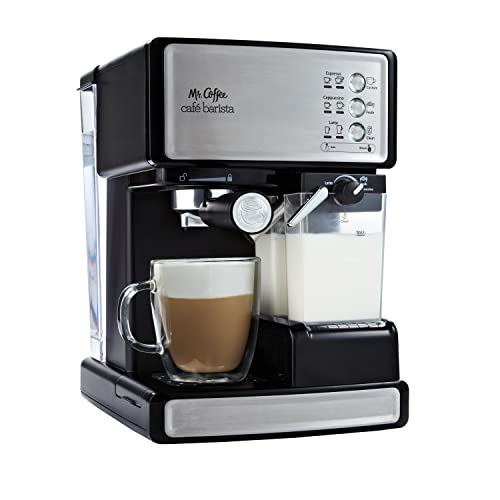
Mr. Coffee Espresso and Cappuccino Machine Café Barista — Best Budget
The Café Barista is the budget door into real cappuccino: a 15-bar pump machine with an automatic milk frother and a one-touch panel that makes espresso, cappuccino, or latte without any steaming skill at all. Fill the removable milk reservoir, dock it, press the drink you want, and the machine froths and dispenses in the right order. For the price of a few weeks of café drinks, that is a compelling proposition.
Strengths
- Automatic frother — cappuccino with zero steaming skill
- One-touch panel for espresso, cappuccino, and latte
- Lowest-cost route to real milk drinks in this guide
Trade-offs
- Pressurized baskets cap ultimate shot quality
- Lighter build than premium rivals
- Milk system needs a quick rinse after each session
| Pump | 15-bar pump system |
| Milk | Automatic milk frother with removable reservoir |
| Drinks | Espresso, cappuccino, latte — one-touch |
| Style | Semi-automatic 3-in-1 |
The automatic frother is the whole story here. Manual wands intimidate beginners and produce inconsistent results; this reservoir system produces the same foamed milk every time, and the reservoir lifts off and stores in the fridge between uses. The espresso side uses pressurized baskets, which forgive pre-ground coffee and imperfect tamping — exactly the forgiveness a first-time owner needs.
Set expectations at the level the price dictates: the build is lighter than the Breville or Philips, the drinks are very good rather than exceptional, and the machine rewards fresh beans without demanding a separate grinder purchase on day one. As a first cappuccino machine — or a gift that introduces someone to making milk drinks at home — it has introduced more people to home cappuccino than any machine in this guide.
One ownership habit matters: rinse the milk reservoir system after use rather than letting milk sit in it, a thirty-second job that keeps the automatic frother hygienic and reliable. Owners who do this report years of service; owners who do not, blame the machine.
Best for: beginners and budget buyers who want cappuccino without a learning curve / Not suited for: espresso hobbyists planning to upgrade their technique
Check the current price on Amazon for the Mr. Coffee Espresso and Cappuccino Machine Café Barista.

Breville Bambino Plus Espresso Machine BES500 — Best Compact
The Bambino Plus solves the small-kitchen cappuccino problem: it is a genuinely compact espresso machine that heats up in moments and textures milk automatically, so a small counter does not have to mean pod drinks. Where the Barista Express is a workstation, the Bambino Plus is an appliance — narrow, quick, and forgiving — that still pulls real espresso through a proper portafilter.
Strengths
- Real espresso and cappuccino from a very small footprint
- Automatic milk texturing with temperature control
- Heats up fast enough for weekday mornings
Trade-offs
- No built-in grinder — a separate purchase
- Small tank and drip tray need frequent attention
- Less manual control than the Barista Express
| Style | Compact semi-automatic espresso machine |
| Milk | Automatic milk texturing |
| Body | Brushed stainless steel |
The automatic steam wand is the headline: it textures milk to a chosen temperature and foam level hands-free, then purges itself. For cappuccino specifically, that consistency is gold — the dry, airy foam a cappuccino wants is a setting rather than a skill. Combined with the fast ThermoJet-style heat-up, the machine fits real mornings: on, shot, milk, done, in less time than a café queue.
There is no built-in grinder, so budget for one — the grinders in our wider coffee coverage, such as a conical burr model, pair naturally — or use fresh pre-ground espresso coffee as a starting point. The drip tray and water tank are small, in keeping with the footprint, so a two-person household will refill and empty more often than with a full-size machine.
Choose the Bambino Plus when counter space is the binding constraint and cappuccino quality still matters. It concedes the Barista Express’s integrated grinder and some manual control, and in exchange it fits kitchens the bigger machine simply cannot.
Best for: small kitchens and apartments that refuse to compromise on cappuccino / Not suited for: households brewing back-to-back drinks for a crowd
Check the current price on Amazon for the Breville Bambino Plus Espresso Machine BES500.
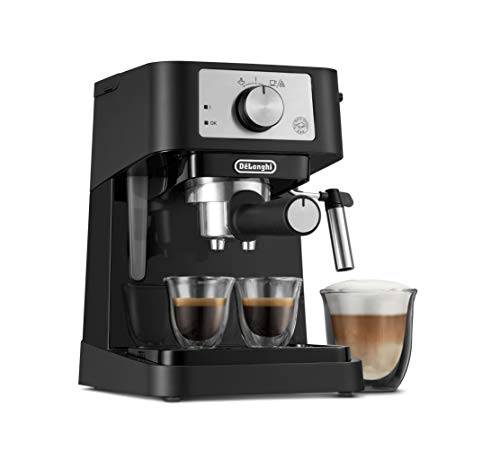
De’Longhi Stilosa Espresso Machine EC260 — Best Value Manual
The Stilosa is the value manual pick: a compact pump machine with a stainless steel boiler and a panarello-style frothing wand that makes learning milk drinks forgiving. The panarello sleeve does part of the aerating work for you, so a beginner’s first cappuccino foam is respectable rather than bubbly soup — and the sleeve removes as your technique improves and you want finer control.
Strengths
- Stainless steel boiler at a budget price
- Panarello wand makes beginner foam forgiving
- Compact, simple, and easy to live with
Trade-offs
- Plastic exterior and light body
- Pressurized baskets limit ultimate quality
- No grinder included
| Pump | 15-bar pump pressure |
| Boiler | Stainless steel boiler |
| Milk | Manual milk frother (panarello wand) |
| Design | Compact manual espresso machine |
Under the hood, the specification is better than the price suggests: a stainless steel boiler holds temperature more honestly than the thermoblocks in many cheap rivals, and the 15-bar pump delivers proper extraction pressure through pressurized baskets that tolerate pre-ground coffee and uneven tamping. This is the classic first real espresso machine formula, executed by the category’s biggest maker.
The compromises are the expected ones at this tier: a mostly plastic exterior, a small footprint that can feel light when you lock in the portafilter, and no path to the refined shots a Barista Express produces. But as a machine to learn on — to discover whether you enjoy the ritual before spending serious money — it is the smartest cheap seat in the category.
Pair it with a simple burr grinder when you are ready, fresh beans, and the milk routine in the how-to section below, and the Stilosa will make cappuccinos that embarrass café chains. Many owners keep it for years as a second machine even after upgrading, which says a great deal about its value.
Best for: learners who want a manual machine and real cappuccino on a tight budget / Not suited for: buyers who want one-touch automatic drinks
Check the current price on Amazon for the De’Longhi Stilosa Espresso Machine EC260.
Comparison Table
| Pick | Badge | Key spec | Best for |
|---|---|---|---|
| De’Longhi BCO430 Combination Pump Espresso and 10-Cup Drip Coffee Machine | Best Overall | 10-cup drip on one side, pump espresso with frothing wand on the other — two machines in one footprint | mixed households where some drink drip coffee and others drink cappuccino |
| Breville Barista Express Espresso Machine BES870XL | Best for Real Cappuccino | built-in conical burr grinder, manual steam wand, café-quality shots for lattes and cappuccinos | cappuccino lovers willing to learn a manual machine for café-level drinks |
| Philips 3200 Series Fully Automatic Espresso Machine with LatteGo EP3241/54 | Best Fully Automatic | one-touch cappuccino via LatteGo milk system, ceramic grinder, five coffee varieties | busy households that want real cappuccino daily with push-button effort |
| Mr. Coffee Espresso and Cappuccino Machine Café Barista | Best Budget | 15-bar pump, automatic milk frother, one-touch espresso/cappuccino/latte panel | beginners and budget buyers who want cappuccino without a learning curve |
| Breville Bambino Plus Espresso Machine BES500 | Best Compact | compact footprint, automatic milk texturing, fast heat-up for small kitchens | small kitchens and apartments that refuse to compromise on cappuccino |
| De’Longhi Stilosa Espresso Machine EC260 | Best Value Manual | 15-bar pump, manual milk frother, stainless steel boiler, compact manual design | learners who want a manual machine and real cappuccino on a tight budget |
What is the difference between a cappuccino maker and a regular coffee maker?
A regular drip coffee maker cannot make cappuccino, and the reason is physics. Cappuccino starts with espresso — water forced through finely ground, tamped coffee at high pressure to produce a concentrated shot with crema. Drip machines let water fall through grounds at atmospheric pressure, which produces a longer, milder drink that no amount of frothed milk will turn into a cappuccino. If a product listing implies otherwise, it is marketing, not engineering.
The second half of the drink is the milk: cappuccino milk is steamed to create microfoam and poured in a ratio of roughly one-third espresso, one-third steamed milk, one-third foam. That requires a steam wand, a panarello frother, an automatic frothing system, or a fully automatic milk carafe — one of which every pick in this guide has. When you shop, ignore the word cappuccino on any box that lacks one of those four mechanisms.
This is why the category splits into combination machines (drip plus espresso in one housing), dedicated espresso machines (espresso only, best cappuccino), and fully automatics (espresso plus automated milk). Decide which family fits your household first; choosing between models inside the family is the easy part.
Manual wand, automatic frother, or fully automatic: which milk system suits you?
A manual steam wand, as on the Barista Express, gives the finest control and the best possible foam, including latte art — at the cost of practice. Expect your first week of cappuccinos to be drinkable but imperfect, and your second month to be genuinely good. A panarello wand, as on the Stilosa, splits the difference: the sleeve injects air for you, making foam quality consistent from day one while capping the finesse you can eventually reach.
Automatic frothers, like the Mr. Coffee Café Barista’s reservoir system, remove skill from the equation entirely — the machine froths and dispenses in sequence. Fully automatic systems, like Philips’ LatteGo, go further and integrate the milk into a one-touch drink, with the crucial advantage of a milk path that comes apart for real cleaning. Milk residue is the hygiene weak point of every milk system; the easier a system is to rinse, the more reliably it will perform over years.
Match the system to your mornings, honestly. If weekdays are a sprint, automation wins and the manual wand becomes a weekend toy. If the ritual itself is the pleasure — the tamp, the steam, the pour — a manual machine will make you happier every single day, and cost less to buy.
Do you need a grinder for good cappuccino at home?
For the manual machines in this guide, a burr grinder is the single biggest quality upgrade available — bigger than the difference between the machines themselves. Espresso extraction is brutally sensitive to grind size, and pre-ground coffee stales within days of opening. The Barista Express builds the grinder in, which is a large part of its value; the Bambino Plus and Stilosa assume you will add one, and a conical burr grinder from our wider coffee coverage is the natural pairing.
The pressurized baskets on the budget picks soften this requirement: they artificially build pressure, so pre-ground coffee and even blade-ground coffee produce acceptable drinks. That forgiveness is a feature for beginners, not a flaw — it lets you start with the machine alone and add the grinder when the hobby takes hold.
Fully automatic machines like the Philips sidestep the question with a built-in ceramic grinder and internal dosing. You lose grind-by-grind control and gain a machine that produces the same drink every time, which for most households is the right trade.
What actually makes a cappuccino different from a latte — and why it changes which machine to buy
Cappuccino and latte start from the same two ingredients and diverge on milk texture and ratio. A cappuccino is equal thirds espresso, steamed milk, and airy foam, served smaller; a latte is a larger drink with much more steamed milk and only a thin foam cap. The practical consequence for machine shopping is that cappuccino rewards foam-making ability above all: a machine whose frothing is weak or bubbly will make a passable latte long before it makes a convincing cappuccino.
This is why the picks are ordered the way they are. The Barista Express’s manual wand can produce the dry, structured foam a cappuccino wants; the automatic systems produce a slightly wetter foam that flatters lattes and still makes a good cappuccino; and the combination machine’s wand, in practiced hands, covers both drinks for a whole household. If your drink is specifically cappuccino, weight the milk system more heavily than any other specification on the page.
Cup choice matters more than most guides admit. A cappuccino belongs in a small, thick-walled cup that holds heat and keeps the thirds in proportion; the same drink stretched across a giant mug becomes a weak latte by another name. Pre-warming the cup with hot water from the machine takes ten seconds and noticeably improves the drink, whatever machine you buy.
How to keep a milk system clean — the maintenance that decides how long your machine lasts
Milk is a food, and every milk pathway in every machine in this guide will sour if it is neglected. The routine is short but non-negotiable: purge the steam wand before and after each use with a short burst of steam, wipe it immediately with a damp cloth while the milk is still wet, and never let a milk reservoir sit at room temperature between drinks. Dried milk on a wand bakes into a varnish that blocks steam tips and flavors the next drink.
Weekly, soak removable wand tips and frother parts in hot water with a little detergent, and rinse automatic reservoirs thoroughly rather than just topping them up. Fully automatic machines like the Philips ask for a deeper brew-group rinse on a schedule the display will announce; do it when asked, because the brew group is the heart of the machine and its cleanliness decides both flavor and lifespan.
Descaling is the other half of longevity. Espresso machines push water through narrow, hot pathways where scale builds fast, and every pick here will eventually demand a descale cycle. Use the manufacturer’s recommended descaler, run it when prompted rather than months later, and your machine’s pump and boiler will repay you with years of consistent pressure — the invisible ingredient in every good cappuccino.
Combination machine, dedicated machine, or fully automatic: the space and budget math
Price the three families honestly, including the accessories each one demands. A combination machine like the BCO430 is one purchase that serves two drink types, but its espresso ceiling is fixed — there is no upgrade path short of replacing it. A dedicated manual machine costs similar money, demands a grinder budget on top if it lacks one, and then keeps improving with your skill and your beans for years. A fully automatic costs the most up front and the least in time: no grinder, no accessories, no learning curve, and a drink quality ceiling set at the factory.
Counter math cuts the other way. The combination machine is one footprint; the dedicated setup is a machine plus a grinder plus a knock box and tamper living somewhere; the fully automatic is one footprint but a deep one, and it needs clearance above for the bean hopper and in front for the milk carafe. Measure your counter run and your cabinet height before falling for any of the three — espresso machines are tall, and the prettiest machine in this guide is useless if its lid cannot open under your cabinets.
The deciding question is who drinks what, and how often. Two cappuccinos every morning for one person points to the Philips or the Barista Express depending on temperament. A household split between pot coffee and milk drinks points to the BCO430. Weekend-only cappuccino for guests points to the Mr. Coffee or the Stilosa, where the investment matches the usage. There is no wrong family in this guide — only mismatches between the machine and the household’s actual week.
What size cappuccino setup does a household actually need?
Espresso machines are sold on possibility and used on routine, so size the purchase to the routine. Count the milk drinks your household truly makes in a week. Two a day, every day, justifies any machine in this guide including the premium fully automatic — the per-drink cost at home undercuts cafés so thoroughly that the machine pays for itself in saved café trips faster than most appliances ever do. Two a week, for slow Sunday mornings, points firmly at the budget end: the Stilosa or the Café Barista will make those drinks happily without tying up serious money or counter.
Tank and boiler size follow the same logic. A household making four cappuccinos back-to-back for guests needs a machine whose steam recovers quickly and whose water tank does not empty mid-round — the full-size picks here handle that; the compact Bambino Plus manages two at a time gracefully and asks for a refill pause after. None of this is a defect; it is sizing. The error is buying café capacity for a one-cup household, or one-cup capacity for a house that entertains every weekend.
Finally, leave physical room for the hobby to grow if it catches. A manual machine invites a better grinder, a scale, fresh-bean subscriptions; a fully automatic deliberately closes that door in exchange for peace. Neither is superior — but knowing which person you are, before you buy, is the cheapest upgrade in this entire guide.
How to Make a Proper Cappuccino at Home, Step by Step
Whatever machine you choose from this guide, the cappuccino method is the same. Learn this sequence once and it transfers to every pick above:
- Start with fresh, cold milk. Whole milk foams most forgivingly and tastes best in cappuccino. Pour it cold into a metal jug, filling to just below the spout — milk roughly doubles in volume as it foams, and an overfilled jug guarantees a mess.
- Pull the espresso shot first. Extract a double shot directly into a warmed cappuccino cup. On manual machines, aim for a shot that runs like warm honey; on automatics, use the espresso or cappuccino program and let the machine sequence the drink.
- Purge and position the wand. Blast the steam wand for two seconds to clear condensation, then submerge the tip just below the milk’s surface. On panarello and automatic systems, the machine handles aeration — your job is simply to have the milk ready and cold.
- Aerate, then texture. For manual wands: keep the tip near the surface early to introduce air (you want a gentle tearing sound), then sink it deeper to spin the milk into a vortex that folds the foam in. Stop when the jug feels hot to the point of discomfort — overheated milk scalds and turns sweet foam flat.
- Tap, swirl, and pour promptly. Tap the jug on the counter to pop large bubbles, swirl until the milk looks like wet paint, and pour immediately in a steady stream over the shot. Cappuccino foam waits for no one; a thirty-second delay lets it separate.
- Finish and clean immediately. Dust with cocoa if you like, serve at once, then purge and wipe the wand before the milk dries. The thirty seconds of cleaning now saves thirty minutes of soaking later.
Your first attempts will teach you more than any guide: too much air makes stiff foam that sits on top like a hat; too little makes a latte. Adjust one variable at a time — milk temperature first, then aeration time — and within a couple of weeks the drink becomes repeatable, which is the real goal.
Common Buying Mistakes
Buying a steam-pressure toy expecting cappuccino. Cheap steam machines cannot build real espresso pressure or proper steam at once. Every pick in this guide uses a pump or a proven automatic system for a reason.
Using old, pre-ground coffee in a manual machine. Espresso exposes stale coffee instantly. Fresh beans, ground as you go, transform the same machine’s output more than any accessory.
Scalding the milk. Milk heated past the point where the jug is uncomfortable to hold turns thin and sweet in the wrong way. Stop earlier than you think; residual heat carries it the last few degrees.
Letting milk dry on the wand. Dried milk blocks steam tips and sours the next drink. Purge and wipe immediately, every time — it is the cheapest maintenance in this entire category.
Skipping the grinder budget on a manual machine. A Bambino or Stilosa without a grinder is half a setup. If the total budget is fixed, the Mr. Coffee automatic or the Philips may serve you better than a manual machine starved of fresh grounds.
Expecting a combination machine to be a café machine. The BCO430’s espresso side is genuinely good, but it shares its budget with a drip brewer. Buy it for household versatility, not to replicate a specialty café.
Final Recommendation
For most households reading this search, the De’Longhi BCO430 is the right answer: drip coffee for the pot drinkers, pump espresso and a frothing wand for the cappuccino drinkers, one footprint. If cappuccino is the whole point and drip is an afterthought, the Breville Barista Express makes the best drinks here, while the Philips 3200 makes the easiest ones — choose based on whether your mornings have room for a ritual.
On a budget, the Mr. Coffee Café Barista’s automatic frother is the friendliest start, and the Stilosa is the learner’s manual machine. The Bambino Plus owns the small-kitchen niche outright. Every pick was verified against Amazon’s catalog data; check price on Amazon before ordering, because this category is discounted often enough that timing matters. Whichever you choose, budget for fresh beans from the start — they improve every machine in this guide more than the next model up would, and they are the difference between a cappuccino maker that gathers dust and one that becomes the center of the morning, every single day of the year.
Keep exploring the rest of our coffee coverage: Best Coffee And Latte Makers Best Coffee And Cappuccino Makers Best Coffee Dual Brew Makers Best Coffee And Tea Makers Best Certified Coffee Makers
Frequently Asked Questions
Can a regular drip coffee maker make cappuccino?
No. Cappuccino requires pressurized espresso and steamed milk; a drip machine provides neither. You need an espresso-capable machine with a steam wand, an automatic frother, or an integrated milk system — the three families covered in this guide.
What is the easiest cappuccino maker for a beginner?
The Mr. Coffee Café Barista, because its automatic frother removes all steaming skill, or the Philips 3200 if the budget allows — its one-touch drinks and tube-free LatteGo system are the lowest-effort route in this guide.
Is a combination coffee and espresso machine worth it?
For mixed households, yes: the De’Longhi BCO430 replaces two machines and serves both drink types well. If only one person drinks espresso and everyone else drinks drip, a cheap drip machine plus a dedicated espresso machine can be a better long-term pairing.
Do I need a separate grinder for cappuccino?
For manual machines, a burr grinder is the biggest quality upgrade you can buy, though pressurized baskets forgive pre-ground coffee while you learn. Fully automatic and built-in-grinder models like the Philips and Barista Express include grinding already.
Why does my cappuccino foam collapse or taste flat?
Usually the milk: it must start cold, be textured promptly, and not be overheated. Stale coffee and a dirty steam wand are the other common culprits — purge and wipe the wand after every use.
How much milk goes in a cappuccino?
Classically, equal thirds: one part espresso, one part steamed milk, one part foam, in a small cup. Larger, milkier proportions make a latte — delicious, but a different drink, and one that forgiving automatic frothers handle especially well.
Are fully automatic cappuccino machines hard to clean?
The milk system is the part to watch. Designs like Philips’ LatteGo come apart into two dishwasher-safe pieces with no tubes, which removes the traditional weak point; the machine will also prompt you through its brew-group rinsing and descaling schedule.
Can these machines make regular coffee too?
Combination machines like the De’Longhi BCO430 brew a true drip pot on one side. Espresso-based machines make long coffee drinks by extending the shot with hot water — an Americano style cup rather than drip. If a shared morning pot matters, buy the combination or pair an espresso machine with an inexpensive drip brewer.
What milk works best for cappuccino foam?
Cold whole dairy milk is the most forgiving and produces the stablest foam, which is why cafés default to it. Oat and other plant milks formulated for baristas foam well on the wands and automatic systems in this guide; skimmed milk makes large, dry bubbles that collapse quickly, and any milk foams worse as it approaches its expiry date.


