Disclosure: airfryerkitchensupply.com is reader-supported. When you buy through links on our site, we may earn an affiliate commission at no extra cost to you.
Where to Buy
Every linked model in this guide to the best coffee dual brew makers was checked against its live Amazon listing before this guide was written. A dual brew maker brews both ways in one machine — a full carafe for the household and a single cup on demand — and the six picks below cover the pod-based, grounds-based and espresso-combination versions of that idea. One pick is deliberately unlinked, and its review explains why.
- Ninja DualBrew Pro Specialty Coffee System (CFP301) — Best Overall — Check the current price on Amazon
- Cuisinart Coffee Center 10-Cup (SS-21NAS) — Best Thermal Carafe — Check the current price on Amazon
- Hamilton Beach FlexBrew Trio 2-Way Coffee Maker — Best Budget Flexibility — Check the current price on Amazon
- De’Longhi All-in-One Espresso & Coffee Maker — Best Espresso Combo — Check the current price on Amazon
- Ninja Hot & Iced XL Coffee Maker (CM371) — Best Pod-Free Dual Brewer — Check the current price on Amazon
- Keurig K-Duo Single Serve & Carafe Coffee Maker — Best Pod Ecosystem — Unlinked pick — Unlinked pick — see the note in its review below.
Dual brew machines exist in several generations under similar names, so confirm the exact model and carafe type on the product page before ordering. If a pick is unavailable, the buying guide below explains how to compare dual brew designs on paper.
The best coffee dual brew makers exist because households are divided. One person drinks a pot across the morning; another wants a single cup, fast, at 6 a.m. and a different single cup at 3 p.m. A dual brew maker is one machine that serves both drinkers: a drip brewer with a carafe on one side, and a single-serve brewer — using pods, grounds, or both — on the other. Bought well, it replaces two machines and ends the argument. Bought badly, it is two mediocre brewers sharing one water line and one footprint.
The designs divide along one big line: what the single-serve side drinks. Pod-based sides take K-Cup-style pods for maximum convenience and per-cup cost. Grounds-based sides use your own coffee in a reusable filter or a paper filter — cheaper per cup, better coffee, more effort. Hybrid machines like the Ninja and Hamilton Beach picks here accept both. And one pick in this guide takes the idea somewhere else entirely, pairing a drip brewer with a true pump espresso side for households whose second drink is a cappuccino rather than a pod.
Five of the six picks were verified against their Amazon listings, ASINs taken from the listing responses. The sixth — the Keurig machine most shoppers expect to see — is included as a pick without a link because our verification connection to the listing was interrupted during this guide’s research window and we do not link products we could not verify. That is stated openly in its review rather than papered over, because a buying guide that invents its links is worse than one that admits a gap.
What follows is an honest map of the category: which machine makes the best carafe, which makes the most flexible single cup, which one is the budget answer, and which households should skip dual brew entirely and buy two separate machines instead. That last group is larger than the marketing suggests, and the buying guide says who is in it.
In this guide
Quick Picks
Six dual brew makers — five listing-verified with links, one unlinked with the reason stated. Badges match the detailed reviews.
- Ninja DualBrew Pro Specialty Coffee System (CFP301) — Best Overall: pods or grounds on the single-serve side, four brew styles, thirteen sizes and a built-in frother — the most complete dual brewer in the group. — check price on Amazon
- Cuisinart Coffee Center 10-Cup (SS-21NAS) — Best Thermal Carafe: a 10-cup thermal carafe that keeps the pot hot without a warming plate cooking it, plus a single-serve side with an over-ice function. — check price on Amazon
- Hamilton Beach FlexBrew Trio 2-Way Coffee Maker — Best Budget Flexibility: a 12-cup carafe on one side and a single-serve side that takes K-Cups, pods or grounds — the FlexBrew formula at the friendliest price tier in the guide. — check price on Amazon
- De’Longhi All-in-One Espresso & Coffee Maker — Best Espresso Combo: the dual brewer for espresso households — a 10-cup drip side and a true 15-bar pump espresso side with a milk frother, on a dual heating system. — check price on Amazon
- Ninja Hot & Iced XL Coffee Maker (CM371) — Best Pod-Free Dual Brewer: no pods anywhere — grounds-based single cups from travel mug to small cup, a 12-cup carafe, four brew styles and rapid cold brew. — check price on Amazon
- Keurig K-Duo Single Serve & Carafe Coffee Maker — Best Pod Ecosystem — Unlinked pick: the benchmark pod dual brewer from the company that owns the pod ecosystem — included for completeness, without a link, because we could not complete API verification for it during this guide’s research window.
How These Picks Were Chosen
Verification followed the program standard: each model was searched by brand and model through the airfryerkitchensupply.com Amazon listing data connection, the Amazon title returned by the listing was matched against the intended product, and the ASIN was taken from the listing response. Five of the six picks passed that process and carry links.
The shortlist was built to cover the category’s real branches instead of ranking six near-identical pod machines: a pods-or-grounds hybrid, a thermal carafe model, a budget hybrid, an espresso combination, a pod-free model, and the pod benchmark in prose. Each pick also had to brew a genuine carafe — single-serve machines with a large travel mug setting were excluded, because a mug is not a pot and the search promises both.
The 6 Best Coffee Dual Brew Makers, Reviewed
Each review names what the single-serve side drinks — pods, grounds, both, or espresso — because that is the decision this category turns on. Prices are not printed; check the current price on Amazon through the links on the verified picks.

Ninja DualBrew Pro Specialty Coffee System (CFP301) — Best Overall
The DualBrew Pro is the dual brewer designed by people who refused to choose. Its single-serve side accepts both pods and grounds, so the household pod drinker and the household coffee snob share one machine without either compromising. The carafe side brews in four styles across thirteen sizes from a single cup to a full pot, and a fold-away frother handles the milk drinks that usually require a third appliance. It is the most complete expression of the category in this guide.
| Single-serve | Pods (K-Cup compatible) or grounds |
|---|---|
| Brew styles | 4 brew styles |
| Sizes | 13 cup-to-pot sizes |
| Extras | Built-in frother, paper filter |
Strengths
- Single-serve side takes pods or grounds — the widest compatibility here
- Four brew styles and thirteen sizes cover everything from a small cup to a full pot
- Built-in frother adds lattes and cappuccinos without another machine
Trade-offs
- The most complex machine here — new users face a real learning curve
- Premium tier pricing within this guide
- Pod and grounds brewing in one chamber means the chamber needs regular cleaning to keep flavors clean
The brew styles are the feature to understand, because they are what separate the Ninja from a basic two-sided machine. Beyond standard drip strengths, the styles include rich and over-ice modes that adjust concentration and temperature for the drink you are actually making — iced coffee brewed strong enough to survive the ice, rather than hot coffee poured over ice and diluted. Households that drink iced coffee half the year get more from those modes than from any other feature in this guide.
The honest costs are size and complexity. This is a large, tall machine that wants a permanent counter home, and its interface rewards the person who reads the manual once. Shared households should also know the pod-versus-grounds flexibility cuts both ways: the machine asks a little more cleaning discipline than a single-format brewer, because pod residue and loose grounds both pass through its world. Keep it clean and it is the best dual brewer here by a clear margin.
Best for: mixed households — pod drinkers and grounds drinkers under one roof — and iced coffee fans / Not suited for: minimalists who want two buttons, or very small counters
Check the current price on Amazon

Cuisinart Coffee Center 10-Cup (SS-21NAS) — Best Thermal Carafe
The Cuisinart Coffee Center makes the carafe the star, and specifically the right kind of carafe. A thermal carafe keeps coffee hot with insulation instead of a hot plate, and coffee held without a burner under it tastes fresher for far longer — no stewed, scorched bottom-of-the-pot flavor at hour two. If your household brews a pot in the morning and drinks it across hours, that single design decision outweighs almost every other feature in this guide.
| Carafe | 10-cup thermal carafe |
|---|---|
| Single-serve | Single-serve brewer with over ice function |
| Design | Drip coffee maker + single-serve in one unit |
Strengths
- Thermal carafe holds coffee hot without a warming plate degrading it
- Single-serve side includes an over-ice function for proper iced coffee
- Cuisinart build and support reputation in countertop appliances
Trade-offs
- 10-cup carafe is smaller than the 12-cup pots on rivals — big households notice
- Thermal carafes need a pre-warm rinse to hold heat at their best
- Single-serve side is pod-format focused compared with the Ninja’s dual-format chamber
The warming plate question deserves the emphasis this pick gives it. A glass carafe on a hot plate is slowly cooking from the moment brewing ends; by the second hour the coffee is noticeably harsher, and by the third it is the office-pot flavor everyone recognizes. A thermal carafe simply holds temperature, so the last cup is close to the first. Slow-morning households, work-from-home drinkers and anyone who has ever microwaved a mug of stale pot coffee should weight this feature heavily — it changes the daily experience more than brew-style menus do.
The single-serve side is competent rather than maximal: it brews pods and handles the over-ice job properly, which covers the realistic second-drinker duties in most homes. What it does not do is the Ninja’s grounds-or-pods flexibility, so households with a committed grounds drinker should look at the pick above. As a carafe-first dual brewer, though, the Coffee Center is the most thoughtfully aimed machine here.
Best for: pot drinkers who sip across the morning and want the last cup to taste like the first / Not suited for: households that need a full 12 cups, or grounds-only single-serve drinkers
Check the current price on Amazon

Hamilton Beach FlexBrew Trio 2-Way Coffee Maker — Best Budget Flexibility
The FlexBrew Trio is the dual brewer for shoppers who want the format without the premium. Hamilton Beach’s long-running formula gives you a full 12-cup drip side and a single-serve side that is genuinely format-agnostic — K-Cups, other pods, or your own grounds in the included basket. That flexibility at a budget tier is the whole story, and for a lot of households it is the only story that matters: one machine, every format, no premium paid for frothers and style menus.
| Carafe | 12 cup |
|---|---|
| Single-serve | K-Cups, pods or grounds |
| Design | 2-way drip + single serve |
| Model | 49976 |
Strengths
- Single-serve side accepts pods or grounds — rare at this price tier
- Full 12-cup carafe, the joint-largest in this guide
- Simple controls that any household member can run
Trade-offs
- Glass carafe on a warming plate — coffee stews if it sits for hours
- Fit, finish and interface are a step below the Ninja and Cuisinart picks
- No specialty brew styles or frother — this is the essentials, done plainly
Hamilton Beach has sold versions of this machine for years, and that longevity is itself a feature at the budget end: the design is known, the quirks are known, and the machine does its two jobs without drama. The single-serve side’s grounds basket deserves a specific mention, because budget dual brewers often quietly lock you into pods and their per-cup cost. Here, the cheap route and the flexible route are the same route — a scoop of your own coffee in the basket costs a fraction of a pod and tastes like the coffee you actually like.
Set expectations on the carafe side honestly: it is a conventional glass pot on a warming plate, which means the coffee is best in the first hour and the machine rewards households that brew and drink rather than brew and hold. If your household holds coffee for hours, the thermal Cuisinart above is worth its premium. If your household drinks the pot while it is fresh, the FlexBrew Trio is the smartest money in this guide.
Best for: budget shoppers who want pod-or-grounds flexibility and a full 12-cup pot / Not suited for: slow-morning households that hold coffee for hours, or feature seekers
Check the current price on Amazon
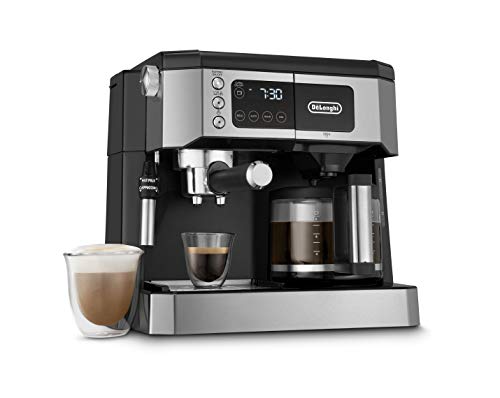
De’Longhi All-in-One Espresso & Coffee Maker — Best Espresso Combo
This De’Longhi redefines what the second brewer in a dual brew machine can be. Instead of a pod side, you get a genuine pump espresso machine — 15-bar pressure per the listing, with a milk frother — sharing a counter footprint with a 10-cup drip brewer. A dual heating system means the two sides are not taking turns with one boiler. For the household split between drip drinkers and cappuccino drinkers, this is not a compromise machine; it is the two machines, integrated.
| Drip side | 10-cup pot |
|---|---|
| Espresso side | 15-bar pump pressure per listing |
| Heating | Dual heating system |
| Extras | Milk frother |
Strengths
- True pump espresso with a milk frother — lattes and cappuccinos, not pod approximations
- Dual heating system lets both sides work as real, independent brewers
- De’Longhi’s espresso expertise is the deepest in this guide
Trade-offs
- Espresso is a skill: grinding, dosing and tamping take practice this guide cannot install
- No pod convenience — the single-cup side is espresso, with espresso’s effort
- The largest learning curve and counter commitment in the group
The honest question for this pick is whether your household’s second drink is actually espresso-based. If it is — if someone is buying cappuccinos out, or nursing a separate espresso habit — the All-in-One replaces real equipment and pays for itself in avoided café trips. The 15-bar pump and frother are the genuine article, and De’Longhi’s dual heating design means the drip drinker is not waiting for the espresso drinker’s boiler, a flaw that cripples lesser combination machines.
If your household’s second drink is a pod, buy literally any other pick in this guide. Espresso made reluctantly, with pre-ground coffee and no interest in technique, loses to a good pod every time on both taste and effort. This machine rewards households that want to make espresso, and it is included here because for those households it is not the fourth-best dual brewer — it is the only one that makes sense.
Best for: households split between drip drinkers and genuine espresso and cappuccino drinkers / Not suited for: pod drinkers, convenience seekers, or anyone unwilling to learn basic espresso technique
Check the current price on Amazon

Ninja Hot & Iced XL Coffee Maker (CM371) — Best Pod-Free Dual Brewer
The CM371 answers the dual brew question for households that want nothing to do with pods. Its single-serve side brews your own grounds across eight sizes, from a small cup to a travel mug, and its carafe side pours a full 12 cups. Four brew styles and a rapid cold brew function give it the most interesting drinks menu of any grounds-only machine here — including cold brew at a speed that makes the overnight jar method feel prehistoric.
| Carafe | 12-cup |
|---|---|
| Single-serve | Grounds-based, 8 sizes from small cup to travel mug |
| Brew styles | 4 brew styles |
| Extras | Rapid cold brew, removable reservoir |
Strengths
- Completely pod-free — no pod cost, no pod waste, your coffee your way
- Rapid cold brew is a genuinely distinctive function done properly
- Removable reservoir is easier to fill and clean than fixed tanks
Trade-offs
- Grounds single-serve means measuring and cleaning a basket — slower than dropping a pod
- No pod option at all, which locks out households with even one pod drinker
- Brew style menus reward a read of the manual to use well
The economics of pod-free deserve one clear paragraph. Pods cost several times more per cup than grounds, every cup, forever, and they generate a steady stream of packaging waste that many households increasingly dislike. A grounds-based dual brewer removes that entire line item while keeping the one-cup convenience — at the price of a minute of measuring and a basket to rinse. For households that drink several single cups a day, that trade pays for the machine and then keeps paying.
The cold brew function is the feature owners end up talking about. Cold brew’s smoothness normally costs an overnight steep; Ninja’s rapid approach compresses that into a same-morning process with the low-acid, smooth character cold brew drinkers want. Combined with the hot styles and the carafe, the CM371 covers the widest honest drinks range of any pod-free machine we could verify — which is why it, and not a second pod machine, takes this slot.
Best for: pod-free households, cold brew drinkers, and anyone tired of per-pod costs / Not suited for: households with any committed pod drinker, or zero-effort mornings
Check the current price on Amazon
Keurig K-Duo Single Serve & Carafe Coffee Maker — Best Pod Ecosystem — Unlinked pick
Honesty first: this pick carries no Amazon link, because the verification step this program requires — confirming the exact model and ASIN — could not be completed for it during this guide’s research window, and we do not publish links we have not verified. The K-Duo is included in prose because a dual brew guide that ignores Keurig would be dodging the category’s center of gravity: Keurig’s machine pairs its single-serve pod brewer with a carafe side, and for households fully invested in the K-Cup ecosystem it is the default candidate.
Strengths
- The deepest pod ecosystem in the category — every flavor and brand of K-Cup style pod fits the routine
- Operation is the simplest in pod coffee: insert, close, brew
- Carafe side covers the household pot without a second machine
Trade-offs
- No verified link in this guide — you will need to search Amazon for the current listing and confirm the exact generation yourself
- Pod-only single-serve: no grounds basket flexibility of the Ninja or Hamilton Beach picks
- Per-cup pod cost is the highest running cost model in this guide
Why include an unverified pick at all? Because readers deserve the complete map, clearly labeled, over a silently incomplete one. The K-Duo’s role in the category is real: it is the machine most pod households picture, its carafe-plus-pod formula is the template rivals copied, and its ownership experience — dead simple, pod-dependent, consistent — is well established. What this guide cannot do today is point you at a specific verified listing, and in a category where Keurig sells multiple generations under similar names, that specificity is exactly what verification protects.
If the K-Duo is your candidate, do the verification this guide could not: search Amazon for the model by its full name, confirm the generation and carafe size on the listing, and check that the seller is Keurig or Amazon rather than an unfamiliar third party. Then compare it honestly against the FlexBrew Trio above, which offers the same basic formula with grounds flexibility, verified and linked. Many households will still choose the Keurig for its ecosystem. They should just choose it with their eyes open.
Best for: households fully committed to the K-Cup ecosystem who are willing to verify the current listing themselves / Not suited for: anyone who wants a verified one-click recommendation from this guide, or grounds flexibility
Unlinked pick: no Amazon link is published for this model because Amazon listing data verification could not be completed during the research window. Search Amazon by the full model name and confirm the generation on the listing before buying.
Comparison Table
The six picks side by side, with key specifications from each verified listing. The unlinked pick’s row is marked, because its details could not be listing-confirmed.
| Pick | Badge | Key Spec | Best For |
|---|---|---|---|
| Ninja DualBrew Pro Specialty Coffee System (CFP301) | Best Overall | Pods + grounds, 4 styles, 13 sizes, frother | mixed households — pod drinkers and grounds drinkers under one roof — and iced coffee fans |
| Cuisinart Coffee Center 10-Cup (SS-21NAS) | Best Thermal Carafe | 10-cup thermal carafe, over-ice single serve | pot drinkers who sip across the morning and want the last cup to taste like the first |
| Hamilton Beach FlexBrew Trio 2-Way Coffee Maker | Best Budget Flexibility | 12-cup carafe, pods or grounds single serve | budget shoppers who want pod-or-grounds flexibility and a full 12-cup pot |
| De’Longhi All-in-One Espresso & Coffee Maker | Best Espresso Combo | 10-cup drip + 15-bar espresso, dual heating | households split between drip drinkers and genuine espresso and cappuccino drinkers |
| Ninja Hot & Iced XL Coffee Maker (CM371) | Best Pod-Free Dual Brewer | 12-cup carafe, pod-free, rapid cold brew | pod-free households, cold brew drinkers, and anyone tired of per-pod costs |
| Keurig K-Duo Single Serve & Carafe Coffee Maker | Best Pod Ecosystem — Unlinked pick | Pod single-serve + carafe (unverified listing) | households fully committed to the K-Cup ecosystem who are willing to verify the current listing themselves |
Read the key spec column as a format map: pods, grounds, both, or espresso. Households should eliminate by format first and compare features second — it shortens the decision enormously.
How to Choose the Best Coffee Dual Brew Maker for Your Household
Start with the single-serve format, because it is the one choice you cannot change later. Pods offer the fastest, most consistent single cup and the highest per-cup cost, with a waste stream some households mind and some do not. Grounds offer the cheapest cup and the best coffee, at the cost of measuring and rinsing. Hybrids — the Ninja DualBrew Pro and FlexBrew Trio here — refuse the choice and suit divided households. Espresso, in the De’Longhi, is not a format so much as a different hobby, and should only be chosen by households that actually want it.
Second, decide the carafe question: glass on a warming plate, or thermal. Glass is cheaper and lets you see the level; the plate slowly stews the coffee. Thermal costs more, hides the level, and keeps the second hour tasting like the first. Households that brew and drink within the hour should save the money. Households that brew at seven and sip until ten should not.
Third, count your sizes honestly. Dual brewers advertise size ranges — the Ninja here offers thirteen — but what matters is whether the machine covers your three real drinks: the weekday single cup, the weekend pot, and the travel mug if you use one. A removable reservoir, like the CM371’s, is worth more in a real kitchen than three extra size settings, because it is the part you handle every single day.
Finally, consider the counter. A dual brewer is one machine doing two jobs, but it is not a small machine: most are taller and deeper than a standard drip brewer, and the pod or grounds side needs clearance to open. Measure the space under your cabinets before the machine arrives, not after.
Dual Brew Maker or Two Separate Machines? The Honest Trade
The dual brewer wins on counter space, on purchase simplicity and on sharing one reservoir and one footprint between two habits. It loses on independence: when one side of a dual brewer fails, both drinks are gone, and neither side of most dual brewers quite matches the best dedicated machine at its job. A dedicated pod brewer is faster; a dedicated drip brewer often makes a better pot; a dedicated espresso machine is a serious instrument next to any combo side.
The households that should buy dual brew are the genuinely divided ones — two drinkers, two habits, one kitchen — and smaller kitchens where two machines physically do not fit. The households that should buy separates are single-habit households (buy the one great machine for the drink you actually make), high-volume households (a dual brewer’s sides queue behind each other at a party), and enthusiasts, for whom the second-best version of their drink is not a saving but a daily small disappointment.
There is also a reliability argument for separates that deserves air: two simple machines have two simple failure modes, and one surviving machine still makes coffee while the other is replaced. A dual brewer concentrates that risk. None of the picks here is unreliable — they are established designs from major makers — but the structure of the risk is real, and planners should know it exists.
Do Dual Brew Makers Actually Make Good Coffee? The Quality Question
Skeptics assume a dual brewer must brew worse than two dedicated machines, and the honest answer is: it depends which half you judge. The carafe sides of the better picks here — the Ninja and Cuisinart especially — brew at proper drip temperatures with even saturation, and in blind home use they are indistinguishable from good mid-range drip machines. The single-serve sides vary more: pod brewing is consistent by design, grounds brewing depends on your dose and grind discipline, and espresso, per the De’Longhi review, depends on the human.
Where dual brewers genuinely give ground is at the enthusiast margin. A specialty drip brewer with precise temperature profiling will out-cup a dual brewer’s carafe side on light-roast, freshly ground coffee — by a margin a trained palate can find and a breakfast table cannot. That is the correct frame for the whole category: dual brewers trade the last few percent of peak quality for a second brewing method in the same footprint. Households that notice the trade are the enthusiast households the previous section already steered toward separates. Everyone else is trading nothing they can taste.
One quality factor is entirely in your hands regardless of machine: freshness. Dual brewers cannot rescue stale coffee, and their convenience tempts households into pre-ground tins and ancient pod boxes. Fresh beans, ground reasonably recently, in whichever format your machine drinks, will do more for the cup than any upgrade within this category.
What Does a Dual Brew Maker Cost to Run?
The machine is the small cost; the coffee is the large one, and the format decides it. Pods are the most expensive way to drink coffee at home by a wide margin per cup, and a household brewing several pods daily spends the machine’s purchase price again on pods in a matter of months. Grounds in a basket or filter cost a fraction as much, which is why the hybrid and pod-free picks in this guide are the economical long-term choices even when their shelf prices are not the lowest.
Descaling is the running cost nobody budgets and everybody pays eventually. Dual brewers have two brew paths sharing water, and mineral scale degrades both temperature and flow. Use the machine’s descale cycle or a descaling solution on the maker’s schedule for your water hardness — the manual for each pick states it — and the machine will make its tenth year tasting like its first. Skip it, and no tier of machine saves you.
How to Use a Dual Brew Maker Well: One Machine, Two Habits
A dual brewer rewards a few shared habits that keep both sides tasting clean and brewing fast. These apply to every pick in this guide.
- Fill the reservoir with fresh water daily. Coffee is mostly water, and yesterday’s water makes today’s coffee taste like the reservoir. Dump and refill each morning; if your machine has a removable reservoir, like the Ninja CM371, that thirty-second habit is even easier and the tank itself gets rinsed in the process.
- Match the side to the moment. Use the carafe side when two or more cups will be drunk within the hour, and the single-serve side for lone cups. Brewing a pot for one cup wastes coffee and staleness-proofs nothing; brewing three single cups for three people wastes everyone’s morning. The machine exists to make this choice free — use it.
- Keep the two paths clean separately. Pod chambers collect pod residue; grounds baskets collect oils; carafe paths collect scale. Wipe the single-serve chamber weekly, wash the basket and carafe with soap regularly rather than only rinsing, and descale on schedule. Cross-contamination between a pod brewed at noon and grounds brewed at six is the main cause of “this machine tastes off” complaints.
- Pre-warm a thermal carafe; rest a glass one off the plate. A rinse of hot water before brewing brings a thermal carafe to temperature so it holds heat at its best. A glass carafe should come off the warming plate once serving is done — or the coffee should move to a thermal server — because the plate keeps cooking what it keeps warm.
- Dial in one drink at a time. When the coffee disappoints, change one variable — dose, grind, size setting or brew style — and taste again. Dual brewers offer more variables than simple machines, which is their pleasure and their trap. The household that changes one thing at a time finds its settings in a week and keeps them for years.
Treat the machine as two brewers sharing a counter and it will behave like two good brewers. Treat it as a black box and it will taste like one.
Common Buying Mistakes
Buying pods for a grounds household — or the reverse
The format decision is the purchase. Households talk themselves into the wrong format with phrases like “we can adapt,” and then a pod machine gathers dust while the old grounds routine continues beside it. Buy the format your household already drinks, or a hybrid that covers both, and let every other feature fight for second place.
Letting a glass carafe sit on the warming plate for hours
The plate that keeps coffee hot also keeps cooking it. The result — harsh, stewed, stale — is the most common complaint about dual brewers and has nothing to do with the machine’s brewing. Drink within the hour, switch to a thermal model, or move the pot to a thermal server.
Never descaling because the coffee still comes out
Scale builds silently, dropping brew temperature and slowing flow long before anything fails outright. By the time the machine complains, the coffee has been under-extracted for months. Descale on the maker’s schedule for your water; it is the cheapest quality upgrade in all of coffee.
Judging by size settings and style counts
Thirteen sizes and four styles are worth having — the Ninja pick earns its badge partly on them — but they are seasoning, not the meal. The meal is format, carafe type and build. Buyers who rank machines by menu length end up with impressive interfaces making the wrong kind of coffee.
Skipping the counter measurement
Dual brewers are tall, and pod and basket compartments open upward. A machine that fits the counter but not the cabinet clearance above it becomes a machine you drag out and push back twice a day, which is a machine you stop using. Measure height with the compartment open, not closed.
Final Recommendation
For most divided households, the Ninja DualBrew Pro is the dual brewer to buy: pods or grounds, thirteen sizes, four styles and a frother make it the one machine that ends every argument at once. Pot-first households should take the Cuisinart Coffee Center and its thermal carafe; budget households the FlexBrew Trio, which delivers the essential formula with grounds flexibility intact; and pod-free households the Ninja CM371, whose cold brew and carafe make pods easy to forget.
Espresso households are the exception that proves the category: for them the De’Longhi All-in-One is not a compromise but the correct two machines in one footprint. And the Keurig K-Duo remains the pod benchmark — included here in prose, without a link, because this guide verifies what it recommends and could not complete that step for it in time. Choose your format first, and the rest of the decision makes itself.
To re-check the shortlist before you buy: Ninja DualBrew Pro Specialty Coffee System (CFP301), Cuisinart Coffee Center 10-Cup (SS-21NAS), Hamilton Beach FlexBrew Trio 2-Way Coffee Maker. Each link goes to the verified Amazon listing, where you can check the current price on Amazon.
For a related shortlist, see Best Coffee Makers Dual Brew. For a related shortlist, see Best Coffee Espresso Combo Machines. For a related shortlist, see Best Coffee And Tea Makers. For a related shortlist, see Best Carafeless Coffee Makers. For a related shortlist, see Best Coffee Brew Makers. For a related shortlist, see Best Cheapest Coffee Makers.
Frequently Asked Questions
What is a dual brew coffee maker?
It is a single machine that brews two ways: a full carafe of drip coffee, and single cups on demand. The single-serve side may use pods, your own grounds, both, or — in the De’Longhi pick here — a pump espresso system instead. Dual brewers suit households whose members drink coffee differently, and kitchens that cannot fit two machines.
Are pods or grounds better in a dual brewer?
Pods win on speed and consistency and lose on per-cup cost and waste. Grounds win on cost, freshness and coffee quality and lose a minute of effort per cup. Neither is objectively better; the right answer is the format your household will actually use daily. Hybrid machines like the Ninja DualBrew Pro and FlexBrew Trio exist precisely for households that cannot agree.
Why does coffee from a warming plate taste stale?
Because the plate keeps the brewed coffee at cooking-adjacent temperatures, continuing to extract bitter compounds and drive off aromatics. Coffee held on a plate degrades noticeably within an hour or two. A thermal carafe holds temperature with insulation instead of added heat, which is why the Cuisinart pick in this guide keeps the last cup tasting close to the first.
Can a dual brew maker make good iced coffee?
Yes, if it has a dedicated over-ice or cold brew function, as several picks here do. Those modes brew stronger or cooler so the coffee survives dilution by ice. Pouring ordinary hot coffee over ice produces a watered-down drink regardless of the machine. The Ninja CM371 goes furthest, with a rapid cold brew function that skips the overnight steep entirely.
How often should I descale a dual brew maker?
Follow the maker’s schedule for your water hardness — typically every one to three months, sooner with hard water. Dual brewers share water paths between two brewing systems, so scale degrades both at once. Most machines in this class have a descale indicator or cycle; when it speaks, listen. Regular descaling is the difference between a machine that tastes right in year five and one that does not.
Is a dual brew maker worth it for a single-person household?
Usually not, unless that one person genuinely drinks both ways — a pot on weekends, single cups on weekdays, for example. A single-habit drinker is better served by one excellent dedicated machine: a great pod brewer, a great drip brewer or a great espresso setup will each beat the corresponding side of a combo at the same money. Dual brew earns its footprint when the household, or the week, is truly divided.


