Disclosure: airfryerkitchensupply.com is reader-supported. When you buy through links on our site, we may earn an affiliate commission at no extra cost to you.
Where to buy
Every grill in this guide to the best coal barbecue grills was verified against Amazon listings before it earned a place here, so the links below lead to the exact models reviewed. Prices move with seasons and promotions, so we never print a fixed price in the article — check price on Amazon on the product page for the current figure. The shortlist:
- Best Overall Coal Barbecue Grill: Weber Original Kettle Charcoal Grill, 22-Inch — check price on Amazon
- Best for Big Family Barbecues: Dyna-Glo XL Charcoal Grill, 576 Sq. In. (DGN576DNC-D) — check price on Amazon
- Best Premium Kettle for Barbecue: Weber Master-Touch Charcoal Grill, 22-Inch (Smoke) — check price on Amazon
- Best Coal Grill and Smoker Combo: Char-Griller Smokin’ Pro Charcoal Grill and Offset Smoker — check price on Amazon
- Best Compact Coal Barbecue Grill: Char-Griller AKORN Jr. Portable Kamado Charcoal Grill and Smoker — check price on Amazon
- Best Budget Barrel for Barbecues: Royal Gourmet CC1830 Barrel Charcoal Grill, 28-Inch — check price on Amazon
Coal barbecue — charcoal barbecue, in the wording most of the world uses — is the original live-fire cooking: food over glowing coals, under a lid, with smoke doing quiet work in the background. The best coal barbecue grills are not necessarily the most elaborate machines. They are the ones that manage a coal fire honestly: air in where you want it, heat held where you need it, ash dealt with without drama, and enough grate to feed the people actually standing in your garden. This guide verifies six, from the classic kettle to the big family barrel, and matches each to the barbecue it serves best.
The category divides by shape, and shape decides behaviour. Kettles concentrate heat and excel at two-zone cooking. Barrels spread a wide, shallow fire that suits direct grilling in volume. Kamados insulate the fire for efficiency and range. Grill-and-smoker combos add a firebox for the cook who wants both crafts. None of these is ‘the best shape’ in the abstract — the best coal barbecue grill is the one whose behaviour matches your menu, your crowd and your patience, and the reviews below are organised around exactly those matches.
A note on fuel language, since this search uses ‘coal’: barbecue coal means charcoal — lump or briquettes made from wood — not mineral coal, which has no place near food. Everything in this guide burns charcoal, and the buying advice assumes it: buy clean, natural fuel without chemical starters, light it in a chimney, and let it ash over before food goes near it. That discipline, plus the right grill, is the whole foundation of good barbecue.
In this guide
Quick Picks
If you are short on time, these are the best coal barbecue grills worth your money, at a glance. Each pick carries a badge for the job it does best, and the same badge appears again in its full review further down so you can jump straight to the detail.
Weber Original Kettle Charcoal Grill, 22-Inch — Best Overall Coal Barbecue Grill
The classic 22-inch kettle in its simplest form — the barbecue benchmark at a sensible tier. Check price on Amazon.
Dyna-Glo XL Charcoal Grill, 576 Sq. In. (DGN576DNC-D) — Best for Big Family Barbecues
576 sq. in. of straightforward coal grilling space for crowds and mixed menus. Check price on Amazon.
Weber Master-Touch Charcoal Grill, 22-Inch (Smoke) — Best Premium Kettle for Barbecue
Master-Touch refinements — lid holder, ash control, thermometer — for weekly barbecue households. Check price on Amazon.
Char-Griller Smokin’ Pro Charcoal Grill and Offset Smoker — Best Coal Grill and Smoker Combo
Barrel grill with side firebox — barbecue now, offset smoking when curiosity strikes. Check price on Amazon.
Char-Griller AKORN Jr. Portable Kamado Charcoal Grill and Smoker — Best Compact Coal Barbecue Grill
Portable insulated kamado — small footprint, real searing, efficient coal use. Check price on Amazon.
Royal Gourmet CC1830 Barrel Charcoal Grill, 28-Inch — Best Budget Barrel for Barbecues
585 sq. in. barrel with warming rack and side table — family barbecue space at a budget tier. Check price on Amazon.
How These Picks Were Chosen
Verification was by the standard method for this programme: each grill was searched by brand and model, and only exact matches between the API’s returned title and the intended product earned a listing link. Coal barbecue is a category full of near-identical barrels and seasonal variants, so that discipline matters — the model named in each review is the model the listing-confirmed.
Selection weighed barbecue fundamentals in order. Fire management first: damper quality, how predictably the grill responds to vent changes, and whether it can hold both a fierce direct fire and a calm indirect one. Capacity second, judged in real barbecue loads — burgers, chicken pieces, a whole bird — rather than headline square inches alone. Third, the ownership basics: ash handling, lid management, grate material and the availability of covers and spares. Value ran through every judgement, because coal barbecue is a hobby where a modest grill in weekly use beats a grand one in storage. The six survivors each own a clear role, from benchmark kettle to budget barrel.
The 6 Best Coal Barbecue Grills
Badges name each grill’s barbecue job. As you read, notice how often the deciding factor is not the fire itself but the workflow around it — tables, lids, ash and room to stage food. Barbecue is a social cook, and the best grills respect that.

Weber Original Kettle Charcoal Grill, 22-Inch — Best Overall Coal Barbecue Grill
Coal barbecue begins here for most people, and for good reason: the basic 22-inch kettle barbecues everything from sausages to a whole chicken with nothing but coal placement and vent control. No thermometer, no enclosed ash catcher, no frills — just the bowl geometry that defined the category. For the buyer who wants the authentic coal barbecue experience at the most sensible tier, this is the starting point that never becomes a wrong answer.
The basic 22-inch Original Kettle strips the formula down to the essentials: a porcelain-enameled bowl and lid, a plated cooking grate, dampers top and bottom, and the One-Touch sweep that pushes ash into the pan below. Nothing about that short list is a compromise for actual cooking. The bowl depth and vent placement are the same recipe that made kettles famous, so a banked fire still gives you a hot zone and an indirect zone, steaks still sear properly over a full chimney, and a whole chicken still roasts beautifully with the lid on and the vents half open.
Where you feel the savings is in convenience rather than results. There is no lid thermometer, ash sits in an open pan instead of an enclosed catcher, and you supply your own side table. For many buyers that trade is completely fair, especially as a first charcoal grill or a second grill dedicated to high-heat work. It also keeps the long-term ownership story simple: replacement grates, covers and parts for this shape are everywhere, and the skills you learn on it transfer directly to any larger or fancier charcoal cooker you buy later.
Strengths
- The simplest honest version of the classic kettle, with nothing gimmicky to break
- Same bowl geometry as pricier kettles, so two-zone cooking works identically
- Light, easy to move, and easy to store in a shed or garage corner
Trade-offs
- Open ash pan lets ash blow around on windy days compared with enclosed catchers
- No lid thermometer, so a separate probe thermometer is a sensible companion
- Fewer convenience touches than the Premium and Master-Touch versions
| Format | 22-inch kettle, charcoal fuel only |
| Ash handling | One-Touch cleaning system (per Amazon listing title) |
| Temperature control | damper-based (per Amazon listing title) |
Best for: First-time charcoal buyers and anyone who wants the classic kettle without extras / Not suited for: Cooks who want a lid thermometer and enclosed ash handling from day one.
Check on Amazon — check the current price on Amazon before you decide, as grill pricing shifts through the season.

Dyna-Glo XL Charcoal Grill, 576 Sq. In. (DGN576DNC-D) — Best for Big Family Barbecues
Some barbecues are events: twenty burgers, a tray of chicken, corn, peppers and a queue of relatives. The Dyna-Glo XL’s 576 square inches are built for that day — a wide coal bed, room to keep a cooler end for finished food, and a simple barrel format anyone can run. If your barbecue brief is volume first, this is the coal grill that answers it without kamado money.
Dyna-Glo’s XL charcoal grill is built around a simple promise: a lot of honest grilling space, 576 square inches per the listing, in a barrel-style body that any charcoal cook can understand in one session. A wide charcoal bed gives even direct heat for burgers, chops and chicken pieces, and banking the coals creates the indirect zone for finishing thicker cuts with the lid down.
It sits in the sensible middle of the market — bigger and more capable than entry kettles, simpler and friendlier in price than kamados or offsets. Fire management is manual in the traditional way: vents, charcoal quantity and placement are your controls, and the grill responds predictably. For backyard barbecues where the brief is volume and value, the XL formula has endured for a reason.
Strengths
- 576 sq. in. of grilling space for family and party loads
- Straightforward barrel-style charcoal grilling without frills
- Good stepping stone between kettles and larger cookers
Trade-offs
- Fewer refinements than premium brands in this size
- Hands-on damper and charcoal management as standard
- No dedicated smoker chamber — smoking is indirect technique
| Cooking area | 576 sq. in. (per Amazon listing title) |
| Format | XL charcoal grill (per Amazon listing title) |
| Fuel | charcoal |
Best for: Families wanting a big, simple coal barbecue grill / Not suited for: Dedicated low-and-slow specialists.
Check on Amazon — check the current price on Amazon before you decide, as grill pricing shifts through the season.

Weber Master-Touch Charcoal Grill, 22-Inch (Smoke) — Best Premium Kettle for Barbecue
Weekly barbecue cooks feel small frictions hundreds of times a season: the hot lid with nowhere to go, ash blowing across the patio, guessing the dome temperature. The Master-Touch removes exactly those frictions while keeping the coal cooking pure. For households whose barbecue is a standing weekly appointment rather than an occasional event, the premium is paid back in calm.
The Master-Touch takes the 22-inch kettle and fixes the small annoyances that owners of basic kettles learn to live with. The headline is the Tuck-Away lid holder: instead of hunting for a hook or resting a hot lid on the patio, you slide it back into a cradle where it also acts as a windbreak. Add the refined ash handling, lid thermometer and sturdier feel throughout, and you have the kettle version aimed at people who grill every week rather than twice a summer.
Cooking performance is pure kettle, which is praise. Bank coals for two zones, run the vents for temperature, and the Master-Touch will sear steaks, roast chickens and hold a gentle indirect fire for ribs. The hinged grate style access (where fitted by variant) makes topping up charcoal mid-cook far less disruptive, which matters on longer sessions. It is the kettle we point keen beginners toward when they know charcoal is their fuel: it removes friction without removing the hands-on fire craft that makes charcoal cooking satisfying in the first place.
Strengths
- Tuck-Away lid holder parks the hot lid safely instead of on the ground
- Upgraded appointments make long cooks and frequent use more comfortable
- Retains the full two-zone flexibility of the 22-inch kettle platform
Trade-offs
- Costs more than simpler kettles while cooking area stays the same 22 inches
- Heavier lid hardware makes it slightly less grab-and-go than the basic kettle
- Still no standard work table for trays, boards and tools
| Format | 22-inch kettle, charcoal fuel only |
| Lid handling | Tuck-Away lid holder (per Amazon listing title) |
| Ash handling | One-Touch cleaning system (per Amazon listing title) |
Best for: Frequent grillers who want the kettle experience with the annoyances removed / Not suited for: Occasional grillers who will not use the upgrades enough to justify stepping up.
Check on Amazon — check the current price on Amazon before you decide, as grill pricing shifts through the season.

Char-Griller Smokin’ Pro Charcoal Grill and Offset Smoker — Best Coal Grill and Smoker Combo
The Smokin’ Pro is for the barbecue cook who suspects smoking is in their future. The main chamber handles direct coal barbecuing for the family, and the side firebox converts the same unit into an offset smoker for ribs and chicken at the weekend. It is an entry-tier build and behaves like one — fires need attention — but as a two-education-in-one purchase it has introduced generations to both crafts.
The Smokin’ Pro is one of the classic starter combinations: a barrel charcoal grill for direct cooking with a side firebox that converts it into an offset smoker. Dual damper control and a warming rack round out a package aimed squarely at the buyer who wants to grill on Fridays and learn smoking on Sundays without buying two machines.
Temper your expectations to the tier and it delivers. The steel is not heavy-gauge, fires need attention, and keen owners typically add gasket tape and learn the firebox’s appetite over a few cooks. In exchange you get the full offset education — clean fires, draw management, patience — plus a perfectly serviceable family grill. Generations of pitmasters started on exactly this style of cooker, which says more than any specification can.
Strengths
- Main chamber grills directly; side firebox enables offset smoking
- Dual dampers give reasonable control for the tier
- Warming rack adds holding space during big cooks
Trade-offs
- Entry-tier steel needs seasoning and rust care
- Offset mode benefits from owner sealing tweaks
- Assembly takes an afternoon, not minutes
| Format | charcoal grill with side fire box offset smoker (per Amazon listing title) |
| Controls | dual damper control (per Amazon listing title) |
| Extras in listing title | chrome plated steel warming rack |
Best for: Starters wanting one unit to grill now and learn offset smoking / Not suited for: Anyone expecting heavy-gauge, hands-off performance.
Check on Amazon — check the current price on Amazon before you decide, as grill pricing shifts through the season.

Char-Griller AKORN Jr. Portable Kamado Charcoal Grill and Smoker — Best Compact Coal Barbecue Grill
Compact coal barbecuing usually means compromise, but the AKORN Jr. cheats: insulated walls make a small coal load behave like a bigger one, and the cast iron grate sears with an authority no other grill this size matches. For balconies, small patios and couples who barbecue properly but in small quantities, it delivers the full coal experience in a fraction of the space.
The AKORN Jr. compresses the insulated-kamado idea into a portable cooker for small households, balconies and trips. The triple-wall steel body does the same job as on its bigger sibling — trapping heat so a small bed of lump charcoal can grill, roast or hold a gentle smoking temperature — while the cast iron grate delivers sears that most small grills cannot match. For two people, a chicken halved or spatchcocked, a pair of thick steaks, or a batch of wings all cook with real kamado character.
Portability is honest rather than theoretical: it is the grill you can actually take to a campsite or move around a small patio without planning the lift. The trade is capacity, full stop. Entertaining means batches, and big briskets belong elsewhere. As a compact coal grill that roasts as well as it grills, though, the Jr. occupies a niche that basic small kettles do not: enclosed, efficient, and far more versatile than its footprint suggests.
Strengths
- Kamado-style efficiency in a size that suits small patios and trips
- Insulated walls keep small charcoal loads burning steadily
- Cast iron grate gives small cooks a proper sear
Trade-offs
- Cooking area suits two to four portions at a time
- Too small for large roasts or party batches
- Kamado technique still applies — vent discipline matters even at this size
| Format | portable kamado, charcoal fuel |
| Construction | triple-wall insulated steel (per Amazon listing title) |
| Grates | cast iron (per Amazon listing title) |
Best for: Small households and travellers wanting kamado cooking in a compact body / Not suited for: Cooking for crowds or very large cuts.
Check on Amazon — check the current price on Amazon before you decide, as grill pricing shifts through the season.
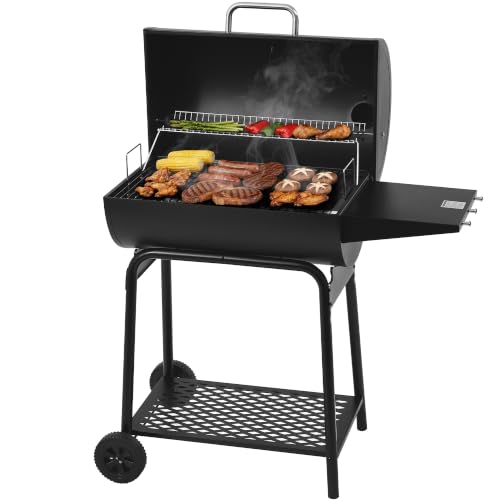
Royal Gourmet CC1830 Barrel Charcoal Grill, 28-Inch — Best Budget Barrel for Barbecues
The CC1830 barrel is the budget barbecue workhorse: 585 square inches, a warming rack for the finished batch, a side table for the next one, and a thermometer in the lid to keep you oriented. It grills directly with confidence and handles indirect roasts with banked coals and patience. Families who barbecue for the neighbourhood on a sane budget start their search here.
The CC1830 in plain barrel form is a honest, roomy charcoal grill for households that want direct grilling space without kettle prices or kamado complexity. The listed 585 square inches plus a warming rack handle family loads of burgers, chicken pieces and vegetables, the side table keeps tools and trays off the ground, and the built-in thermometer gives a useful guide to what the fire is doing.
Barrel grills cook with a wide, shallow fire, which makes them natural direct-heat machines and decent indirect cookers when coals are banked to one end. This one follows that script faithfully. It will not smoke with an offset’s purity or hold heat like a kamado, and the steel wants a cover and the occasional wipe of oil on hinges and handles. Judged as a budget coal barbecue for weekly family use, it delivers space and simplicity in the right proportions.
Strengths
- Straightforward barrel grilling with useful warming rack
- Side table adds the workspace small grills often lack
- Friendly size and tier for first-time charcoal buyers
Trade-offs
- No offset firebox on this version for true smoking
- Barrel steel needs the usual care against rust
- Temperature control is damper-based and hands-on
| Cooking area | 585 sq. in. (per Amazon listing title) |
| Format | 28-inch barrel charcoal grill with side table (per Amazon listing title) |
| Features in listing title | warming rack, built-in thermometer |
Best for: Families wanting a roomy, simple barrel grill for weekly barbecues / Not suited for: Dedicated smoking projects.
Check on Amazon — check the current price on Amazon before you decide, as grill pricing shifts through the season.
Comparison Table
| Pick | Badge | Key spec | Best for |
|---|---|---|---|
| Weber Original Kettle Charcoal Grill, 22-Inch | Best Overall Coal Barbecue Grill | Format: 22-inch kettle, charcoal fuel only | First-time charcoal buyers and anyone who wants the classic kettle without extras |
| Dyna-Glo XL Charcoal Grill, 576 Sq. In. (DGN576DNC-D) | Best for Big Family Barbecues | Cooking area: 576 sq. in. (per Amazon listing title) | Families wanting a big, simple coal barbecue grill |
| Weber Master-Touch Charcoal Grill, 22-Inch (Smoke) | Best Premium Kettle for Barbecue | Format: 22-inch kettle, charcoal fuel only | Frequent grillers who want the kettle experience with the annoyances removed |
| Char-Griller Smokin’ Pro Charcoal Grill and Offset Smoker | Best Coal Grill and Smoker Combo | Format: charcoal grill with side fire box offset smoker (per Amazon listing title) | Starters wanting one unit to grill now and learn offset smoking |
| Char-Griller AKORN Jr. Portable Kamado Charcoal Grill and Smoker | Best Compact Coal Barbecue Grill | Format: portable kamado, charcoal fuel | Small households and travellers wanting kamado cooking in a compact body |
| Royal Gourmet CC1830 Barrel Charcoal Grill, 28-Inch | Best Budget Barrel for Barbecues | Cooking area: 585 sq. in. (per Amazon listing title) | Families wanting a roomy, simple barrel grill for weekly barbecues |
Match the row to your barbecue’s typical headcount and menu. Kettles own versatility, the big barrels own volume, the little kamado owns the small patio, and the combo owns the path into smoking. If two rows both fit, choose the one whose trade-offs you mind least — you will live with the trade-offs weekly and the strengths will take care of themselves.
How to Choose a Coal Barbecue Grill
Count your barbecue honestly. Two to four people, weekly: a 22-inch kettle or a compact kamado covers it with room to spare. Six to ten, regularly: look at the big barrels and the 576-square-inch class, where a full mixed menu fits in one or two batches. Beyond that, you are in multi-grill or event territory, and a second modest grill often serves better than one giant one, because it gives you a second fire at a second temperature.
Then judge the fire controls, because coal barbecue is air management. Dampers should move positively and stay where you set them. Lids should seal well enough that closing the vents actually calms the fire — test this reputation in reviews and owner reports, since it decides whether indirect cooking and safe shutdown are realistic. Grates matter next: cast iron for searing authority, porcelain-coated steel for easy care, plain steel for budget. And plan the ash: a grill whose ash is easy to remove cold, into a metal bin, is a grill that will be cleaned often enough to perform well.
Finally, buy the accessories that make coal barbecue pleasant from day one: a chimney starter, a probe thermometer, a cover, and a metal ash container. Together they cost a fraction of any grill here and they remove the four most common frustrations — slow lighting, guessed doneness, weather damage and dangerous ash — in a single stroke.
Direct, Indirect and Everything Between: How Coal Barbecues Actually Cook
Direct barbecuing is food over the coals: burgers, sausages, steaks, skewers, vegetables. It is fast, fierce and needs your attention. Indirect barbecuing is food beside the coals with the lid down: whole chickens, roasts, ribs, anything thick or fatty that needs time. The lid turns the grill into an oven, the coals become the heating element rather than the contact surface, and smoke has time to do its work. Almost every memorable barbecue plate uses both — a sear in the direct zone, a finish in the indirect zone.
Your grill choice should reflect your ratio. Direct-heavy menus flatter wide barrels with big coal beds. Indirect-heavy menus flatter kettles and kamados, whose lids and shapes circulate heat kindly. Mixed menus — most family barbecues — flatter the versatile middle: a 22-inch kettle with disciplined coal banking handles a whole afternoon’s variety on one fire. Whichever you choose, learn its zones in the first few cooks by deliberately placing food in different spots and noting the results. Every coal grill has a personality map; the cooks who learn theirs early barbecue better than the cooks who buy bigger.
Planning a Coal Barbecue Menu Around Your Grill
A good barbecue menu is a traffic plan for one fire. Start with the item that needs the grill longest and most gently — a whole chicken, a pork shoulder joint, thick ribs — and give it the indirect zone first, while the coals are at their most vigorous and you are freshest. As it rests, wrapped and held, the fire’s second act belongs to the medium items: chicken pieces, sausages, vegetable skewers. The final act, over the still-hot heart of the coals, is for the fast food: burgers, steaks, prawns, flatbreads, and the crisping of anything that needs it.
That sequence means one lighting serves the whole menu, the resting meat frees the grate exactly when the crowd is hungriest, and the cook is never fighting for space. It also shapes the shopping list: choose items whose cooking styles interlock rather than compete. Three foods that all need fierce direct heat at the same moment will defeat any grill in this guide; a menu that staggers its demands will make even the compact kettle feel spacious.
Build in a holding strategy and a cold course. Salads, breads and desserts that never touch the grill are not a failure of barbecue ambition — they are what let the fire do its work unhurried. The hosts who look relaxed at their own barbecues are running this kind of plan, whether or not they have ever written it down. Write yours down the first few times; after that, the rhythm becomes the way you cook.
Barbecuing for a Crowd on a Coal Grill
Twenty guests change the physics of barbecue less than they change its logistics. The fire is the easy part: a large barrel or a 22-inch kettle run in waves will cook for a crowd, because grilled food is naturally batched. The real work is staging — raw food arriving in order, cooked food resting and holding safely, and a serving rhythm that keeps the first plate as good as the last. Two zones become three in your mind: cooking, finishing and holding, with the grill’s coolest edge and a low oven indoors sharing the holding duty.
Choose a crowd menu with a backbone item that holds well — chicken pieces, sausages, pulled meats — and let the theatrical items, the steaks and skewers, play a supporting role in small batches. Sauces and salads scale effortlessly; grate space does not, so respect it. Enlist a second pair of hands for the serving window specifically, and consider the two-grill strategy this guide mentions elsewhere: a second modest coal grill, even a portable, doubles your zones and halves your stress for less than the cost of one giant cooker.
Above all, light the fire earlier than feels necessary. A crowd forgives a held sausage happily; it does not forgive an hour of watching unlit coals. The experienced barbecue host’s secret is not a bigger grill — it is a timeline with slack in it, and a menu designed to be delicious across that slack rather than perfect for one fragile minute.
Regional Barbecue Styles — and the Coal Grills That Cook Them
Barbecue traditions grew up around local fuel, local animals and local patience, and a coal grill cook can visit most of them without leaving the patio. The grilled traditions — the asado spirit of South America, the yakitori bars of Japan, the skewer cultures of the Mediterranean and Middle East — are direct-heat arts: small food, fierce coals, constant turning, eating as it comes off the fire. Wide barrels, kettles run lid-off over a spread bed, and hibachi-style small grills all serve this world, and the coal is the seasoning as much as the heat.
The smoked traditions ask for the indirect arts this guide keeps returning to. American low-and-slow — ribs, shoulders, brisket — is the offset and bullet smoker’s homeland, and the kettle with a snake of briquettes is its respected home dialect. British and European barbecue culture, built around the family garden, lives in the mixed menu: sausages and burgers direct, a chicken roasting indirectly at the edge, everything eaten outside if the weather allows even a rumour of summer. The kamado traditions, youngest of all, borrow from everywhere and answer with efficiency.
What unites the styles is more instructive than what divides them: a clean fire, food matched to the heat it needs, and a cook who tends rather than abandons. Choose the grill in this guide whose shape flatters the tradition you love most, and borrow freely from the others — the coal does not care about borders, and neither, in the end, does anyone holding a plate.
Coal Barbecue for Beginners: Your First Four Cooks, In Order
Cook one is sausages and burgers over a banked fire, and its only curriculum is the zones: food over the coals, food beside the coals, and the visible difference between them. Cook one also teaches the lid — down for finishing, up for turning — and the patience to let a chimney ash over fully before a single item is grilled. Nobody should leave cook one with anything more complicated in their head than that, and everybody should leave it with dinner.
Cook two is chicken pieces, thighs above all, because they teach rendering, flare management and the crisping finish in one forgiving package. Cook three is a whole spatchcocked chicken, the first indirect project: a drip pan, a calm fire, a rested bird, and the discovery that a coal grill is also an oven. Cook four is the first mixed menu run on the three-zone method from this guide’s how-to — a small crowd, a staggered plan, and the cook’s first experience of a barbecue that feels run rather than survived.
After those four cooks, a beginner owns the repertoire that covers ninety percent of all coal barbecuing ever done, on any grill in this guide, at any size. Everything after is refinement: smoke wood, longer cooks, bigger crowds, finer timing. The sequence matters more than the speed. Barbecue learned in this order feels easy, because each cook only asks for one new skill — and that, more than any feature on any grill, is how people become the kind of cooks whose barbecues get talked about.
Vegetables, Breads and the Rest of the Coal Barbecue Plate
A coal barbecue plate is judged whole, and the grill that only cooks meat is working at half its talent. Vegetables over coals are not a concession to the meatless; they are some of the finest food a fire makes. Corn in its husk steams and smokes at the grill’s edge. Peppers blister directly over the coals and sweeten in a way no oven copies. Thick onion slices, aubergine planks, courgette spears and halved little gem lettuces all take grill marks and smoke beautifully in the minutes while meat rests — which is exactly when the grate is empty and the fire is perfect.
Bread belongs on the coal grill too. Flatbreads puff and char in seconds over direct heat; sliced sourdough grills into the toast that carries everything else; a whole loaf warmed in the indirect zone, wrapped, arrives at the table like it was baked for the occasion. Even dessert has a place: halved peaches, pineapple spears and bananas in their skins all caramelise over a dying fire, using heat that would otherwise be wasted while the coals cool.
Planning these around the meat is the host’s quiet craft — vegetables staged by cooking time, bread last and fast, fruit on the embers at the end. The grills in this guide all have the zones for it: a hot heart, a gentle edge, and a lid to hold warmth. A barbecue that uses the whole fire, from first fierce heat to last ember, feeds people better and wastes nothing — and it is the surest sign that the cook, not just the grill, has been well chosen.
How to Set Up a Coal Barbecue for a Mixed Family Menu
Light a full chimney of charcoal and, when it is ashed over, pour two-thirds onto one side of the charcoal grate and one-third in a thinner layer across the rest. That gives you a hot zone, a medium zone and — at the far edge — a holding zone, all on one fire. Preheat with the lid on, brush and lightly oil the grate, and start the food that takes longest: chicken pieces and thick sausages first, in the medium zone, lid down, turning occasionally.
As the afternoon runs, move finished food to the holding edge where it stays warm without cooking further, and use the hot zone in short bursts for burgers, steaks and the final crisping of chicken skin. Vegetables thread through the gaps — corn in its husk at the edges, peppers and onions where the heat suits them. Keep the lid down between tasks; every open minute is heat lost and flare risk gained. When the last food comes off, close all vents to extinguish the fire, and deal with ash only when it is completely cold. That single-fire, three-zone method is the whole secret of relaxed family barbecuing, and every grill in this guide can run it.
Common Buying Mistakes
Spreading coals evenly for every cook. A uniform coal bed gives you one temperature and no refuge. Bank the coals and you gain zones — the difference between juggling and cooking.
Barbecuing with the lid up by default. Lid-up cooking is grilling at half power with flare-ups. Lid down, vents set, and the grill becomes the oven-smoker hybrid that makes barbecue flavour.
Using mineral coal or treated fuel. Barbecue fuel is charcoal — lump or natural briquettes. Anything else risks tainting food and voiding common sense. If the bag does not say charcoal, it does not go in the grill.
Letting ash build up across cooks. Ash chokes airflow, and a choked fire is an uncontrollable one. Empty cold ash regularly and the same grill suddenly holds temperature like a different machine.
Buying for the biggest day of the year. The grill that suits your monthly barbecue will serve the annual party with batches and patience. The grill bought for the party will waste fuel and space the other eleven months.
Final Recommendation
Start with the classic kettle if you want the benchmark coal barbecue at the most sensible tier — it is the grill this category is measured by. Step up to the Master-Touch if weekly use makes its refinements worthwhile, out to the Dyna-Glo XL or the Royal Gourmet barrel if your barbecues feed a crowd, and into the Smokin’ Pro if smoking is calling. Small patios should take the AKORN Jr. and enjoy full-strength coal cooking in miniature. Whichever you choose, learn its zones, keep its ash clean, and it will barbecue faithfully for seasons.
Weber Original Kettle Charcoal Grill, 22-Inch (Best Overall Coal Barbecue Grill) Dyna-Glo XL Charcoal Grill, 576 Sq. In. (DGN576DNC-D) (Best for Big Family Barbecues) Weber Master-Touch Charcoal Grill, 22-Inch (Smoke) (Best Premium Kettle for Barbecue) are the three we would start with. Check price on Amazon for each, then commit to the one that matches your space and the way you actually cook.
Related reading on this site: Best Charcoal Grills Using Real Charcoal; Best Charcoal Barbecue Grills; Best Coal Grills; Best Coal Fired Grills; Best Charcoal Grills; Best Cheapest Grills.
Frequently Asked Questions
Is ‘coal’ in coal barbecue grills the same as charcoal?
Yes — in barbecue usage, coal means charcoal: lump charcoal or briquettes made from wood. It does not mean mineral coal, which should never be used for cooking food. Every grill in this guide is a charcoal grill, and all the fuel advice here assumes natural charcoal lit in a chimney starter.
What size coal barbecue grill does a family need?
A 22-inch kettle handles a family of four to six comfortably with two-zone cooking. Larger households or regular entertainers should look at the 576 sq. in. barrel class and above. Compact kamados and 18-inch kettles suit couples and small patios. Buy for your typical barbecue, not your largest one.
Can a coal barbecue grill also smoke food?
Yes, with indirect technique: banked coals, a drip or water pan, lid down and patience. Kettles and kamados do this particularly well. Dedicated smoking in quantity is better served by a combo with an offset firebox or a dedicated smoker, both of which appear in this guide’s wider cluster of reviews.
How do I keep a coal fire at a steady temperature?
Control the air. Set the vents, make small changes, and wait several minutes before changing again. Keep the lid down, position the grill out of strong wind, and maintain the fire with small additions of lit charcoal rather than large dumps of cold fuel.
Briquettes or lump charcoal for barbecuing?
Briquettes give even, predictable, longer burns — the forgiving choice for long indirect cooks and beginners. Lump burns hotter and cleaner with less ash, suiting searing and kamados. Many barbecue cooks keep both and choose per menu, which is the practical answer.
How do I dispose of coal ash safely?
Let it cool completely — longer than you think, since ash insulates live embers — then transfer it to a metal container with a lid, kept away from combustibles. Never put ash in plastic bins or cardboard, and never the same evening as the cook if there is any doubt at all.


