Disclosure: airfryerkitchensupply.com is reader-supported. When you buy through links on our site, we may earn an affiliate commission at no extra cost to you.
Where to buy
Every grill in this guide to the best cheapest grills was verified against Amazon listings before it earned a place here, so the links below lead to the exact models reviewed. Prices move with seasons and promotions, so we never print a fixed price in the article — check price on Amazon on the product page for the current figure. The shortlist:
- Best Cheapest Charcoal Grill: Cuisinart Portable Charcoal Grill, 14-Inch (CCG-190RB) — check price on Amazon
- Best Cheapest Kettle: Weber Smokey Joe Portable Charcoal Grill, 14-Inch — check price on Amazon
- Best Cheapest Full-Size Gas Grill: Char-Broil Classic 3-Burner Propane Gas Grill — check price on Amazon
- Best Cheapest Electric Grill for Apartments: George Foreman Indoor/Outdoor Electric Grill with Stand, 15-Serving — check price on Amazon
- Best Cheapest Full-Size Charcoal Grill: Char-Griller Patio Pro Charcoal Grill and Smoker, 250 Sq. In. — check price on Amazon
- Best Ultra-Budget Backup Grill: Gas One Portable Charcoal Grill, 14-Inch — check price on Amazon
Cheap grills have a reputation problem, and most of it is earned by grills that should never have been sold: wobbly legs, foil-thin steel and fires you cannot control. The best cheapest grills are different. They cut the right corners — size, materials, convenience features — while keeping the fundamentals intact: a fire or heating element you can actually control, grates that cook evenly enough, and construction that survives more than one summer. This guide verifies six of them across charcoal, gas and electric, because ‘cheapest’ depends entirely on your situation.
Set your expectations by physics. At the lowest tiers you are buying smaller cooking areas, lighter materials and manual everything. What you should never accept at any price is a grill that cannot control its heat, cannot be cleaned, or cannot be used where you live. A tiny charcoal kettle used weekly beats a big cheap gas grill that rusts in a year, and an electric grill you are allowed to use beats a charcoal grill your building bans.
Total cost deserves a mention, because the sticker is not the whole story. Charcoal grills add ongoing fuel costs but ask almost nothing in parts. Gas grills add propane refills and eventual burner and igniter replacements. Electrics add neither, but tie you to an outlet. The cheapest grill over three summers is often not the cheapest on the shelf — the reviews below flag where each pick spends or saves you money over time.
In this guide
Quick Picks
If you are short on time, these are the best cheapest grills worth your money, at a glance. Each pick carries a badge for the job it does best, and the same badge appears again in its full review further down so you can jump straight to the detail.
Cuisinart Portable Charcoal Grill, 14-Inch (CCG-190RB) — Best Cheapest Charcoal Grill
14-inch portable charcoal with dual vents and locking lid — real charcoal cooking at the lowest sensible tier. Check price on Amazon.
Weber Smokey Joe Portable Charcoal Grill, 14-Inch — Best Cheapest Kettle
Weber’s 14-inch travel kettle — the cheapest entry into the kettle family, with parts support everywhere. Check price on Amazon.
Char-Broil Classic 3-Burner Propane Gas Grill — Best Cheapest Full-Size Gas Grill
Three burners and 360 sq. in. per the listing — family capacity with push-button ease at a budget tier. Check price on Amazon.
George Foreman Indoor/Outdoor Electric Grill with Stand, 15-Serving — Best Cheapest Electric Grill for Apartments
Plug-in grill on a removable stand, rated 15-serving — the cheapest route where open flame is banned. Check price on Amazon.
Char-Griller Patio Pro Charcoal Grill and Smoker, 250 Sq. In. — Best Cheapest Full-Size Charcoal Grill
250 sq. in. over cast iron grates with a shelf — a real patio charcoal grill at a starter tier. Check price on Amazon.
Gas One Portable Charcoal Grill, 14-Inch — Best Ultra-Budget Backup Grill
14-inch locking-lid portable at the lowest tier — the boot-of-the-car, picnic-anywhere option. Check price on Amazon.
How These Picks Were Chosen
Every pick was verified the same way as in our premium guides: searched by brand and model, with the link taken only from an exact Amazon title match. Cheap products churn fast — models appear and vanish between seasons — so verification matters more here, not less. Anything we could not confirm exactly was excluded.
Selection applied a budget-specific filter on top of the usual tests. First, control: vents, burners or thermostats had to give real influence over cooking temperature, because an uncontrollable cheap grill is just a fire in a box. Second, honest capacity: we state plainly how many people each grill actually feeds. Third, durability signals: grate material, leg and lid design, and whether replacement parts exist. Fourth, situational fit — the cheapest grill for a camper, a family and an apartment are three different products, so the six picks deliberately span those lives rather than crowding one niche. Prices are never printed here because budget pricing moves constantly; check price on Amazon on the listing itself.
The 6 Best Cheapest Grills
Read these reviews with your situation in front of you: household size, where the grill will live, and whether open flame is allowed. The badges name each pick’s situation explicitly, and the trade-offs sections are blunt — at this end of the market, knowing what you are giving up is the whole skill.

Cuisinart Portable Charcoal Grill, 14-Inch (CCG-190RB) — Best Cheapest Charcoal Grill
Cheap should still mean capable, and this little Cuisinart keeps the two features that matter most at this size: dual vents for actual temperature control and lid locks that make it a tidy, carryable package. It grills burgers, dogs and chicken pieces over real charcoal for one to three people, and it does so at a tier where buying two — one for home, one for the camping kit — is a rational thought.
The Cuisinart 14-inch portable is what honest cheap grilling looks like: a compact charcoal bowl with a dual-vent system for basic temperature control and three lid locks that keep it sealed for one-handed carrying. It is sold for camping and small-space cooking, and that is exactly where it shines — burgers, hot dogs, skewers and chicken pieces for one to three people, over real charcoal, for very little money.
Judge it as a disposable-adjacent starter and it makes sense; judge it as a lifetime grill and it will frustrate. The steel is light, the grate is small, and two-zone technique is minimal at this size. But as a first grill for a student flat, a camping kit staple, or a balcony cooker where regulations and space are tight, it delivers the essential experience — fire, charcoal flavour, lid-down finishing — at the lowest sensible tier.
Strengths
- Among the most affordable ways to cook over real charcoal
- Dual vents give more control than most ultra-budget grills
- Lid locks make it a tidy travel and camping package
Trade-offs
- Small grate — meals for one to three people
- Lightweight build is not a decades-long heirloom
- Basic legs and handles reflect the budget tier
| Format | 14-inch portable charcoal grill (per Amazon listing title) |
| Vents | dual air vent system (per Amazon listing title) |
| Portability | 3 lid locks for one-handed carry (per Amazon listing title) |
Best for: Students, campers and anyone wanting the cheapest honest charcoal start / Not suited for: Families or long-term heavy use.
Check on Amazon — check the current price on Amazon before you decide, as grill pricing shifts through the season.
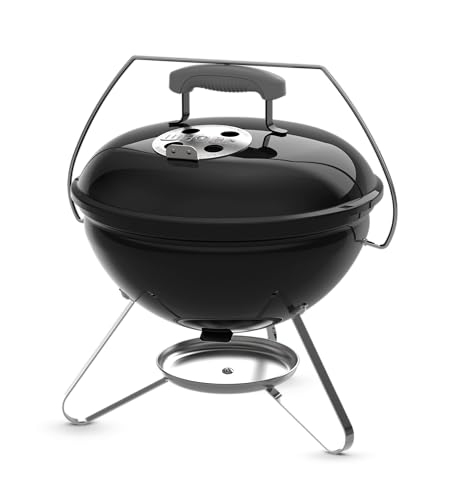
Weber Smokey Joe Portable Charcoal Grill, 14-Inch — Best Cheapest Kettle
The Smokey Joe costs more than the rock-bottom portables and the difference buys the Weber ecosystem: a proper kettle shape, a lid lock that doubles as a carry handle, and replacement grates and parts available everywhere for years. If your cheapest grill is also going to be your travel grill, beach grill and balcony grill, that durability trail makes it the value pick rather than merely a cheap one.
The Smokey Joe miniaturises the kettle idea into a 14-inch grill you can carry in one hand, and it keeps the important parts: a real charcoal fire, a lid for oven-style finishing, and dampers for basic control. The Tuck-N-Carry lid lock doubles as a handle and keeps everything together in the car, which is why these little kettles show up at campsites, tailgates and apartment balconies everywhere. Burgers, sausages, skewers and chicken pieces all cook with proper charcoal character.
Set expectations by size and it never disappoints. The grate handles a meal for two to four people; beyond that you are cooking in batches. Two-zone cooking exists but in miniature, so it suits direct grilling with a small cool corner rather than long indirect roasts. As a cheapest-way-in to the Weber kettle family, a travel grill, or a second grill for small weeknight cooks, it is hard to fault. As your only grill for family parties, it will feel small within a month.
Strengths
- Genuinely portable kettle for camping, tailgating and beach cooks
- Lid lock keeps ash and parts contained in transport
- Uses very little charcoal, ideal for small cooks
Trade-offs
- 14-inch grate suits two to four portions, not a crowd
- Short legs mean tabletop use or bending down to cook
- Limited room for two-zone technique compared with full-size kettles
| Format | 14-inch portable kettle (per Amazon listing title) |
| Portability | lightweight with Tuck-N-Carry lid lock (per Amazon listing title) |
| Fuel | charcoal |
Best for: Campers, tailgaters, balconies and small households wanting real charcoal flavour / Not suited for: Feeding more than four people in a single batch.
Check on Amazon — check the current price on Amazon before you decide, as grill pricing shifts through the season.

Char-Broil Classic 3-Burner Propane Gas Grill — Best Cheapest Full-Size Gas Grill
Cheapest means something different at full size: the Char-Broil Classic is the lowest tier at which a family can grill a whole meal in one batch without batches and juggling. Three burners give a basic hot side and cooler side, side shelves hold the trays, and there is no ash, no chimney and no waiting. For busy households counting both money and minutes, this is the pragmatic cheapest grill.
The Char-Broil Classic 3-Burner is the budget gas benchmark: 360 square inches of cooking area and three burners per the listing, side shelves for trays, and the push-button convenience that makes weeknight grilling realistic for busy households. It feeds a family in one batch, lights in seconds, and asks for no ash cleanup — which, at the cheapest tier, is exactly the trade many buyers are looking for.
What you give up is charcoal character. Gas gives clean, controllable heat but no smoke flavour, and the porcelain-coated grates want non-metal brushes to keep their coating intact. Running costs shift from charcoal bags to propane refills. As the cheapest full-size grill that a family can genuinely live with, though, the Classic earns its place in a cheapest-grills guide honestly.
Strengths
- Cheapest route to full-size, family-capacity grilling in this guide
- Push-button convenience — no charcoal handling or ash
- Side shelves give basic working space
Trade-offs
- Gas flavour is milder than charcoal — no real smoke character
- Porcelain-coated grates need gentle cleaning to protect the coating
- Burners and igniters are wear items over the years
| Burners | 3, output 30,000 BTU (per Amazon listing title) |
| Cooking area | 360 sq. in. (per Amazon listing title) |
| Grates | porcelain-coated (per Amazon listing title) |
| Extras in listing title | side shelves |
Best for: Busy families wanting the cheapest full-size, no-fuss grilling / Not suited for: Buyers who prioritise charcoal flavour.
Check on Amazon — check the current price on Amazon before you decide, as grill pricing shifts through the season.
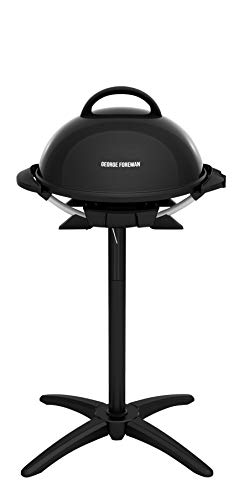
George Foreman Indoor/Outdoor Electric Grill with Stand, 15-Serving — Best Cheapest Electric Grill for Apartments
For apartment dwellers the cheapest grill is the one you are actually allowed to use. The Foreman plugs into a standard outlet, stands on the balcony or lifts off its stand for the counter, and grills a surprising amount at once for an electric. No fuel storage, no ash, no landlord issues. It will never taste of charcoal — and for many renters it is the difference between grilling and never grilling.
The George Foreman Indoor/Outdoor is the cheapest-grills answer for people whose building bans open flame. It plugs in, stands on its own removable stand on a balcony or patio, or sits on a counter indoors, and the listing rates it at a 15-serving capacity — generous for an electric. Chicken breasts, burgers, vegetables and kebabs all cook with proper grill contact and easy cleanup.
The compromise is character: electricity cannot make smoke, and peak heat is polite rather than fierce. In exchange you get a grill that is legal almost everywhere, ready in minutes, and free of fuel storage and ash. For apartment households it is often the difference between grilling and not grilling at all, which makes it one of the most useful budget picks in this guide despite the missing charcoal.
Strengths
- Works where charcoal and gas are banned — apartments and balconies
- Removable stand converts between patio and countertop use
- No fuel to store, no ash, minimal cleanup
Trade-offs
- Electric heat gives grill marks but no smoke or charcoal flavour
- Needs an outlet — not a camping or park grill
- Maximum temperatures are gentler than a charcoal sear
| Format | electric grill with removable stand (per Amazon listing title) |
| Capacity | 15-serving (per Amazon listing title) |
| Use | indoor and outdoor (per Amazon listing title) |
Best for: Apartments, balconies and dorms where open flame is not allowed / Not suited for: Anyone seeking authentic charcoal or smoke flavour.
Check on Amazon — check the current price on Amazon before you decide, as grill pricing shifts through the season.

Char-Griller Patio Pro Charcoal Grill and Smoker, 250 Sq. In. — Best Cheapest Full-Size Charcoal Grill
The Patio Pro is the cheapest grill here that feels like a permanent patio fixture rather than a portable: a proper stand, a metal shelf, damper control and — rare at this tier — cast iron grates that sear like they mean it. At 250 square inches it serves small households whole meals and plays support grill for bigger households. As a first charcoal grill that teaches real skills cheaply, it is the standout.
The Patio Pro is Char-Griller’s answer for small outdoor spaces: 250 square inches of cooking area over cast iron grates, a metal shelf for tools, and damper control that lets it smoke small loads as happily as it grills. For a couple or a small family on a patio, that is a well-judged set of compromises — real charcoal flavour and searing manners without a cooker that swallows the whole terrace.
It also works as a cheap way into charcoal for renters and first-time buyers: the investment is modest, the skills are the real ones, and the cast iron grates leave marks that make weeknight chicken and burgers feel like an event. Capacity is the ceiling — think meals for two to four, or a supporting role beside a larger grill — and the small fire needs topping up on longer cooks. Sized honestly, it is a satisfying little cooker.
Strengths
- Compact footprint designed for patios, with a useful shelf
- Cast iron grates at a budget tier is a genuine plus
- Damper control allows basic smoking as well as grilling
Trade-offs
- 250 sq. in. suits small households and side dishes for groups
- Small firebox means shorter cooks between charcoal top-ups
- Not a party grill
| Cooking area | 250 sq. in. (per Amazon listing title) |
| Grates | cast iron (per Amazon listing title) |
| Features in listing title | metal shelf, damper control |
Best for: Patios, couples and first-time charcoal buyers on a budget / Not suited for: Feeding groups in one batch.
Check on Amazon — check the current price on Amazon before you decide, as grill pricing shifts through the season.

Gas One Portable Charcoal Grill, 14-Inch — Best Ultra-Budget Backup Grill
There is a tier below ‘cheap’ called ‘why not’, and the Gas One lives there honourably: a small charcoal grill with a locking lid and dual vents that stores anywhere and turns any park bench or tailgate into a cookout. Nobody’s main grill, everybody’s spare. If your budget is truly minimal or you want a second grill that owes you nothing, this is the one to throw in the car.
Gas One’s 14-inch portable is built to a price and honest about it: a small charcoal grill with a three-point locking lid and dual venting that covers the fundamentals — light coals, control airflow, cook with the lid down — for tailgates, picnics and tiny patios. It is the sort of grill that lives in a car boot or storage box and comes out whenever an impromptu cookout appears.
Within its size it behaves well: the locking lid helps hold heat for finishing chicken pieces, and the vents give you the one control that matters most at this scale. Nobody should expect heirloom build or party capacity. As the cheapest credible route to real charcoal flavour, or as a backup grill that costs little and stores anywhere, it does its job without pretending to be more.
Strengths
- Ultra-budget entry to real charcoal cooking
- Locking lid keeps heat in and parts together in transit
- Dual vents allow basic heat management
Trade-offs
- Small cooking area for small meals only
- Light construction at this tier
- Minimal indirect-cooking room
| Format | 14-inch portable charcoal grill (per Amazon listing title) |
| Lid | 3-point locking lid (per Amazon listing title) |
| Vents | dual venting system (per Amazon listing title) |
Best for: Tailgaters and picnickers wanting an ultra-budget charcoal option / Not suited for: Regular family cooking.
Check on Amazon — check the current price on Amazon before you decide, as grill pricing shifts through the season.
Comparison Table
| Pick | Badge | Key spec | Best for |
|---|---|---|---|
| Cuisinart Portable Charcoal Grill, 14-Inch (CCG-190RB) | Best Cheapest Charcoal Grill | Format: 14-inch portable charcoal grill (per Amazon listing title) | Students, campers and anyone wanting the cheapest honest charcoal start |
| Weber Smokey Joe Portable Charcoal Grill, 14-Inch | Best Cheapest Kettle | Format: 14-inch portable kettle (per Amazon listing title) | Campers, tailgaters, balconies and small households wanting real charcoal flavour |
| Char-Broil Classic 3-Burner Propane Gas Grill | Best Cheapest Full-Size Gas Grill | Burners: 3, output 30,000 BTU (per Amazon listing title) | Busy families wanting the cheapest full-size, no-fuss grilling |
| George Foreman Indoor/Outdoor Electric Grill with Stand, 15-Serving | Best Cheapest Electric Grill for Apartments | Format: electric grill with removable stand (per Amazon listing title) | Apartments, balconies and dorms where open flame is not allowed |
| Char-Griller Patio Pro Charcoal Grill and Smoker, 250 Sq. In. | Best Cheapest Full-Size Charcoal Grill | Cooking area: 250 sq. in. (per Amazon listing title) | Patios, couples and first-time charcoal buyers on a budget |
| Gas One Portable Charcoal Grill, 14-Inch | Best Ultra-Budget Backup Grill | Format: 14-inch portable charcoal grill (per Amazon listing title) | Tailgaters and picnickers wanting an ultra-budget charcoal option |
The cheapest headline number in this table is not the winner — the winner is the cheapest grill that fits your life. Portables win on storage and travel, the full-size gas wins on family throughput, the electric wins wherever flame is banned, and the Patio Pro wins as a first real patio charcoal grill. Match the row to your address and household, then check the current price.
How to Choose Among the Cheapest Grills Without Buying Twice
The oldest trap in budget grilling is buying the absolute cheapest option, hating it, and buying again within a year — the most expensive path of all. Avoid it by spending your limited budget on the fundamentals in this order: heat control first (vents that actually seal and adjust, or burners with real range), grate quality second (cast iron or porcelain-coated over thin chrome wire where you can get it), and stability third (a grill that wobbles will spill a chimney of coals one day). Cosmetics, extra shelves and novelty features come last, if at all.
Fuel choice is the second decision. Charcoal gives the best flavour per dollar and the simplest mechanics, at the cost of setup time, ash and ongoing fuel spend. Gas gives speed and family capacity, at the cost of parts over time and milder flavour. Electric gives permission — it works where the others are banned — at the cost of smoke flavour and outlet dependence. There is no shame in any of the three; there is only mismatch. A student with a balcony, a family with a garden and a camper with a car boot need different ‘cheapest’ grills, and this guide’s six picks map to those lives deliberately.
Finally, think in cost per cook. A grill used twice a week for three summers delivers hundreds of cooks; even a modest step up in build quality divides into pennies per meal. A grill used twice a year can be the cheapest thing on the shelf without apology. Be honest about which buyer you are before you decide where your tier sits.
What Is the Cheapest Grill Size That Still Cooks a Real Meal?
Fourteen inches of round grate — the size of three picks here — cooks a real meal for two to three people: four burgers, or six chicken thighs, or a spatchcocked small chicken with planning. It does not cook a family party in one batch, and no arrangement of food changes that geometry. Around 250 square inches, the Patio Pro’s class, a small family’s mixed meal fits in one go. At 360 square inches, the Char-Broil’s class, a family of five eats from one batch with room to stage.
Batch cooking is the honest workaround, and it is not a failure: grill in waves, hold finished food in a low oven or wrapped in foil, and a small grill feeds a crowd with patience. What small grills cannot fake is two-zone cooking at scale — the indirect side shrinks to a token corner. If your signature dish is a whole chicken or a big indirect roast, size up or choose a spatchcock technique that flattens the bird into direct-grill territory. Size is the one specification you cannot upgrade later, so it deserves the most honesty at purchase.
Cheap Grill Safety: The Checks That Cost Nothing
Budget grills are safe when they are assembled carefully and used attentively — and most cheap-grill incidents trace back to skipping one of those two things. Assembly first: tighten every fastener, confirm the legs lock or bolt solidly, and test the grill’s stability empty before a fire ever goes in it. A grill that rocks on a flat surface gets returned or fixed, not cooked on. Check that lids sit true and vents move freely; a vent jammed open on a charcoal grill is a temperature problem and a shutdown problem at once.
Placement is the second discipline. Any grill — charcoal, gas or electric — needs clearance from walls, fences, overhangs and dry vegetation, on a surface that cannot burn. Charcoal adds ash discipline: never empty ash until it is completely cold, use a metal container with a lid, and keep that container away from the house and anything combustible for a day, because ash insulates embers far longer than intuition suggests. Gas adds a leak check: brush soapy water on connections when a tank is changed and watch for bubbles before lighting.
Finally, the cooking itself. Never leave a lit grill unattended, keep children and pets outside a sensible radius, keep a clear path between grill and kitchen so trays are never rushed, and know how your grill shuts down — vents closed for charcoal, burners and tank off for gas, unplugged for electric — before you need to do it quickly. None of this costs money. All of it is the difference between a cheap grill being a bargain and being a liability.
When to Upgrade From a Cheap Grill — and When Not To
A cheap grill has done its job when it has taught you two things: whether you actually grill often, and what frustrates you when you do. Those frustrations are your upgrade specification. If the frustration is capacity — every cook is a three-batch marathon — the upgrade is size. If it is temperature control — fires that spike and die, vents that do nothing — the upgrade is build quality and sealing. If it is rust and decay, the upgrade is material: enamelled steel, aluminum or ceramic, plus the cover habit you now know you needed.
Equally important is when not to upgrade. If the cheap grill sits unused for weeks, a better grill will sit unused more expensively. If your frustration is actually technique — food burning, chicken drying — a season of deliberate practice on the cheap grill will fix what money cannot. And if your cheap grill is a portable doing portable duty, its expensive replacement is often a second grill for home, not a substitute: the two-grill household, one small and one substantial, is where many grillers happily end up.
When you do upgrade, keep the cheap grill if storage allows. It becomes the travel grill, the overflow grill for party sides, the loaner that converts a neighbour. The cheapest grills in this guide were chosen to age into exactly those second careers — which is the final sense in which a well-chosen cheap grill is never really a compromise at all.
The Real Running Costs of the Cheapest Grills, Fuel by Fuel
The purchase price of a cheap grill is the down payment; the fuel decides the mortgage. Charcoal is the most visible running cost — a bag at a time, cook by cook — but it is also the most controllable. A cook who closes the vents after cooking and reuses the unburned charcoal can cut fuel spend dramatically, and a small grill sips where a large one gulps. Over a season of weekly cooking, charcoal for a 14-inch portable and charcoal for a big barrel are entirely different budgets, which is why right-sizing appears so often in this guide: at the cheap end of the market, size is a running-cost decision disguised as a capacity decision.
Gas shifts the cost pattern. Propane refills are infrequent and painless, the per-cook cost is predictable, and the real expenses arrive later as parts: burners corrode, igniters fail, heat tents rust. On a budget gas grill those parts are inexpensive and widely available — one of the Char-Broil’s quiet virtues — but they are not free, and a cheap gas grill run hard for three summers will usually ask for one round of them. The household that hates surprises should count a burner set as a planned mid-life expense, not a betrayal.
Electricity is the simplest ledger of all: no fuel to store, no parts train beyond the element and cord, and a per-cook energy cost that is modest and invisible inside a utility bill. What electric spends instead is capability — no smoke, gentler heat — which is a flavour cost, not a financial one. For the apartment household, that trade is usually correct twice over: the electric grill is both the cheapest to run and the only one permitted to run at all.
The honest way to compare is cost per cooked meal across the life you expect. Divide the purchase and the likely parts by the number of cooks, add the fuel for those cooks, and the ‘cheapest grill’ often changes names. A slightly sturdier grill cooked on two hundred times beats a flimsier one cooked on fifty times before it sags, every single time. Buy for the cooking life you will actually live, and the arithmetic of cheap grills starts working for you instead of against you.
Teaching a Beginner on a Cheap Grill: A First Month Plan
A cheap grill is the finest classroom in cooking, provided the lessons are sequenced. Week one is fire only: light a chimney, spread the coals, close the lid, and watch what the vents do — no food at stake, no audience, just the machine’s behaviour made familiar. Cook sausages at the end of that session, because sausages forgive everything and reward immediately. Week two adds the two-zone fire and chicken thighs, the most instructive food in grilling: render them gently on the indirect side, crisp them briefly over the coals, and learn more in one cook than in a month of burgers.
Week three is the whole chicken, spatchcocked, which teaches lid clearance, drip management, resting and carving in a single afternoon — and produces a dinner that makes a new griller feel like a cook. Week four is repetition with one change: a different fuel, a different cut, a guest. The cheap grill’s role in all of this is honesty. It does not automate, compensate or forgive in secret; it shows the beginner exactly what their hands did, which is what teaching means.
By the end of that month the beginner owns the only curriculum that matters — fire, zones, patience, doneness — and owns it on equipment that cost very little and can travel, lend and support for years. Expensive grills purchased after that education are chosen with a connoisseur’s eye, because the buyer finally knows which frustrations are worth paying to remove. That is the deepest sense in which the cheapest grills in this guide are not the budget option. They are the correct first chapter.
Reading Reviews of Cheap Grills Without Being Fooled
Cheap grills attract a particular kind of review noise, and learning to filter it is a buying skill in itself. Discount the one-summer wonders — praise written in the first fortnight, before rust, warping and burner failures have had their chance to vote. Weight instead the reviews written after a full season, especially the ones that describe a specific failure and a specific fix, because those tell you both the grill’s weakness and whether the weakness is manageable. A cheap grill with a known, fixable flaw is a safer buy than a cheap grill with a spotless fortnight.
Watch for the assembly signal hidden in complaints. A striking share of budget-grill misery is born in the first hour: holes misaligned by a rushed build, legs attached loosely, dampers fitted backwards. Reviews that mention a patient second assembly attempt succeeding are telling you the grill was fine and the Saturday was not. Conversely, repeated reports of the same part failing the same way across many owners is a genuine design verdict, and no amount of careful assembly argues with it.
Finally, match the reviewer’s life to yours before matching their verdict. A camper’s five-star portable is a family’s one-star patio grill, and an apartment cook’s beloved electric is a charcoal devotee’s disappointment. The picks in this guide were verified against the manufacturer’s own listing data and chosen for defined situations precisely so you can skip that translation work — but the habit of reading reviews situationally will serve every purchase after this one, at every tier, for as long as you grill.
How to Get the Most From a Cheap Grill
Cheap grills reward technique more than expensive ones do, because you are the missing features. Light charcoal in a chimney, never with fluid, and wait for the grey-ash stage before cooking — this alone fixes most ‘cheap grill, bad food’ stories. Create two zones by banking coals to one side even on a small grill; a small cool corner is still a refuge for food that is browning too fast. Preheat with the lid on, oil the grate lightly once hot, and cook with the lid down whenever thickness allows, because the lid is your oven and your smoke trap.
Manage the grill’s weaknesses directly. Thin steel loses heat in wind, so park the grill in shelter and keep the lid shut. Small grates crowd easily, so cook in batches rather than steaming a piled-up load. After cooking, close the vents to kill the fire and save reusable charcoal, brush the grate while warm, and empty ash only when fully cold. Store the grill covered or indoors — at this tier, weather is the main cause of death, and a cover is the cheapest life-extension you will ever buy.
Common Buying Mistakes
Buying the largest cheap grill instead of the best small one. A big, flimsy grill cooks worse and dies faster than a small, sound one. Fundamentals beat floor space at this tier.
Ignoring your building or site rules. A charcoal grill you cannot legally use on your balcony is not cheap at any price. Check first; electric exists precisely for this situation.
Forgetting the running costs. Charcoal, propane refills, replacement grates and covers all belong in the budget. The purchase price is the beginning of the cost, not the total.
Leaving a budget grill out in the rain. Light steel rusts quickly, especially with ash left inside. A cover and cold-ash discipline double the life of a cheap grill for almost no money.
Judging by the first cook. Every grill has hot spots and habits. Learn yours over three or four cooks — where the hot corner is, how the vents behave — before concluding anything about it.
Final Recommendation
If charcoal is allowed where you live, the Cuisinart 14-inch is the cheapest honest start, the Smokey Joe is the cheap grill to keep for years, and the Patio Pro is the cheapest that feels like a real patio fixture. Families who value speed over smoke should take the Char-Broil gas grill, apartment households should take the Foreman electric without a second thought, and anyone wanting a spare for the car should add the Gas One. Cheap, chosen well, is not a compromise — it is a match between a simple tool and a clear-eyed buyer.
Cuisinart Portable Charcoal Grill, 14-Inch (CCG-190RB) (Best Cheapest Charcoal Grill) Weber Smokey Joe Portable Charcoal Grill, 14-Inch (Best Cheapest Kettle) Char-Broil Classic 3-Burner Propane Gas Grill (Best Cheapest Full-Size Gas Grill) are the three we would start with. Check price on Amazon for each, then commit to the one that matches your space and the way you actually cook.
Related reading on this site: Best Charcoal Grills Using Real Charcoal; Best Coal Grills; Best Cheapest Charcoal Grills; Best Affordable Charcoal Grills; Best Charcoal Grills; Best Camping Charcoal Grills.
Frequently Asked Questions
How long does a cheap grill actually last?
With a cover, cold-ash discipline and indoor or sheltered storage, the better budget grills here give several seasons of regular use. Left uncovered outdoors with wet ash inside, thin steel can rust through in a single year. Care matters more at this tier than at any other.
Is a cheap charcoal grill better than a cheap gas grill?
They optimise different things. Charcoal wins on flavour and mechanical simplicity; gas wins on speed, capacity per dollar at full size, and weeknight convenience. Choose by your cooking rhythm, not by ideology — both appear in this guide because both are right for someone.
Can a 14-inch grill really feed a family?
In batches, yes; in one load, it feeds two to three people comfortably. Families who grill in waves — burgers first, chicken resting while vegetables cook — manage well. If one-batch family meals are non-negotiable, step up to the 250–360 sq. in. class.
Are cheap grills safe?
The designs here are standard and safe when used as directed: stable surface, clearance from combustibles, never unattended, ash disposed of cold in metal. The risks come from wobbly no-name construction and careless use, which is why this guide sticks to verified brands with parts support.
What accessories are worth buying with a cheap grill?
A chimney starter for charcoal models, a cover, a probe thermometer and a stiff grate brush cover nearly everything. Those four items improve results and lifespan more than any grill upgrade at this tier. Skip elaborate tool sets until you know your habits.
Should I buy the cheapest grill or save for a better one?
If you will grill weekly for years, saving for a mid-tier grill usually wins on cost per cook. If you are testing whether grilling fits your life, moving house soon, or equipping a campsite, a well-chosen cheap grill is the rational buy — several picks here are exactly that.


