Where to buy
Check the latest price, availability and delivery on Amazon. Orders are placed on Amazon. We may earn a commission from qualifying purchases.
- Best overall: Amazon Basics Expandable Adjustable Metal Closet Organizer, Chrome — Check on Amazon
- VIPEK V1 Wire Garment Rack, 4 Tiers, Black — Check on Amazon
- C&AHOME Wire Cube Storage Organizer, 12-Cube — Check on Amazon
- SONGMICS Cube Storage Organizer, 16-Cube (ULPC44L) — Check on Amazon
See 2 more Amazon options
- SONGMICS Portable Closet, Freestanding (URYG24BK) — Check on Amazon
- Amazon Basics 5-Shelf Adjustable Wire Rack, Chrome — Check on Amazon
Read the full guide ↓
Disclosure: As an Amazon Associate, airfryerkitchensupply.com earns from qualifying purchases. Links to Amazon on this page are affiliate links; they cost you nothing extra. Listing details such as price and availability change often, so check the current Amazon listing before you buy.
A guest room closet leads a double life, and any organizer in it has to serve both. When someone stays, it is a wardrobe: your guest arrives with hanging clothes, looks for a rod with actual space and a shelf they are allowed to use, and — if they find neither — lives out of the suitcase on the floor and says nothing about it. The rest of the year, that same closet is the household’s overflow valve: spare bedding, good towels, off-season coats, the air mattress, everything with no home elsewhere. An organizer that only does one job fails at the other, so this guide judges all six picks on both — how they host, and how they store between visits.
The good news is that $100 is a real budget for this. It buys complete organizers, not accessories: an expandable wire system for the guest closet you already have, freestanding frames that give a closet-less room a wardrobe, modular cubes that split into a guest zone and a household zone, and a plain shelf tower that turns the closet into a linen store. Every pick here is a one-time install, done on a free afternoon, that never needs touching again except for a ten-minute reset between guests. Nothing below requires a contractor, a rail system or a second purchase to be useful.
One honest note before the picks: the famous installed systems are not here, because they sit above this guide’s $100 budget for a complete kit. Rubbermaid’s Configurations kits and ClosetMaid’s ShelfTrack and SuiteSymphony starter kits are named in this guide only as the step-up, unlinked. And as in the rest of this series, the load numbers printed on these listings are maker claims, not measurements — where a maker’s own documents disagree with each other, the review says so and plans around the smallest figure.
In this guide
Quick Picks
Short on time? Each row below names a hosting situation and the product that suits it, with a link to the listing. Check price on Amazon for the current price.
| Buyer type | Pick | Why it stands out | Link |
|---|---|---|---|
| Best overall | Amazon Basics Expandable Adjustable Metal Closet Organizer, Chrome | Two shelf towers plus two expandable rods that stretch 57–80 inches to fit the guest closet; check price on Amazon | Check on Amazon |
| Best freestanding | VIPEK V1 Wire Garment Rack, 4 Tiers, Black | Powder-coated steel rack with four shelves and a hanging rod for a guest room with no usable closet; check price on Amazon | Check on Amazon |
| Best wire cubes | C&AHOME Wire Cube Storage Organizer, 12-Cube | Twelve wire-grid cubes you can shape to the wall — some for the guest, some for the household; check price on Amazon | Check on Amazon |
| Best plastic cubes | SONGMICS Cube Storage Organizer, 16-Cube (ULPC44L) | Sixteen larger cubes with solid panels — nothing falls through; check price on Amazon | Check on Amazon |
| Best budget portable | SONGMICS Portable Closet, Freestanding (URYG24BK) | Two hanging rods plus fabric shelves in a light, tool-free frame that flat-packs between visits; check price on Amazon | Check on Amazon |
| Best shelf tower | Amazon Basics 5-Shelf Adjustable Wire Rack, Chrome | Five adjustable wire shelves and no rod — a linen tower for spare bedding and towels; check price on Amazon | Check on Amazon |
How These Picks Were Chosen
The first filter was the budget, applied to a complete organizer — not to a starter piece that needs a second purchase to be useful. Each pick below is the whole product: frame, shelves and, where the design has them, hanging rods, in one box within this guide’s $100 budget. Anything whose under-$100 version turned out to be a single tower, a half-kit or an accessory pack was left out, as were the installed rail systems (Rubbermaid Configurations, ClosetMaid ShelfTrack and SuiteSymphony), which sit above the cap as complete kits. The Whitmor Double Rod Freestanding Closet, a genuine classic, is named in this guide as an alternative but not linked.
The second filter was the guest room itself. We asked of every pick: Can the host install it once and never think about it again? Does a guest immediately see where their clothes are supposed to go — rod space that is visibly empty, a shelf that is visibly theirs? And when the guest leaves, does the unit swallow spare linens and off-season overflow without looking like a storage unit with a bed in front of it? Picks that serve guests but cannot store, or store but leave the guest nowhere to hang a dress, were marked down, and each review scores its pick on both halves of the job.
We did not use these products ourselves. We read the maker listings, manuals and specification tables, and compared dimensions, materials and assembly methods. Two kinds of evidence were kept separate throughout, because this category blurs them on purpose. Dimensions and materials are facts from the listing and are stated as facts. Load ratings are maker claims, and they are labeled as such every time one appears. That discipline decided the fine print of the top pick: the Amazon Basics expandable system carries three different load figures across its own listing and manual — 100 pounds per shelf in the product description, 80 pounds per shelf in the manual, and a 150-pound “weight limit” in the specification table — and the honest response is to plan around the smallest and say why. The same applies to the VIPEK rack’s headline 500-pound claim and the Amazon Basics tower’s 350-pounds-per-shelf figure: static, evenly distributed, best-case maker numbers, useful for ranking frames against each other and useless as a promise about your spare duvets.
The 6 Best Closet Organizers for Guest Rooms Under $100
Amazon Basics Expandable Adjustable Metal Closet Organizer, Chrome
Who it suits: Hosts whose guest room has a standard reach-in closet roughly five to six and a half feet wide, and who want to organize it once — proper hanging space for guests on one side, shelving for the household’s spare bedding on the other — instead of shoving everything onto one rod and a floor pile.
This is the only true in-closet system in this guide, and it is the natural guest-room default because it maps exactly onto the closet’s double life. Two wire shelf towers, five adjustable shelves each, are joined by two hanging rods that telescope to meet them: set one rod as the guest’s — left visibly empty, at a height that takes dresses and coats — and give the second rod to long-term hanging storage, while the ten shelves divide between guest towels and the spare linen sets. The listing title gives the width range as 57 to 80 inches, while Amazon’s own manufacturer text describes the assembled unit as 14 by 58 to 63 by 72 inches — the towers are fixed, the rods do the stretching, and the practical reading is that it suits closets from just under five feet to about six and a half feet wide, with the title’s 80-inch figure best treated as the rods’ absolute maximum rather than a comfortable fit. Shelves and rods both reposition in 1-inch increments, so the layout you set on install day is the layout every future guest meets. It is also the most decorated pick here — Good Housekeeping’s closet-organizer testing named it a best-value pick.
The construction is chrome-finished steel wire with plastic slip sleeves, screw-together assembly, four extra-wide leveling feet, plastic shelf liners and wall-mounting hardware in the box — a one-afternoon install for the host, after which there is nothing to adjust, tighten or explain. Two honest cautions belong with those specs. First, depth: the towers are 14 inches deep, and a standard hanger is about 17 inches long, so hung clothes project past the frame. Inside a normal 24-inch-deep guest closet that is a non-issue; in a shallow closet or linen press it is a genuine problem, and it is the first measurement to check. Second, the load figures contradict each other — 100 pounds per shelf in Amazon’s description, 80 pounds per shelf and 50 pounds per extended rod in the manual, 150 pounds as the listing’s overall “weight limit.” All are maker figures; plan around the manual’s lower numbers and the system is honestly rated for a guest wardrobe plus a household’s worth of spare bedding. This pick sits toward the upper end of this guide’s budget, so check price on Amazon to confirm the current price is still under the cap before you buy.
- The only pick that expands to fit your closet’s width, with 10 shelves and 2 rods adjustable in 1-inch increments — enough structure to zone guest space and household storage in one closet.
- Shelf liners and wall-mounting hardware included — the two extras wire systems usually charge for.
- Good Housekeeping best-value pick; check price on Amazon.
Honest limitation: The 14-inch-deep towers are shallower than a hanger is long, so clothes overhang the frame — fine in a standard closet, wrong for a shallow one — and Amazon’s own load figures for it disagree with each other, so the conservative manual numbers are the ones to trust.
Choose it if your guest room has a normal reach-in closet and you want one box, installed once, to finish the job. Skip it if your closet is under about 57 inches wide, unusually shallow, or the guest room has no closet at all — that is the freestanding pick below.

VIPEK V1 Wire Garment Rack, 4 Tiers, Black
Who it suits: Hosts whose guest room has no closet — a converted office, a den with a daybed — or whose guest closet has been permanently given over to storage, and who need a real wardrobe standing in the room itself: a rod guests can hang event clothes on, with shelves for their folded things.
Where the Amazon Basics system disappears into a closet, the VIPEK V1 stands in for one, and in a guest room that is a more demanding job than it sounds, because the unit is on display. The frame is powder-coated steel — VIPEK describes carbon steel, the listing’s specification table says iron frame with a powder-coated finish — standing 35.4 inches long by 15.7 inches deep by 70.9 inches high, with four height-adjustable wire shelves and a hanging rod across the top. That layout suits guests precisely: hanging space where a dress or suit needs it, shelves beside and below for folded clothes and the contents of a carry-on, all on a footprint smaller than a dresser. At 22.1 pounds it is light enough for the host to move when the room changes purpose, and the black finish is the one that looks deliberate in a bedroom rather than borrowed from a stockroom. Between visits, the same frame holds the overflow: spare blankets on the shelves, off-season coats on the rod, and it still reads as furniture rather than storage.
The headline number needs its warning label. VIPEK rates the V1 at a maximum load of 500 pounds, and that is a maker’s whole-unit figure — the theoretical total with weight spread perfectly across every shelf and the rod, not a per-shelf promise and not a number a 22-pound frame should be asked to prove with your coat collection. Read it as “the sturdiest frame in this guide,” which the steel construction supports, rather than as a loading instruction; in practice the rod will tell you it is full long before any rating is tested. The linked version is the black finish — check price on Amazon for the current price and confirm it still fits this guide’s $100 budget before you buy.
- Steel frame with four adjustable shelves plus a full-width hanging rod — a complete standalone wardrobe in 35.4 inches of wall.
- The strongest construction in this guide; the maker’s 500 lb whole-unit claim is marketing, but the frame beneath it is genuinely heavy-duty.
- Black finish; check price on Amazon.
Honest limitation: At 35.4 inches wide it is one guest’s wardrobe, not a couple’s, and you should check the current price on Amazon to confirm it still fits the under-$100 budget.
Choose it if your guest room needs a freestanding wardrobe that can take a heavy hanging load and look presentable doing it. Skip it if the current price on Amazon no longer fits the budget, your guests travel as a couple with a week of hanging clothes, or the room already has a closet worth organizing instead.

C&AHOME Wire Cube Storage Organizer, 12-Cube
Who it suits: Hosts whose guest-room problem is folded storage rather than hanging — spare towels and bedding that need a home, plus a few genuinely empty cubes a guest can claim — especially in an awkward space, under a slope or beside a door, where a fixed rectangle will not fit but a shape you build yourself will.
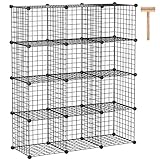
Cube organizers earn their place in a guest-room guide by being the only picks that divide cleanly in two. This set is twelve cubes built from wire grid panels and plastic connectors, 36.6 inches long by 12.4 inches deep by 48.4 inches high in the standard four-by-three arrangement — but the arrangement is a suggestion, not a rule: build it three wide and four tall for a narrow wall, step it down under an eave, or split it into two smaller units. The guest-room way to build it is by zone: the household’s cubes, filled with spare linens and off-season storage, on one side, and two or three cubes left conspicuously empty at a guest’s natural reach height on the other. Each cube is 11.8 inches across, which is the dimension that decides what fits: standard fabric storage bins up to about 11.5 inches sit inside neatly, folded sweaters and t-shirts stack well, and a pair of shoes fits with room to spare. The wire construction is the airier of the two cube systems here — you can see everything, nothing traps moisture, and spare bedding stored for months stays fresher for the airflow.
This set, sold by C&AHOME itself, sits in the lower part of this guide’s budget — check price on Amazon for the current price. That positioning matters in a guest room because this pick is deliberately half a solution — it stores, beautifully, but it hangs nothing, so leaving room in the budget for a rail or garment rack helps when your guests arrive with clothes that crease. What wire cubes will not do is hold small loose items: socks, chargers and accessories drop through the grid unless they live in bins, and the open faces mean the unit looks exactly as tidy as your folding is — in a room a guest sleeps in, that tidiness is on show. Load-wise, treat each cube as light-duty — a cube of folded clothes or spare towels is the design case; a cube of hardback books is how panels bow and connectors complain.
- Rebuildable 12-cube grid: build a guest zone and a household zone in one unit, and reshape it as the room’s role changes.
- Sold by the maker on Amazon; check price on Amazon.
- 11.8-inch cubes accept standard fabric bins up to about 11.5 inches.
Honest limitation: Wire grids let small items fall through and offer no hanging at all, so a guest with dresses or suits still needs a rod somewhere — and per-cube loads are light-duty folded clothes, not books or heavy gear.
Choose it if your guest room’s chaos is folded storage and you can leave a few cubes empty for visitors. Skip it if hanging space is the real shortage, or you want a closed, furniture-like front.
SONGMICS Cube Storage Organizer, 16-Cube (ULPC44L)
Who it suits: Hosts who like the cube idea but want solid panels instead of wire grid — for a guest room that doubles as a nursery or kids’ overflow room, or any space where small things escaping through the grid would drive them mad — and who want the most cubes the budget offers.
SONGMICS’ 16-cube set is the plastic counterpart to the wire grid above: polypropylene panels joined by connectors, building to 48.4 inches wide by 12.2 inches deep by 48.4 inches high, which works out to roughly 12-inch cubes — a touch larger than the wire set’s, and there are sixteen of them rather than twelve. Sixteen cubes is where the guest-room zoning idea gets comfortable: a full column for spare bedding, a column for towels and the household’s overflow, and still a two-by-two block of empty cubes waiting for whoever is sleeping over. The solid panels change what the unit is good at. Nothing falls through, panels wipe clean — a genuine virtue in a room that hosts children — the closed backs make each cube read as a cubby rather than a cage, and the finished block looks calm enough to stand in a bedroom without bins dressing it up. Like the wire set it reconfigures — a four-by-four square, a stepped pyramid for a child’s reach, or two eight-cube blocks — and SONGMICS sells the line in several colorways, including a door-fronted variant for buyers who want the cubes closed; the linked white set is the open-cube version, so check which variant you are ordering.
This set sits in the lower-to-middle part of this guide’s budget, and its position can vary by color, so compare colorways before defaulting to the first one shown and check price on Amazon for the current price of the finish you choose. The honest weakness is the material itself. Plastic panels flex in a way wire does not: a cube loaded with heavy books or a leaning stack of denim will bow its panel over time, and the connectors hold by friction, so the unit should be assembled where it will live and never dragged across a room fully loaded — push on a corner and a joint can pop. For a guest room there is one more discipline: a tall cube block in a room where other people’s children sleep deserves the wall strap any tall unit does. Kept to clothes, shoes, toys and linens, it is the most storage in this guide.
- Sixteen solid-panel cubes — the largest cube count here — with nothing able to fall through the grid.
- Check price on Amazon — the position within the budget can vary by colorway.
- Roughly 12-inch cubes in a 48.4-inch square that also builds stepped or split — enough cubes to zone guest space and household storage apart.
Honest limitation: Plastic panels bow under genuinely heavy loads and the friction connectors can pop if the loaded unit is dragged — this is a clothes-and-linens organizer, assembled in place, not a bookcase for hardbacks, and it offers no hanging space.
Choose it if you want maximum cubby storage with a clean, closed look for linens, kids’ things and a guest’s folded clothes. Skip it if your loads are heavy, or your guests mainly need to hang clothes — pair it with a rail or choose a frame above.

SONGMICS Portable Closet, Freestanding (URYG24BK)
Who it suits: Hosts whose guest room is only a guest room sometimes — a home office that hosts twice a year, a first apartment, a spare room still finding its purpose — where a closet has to appear before a visit, assemble without tools, and come apart just as easily when the guests go home.
This is the lightest design in the guide: steel tubes and plastic connectors forming a frame 44.1 inches wide by 16.9 inches deep by 65 inches high, with non-woven fabric shelves and two hanging rods. That footprint is a real closet’s worth of layout — double hanging on one side, a column of fabric shelves for folded clothes and shoes on the other — in a unit one person can carry room to room. For occasional hosting it has one virtue none of the other picks match: assembly is push-together with no tools, and disassembly is the same in reverse, so it is the only pick here that genuinely flat-packs — up in twenty minutes before a visit, down and into a cupboard after it, freeing the room to be an office again. It has been available since 2019, which in this category is its own kind of evidence: the design is known and the failure modes are known.
The fabric shelves define both its positioning and its ceiling. SONGMICS’ own figures for this design are modest — and inconsistent: one listing rates each fabric shelf at 17.6 pounds and the hanging rail at 44 pounds, while the brand’s retail copy elsewhere says 22 pounds per shelf and 33 per rod. All are maker figures, they do not agree, and the safe conclusion is the obvious one: this is light-duty storage. Fabric shelves also sag into a hammock under point loads, so folded stacks and a guest’s weekend clothes sit fine and a single heavy storage box does not, and owner feedback on this design mentions leaning when one side is loaded with heavy hanging clothes while the other stays light — load the shelves low and the hanging evenly and it behaves, which for a two- or three-night stay it comfortably does. The identical unit is also sold at Target, and this pick sits in the lower part of this guide’s budget — check price on Amazon for the current price before you buy.
- A complete two-rod closet layout — hanging plus shelved folded storage — in the lightest frame here.
- Tool-free push-together assembly that also comes apart flat, so the guest room can stop being a guest room between visits.
- The identical unit is also sold at Target; check price on Amazon.
Honest limitation: Fabric shelves are the weakest surface in this guide — they sag under point loads, the maker’s own load figures for the design contradict each other, and uneven loading can make the frame lean; it is a few-nights-at-a-time closet, not a permanent heavy wardrobe.
Choose it if you host occasionally and want the most closet for light clothes, with zero tools and a flat-pack exit. Skip it if guests stay for weeks, your spare-room loads are heavy — winter coats, denim by the stack — or you expect the unit to stand permanently for a decade.

Amazon Basics 5-Shelf Adjustable Wire Rack, Chrome (36 x 14 x 72 in)
Who it suits: Hosts whose guest closet already has a working rod but wastes its floor and walls — or who run the guest room off a linen closet or walk-in — and need strong, adjustable shelving only: stacked spare bedding, towel sets and the air mattress, with no pretense of hanging space.
Sometimes the right guest-room organizer is not a closet system at all. This is Amazon’s standard five-shelf wire rack — 36 inches wide by 14 inches deep by 72 inches tall, chrome steel, shelves adjustable in 1-inch increments on slip sleeves with no tools, leveling feet included — and its guest-room case is simple: it is exactly the depth of a closet shelf tower, it fits against a walk-in wall or inside a wide reach-in beside the hanging section, and it turns the vertical space most guest closets waste into five levels of the things hosting actually consumes. Spare duvet sets on one shelf, towels on another, the extra pillows and the air mattress above — stacked in the open, where the host can see at a glance what is clean and ready. The 14-inch depth that limits the expandable system above does not matter here, because nothing hangs from it. Between visits it is the household’s linen store; during a visit, one cleared shelf at waist height becomes the guest’s, for the folded clothes that come out of the suitcase.
This rack sits in the middle part of this guide’s budget — check price on Amazon for the current price. The maker’s load claim is the category’s most theatrical: 350 pounds per shelf, evenly distributed. That is a static lab figure for a shelf loaded like a sandbag, not a linen plan; the honest translation is that the frame is far stronger than folded bedding will ever ask it to be, which is the only reason the number matters. Two practical notes: wire shelves want liners or bins under small items, the same as any wire in this guide, and at 72 inches tall it needs the included leveling feet set properly on carpet — and a wall strap if children will sleep in the room, as with any tall rack.
- Five shelves adjustable in 1-inch increments — the strongest, simplest folded-storage tower in the guide, sized for bedding and towel stacks.
- Check price on Amazon.
- No-tool slip-sleeve assembly and leveling feet; 36 x 14 in footprint fits walk-ins and wide reach-ins.
Honest limitation: There is no hanging rod at all — this is shelving only, so it complements a guest closet rather than replacing one — and the 350 lb-per-shelf figure is a maker lab number, not a loading target.
Choose it if your guest room’s rod works and its shelves are the problem — or the room runs off a linen closet. Skip it if guests need hanging space — that is the expandable system or the VIPEK above.

Comparison Table
| Product | Construction | Best use | Link |
|---|---|---|---|
| Amazon Basics Expandable Closet Organizer | Chrome wire, 2 towers + 2 expanding rods | Organizing the guest closet itself, 57–80 in wide — guest hanging plus household shelves | Check on Amazon |
| VIPEK V1 Wire Garment Rack | Powder-coated steel, 4 shelves + rod | A standalone wardrobe in a guest room with no closet | Check on Amazon |
| C&AHOME Wire Cube Storage, 12-Cube | Wire grid panels + connectors | Folded storage shaped to an awkward space, zoned guest/household | Check on Amazon |
| SONGMICS Cube Storage, 16-Cube | Plastic panels + connectors | Maximum cubbies with solid, wipeable panels for linens and overflow | Check on Amazon |
| SONGMICS Portable Closet (URYG24BK) | Steel tube frame, fabric shelves, 2 rods | A temporary guest closet that flat-packs between visits | Check on Amazon |
| Amazon Basics 5-Shelf Wire Rack | Chrome wire, 5 shelves, no rod | A linen tower for spare bedding beside an existing rod | Check on Amazon |
How to Choose a Closet Organizer for a Guest Room
Start with the honest question: how often is this room actually a guest room? A room that hosts monthly deserves a permanent install — the expandable system inside the closet, or the VIPEK standing in it. A room that hosts twice a year and works as an office the rest of the time is better served by the portable closet that flat-packs away, or by cubes that hold office and household storage between visits and clear a zone when guests come. Buying a permanent wardrobe for a twice-a-year room wastes both the money and the room.
Measure the closet you have, not the one in the listing photo. Width wall to wall at floor level — baseboards steal half an inch on each side and old houses are rarely square. Depth: a standard reach-in is about 24 inches deep and hanging clothes need roughly 22 of them, which is why the 14- to 17-inch-deep units here work — they hold the shelves and rods while the clothes use the closet’s depth. Height, including anything already installed you plan to keep. And the door: a swinging door needs its arc clear, which can rule out the deepest tower position.
Count the guest’s hanging, not yours. Guests travel with a few shirts, a dress or suit for the event they came for, a coat in winter. That is roughly two feet of rod — but it has to be empty rod, at a usable height, with spare hangers on it. If household overflow already fills the rod, no organizer fixes the hosting problem until some of it moves to cubes or shelves; zoning, not capacity, is usually the real purchase.
Decide the split before you assemble anything. Every pick works best with a declared division: this rod, these shelves, these cubes are the guest’s; the rest is the household’s and stays put during visits. A half-and-half split suits most homes — guests rarely need more than a rod section, two shelves and a cube or two — and it makes the ten-minute reset possible, because you are restoring a known layout rather than inventing one under pressure.
Match the shelf surface to what will actually sit on it. Open wire is the strongest and most ventilated — good for spare bedding stored for months — and lets small items tilt through the gaps; the fix is shelf liners (included with the expandable system) or bins sized to the shelf. Plastic cube panels are the tidy trade: a solid, wipeable floor that keeps small things put, paid for with flex under heavy loads. Fabric shelves are the lightest surface and behave like one: happy under folded stacks, hammocking under a single heavy box. Wire for strength, panels for tidiness, fabric for portability — and in a guest room, whatever the guest sees should look intentional, which favors panels and finished frames on display.
The Guest Closet’s Double Life: Visitors by Weekend, Storage by Week
Most closet advice assumes the closet belongs to the person sleeping in the room. A guest closet belongs to two different users on two different schedules, and it fails when either one is designed for alone. Design it for storage alone and it becomes the household’s dumping ground with a bed nearby: the rod fills with off-season coats, the shelves with boxes, and the arriving guest gets the floor and the suitcase. Design it for guests alone and you have built a hotel wardrobe that sits empty fifty weeks a year while the household’s spare bedding overflows into hall closets and under-bed boxes. The organizers in this guide earn their place by doing both jobs in one footprint, and the mechanism is zoning. The expandable system zones by structure — a guest rod and a household rod, guest shelves and storage shelves, fixed in 1-inch increments on install day. The cube sets zone by block — a visible run of empty cubes that stays empty because the household’s cubes beside them absorb the overflow instead. The shelf tower zones by level: hosting supplies stacked in the open where they can be audited at a glance, one level kept clear as the guest’s shelf.
Two rules make the double life work. First, the guest zone must be defensible — empty space gets colonized, so give the guest’s rod and shelves a reason to stay empty: hang the spare hangers there, stack the guest towels there, and let household things expand into any space except that one. Second, the storage side should store hosting things first — spare bedding, towel sets, extra pillows, the air mattress and its pump — before anything else, because those are the items you will otherwise be hunting for the night before a visit. General overflow is third priority, in the cubes and upper shelves, out of the guest’s sightline. Get the zoning right and the two lives stop competing: storage makes hosting easier, and hosting keeps storage honest.
What Guests Actually Need: A Rod, a Shelf and Permission to Use Them
Watch a guest unpack and you learn what a guest closet is really for. They will not open drawers, move your things, or ask where they may put their clothes — asking feels like a complaint, and most guests would rather live out of a suitcase than make one. So the space has to announce itself. A section of rod standing empty, with four or five hangers waiting on it, is an announcement. A cleared shelf or two empty cubes at waist height is an announcement. A closet door that opens onto visible, intentional emptiness tells the guest the room was prepared for them, which is most of what hosting feels like from the other side. That is why the strongest picks here have legible structure — the expandable system’s separate rods, the cube sets’ obvious empty blocks, the VIPEK’s open shelves — and why the commonest failure is not a lack of storage but a lack of available storage: plenty of organizer, none of it empty.
The full list of what a guest needs is short, and every item on it is simple once the organizer is in place. Hanging space for the clothes that crease — roughly two feet of rod. A flat surface for folded clothes, so the suitcase can be unpacked and put away rather than lived out of. Somewhere for the empty suitcase itself — the top shelf of the closet, or the top of a cube unit, beats the corner of the room. Spare hangers, more than you think: guests arrive with none. And one small courtesy that organizers make easy: a cube or shelf holding the guest supplies — spare towel set, an extra blanket, a phone charger — where the guest can find them without a house tour. None of this requires a bigger budget. It requires reserving part of the organizer you already bought, which is a decision, not a purchase.
Set It Up Once: The Host’s Afternoon, and the Ten-Minute Reset
The hidden cost of guest-room storage is the scramble: a visit means an evening of moving boxes out of the guest closet into the hall, the bedroom, the car — and reversing the migration after the guests leave. A fixed organizer ends it by giving everything a permanent address. The install is a one-afternoon job for every pick here: the expandable system screws together inside the closet, the VIPEK and the wire tower assemble on slip sleeves and bolts, the cube sets press together panel by panel, and the portable closet goes up tool-free in minutes. Anchor anything tall while you are at it: five- and six-foot frames and cube towers are tip risks where children may climb, and the wall strap is part of the install, not an optional extra.
After that, hosting maintenance shrinks to a reset with a fixed shape. Strip the bed, and spare bedding goes back on its shelf or into its cubes — visible, counted, replaced if a set is in the wash. Guest towels return to their shelf. The guest rod goes back to empty-with-hangers; anything left behind gets one cube as a lost-property box. Evict whatever crept into the cubes and shelves during the visit. Ten minutes, because nothing has to be decided — the layout you installed is the layout you restore. That is what the $100 buys a host: a guest room always one short reset away from ready, instead of one long scramble.
Common Buying Mistakes
Filling the guest closet entirely with household overflow. The commonest mistake, and the one that defeats the room’s purpose: the organizer is bought, installed and promptly loaded with everything the household needs to store, leaving the arriving guest the suitcase-on-the-floor experience the purchase was meant to fix. Decide the guest’s share — a rod section, two shelves, a few cubes — before the first box goes in, and defend it.
Buying to the title’s width instead of the assembled width. The expandable system at the top of this guide is “57–80 inches” in its title and 58–63 inches in its manufacturer’s own text. Listings quote the most flattering dimension they can defend — a rod at full stretch, a frame measured without its feet. Measure your space, then check the specification table’s assembled dimensions, and leave an inch of grace on every side.
Reading a whole-unit load claim as a per-shelf promise. “500 lb capacity” on a garment rack is the sum of every surface loaded perfectly, not an invitation to hang 500 pounds from the rod. The mistake shows up as a bowed rod or a leaning frame a month later, blamed on quality when the real fault was arithmetic. Use maker numbers to compare frames; use the manual’s lowest figure to plan the load.
Forgetting the hangers — and the hanger’s length. An organizer with empty rod space but no spare hangers still leaves the guest living out of a suitcase, and a hanger is about 17 inches long, so a shirt on one is roughly 22 inches deep with the sleeve’s drape: shallow units and shallow closets fail on the clothes, not the frame. Budget a ten-pack of matching hangers into any guest-room setup, and if your closet is under 22 inches deep, prioritize shelf-and-cube storage and keep hanging on the existing rod.
Skipping the wall anchor in a room where children sleep. Five- and six-foot freestanding frames and cube towers are tip risks in homes with children or large dogs, full stop — and a guest room concentrates the risk, because visiting children climb in unfamiliar rooms. Most of these units include or accept a wall strap; the five minutes to fit it is the simplest safety step in this guide.
Assembling a cube unit in the wrong room, or during the visit. Cube grids and the portable closet are light because their joints are friction and connector based — which means a loaded unit dragged sideways across carpet can pop a corner or start a lean. Build it where it will stand, load it after, and re-check the connectors are fully seated a week later. And do the building on a quiet weekend, not the afternoon your guests arrive.
Final Recommendation
- Most hosts, organizing an existing guest closet: Amazon Basics Expandable Adjustable Metal Closet Organizer.
- Guest room with no closet, or a closet given to storage: VIPEK V1 Wire Garment Rack.
- Folded storage in an awkward space: C&AHOME Wire Cube Storage Organizer, 12-Cube.
- Most cubbies, cleanest look: SONGMICS Cube Storage Organizer, 16-Cube.
- Occasional hosting, room changes purpose: SONGMICS Portable Closet (URYG24BK).
- Shelves only, for the linen store: Amazon Basics 5-Shelf Adjustable Wire Rack.
Our top two are the expandable Amazon Basics system for the majority case — a guest closet that needs to host on weekends and store all week, zoned once and reset in minutes — and the VIPEK V1 for the room with no closet to organize, where the organizer has to be the wardrobe and look like furniture doing it. Between them they cover the two honest jobs at this budget, and the other four picks exist for the shapes those two cannot be: cubes for walls that are not rectangles and households that need the split made visible, fabric for a room that only hosts sometimes, and a plain wire tower for the closet whose rod was never the problem. One pattern is worth carrying away from the whole guide: at $100 the complete organizer is a solved problem — every pick here fits the cap as a whole, usable unit — while the famous installed systems do not, so the room this budget leaves against a built-in is better used on the bins, liners and spare hangers that make any of these frames work at their best. Measure the space, declare the guest’s share before you load anything, anchor anything tall, and check price on Amazon before you order.
Frequently Asked Questions
What is the best closet organizer for a guest room under $100?
For most hosts, the Amazon Basics Expandable Closet Organizer: it fits itself to an existing guest-room closet, with two five-shelf towers and two telescoping rods covering roughly five to six and a half feet of width — enough structure to give guests their own rod and shelves while the rest stores the household’s spare bedding, with liners and wall hardware included. If the guest room has no closet, the answer changes to the VIPEK V1, the sturdiest freestanding frame here. Both sit near the cap in this guide’s budget, so check price on Amazon for the current price.
How much of the guest closet should I keep empty for guests?
Less than you fear, but it must be genuinely empty and visibly so. A workable split for most homes: one rod section of about two feet with spare hangers on it, two shelves or two to four cubes cleared, and floor or top-shelf space for a suitcase. Guests travel light relative to a wardrobe — a few hanging outfits, folded clothes, toiletries — and what they need is not volume but permission: space that is obviously theirs, so nothing has to be asked or moved. The rest of the closet can honestly serve as household storage, and in most homes it should.
Can a freestanding organizer really replace a guest-room closet?
For a guest’s stay, yes — the VIPEK V1 and the SONGMICS portable closet both combine hanging space (two rods on the SONGMICS) with shelving in a footprint under four feet wide, which covers a weekend-to-two-week wardrobe comfortably. What they cannot replace is the closet’s enclosure: clothes stay visible and gather dust faster than behind a door, which is why freestanding units suit guest bedrooms and dressing corners better than living rooms, and why a room that hosts for a month at a time may still want the in-closet system if a closet exists.
Are cube organizers strong enough for spare bedding and guest clothes?
Yes, for the loads bedding and clothes actually are. A cube of folded sweaters or a spare duvet set weighs a few pounds, far inside what wire grid or plastic panels hold happily for years. Cubes fail when they are asked to be bookcases — a cube packed with hardbacks can bow a plastic panel or stress a wire connector — and when a tall, loaded unit is dragged instead of rebuilt in place. Keep books and heavy gear on the wire shelf tower, keep cubes for clothes, shoes and linens, and anchor tall stacks to the wall — especially in a room where visiting children sleep.
How much weight can these organizers really hold?
Less than the titles say, and enough for the job. The headline figures — 500 pounds for the VIPEK, 350 pounds per shelf for the Amazon Basics tower — are maker claims under ideal, evenly distributed conditions. The figures worth planning around are the conservative ones: the expandable system’s manual rates its shelves at 80 pounds and an extended rod at 50, and the SONGMICS portable closet’s fabric shelves at under 20 pounds each. A guest’s hanging clothes typically weigh well under 30 pounds and a shelf of spare bedding less, so every frame here is adequate when loaded evenly — heavy items low, weight spread, nothing heavy hung from the middle of an extended rod.
Which closet organizer is best if the guest room doubles as an office?
The SONGMICS Portable Closet, because it is the only pick designed to disappear: tool-free assembly before a visit, flat-pack disassembly after it, nothing left against the wall. Cube units are the other good answer — they hold office and household storage all year and simply have a few cubes cleared when guests come, so the room never fully changes identity. The permanent frames (the expandable system, the VIPEK, the wire tower) suit rooms that host often enough to justify a fixed wardrobe standing in them year-round.
Why are Rubbermaid and ClosetMaid systems not in this guide?
Positioning. Rubbermaid Configurations kits and ClosetMaid’s ShelfTrack and SuiteSymphony starter kits sit above this guide’s budget as complete kits, and the starter options for those brands are single towers or partial kits that do not organize a whole closet. They are good systems and the natural step-up if your budget grows, but under a strict $100 cap for a complete organizer, the six freestanding and in-closet picks here are what the budget honestly buys.
- Best Closet Organizer Under $75
- Best Closet Organizer Under $200
- Best Closet Organizer For Apartments Under $100
- Best Blackout Curtains For Guest Rooms Under $100
- Best Bed Sheet Set For Guest Rooms Under $100
- Best Nightstand For Guest Rooms Under $100
Related Guides
- Best Closet Organizer For Guest Rooms Under $30
- Best Closet Organizer For Guest Rooms Under $75
- Best Closet Organizer For Guest Rooms Under $200
- Best Closet Organizer For Guest Rooms Under $400
- Best Closet Organizer For Guest Rooms Under $700