Where to buy
Check the latest price, availability and delivery on Amazon. Orders are placed on Amazon. We may earn a commission from qualifying purchases.
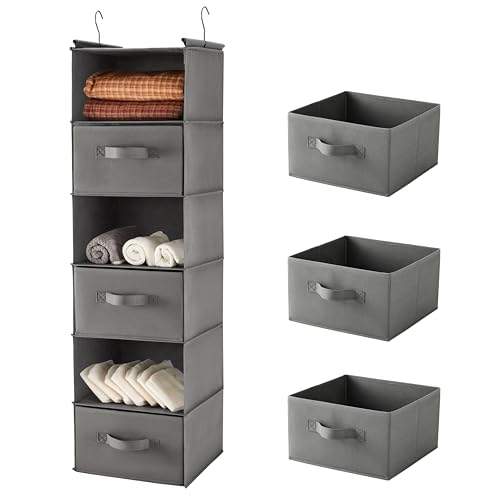
- Best overall: MAX Houser 6 Tier Shelf Hanging Closet Organizer, Grey — Check on Amazon
- Simple Houseware 24 Pockets Crystal Clear Over The Door Hanging Shoe Organizer, Gray — Check on Amazon
- Amazon Basics Collapsible Fabric Storage Cubes, 10.5 x 10.5 x 11 Inch, Beige, 6-Pack — Check on Amazon
- Criusia 6 Pack Drawer Organizer Dividers, 58 Cell, Beige — Check on Amazon
See 2 more Amazon options
- Fab totes 6 Pack Storage Bags for Clothes, 60L, with Lids and Zipper Windows — Check on Amazon
- Spacesaver Jumbo Vacuum Storage Bags, 40 x 30 Inch, 3-Pack with Pump — Check on Amazon
Read the full guide ↓
Disclosure: As an Amazon Associate, airfryerkitchensupply.com earns from qualifying purchases. Links to Amazon on this page are affiliate links; they cost you nothing extra. Listing details such as price and availability change often, so check the current Amazon listing before you buy.
The best closet organizers for apartments under $30 are not closet systems, and in a rental that is a feature, not a compromise. A closet system — rails, uprights, shelves, drawers, hardware — is furniture you screw into a wall, and even the simplest kits live in the next price class up. In an apartment you could not install one if you wanted to: the lease forbids the drilling, the deposit punishes the holes, and anything you build into a closet you do not own gets left behind or ripped out on moving day. Thirty dollars buys the layer that works inside the closet your landlord already gave you, and asks nothing of the walls: hanging shelves that hook over the existing rail, pockets that move shoes onto the back of a door, fabric cubes that give a shelf a structure, drawer cells that end the underwear avalanche, and bags that shrink the seasonal pile. Nothing in this guide needs a drill, a screw, an adhesive strip or a landlord’s permission — and every pick unhooks, lifts out or folds flat when the lease ends.
Apartment closets fail in predictable ways. They are small — one short rail, one high shelf, a door that opens into the room’s only walking space. They are shared with the building’s compromises: the water heater’s cousin, the sloping ceiling, the shelf positioned for someone taller. And the mess is rarely a shortage of square feet so much as a shortage of divisions: one rail and one shelf being asked to do four jobs with no structure at all. So this guide covers the six honest families of organizer that genuinely sell at or under $30 on Amazon, one pick per job, each judged by the renter’s tests: Does it install without touching a wall? Does it survive a small closet’s proportions? And does it leave with you — folded, stacked or rolled — when you go? For most renters we would start with the MAX Houser hanging shelves: twelve inches of the rail you already have becomes six shelves of folded clothes, and it unhooks in seconds at move-out. If shoes are the mess, skip to the door pockets. If your dresser drawers are the disaster, the cell dividers are the fix. Below you will find a quick picks table, detailed notes on each of the six products, a comparison table, a buying checklist, the mistakes renters make most at this price, and answers to the questions that come up again and again.
In this guide
Quick Picks
Short on time, or comparing several options at once? Each row below names a renter type and the product that suits it, with a link to the listing. Organizer prices move with deals and colorways, so check the current price on Amazon for the variant you want before you buy.
| Buyer type | Pick | Why it stands out | Link |
|---|---|---|---|
| Best overall | MAX Houser 6 Tier Shelf Hanging Closet Organizer, Grey | Six shelves from twelve inches of the landlord’s rail; unhooks in seconds | Check on Amazon |
| Best for shoes | Simple Houseware 24 Pockets Over The Door Shoe Organizer, Gray | 24 clear pockets on the back of a door; zero floor, rail or wall used | Check on Amazon |
| Best shelf bins | Amazon Basics Collapsible Fabric Storage Cubes, 10.5 Inch, 6-Pack | Six matching cubes that give the rental shelf a structure | Check on Amazon |
| Best for drawers | Criusia 6 Pack Drawer Organizer Dividers, 58 Cell | 58 cells sort socks, underwear and bras without marking the drawer | Check on Amazon |
| Best for seasonal clothes | Fab totes 6 Pack Storage Bags, 60L, with Lids | Six lidded, windowed bags that free a small closet of its off-season half | Check on Amazon |
| Best for bulky bedding | Spacesaver Jumbo Vacuum Storage Bags, 3-Pack | Comforters compressed flat for apartments with no linen closet | Check on Amazon |
How These Picks Were Chosen
The first filter was the budget, applied to a complete, usable product. A pick had to be a full set that does its job out of the box — six shelves, six cubes, six bags, a full 24-pocket door panel — within the under-$30 budget on Amazon, with an ASIN we could verify against the actual listing. Single bins priced to look like sets, two-packs dressed as six-packs, and listings we could not tie to a specific product were all excluded, however famous the brand.
The second filter was the lease, and it re-ordered this guide. Every pick had to pass three renter tests. It installs with no drilling, no screws and no adhesive — hooks, gravity and friction only — so there is nothing to fill, paint over or explain at inspection. It reverses completely: what goes up in five minutes comes down in five minutes and leaves the closet exactly as the inventory photos recorded it. And it is portable in the practical sense, folding flat, stacking or rolling into a moving box, because an organizer that only fits this apartment’s odd closet is a purchase with an expiry date printed on the lease. Products that failed those tests — anything wall-mounted, anything cut-to-fit, anything built in — were left out however good they are for owners.
We did not use these products ourselves. We read maker listings and specification pages, compared dimensions, materials and compartment counts, cross-checked listing details against independent coverage, and favored a spread of the six jobs under-$30 apartment organizing actually consists of — hanging, door storage, shelf bins, drawer division, lidded bags and compression — over six versions of the same fabric box. Where a maker prints a load figure, the article says it is a maker figure: at this tier, “holds up to” numbers come from the brand’s own page, not from any standard test, and several picks below are judged partly on how honest their numbers look.
One thing we checked carefully was what each product is made of, because at this tier the material is the product. The honest materials here are non-woven fabric over cardboard inserts, clear PVC pockets, and vacuum-bag plastic film. None of them is wood, metal frame or rigid plastic, and none of the picks pretends to be: they are judged on whether the construction suits the load they will actually carry — sweaters yes, a shelf of hardback books no. In a rental that softness has a second virtue: fabric and cardboard cannot scratch the landlord’s shelf, dent the door or mark the paint the way rigid or metal organizers can.
A word on the claims we did not grade on. Listings in this aisle promise space “doubled” or “tripled” and storage increased by heroic percentages. Compression bags really do shrink soft goods dramatically, and a hanging shelf really does convert dead rail space — but the percentages are marketing arithmetic, not measurements, and we treated them that way throughout. What we graded was simpler: does the product impose a structure on a space that had none, will the structure survive being used every day, and can you take it with you when you go?
The 6 Best Closet Organizers for Apartments Under $30
MAX Houser 6 Tier Shelf Hanging Closet Organizer, Grey
Who it suits: Renters whose apartment closet is one rail and a prayer — and every tenant whose folded clothes currently live in a pile on the floor because the landlord’s shelf is already full.
This is the pick that changes a rental closet the most, and the mechanism is exactly as renter-friendly as a mechanism gets: two metal hooks over the rail that is already there, and a column of six fabric shelves hangs where shirts used to. The unit measures about 12 inches long by 11.5 inches wide by 42 inches tall, each shelf roughly 12 by 11.5 by 7 inches — sweater-sized, T-shirt-sized, jeans-if-you-must-sized. The shelves are non-woven fabric stiffened with thick cardboard inserts, the whole thing folds flat when it is not in use, and it sits comfortably inside this guide’s budget — check price on Amazon for the current offer on the Grey 6-tier variant.
Judge it by the apartment arithmetic. A typical rental closet gives you one rail and asks it to hold everything; the air beneath the hanging shirts is the largest unused volume in the room. This column converts twelve inches of that rail into six shelves while the rail keeps working on either side, and it does so without a single mark on the property: no holes to fill at move-out, no adhesive to peel paint, nothing for an inspection to find. When the lease ends it unhooks, folds flat and rides to the next apartment in a tote bag — and because rental closets everywhere are built around the same standard rail, it will fit the next one too.
The honest frame for this product is light shelves that appear from nowhere. MAX Houser rates each shelf at 4.5 lb, and that maker figure should be believed and respected: it is a sweater shelf, a T-shirt shelf, a shelf for folded leggings and pajamas — roughly a neat stack of knitwear per tier. Loaded that way, six tiers hold a real wardrobe’s worth of folded clothes in the floor space of a shoebox.
- Six shelves from about 12 inches of the existing rail — no tools, no holes, no permission needed.
- Sits well inside the under-$30 tier — check the current price on Amazon.
- Folds flat and unhooks in seconds: the organizer that leaves with you on moving day.
Honest limitation: The maker’s own rating is 4.5 lb per shelf. Stacks of jeans, hoards of hardbacks or a shoe collection will bow the cardboard inserts over time, and a hanging column also sways slightly when you pull from the bottom shelves. Treat it as knitwear shelving, not furniture.
Choose it if your rental closet is rail-rich and shelf-poor. Skip it if everything you own is heavy denim, or your rail is already packed end to end — the column needs its 12 inches.

Simple Houseware 24 Pockets Crystal Clear Over The Door Hanging Shoe Organizer, Gray (64 x 19 Inch)
Who it suits: Renters in small apartments whose closet floor has disappeared under shoes — and anyone in a studio, where the bedroom door is storage surface too.
The second pick uses the only storage surface most apartments have spare: the back of the door. Simple Houseware’s panel hangs from hooks over a standard door and offers 24 clear pockets in a panel about 64 inches long by 19 inches wide. The pockets are transparent, which is the entire point — a shoe organizer you cannot see into becomes a shoe museum you never open — and the standard arrangement is one shoe per pocket for larger sizes, a pair per pocket for sandals, flats and children’s shoes. It is sold by the brand’s own storefront and sits at the low end of this budget tier — check price on Amazon — and, per pair of shoes removed from the floor, it is possibly the best value here.
For a renter, the door is the safest surface in the home to organize on. The hooks are the standard removable kind — they slide over the door’s top edge, hold by the panel’s weight, and lift off without a mark, a hole or a trace. Nothing touches a wall; nothing needs the landlord’s blessing. The panel works just as well on a bathroom or pantry door for the things that are not shoes — cleaning bottles, toiletries, gloves and hats, chargers and cables — which in a small apartment is often the more valuable use. And on moving day it rolls up around the hooks and goes in a box.
The weakness is the door itself, and renters should check two things before ordering. The hooks need clearance between the top of the door and the frame, or the door will scrape or refuse to close cleanly — a common surprise in older buildings with settled frames. And a loaded panel adds weight the hinges were not consulted about: on a door that slams, twenty-four pockets of shoes will announce themselves, and the panel’s swing can scuff the door’s paint over a year. Felt pads behind the panel and a door that closes gently solve most of it — and felt pads, unlike screws, are a deposit-safe fix.
- 24 clear pockets: shoes visible at a glance, off the floor entirely, on a surface you already have.
- Sits at the low end of this guide’s budget tier — check price on Amazon.
- Hooks over any standard door and lifts off without a trace; equally useful for toiletries, accessories and supplies.
Honest limitation: Bulky high-tops and wide men’s shoes strain the pockets — one shoe per pocket is the realistic plan for larger sizes, halving the headline capacity. And a heavily loaded panel can make a light door swing, rattle or resist closing if the hook clearance is tight.
Choose it if shoes on the floor are your closet’s main failure. Skip it if your doors are unusually thick, your door-to-frame gap is too tight for hooks, or your collection is mostly boots — boots need a different answer entirely.

Amazon Basics Collapsible Fabric Storage Cubes, 10.5 x 10.5 x 11 Inch, Beige, 6-Pack
Who it suits: Renters whose apartment closet has a shelf — the landlord’s shelf, at the landlord’s height — where folded clothes and accessories currently blur into one long, sliding pile.
If the hanging shelf is how you add structure to a rail, these cubes are how you add it to a shelf. Six identical fabric bins, each about 10.5 by 10.5 by 11 inches with a sewn handle on the front, turn a shelf run into six labeled-by-position compartments: sweaters here, gym clothes there, the scarf-and-gloves cube by the door side. The 10.5-inch size is the standard small cube — made to fit the common 11-inch-class cube organizers and to sit two or three across a typical closet shelf. Check the current price on Amazon for the six-pack. The line is one of the most-reviewed in the category, which at this tier is worth something: the failure modes are known and mundane.
The rental virtues are quiet but real. The cubes simply sit — on the closet shelf, on a bedroom floor, on top of a dresser in a studio with no closet at all — and fabric over cardboard cannot scratch a painted shelf or chip a door the way a wire or wooden bin can. Because they are soft, they also forgive the irregular geometry of rental shelving: a shelf that is 10.75 inches deep in an older building takes a soft cube where a rigid box would jam. When you move, they collapse flat and stack into nothing; six cubes that organized this apartment occupy less moving-truck space than a shoebox.
The construction is the category standard — non-woven fabric over cardboard panels, collapsible flat when empty — and it should be loaded like it. A cube of folded clothes is a happy cube. A cube used as a bookshelf, a toolbox or a dumbbell rack will bulge at the sides and eventually tear at the handle stitching, because the handle is for sliding the bin out, not for carrying it by one hand at maximum load. Used as intended, the transformation is out of proportion to the simple construction: a shelf you can actually search, where pulling one cube no longer avalanches the other five.
- Six matching 10.5-inch cubes: the standard size for cube shelving and closet shelves.
- Six-pack sits inside the under-$30 tier — check the current price on Amazon.
- Soft fabric cannot scratch the landlord’s shelf; collapses flat for the move.
Honest limitation: Measure your openings before ordering: 10.5-inch cubes rattle loosely in 13-inch cube frames and do not fit openings under 11 inches at all — a real risk in older apartments with non-standard shelving. The fabric-and-cardboard build also dislikes damp closets and heavy loads — these are clothes bins, not general storage.
Choose it if you have shelves or a cube frame and no divisions. Skip it if your cube frame is the 13-inch size — buy that size instead — or your closet has no shelf to put them on.
Criusia 6 Pack Drawer Organizer Dividers, 58 Cell, Beige
Who it suits: Renters whose underwear drawer is a fabric soup — including tenants in furnished apartments, organizing drawers that belong to someone else.
Drawers fail differently from closets: the space exists, but everything in it migrates into everything else. Criusia’s answer is a set of six foldable fabric bins with a total of 58 cells — two large square bins (one 6-cell, one 24-cell) and four rectangular bins (two 8-cell, two 6-cell), each about 4 inches high. The logic maps onto a real drawer: the 24-cell bin takes socks or rolled underwear, the 8-cells take briefs and ties, the 6-cells take bras, scarves and thicker items. The set sits comfortably inside this budget tier — check price on Amazon — and one set is sized to transform one deep drawer or two shallow ones.
The apartment case for soft bins over rigid trays is stronger than it first looks. In a furnished rental the dresser is the landlord’s furniture: a rigid plastic or bamboo tray that is a half-inch too big gets forced, and forcing marks drawer interiors — exactly the kind of small damage that surfaces at deposit time. These bins are fabric; they flex to the drawer instead of arguing with it, slide in and out without scraping, and leave the drawer precisely as found when you lift them out at move-out. In your own dresser the same softness forgives the odd drawer dimensions that older and budget furniture is full of.
Four inches of height is the number to check, because it is the pick’s one real gate: most dresser drawers are 4 to 6 inches deep inside, and a 4-inch bin fits them with the drawer closing over the top — but shallow drawers under 4 inches exist, and no cell count compensates for a drawer that will not shut. Measure the inside depth, and the inside width and length while you are at it: the bins are soft, so they forgive an inch of mismatch by flexing, which rigid trays do not. In exchange for that softness they give up crispness — cells hold their shape best when they are full, and a half-empty 24-cell bin slumps companionably into its neighbors.
- 58 cells across six bins: a whole small-clothes taxonomy in one purchase.
- Sits inside the under-$30 tier — check the current price on Amazon.
- Soft fabric flexes to fit — and cannot scratch — a landlord’s drawer.
Honest limitation: The bins are 4 inches tall — too tall for genuinely shallow drawers, which will not close over them. And like all fabric cell dividers, they organize small soft things only; a cell that fits a pair of socks will not hold a belt buckle’s ambitions for long.
Choose it if your drawers are deep enough and your small clothes are many. Skip it if your drawers are under 4 inches deep inside, or you want rigid, wipe-clean trays — those are a different product in a different tier.

Fab totes 6 Pack Storage Bags for Clothes, 60L, with Lids and Zipper Windows
Who it suits: Renters in small apartments who rotate a wardrobe seasonally — because in a one-rail closet, the off-season half is not stored somewhere else, it is evicting the clothes you actually wear.
Where the cubes organize what you use weekly, these bags file away what you use twice a year — and in an apartment that filing is what makes the small closet survivable. Six zippered bags, each about 21.65 by 13.78 by 12.40 inches, in non-woven fabric with a clear PVC window on top and reinforced handles at the sides. The maker’s 60-liter figure per bag should be read as a maker figure, but the dimensions are real, and six bags at that footprint is a serious volume: a full off-season wardrobe, or the spare duvets, or the household’s entire stock of guest bedding, each bag labeled by its window rather than by opening it. The bags live where apartments have room: on the closet’s top shelf, under the bed, on top of a wardrobe. The six-pack sits at the low end of this budget tier on a per-bag basis — check price on Amazon.
The listing itself supplies this pick’s honest limitation, which is refreshing: the maker states the bags have no side or base reinforcement, and must be filled completely to stack as shown in the photos. Believe it. A half-filled Fab tote is a pillow with a zipper; it will not stack, it will not hold a rectangular shape, and its handles are for sliding a full bag off a shelf, not for hauling it up stairs by one strap. Filled fully and stacked on a shelf or slid under a bed, though, the set does the seasonal job about as well as fabric bags can — and at this tier, a torn zipper in year three is an annoyance, not a tragedy. For the move, empty bags fold flat to nothing, and full ones are simply soft, carryable boxes that need no packing of their own.
- Six large lidded bags with clear windows: the off-season wardrobe, filed and visible.
- Six-pack sits at the low end of the tier on a per-bag basis — check the current price on Amazon.
- Each bag about 21.65 x 13.78 x 12.40 inches; folds flat when empty, doubles as a moving bag when full.
Honest limitation: No side or base reinforcement, by the maker’s own description: the bags only hold their shape and stack when filled completely. They are also non-woven fabric, so they are not waterproof, not rodent-proof and not suitable for damp basements or storage units — the damp corners apartments sometimes offer as “extra storage.”
Choose it if you rotate clothes seasonally and have a top shelf or under-bed space to file them in. Skip it if you need rigid, stackable-anything boxes, or your only storage space is damp.

Spacesaver Jumbo Vacuum Storage Bags, 40 x 30 Inch, 3-Pack with Pump
Who it suits: Apartment dwellers with no linen closet — which is most of them — whose spare comforter, winter duvet and ski jackets are currently consuming the closet shelf everything else needs.
The last pick attacks the one apartment problem the other five cannot: volume itself. Three jumbo bags, each 40 by 30 inches, with a hand pump included: load a bag with a comforter or a stack of winter coats, seal the double zip, draw the air out through the valve, and the bag goes from a duvet’s loft to a flat, stackable slab that slides under a bed or stands on a closet shelf an inch thick. The 3-pack sits at the upper end of this guide’s budget tier — check price on Amazon — and still inside the budget. Jumbo is the operative word — at 40 by 30 inches these swallow a full comforter without the fold-wrestling smaller bags demand, and three bags cover most households’ entire stock of bulky bedding.
In a house, compression is a convenience; in an apartment it is square footage. The top shelf of a small rental closet holds either three duvets or three flat bags plus everything the cubes and seasonal bags could not take — the difference is the closet’s whole working capacity. The bags are also the rare organizer that improves the move itself: bedding travels compressed, protected from dust and damp in transit, and re-lofts at the other end.
Compression has honest costs, and they belong in the review rather than the fine print. Vacuum-stored clothes come out wrinkled — plan on a steam or a wash for anything crisp. Natural down and feather fill tolerates compression worst: makers of down bedding advise against long-term vacuum storage, and a season is a safer horizon than a year for anything lofty and expensive. And seals fail: a bag that slowly re-inflates over a month is the category’s standard disappointment, usually traced to a zip that was not fully closed or a valve cap left loose. None of that cancels the math. A closet shelf that holds three flat bags instead of three duvets is a shelf that also holds everything else in this guide.
- Three jumbo 40 x 30 inch bags with pump included — comforters fit whole.
- Sits at the upper end of the under-$30 tier — check the current price on Amazon.
- Compressed bags stack flat on a shelf, slide under a bed, and travel well on moving day.
Honest limitation: Contents come out wrinkled, down and feather fill should not live compressed long-term, and a poorly closed zip or valve means a bag that quietly re-inflates. These are also the only pick here that stores things away — nothing in a sealed bag is reachable in ten seconds.
Choose it if bulky bedding and winter coats are what is eating your small closet. Skip it if your overflow is everyday clothes you reach for weekly, or your prize possession is a down duvet you store all summer.

Comparison Table
| Product | Type | Best use | Link |
|---|---|---|---|
| MAX Houser 6 Tier Hanging Organizer | Hanging fabric shelves | Turning the landlord’s rail into folded-clothes shelves | Check on Amazon |
| Simple Houseware 24-Pocket Door Organizer | Over-door clear pockets | Shoes and small items off the floor, no wall touched | Check on Amazon |
| Amazon Basics Fabric Storage Cubes, 6-Pack | Collapsible shelf bins | Dividing the rental shelf without scratching it | Check on Amazon |
| Criusia Drawer Organizer Dividers, 6-Pack | Fabric cell bins | Socks, underwear, bras and small clothes | Check on Amazon |
| Fab totes Storage Bags, 6-Pack | Lidded fabric bags | Seasonal clothes on the top shelf or under the bed | Check on Amazon |
| Spacesaver Jumbo Vacuum Bags, 3-Pack | Vacuum compression bags | Comforters and coats in apartments with no linen closet | Check on Amazon |
How to Choose a Closet Organizer for an Apartment Under $30
- Start with the lease, not the listings. If it needs a screw, a nail or an adhesive strip, it is not an apartment organizer — it is a deposit negotiation. Every pick in this guide hangs, hooks or sits, and that is the correct first filter for rental storage.
- Name the mess before you buy the box. Rail with no shelves, shoes on the floor, a shelf with no divisions, drawers with no cells, or bulk with no home — each failure has exactly one pick in this guide, and buying a second kind of bin for a first kind of problem is how small closets fill with organizers and stay messy.
- Measure the rental’s actual dimensions. Rail width for the hanging shelves (about 12 inches), door thickness and frame clearance for the door panel, shelf opening for the cubes (11 inches minimum), drawer depth for the cell bins (4 inches minimum). Rental closets are the least standard spaces in the home, and every failed organizer in every return bin was the right product in the wrong measurement.
- Respect the load figures — especially the small ones. The hanging shelf’s maker rating is 4.5 lb per shelf. That is not a challenge; it is the product telling you it is knitwear furniture. Fabric organizers loaded past their design do not break dramatically — they sag, bow and tear slowly, which is worse.
- Match the organizer to the access pattern. Daily-use clothes need open, reachable structure: hanging shelves, cubes, door pockets. Twice-a-year clothes belong in lidded bags. Once-a-season bulk belongs in vacuum bags. Sealing your weekly wardrobe in a vacuum bag is the most organized way to be late every morning.
- Count the unit, not the headline. Six-pack or single? One bag or three? This aisle prices like the curtain aisle: the number in the title is the product, and a single “storage bag” is a very different purchase from a set of six — check price on Amazon for the exact pack you are comparing.
- Buy for the next apartment too. Standard sizes — the 10.5-inch cube, the rail-width hanging shelf, the door panel — fit the next rental’s closet as reliably as this one’s. Odd, cut-to-fit or built-for-this-closet solutions are money spent on a home you will hand back.
- Plan for the material’s real life. Non-woven fabric and cardboard inserts are dry, indoor, gentle-load materials. A damp closet or a basement storage cage wants rigid plastic, which lives in a higher tier. Buy the material your building can keep alive.
- Leave one space empty. Every organizer system filled to 100% on day one has nowhere for the next purchase to go, and the overflow restarts the pile. One empty cube or one spare bag is not waste; it is the system’s expansion slot.
- Check the price on your colorway. Organizer listings reprice by color, so check the current price on Amazon for the named variant in this guide rather than assuming another colorway costs the same.
Nothing Screwed, Nothing Drilled: The Deposit Test
Every storage product makes two promises: what it will hold, and what it will do to the room. Owners read the first promise. Renters have to read the second, because the second one is itemized at move-out. A screwed-in shelf leaves holes that need filling and painting. An adhesive hook that fails takes paint with it. A tension rod is the honorable exception most leases tolerate — and notice that nothing in this guide even needs one. The six picks attach by hook, by drape and by gravity: over a rail, over a door, onto a shelf, into a drawer. The closet’s condition on your last day is its condition on your first, which is the only standard a deposit inspection actually applies.
The test cuts the other way too, and it is worth applying to organizers you already own or are tempted by above this tier. Ask of any storage product: what does it touch, and how does it let go? A fabric cube touches a shelf with its own soft base and lets go by being lifted. A soft drawer bin touches wood with fabric and lets go the same way. A wire rack touches with four small feet and a habit of rusting onto painted shelves in damp closets — a quieter deposit risk than a screw hole, and a real one. The picks here were chosen so that every contact surface is soft, dry and reversible. In a rental, that is not a limitation of the $30 tier. It is the tier’s whole design brief, arrived at honestly.
There is a subtler rental benefit to the no-install rule: everything stays negotiable. A closet organized with hooks and bins can be reorganized in an afternoon when a partner moves in, a roommate leaves, or the closet’s job changes from wardrobe to wardrobe-plus-linen-plus-cleaning-supplies — the normal biography of an apartment closet. Built-ins freeze one tenant’s guess about a room. Thirty dollars of reversible structure keeps the guess cheap to revise.
The Small Rental Closet: One Rail, One Shelf, No Linen Closet
The standard apartment closet is a study in missing surfaces: one rail at one height, one shelf above it — usually too high to use daily — and floor space shared with the shoes. There is no linen closet, often no hall closet, and the bedroom itself may be doing wardrobe duty for two people. Organizing that space is not about buying more storage; it is about assigning the few surfaces that exist to the jobs they are best at, and moving everything else out of the daily zone entirely.
The working layout this guide’s picks build, in order. The rail keeps the clothes that must hang, and surrenders twelve inches to the hanging shelves, which take the folded wardrobe — the clothes that were colonizing the shelf and the floor. The landlord’s shelf, now freed, takes the cubes: small categories with handles, searchable at standing height with a step stool’s worth of effort. The back of the door takes the shoes, which were never closet items at all, just floor items with ambitions. The top shelf and the under-bed void take the seasonal rotation in lidded bags, and the bulky bedding goes into vacuum bags and shrinks to an inch of shelf. What remains in the dresser drawers gets cells. Nothing in that layout required a second closet; it required each surface to stop doing the other surfaces’ jobs.
Two small-apartment disciplines make the layout hold. First, the daily zone is sacred: anything reached for weekly or more lives between knee and shoulder height, and anything stored above the rail or under the bed is, by definition, seasonal — if you find yourself climbing for a Tuesday shirt, the layout, not the closet, is wrong. Second, volume leaves before structure arrives: compress the bedding and file the off-season clothes first, and the hanging shelves and cubes will have a closet worth organizing. Renters who buy structure for a closet still full of July’s winter coats end up organizing the coats.
Moving Day: The Organizer That Leaves With You
Renting reorganizes your relationship with everything you own, because everything you own will be carried down stairs by you, on a date chosen by a lease. Storage furniture fails that test expensively: the built-in cannot come, the heavy shelving unit costs a van trip, the organizer cut for this closet’s slope fits no closet you will ever rent again. The picks in this guide were chosen with the move already in mind, and it shows in the materials. Fabric and cardboard are light. Everything folds, collapses, rolls or nests. The entire six-product system in this guide, emptied, occupies less space than one of the storage bags it includes.
Better still, most of the system moonlights as moving supplies. The lidded bags carry the off-season wardrobe to the truck as they are. The vacuum bags move the bedding compressed and dust-free. The cubes, carried by their bases, move their own contents. The hanging shelf folds into a drawer of the dresser it will organize at the other end, and the door panel rolls around its hooks. A renter who buys this tier is not buying disposable storage for one apartment; they are buying the portable layer that makes every subsequent small closet work on the first night — which, across two or three leases, is where the $30 quietly becomes the best-spent money in the home.
The honest limit is lifespan. Cardboard inserts and non-woven fabric are not heirloom materials, and a system moved four times will show it: a bowed shelf here, a torn handle there. Read that as the trade it is. You are renting flexibility at a tier where replacing one tired piece is a minor expense, in exchange for never leaving an organizer behind, never paying to move one, and never negotiating with a landlord about one. For the years when your address is provisional, that is the right side of the trade.
Common Buying Mistakes
- Drilling into a rental closet for a shelf or rail that a hook-based organizer would have replaced — and paying for the holes twice, once in filler and once in deposit.
- Searching for a closet system at an accessory price, then feeling cheated by honest products that never claimed to include rails and shelves.
- Buying a single bin at a set’s expected price — the unit-count trap that runs this whole aisle.
- Loading hanging fabric shelves with jeans, books or shoes until the cardboard inserts bow, then blaming the shelves.
- Ordering 10.5-inch cubes for a 13-inch cube frame (they swim) or an 11-inch opening (they do not fit) without measuring the rental’s non-standard shelving first.
- Hanging a loaded shoe panel on a door with no hook clearance, so the door never quite closes again — and scuffing the paint the deposit was meant to protect.
- Vacuum-sealing everyday clothes and spending every morning breaking a seal — compression is for seasonal storage, not rotation.
- Storing down or feather bedding compressed for a whole year, against the bedding makers’ own advice.
- Stacking half-filled soft storage bags and wondering why the pile slumps — the maker says fill them completely, and means it.
- Buying an organizer sized for this apartment’s one odd closet and discovering, at the next lease, that it fits nothing you will ever rent again.
Final Recommendation
- Most renters: MAX Houser 6 Tier Hanging Organizer — six shelves from a foot of the rail you already have.
- Shoe overflow: Simple Houseware 24-Pocket Door Organizer.
- The landlord’s shelf: Amazon Basics Fabric Storage Cubes, 6-Pack.
- Chaotic drawers: Criusia 58-Cell Drawer Organizer Dividers, 6-Pack.
- Seasonal rotation: Fab totes Storage Bags, 6-Pack.
- Bulky bedding, no linen closet: Spacesaver Jumbo Vacuum Bags, 3-Pack.
Our top two are the MAX Houser hanging shelves and the Simple Houseware door panel, because between them they cover the two spaces almost every rental closet is wasting: the empty air under the rail and the blank back of the door. Together they sit inside this budget tier as a pair — check price on Amazon for each — and they ask for no tools, no drilling and no landlord’s permission, and they leave with you when you go. Add the pick that matches your third problem, if you have one. None of these products will turn a reach-in closet into a dressing room, and they do not try to. They are the honest $30 layer, specified for tenants: measure the space, respect the load, keep every surface soft and reversible, check the live price and the unit count on the listing, and buy the structure your apartment closet is actually missing.
Frequently Asked Questions
Can you really buy a closet organizer system for under $30?
Not a system — and in an apartment, you would not want to install one anyway. Rails, uprights, shelving and drawers start above this budget even in wire and basic metal, and they attach to walls a tenant does not own. What $30 genuinely buys is the accessory layer that organizes the closet your landlord already installed: hanging shelves for the rail, cubes for the shelf, pockets for the door, cells for the drawers and bags for the bulk. For most messy rental closets, that layer is the actual problem.
Will any of these organizers damage my apartment or cost me my deposit?
They are chosen so that they cannot, used as directed. Nothing here screws, nails or sticks: the shelves hook over the rail, the panel hooks over the door, the cubes and bags sit, the bins rest inside drawers. Every contact surface is fabric or cardboard, so nothing scratches paint or shelf finishes. The two things to manage are a loaded door panel swinging against its door — felt pads fix it — and a door whose frame gap is too tight for the hooks, which you can check with a coin’s thickness before ordering.
Do I need my landlord’s permission to use these?
For everything in this guide, no — that is the point of the no-install rule. Hooks over an existing rail and a door, bins on an existing shelf, bags under a bed: these are furnishings, not alterations, and they reverse in minutes at inspection or move-out. Permission enters the picture only when a product fixes to the building — screws, adhesive strong enough to take paint, cut-to-fit rails — and this guide excluded those products on exactly that ground.
How much weight can a hanging closet shelf hold?
Less than you hope, and the honest listings say so: the hero pick’s maker rating is 4.5 lb per shelf. That is a stack of sweaters or T-shirts per tier, not a shelf of jeans or books. Fabric-and-cardboard shelves sag slowly rather than snapping, so overload shows up as bowed shelves over a season. If your loads are heavy, you need rigid shelving from a higher tier — and a conversation with your landlord about installing it.
Will an over-the-door organizer damage my door?
Usually not, with two checks first: the hooks need clearance between the top of the door and the frame, or the door will scrape or refuse to close; and a fully loaded panel is heavy enough to make a light door swing and rattle, which felt pads behind the panel mostly fix. The hooks themselves are the standard removable kind — no screws, no holes, nothing a landlord can object to.
Do vacuum storage bags wrinkle clothes?
Yes — plan on it. Anything stored compressed comes out creased and wants a steam, a hang or a wash before wearing. Vacuum bags are for the off-season and the bulky: comforters, duvets, winter coats. Natural down and feather fill is the exception to even that: bedding makers advise against long-term compression, so give prized down a lidded bag instead and keep vacuum storage to a season.
What size storage cubes fit standard cube shelving?
Measure the opening, not the furniture’s marketing name — doubly so in rentals, where shelving is often older and less standard. The common small cube is about 10.5 inches and fits 11-inch-class cube organizers; larger frames take 13-inch cubes. A 10.5-inch cube in a 13-inch frame wastes the frame, and an 11-inch opening will not take a 13-inch cube at any level of determination. The picks in this guide are the 10.5-inch size.
Are drawer organizer cells worth it, or should I just fold better?
Cells do the one thing folding cannot: they stop migration. A perfectly folded drawer is one rummage away from soup, because nothing separates the categories. A 24-cell bin keeps socks socks through a month of mornings. The gate is measurement — the bins here are 4 inches tall, and a drawer shallower than that inside will not close over them, so measure before the cells, not after.
What if a pick has moved over $30 when I shop?
Check the other picks before you stretch, and check the current price on Amazon before you buy. Organizer prices move weekly and by colorway, and this guide was built with overlap for exactly that reason: several picks sit well inside the tier, so another pick may fit the budget even if one has moved. Never pay a “deal ended” premium for a fabric organizer — the next cycle is days away, not months.
- Best Closet Organizer Under $30
- Best Closet Organizer For Apartments Under $75
- Best Blackout Curtains For Apartments Under $30
- Best Bed Sheet Set For Apartments Under $30
- Best Bedside Lamp For Apartments Under $30
Related Guides
- Best Closet Organizer For Apartments Under $75
- Best Closet Organizer For Apartments Under $100
- Best Closet Organizer For Apartments Under $200
- Best Closet Organizer For Apartments Under $400
- Best Closet Organizer For Apartments Under $700