Where to buy
Check the latest price, availability and delivery on Amazon. Orders are placed on Amazon. We may earn a commission from qualifying purchases.
- Best overall: ClosetMaid SuiteSymphony Wood Closet Organizer Kit with Tower, 3 Hang Rods, Top Shelves and 2 Drawers, Graphite Grey — Check on Amazon
- Unikito 8FT Closet System with 4 Drawers and Mirror, White — Check on Amazon
- VIPEK V50 Extra Large Closet Rack, Heavy Duty Freestanding Wardrobe, Black — Check on Amazon
- VIPEK X3 Expandable Heavy Duty Clothes Rack, Black — Check on Amazon
See 2 more Amazon options
- ClosetMaid SuiteSymphony 25-Inch Starter Kit with Tower and 3 Hang Rods, Pure White — Check on Amazon
- Aheaplus Closet System, 6–15 Ft, with 8 Wooden Drawers, White — Check on Amazon
Read the full guide ↓
Disclosure: As an Amazon Associate, airfryerkitchensupply.com earns from qualifying purchases. Links to Amazon on this page are affiliate links; they cost you nothing extra. Listing details such as price and availability change often, so check the current Amazon listing before you buy.
Four hundred dollars is a serious closet budget anywhere, and in an apartment it has to survive a test a house never applies: the lease. At this tier the money buys real closet systems — a furniture-look laminate kit with drawers that close, an eight-foot wood system with a mirrored tower, freestanding steel frames nearly eight feet wide — but every one of them makes a different bargain with the building you do not own. Some screw into studs and stay behind when you leave. Some stand on the floor and leave with you. One can even be cut to fit this apartment’s closet, which means it fits no other closet ever again. The honest starting point is the one this category always reaches: $400 buys one closet wall done properly. It does not buy a professionally designed and installed custom closet — that kind of service sits far above this budget — and it does not buy both walls of a large walk-in. What it buys, chosen with your tenancy in mind, is a wall of storage that earns its money before your lease runs out.
So the six picks below are the same six systems our under-$400 base guide verified, re-judged for rental life. For a renter on a long lease with a landlord who allows anchoring, we would start with the SuiteSymphony drawer kit, because it is the most direct route to a closet that looks built rather than assembled. If your lease forbids drilling — or your tenancy is measured in months, not years — the freestanding VIPEK frames carry a whole wardrobe without a single hole, and the expandable one will fit your next apartment too. Below you will find a quick picks table, detailed notes on each of the six, a comparison table, a renter’s buying checklist, the lease test and the tenancy logic worked through in plain terms, the mistakes renters make most at this price, and answers to the questions that come up again and again.
In this guide
Quick Picks
Short on time, or comparing several options at once? Each row below names a renter type and the product that suits it, with a link to the listing. Note the mounting as you read: two of these systems anchor to the wall, two stand free on the floor, one is furniture that assembles in place, and one is a wide set built for spaces most apartments do not have — and in a rental, which of those you are holding matters again on moving day.
| Buyer type | Pick | Why it stands out | Link |
|---|---|---|---|
| Best overall | ClosetMaid SuiteSymphony Kit with Tower, Top Shelves and 2 Drawers, Graphite Grey | The built-in furniture look with drawers in the box, for closets 5 to 9 feet wide — if your lease allows anchoring | Check on Amazon |
| Best for drawers and value | Unikito 8FT Closet System with 4 Drawers and Mirror, White | Four drawers, three rods and a mirrored tower across a full eight feet, positioned well within this budget | Check on Amazon |
| Best freestanding, extra wide | VIPEK V50 Extra Large Closet Rack, Black | Nearly 90 inches of carbon-steel wardrobe that never touches a wall — the no-permission pick | Check on Amazon |
| Best expandable fit | VIPEK X3 Expandable Heavy Duty Clothes Rack, Black | Shelves and rods telescope from 62 to 96 inches — and telescope back down for the next apartment | Check on Amazon |
| Best starter tower | ClosetMaid SuiteSymphony 25-Inch Starter Kit, Pure White | A 25-inch tower and three rods you can add drawers and doors to later — spread the spend across the lease | Check on Amazon |
| Best for wide walk-ins | Aheaplus Closet System, 6–15 Ft, with 8 Wooden Drawers, White | Eight drawers and two towers sized for walls up to fifteen feet — a loft or long-lease pick, not a typical rental one | Check on Amazon |
How These Picks Were Chosen
The first filter was the budget itself, applied to the configuration you would actually buy. Every product below is a real Amazon listing whose relevant configuration — the full kit, not a starter fragment or a single add-on drawer — sells at or under $400 in the United States. Prices change often, so this guide does not print a fixed figure for any pick; use the Amazon link in each review to check the current price on Amazon for the exact configuration before you buy. Anything that called itself a closet system but turned out to be a lone tower, a single shelf, or a kit whose drawers and rods were all sold separately was left out, however good it might be, because it does not answer the search you actually made.
The second filter was the load numbers, because at this price they grow theatrical: 1,000 lb, 1,210 lb, even 1,300 lb. Those are maker claims for a whole system under ideal, evenly spread loads, with no independent test behind them, and the reviews below treat them that way. Where a maker or a careful roundup publishes a per-part limit — per rod, per shelf, per system on a wall-hung kit — we print that limit, because it tells you how the product actually wants to be loaded, and in a rental it also tells you how much of your wardrobe is hanging off a wall you may have to hand back undamaged.
The third filter was the apartment itself, and it re-ordered this guide. We asked of every pick: What does installation do to the walls, and can it be undone for the price of a tube of filler? How much of the purchase survives a move — all of it, some of it, or none of it, because it was cut to this closet’s measurements? And how much use will you get from it across the months of tenancy you have actually signed for? Where a pick fails a renter test, the review says so in plain terms: the best-looking system in this guide is also the one that stays behind, and the widest set here is the one least likely to fit your next place. One product we wanted in this guide, John Louis Home’s Standard system in genuine kiln-dried pine, is discussed by name in the ceiling section below and deliberately not linked: its Amazon listing is real, but we could not verify a current US price at or under $400 for it, and this series does not guess at either links or prices.
The 6 Best Closet Organizers for Apartments Under $400
ClosetMaid SuiteSymphony Wood Closet Organizer Kit with Tower, 3 Hang Rods, Top Shelves and 2 Drawers, Graphite Grey
Who it suits: Renters on a long or renewing lease — two years or more — whose landlord allows wall anchoring, and who want the finished, built-in look of a fitted closet without paying a closet company to design and install it.
This is the kit the cheaper guides kept pointing at. SuiteSymphony is ClosetMaid’s furniture-grade line: engineered-wood towers and shelves in a Graphite Grey finish, built to look like cabinetry rather than wire. This configuration fits closets 5 to 9 feet wide and bundles the pieces shoppers usually end up buying separately — a shelving tower, three hang rods, top shelves that run the width of the closet, and two drawers in the tower. The rods in this line expand from 30 to 48 inches and can be trimmed, and the tower’s shelves adjust, so the layout can be tuned to a wardrobe rather than accepted as drawn. Roundups that score this line put the system’s load rating at 175 lb — a modest, believable figure next to the four-digit claims elsewhere in this guide, and a reminder that a wall-hung laminate kit is for clothes, not for storing a library along the top shelf.
On price, this kit sits near the top of this guide’s budget — check the current price on Amazon for the exact Graphite Grey drawer configuration before you plan around it, because finish and bundle variations sit in different places within the band, and a different configuration is a reason to check the listing carefully, not a rounding error. What the step up from the lower tiers buys is the finish and the drawers — a closet that reads as furniture from the doorway, in a system with matching add-on drawers, doors and shoe shelves sold by the same brand when you want to grow it.
For a renter, though, the real specification is the install. The tower must be squared and anchored into the wall — into studs, not drywall optimism — and that is a landlord conversation before it is a purchase. The good news is that closet interiors are the most forgiving surface in any apartment: a handful of screw holes inside a closet patch invisibly with filler and a dab of paint, and many leases treat them like picture-hanging holes. The honest cost is different: this kit is a fixture. It will not come with you in any practical sense, so its cost has to be justified by the months you will live with it — the tenancy section below works through that logic, and it is why this pick tops the guide for long leases and would not top it for short ones.
- A complete furniture-look kit — tower, three rods, top shelves and two drawers — in one box, for 5 to 9 foot closets.
- Expandable, trimmable rods and adjustable tower shelves, in a line with matching add-on drawers, doors and shoe shelves.
- A believable 175 lb system rating in roundup scoring, rather than a four-digit marketing total.
Honest limitation: It is laminate over engineered wood, not solid wood, and it is a wall-anchored, measure-twice install that effectively stays with the apartment: the tower must be squared and fixed properly, removal means patching holes, and because it sits near the top of this budget, check the current price on Amazon to confirm the configuration you want still belongs in this guide before you commit.
Choose it if your lease has years to run, your landlord allows anchoring, and the built-in look is the point of the project. Skip it if your tenancy is a year or less, drilling is forbidden, or you need maximum hanging capacity for your place in the band — the freestanding steel below carries more within this budget, and it leaves with you.

Unikito 8FT Closet System with 4 Drawers and Mirror, White
Who it suits: Renters in larger apartments — a genuine walk-in or a wide reach-in — who want the most drawers and the most finished tower they can get without approaching the top of the budget.
Unikito’s eight-foot system is the value play of this tier: a 96-inch-wide, 16-inch-deep, 80-inch-tall wood system built around a 25-inch tower, with three extendable hanging rods, three storage shelves and four drawers — two large, two small — plus the line’s signature mirror set into the tower. It is sized for spaces from 48 to 96 inches and can be cut to fit, which makes it one of the few kits here that adapts downward to a six-foot closet as readily as it fills an eight-foot wall. The maker rates the system to 1,000 lb; treat that as the usual whole-system marketing figure rather than a per-shelf promise, and load the drawers and shelves the way you would any engineered-wood furniture.
Its position in the band is part of the appeal: for a system with this many drawers, it sits comfortably within this budget rather than up against the ceiling — check price on Amazon for the current figure on the four-drawer mirrored-tower version. That positioning leaves room in the overall project for a shoe tower, a second organizer for the entryway, or simply money unspent. At that position the honest question is not whether it beats the SuiteSymphony above on finish — the ClosetMaid’s cabinetry look is a step up — but whether the difference matters in a closet with the door closed. For a walk-in you dress inside every morning, the mirror and the four drawers argue that it does not.
The rental cautions are weight and the saw. This is a floor-standing furniture build rather than a wall-hung kit, so it asks less of the walls than the SuiteSymphony — but it is a heavy, two-person assembly that goes together like furniture and comes apart like furniture too, which is to say reluctantly. And the cut-to-fit feature is a one-way door: trimmed to this apartment’s six-foot closet, it will never be an eight-foot system again. Buy it at the size your closet needs only if the tenancy is long enough to enjoy it there, because on moving day this is the pick most likely to be sold with the listing photos still showing it in place.
- Four drawers, three rods, three shelves and a mirrored 25-inch tower across a full eight feet.
- Fits 48 to 96 inches and can be cut to fit, so one kit covers most primary closets.
- Positioned comfortably within this budget for the storage offered — check price on Amazon.
Honest limitation: The 1,000 lb figure is a maker claim for the whole system, the construction is engineered wood rather than solid timber, cutting it to fit is irreversible, and Unikito sells several near-identical 8-foot variants — confirm the listing you land on is the four-drawer, mirrored-tower version before ordering.
Choose it if drawers and a finished tower matter more than a furniture-brand finish, and your lease gives an eight-foot build time to pay for itself. Skip it if your closet is under four feet wide, you move often, or you want a system with a deep add-on catalog behind it.

VIPEK V50 Extra Large Closet Rack, Heavy Duty Freestanding Wardrobe, Black
Who it suits: Renters whose lease forbids drilling — and anyone in a room with no usable closet at all — who needs a whole wardrobe’s worth of hanging and shelving without asking anyone’s permission.
The V50 is the biggest freestanding frame in this guide: about 89.8 inches long, 15.7 inches deep and 76.4 inches high, in powder-coated carbon steel, with four hanging rods and wire shelving across its width. VIPEK rates the whole frame to 1,300 lb, and the per-part figures reported for it are the ones worth planning around — about 75 lb per hanging rod and 88 lb per wire shelf, which is a full wardrobe of coats and folded clothes on any honest loading pattern. It assembles without tools in the brand’s slip-sleeve style and includes an anti-tip wall anchor. That anchor deserves a renter’s footnote: it is a single small fixing, the kind most leases that allow picture hooks will tolerate, and a frame this size loaded unevenly is exactly the case anti-tip hardware exists for — but if your lease forbids even that, load the bottom shelves heavy, keep the top light, and stand it flush against the wall.
Positioned well within this budget — check the current price on Amazon — the V50 is the capacity value of the guide: the most hanging space here without approaching the top of the band. In an apartment, what you are really buying is freedom from the wall: no studs, no anchors in plaster, no landlord conversation, and a wardrobe that disassembles into a car on moving day and reassembles in the next place at the same size. The trade is openly aesthetic: this is a handsome industrial rack, not furniture, and it shows everything you hang on it. In a loft bedroom, a spare room or a closet with a door, that trade is easy — and it is the only trade at this tier that costs you nothing at move-out.
- Nearly 90 inches of freestanding wardrobe: four rods plus wire shelves, no wall fixings required.
- Per-part maker figures of about 75 lb per rod and 88 lb per shelf, under a 1,300 lb whole-frame claim.
- Positioned well within this budget for its capacity — check price on Amazon.
Honest limitation: It is an open rack, so nothing is hidden and nothing is dust-free; it also eats about 16 inches of floor depth along its whole length, which a small bedroom — as opposed to a walk-in — will feel every day.
Choose it if you cannot or will not drill, and have the wall length to give it. Skip it if you want drawers and doors, or your closet is a standard reach-in under six feet.

VIPEK X3 Expandable Heavy Duty Clothes Rack, Black
Who it suits: Renters whose closet defeats fixed-width kits — the 5-foot-6 wall, the corner walk-in — and serial movers who want one frame that adjusts to this apartment and the next one.
The X3’s idea is telescoping everything. Four wire shelves and four hanging rods each extend from about 24 to 41 inches, so the whole carbon-steel frame sets up anywhere from 62 to 96 inches wide, in a straight run or folded into an L for a corner, with locking fittings on the telescoping sections so an extended rod cannot creep shorter under load. VIPEK rates the frame to 1,210 lb in total — again a whole-system maker claim — and the frame stands 76.4 inches tall and about 15.7 inches deep, at roughly 46 lb before you load it. Assembly is the deliberate kind: roundups put it around 90 minutes, because the shelves must be expanded to width before the screws are tightened, which rewards planning the layout on paper first.
It sits comfortably within this budget — check price on Amazon for the current figure before you buy. For a renter, though, the decisive specification is not the price — it is the range. Every other pick in this guide is bought for one closet’s measurements; the X3 is bought for a width band, which means the closet it fits is whichever one you live in next. Against its sibling above, the choice is simple: the V50 is wider and simpler, the X3 is the one that fits the wall you actually have — including the corner the V50 cannot turn, and including next year’s wall, whatever width it turns out to be.
- Every shelf and rod telescopes, for a 62 to 96 inch fit with no cutting — straight or L-shaped.
- Locking fittings on the extending sections, a known weak point on cheaper expandable racks.
- Positioned comfortably within this budget — check price on Amazon.
Honest limitation: Like the V50 it is an open wire rack with no drawers and no doors, and the expandable design asks for a careful, measure-first assembly — rush it and you will be loosening screws to fix a shelf set at the wrong width.
Choose it if your closet width is non-standard, has a corner worth using, or is likely to change at the next move. Skip it if your wall is a clean eight feet — the fixed V50 is simpler — or you want closed storage.

ClosetMaid SuiteSymphony 25-Inch Starter Kit with Tower and 3 Hang Rods, Pure White
Who it suits: Renters furnishing a closet in stages — a tower and rods now, drawers and doors when the budget recovers — or working with a narrower closet that the full drawer kit would overwhelm.
This is the entry point to the same SuiteSymphony line as our top pick, in Pure White: a 25-inch tower with five shelves, two of them adjustable, plus three hang rods that expand from 30 to 48 inches, rated by the maker for closets from 5 to 10 feet wide. The material is manufactured wood, TSCA Title VI compliant, and the tower is the same insert the wider kits build around, which is the point: SuiteSymphony sells matching drawers, doors, shoe shelves and extra rods for this tower, so a starter kit bought this year becomes the full system next year without replacing anything. It is the only pick in this guide designed to be unfinished on purpose.
It sits well below the full drawer kit above in this guide’s band — check price on Amazon for the current figure — with the difference honestly accounted for: no drawers, no top shelves, and an expansion path you will pay for later if you take it. The staged structure suits a tenancy better than it first appears. A renter unsure whether they will renew can anchor one tower now — a smaller patching job at move-out than a full-width kit — and add the drawers only once the lease is safely renewed. Judged as a finished closet it is the least complete value here; judged as an option on the best-looking system in the guide, exercised in stages as the tenancy proves itself, it is the most renter-shaped purchase on the list. Just go in knowing the finished total, once the add-ons are in, will exceed this guide’s budget.
- The SuiteSymphony tower and three expanding rods, positioned well below the full drawer kit in this band.
- Five tower shelves, two adjustable, with a full catalog of matching drawers, doors and shoe shelves behind it.
- A staged route into the furniture-look system — check price on Amazon.
Honest limitation: It is still a wall-anchored install, so the permission question applies in full; as sold, there are no drawers and no top shelves, and the finished system you are imagining will cost more than this guide’s budget by the time the add-ons are in — go in with that finished total in mind, not just the starter kit’s place in the band.
Choose it if you are building the closet in stages, your space is narrow, or you want to test the tenancy before committing to the full kit. Skip it if you want the closet finished in one purchase — the drawer kit at the top of this guide is the same line, complete.
Aheaplus Closet System, 6–15 Ft, with 8 Wooden Drawers, White
Who it suits: Renters in genuinely wide spaces — a loft with a 10 to 15 foot dressing wall, a converted primary suite — on a lease long enough to justify a two-person furniture build.
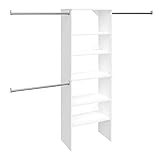
Aheaplus plays a different game from everyone else here: width. This set is built for spaces from 6 to 15 feet wide, arranging two towers, four expandable hanging rods and eight wooden drawers along the wall, with six shelves, two of them adjustable, and anti-tip kits in the box. The overall depth is about 15.8 inches and the height 80 inches, and the sections can be arranged side by side or split, so a long wall gets a continuous run and a two-wall closet gets a tower on each side. Eight drawers is the headline: it is double the Unikito’s count and four times the SuiteSymphony kit’s, which makes this the only pick that can genuinely retire a bedroom dresser rather than merely supplement one.
It sits near the top of this budget — check the current price on Amazon — and fairly so for the width covered. Two practical notes from review coverage of this system deserve printing: it ships in two boxes that may arrive on different days, so do not book the installation weekend until both have landed, and a build this wide is a two-person afternoon, not a solo hour. The construction is engineered wood throughout — at this width and price, solid timber is not on the menu anywhere, whatever a listing’s photos imply.
In an apartment, all of that cuts harder than it does in a house. A 6-to-15-foot system presumes a wall most rentals do not have; assembled at width, it is the least portable purchase in this guide, the hardest to resell quickly, and the most likely to be left behind or sold at a steep discount when the lease ends. None of that makes it a bad system — it makes it a long-lease system. If your tenancy is a year, the honest pick is a VIPEK that leaves with you; if you have signed for three years in a loft with one enormous wall, this is the only pick that fills it.
- Eight wooden drawers and two towers across a 6 to 15 foot fit range — the widest system in this guide.
- Four expandable rods and six shelves, with sections that can split across two walls.
- Positioned near the top of this budget for the widest fit range here — check price on Amazon.
Honest limitation: It ships in two boxes that can arrive days apart, the install is a two-person job, and in a closet under eight feet you are paying for width you will never use — the Unikito covers that wall from a lower position in this band, and neither of them moves house gracefully.
Choose it if your rental is ten feet or wider at the closet wall and your lease runs long. Skip it if your closet is a standard reach-in, your tenancy is short, or you want a single-brand add-on catalog behind the kit.

Comparison Table
| Product | Type | Best use | Link |
|---|---|---|---|
| ClosetMaid SuiteSymphony Kit with 2 Drawers, Graphite Grey | Wall-anchored laminate system | The built-in furniture look for 5 to 9 foot closets — long leases, permission granted | Check on Amazon |
| Unikito 8FT Closet System with Mirror, White | Wood walk-in system | Four drawers and a mirrored tower across eight feet | Check on Amazon |
| VIPEK V50 Extra Large Closet Rack, Black | Freestanding steel frame | Maximum hanging without drilling, nearly 90 inches wide | Check on Amazon |
| VIPEK X3 Expandable Clothes Rack, Black | Expandable freestanding frame | Odd widths and corners, 62 to 96 inches — fits this apartment and the next | Check on Amazon |
| ClosetMaid SuiteSymphony 25-Inch Starter Kit, Pure White | Starter tower kit | Building the furniture-look closet in stages across a lease | Check on Amazon |
| Aheaplus Closet System with 8 Drawers, White | Wide multi-tower system | Walk-ins and loft walls from 6 to 15 feet that need real drawer storage | Check on Amazon |
How to Choose a Closet Organizer for an Apartment Under $400
- Read the lease before the listings. Many leases restrict drilling outright or allow small holes with patching. A wall-anchored kit is only a bargain if you are allowed to anchor it; knowing the rule tells you whether you are shopping the wall kits or the freestanding frames.
- Run the tenancy test on anything permanent. Weigh what an anchored kit asks of you against the months left on your lease, honestly — not the renewal you hope for, the term you have signed. The same kit is easy to justify across a long tenancy you will dress from daily, and much harder to justify with only a short stretch left, after which it stays behind. A short remaining term is a reason to buy a frame that leaves with you instead.
- Decide what the $400 is really buying. At this tier the money splits three ways — finish (laminate systems), drawers (wood walk-in sets), or raw capacity (freestanding steel). Pick the one your closet lacks; no kit here wins all three, and renters usually get the most from the one that survives the move.
- Price the complete closet, not the kit. Starter towers need their add-ons, and wall kits assume your wall is the size on the box. A starter tower plus the drawers and doors it needs to feel finished adds up to a full-system commitment wearing a starter label — fine, if the lease is long enough for stage two.
- Read load ratings as maker claims. The four-digit totals are whole-system marketing. The per-part numbers — per rod, per shelf — and modest system ratings like the SuiteSymphony’s 175 lb are the figures to load by, especially when the load hangs off a wall you must hand back.
- Measure the wall, then the wardrobe. Width decides the kit; the wardrobe decides the layout. Count your long-hang items (dresses, coats) separately from double-hang (shirts, trousers) before choosing, because kits allocate their rods very differently — and measure at several heights, because apartment closets are rarely square.
- Check the depth against your hangers and your doors. Most systems here are about 16 inches deep; a standard hanger with a coat wants roughly 20 inches of swing room inside a closed closet. In a 24-inch reach-in that works; in a shallow rental closet with bifold doors, measure before you fall in love.
- Count drawers honestly. A drawer you will open daily is worth more than two shelves of folded stacks. If the closet must replace a dresser — common in studios and small rentals — start from the drawer count: eight, four, two, none, and shop backwards from it.
- Plan the exit before the install. Know how the system comes apart, whether it fits through the door and into a car or van, and what you will do with it if the next apartment’s closet is a different width. The purchase you can take with you is worth more than its spec sheet says.
- Anchor anything tall and loaded. Towers and wide frames ship with anti-tip hardware for a reason. A single small fixing is usually the most lease-friendly hole in this whole guide — fit it, especially anywhere a drawer stack could be climbed.
The Lease Test: What $400 of Closet Is Allowed to Touch Your Walls
Nothing about a closet organizer is inherently anti-lease. Every pick in this guide is removable, and even the wall-anchored kits leave nothing behind that filler and paint cannot erase in an afternoon. But leases are not written about outcomes; they are written about actions, and the action most of them regulate is drilling. So the lease test has three questions, in order. Does your lease restrict holes in walls, and does it distinguish between a picture hook and a closet anchor? Closet interiors are where landlords are most relaxed — the holes are invisible in daily life and patch to nothing — but the clause, not the custom, is what your deposit is judged against. Second: if the lease is silent or restrictive, have you asked? A short email — “may I anchor a closet tower inside the bedroom closet, holes patched at move-out?” — gets a yes surprisingly often, and a written yes is worth more than any assumption. Third: what does the system actually need? The SuiteSymphony kits anchor a tower and rails at multiple points. The freestanding VIPEKs need nothing at all, except the anti-tip strap’s single small fixing — which is the one hole in this guide we would argue for even under a strict lease, because a loaded 76-inch frame is a safety item, not a decoration.
Renters who cannot get a yes are not locked out of this tier; they are routed within it. The V50 and X3 carry a full wardrobe on the floor, the Unikito stands as furniture, and only the two SuiteSymphony kits truly require the wall. What a no-drilling lease does forbid is pretending otherwise: hanging a laminate tower on drywall anchors because the wall “felt solid,” or skipping anchors entirely and leaning the tower, is how an anchored kit becomes a deposit deduction and a pile of split particleboard. The lease test is not a hoop to jump through before the real shopping. At $400, it is the real shopping — it decides which family of system you are buying before price, finish or drawers get a vote.
Tenancy Logic: Judging a Permanent Kit Against the Lease You Have Left
A homeowner judges a closet against the years they will own the house. A renter has a harder test: the months left on a signed lease. Weigh a permanent kit against that remaining term honestly and the guide re-sorts itself. The SuiteSymphony drawer kit is an easy yes across a long tenancy — a closet you dress from daily, in a place you expect to stay, has ample time to earn its place near the top of this budget. The same kit with only a short stretch left on the lease is a much harder case, because at move-out it becomes a fixture in someone else’s apartment: its residual value to you is close to zero, since a wall-anchored laminate kit is worth almost nothing once removed. Against that, a freestanding VIPEK frame asks for no such justification — when the lease ends it comes apart, gets into the car, and keeps serving in the next apartment, so the purchase survives the tenancy that paid for it.
Two refinements keep that judgment honest. First, cut-to-fit is a tenancy decision, not a fitting detail: the Unikito trimmed to this closet is a system that fits exactly one closet in the world, so it has to justify itself here, in this lease, the same way an anchored kit does. Second, staged buying is the renter’s hedge. The SuiteSymphony starter tower is a smaller commitment placed now; the drawers and doors are a second commitment placed only after the lease renews. That is the one structure in this guide that lets the tenancy prove itself before the full budget is committed — and it is worth more to a renter than the same commitment made all at once on a system that cannot wait.
Moving Day, and What $400 Cannot Buy
Moving day applies the final test, and the six picks rank almost inversely to their permanence. The X3 telescopes down and fits the next closet in a width band — the only pick here bought for a range rather than a measurement. The V50 breaks down into a car-load of steel and reassembles at the same generous size. The starter tower unbolts, though its add-on dreams travel with it only if the next closet suits the same line. The Unikito and the Aheaplus move the way furniture moves: possible, heavy, two people and a van, with every cut and trim made for the old apartment now working against the new one. And the anchored SuiteSymphony kit, the best-looking closet in this guide, mostly does not move at all — it is sold with the tenancy, gifted to the next tenant, or left as the previous renter’s upgrade, which is exactly why it had to be justified against the length of the lease above.
It is also worth stating plainly what is not in this guide, because renters at this budget often go looking for it and are told it is one upgrade away. A professionally designed custom closet — a design service, made-to-measure millwork, installation included — sits far above this guide’s budget and climbs steeply from there; nothing in this budget is that product with a different label. Solid wood is the other absence: John Louis Home’s Standard system is genuine kiln-dried pine and is sold on Amazon, but we could not verify that it belongs within this guide’s budget this session, and its drawer-equipped Deluxe systems and walk-in layouts sit above this budget — so it is named here, honestly, without a link. Elfa, the premium track program from The Container Store, is not sold on Amazon at all. And Easy Track’s rail-hung Deluxe Starter kits are a legitimate alternative we came across on Amazon, but we could not verify the listing’s ASIN this session, so it is named rather than linked. What $400 genuinely buys in a rental — and the six picks above are the proof — is one wall of a closet finished properly, in a form your lease allows and your tenancy can repay.
Common Buying Mistakes
- Anchoring a wall kit in the last months of a lease, then donating it to the next tenant because it cannot practically move.
- Drilling first and reading the lease afterwards — the deposit conversation happens at move-out, when the holes are counted.
- Cutting a cut-to-fit system to this apartment’s closet without counting the tenancy: trimmed is forever, and it fits no future closet.
- Comparing systems by their headline load total — 1,300 lb against 1,000 lb — instead of by drawers, rod layout and per-part limits.
- Treating a starter tower as a finished closet, then being surprised by the add-on drawer and door prices on the way to the imagined result.
- Skipping the anti-tip anchor on a tall frame because the lease forbids holes, then loading the top shelves heaviest — the one small fixing is the cheapest safety in this guide.
- Ordering a two-box wide system and booking the installation for the day the first box arrives.
- Measuring the closet’s width and forgetting its depth — then discovering the bifold doors will not close over hangers in a 16-inch-deep system.
- Buying an eight-foot system for a six-foot rental closet because the wider system looked like better value; unused width is not storage, it is a moving problem.
- Choosing the furniture finish for a closet that lives behind a closed door, while the drawer count — the thing you touch daily — goes short.
Final Recommendation
- Long lease, permission to anchor: ClosetMaid SuiteSymphony Kit with Tower, Top Shelves and 2 Drawers, Graphite Grey.
- Drawers and value: Unikito 8FT Closet System with 4 Drawers and Mirror.
- No drilling, maximum hanging: VIPEK V50 Extra Large Closet Rack.
- Odd widths, corners and future moves: VIPEK X3 Expandable Heavy Duty Clothes Rack.
- Building in stages: ClosetMaid SuiteSymphony 25-Inch Starter Kit, Pure White.
- Wide loft walls on a long lease: Aheaplus Closet System, 6–15 Ft, with 8 Wooden Drawers.
Our top two are the SuiteSymphony drawer kit for renters whose lease and landlord allow anchoring, and the Unikito 8FT for renters who would rather have four drawers and a mirror than a furniture-brand finish, because between them they cover the two honest reasons to spend $400 on an apartment closet: how it looks from the doorway, and how it works at 7 a.m. If your walls are off-limits, skip both without regret and take the VIPEK V50’s capacity from well within the budget — or the X3, if your next closet’s width is still a guess. None of these systems will turn a rental reach-in into a boutique dressing room, and they do not try to. They are one wall, finished properly, in a form your tenancy can repay: read the lease, weigh the kit against the time left on it, respect the per-part load limits, check the current price on Amazon, and order the one that matches the apartment — and the lease — you actually have.
Frequently Asked Questions
Can a renter install a wall-mounted closet system?
Usually, with permission. A wall-anchored kit like the SuiteSymphony leaves a handful of screw holes inside the closet — the most forgiving surface in the apartment, patching invisibly with filler and paint. But the lease governs, not the custom: check its drilling clause, and if it is silent or restrictive, get a short written yes from the landlord before you order. If the answer is no, the freestanding frames in this guide need no permission at all.
Will closet anchor holes cost me my deposit?
Patched closet holes, on their own, rarely do — they are comparable to picture-hanging holes and sit inside a closet where they are barely visible. Unpatched holes, anchors torn out of drywall, or a tower hung without studs that has pulled its fixings loose are a different story. The deposit risk in this guide is not drilling; it is drilling badly, or drilling where the lease expressly forbids it.
How long a lease justifies a premium wall kit?
Weigh it against the time you have actually signed for. An anchored kit near the top of this budget has ample time to earn its keep across a long tenancy — and unlike a freestanding frame, it is worth almost nothing to you the day you move out. As a rule of thumb: two years or more, a wall kit can justify itself; under a year, buy the system that leaves with you.
Which system is best if I move every year or two?
The VIPEK X3. It is freestanding, so no permission and no patching; it disassembles for the car; and its shelves and rods telescope from 62 to 96 inches, so it fits the next apartment’s closet in a width band rather than at one exact measurement. The V50 is the runner-up — simpler and wider, but fixed at nearly 90 inches, which the next place has to have room for.
Is a freestanding rack sturdy enough for a full wardrobe?
Yes, loaded the way its per-part figures suggest. The V50’s reported maker figures run about 75 lb per hanging rod and 88 lb per wire shelf — a full rail of winter coats is roughly the heaviest load a wardrobe applies to one part. The four-digit totals (1,300 lb on the V50, 1,210 lb on the X3) are whole-frame maker claims under ideal, evenly spread loads; plan by the small numbers, use the anti-tip anchor, and the frames feel overbuilt.
Do I need the anti-tip anchor if my lease forbids drilling?
The anchor is one small fixing, and it is the hole we would ask permission for even under a strict lease — a short email usually gets it, because landlords understand tipping furniture. If even that is refused, mitigate honestly: stand the frame flush to the wall, load the bottom shelves heaviest, keep the top light, and never let a drawer stack or a loaded frame stand where a child could climb it. What you should not do is skip the anchor and load the top like it is there.
What if the system does not fit my next apartment?
That depends entirely on which kind you bought. The X3 re-telescopes to a new width. The V50 needs another long wall. Furniture systems like the Unikito and Aheaplus can be split into sections or resold locally, at a discount for the trims made to your old closet. An anchored laminate kit, realistically, stays — which is why this guide judges it against the lease you have signed, not the one you hope to sign next.
- Best Closet Organizer Under $400
- Best Closet Organizer For Apartments Under $200
- Best Closet Organizer Under $1000
- Best Blackout Curtains For Apartments Under $400
Related Guides
- Best Closet Organizer For Apartments Under $30
- Best Closet Organizer For Apartments Under $75
- Best Closet Organizer For Apartments Under $100
- Best Closet Organizer For Apartments Under $200
- Best Closet Organizer For Apartments Under $700