Disclosure: airfryerkitchensupply.com is reader-supported. When you buy through links on our site, we may earn an affiliate commission at no extra cost to you.
How to Choose Children’s Slippers: Start With the Sole
The sole is the most important and most overlooked part of a child’s slipper. For toddlers and early walkers, insist on a rubber or rubber-like outsole with visible tread; fabric soles and simple grip dots wear smooth quickly and are the main reason children slide on tile and hardwood. For older children, an indoor-outdoor rubber or TPR sole is close to mandatory, because they will wear the slippers outside whatever the label says, and a sole that cannot handle concrete will be worn through in a month.
Sole flexibility matters in the opposite direction for the youngest wearers. A toddler’s foot is still developing, and a very stiff sole changes how they walk. Look for soles that flex at the ball of the foot with gentle hand pressure. School-age children can handle — and benefit from — firmer soles with more structure, especially if they wear slippers for hours at a time.
Sizing Children’s Slippers Without the Guesswork
Children’s slipper sizing is the category’s biggest source of returns, because three systems overlap: toddler, little kid and big kid sizes, and the same number means different lengths in each. Always measure the child’s foot in the evening, standing, in the socks they will wear with the slippers, and match the measurement in centimeters or inches to the specific listing’s size chart rather than trusting the headline size. When a child falls between sizes in a soft slipper, choose the larger size; in a structured moccasin, stay closer to the true size so the heel does not slip.
Leave roughly a thumb’s width — about half an inch — of growing room at most. More than that in a backless or loose slip-on creates a trip hazard, because the foot slides forward and the child shuffles to keep the slipper on. Check fit monthly for under-fives: at peak growth, a size lasts only a few months, and children rarely report tight footwear until it is already distorting how they walk.
Warmth, Materials and the Season Question
Match the lining to your floors, not to the calendar. Sherpa and faux-shearling linings suit unheated floors, stone, tile and cold climates. Real shearling, as on the Project Cloud pick, adds breathability that matters for all-evening wear. Plush uppers without lining are comfort products for milder rooms. Unlined moccasins and house shoes are the right answer for heated floors and warm climates, where a lined slipper simply becomes a sweaty one that children kick off.
On materials generally: leather uppers outlast everything else here but demand gentler care. Microsuede is the practical middle ground — durable, wipeable and inexpensive. Plush textiles are the softest and the fastest to look worn. If the slippers will be washed weekly, choose a synthetic pair designed for it and keep leather and shearling out of the rotation.
Safety Checks Worth Doing at Home
When a new pair arrives, run three quick checks before the tags come off. First, the bend test: the sole should flex at the toes, not fold in the middle of the arch. Second, the grip test: have the child walk, then shuffle deliberately, on your smoothest floor while you watch for sliding. Third, the retention test: ask the child to hop and to walk up stairs; a slipper that leaves the foot on stairs is a fall risk and should go back regardless of how cute it is.
Ongoing, inspect soles monthly. Smooth-worn tread on a child’s slipper is the equivalent of bald tires, and it happens fastest on the fabric-soled pairs. Also check inside for compressed, lumpy footbeds and for any detached lining a small child could pick at. Retire slippers when the sole is smooth, the upper tears at the toe, or the foot overhangs the footbed — whichever comes first.
How to Measure Your Child’s Foot and Break In New Slippers
Step one: measure at the right time. Feet are at their largest in the late afternoon or evening, and a morning measurement can under-read by half a size. Have the child stand with full weight on a sheet of paper against a wall, in the socks they will wear with the slippers. Step two: mark the heel and the longest toe on the paper, then measure the distance with a ruler. Repeat with the other foot — most children have one foot measurably larger — and use the larger measurement.
Step three: match the measurement to the size chart on the specific listing you are buying, not to a generic chart and not to the size of the child’s current trainers. Brands cut slippers on different lasts, and moccasin styles in particular run closer than plush styles. Step four: when the slippers arrive, do the thumb check at the toe and the heel-slip check on a walk down the hall before removing any packaging you would need for a return.
Breaking in is gentle for children’s slippers because the materials are soft, but a short first wear still helps. Let the child wear new slippers for an hour indoors the first evening rather than a full day, and check for red marks at the heel and toes afterward. Memory foam footbeds will mold noticeably over the first week, so a pair that feels merely okay on day one often feels better by day seven — while a pair that pinches on day one will not improve, because foam compression does not add length. Distinguish snug from short: snug is fine, toes touching the front is not.
Slippers by Age: What Changes From Toddler to Big Kid
The toddler stage, roughly ages one to three, is about protection and grip with minimal structure. Feet at this age are still largely cartilage, walkers are unsteady, and the slipper’s job is to keep toes warm and steps planted without interfering with natural foot movement. Soft uppers, flexible thin rubber soles and easy, forgiving fits are correct here, which is why the Dearfoams Lil Bear leads this stage of the guide. Avoid anything stiff, heavy or high-cut at this age, and expect to replace pairs for size long before they wear out.
Preschool and early school years, roughly ages four to seven, add independence and range. Children this age dress themselves, roam the whole house, and begin the indoor-outdoor drift that destroys fabric soles. This is the stage where elastic-gore moccasins and lined house slippers earn their keep: the child can pull them on alone, the sole survives the driveway, and the lining question depends on your floors. It is also the age where design starts to matter socially — a child who finds their slippers babyish will simply stop wearing them, so involve them in the choice between two parent-approved options.
Big kids, roughly ages eight and up, wear slippers like light shoes and should buy them that way. Weight and activity both rise, so cushioning compresses faster, soles need genuine tread, and structure matters for children who spend whole evenings on their feet. Plain, shoe-like styling is not vanity at this age; it is what makes the product usable. Parents should also start checking wear the way they would on trainers — monthly sole inspections, and replacement when tread smooths out — because a big kid in a worn-out slipper on a staircase is the highest-risk combination in this entire category.
Where to buy
The best childrens slippers below were verified cache, with each review quoting its size band and sole facts from the verified title wherever the title states them. This roundup deliberately reviews six models not repeated in the sibling house-slippers guide, for twelve distinct verified options across both.
Fireside by Dearfoams Unisex Child Dempsey Shearling Clog Slipper (Chestnut, 3 Big Kid) — Check the current price on Amazon
Hurley Kids Modi Slippers (Chestnut, Faux Fur Fleece Lining) — Check the current price on Amazon
OWIF Toddler Slippers — Dinosaur (Green, Non Slip) — Check the current price on Amazon
Dearfoams Kids Toddlers Whimsical Animal Critter Washable Slipper (Purple Unicorn, US 7-8) — Check the current price on Amazon
L-RUN Toddler Slipper (Beige, 5.5-6 Infant = EU22-23) — Check the current price on Amazon
Fadezar Toddler Slipper — Bunny (Pink, Non-Slip Rubber Sole, 8-9 Toddler) — Check the current price on Amazon
Introduction: Finding the best childrens slippers Without Guesswork
The search for the best childrens slippers lands parents in a category where cuteness is oversupplied and information is not: listings lead with characters and colours, while the facts that decide success — which size band, what sole, how it stays on — sit in the small print. The best childrens slippers answer those facts in their titles, and this guide chose its six picks by reading titles the strict way: house slippers only, in children’s bands, with every sole, lining, and material claim traceable to the verified API text. No dance or ballet slippers, no sandals or slides, and nothing sold on medical promises.
The six span the range a family actually shops: a genuine shearling clog for big kids, fleece-lined slip-on slippers from a major children’s brand, a dinosaur slipper with a stated non-slip build for playful ages, a washable animal critter slipper for toddlers, a small-size toddler slipper in an infant-to-toddler size, and a plush bunny slipper with a stated non-slip rubber sole and a half-cover heel. Between them: every band from infant sizes to big kids, and warmth from everyday cosy to deep winter.
A sibling guide on this site covers children’s house slippers with a different six models; this roundup’s angle is the broader children’s category — the gift purchase, the replacement purchase, the grandparent purchase — judged on the same strict evidence. Where the two guides agree is on method: measure the foot, respect the band, and let the sole suit the floors of the house the slippers will actually live in.
A final framing note: this guide treats slippers as part of a child’s home equipment, closer to pyjamas than to fashion. The questions that matter are the pyjama questions — does it fit this season, is it warm enough for this house, does it survive this family’s laundry, will the wearer actually keep it on. Answer those from verified titles and measured feet, and the category’s noise falls away.
Key Takeaways
- This roundup’s six models are distinct from the sibling house-slippers guide — twelve verified options across both.
- Size bands and stated soles lead every review; character designs come second, where they belong.
- Washability is a headline feature for toddlers — one pick states it in its title.
- Shearling and fleece linings mark the warm end; plush novelty designs mark the fun end; both are legitimate.
- A half-cover heel and enclosed formats stay on better than backless scuffs for young children.
In this guide
Quick Picks
Six verified childrens slippers, none repeated from the sibling guide. Badges name each pair’s job, and reviews repeat the confirmed band and sole facts.
Best Overall: Fireside by Dearfoams Unisex Child Dempsey Shearling Clog Slipper (Chestnut, 3 Big Kid) — Check price on Amazon
Best Warm Slip-On: Hurley Kids Modi Slippers (Chestnut, Faux Fur Fleece Lining) — Check price on Amazon
Best for Playful Toddlers: OWIF Toddler Slippers — Dinosaur (Green, Non Slip) — Check price on Amazon
Best Washable: Dearfoams Kids Toddlers Whimsical Animal Critter Washable Slipper (Purple Unicorn, US 7-8) — Check price on Amazon
Best for the Smallest Feet: L-RUN Toddler Slipper (Beige, 5.5-6 Infant = EU22-23) — Check price on Amazon
Best Plush with a Real Sole: Fadezar Toddler Slipper — Bunny (Pink, Non-Slip Rubber Sole, 8-9 Toddler) — Check price on Amazon
How These Picks Were Chosen
The selection rules matched the sibling guide’s and added one of its own: no model could repeat. Candidates had to be children’s house slippers verified cache; ballet, dance, and kung-fu styles, sandals, slides, flip-flops, massage footwear, and baby booties were excluded, as was any listing whose main pitch was medical. Claims in reviews come only from listed titles, and the cache’s own notes where they exist.
The resulting six balance the category’s real axes: warmth (a shearling clog, a fleece-lined slip-on), care (a washable critter slipper), grip (two picks stating non-slip construction), and the novelty factor that decides toddler compliance (a dinosaur, a bunny). Bands run from an infant/toddler size through big-kid, so a family with siblings can shop the whole list. Adult slippers that merely look small in photographs were excluded — every pick is a children’s product by its own title.
One further selection principle deserves recording: the six picks were required to be purchasable as a coherent set across a childhood, not merely as six isolated good pairs. Bands had to tile the map from infant sizes to big kids without a hole a parent would fall through mid-growth, and warmth levels had to span the year so that a family could stay inside this one verified list from first walkers to the last year slippers are worn at all. A roundup is a small system, and this one was assembled as a system — which is why its internal variety is deliberate rather than accidental, and why its two or three redundancies sit exactly where childhood moves fastest.
The 6 Best Childrens Slippers, Reviewed by Band, Sole, and Warmth

Fireside by Dearfoams Unisex Child Dempsey Shearling Clog Slipper (Chestnut, 3 Big Kid) — Best Overall
The Dempsey takes the top badge on construction: a children’s clog slipper in genuine shearling, stated plainly in its title, in a 3 Big Kid size, in chestnut. Shearling is the traditional warm-slipper material — naturally warm, breathable, and durable — and the Fireside line is the premium branch of a major slipper maker, which shows in the format: an enclosed clog that stays on a big kid’s foot through household traffic, rather than a novelty shell over a thin sole.
The clog format’s trade is openness at the heel: easier on and off, slightly less locked-in than a full moc, and for big kids — competent walkers all — that trade usually favours the clog. The title states no sole technology, so none is claimed; on very smooth floors, the sole guidance in the buying guide applies. Chestnut shearling also hides wear gracefully and suits the gift occasion. For a big kid in a cold house, this is the pair most likely to still be in service next winter.
Strengths
- Genuine shearling stated in the verified title
- Enclosed clog format stays on big-kid feet
- Chestnut colour hides everyday wear
Trade-offs
- Heel-open clog is less locked-in than a moc
- Sole specifics not stated in the title
- Premium natural material, premium tier
Spec box (from the verified listing title only):
- Size stated in listing title: 3 Big Kid US
- Material stated in listing title: genuine shearling
- Style stated in listing title: clog slipper
Best for: big kids in cold houses, and gift purchases that should last / Not suited for: toddlers, whose bands and balance needs differ
Check on Amazon — check price on Amazon before ordering, and confirm the size and configuration on the listing page.
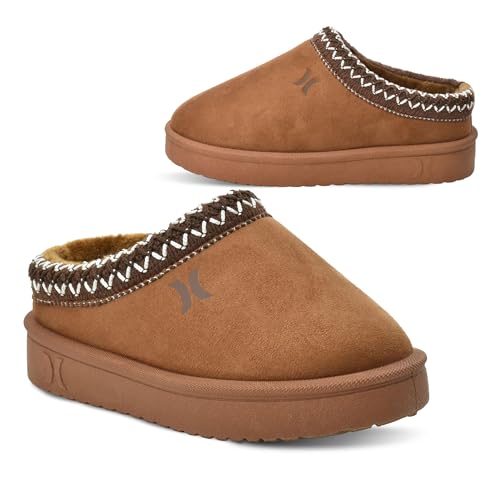
Hurley Kids Modi Slippers (Chestnut, Faux Fur Fleece Lining) — Best Warm Slip-On
The Modi is the warmth-and-durability pick from a brand children recognise: slip-on clog slippers with a faux fur fleece lining, positioned by their title as warm winter house slippers for boys and girls, in chestnut. The title’s own word durable leads its pitch, and the format backs it — an enclosed clog body that shrugs off the door-frame bumps and stair-edge scuffs of household life better than an all-plush novelty slipper.
The indoor-outdoor wording in the title gets the same interpretation as elsewhere in this guide: a sole that tolerates the porch and the doorstep, in a product that remains house footwear. No numeric size appears in the title text, so the listing’s selector and an evening foot measurement are the route to the right pair. For a child who runs cold and a parent who wants one sturdy pair for the whole winter, the Modi’s stated lining and clog build make it the workhorse pick.
Strengths
- Faux fur fleece lining stated in the title
- Durable positioning from a recognised kids’ brand
- Enclosed clog format for household knocks
Trade-offs
- Numeric size not stated in the title — check the selector
- Indoor-outdoor wording should not make it a school shoe
- Clog format is heel-open
Spec box (from the verified listing title only):
- Lining stated in listing title: faux fur fleece lining
- Format stated in listing title: slip-on clogs
- Positioning stated in listing title: warm winter house slippers
Best for: cold floors and children who are hard on slippers / Not suited for: households wanting a fully enclosed heel
Check on Amazon — check price on Amazon before ordering, and confirm the size and configuration on the listing page.
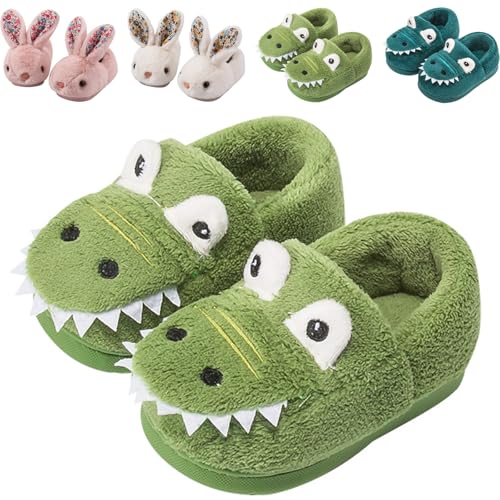
OWIF Toddler Slippers — Dinosaur (Green, Non Slip) — Best for Playful Toddlers
The dinosaur pick understands its wearer: for a toddler, the slipper that gets worn is the one that is also a toy, and a green dinosaur clears that bar effortlessly. Crucially, the fun is not the whole product — the title states non slip construction and warm, soft, winter-fuzzy positioning for indoor bedroom use, which is the correct feature stack for a small child on home floors: grip for the wobble years, warmth for cold mornings, and a design that earns cooperation at the bedroom door.
The title addresses toddler boys in its wording; the dinosaur itself answers to any toddler who roars. No numeric band appears in the title, so sizing runs through the listing’s chart against a measured foot, as the how-to section describes. Novelty slippers sometimes skimp on enclosure; a house-shoe format like this one, rather than a backless scuff, is the right shape for the age. This is the pair most likely to be requested by name each morning.
Strengths
- Non slip stated in the verified title
- Warm fuzzy winter construction stated
- Dinosaur design earns toddler compliance
Trade-offs
- Numeric band not stated in the title
- Novelty design has a natural age limit
- Marketed wording says boys — the design suits any dinosaur fan
Spec box (from the verified listing title only):
- Sole stated in listing title: non slip
- Warmth stated in listing title: warm, soft, winter fuzzy
- Audience stated in listing title: toddler boys
Best for: toddlers who need a reason to keep slippers on / Not suited for: older children who have outgrown novelty designs
Check on Amazon — check price on Amazon before ordering, and confirm the size and configuration on the listing page.

Dearfoams Kids Toddlers Whimsical Animal Critter Washable Slipper (Purple Unicorn, US 7-8) — Best Washable
Washable is the word that earns this pick its badge, stated right in the title: a toddler critter slipper, in a purple unicorn design, in a US 7-8 toddler size, that can be washed. Anyone who has parented a toddler through a stomach bug, a juice incident, or a garden-door expedition in indoor footwear knows that washability is not a convenience feature — it is the difference between a slipper that survives the season and one that is retired by an smell. The whimsical critter format keeps the compliance factor high while the care story stays practical.
The title does not state sole technology, so grip claims are not made here; the buying guide’s floor guidance applies, and toddlers on stairs need supervision regardless. Dearfoams’ children’s line is an established quantity, and a stated size in the title — rarer than it should be in this category — makes ordering cleaner. For the youngest wearers in this roundup, washable plus whimsical is the correct combination.
Strengths
- Washable stated in the verified title
- Precise US 7-8 toddler size in the title
- Critter design encourages wearing
Trade-offs
- Sole specifics not stated in the title
- Unicorn design will not suit every child
- Toddler band is outgrown quickly
Spec box (from the verified listing title only):
- Size stated in listing title: US 7-8, toddlers
- Care stated in listing title: washable
- Design stated in listing title: animal critter, purple unicorn
Best for: toddlers and the parents who wash what toddlers wear / Not suited for: big kids, and households prioritising stated grip soles
Check on Amazon — check price on Amazon before ordering, and confirm the size and configuration on the listing page.

L-RUN Toddler Slipper (Beige, 5.5-6 Infant = EU22-23) — Best for the Smallest Feet
The smallest feet in the roundup get the most precisely labelled pick: the L-RUN title states its size two ways — 5.5-6 Infant and EU22-23 — which removes the conversion guessing that plagues cross-border children’s sizing. It is an indoor house slipper in beige, for girls or boys per the title, aimed at the stage where a child is walking confidently indoors and cold or smooth floors make bare feet impractical.
At this size, the review’s guidance matters more than its feature list, and the title is short on features — no sole or lining claims are stated, so none are repeated. What can be said: choose the size by measured foot length against the stated EU band, keep the use indoor and supervised on stairs, and expect the pair to be outgrown on schedule. A plain beige slipper at this age is also the hand-me-down champion of the category, passing to a sibling without a design argument.
Strengths
- Dual size labelling (US infant and EU) in the title
- Unisex beige suits siblings and hand-me-downs
- Indoor house positioning stated
Trade-offs
- No sole or lining claims stated in the title
- Smallest band — shortest service life
- Plain design offers no novelty compliance hook
Spec box (from the verified listing title only):
- Size stated in listing title: 5.5-6 Infant = EU22-23
- Positioning stated in listing title: indoor house slipper
- Colour stated in listing title: beige
Best for: the youngest indoor walkers in the 5.5-6 infant band / Not suited for: children who need stated grip or warmth features
Check on Amazon — check price on Amazon before ordering, and confirm the size and configuration on the listing page.

Fadezar Toddler Slipper — Bunny (Pink, Non-Slip Rubber Sole, 8-9 Toddler) — Best Plush with a Real Sole
The bunny pick closes the roundup by combining the category’s two toddler virtues in one title: a warm, cosy plush bunny design for autumn and winter, and a stated non-slip rubber sole — plus a half cover heel, the small design decision that keeps a plush slipper on a small foot instead of decorating the hallway floor. The size is stated precisely at 8-9 Toddler, unisex, in pink.
Rubber as the stated sole material matters: it is the sole construction most likely to keep its grip through a season of kitchen floors, and the half-cover heel answers the plush category’s usual weakness, which is heels slipping out of soft uppers. The title’s warmth language is seasonal and this review repeats it as such — this is an autumn-and-winter pair, and a hot summer house will want a lighter option from the sibling guide. For a plush purchase that respects physics, this is the one.
Strengths
- Non-slip rubber sole stated in the title
- Half cover heel helps the slipper stay on
- Precise 8-9 Toddler size stated
Trade-offs
- Pink bunny design will not suit every child
- Warm plush is a cold-season weight
- Novelty format has an age ceiling
Spec box (from the verified listing title only):
- Size stated in listing title: 8-9 Toddler
- Sole stated in listing title: non-slip rubber sole
- Design stated in listing title: half cover heel; warm bunny, cozy plush
Best for: toddlers in the 8-9 band during autumn and winter / Not suited for: summer wear or children past novelty designs
Check on Amazon — check price on Amazon before ordering, and confirm the size and configuration on the listing page.
Comparison Table
The table below puts the picks side by side using only the key specification confirmed in each verified listing title, so the comparison never claims more than the listings themselves state.
| Pick | Badge | Key spec (listing title) | Best for |
|---|---|---|---|
| Fireside by Dearfoams Unisex Child Dempsey Shearling Clog Slipper (Chestnut, 3 Big Kid) | Best Overall | Size stated in listing title: 3 Big Kid US | big kids in cold houses, and gift purchases that should last |
| Hurley Kids Modi Slippers (Chestnut, Faux Fur Fleece Lining) | Best Warm Slip-On | Lining stated in listing title: faux fur fleece lining | cold floors and children who are hard on slippers |
| OWIF Toddler Slippers — Dinosaur (Green, Non Slip) | Best for Playful Toddlers | Sole stated in listing title: non slip | toddlers who need a reason to keep slippers on |
| Dearfoams Kids Toddlers Whimsical Animal Critter Washable Slipper (Purple Unicorn, US 7-8) | Best Washable | Size stated in listing title: US 7-8, toddlers | toddlers and the parents who wash what toddlers wear |
| L-RUN Toddler Slipper (Beige, 5.5-6 Infant = EU22-23) | Best for the Smallest Feet | Size stated in listing title: 5.5-6 Infant = EU22-23 | the youngest indoor walkers in the 5.5-6 infant band |
| Fadezar Toddler Slipper — Bunny (Pink, Non-Slip Rubber Sole, 8-9 Toddler) | Best Plush with a Real Sole | Size stated in listing title: 8-9 Toddler | toddlers in the 8-9 band during autumn and winter |
How to Choose Childrens Slippers: Band, Closure, and Sole
Start with the band, because children’s sizing is three scales wearing one vocabulary. Infant, toddler, little kid, and big kid sizes each run their own numbering, and the same numeral means different feet on different scales. The dependable method is a measured foot length — child standing on paper in the evening, heel to longest toe — matched against the specific listing’s chart. Several picks here state their band or size in the title itself, which is the category at its best; where a title does not, the chart on the listing is the only authority worth trusting.
Closure decides whether the measured fit survives contact with childhood. Enclosed mocs and clogs stay on; half-cover heels, like the bunny pick’s stated design, are the plush category’s answer to the same problem; loose backless scuffs are the format most likely to be found abandoned under furniture. Soles decide the floor question: stated non-slip constructions — rubber soles especially — for tile, wood, and laminate; softer soles are fine for carpeted homes. Choose in that order and most children’s slipper purchases simply work.
Warmth, Washability, and the Real Life of a Child’s Slipper
A child’s slipper lives harder than an adult’s: it meets breakfast spills, bathroom puddles, pet water bowls, and the occasional unauthorised garden expedition. Warmth features should therefore be read alongside care features. Shearling and fleece linings deliver the deepest winter warmth; plush synthetics deliver warmth with easier care; and a stated washable construction — the critter pick’s headline — is worth more across a toddler season than any marginal difference in softness, because an unwashable slipper’s life ends at its first unforgettable incident.
Plan the rotation the way you plan children’s shoes generally: one pair in service, expectations set for a size change within the year, and a recheck of fit whenever behaviour changes — shuffling, kicking off, or toe-curling are a child’s size chart, written in actions. None of this requires premium spending; it requires the band, the sole, and the care story to be right, which is why this guide quotes those from titles and stays silent where titles are silent.
House Slippers Are Indoor Footwear: Scope and Supervision
Every product in this roundup is a house slipper, and the category’s scope deserves one plain paragraph. House slippers provide warmth, comfort, and steadier footing on indoor floors. They are not outdoor shoes, whatever a title’s indoor-outdoor phrase suggests about doorstep tolerance, and they are not medical products — nothing here is presented as treating, supporting, or correcting any condition of a child’s foot, and comfort is the only promise this guide makes on any maker’s behalf.
Supervision completes the picture for the youngest wearers: toddlers on stairs need an adult’s attention in any footwear, new walkers do much of their learning barefoot on safe floors, and slippers join the routine for cold and smooth surfaces. Kept inside that scope, a good pair of children’s slippers is a small, daily kindness — warm feet at breakfast, steady steps on the kitchen tile, and a dinosaur or a bunny exactly where a small person left them, ready for tomorrow.
Slippers as Gifts: What Grandparents and Gift-Givers Should Know
Children’s slippers are a favourite gift precisely because they are useful, sized, and fun — and a frequent gift failure for the same reasons, when the size is guessed from the child’s age. Ages and shoe sizes correlate loosely at best in childhood, and a gift pair a size off is a pair unworn. The gift-giver’s correct move is unglamorous: ask the parent for the current shoe size or, better, the foot length in centimetres, and buy the band that measurement indicates. Several picks here state their size in the title, which makes the matching checkable before the box is wrapped.
Occasion shapes the choice within the list. The shearling Dempsey and the fleece-lined Hurley are the substantial winter gifts, the kind that anchor a holiday. The washable critter and the novelty dinosaur and bunny are the joyful gifts, sized for toddlers and priced by their nature as seasonal pleasures. A gift receipt and a note of the band bought are the two courtesies that complete any of them — children’s feet treat every calendar as a deadline, and an exchangeable right pair beats a sentimental wrong one every time.
Two Houses, School Bags, and Other Real-World Slipper Logistics
Modern childhood runs between addresses — two homes, grandparents’ houses, sleepovers — and slippers multiply accordingly. A practical pattern many families land on is a home pair and a travel pair: the best-fitting, grippiest pair stays at the main house, while a lighter, packable pair lives in the sleepover bag or at the grandparents’, where floor surfaces differ and a stated non-slip sole earns its keep on unfamiliar tile. The mid-tier picks in this guide suit the travel role well, and a pair left permanently at a second house ends the forgotten-slipper negotiation at every departure.
Labelling is the unglamorous technology that makes the system work: a name inside the heel, a photograph of the current pair on a parent’s phone for size reference, and a note of the band and brand that fit, kept where the next purchase will happen. Children’s slippers are replaced on a growth schedule, not a wear schedule, and the family that records what worked buys the next pair in five minutes — while the family that guesses buys it twice.
Reading a Children’s Slipper Listing Like a Reviewer
Parents can borrow this guide’s method for any listing it did not cover, because the method is only disciplined reading. Find four facts in the title or specifications: the band, stated in the seller’s own size language; the sole, stated as a construction or not stated at all; the lining or warmth material, stated or not; and the format — moc, clog, bootie, scuff — which decides how the slipper stays on. A listing that states all four is shopping-friendly. A listing that states only a character name and a colour is asking the photograph to do the work, and photographs of slippers are optimists.
Then apply the two scepticisms. First, audience scepticism: a title that says kids but shows adult proportions, or that mixes baby, toddler, and big-kid language in one breath, is a listing whose size selector must be read twice. Second, claim scepticism: comfort words are free, but construction words — shearling, rubber sole, washable, genuine leather — are checkable, and the listings worth money are the ones whose titles spend words on construction. The six picks here were chosen by exactly that reading, and any future pair can be judged by it in under a minute.
The Economics of Children’s Slippers: Cost Per Season, Not Per Pair
Children’s slippers invert normal value thinking, because the product expires by growth before it expires by wear. The right unit is cost per season of correct fit: a premium shearling pair that fits for one winter and hands down to a sibling for a second is, across two children, a mid-priced purchase twice over. A bargain pair in the wrong band that is refused, outgrown in a month, or retired with a smooth sole is expensive at any sticker. This is why the guide’s badges sort by job rather than by tier — the Dempsey’s premium makes sense for a big kid with younger siblings behind them, while a toddler’s fast-moving bands argue for the honest mid-tier and the washable, grippable picks.
Hand-me-downs deserve their line in the economics: children’s house slippers, worn indoors by light people, often outlast their first owner’s need for them with sole and lining intact. A pair bought well — correct band, sound construction, a design the next child will accept — serves two or three childhoods. Buying with the second wearer in mind is not sentimentality; it is the category’s actual arithmetic, and it quietly favours the classic formats and colours among these picks.
Sibling Strategy: Buying for Two or More Children at Once
Households with siblings can shop this category as a system rather than a series of emergencies. Stagger the purchases by band so hand-me-downs flow downhill: the big kid’s outgrown pair, checked for sole life, becomes the younger child’s next size at exactly the moment the younger child needs it — provided the design survives the transfer, which is an argument for the classic formats and colours among these picks when buying for the eldest. Novelty pairs, by contrast, are personal property: a dinosaur chosen by one child is rarely inherited with enthusiasm by another, and should be bought as the single-child pleasure it is.
Keep a simple ledger — child, band, brand, date — wherever the family’s records live. Children’s footwear purchases fail on forgotten information more often than on bad products, and three lines of notes convert the next three purchases into reorders. When the ledger shows a child entering a new band, shop the roundup by that band first and by preference second; the reviews here are organised so that a parent with the ledger open can reach the right two or three candidates in a single pass.
The Shortlist by Child: Matching the Six to Real Wearers
For the big kid whose slippers must simply work — cold floors, fast movement, no fuss — the Dempsey shearling clog is the grown-up end of childhood footwear: warm, enclosed, durable, and free of characters to outgrow. Pair it with the Hurley Modi as the household’s second, harder-wearing option, and a big kid’s slipper needs are met for the whole cold season in two purchases, both verified, both honestly described.
For the toddler, choose by your house’s dominant fact. If the fact is smooth floors, the Fadezar bunny’s stated rubber sole and half-cover heel lead, with the OWIF dinosaur as the grip-stated alternative whose design may land better with a dinosaur household. If the fact is mess — and with toddlers it so often is — the washable Dearfoams critter is the pick that survives the season’s incidents with its dignity and its hygiene intact.
For the youngest walker, the L-RUN’s precisely dual-labelled sizing is the whole argument: at the smallest bands, an accurate fit is the feature, and every other consideration is decoration. Buy it by measured length, keep the use indoor and supervised, and let it hand down when the band is outgrown — the smallest slippers in this guide may serve the most children before they retire.
How to Measure a Child’s Foot and Verify Slipper Fit at Home
Measure in the evening, when feet are at their largest. Have the child stand full-weight on a sheet of paper — sitting measurements understate length — and mark behind the heel and at the longest toe, which is not always the big toe. Measure both feet and use the longer one. Compare the length in centimetres or inches against the listing’s chart for the exact band you are buying; where a title states a dual size, like the L-RUN pick’s US and EU figures, cross-check both against your measurement.
When the pair arrives, run the three tests. The thumb test: about a thumb’s width between longest toe and the slipper’s front — less cramps, more trips. The heel test: the child walks away from you across the hardest floor in the house, and the heel stays in the slipper rather than lifting out with each step. The stair test, supervised: one or two treads, watching for folding at the toe or sliding at the heel. A pair that fails any test goes back while the window is open, whatever the label said.
Recheck monthly for toddlers and every couple of months for older children, and retire a pair when the grip pattern wears smooth even if the upper still looks fine — the sole was the safety feature, and its retirement date is written in its tread. Keep the outgrown-but-sound pairs; children’s slippers hand down and across to cousins with a reliability few children’s products match.
At season’s end, wash or clean the pair that will be stored, dry it completely, and store it with the size label visible — outgrown pairs pass to younger siblings, cousins, and neighbours at a rate few children’s products match, and a clean, labelled pair is a gift waiting for its next feet. The pair that will not be passed on, because its sole has worn smooth, should leave the house entirely: a retired grip is a hazard wearing a familiar face.
Common Buying Mistakes
The recurring mistake is buying by the numeral alone across band boundaries — a size 8 toddler and a size 8 in any other scale are strangers. The second is the generous size-up: oversized slippers fold at the toe, slide at the heel, and convert a grip sole into a trip mechanism. The third is choosing purely on the character design while ignoring whether the title states a sole at all; on hard floors, the stated non-slip construction is the feature that earns its keep daily.
Fourth, treating house slippers as outdoor shoes because a title tolerates the doorstep — construction decides the job, and playground miles belong to shoes. Fifth, keeping a pair past its sole’s life because the upper still looks cute. And sixth, expecting any slipper to do clinical work: comfort, warmth, and steadier indoor footing are the honest promises of this category, and they are enough.
A final mistake is brand loyalty outrunning the size chart: a maker whose toddler line fit beautifully may cut its big-kid bands differently, and yesterday’s perfect brand is no guarantee at tomorrow’s size. The measurement ritual — evening, paper, longer foot, chart — takes three minutes and outranks every loyalty. Feet change; the ritual should not.
Final Recommendation
Shop the list by band and job. Big kids in cold houses get the shearling Dempsey; hard-wearing warmth gets the Hurley Modi. Toddlers split three ways: the OWIF dinosaur for playful grip, the Dearfoams critter where washability rules, and the Fadezar bunny where a plush design must still bring a real rubber sole and a heel that stays on. The smallest feet get the L-RUN, the most precisely size-labelled pair here.
And if none of these six is the one, the sibling house-slippers guide reviews six different verified models — between the two, most families will find their pair. Measure in the evening, match the band, demand the sole in writing, and the best childrens slippers for your house will be the ones still being worn, willingly, in a month’s time.
One last word, addressed to the adult who has read this far into a guide about small footwear: the care you are taking over a pair of children’s slippers — measuring feet at dusk, reading titles for sole constructions, weighing washability against warmth — is the ordinary, unphotographed substance of raising children well. The products here are modest; the attention is not. Buy the pair the evidence supports, write the band on the calendar for next season, and enjoy the brief era when a dinosaur on a small foot, crossing a kitchen at breakfast speed, is one of the best sights a house contains.
And one small, practical coda: when a pair is confirmed as the right fit, buy nothing more — resist the spare-pair urge in the same band, because the band itself is the perishable part. The money earmarked for a duplicate serves better held for the next size up, which will arrive sooner than expected and will be needed on a specific cold morning. In this category, readiness is a fund, not a stockpile.
Related guides on this site: Best Affordable House Slippers For Women, Best All Around Slip On Slippers, Best Allday Comfort Slippers, Best American Made Slippers, Best Anti Fatigue Slippers.
Frequently Asked Questions
What is the difference between this guide and the children’s house slippers guide?
Scope and selection. This roundup covers the broader children’s slipper category — gifts, replacements, seasonal pairs — with six verified models that do not repeat the sibling guide’s six house-slipper picks, so the two guides together offer twelve distinct options judged by the same title-strict method.
How do I convert my child’s shoe size to a slipper size?
Do not convert from memory — measure foot length in the evening and use the listing’s chart for its band. Infant, toddler, little kid, and big kid scales number independently. One pick here states both US infant and EU sizes in its title, which shows the cross-check worth doing.
Are novelty slippers like dinosaurs and bunnies a bad idea?
No — for toddlers, the design is what gets the slipper worn, and a worn slipper with a stated non-slip sole beats a superior slipper refused. Both novelty picks here state non-slip construction in their titles; choose novelty with the sole in writing, not instead of it.
How long should a pair of childrens slippers last?
Until fit or sole retires it: toes at the front, heels slipping, or grip worn smooth. In growth-spurt years that can be a single season, which is an argument for mid-tier correctness over premium excess — except where warmth and durability, like the shearling pick, justify the tier.
Can childrens slippers go in the washing machine?
Only where the product says so — one pick here states washable in its title, and it earns a badge for it. Other constructions, especially natural shearling and leather, live by gentler rules. Read the care instructions of the specific pair rather than assuming the category’s habits.
Should children wear slippers or go barefoot at home?
Both, by situation: barefoot on safe, warm floors is normal and healthy for developing feet, while slippers earn their place on cold floors, smooth floors where grip helps, and in houses where floors are shared with pets and outdoor shoes. Supervise toddlers on stairs either way.


