Disclosure: airfryerkitchensupply.com is reader-supported. When you buy through links on our site, we may earn an affiliate commission at no extra cost to you.
Where to buy
Anti-fatigue slippers earn their name in the kitchen and at the sink, not in a product title — so order for the room where you stand longest, and judge them after a full evening on your feet rather than a first soft step. The linked picks below were confirmed cache; all are ordinary house slippers with memory-foam or cushioned footbeds, which is exactly what this category should be.
RockDove Men’s Original Two-Tone Memory Foam Slipper — Check the current price on Amazon
Dearfoams Men’s Brendan Breathable Memory Foam Clog — Check the current price on Amazon
HomeTop Men’s Knit Moccasin Slippers, Dark Gray — Check the current price on Amazon
EverFoams Men’s Cotton Knit Memory Foam Slippers, Space Black — Check the current price on Amazon
VeraCosy Men’s Durable Memory Foam Slippers, Matt Black — Check the current price on Amazon
Women’s contoured cork-and-foam house slipper with arch support shaping — unlinked pick in this guide; check price on Amazon by searching the exact product name, because we could not confirm a listing through our verification pass for this batch.
The best anti-fatigue slippers solve a specific problem: the slow ache that builds through the heels, arches, and lower back when you stand on hard floors to cook, wash up, fold laundry, or work at a standing counter at home. They are not medical devices and this guide makes no medical claims — they are well-cushioned house slippers with supportive, resilient footbeds and soles that stay put on kitchen and bathroom hard floors. The six picks below separate genuine all-evening comfort from slippers that feel plush for ten minutes and then flatten to nothing.
In this guide
Quick Picks
RockDove Men’s Original Two-Tone Memory Foam Slipper — Best Overall. The balanced default: a memory-foam footbed that stays supportive through an evening of cooking, a non-slip sole for hard floors, and a washable knit upper.
Check the current price on Amazon
Dearfoams Men’s Brendan Breathable Memory Foam Clog — Best for Hot Feet. A perforated, breathable clog on a memory-foam footbed — anti-fatigue cushioning for people whose feet overheat in plush slippers, with wide widths available.
Check the current price on Amazon
HomeTop Men’s Knit Moccasin Slippers, Dark Gray — Best Closed-Heel Hold. A moccasin shape that wraps the heel, with fleece lining and a non-slip sole — for standers who dislike the loose feel of mules and clogs.
Check the current price on Amazon
EverFoams Men’s Cotton Knit Memory Foam Slippers, Space Black — Best Lightweight. A lighter cotton-knit take on the memory-foam formula — the pair that disappears on the foot during long, low-key days at home.
Check the current price on Amazon
VeraCosy Men’s Durable Memory Foam Slippers, Matt Black — Best for Indoor-Outdoor Errands. A durable, supportive memory-foam slipper built to survive the doorstep, the bins, and the garden path without a shoe change.
Check the current price on Amazon
Women’s contoured cork-and-foam house slipper with arch support shaping — Best Women’s Contoured Fit. A specification to shop for, since the verified shortlist for this batch is men’s styles: a women’s house slipper with a shaped, contoured footbed rather than a flat foam pad.
How These Picks Were Chosen
We chose by footbed behaviour over time, not first impressions. A good anti-fatigue footbed compresses under the heel and then recovers between steps, spreads load across the whole foot, and keeps some structure at the arch instead of collapsing into a flat pad. We also required a real outsole with grip for hard indoor floors, an upper that holds the foot so it is not gripping with its toes to keep the slipper on, and construction that survives washing or at least regular airing. Every linked pick is a verified house slipper from this site’s API cache — men’s styles dominate the verified shortlist, and the fit and sizing notes say so plainly rather than pretending otherwise.
The 6 Best Anti-Fatigue Slippers

RockDove Men’s Original Two-Tone Memory Foam Slipper — Best Overall
Check the current price on Amazon
This is the pick for the person who stands longest in the house — the cook. The foam footbed cushions the heel strike on tile or laminate, the two-tone knit upper holds the foot without a back strap, and the sole is made for moving between kitchen, hallway, and a quick step outside rather than shuffling only on carpet.
Strengths
- Memory-foam footbed cushions heel and forefoot through long standing sessions
- Non-slip outsole suited to kitchen tile and laminate
- Machine washable, so the footbed can be refreshed instead of retired early
Trade-offs
- Men’s sizing and last — women buying this style should size by the chart carefully
- Foam softens over months of daily use, as all foam footbeds do
- Open-back mule shape is not the choice for anyone who needs a heel strap for stability
Key details: Memory foam footbed, knit upper, indoor/outdoor non-slip sole, machine washable (from the Amazon listing title).
Judge this slipper at the end of a cooking session, not the start. The right sign is that you notice your feet less than you did in socks or bare feet on the same floor — particularly at the heel, where hard floors punish first. Between uses, leave the pair somewhere airy rather than kicked under a radiator; foam recovers better, and lasts longer, when it is not heat-cycled daily. If you stand at a counter for work as well as cooking, consider keeping this pair for the kitchen and a fresher pair for the rest of the house, rotating them the way runners rotate shoes.
Best for: home cooks and anyone standing on hard floors for an hour or more at a stretch / Not suited for: anyone who needs a closed heel or a firm orthotic-style footbed
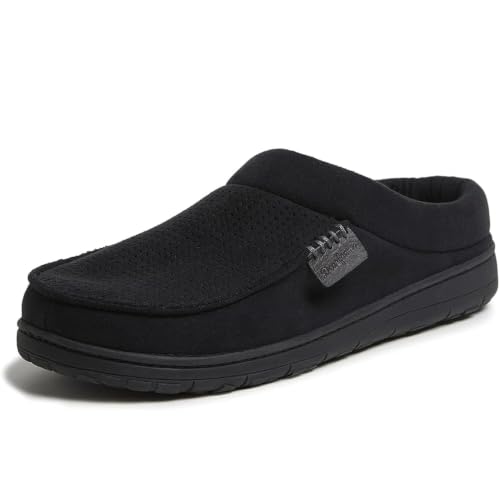
Dearfoams Men’s Brendan Breathable Memory Foam Clog — Best for Hot Feet
Check the current price on Amazon
Warm kitchens and warm feet are a poor match for shearling. This clog answers with a perforated upper that lets heat escape while the foam underneath does the standing work. The clog shape also slips on hands-free at the door, which suits cooks moving between stove, fridge, and bins.
Strengths
- Perforated breathable upper for warm kitchens and warm feet
- Memory-foam footbed for standing comfort
- Offered in wide widths, which most anti-fatigue slippers are not
Trade-offs
- Clog shape offers the least heel hold of any pick here
- Breathable means not warm — a poor winter choice on cold floors
- Black perforated is the verified configuration in this pass
Key details: Memory foam footbed, perforated upper, wide widths offered, indoor/outdoor use (from the Amazon listing title).
The wide-width option is the quiet headline here. Much standing discomfort blamed on floors is actually a footbed that is too narrow, forcing the foot to sit on the raised edges of the insole instead of the cushioned centre. If your feet spread when you stand — most do — a wide fit lets the foam work as designed. Wear this pair for a full evening before judging: breathable clogs feel underwhelming in the first minute out of the box and prove themselves in hour two, when plush slippers have become ovens and this pair is still neutral.
Best for: warm feet, wider feet, and long sessions in a warm kitchen / Not suited for: cold floors, winter wear, or anyone unsteady in backless footwear

HomeTop Men’s Knit Moccasin Slippers, Dark Gray — Best Closed-Heel Hold
Check the current price on Amazon
A moccasin holds the whole foot, which changes the standing experience: instead of your toes subtly gripping to keep a mule on, the foot can relax flat on the footbed, and a relaxed foot fatigues more slowly. The fleece lining makes this the warmer of the linked picks, aimed at cooler floors and evening wear.
Strengths
- Full moccasin wrap keeps the heel seated without toe-gripping
- Fleece lining for cooler floors and evening standing
- Non-slip sole and machine-washable knit upper
Trade-offs
- Warmer than the breathable picks — hot feet should look at the Dearfoams clog
- Moccasin styling is casual even by house-shoe standards
- Sizing by the listed men’s chart; the wrap fit forgives less than a mule
Key details: Knit upper, fleece lining, non-slip sole, machine washable, lightweight (from the Amazon listing title).
Choose the moccasin when your standing happens in several rooms — cooking, then laundry, then a desk — because the secure fit is what you notice on stairs and turns, where a loose mule makes you shorten your stride. The fleece lining also makes this the pair to reach for on stone or tile floors in winter, when cold itself stiffens feet and adds to the ache people blame on the floor alone. Wash it on the gentle cycle the label directs and air-dry it fully; a fleece lining put away damp will smell long before the footbed wears out.
Best for: cooler homes, multi-room standing, and anyone who hates backless slippers / Not suited for: hot feet or warm-climate kitchens

EverFoams Men’s Cotton Knit Memory Foam Slippers, Space Black — Best Lightweight
Check the current price on Amazon
Some anti-fatigue slippers solve standing by adding bulk; this one keeps the foam footbed and trims everything else. The cotton knit upper breathes reasonably, weighs little, and packs flat, which also makes this the natural travel or second pair in the list.
Strengths
- Memory-foam footbed in a noticeably lightweight build
- Cotton knit upper is breathable and soft against bare feet
- Machine washable and non-slip soled for everyday house use
Trade-offs
- Lighter build means less structure at the arch than heavier picks
- Cotton knit shows spills in a kitchen — treat it as a house pair, not a cooking-apron substitute
- Men’s sizing as verified; check the chart rather than assuming your shoe size
Key details: Cotton knit upper, memory foam footbed, non-slip sole, machine washable (from the Amazon listing title).
This is the pair for the standing desk at home, the slow morning, and the day of small tasks rather than one long cooking session. Its foam is doing the same job as the heavier picks; what you give up is the sense of armour, and what you gain is a slipper you will actually keep on all day, which is the only kind that can help your feet. Rotate it with any other pair you own if you wear it daily — foam that gets a rest day recovers more of its loft, and two mid-priced pairs rotated usually outlast one premium pair worn every single day.
Best for: all-day home wear, standing desks, and lighter standing loads / Not suited for: the heaviest daily cooking loads, where a beefier footbed earns its place

VeraCosy Men’s Durable Memory Foam Slippers, Matt Black — Best for Indoor-Outdoor Errands
Check the current price on Amazon
Standing fatigue and doorstep trips come together in real homes: the cook who steps out to the herb bed or the bin mid-recipe. This pick is built for that pattern, with a sturdier sole and a listing that emphasises support and durability over plushness.
Strengths
- Supportive memory-foam footbed described as durable by design
- Indoor-outdoor sole handles doorsteps and paths
- Breathable, machine-washable build for everyday wear
Trade-offs
- Sturdier sole feels firmer underfoot than the softest house-only picks
- Matt black verified configuration; other colours not confirmed here
- Still a slipper, not a shoe — not for long outdoor walks
Key details: Memory foam footbed, supportive build, indoor/outdoor sole, machine washable (from the Amazon listing title).
Judge this pair by transitions: kitchen tile to doorstep to path and back, several times a day. A sole that stays grippy across those surfaces, and a footbed that does not bottom out when you stand on a cold step waiting for a kettle’s worth of herbs to be picked, is worth more than extra softness you only feel on carpet. Keep a small mat inside the door for this pair — grit carried in on an outdoor-capable sole is the enemy of the hard floors you bought anti-fatigue slippers to stand on.
Best for: cooks and home workers who step outside repeatedly through the day / Not suited for: anyone wanting the softest possible carpet-only slipper
Women’s contoured cork-and-foam house slipper with arch support shaping — Best Women’s Contoured Fit
A contoured footbed — raised gently at the arch and cupped at the heel — spreads standing load differently from flat foam: less pressure at the heel strike, more contact through the midfoot. For many women who stand to cook, that shaping, in a correctly sized women’s last, matters more than another half-inch of plush foam in a men’s size-down.
Strengths
- Contoured footbed supports the arch instead of leaving it to bridge a flat pad
- Women’s last fits narrower heels that slide in men’s moccasins and mules
- Heel cup keeps the foot centred on the cushioning through a long session
Trade-offs
- Contours are personal — a shaped footbed that suits one arch can annoy another
- No confirmed listing in this guide, so sizing and returns policy matter when you shop
- Avoid any listing making medical or pain-treatment claims; comfort is the honest promise
Shop this specification in person or with free returns if you can, because contour fit is the hardest thing to judge from a photograph. Stand in the slipper for several minutes on a hard floor — not carpet — and check three things: the arch rise should feel present but not pushy, the heel should sit in the cup without the edges digging, and your toes should lie flat without curling. If a listing promises to treat a condition rather than to cushion standing, treat that as a reason to choose a different listing, however good the footbed looks.
Best for: women who stand to cook and prefer a shaped footbed in a women’s fit / Not suited for: anyone who knows from experience that raised arches irritate their feet
Unlinked pick — no confirmed Amazon listing was available through our verification pass for this batch, so no purchase link is included. Search the exact name on Amazon and compare the listing carefully before buying.
Comparison Table
| Pick | Badge | Key detail | Best for |
|---|---|---|---|
| RockDove Men’s Original Two-Tone Memory Foam Slipper | Best Overall | Memory foam, washable knit upper | home cooks and anyone standing on hard floors for an hour or more at a stretch |
| Dearfoams Men’s Brendan Breathable Memory Foam Clog | Best for Hot Feet | Breathable perforated clog, wide widths | warm feet, wider feet, and long sessions in a warm kitchen |
| HomeTop Men’s Knit Moccasin Slippers, Dark Gray | Best Closed-Heel Hold | Moccasin wrap, fleece lined | cooler homes, multi-room standing, and anyone who hates backless slippers |
| EverFoams Men’s Cotton Knit Memory Foam Slippers, Space Black | Best Lightweight | Lightweight cotton knit, memory foam | all-day home wear, standing desks, and lighter standing loads |
| VeraCosy Men’s Durable Memory Foam Slippers, Matt Black | Best for Indoor-Outdoor Errands | Durable supportive foam, indoor-outdoor sole | cooks and home workers who step outside repeatedly through the day |
| Women’s contoured cork-and-foam house slipper with arch support shaping | Best Women’s Contoured Fit | Contoured footbed, women’s last | women who stand to cook and prefer a shaped footbed in a women’s fit |
RockDove Men’s Original Two-Tone Memory Foam Slipper — check price on Amazon
Dearfoams Men’s Brendan Breathable Memory Foam Clog — check price on Amazon
HomeTop Men’s Knit Moccasin Slippers, Dark Gray — check price on Amazon
EverFoams Men’s Cotton Knit Memory Foam Slippers, Space Black — check price on Amazon
VeraCosy Men’s Durable Memory Foam Slippers, Matt Black — check price on Amazon
How to Choose Anti-Fatigue Slippers for Your Kind of Standing
Name your standing first. Cooking standing is intermittent — three minutes at the stove, a turn to the fridge, a lean at the sink — and it rewards a slipper that slips on fast, grips on tile, and tolerates splashes. Desk standing is static and long, and it rewards contour and arch contact, because a motionless foot loads the same two points for an hour. Laundry and household standing is mobile, up and down stairs, and it rewards heel hold above everything. The same slipper rarely wins all three, which is why this guide badges by job rather than declaring one miracle pair.
Then judge the footbed by recovery, not softness. Press your thumb hard into the heel of the footbed for five seconds and let go: a good anti-fatigue foam rebounds visibly; a poor one keeps your thumbprint like dough. In wear, that difference is the gap between cushioning at minute forty and a flattened pad that merely separates your foot from the floor by a few millimetres of tired foam.
Fit is a fatigue feature. A slipper half a size loose makes the toes grip and the calf work; half a size tight concentrates load at the heel and ball. Buy for your standing foot — feet spread under load and swell slightly by evening — and if you are between sizes in a mule or clog, the larger size usually stands better, while in a moccasin the snugger wrap usually wins. Wear the pair around the house for a full evening before deciding, on hard floors, doing your real tasks.
Finally, be honest about heat. Warm feet in a fleece-lined slipper will be kicked off by eight o’clock, and a slipper on the floor cushions nothing. Breathable uppers, cotton knits, and perforated clogs exist in this category precisely because the best anti-fatigue slipper is the one still on your feet at the end of the evening.
Slippers Versus Anti-Fatigue Mats — and Using Both
A cushioned mat at the sink or stove fixes one spot beautifully and does nothing for the walk to the fridge. Slippers travel with you and cushion every step, but no slipper footbed matches a thick mat for a truly static hour. Many heavy home cooks end up with both: slippers for the whole floor, a mat where the longest static stand happens. If budget forces a choice, choose slippers when your standing is spread across rooms, and the mat when it is concentrated at one counter. Either way, retire foam when it stops recovering — a flattened anti-fatigue product is just footwear, and judging the category by a worn-out pair is how people conclude wrongly that none of it works.
How to Get the Most Standing Comfort From Your Slippers
Break them in on real tasks. Wear a new pair for one full cooking or working session on hard floors before judging them; footbeds and uppers settle noticeably in the first hours, and a pair that feels merely fine at minute five may feel right at minute fifty.
Rotate if you stand daily. Two pairs alternated day about will each last far longer than one pair worn every day, because foam recovers loft during its rest day. Rotation is the cheapest comfort upgrade in this whole category.
Keep soles clean. Kitchen grease and household dust film over a non-slip sole quietly; wipe or rinse the soles weekly and let them dry fully, and the grip you bought will still be there in month six.
Air the footbeds. Leave slippers somewhere ventilated after wear rather than in a closed cupboard or under a radiator. Foam and fleece both last longer, and smell less, when they dry completely between sessions.
Replace on recovery, not appearance. When the heel of the footbed stays compressed, when you can feel the floor’s hardness through the foam at your usual standing spot, the anti-fatigue work is done — however tidy the uppers still look.
Common Buying Mistakes
Buying the plushest slipper in the shop. Plush is a first-minute sensation. Deep soft pile over a thin, fast-flattening pad is the standard recipe for disappointment in this category; judge by footbed recovery and what the slipper feels like after an hour.
Wearing a loose mule for stair-heavy chores. Backless slippers and stairs are a poor combination, and toe-gripping to keep them on adds its own fatigue. Choose a moccasin or closed-heel style for multi-room, stair-using days.
Expecting medical results from a comfort product. Anti-fatigue slippers cushion standing; they do not diagnose or treat foot, knee, or back conditions. Persistent pain deserves a professional, and any listing promising treatment should lose your trust.
Wearing one pair every day until it dies. Daily wear without rest days compresses foam permanently far sooner. Rotation is not upselling — it is how foam footbeds are designed to be used.
Ignoring the sole because the top looks cosy. On kitchen tile and bathroom floors, the sole is safety equipment. A beautiful slipper that skates on a damp floor has failed its first job.
Final Recommendation
Start with the RockDove two-tone slipper for the classic case — long cooking sessions on hard floors — and the Dearfoams breathable clog if your feet run hot or you need a wide width. Choose the HomeTop moccasin when you want the heel held, the EverFoams when you want the lightest all-day pair, and the VeraCosy when your day keeps taking you out of the door. Shop the women’s contoured specification with returns available, and judge every pair at the end of a real evening, not the start. Related reading in this programme:
Start with the RockDove Men’s Original Two-Tone Memory Foam Slipper if it matches your situation — check price on Amazon and confirm the size, finish, or configuration on the listing before ordering.
Start with the Dearfoams Men’s Brendan Breathable Memory Foam Clog if it matches your situation — check price on Amazon and confirm the size, finish, or configuration on the listing before ordering.
Start with the HomeTop Men’s Knit Moccasin Slippers, Dark Gray if it matches your situation — check price on Amazon and confirm the size, finish, or configuration on the listing before ordering.
Start with the EverFoams Men’s Cotton Knit Memory Foam Slippers, Space Black if it matches your situation — check price on Amazon and confirm the size, finish, or configuration on the listing before ordering.
Start with the VeraCosy Men’s Durable Memory Foam Slippers, Matt Black if it matches your situation — check price on Amazon and confirm the size, finish, or configuration on the listing before ordering.
Best Non-slip Bath Mats For Seniors Best Absolutely Non-slip Bathroom Rugs For Elderly Best Antifungal Bath Towels Best Bathroom Storage For Small Apartment
Matching the Slipper to the Job, Room by Room
The kitchen is the headline room for anti-fatigue slippers because it combines the hardest floors with the longest stands, but it is not the only room that matters. A laundry room with a concrete or tiled floor asks for the same cushioning in shorter bursts, plus a sole that tolerates a damp floor near machines. A home workshop or garage-adjacent utility space asks for the durable indoor-outdoor end of the category, where the VeraCosy specification earns its place and a delicate knit would be destroyed in a season.
The standing desk deserves its own thinking because the standing is static in a way cooking never is. A cook shifts, turns, and steps; a desk worker plants. Static standing loads the same points continuously, which is where a contoured footbed or the thickest foam earns its keep, and where the habit of shifting weight, perching, and sitting for intervals matters as much as the footwear. If your feet ache at a desk, alternate the slippers with a cushioned mat and with sitting — the slipper is one tool in a rotation, not a licence to stand motionless for four hours.
For evening wear — the cook who finishes, eats, and then stands again to wash up — warmth and ease compete. This is where the moccasin’s fleece lining and closed heel suit the slower pace, and where a pair kept by the sofa, separate from the kitchen pair, extends the life of both. Households that run two pairs by zone consistently report the arrangement feels indulgent for exactly one week and then simply feels like how the house works.
Cold floors change the category in winter. A breathable summer clog on January stone tiles will be abandoned, and an abandoned slipper cushions nothing, so seasonal rotation is legitimate: the HomeTop moccasin or a lined style for the cold months, the Dearfoams breathable clog or the EverFoams knit for the warm ones. Foam also stiffens slightly in a cold room, so the pair kept by a warm hearth will feel softer than the identical pair kept in a cold hallway — a small physics lesson that explains many puzzled reviews.
For anyone buying for a parent or relative, fit and habit beat specification. Choose the style closest to what they already wear — a moccasin wearer given a clog will leave the clog in the box — size generously for evening feet, and prefer the pair they can wash or that you can wash for them. The best anti-fatigue slipper in a care context is the one that is actually on the person’s feet at the stove, and familiarity is what puts it there.
One last matching note: floors themselves vary within a house. The same slipper sole that grips kitchen tile perfectly can feel grabby on polished wood and under-gripped on a damp bathroom floor. If your standing spans all three, the all-round sole of the RockDove is the compromise to start from, and the test is a deliberate walk across each surface in the first evening, before the pair’s fate is decided by the room it happened to be tried in.
How Long Should They Last — and the Rotation Maths
Foam footbeds are consumables with a service life set by hours under load, not by calendar. A pair worn for three standing hours a day, every day, is doing roughly a thousand hours a year, and by the end of it the heel foam will have taken a permanent set. Rotating two pairs does not merely double the calendar life; each pair’s foam recovers more completely between wears, so the pair of pairs usually outlasts two pairs bought and worn sequentially. That is the entire economic argument for rotation, and it is why this guide treats a second pair as equipment rather than indulgence.
Judge end of life by the standing test, not the mirror. Put the slippers on, stand at your usual counter for ten minutes, and compare the feeling honestly with your memory of the first month: if the floor’s hardness is arriving through the foam and your heels are reporting by the end, the footbed is done even if the uppers look new. Retire the pair to garden or garage duty — the soles usually have life left for that — and let the fresh pair take the kitchen. Comfort products that are kept past their working life teach people the false lesson that the whole category does not work.
Questions to Ask Before You Spend Anything
Ask where you stand, for how long, and on what floor — the three coordinates of this entire category. An hour of cooking on tile, twenty minutes of ironing on laminate, and a morning of workshop standing on concrete are three different purchases wearing one name. Write your honest answer down before you look at a single product, because the badges in this guide are keyed to exactly those answers, and a slipper chosen for someone else’s standing will disappoint you in your own kitchen.
Ask how your feet run: hot or cold, narrow or wide, happy in a mule or always kicking backless footwear off without noticing. These are not details; they eliminate half the category each. Hot feet delete the fleece-lined options. Wide feet promote the Dearfoams clog with its wide widths from a niche pick to the main event. A lifelong mule-kicker needs the moccasin’s wrap, and no foam quality will compensate for a shape your feet reject by reflex.
Ask what your floors demand of a sole. Polished wood, wet-look tile, and a bathroom’s hard floor each punish a different sole weakness — skating, grabbing, and damp grip respectively. If your standing crosses all three daily, start from the all-round pick and test the pair across every surface in the house during the first evening, while the returns decision is still free.
Ask whether you will rotate. If the honest answer is one pair, worn daily, then durability of foam matters more and the replacement horizon is a year of heavy use — budget for it as a consumable, the way you budget for the knives’ sharpening. If two pairs are realistic, the maths in this guide’s rotation section applies and each pair can be a little less armoured, because rest is doing part of the work that construction does in a single pair.
Ask who else will wear them, because household slippers migrate. A pair bought for the cook will be worn by a partner to the bins, by a teenager to the door, by a guest who was offered them out of politeness. If the migration is inevitable, the durable indoor-outdoor specification absorbs it best; if the pair is sacred, keep it in the kitchen and let a cheaper pair live by the door for everyone else’s errands.
And ask what success feels like, so you can judge it: not a cloud, not a cure — just an evening at the stove after which your feet are not the loudest complaint in your body. That modest, measurable outcome is what this category genuinely sells, and a pair that delivers it for a year of evenings has earned every penny of a mid-range price.
Key Takeaways for Feet That Stand All Evening
Anti-fatigue is a behaviour of foam under load over time, not a softness you can judge in a shop doorway. Recovery — the footbed springing back between steps and between days — is the property to buy, and rotation is the habit that protects it. Two modest pairs alternated will out-serve one premium pair worn daily, in comfort and in lifespan alike.
Shape is as decisive as foam. A mule, a clog, and a moccasin load the foot differently, hold it differently, and suit different gaits, rooms, and temperatures. The right shape for your standing — secure for stairs and multi-room days, breathable for warm kitchens and warm feet — is worth more than any marginal difference in foam between two well-made pairs.
Heat is the silent deal-breaker: the most cushioned slipper in this guide is worthless in the corner where it was kicked off at eight o’clock. Choose for the feet you have in the season you are in, and let a second, seasonal pair be a practical rotation rather than an indulgence.
Judge every pair at the end of a real evening, on your real floors, doing your real tasks — and retire it when the standing test, not the mirror, says the foam is done. That discipline, more than any brand, is what separates households that swear by anti-fatigue slippers from households that swear at them.
A Final Word on Value in This Category
Value in anti-fatigue slippers is measured in evenings, not in foam thickness. A mid-priced pair that is worn four hundred evenings and retired on time has delivered its category’s whole promise at a modest cost per evening; a premium pair abandoned in a fortnight because its shape annoyed its owner is the expensive purchase, whatever its ticket said. Fit and habit are the value, and both are knowable within the first week — which is why the returns window, used honestly, is part of the product.
Spend first on the pair for your longest standing job, and let the second pair — the rotation partner, the seasonal opposite — be the simpler one. The hierarchy keeps the money where the hours are, and it mirrors how the guide’s badges are ordered: the kitchen pair earns the research, the door pair earns the durability, and the evening pair earns the fleece.
Resist the two false economies: the plush bargain whose foam dies in a season, teaching you to distrust a category that works; and the medical-looking premium whose promises outrun what any slipper can honestly do. The middle of this market — washable, well-soled, resiliently foamed, in the shape your feet accept — is where value has always lived in footwear, and slippers are footwear.
Buy that middle pair, rotate it if you can, wash it when it asks, and replace it when the standing test says so. Your evenings at the stove will be measurably kinder, and you will have bought exactly what this category sells — no more, and honestly, no less.
One last practical note before the questions below: if you are buying two pairs at once — the rotation this guide keeps recommending — buy them a week apart rather than together. Live with the first pair through several real evenings, confirm the size and the shape against your floors and your feet, and only then order the second, in the same size if the first proved right or adjusted if it taught you something. Rotation bought in one guess doubles the cost of a sizing mistake; rotation bought in two steps turns the first pair into the fitting room for the second. And if the first pair surprises you — if the clog beats the moccasin you were sure about, or the light knit outlasts the heavy foam in your affections — believe the evidence of your own evenings over the badges in any guide, including this one. Badges are averages; your kitchen, your floors, and your feet are the specific case, and the specific case is the one that has to stand at the stove tomorrow night. That is the whole philosophy of this category in one paragraph: test honestly, rotate sensibly, replace on evidence, and let your feet file the only review that matters.
A closing thought on buying for someone else, since many pairs in this category are gifts: a gift slipper succeeds when it respects the recipient’s existing habits — their shape, their warmth, their floors — rather than the giver’s idea of luxury. Include the receipt without embarrassment, size for the evening foot, and choose the washable pair if the recipient’s laundry is not your business to schedule. The kindest version of this gift is the one still being worn, and washed, and quietly reordered in the same size a year later.
Related guides
- Best Smiley Face Slippers
- Best New Design Slippers
- Best Room Lounging Slippers
- Best Slippers For Baxters Neuropathy
Frequently Asked Questions
What makes a slipper ‘anti-fatigue’ rather than just soft?
A footbed that spreads load and recovers between steps. Softness alone collapses under standing weight within minutes; resilient memory foam or a contoured footbed keeps cushioning at the heel and forefoot through a whole session, which is the effect people actually describe as less tiring.
Are anti-fatigue slippers better than standing on a mat?
They solve different geometry. A mat is better for one fixed standing spot; slippers are better when you move between rooms and tasks. Many people who stand a lot at home use slippers everywhere plus a mat at the sink or stove.
How long do memory-foam slippers stay supportive?
It depends on daily hours and whether you rotate pairs. Worn every day, expect the foam to feel noticeably flatter within a year of heavy use; rotated with a second pair, the same footbed lasts much longer. Replace when the heel no longer rebounds.
Can I wear anti-fatigue slippers with socks?
Yes, and in winter a sock also keeps a breathable style comfortable. Just check the fit with the sock on — a moccasin that was snug barefoot can become tight, and a mule that was fine can start to slip.
Are open-back slippers safe for older users?
For steady walkers on one level, usually; for anyone unsteady, on stairs, or carrying hot pans, a closed-heel moccasin style is the more sensible choice. This guide badges the HomeTop moccasin for exactly that case.
Do anti-fatigue slippers help with foot pain?
They cushion standing on hard floors, which many people find more comfortable, but they are comfort footwear, not a treatment. Ongoing or worsening foot pain should be assessed by a clinician rather than shopped away.


