Disclosure: airfryerkitchensupply.com is reader-supported. When you buy through links on our site, we may earn an affiliate commission at no extra cost to you.
Where to buy
The fastest route to any verified pick in this guide to best child rocking chairs is Amazon, where you can confirm the exact size, colour and configuration on the listing page before ordering. Use the links below to check price on Amazon for each verified pick; unlinked slots carry no link until their listing is verified, and that is deliberate — we would rather leave a gap than send you to the wrong product.
- JOYMOR Kids Wooden Rocking Chair (Best Overall): Check on Amazon
- INFANS Kids Sofa Toddler Rocking Armchair (Pink) (Best for Toddlers): Check on Amazon
- Homeware Kids’ Wooden Farm Rocking Chair (Best for Ages 1-5): Check on Amazon
- BplusZ Toddler Rocking Chair (White) (Best Anti-Tip Wooden Rocker): Check on Amazon
- Outvita Kids Rocking Chair (Brown) (Best High-Back Reading Rocker): Check on Amazon
- CALMPLAY Kids Rocking Chair — Sensory Rocker (Best for Quiet Corners): Check on Amazon
If you are comparing the best child rocking chairs, the honest starting point is that this is a safety purchase before it is a furniture purchase. A child’s rocker lives on the floor of a nursery, bedroom or playroom, gets climbed on as often as it gets sat in, and tips, pinches and slides in ways an adult rocker never has to worry about. Every pick in this guide is a chair sized and stated for children in its verified listing title — with the age range the maker states, and, where the title states it, an anti-tip design or a weight capacity. Where a title does not state an age, a capacity or a certification, this guide says so instead of filling the gap with reassuring language.
We shortlisted wooden rockers for the classic nursery-and-reading-corner job, one plush rocking armchair for younger toddlers, and one reading-seat rocker for quiet corners and classrooms. What separates them is not colour — it is the stated age band, how the rocker is built to resist tipping, whether the back and armrests suit a small reader, and how much floor the rocker arc needs. Read the age band on each pick literally: a chair stated for ages 3-6 is not a chair for a confident 18-month-old, whatever the photographs suggest.
One rule runs through the whole guide: an adult should be present when a young child rocks, especially in the first weeks while the child learns how far the chair travels. That is not boilerplate. Rockers move, small fingers explore the gap under runners, and other children push. The buying guide below turns that into a concrete stability check you can do in the first five minutes after assembly, before the chair becomes part of the furniture.
In this guide
Quick Picks: Our Shortlist at a Glance
Six child-sized rockers, each with a distinct job. Badges match the detailed reviews below, and every pick links to its verified Amazon listing so you can confirm the stated age band and current configuration yourself.
Best Overall — JOYMOR Kids Wooden Rocking Chair: The widest stated age band in this guide (3-9) with the only stated weight capacity, a higher backrest and armrests, in solid wood for indoor or porch use. — Check on Amazon
Best for Toddlers — INFANS Kids Sofa Toddler Rocking Armchair (Pink): A plush rocking armchair on a solid wooden frame with an anti-tipping design stated in the title — the softest landing for a young toddler’s first rocker. — Check on Amazon
Best for Ages 1-5 — Homeware Kids’ Wooden Farm Rocking Chair: The youngest stated band in the guide (ages 1-5), a sturdy wooden toddler rocker with a barnyard theme and easy adult assembly, made for nurseries. — Check on Amazon
Best Anti-Tip Wooden Rocker — BplusZ Toddler Rocking Chair (White): A wooden rocker for ages 3-6 whose title states an anti-tip design outright — the checklist pick for parents who want tip resistance named, not implied. — Check on Amazon
Best High-Back Reading Rocker — Outvita Kids Rocking Chair (Brown): Solid wood, a high backrest and rounded armrests for ages 3-6 — the reading-room pick, with rounded armrest edges that suit small hands and faces. — Check on Amazon
Best for Quiet Corners — CALMPLAY Kids Rocking Chair — Sensory Rocker: A reading-seat rocker for age 3 and up, placed by its maker in playrooms, daycares and quiet-time corners — the calm-down end of the rocking spectrum. — Check on Amazon
Key Takeaways
- Match the chair to the age band stated in its title — 1-5, 3-6 and 3-9 are different chairs, not marketing shades of the same chair.
- Anti-tip design is worth prioritising where the title states it; where it does not, do the hands-on stability check in the how-to section before first use.
- Give every rocker clear floor on all sides: the rocker arc plus a margin for small feet and wandering siblings.
- Wooden rockers with higher backrests suit longer reading sessions; plush rocking armchairs suit shorter, supervised toddler sits.
- No pick in this guide claims a safety certification, because no verified title states one — judge by stated age, build and your own stability check.
How These Picks Were Chosen
We searched Amazon listing data for child rocking chairs and kept only listings whose titles state they are for kids, toddlers or children — adult porch rockers, glider chairs for nursing adults and novelty ride-on toys were excluded even when they appeared in the same results. From the child-sized results we required at least one concrete, checkable fact in the title: a stated age range, a stated weight capacity, a stated anti-tip design, or a stated construction such as solid wood. Chairs that offered nothing but adjectives were dropped.
Deduplication mattered in this category: several brands sell the same rocker in two colours under separate listings, and those colour variants count as one pick here, not two. The final six spread across the real decision points a parent faces — the youngest toddler band (ages 1-5), the core preschool band (ages 3-6), the wider school-age band (ages 3-9), a plush armchair format, and a calmer reading-seat format for quiet corners. Prices were never used as a quality signal, and no rating or review count appears anywhere in this guide, because those numbers change constantly and tell you nothing about whether a rocker suits your child.
Finally, a note on what we did not do: we did not repeat any certification claim. If a maker’s wider marketing mentions standards, that is a question to put to the listing’s documentation, not something this guide asserts. What you get here is exactly what the verified titles support, plus the practical checks any careful buyer can perform at home.
The 6 Best Child Rocking Chairs, Reviewed
Each review states who the chair suits, three strengths, three trade-offs, a spec box limited to facts from the verified title, and a plain verdict. Specs a title does not state are marked Not stated rather than guessed.

JOYMOR Kids Wooden Rocking Chair — Best Overall
The JOYMOR is the pick for families who want one wooden rocker to last beyond the preschool years. Its title states the broadest brief here: solid wood construction, a higher backrest with armrests, indoor or outdoor porch use, ages 3-9 and a 150 lb capacity — the only capacity figure stated by any pick in this guide.
Strengths
- Widest stated age band (3-9), so it outlasts narrower toddler rockers
- Only pick with a stated weight capacity (150 lb), which makes the sturdiness question answerable
- Higher backrest and armrests suit longer, settled reading sessions
Trade-offs
- A 3-year-old at the small end of the band should be checked against the seat height before ordering
- Porch use still means bringing it in during prolonged wet weather, as with any wooden chair
- No anti-tip design is stated in the title, so run the stability check in this guide after assembly
| Spec | Detail (from the verified listing title) |
|---|---|
| Stated age range | Ages 3-9 |
| Stated capacity | 150 lb |
| Construction | Solid wood (as stated) |
| Backrest | Higher backrest, with armrests |
| Use | Indoor / outdoor porch |
| Safety certification | Not stated |
That capacity figure matters more than it might seem. Most child rockers ask you to trust adjectives; this one publishes a number, which lets a parent of a bigger 8- or 9-year-old make a grounded decision instead of guessing. The higher backrest changes how the chair gets used, too: younger children perch, older children lean back with a book, and the armrests give that lean somewhere to land. As a porch rocker it earns its keep in covered outdoor reading corners, but treat ‘outdoor’ as sheltered use. The honest gap is tip resistance: nothing in the title speaks to it, so the five-minute rock-and-nudge check in the how-to section is not optional with this chair — it is how you complete the information the listing leaves out.
Best for: Families wanting one solid-wood rocker spanning ages 3-9, including porch reading corners / Not suited for: Toddlers under 3, or buyers who want tip resistance stated by the maker rather than checked at home
Check on Amazon — check price on Amazon before you buy, because sizes and colours change the final cost.
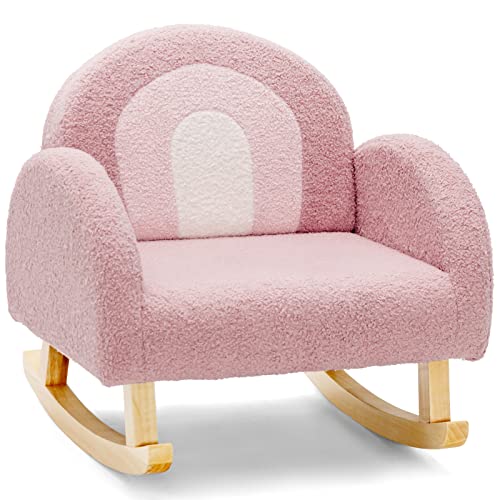
INFANS Kids Sofa Toddler Rocking Armchair (Pink) — Best for Toddlers
The INFANS takes a different route from the wooden slat rockers: a plush, sofa-style armchair that rocks, built on a solid wooden frame. Its title states the feature parents of the youngest rockers ask about first — an anti-tipping design — and places it in kindergartens and playrooms, which tells you the intended scale and setting.
Strengths
- Anti-tipping design stated in the title — the headline feature for a first rocker
- Plush armchair format is forgiving for toddlers who flop sideways as much as they sit
- Solid wooden frame under the soft exterior, per the title
Trade-offs
- No age range is stated in the title, so judge fit by your child’s size and confirm on the listing
- Plush fabric needs more cleaning attention than bare wood after snack-time incidents
- The pink colourway will not suit every room or every child
| Spec | Detail (from the verified listing title) |
|---|---|
| Format | Rocking armchair / kids sofa |
| Frame | Solid wooden frame, plush fabric (as stated) |
| Tip resistance | Anti-Tipping Design (as stated) |
| Stated age range | Not stated |
| Setting | Kindergarten / playroom (as stated) |
| Safety certification | Not stated |
For a first rocker, the failure mode parents worry about is the backward tip when a toddler rocks with enthusiasm. A maker stating an anti-tipping design in the title is making a checkable claim about geometry, and that is why this chair leads the toddler picks despite its missing age band. The armchair format helps in a quieter way: wide, soft sides contain a wriggly sitter better than open rails. Use it on a flat floor, keep the rocking gentle end of the day in mind — this is a wind-down chair, not a ride — and supervise early sessions until your child’s rocking rhythm is predictable. The unstated age range is a genuine gap: measure your child against the seat rather than assuming ‘toddler’ covers everyone.
Best for: Young toddlers getting a first rocker, and playrooms that want a soft, contained seat / Not suited for: Older children who need a stated age band and capacity, or high-mess settings where plush fabric is impractical
Check on Amazon — check price on Amazon before you buy, because sizes and colours change the final cost.

Homeware Kids’ Wooden Farm Rocking Chair — Best for Ages 1-5
The Homeware farm rocker is the nursery classic in this line-up: a wooden toddler rocker decorated with colourful barnyard animals, stated for ages 1-5 — the youngest band any pick here claims — and described as a sturdy wood rocker with easy adult assembly.
Strengths
- Youngest stated age band (1-5), sized for genuine toddlers rather than preschoolers
- Themed design gives the chair a storybook pull that plain rockers lack
- Easy adult assembly is stated, which matters when nursery furniture competes for an evening
Trade-offs
- The 1-5 band means keen rockers will outgrow it sooner than the 3-9 JOYMOR
- A stated age of 1 still means full supervision — a one-year-old rocks with an adult right there
- Theme-led design dates faster than a plain finish as tastes change
| Spec | Detail (from the verified listing title) |
|---|---|
| Stated age range | Ages 1-5 |
| Construction | Wood rocker (as stated) |
| Theme | Colourful barnyard animals |
| Assembly | Easy adult assembly (as stated) |
| Setting | Nursery, bedroom or playroom |
| Safety certification | Not stated |
Age honesty is this chair’s real feature. A rocker stated from age 1 is built low and small, which is exactly right for a child whose feet should be able to steady themselves, and exactly wrong for a tall 5-year-old — the band’s top end is a limit, not a target. The barnyard artwork is not trivial, either: toddlers adopt chairs that feel like theirs, and a chair a child chooses is a chair that gets used for books instead of climbing practice. Assembly being stated as easy is a small mercy worth naming. What the title does not state is tip resistance or capacity, so the stability check applies here with extra force, and the youngest users should rock on carpet or a mat, at gentle amplitude, with an adult in arm’s reach.
Best for: Nurseries and toddlers aged 1-5 who will love a themed first rocker / Not suited for: Families wanting one chair to serve through the school years
Check on Amazon — check price on Amazon before you buy, because sizes and colours change the final cost.

BplusZ Toddler Rocking Chair (White) — Best Anti-Tip Wooden Rocker
The BplusZ is the straightforward wooden rocker for the core preschool years: stated for ages 3-6, wooden, and — the reason it earns its badge — carrying an anti-tip design claim in its title, alongside use across nursery, bedroom, living room and outdoor reading spots.
Strengths
- Anti-tip design stated in the title, not left to inference
- Ages 3-6 is the honest core band for a first ‘real’ wooden rocker
- Neutral white finish fits nurseries that will be redecorated around it
Trade-offs
- No weight capacity is stated, so bigger 6-year-olds need a careful fit check
- White shows scuffs and crayon faster than the brand’s darker finishes
- Brand sells near-identical colour variants — check you are ordering the listing you mean
| Spec | Detail (from the verified listing title) |
|---|---|
| Stated age range | Ages 3-6 |
| Tip resistance | Anti-Tip Design (as stated) |
| Construction | Wooden rocker (as stated) |
| Setting | Nursery, bedroom, living room, outdoor reading room |
| Colour | White |
| Safety certification | Not stated |
This is the pick for the parent who reads listings the way this guide does: claim by claim. Anti-tip geometry in a 3-6 rocker addresses the exact accident pattern of the age group — standing in the chair, rocking standing, leaning back to reach a shelf. Stating it does not remove the need for supervision or for your own post-assembly check, but it means the maker designed against the risk rather than decorating around it. The white finish is a practical trade: bright in a small nursery, honest about wear. Note the dedup point in the specs — BplusZ lists sibling colourways separately; they are the same chair, so do not let a colour variant masquerade as a second option in your shortlist.
Best for: Preschoolers aged 3-6, especially energetic rockers, in nursery or reading corners / Not suited for: Children outside the 3-6 band, or buyers who need a stated weight capacity
Check on Amazon — check price on Amazon before you buy, because sizes and colours change the final cost.

Outvita Kids Rocking Chair (Brown) — Best High-Back Reading Rocker
The Outvita pairs the preschool age band (3-6) with the details a reading chair wants: solid wood construction, a high backrest and rounded armrests, aimed at living rooms and reading rooms. The rounded armrests are a small phrase in the title and a meaningful one in a child’s chair.
Strengths
- Rounded armrests — a child-friendly detail stated in the title, not assumed
- High backrest supports settled, longer sits with a book
- Solid wood construction stated, for indoor reading-room or outdoor use
Trade-offs
- No anti-tip design or capacity is stated — the home stability check carries the weight here
- Brown finish only in this verified listing; colour choice is limited
- High back makes it a bigger floor footprint than low toddler rockers
| Spec | Detail (from the verified listing title) |
|---|---|
| Stated age range | Ages 3-6 |
| Construction | Solid wood (as stated) |
| Backrest | High backrest, rounded armrests |
| Setting | Living room or reading room; outdoor design support |
| Colour | Brown |
| Safety certification | Not stated |
Rounded armrests sound like styling until you picture a 4-year-old hauling themselves up by them, or tipping sideways against them. Edge geometry is where child furniture earns or loses trust, and this title states the friendly version. The high backrest completes the reading brief: support along the whole back turns the rocker from a perch into a place a child stays for a whole picture book. Set against that, the listing is silent on tip resistance and capacity, so this chair asks more of the buyer’s own checks than the BplusZ does. Place it on a level floor, confirm the rock is even in both directions after assembly, and it becomes the chair a reading corner is built around.
Best for: Ages 3-6 reading corners in living rooms, and parents who value rounded, child-friendly edges / Not suited for: Buyers who want tip resistance or capacity stated by the maker
Check on Amazon — check price on Amazon before you buy, because sizes and colours change the final cost.

CALMPLAY Kids Rocking Chair — Sensory Rocker — Best for Quiet Corners
The CALMPLAY rocker is positioned by its title as a reading seat for quiet time — for playrooms, sensory rooms and daycares, for children aged 3 and up, indoors or outdoors. We include it as the calm-corner option, and we describe it in those plain terms: a rocker meant for settling, not for speed.
Strengths
- Purpose-stated for quiet time and reading, which matches how many families actually use a second rocker
- Daycare in the stated settings implies a chair built for repeated daily use
- Age floor stated clearly (+3), so there is no guessing about the youngest user
Trade-offs
- No capacity, construction material or anti-tip design is stated in the title
- The ‘sensory’ framing in the title is the maker’s positioning; this guide makes no therapeutic claim for it
- Less conventional shape than a classic wooden rocker — check the footprint against your corner
| Spec | Detail (from the verified listing title) |
|---|---|
| Stated age | Kids +3 (age 3 and up, as stated) |
| Format | Reading seat rocker |
| Setting | Playroom, sensory room, daycare, quiet time |
| Use | Indoor / outdoor |
| Weight capacity | Not stated |
| Safety certification | Not stated |
Every rocking-chair guide needs the chair that is not about rocking hard. Quiet corners in classrooms and homes work when the seat itself signals the behaviour — sit, breathe, read — and a reading-seat rocker bought for that corner does a different job from the nursery rocker. That is the honest basis for this pick. It is also the pick with the thinnest stated facts: no material, no capacity, no tip claim. So the advice is stricter here — verify dimensions and construction on the listing page, keep it for the stated 3-plus group only, and let its role be the calm one. Used that way, it fills a slot none of the wooden rockers fill as deliberately.
Best for: Quiet corners, classrooms and daycares wanting a settle-down reading rocker for age 3+ / Not suited for: Buyers who need stated capacity or construction details before ordering
Check on Amazon — check price on Amazon before you buy, because sizes and colours change the final cost.
Comparison Table
| Pick | Badge | Key spec | Best for |
|---|---|---|---|
| JOYMOR Kids Wooden Rocking Chair | Best Overall | Ages 3-9; 150 lb stated capacity; solid wood | Families wanting one solid-wood rocker spanning ages 3-9, including porch reading corners |
| INFANS Kids Sofa Toddler Rocking Armchair (Pink) | Best for Toddlers | Anti-tipping design stated; plush armchair on solid wooden frame | Young toddlers getting a first rocker, and playrooms that want a soft, contained seat |
| Homeware Kids’ Wooden Farm Rocking Chair | Best for Ages 1-5 | Ages 1-5 stated; wooden toddler rocker; barnyard theme | Nurseries and toddlers aged 1-5 who will love a themed first rocker |
| BplusZ Toddler Rocking Chair (White) | Best Anti-Tip Wooden Rocker | Ages 3-6; anti-tip design stated; wooden | Preschoolers aged 3-6, especially energetic rockers, in nursery or reading corners |
| Outvita Kids Rocking Chair (Brown) | Best High-Back Reading Rocker | Ages 3-6; solid wood; high backrest, rounded armrests | Ages 3-6 reading corners in living rooms, and parents who value rounded, child-friendly edges |
| CALMPLAY Kids Rocking Chair — Sensory Rocker | Best for Quiet Corners | Age 3+ stated; reading-seat rocker for quiet time | Quiet corners, classrooms and daycares wanting a settle-down reading rocker for age 3+ |
How to Choose the Best Child Rocking Chairs for Your Child
Start with the stated age band, and treat it as engineering, not marketing. A rocker stated for ages 1-5 sits lower, with a shorter rock, than one stated for 3-9, because leg length decides whether a child can plant their feet to start, stop and steady the chair. If your child’s feet dangle with no floor contact, the chair is too big whatever the photograph suggests; if their knees crowd their chest, it is too small. The right fit lets the child sit back, feet able to touch down, with the backrest meeting their back rather than their neck.
Next, tip resistance. Rockers tip backward when enthusiasm outruns geometry, and sideways when a child climbs in from the side. Some titles in this guide state an anti-tip design; others say nothing. Silence is not a failing grade — it is an instruction to check the chair yourself: after assembly, rock it firmly through its full arc on your floor, press down on the top of the backrest, and confirm it recovers rather than hesitates at the balance point. Do this before the first ride, and repeat it whenever screws are re-tightened.
Construction comes third. Solid wood is stated on several picks and suits heirloom expectations and easy re-tightening; plush armchair formats trade that rigidity for containment and comfort for the youngest sitters. Then placement: a rocker needs its full arc plus margin — a hand’s width of clear floor behind the backrest’s travel at minimum, and never a spot where the runners cross a doorway swing, a rug edge thick enough to catch, or a sibling’s play path. Finally, match the chair to its job: high backs and armrests for reading, low and soft for first toddler sits, calm reading-seat shapes for quiet corners.
Wooden Rockers vs Plush Rocking Armchairs: Which Suits Your Home?
The classic wooden rocker is the durable default. It wipes clean, its joints can be re-tightened as years of rocking loosen them, and its open frame makes the stability check easy — you can see and test the whole structure. Its trade-offs are hardness and noise: runners on a hard floor are audible in the room below, and a toddler who flops will meet wood, not cushioning. A rug or mat under the runners answers both points and protects the floor, provided the mat lies flat and cannot bunch under the rock.
The plush rocking armchair inverts those trades. Containment is its safety story: soft, wide sides keep a young sitter centred, and the anti-tipping design stated on the INFANS pick addresses the backward tip directly. In exchange you accept fabric care — crumbs, spills and the occasional marker — and a chair a child outgrows in both size and style sooner. Neither format is ‘safer’ in the abstract; each manages a different risk. Young toddlers who sit briefly and wobble benefit from containment; older children who read for twenty minutes benefit from structure, back support and a chair that still fits at six.
Budget framing helps the decision without naming prices: wooden rockers in the stated 3-6 and 3-9 bands are the value play per year of use, because the band is the lifespan. A 1-5 chair bought at age 1 gives four years; the same chair bought at 4 gives one. Buy the band your child is entering, not the one they are leaving.
How to Set Up and Safety-Check a Child’s Rocking Chair
Assembly is an adult job — one pick states ‘easy adult assembly’ in its title, and the principle applies to all of them. Work through it in order: first, assemble on a flat surface and tighten every fastener fully, in the sequence the maker gives, because a rocker built slightly twisted will rock unevenly forever. Second, place the chair where it will live and check the floor: level, hard or low-pile, with the full rocking arc clear of walls, furniture edges and other children’s toys.
Third, run the stability check. Sit the chair empty and rock it by hand through its full travel; it should move smoothly, without catching, clicking or a point where it wants to stay tipped. Press down firmly on the top rail of the backrest — the chair should resist and return, not continue backward. Rock it side to side gently by the armrests to feel for lateral wobble, which usually means a fastener needs another quarter-turn. Fourth, teach the first session: feet for starting and stopping, hands inside the chair, one child only, and an adult within reach until the rhythm is familiar. Fifth, maintain it: re-check fasteners monthly in the first season, keep runners clean so grit does not score the floor or change the rock, and retire or repair any chair that develops a crack in a runner — the runner is the one part that must never be ‘probably fine’.
Rocking Chairs by Room: Nursery, Bedroom, Playroom and Porch
The nursery is where the youngest bands earn their keep. A low 1-5 rocker beside the feeding chair gives a toddler their own version of the room’s central ritual, and at that age the chair’s job is mostly to be sat in briefly, proudly and under supervision. Keep the arc clear of the cot and the changing table, put a flat mat under the runners if the floor is hard, and expect the chair to be as much climbed-around as rocked-in during the first months — which is precisely why the stability check matters more in a nursery than anywhere else.
In a child’s bedroom, the rocker becomes a reading chair, and the specification shifts toward backs and armrests: the Outvita’s high backrest and rounded armrests, or the JOYMOR’s higher backrest, support the twenty-minute story session that a low toddler rocker cannot. Place it where the light is — near the window by day, within reach of the bedside lamp by night — and give it a small side surface for the book pile, because a reading corner that works is a system, not a chair. Playrooms invert the priorities again: durability, wipe-clean surfaces and a chair that tolerates being a boat, a horse and a fort component. The plush INFANS armchair suits the playroom’s soft landing needs, while the BplusZ’s stated anti-tip design suits its energy.
The porch is the JOYMOR’s stated territory and the one place a child’s rocker joins adult furniture outdoors. Covered, dry and supervised, a porch rocker teaches the slow pleasure of rocking in open air; uncovered and weather-beaten, any wooden chair ages in a season. Bring it in for winter, check its runners for grit before it comes back inside — grit under a runner is sandpaper with a schedule — and re-run the stability check each time it changes surface, because a chair stable on boards may behave differently on stone.
How Long Will a Child’s Rocking Chair Last? Fit Checks as They Grow
A rocker is outgrown in stages, and each stage has a check. Stage one: feet. While a child can plant their feet flat with the chair at rest, they control starting and stopping; when the chair’s growth — really the child’s — leaves feet dangling at the front of the rock, control fades and supervision must tighten. Stage two: knees. When knees rise well above the seat’s level at rest, the chair is becoming a perch rather than a seat, and longer sits will end in wriggling. Stage three: the backrest. When the top rail meets the shoulder blades instead of supporting below them, reading comfort goes first, and the child will vote with their absence.
Run these checks at birthdays, when you are already measuring everything else, and let them — not sentiment — time the successor chair. The stated bands predict the calendar honestly: a 1-5 chair bought at one serves about four years; a 3-9 chair bought at three can serve six. That arithmetic is why this guide keeps returning to buying into the band your child is entering. A chair that is outgrown on schedule has not failed; it has completed the exact service its title promised, and it passes to a sibling, a cousin or another family’s nursery with its runners re-checked and its fasteners re-tightened by the adult handing it on.
Care extends the calendar within the band. Tighten fasteners seasonally, keep wooden runners clean and dry, spot-clean plush fabric promptly, and store a spare chair flat-footed rather than balanced on its runners. None of this is burdensome; it is the ordinary maintenance of a piece of furniture that carries the most precious cargo in the house, at the exact age when that cargo cannot assess a wobble for itself.
A Short History of the Child’s Rocking Chair — and Why the Classics Persist
The child’s rocker is one of the oldest pieces of scaled-down furniture: small wooden rockers have been made for children for well over a century, and the silhouette in this guide’s wooden picks — runners, slatted or solid back, armrests at child height — would be recognisable to a great-grandparent. That persistence is not nostalgia; it is the shape surviving because it works. The rock soothes at an age when soothing is a large part of the day’s work, the size gives a small person one piece of the room that is unambiguously theirs, and the construction is simple enough to be repaired with household tools for generations.
What has changed is the information around the chair. Modern listings state age bands, capacities and anti-tip designs — the facts this guide is built on — where older chairs asked buyers to trust the maker’s reputation alone. The newer formats answer newer rooms: the plush armchair for the soft-furnished playroom, the reading-seat rocker for the classroom quiet corner. The wise buyer takes the classic shape and the modern information together: a design proven by a century, specified by a title you can check, and verified in your own home by the five-minute stability routine that no century has improved on.
Buying Second-Hand or Passing a Rocker On: What to Inspect
Children’s rockers circulate — between siblings, cousins, neighbours and marketplaces — and a used chair can be an excellent buy or a quiet hazard depending on ten minutes of inspection. Start with the runners, because they are the chair’s foundation and its most stressed component: sight along each runner for cracks, splits or a flattened wear spot, and reject any chair whose runner is damaged, because a runner cannot be cosmetically repaired into strength. Rock the chair on a hard, level floor — not the seller’s carpet — and listen: clicking, creaking at one point in the arc, or a visible twist as it moves all say a joint is failing, and joints on a child’s chair are not a negotiation.
Check every fastener you can reach, and ask whether the chair has ever been repaired; a well-executed re-gluing by a careful owner is a point in its favour, while filler, tape or a suspiciously fresh coat of paint over a joint is a reason to walk away. Sit your own weight in it only if the chair’s scale makes that sensible — for toddler rockers, load the seat with books and press the backrest instead. Inspect for the small hazards that age introduces: splinters along hand-worn edges, peeling paint or finish a mouthing toddler could worry at, loose decorative elements, and any added cushion or strap whose provenance nobody can explain. Clean the chair thoroughly before its first use in your home, re-run the full stability routine from this guide’s how-to section, and the second-hand rocker takes its place with the same standing as a new one. A chair that passes all of this has decades in it; a chair that fails any of it is not a bargain at any price, because the passenger cannot inspect it for themselves.
Common Buying Mistakes
Buying an adult rocker and calling it a child’s chair. Adult rockers sit higher, rock further and leave small feet dangling; every pick here is stated for children in its title, and that statement is the first filter to apply to any chair you consider elsewhere.
Ignoring the stated age band at both ends. Too big is a control problem today; too small is a chair outgrown by spring. Buy into the band your child is entering.
Assuming a certification that was never stated. None of these titles states a safety certification. If certification matters to your decision — a reasonable position — verify it in the listing’s documentation before ordering, and do not let any guide, including this one, imply it for you.
Skipping the post-assembly stability check. Five minutes with your own hands tells you more about tip behaviour on your floor than any product page can.
Counting colour variants as different chairs. Several brands list the same rocker per colour. Compare models, not listings, or your shortlist of six is really a shortlist of three.
Placing the rocker on a thick rug edge or in a traffic path. Runners need a consistent surface and a clear arc; a chair that catches mid-rock teaches a child to fear a good chair.
Final Recommendation
For most families, start with the JOYMOR: the widest stated age band, the only stated capacity, and a higher backrest that grows from preschool perching to school-age reading. For a young toddler’s first rocker, the INFANS armchair’s stated anti-tipping design and soft containment make it the gentler introduction, while the Homeware farm rocker is the nursery pick for the 1-5 band. If tip resistance stated in writing is your deciding factor in a wooden chair, choose the BplusZ; if the chair anchors a reading corner, the Outvita’s rounded armrests and high back earn it; and for classrooms and quiet corners, the CALMPLAY fills the calm seat role. Whichever you choose, do the assembly carefully, run the stability check, and keep an adult close for the first weeks of rocking.
Keep exploring the cluster: Best Rocking Chairs For Newborn, Best Booster Chairs For Toddlers, Best Toddler Table And Chairs For Eating, Best Outside Table And Chairs.
Frequently Asked Questions
What age should a child be before using a rocking chair?
Follow the age band stated for the specific chair — in this guide those bands start at age 1, 3 or 3-9 depending on the model. Whatever the band, the youngest users should rock with an adult within arm’s reach, on a flat floor, at gentle amplitude, until their control is proven.
How do I check whether a child’s rocking chair is stable?
After assembly, rock it by hand through its full arc, press down on the top of the backrest to confirm it recovers, and feel for side-to-side wobble. Repeat the check after the first week and whenever you re-tighten fasteners. A chair that hesitates at its balance point or clicks mid-rock needs attention before a child uses it.
Are wooden or plush rocking chairs better for toddlers?
They manage different risks. Plush armchair formats contain a wobbly young sitter and can state anti-tipping designs; wooden rockers are sturdier over years, wipe clean and suit longer reading sits as children grow. Match the format to your child’s age and how the chair will be used.
Do these rocking chairs carry safety certifications?
No verified title in this guide states a safety certification, so this guide claims none. If a certification is important to your purchase, check the documentation on the product listing itself before ordering.
Can a child’s rocking chair be used outdoors?
Several picks state indoor/outdoor or porch use. Treat that as sheltered use: bring wooden rockers in during prolonged wet weather, and always re-run the stability check when you move a chair to a new surface.
What weight can a child’s rocking chair hold?
Only one pick states a capacity in its title — the JOYMOR, at 150 lb. Where a title states no capacity, this guide prints ‘Not stated’ rather than estimating; check the listing for the specific model you are considering.


