Disclosure: airfryerkitchensupply.com is reader-supported. When you buy through links on our site, we may earn an affiliate commission at no extra cost to you.
Where to buy
Shopping for the best chemical toilets? Every toilet in this guide is a self-contained chemical (portable cassette) model verified against Amazon’s catalogue data before linking — brand, tank size and flush type below come from those verified listings. Holding-tank treatment is sold separately for all of them, so budget a bottle alongside whichever you choose.
- Thetford Porta Potti 365 (Best Overall) — Check the current price on Amazon
- Dometic 976 Portable Toilet 5.0 Gallon (Best Flush Performance) — Check the current price on Amazon
- Camco Portable RV Toilet 5.3 Gallon (Best Value in the 5-Gallon Class) — Check the current price on Amazon
- Thetford Porta Potti 135 (Best Compact) — Check the current price on Amazon
- Dometic 972 Portable Toilet 2.6 Gallon (Best for Tight Marine and Van Spaces) — Check the current price on Amazon
- VEVOR Portable RV Toilet 5.3 Gallon (Best Budget Pressurised Flush) — Check the current price on Amazon
A chemical toilet is a portable toilet that treats waste chemically in a sealed holding tank: you dose the tank with a holding-tank treatment, use the toilet like any other, and empty the sealed cassette at a dump point days later. The best chemical toilets are the ones that make that cycle forgettable — a seal that never betrays you, a flush that keeps the bowl clean, a pour that does not splash, and parts you can still buy in five years. Everything in this guide is judged on those unglamorous virtues, because a chemical toilet is not an appliance you admire; it is one you trust at 2 a.m. in a van, a boat cabin, a job site or a spare room during a bathroom renovation.
The category divides by capacity and flush. Compact two-to-three-gallon models serve solo travellers, small boats and emergency home use. Five-gallon-class models serve couples, families and full-time vehicle dwellers. Flush systems run from simple bellows and piston pumps to pressurised and battery-electric designs, in ascending order of bowl cleanliness and mechanical complexity. The six picks below cover that map deliberately, from Thetford’s benchmark Porta Potti 365 to a pressurised-flush VEVOR.
One scope note, stated plainly: chemical toilets in this guide means portable chemical cassette toilets — the consumer product the term refers to on Amazon. Fixed marine sanitation systems, incinerating toilets and composting toilets are different appliance classes with their own guides elsewhere on this site; if your need is a permanent installation, start there instead.
Consider, finally, where the toilet will serve, because the same model reads differently across duties. In a vehicle it is shaken and temperature-cycled; on a boat it is heeled and splashed; in a spare room it is furniture; on a site it is infrastructure. The reviews note these duties per pick, and the guide’s criteria — seal, capacity, flush, support — are weighted to travel well across all of them. Buy for your harshest duty, and the gentler ones take care of themselves.
In this guide
Quick Picks
Thetford Porta Potti 365 — Best Overall. The category benchmark: a mid-size cassette, piston flush, rotating pour spout and the deepest parts support in portable sanitation — the chemical toilet against which others are judged. Check the current price on Amazon
Dometic 976 Portable Toilet 5.0 Gallon — Best Flush Performance. Dometic’s 976 brings a pressurised flush to a five-gallon holding tank — the cleanest-rinsing bowl in this guide, from the other giant of RV sanitation. Check the current price on Amazon
Camco Portable RV Toilet 5.3 Gallon — Best Value in the 5-Gallon Class. A 5.3-gallon tank closed by a sealing slide valve and flushed by a bellows pump — Camco’s straightforward, lightweight take, with the most reassuring carry seal in the guide. Check the current price on Amazon
Thetford Porta Potti 135 — Best Compact. The small Porta Potti: Thetford’s seal, spout and parts support in a compact body for solo travellers, small boats and emergency home backup. Check the current price on Amazon
Dometic 972 Portable Toilet 2.6 Gallon — Best for Tight Marine and Van Spaces. A 2.6-gallon Dometic for the spaces a five-gallon toilet cannot enter — day boats, micro-campers and under-bunk installations — with adult ergonomics kept as honest as the size allows. Check the current price on Amazon
VEVOR Portable RV Toilet 5.3 Gallon — Best Budget Pressurised Flush. A push-button pressurised flush and a 5.3-gallon waste tank at a budget tier — VEVOR brings the premium flush style down-market, with the support caveats stated plainly. Check the current price on Amazon
How These Picks Were Chosen
Verification preceded everything: each model was confirmed, with brand, model, capacity and flush details read from the catalogue titles, before a link was attached. No prices or ratings are printed anywhere in this article, because both change too quickly to be honest in print; tier language in each review does that job instead.
The shortlist criteria were chemical-toilet specific. Seal integrity and the reputation of the pour system came first — the cassette is carried through living spaces, so the valve and spout design is the product. Capacity coverage came second, spanning compact to full-size so the guide serves a solo boater and a van-life couple with equal honesty. Flush effectiveness third, because a bowl that rinses poorly is where odour begins. Finally, brand support: seals and latches are wear items, and the established RV and marine brands stock them for years.
We included one value-tier pressurised model to test whether the budget end can deliver the format’s best flush style, and scored it with its support questions stated rather than hidden.
A note on what did not decide this list: headline capacity alone, novelty features, and the race to the largest tank. A chemical toilet’s failures in the field are almost never ‘the tank was too small’ — they are a seal that wept in a hot vehicle, a pour that splashed at a strange disposal point, a flush too weak to keep the bowl clean, a part that could not be replaced. The shortlist was built backwards from those failures, which is why established sanitation brands dominate it and why the one value-tier pick carries its caveat in plain sight.
The 6 Best Chemical Toilets, Reviewed

Thetford Porta Potti 365 — Best Overall
The Porta Potti 365 is the chemical toilet equivalent of a benchmark: not the biggest, not the fanciest, but the one whose every detail has been refined by decades of RV and marine service. The rotating pour spout is the detail owners cite most — emptying a cassette will never be pleasant, but a spout that directs the pour and vents the tank makes it controlled, quick and splash-free.
Strengths
- Rotating pour spout empties smoothly without glugging and splashing
- Parts and seals stocked for years through Thetford’s network
- Piston flush is powerful, simple and needs no batteries
Trade-offs
- Lower seat than home fixtures — a platform helps some users
- Mid-size tanks mean regular dumping in heavy family use
- Utilitarian looks inside a finished interior
| Line | Porta Potti 365 (model 92820) |
| Uses per maker | RV, marine, camping, vans, trucks, healthcare |
| Format | Two-piece portable, detachable sealed tank |
The piston flush is the second virtue: a firm, mechanical rinse with no battery to die at a campsite and no motor to fail. Seals, latches and caps are stocked wear items rather than special orders, which in a product built around a rubber blade seal is the difference between a five-year toilet and a fifteen-year one.
Seat height is its honest compromise — lower than a household fixture — and heavy family use will fill its mid-size tanks at a pace that argues for the larger models below. For the broad middle of buyers, though, the 365 remains the chemical toilet to beat.
Best for: vehicle dwellers, boaters and renovators wanting the proven benchmark / Not suited for: families needing maximum capacity between dumps
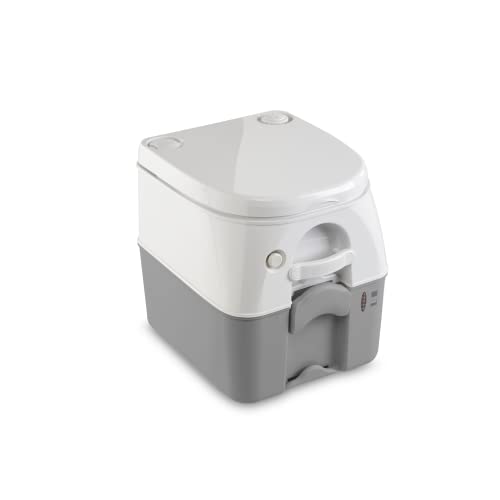
Dometic 976 Portable Toilet 5.0 Gallon — Best Flush Performance
Odour in a chemical toilet is usually born at the bowl, not the tank: residue left by a weak flush ferments between uses. The 976 attacks the problem at its source with a pressurised flush that pushes water around the bowl with real force, so each use leaves the bowl genuinely clean. In a van, a boat cabin or a small room, that cleanliness margin is the difference between a toilet that disappears into daily life and one that announces itself.
Strengths
- Pressurised flush rinses the bowl more thoroughly than pump rivals
- Five-gallon tank suits couples and longer intervals
- Dometic dealer and parts network across the RV world
Trade-offs
- More flush components than a bellows or piston design
- Five gallons is mid-pack against 5.8-gallon rivals
- Heavier than the lightest portables when empty
| Holding tank | 5.0 gallons |
| Brand line | Dometic 976 |
| Format | Two-piece portable, detachable tank |
The five-gallon tank places it in the couples’ class, and Dometic’s support network — the same one that services its fixed RV toilets across a continent of dealerships — answers the parts question as convincingly as Thetford does.
Choose the 976 when the toilet will live close to where you sleep and eat, and when flush quality therefore outranks absolute capacity. It is the connoisseur’s chemical toilet: less famous than the Porta Potti, better at the one job of rinsing.
Best for: van and boat living where the toilet shares your air / Not suited for: minimalists who want the fewest possible moving parts

Camco Portable RV Toilet 5.3 Gallon — Best Value in the 5-Gallon Class
Camco optimised this toilet for the moment every chemical-toilet owner knows: carrying a full cassette through a space you also live in. Its sealing slide valve closes the tank with a firm mechanical action, and that confidence — plus a proper built-in carry handle and a light body — makes it the least stressful cassette to transport in this guide.
Strengths
- Slide valve seals positively for the carry through living space
- Very little to break: no piston seals, no electrics
- Light and compact for its capacity class
Trade-offs
- Bellows flush is the weakest bowl rinse here
- No level indicator on this model
- Basic finish and detailing
| Holding tank | 5.3 gallons, detachable |
| Valve | Sealing slide valve |
| Flush | Bellows-type manual |
| Carry | Built-in carry handle |
The bellows flush is the accepted trade. It moves water, but without the scouring force of the Dometic’s pressurised system or the Thetford’s piston, so a brush becomes a regular companion. In exchange, the mechanism is nearly unbreakable and utterly winter-proof, and the whole toilet sits at a value tier despite its generous 5.3-gallon tank.
For campsites, job sites, ice-fishing shelters and spare-room duty — anywhere the toilet works hard and travels often — the Camco’s priorities are the right ones. For a full-time tiny home, spend up for flush quality.
Best for: campers and site workers who carry the cassette often / Not suited for: full-timers who want the cleanest-rinsing bowl

Thetford Porta Potti 135 — Best Compact
Compaction is a feature when the space is a boat locker or a campervan cupboard, and the Porta Potti 135 is the compact chemical toilet from the brand that knows the format best. It shrinks the 365’s formula — sealed detachable tank, sound pour design, real parts support — into a body that stows where full-size portables simply do not fit.
Strengths
- Genuinely compact — fits lockers, cuddy cabins and cupboards
- Same brand ecosystem and seal quality as its big sibling
- Light enough to carry full without dread
Trade-offs
- Small tank fills fast with more than one user
- Lowest seat in this guide
- Not a family or full-time solution
| Line | Porta Potti 135 |
| Format | Compact two-piece portable |
| Brand support | Thetford parts network |
The limits are arithmetic, not quality: a small tank in multi-user service means dumping every day or so, and the low seat asks the most of knees. As a solo traveller’s toilet, an overnight boat’s head, or a home’s emergency backup during plumbing work and outages, those limits rarely bind.
Buy the 135 for the space you actually have. Owners who force a full-size portable into a locker-sized life end up resenting a good toilet; owners who match the 135 to solo and occasional duty praise it for years.
Best for: solo travellers, small boats and emergency home use / Not suited for: families and full-time couples

Dometic 972 Portable Toilet 2.6 Gallon — Best for Tight Marine and Van Spaces
There is a class of installations where the toilet question is not ‘which is best’ but ‘which fits at all’: the day-boat cuddy, the micro-camper’s under-bed drawer, the ice shelter, the garden room. The Dometic 972 is built for that class — a 2.6-gallon chemical toilet from a serious sanitation brand, small in every dimension but not toy-like in construction.
Strengths
- Small footprint fits genuine micro-spaces
- Dometic build and parts support in a compact body
- Manageable full-tank carry for almost anyone
Trade-offs
- 2.6 gallons is strictly occasional-duty capacity
- Compact seat dimensions suit smaller users best
- Frequent emptying is part of the deal
| Holding tank | 2.6 gallons |
| Brand line | Dometic 972 |
| Format | Compact two-piece portable |
Capacity honesty matters here: 2.6 gallons serves a day’s occasional use for a couple, or a solo user’s weekend, and then it wants emptying. The consolation is that a full 2.6-gallon cassette is a light, easy carry that almost any adult can manage without strain — the compact class’s hidden virtue.
If your space can take a five-gallon model, take one; capacity is comfort. If it cannot, the 972 is the compact answer that does not apologise for its brand or its seals.
Best for: day boats, micro-campers and the tightest installations / Not suited for: anyone planning multi-day multi-user service

VEVOR Portable RV Toilet 5.3 Gallon — Best Budget Pressurised Flush
VEVOR’s proposition is simple: the pressurised flush that makes the Dometic 976 the cleanest-rinsing toilet here, at a budget tier, with a 5.3-gallon waste tank and a 3.2-gallon fresh tank that are both fully competitive on capacity. On specification alone, it embarrasses dearer rivals.
Strengths
- Pressurised flush performance at a budget tier
- Generous waste and fresh capacities
- Leak-proof detachable design for vehicle use
Trade-offs
- Brand support and seal availability are unproven long-term
- Finish trails the legacy brands
- Pressurised system has more to maintain than a bellows
| Waste tank | 5.3 gallons, detachable |
| Fresh tank | 3.2 gallons |
| Flush | Push-button pressurised |
The review’s duty is to price the unknowns. Seal kits and latches for a VEVOR toilet five years from now are a question the legacy brands answer with stocked shelves; VEVOR answers with a marketplace listing that may or may not persist. The sensible ownership move is to buy a spare seal early, while the model is current, and treat the saving as partly spent on that insurance.
For a camper, a renovation project, a hunting cabin or a first portable bought to learn the lifestyle, the trade is rational and the flush is genuinely good. For a decade-long full-time installation, the Thetford and Dometic above remain the safer money.
Best for: budget buyers wanting pressurised flushing for camping and projects / Not suited for: decade-horizon full-timers who need guaranteed parts
Comparison Table
| Pick | Badge | Key spec | Best for |
|---|---|---|---|
| Thetford Porta Potti 365 | Best Overall | Porta Potti 365 (model 92820) | vehicle dwellers, boaters and renovators wanting the proven benchmark |
| Dometic 976 Portable Toilet 5.0 Gallon | Best Flush Performance | 5.0 gallons | van and boat living where the toilet shares your air |
| Camco Portable RV Toilet 5.3 Gallon | Best Value in the 5-Gallon Class | 5.3 gallons, detachable | campers and site workers who carry the cassette often |
| Thetford Porta Potti 135 | Best Compact | Porta Potti 135 | solo travellers, small boats and emergency home use |
| Dometic 972 Portable Toilet 2.6 Gallon | Best for Tight Marine and Van Spaces | 2.6 gallons | day boats, micro-campers and the tightest installations |
| VEVOR Portable RV Toilet 5.3 Gallon | Best Budget Pressurised Flush | 5.3 gallons, detachable | budget buyers wanting pressurised flushing for camping and projects |
How a Chemical Toilet Actually Works
The system has three parts: a bowl with a flush, a fresh-water tank that feeds the flush, and a sealed waste cassette dosed with holding-tank treatment. The treatment is the ‘chemical’ in the name — modern formulas use enzymes and biocides to control odour and break down waste and paper between dumps. Dose it after every empty, with the small amount of water the maker directs, and it works from the first use; dose it late, into a tank already in use, and you are fighting a battle chemistry was meant to prevent.
The seal between bowl and cassette — a blade or slide valve — is the component the whole experience hangs on. Open for use, it must close completely for carrying, and its rubber blade is a wear item that wants cleaning and eventual replacement. A toilet whose maker sells that blade as a spare part is a toilet designed for a long life; one that does not is a disposable with a longer fuse.
Emptying is a designed ritual, not an improvisation: close the valve, detach the cassette, carry it upright to a dump point, pour through the spout with the vent open, rinse, re-dose, refit. Every pick in this guide supports that ritual properly; the differences are in how gracefully — spout design, venting, handle placement — each one performs it.
Choosing Capacity: The Arithmetic of Dumping
Capacity planning starts from a simple rate: in full-time use, each person consumes roughly a gallon of waste-tank capacity per day, less when the toilet shares duty with other facilities. Work backwards from how often you are willing to dump. A solo traveller content with a weekly rhythm needs five gallons class; a couple on the same rhythm needs the top of the class and realistic expectations; a family at a festival needs the biggest tank and a daily plan.
Then apply the carry test, which marketing never mentions: waste is water-weight, so a full cassette weighs roughly eight pounds per gallon plus the toilet’s own structure. A full 5.8-gallon cassette is a serious carry across a campsite; a full 2.6-gallon compact is a light one. Match the tank to the strongest reason you will actually empty it on schedule — because a chemical toilet’s worst failure mode is not mechanical at all. It is a full tank, a postponed dump, and a seal asked to hold what it should never have been asked to hold.
Fresh-water capacity deserves the same glance: an efficient flush stretches both tanks together, which is why the pressurised and well-designed pump flushes in this guide earn their keep on long intervals between services.
Chemical Toilet vs Composting, Incinerating and Cassette Systems
Portable chemical toilets overlap several neighbours, and the honest map helps you shop the right aisle. The cassette toilets in this site’s bus-living guide are the same fundamental format — a detachable sealed tank — viewed through vehicle installation; the overlap is deliberate and the products rhyme. Composting toilets replace chemistry with biology: no dump stations, no chemicals, but a vent fan, a solids medium to manage, and a premium tier. They suit off-grid permanence better than occasional use.
Incinerating toilets burn waste to ash with electricity or gas — superb for remote cabins with power, irrelevant to a boat locker or a festival tent. Fixed marine and RV systems with plumbed black tanks serve permanent installations, trading the cassette’s carry for a pump-out hose. Chemical portables win where they have always won: zero installation, the lowest entry tier, service anywhere a dump point exists, and a format you can stow in a cupboard when the trip ends.
Choose by duty cycle. Occasional, portable and budget-led: chemical. Permanent, off-grid and daily: composting earns its tier. Plumbed and parked: black tank. Most readers of this guide are in the first camp, and for them the six picks above are the market’s honest shortlist.
Holding-Tank Treatments: Choosing and Using the Chemistry
The treatment is half the product, and it deserves the same deliberation as the toilet. Modern treatments divide into enzyme-based formulas, which digest waste biologically and are the gentler environmental choice, and biocide formulas, which suppress the biology that makes odour. Both work; the enzyme route asks for a little more warmth and time, the biocide route for a little more care in disposal. What no longer belongs in a cassette is the formaldehyde chemistry of the last century — increasingly restricted, unwelcome at many disposal points, and unnecessary given the alternatives.
Dosing is where treatments succeed or fail. Dose after every empty, into the cassette with the maker’s directed water, so the chemistry is present from the first use. Under-dosing is false economy — a half-treated tank announces itself — and over-dosing wastes product and can overwhelm enzyme formulas. In heat, shorten the interval rather than raising the dose: an early empty beats a stronger chemical fight.
Paper is the treatment’s partner. Fast-dissolving paper made for portable and marine toilets breaks down in the cassette instead of matting and clogging the pour; ordinary paper works in modest amounts. Wipes never — not the flushable-labelled ones, not any — because a cassette has no macerator and its spout is exactly wipe-sized.
Winter, Heat and Storage: The Seasonal Life of a Chemical Toilet
Chemical toilets live outdoors-adjacent lives, and the seasons write their maintenance calendar. Summer’s rule is rhythm: heat accelerates the tank’s chemistry, so empty earlier than capacity demands, keep the toilet shaded where the installation allows, and never leave a charged cassette in a sealed hot vehicle longer than the trip requires. The seal, meanwhile, works hardest in heat — a blade that is clean and supple in July is the difference between a sealed system and a rumour.
Winter’s rule is water discipline. A toilet in an unheated van, boat or cabin must be emptied, rinsed and drained before a freeze: expanding ice cracks tanks and splits valve bodies, and the damage is discovered in spring, at the first trip, with the warranty of physics long expired. Leave the valve open in storage so no pocket of water is trapped, and store the cassette dry with its cap off if the space is secure.
Storage generally: clean, dry, seals relaxed, treatment bottle stored separately and upright. A chemical toilet put away properly in autumn is a five-minute commissioning in spring; one put away dirty is a project. The appliance’s whole philosophy is that small, regular care replaces large, occasional misery — the seasons are simply where that philosophy is graded.
Chemical Toilets for Care, Recovery and Home Emergencies
One duty deserves its own section because it drives a large, quiet share of purchases: the chemical toilet as a home care appliance. During a bathroom renovation, after hip or knee surgery, for overnight care of an elderly parent, or through a water outage, a sealed portable toilet in a bedroom or spare room restores independence and dignity in a way no bucket arrangement approaches. The Porta Potti’s own listing names healthcare among its uses, and the category’s design — a real seat, a real flush, a sealed tank serviced by a carer in minutes — is precisely adapted to it.
Choose for this duty on carer criteria: a pour spout that empties gracefully, because someone will do it daily; a tank sized to the rhythm the household can sustain; a seat height the user can manage, with a stable frame or nearby support if balance is a concern; and a position in the room that is private, ventilated and on a surface that forgives. The compact picks in this guide serve single rooms well; the mid-size benchmarks serve longer recoveries.
Treat the arrangement as temporary infrastructure and it will be remembered kindly: a small mat beneath, supplies kept with the unit, a service rhythm the whole household knows. Many families buy for a renovation and keep the toilet for outages and guests thereafter — it is the rare emergency purchase that never becomes clutter.
The Economics of Chemical Toilets: Cost of Ownership, Honestly
The purchase tier of a chemical toilet is only its first cost, and the honest ledger has three more lines. Treatment is a consumable for the toilet’s whole life — modest per dose, perpetual in total, and the one line never to economise on, because under-dosing purchases odour at a discount. Seals are the second line: a blade seal every few seasons on a hard-worked unit, cheap from the established brands, potentially unobtainable for a no-name import — which is how a budget toilet becomes a full replacement instead of a service part.
The third line is the toilet’s own lifespan, and it is where the arithmetic turns. A benchmark portable serviced with seals serves a decade or more; a disposable-grade unit serves until its first unserviceable wear item. Divided by years, the benchmark is usually the cheaper toilet — the same conclusion this site reaches about most tools that touch daily life. Buy the tier your duty cycle justifies: occasional users can rationally choose value, because their wear clock runs slowly; daily users should buy the brands whose parts shelves are older than their plans.
None of this requires printed prices to understand — tiers and lifespans tell the story, and they change far more slowly than the numbers on a listing.
Reading Dimensions and Honest Capacities
Chemical toilet listings reward a sceptical eye in two places. Dimensions first: the footprint that matters is the toilet at its widest, including latches and the pour spout’s swing when the cassette is removed — a unit that fits its cupboard but cannot surrender its cassette inside it does not fit. Measure the extraction path, not just the parking space, and remember the seat lid’s swing above.
Capacities second: fresh and waste figures are sometimes listed separately and sometimes merged into a single flattering number, and this guide has reported them as the verified listings state them — waste tank, fresh tank, each in its place. When you compare across brands, compare waste to waste and fresh to fresh, and treat any listing that will not separate them as a question to ask before money moves. The arithmetic of your dumping rhythm runs on the waste figure alone.
A Final Word on Fit
Measure twice is a carpenter’s proverb that belongs in this category too: before any purchase, measure the space, the extraction path for the cassette, and the doorway the toilet must pass through on its way in. More chemical toilets are returned for geometry than for any failure of function, and every return was preventable with a tape measure and five honest minutes. The best chemical toilet is the one that fits your space, your rhythm and your carry — in that order, and the picks above were chosen to give every combination of those a worthy candidate.
How to Use and Maintain a Chemical Toilet
A chemical toilet rewards a small, consistent routine and punishes improvisation. Learn the routine once and the appliance becomes invisible — which is the highest praise sanitation earns.
- Charge the cassette before first use: add the maker’s directed amount of water and the correct dose of holding-tank treatment, so chemistry is working from the first flush.
- Use the flush as designed — enough water to rinse the bowl fully each time. Skimping on flush water is the most common cause of bowl odour between dumps.
- Keep the blade seal clean: a quick wipe when you empty, and never let paper or grit sit trapped in the seal, which is how slow leaks and smells begin.
- Empty before the tank is brim-full — at the indicator if fitted, or on your planned rhythm. Detach, carry upright, pour through the spout with the vent open, and rinse the cassette at every dump.
- Re-dose immediately after emptying, refit the cassette, and confirm the seal seats smoothly before the toilet returns to service.
- Seasonally, remove and inspect the blade seal and cap gaskets; clean, lubricate only with products the maker approves for the seal material, and replace any seal that is stiff, nicked or slow to close.
- Label the cassette with the date of its last seal inspection, in marker, on an inner surface. The note takes five seconds and converts the seasonal seal check from a memory test into a glance — the kind of small system that separates maintained equipment from hopeful equipment.
Store the toilet clean, dosed with fresh water only, seals relaxed and the cassette empty. A chemical toilet stored with waste in it, or with a perished seal left another season, will introduce itself memorably at the next trip’s first use.
Troubleshooting the common four: persistent odour with the valve closed points to the blade seal — clean it, then replace it if the smell survives. A flush that loses pressure on a pressurised model usually means the fresh tank’s cap seal or the pump mechanism needs inspection per the maker’s manual. A cassette that is hard to detach has usually been overfilled or has a swollen seal; empty, clean and lubricate only with maker-approved products. And a pour that splashes is technique, not product: vent open first, spout fully rotated, pour slower than feels necessary.
One more field note, on paper jams at the pour: a cassette that pours slowly or clogs at the spout has almost always been fed wipes or an excess of slow-dissolving paper. The remedy is water, patience and a thorough rinse at the disposal point — never a tool forced into the spout, which endangers the seal you depend on. Prevention is the paper discipline in the guide above, and it is absolute: in a cassette, the wrong paper is not a preference, it is a blockage with a waiting period.
Common Buying Mistakes
Using household bleach or harsh chemicals in the tank. They attack seals, kill the treatment’s working chemistry and can create a worse problem than the one you were solving. Use purpose-made holding-tank treatment, dosed as directed.
Waiting until the cassette is completely full. A brim-full cassette is heavy, splash-prone and hard on its seal. Empty on a rhythm or at the indicator — the last gallon is the most expensive one to carry.
Skimping on flush water to ‘save capacity’. A poorly rinsed bowl is where odour starts, and no tank treatment reaches residue stuck above the seal. Flush properly; capacity anxiety is solved by tank size, not by dirty bowls.
Ignoring the blade seal until it leaks. The seal is a wear item with a finite life. Inspect it seasonally and keep a spare if your model supports it — a seal failure on a trip is the category’s defining bad day.
Emptying anywhere that is not a disposal point. Chemical toilet waste belongs at dump stations and approved facilities — never storm drains, open ground or waterways. The treatment chemicals that help in a tank harm a watercourse.
Buying on capacity photographs instead of dimensions. A five-gallon toilet from one maker can be taller, wider or longer than another’s, and in a boat locker or van cupboard the centimetres decide. Shop by the measured space and the manufacturer’s stated dimensions — never by the tank number alone.
Final Recommendation
The Thetford Porta Potti 365 remains the chemical toilet to buy when in doubt: proven seals, a graceful pour, parts for years. The Dometic 976 is the flush-quality champion for toilets that live in your air; the Camco is the carrier’s friend and the value pick of the five-gallon class; the two compacts — Porta Potti 135 and Dometic 972 — serve the small spaces honestly; and the VEVOR delivers pressurised flushing on a budget with its support caveat priced in.
Match capacity to your dumping rhythm and your carrying strength, dose the treatment religiously, and any of these six will do the least glamorous job in your setup without ever becoming a story. The camping-specific and bus-living guides below narrow the same format for those two lives.
Shortlist: Thetford Porta Potti 365 (Best Overall) · Dometic 976 Portable Toilet 5.0 Gallon (Best Flush Performance) · Camco Portable RV Toilet 5.3 Gallon (Best Value in the 5-Gallon Class)
Best Chemical Toilets For Camping Best Cassette Toilets For Bus Living Best Chair Height Toilets Best Caulk For Toilets Best Caulk For Around Toilets
Frequently Asked Questions
What chemicals does a chemical toilet need?
A purpose-made holding-tank treatment, dosed into the waste cassette with a little water after every empty. Modern treatments use enzyme and biocide formulas to control odour and break down waste and paper. Avoid household bleach and harsh cleaners — they damage seals and defeat the treatment’s chemistry.
How long can a chemical toilet go between empties?
It depends on tank size and users. As a planning figure, each person in full-time use accounts for roughly a gallon of waste capacity a day, so a five-gallon-class toilet serves a couple for a few days and a solo user for the better part of a week. Heat shortens the comfortable interval — empty early in summer.
Do chemical toilets smell?
A maintained one should not. Odour traces to a worn blade seal, a missed treatment dose, a bowl rinsed too skimpily, or waste left sitting in heat. All four are maintenance, not fate — which is why this guide scores seals, flush quality and parts support above cosmetic features.
Where can you empty a chemical toilet?
At RV dump stations, campground and marina disposal points, and other approved facilities. Never into storm drains, open ground or waterways — the treatment chemicals are designed for sewer systems, not ecosystems. Many owners also empty at home into a sewer cleanout where local rules allow.
What is the difference between a chemical toilet and a cassette toilet?
In practice, very little in the portable class: both use a detachable sealed waste tank. ‘Cassette’ emphasises the removable tank and its vehicle installations — buses, caravans, boats — while ‘chemical’ emphasises the treatment working in the tank. The products overlap heavily, and this site’s bus-living guide covers the same format from the installation side.
Can a chemical toilet be used indoors at home?
Yes — during bathroom renovations, for overnight care needs, in garden rooms and during outages, a sealed chemical toilet is a common and sensible stand-in. Ventilate the room normally, keep the seal and dosing routine, and empty at an approved point. It is a temporary appliance at home, but a capable one.
Can you put regular toilet paper in a chemical toilet?
Yes, in modest amounts — it breaks down, especially with a working treatment in the tank. Fast-dissolving paper designed for portable and marine toilets is the better choice: it disintegrates quickly, pours cleanly and never mats in the cassette. What must never go in is any kind of wipe, including those labelled flushable.
How should a chemical toilet be prepared for winter storage?
Empty and rinse the cassette, drain the fresh tank and flush system, and leave the valve open so no water is trapped to freeze and crack the body. Store it clean and dry with the seals relaxed. In a heated, lived-in space, none of this is necessary — it is the unheated freeze that does the damage.
How long does a chemical toilet last?
The body of a well-made portable lasts a decade or more; its wear items — blade seal, cap gaskets, occasionally a pump component — are what age, and on the established brands they are stocked spares. A chemical toilet’s lifespan is therefore mostly a question of whether its maker sells the small parts, which is a core criterion in this guide’s shortlist.
Can a chemical toilet be used in a wheelchair-accessible setup?
It can serve with planning: the user transfers to the toilet’s seat as they would to any low seat, so nearby support — a stable frame, a grab point, an assistant — matters more than the model. The low seat height of portables is the main limitation; a secure platform or a transfer frame addresses it. For a permanent accessible installation, a plumbed solution is usually the better long-term answer.


