Disclosure: airfryerkitchensupply.com is reader-supported. When you buy through links on our site, we may earn an affiliate commission at no extra cost to you.
Where to buy
Shopping for the best caulk for toilets? Toilet sealing is a small-bead job, so this guide favours control over bulk: squeeze tubes, one cartridge option for multi-fixture days, a tool-inclusive kit, and one honest tape alternative. Every product was verified against Amazon’s catalogue data before a link was attached, and sizes and colours below come straight from those verified listings.
- GE Advanced Silicone Caulk, White, 10 oz Cartridge (Best Overall) — Check the current price on Amazon
- GE Advanced Silicone Caulk, White, 2.8 oz Tube (Best for a Single Toilet) — Check the current price on Amazon
- Gorilla 100% Silicone Caulk, White, 2.8 oz Tube (Best Against Mildew) — Check the current price on Amazon
- White Silicone Caulk and Tool Kit, 12 oz (Best Kit for First-Timers) — Check the current price on Amazon
- GE Advanced Silicone Caulk, Clear, 2.8 oz Tube (Best Clear Option) — Check the current price on Amazon
- Fixmend Self-Adhesive Caulk Tape, 3 Rolls (Best No-Mess Alternative) — Check the current price on Amazon
The best caulk for toilets is not a special toilet-only product — no such chemistry exists — it is the right bathroom silicone in the right format for a very specific joint: the line where a porcelain base meets a finished floor. That joint is narrow, curved, constantly splashed, mopped against weekly, and expected to flex a fraction as a heavy fixture takes shifting loads. The sealants that succeed there are 100% silicone kitchen-and-bath formulas, and the ones that fail are usually acrylics chosen for easy cleanup, or good silicones applied over old silicone, which never bonds.
This article approaches the toilet job from the installer’s side. Alongside the two benchmark GE tubes and Gorilla’s mould-resistant formula, it includes a full cartridge for readers sealing several fixtures, a kit that bundles sealant with the removal and finishing tools the job actually needs, and — deliberately — a self-adhesive caulk tape, reviewed honestly as what it is: not caulk, but a legitimate cosmetic seal for the right floor and the right expectations.
One practice runs through every review and the guides that follow: seal the front and sides of the base, and leave the back unsealed so a failing wax ring can reveal itself with visible water instead of rotting the floor in hiding. If you take nothing else from this page, take that — it is worth more than any brand choice below.
One more piece of framing: toilets are the fixture where homeowners most often caulk wrong, because the joint looks like every other bathroom joint and behaves like none of them. It is the only seal in the room that is deliberately left incomplete, the only one hiding a wax seal beneath it, and the only one whose failure to be caulked correctly can cost a floor. This guide treats it with that respect — the products are ordinary bathroom silicones, but the doctrine around them is specific, and the doctrine is the point.
In this guide
Quick Picks
GE Advanced Silicone Caulk, White, 10 oz Cartridge — Best Overall. For anyone with a caulk gun, the cartridge of GE’s Advanced kitchen-and-bath silicone is the benchmark toilet sealant: full waterproof silicone, strong adhesion claims, and enough volume for every fixture in the room. Check the current price on Amazon
GE Advanced Silicone Caulk, White, 2.8 oz Tube — Best for a Single Toilet. The same GE Advanced silicone in the hand-squeeze tube that suits a toilet base best: precise, gun-free, and sized to the job with minimal waste. Check the current price on Amazon
Gorilla 100% Silicone Caulk, White, 2.8 oz Tube — Best Against Mildew. Gorilla’s bathroom silicone in the same precise tube format, formulated and positioned for mould resistance — for the toilet base in a steamy, hard-used bathroom. Check the current price on Amazon
White Silicone Caulk and Tool Kit, 12 oz — Best Kit for First-Timers. A bundle that pairs white waterproof silicone with a 5-in-1 caulk tool, a remover and finishing tools — the honest truth being that first-timers fail on tools and prep, not on sealant. Check the current price on Amazon
GE Advanced Silicone Caulk, Clear, 2.8 oz Tube — Best Clear Option. Clear GE Advanced silicone for coloured fixtures, dark stone and wood-look floors — the seal that does its work invisibly. Check the current price on Amazon
Fixmend Self-Adhesive Caulk Tape, 3 Rolls — Best No-Mess Alternative. Not a caulk at all — a self-adhesive waterproof sealing strip with its own tool, included honestly for renters and cosmetic refreshes where a peel-and-stick line beats a silicone project. Check the current price on Amazon
How These Picks Were Chosen
Verification came first: each product’s listing was confirmed — silicone type, colour and container size taken from the catalogue title itself — before any link was attached, and no prices or star ratings appear anywhere in this article because both change too fast to print honestly.
Shortlisting then used toilet-specific tests. The sealant had to be a true silicone or an explicitly silicone bathroom formula, flexible after cure, and mould-resistant in positioning, because the base perimeter is the most persistently damp joint in the house. Format earned equal weight with chemistry: a toilet base is laid kneeling, one-handed, in the gap between bowl and wall, so squeeze tubes and kits scored ahead of cartridges for most readers, with one cartridge retained for multi-fixture sessions.
The tape pick was included under a transparency rule: it is labelled in its review as a tape, not a caulk, with its real limits stated. It earns its place for renters and cosmetic refreshes, not as a substitute for silicone where a durable waterproof seal is the goal.
Scoring for this guide weighted the toilet’s realities: adhesion across the porcelain-to-flooring pair of substrates; flexibility under a heavy fixture’s micro-movement; mould behaviour in a joint that is mopped weekly and dried rarely; and format control in the worst working position in the house. A fifth criterion separated the finalists — honesty of positioning. Products that state their material, size and purpose plainly in their own listings scored above those wrapped in superlatives, which is one reason the benchmark brands anchor this list.
The Best Caulk for Toilets: 6 Picks Reviewed

GE Advanced Silicone Caulk, White, 10 oz Cartridge — Best Overall
Rankings flip with context, and in this article the cartridge takes the top spot because ‘caulk for toilets’ is so often one task inside a bathroom refresh: toilet today, tub and vanity while the gun is loaded. GE’s Advanced formula is the reference kitchen-and-bath silicone — fully waterproof, flexible when cured, and positioned on adhesion, which is precisely the property a base bead lives or dies by where porcelain meets flooring.
Strengths
- Benchmark formula with adhesion claims that matter at porcelain-to-floor joints
- One cartridge seals the toilet and the rest of the bathroom
- Gun delivery suits confident hands and longer runs
Trade-offs
- Overkill — and often wasted — for a single toilet base
- Needs a gun and a steady hand to avoid a fat, amateur bead
- Leftover cartridge has a short useful life once opened
| Type | 100% silicone, kitchen & bath |
| Colour | White |
| Size | 10 fl oz cartridge |
| Claims per maker | 100% waterproof, 5x stronger adhesion, shrink & crack proof |
Used at the toilet alone it demands discipline: snip the nozzle small, ease the trigger, and let taped edges define the bead. The gun will happily lay twice the silicone the joint needs, and excess at a base is not extra protection — it is a dirt trap with a longer cure.
If your project is genuinely one toilet and nothing else, buy the 2.8-ounce tube reviewed below instead and spend the difference on a proper caulk-removal tool. Right-sized buying is a theme of this guide, and the cartridge is the right size for a room, not a fixture.
Best for: a full bathroom reseal with the toilet as one of several fixtures / Not suited for: a single toilet and no other sealing planned

GE Advanced Silicone Caulk, White, 2.8 oz Tube — Best for a Single Toilet
Everything the cartridge does chemically, this tube does in miniature — and at a toilet base, miniature is a feature. The bead is short and curved, the working position is a kneel with your shoulder against a wall, and the margin between a neat fillet and a smear is hand pressure. A squeeze tube answers pressure instantly; a gun answers it a half-second late, which at a base is the whole game.
Strengths
- Best bead control of any format at a curved toilet base
- No gun, no cartridge waste, no skinned-over leftovers
- White disappears against standard porcelain
Trade-offs
- Poor economics across several fixtures
- Squeezing a long bead can tire the hand on bigger jobs
- Unpaintable, as with all silicones
| Type | 100% silicone, kitchen & bath |
| Colour | White |
| Size | 2.8 fl oz squeeze tube |
| Claims per maker | 100% waterproof, shrink & crack proof |
The 2.8-ounce size is also honest sizing: enough for the front and sides of one base with a modest surplus for the vanity edge or a tile gap you will inevitably notice while you are down there. What remains keeps better in a small tube than in a punctured cartridge, though all opened silicone is on a clock.
Buy this when the toilet is the project. It is the recommendation most readers of this article should actually follow, whatever the ranking above says about the cartridge’s room-sized virtues.
Best for: one toilet, one afternoon, no other fixtures waiting / Not suited for: a whole-bathroom reseal in a single session

Gorilla 100% Silicone Caulk, White, 2.8 oz Tube — Best Against Mildew
Mildew at a toilet base is a cosmetic failure with an outsized effect: the bathroom can be scrubbed spotless and the speckled black bead still makes it look uncared-for. Gorilla builds this tube around resisting exactly that, and in bathrooms that steam daily, vent poorly or serve a household of long showers, that formulation focus is the deciding spec.
Strengths
- Mould-resistant positioning for the dampest joint in the house
- Tube control equals the GE for base work
- Wide retail availability when a tube is needed today
Trade-offs
- Sits at a premium tier for its size
- White only — wrong for dark floors
- Cannot rescue a bead laid over dirty, old caulk
| Type | 100% silicone sealant |
| Colour | White |
| Size | 2.8 fl oz tube |
| Positioning per maker | Mould resistant, waterproof; sinks, tubs, showers, tile, faucets |
Application is identical to the GE tube — same kneeling geometry, same squeeze control, same tape-both-sides discipline — so this is a formulation choice, not a format choice. Pick it where the bathroom’s history says mould is the enemy; pick GE where all-round value and track record lead.
One caution travels with any mould-resistant claim: resistance is not immunity, and it is not retroactive. A bead laid over an old, contaminated joint will show the old joint’s problems through and around it. Strip, clean, dry, then seal.
Best for: humid bathrooms, family bathrooms and rentals with mildew history / Not suited for: dark-floored bathrooms where a white line would glare

White Silicone Caulk and Tool Kit, 12 oz — Best Kit for First-Timers
Ask experienced installers what ruins a first caulking job and few will name the sealant. They will name the old caulk left in the joint, the missing scraper, and the bead ‘tooled’ with a dry fingertip into a smeared ribbon. This kit is built around that reality: white waterproof silicone plus a 5-in-1 tool, a remover and finishers, so the preparation and the finish are equipped, not improvised.
Strengths
- Includes the removal tool — the step every beginner under-buys
- Finishing tools produce a cleaner bead than a fingertip
- One purchase covers the whole toilet job end to end
Trade-offs
- Sealant is a lesser-documented label than GE or Gorilla
- Kit costs more than a bare tube if you already own tools
- Tool quality in bundles is serviceable, not professional grade
| Contents per maker | White silicone sealant, 12 oz, with caulk tool kit |
| Tools | 5-in-1 caulk tool, remover tool, finishing tool |
| Positioning | Bathroom, shower and bathtub caulking |
The sealant itself is a straightforward white silicone positioned for bathroom, shower and tub work; it does not carry the flagship brands’ track records, and this review will not pretend otherwise. What it carries is completeness. For a first toilet, a complete mid-tier kit reliably outperforms a premium tube with no tools, because the failure modes are in the process.
If you already own a sharp remover and a profiling tool, save the premium and buy the GE or Gorilla tubes above. If your toolbox is a kitchen drawer, this is the most practical purchase on the page.
Best for: first-time caulkers with no removal or finishing tools / Not suited for: experienced hands who already own a full caulking kit

GE Advanced Silicone Caulk, Clear, 2.8 oz Tube — Best Clear Option
Coloured toilets and dark floors have returned to bathrooms, and white caulk has not aged well alongside them: it outlines the base like chalk at a crime scene. Clear silicone is the professional answer — the joint is sealed, waterproofed and flexibly bonded, and visually almost absent. This is the same GE Advanced formula as the guide’s benchmark picks, in the controllable small tube.
Strengths
- Invisible on dark, patterned and natural flooring
- Same trusted formula and tube control as the white pick
- Ideal for coloured or designer fixtures
Trade-offs
- Shows every speck of dirt trapped beneath the bead
- Slightly harder to see while applying — tape lines matter more
- Unpaintable like all silicone
| Type | 100% silicone, kitchen & bath |
| Colour | Clear |
| Size | 2.8 fl oz squeeze tube |
| Claims per maker | 100% waterproof, shrink & crack proof |
Clear’s single demand is honesty in preparation. A white bead hides a multitude of sins; a clear bead displays them, sealed in permanently. The joint must be stripped bare, cleaned and dried as if it were going to be inspected — because through clear silicone, it will be, daily.
On pale tile with a white fixture, save yourself the effort and use white. Everywhere else, clear is how the job looks like it was done by someone who does this for a living.
Best for: dark tile, stone, wood-look floors and coloured fixtures / Not suited for: rushed prep — clear caulk preserves your shortcuts visibly
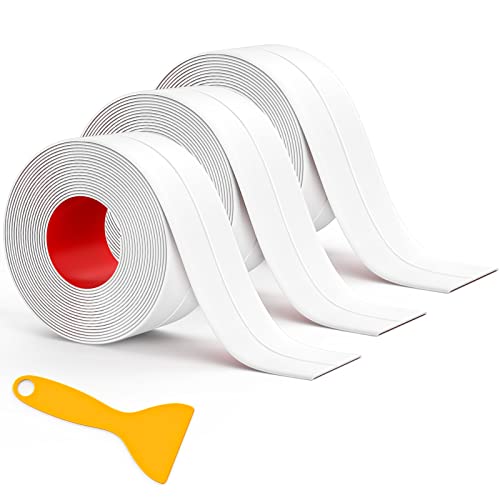
Fixmend Self-Adhesive Caulk Tape, 3 Rolls — Best No-Mess Alternative
Honesty first: this is tape. It does not penetrate the joint, bond chemically, or flex like cured silicone, and it will not outlast a properly laid silicone bead. What it does is cover the base-to-floor line with a clean, waterproof, white strip in about ten minutes, with no cure time, no smell and no tools beyond the included applicator — and for a rental refresh, a pre-inspection tidy, or a floor you plan to replace soon anyway, that is a rational product.
Strengths
- No gun, no tube, no cure time and no solvent cleanup
- Removable in a way cured silicone never is — renter-friendly
- Forgiving straight-line application on flat floors
Trade-offs
- It is a surface strip, not a bonded seal — less durable than silicone
- Corners and curves at a toilet base challenge any tape
- Adhesive ages with heat and water; expect a shorter service life
| Format | Self-adhesive caulk tape, 3 rolls |
| Roll size | 1.5 in x 10.5 ft per maker |
| Includes | Sealing tool |
| Positioning per maker | Waterproof strip for toilet, bathtub, shower, countertop, floor tile |
The toilet base is actually one of its kinder applications, because the run is short. The challenges are the curves: work slowly around the base’s contour, press the strip fully with the tool, and accept that tight radii may need a discreet silicone dab at the very back corners — remembering, as always, to leave a tell-tale gap rather than sealing the perimeter shut.
Choose tape with open eyes and it will please you. Choose it expecting silicone performance and it will peel its way into a bad review. The silicone picks above remain this guide’s recommendation wherever a lasting waterproof seal is the actual goal.
Best for: renters and quick cosmetic refreshes on flat floors / Not suited for: a permanent, waterproof base seal — use silicone instead
Comparison Table
| Pick | Badge | Key spec | Best for |
|---|---|---|---|
| GE Advanced Silicone Caulk, White, 10 oz Cartridge | Best Overall | 100% silicone, kitchen & bath | a full bathroom reseal with the toilet as one of several fixtures |
| GE Advanced Silicone Caulk, White, 2.8 oz Tube | Best for a Single Toilet | 100% silicone, kitchen & bath | one toilet, one afternoon, no other fixtures waiting |
| Gorilla 100% Silicone Caulk, White, 2.8 oz Tube | Best Against Mildew | 100% silicone sealant | humid bathrooms, family bathrooms and rentals with mildew history |
| White Silicone Caulk and Tool Kit, 12 oz | Best Kit for First-Timers | White silicone sealant, 12 oz, with caulk tool kit | first-time caulkers with no removal or finishing tools |
| GE Advanced Silicone Caulk, Clear, 2.8 oz Tube | Best Clear Option | 100% silicone, kitchen & bath | dark tile, stone, wood-look floors and coloured fixtures |
| Fixmend Self-Adhesive Caulk Tape, 3 Rolls | Best No-Mess Alternative | Self-adhesive caulk tape, 3 rolls | renters and quick cosmetic refreshes on flat floors |
What ‘Caulk for Toilets’ Really Means: Anatomy of the Base Joint
Strip the job to its mechanics and the toilet-base joint has three enemies: water from above (splashes, mopping, condensation running down the bowl), movement from the side (a heavy fixture shifting fractions of a millimetre under load, season after season), and biology from within (mould colonising a permanently damp seam). A successful sealant answers all three: waterproof, flexible when cured, and mould-resistant. That is the entire spec sheet that matters, and it is why 100% silicone kitchen-and-bath products fill this guide.
What the joint is not is a leak repair. Water that originates under the toilet — from the wax ring or the flange — travels upward and outward under pressure of use, and no surface bead will stop it; it will only redirect it into the floor. This is why the back of the base is left unsealed throughout this guide: the one place a subsurface leak can announce itself cheaply is the back edge, and sealing it trades a ten-minute diagnosis for a rotted subfloor.
The joint also is not structural. Caulk does not steady a toilet, stop a rock, or substitute for flange bolts and a sound wax ring. Every caulk decision in this article assumes a solidly mounted toilet; where that assumption fails, the correct product is a wax ring and an afternoon, not a sealant.
Toilet Base Caulk vs the Rest of the Bathroom
Readers often ask whether the toilet tube should also do the tub and shower. Chemically, yes — the same kitchen-and-bath silicone serves all three — but the joints behave differently and reward different formats. The tub-to-wall joint is long, straight and flooded daily; it rewards a cartridge’s volume and a generous, well-tooled bead, and it is fully sealed all the way around, because a tub has no wax ring hiding beneath it. The shower corner is a vertical joint where sag resistance and tooling speed matter.
The toilet base is the opposite profile: short, curved, horizontal, kneeling-height, and deliberately incomplete at the back. That is why this guide’s formats lean small and precise while a tub guide would lean bulk. If you are buying one product for the whole room, buy the cartridge for volume and accept the extra care the toilet bead demands — or buy the cartridge for the wet joints and one small tube for the base, which is what many professionals quietly do.
One more difference: colour. Tub and shower joints are usually white-on-white. Toilet bases sit on the room’s feature flooring — the dark tile, the wood-look plank — which is why the clear pick and even the tape earn places here that they would not in a shower roundup.
How Long Toilet Caulk Lasts, and When to Redo It
A well-applied silicone bead at a toilet base is a multi-year installation — commonly the better part of a decade in a gentle household, less where the floor flexes, the bathroom steams daily, or cleaning is aggressive with bleach and stiff brushes. The bead does not usually fail all at once; it fails at an edge, lifting where a mop catches it, or darkening where mould colonises a section whose surface has been abraded by years of scrubbing.
Redo the job when you see any of three things: a lifted edge that admits a fingernail, black mould that survives a careful cleaning (it is in the bead, not on it), or cracking — rare in silicone, common in the acrylic someone may have used before you. Redoing means the full ritual: complete removal, because new silicone will not bond to old, a cleaned and dried joint, and a fresh bead with the back left open.
Do not be tempted by the shortcut of a second bead over the first ‘to thicken it’. It bonds to nothing, peels in ribbons, and doubles the removal work when you eventually do the job properly. In caulking, the redo done right is faster than the redo done twice.
The Wax Ring Beneath: What Your Caulk Is Really Living With
Every toilet sits on a wax ring — a donut of wax (or a modern waxless equivalent) compressed between the toilet’s outlet and the floor flange, sealing the drain against water and sewer gas. It is a brilliant, cheap, century-old component with one weakness: it seals by compression, and a toilet that rocks works the wax like a pump until the seal fails. When it fails, water appears at the base during flushes — the exact symptom homeowners try to caulk away.
This is the mechanical reason behind this guide’s two standing rules. Rocking comes first because rocking kills wax; a toilet must be reset, with a new ring and a sound flange, before any surface sealing is contemplated. And the back gap exists because wax failure is a when, not an if, over a long enough ownership — the unsealed back is the tell-tale that converts a hidden floor-rotting leak into a visible, cheap repair.
Understand the wax ring and the caulk doctrine stops sounding fussy. The surface bead is weatherproofing for the floor’s sake; the wax is the plumbing. Confusing the two — asking the bead to do the ring’s job — is the single most expensive misunderstanding in bathroom maintenance.
A Short History of Doing This Wrong, and the Modern Consensus
Ask three generations of homeowners about caulking a toilet and you will collect three doctrines: seal it completely, never seal it at all, and seal it partly. Each came from a real experience. The seal-everything era produced beautiful bases and rotted floors. The never-seal reaction produced sound floors and mop water wicking under bases, rotting them more slowly from the other direction. The modern consensus — front and sides sealed, back open — is the synthesis that keeps both failure modes visible and managed.
Codes have converged alongside practice: many jurisdictions now require the fixture-to-floor joint to be sealed, which the partial bead satisfies while preserving the leak path. Professional plumbers, who inherit the failures of every doctrine, are the partial bead’s strongest constituency — they are the ones who lift toilets and read floors like tree rings.
If an older relative or a vintage DIY book argues for a complete seal, they are not foolish; they are quoting the doctrine of their era. But the floor you are protecting is yours, and the current evidence — from the people who repair the failures — supports the gap at the back.
Toilet Caulk in Rentals, Resale and Inspection Situations
A surprising share of toilet caulking is done under someone else’s eyes: a landlord’s turnover, a pre-listing refresh, a home inspection response. Each audience reads the base differently, and the wise caulker knows which game they are playing. In a rental turnover, the bead is hygiene theatre as much as sealing — a clean, mould-free line at the base signals a bathroom that has been genuinely serviced, and the mould-resistant pick in this guide is the turnover specialist for exactly that reason. The tape pick also earns its keep here, where speed and removability can outrank permanence.
For resale, the calculus is cosmetic honesty: a fresh bead photographs as care, and buyers’ inspectors do look at toilet bases — for the rocking and the water staining that this guide teaches you to fix properly rather than seal over. Never caulk a base to hide a known leak for a sale; that is the one use of this product that crosses from maintenance into misrepresentation, and it surfaces in inspections and in law with equal reliability.
For inspection responses, document the doctrine: if an inspector flags an unsealed base, the front-and-sides bead with the open back is the professionally defensible answer, and being able to say why — the wax-ring tell-tale — marks the difference between a homeowner who caulked and one who understood. In all three situations, the product in the tube matters less than the correctness of the joint, which is this article’s refrain because it keeps being true.
Silicone Removal, Revisited: The Craft Inside the Craft
Since every re-caulk stands or falls on removal, it deserves its own method. Work in three passes. The mechanical pass cuts the bead’s two edges with a sharp knife — fresh blades, plural, because silicone dulls them — and peels the body away in the longest strips you can persuade. The chemical pass treats the remaining film with a silicone remover, given its full directed dwell time; silicone film is a polymer skin, and it yields to chemistry and patience, not to force. The detail pass scrapes the softened residue with plastic tools, wipes with the maker’s solvent, and inspects by touch: a joint ready for new silicone feels like clean porcelain and clean floor, with no slick patches.
Protect the surroundings as you go. Porcelain resists almost everything; flooring does not — vinyl softens under some removers, stone shadows under oils, and grout drinks anything coloured. Mask the floor during the chemical pass if your remover is aggressive, and ventilate the room, because a small bathroom concentrates solvents quickly.
Budget the time honestly: for a toilet base, removal is thirty to forty-five minutes against the bead’s five. Homeowners who schedule the job as ‘an hour with the caulk gun’ run out of patience at the exact moment patience is the product. Schedule it as a removal job with a caulking finale and the proportions feel right.
How to Apply Caulk at a Toilet Base Correctly
Ninety percent of this job is removal and masking. The bead itself takes three minutes; give the other twenty-seven to preparation and you will only do this once.
- Test the toilet for movement first. A rocking toilet gets reset on a new wax ring before any caulk is opened — sealant over movement is a guaranteed failure.
- Strip the old bead completely. Cut it free with a utility knife or remover tool, lift it in strips, and clear silicone residue with a remover product and patient scraping.
- Wipe the joint clean with the solvent your sealant maker recommends and let it dry fully. Dust, moisture and soap film are the three silent bond-killers.
- Run painter’s tape along the porcelain and along the floor, a quarter-inch apart. On curved bases, use short tape segments and follow the contour.
- Lay the bead around the front and sides in one steady pass per section. Stop at the back corners — the rear of the base stays unsealed as a leak tell-tale.
- Tool once with a finishing tool or the kit’s profiler, wipe the tool, and pull the tape immediately while the silicone is wet.
- Leave the bead untouched for the maker’s full cure time before mopping, showering steam into the room, or letting the base take splashes.
- Run one practice bead on cardboard or a scrap board before the real joint. Thirty seconds of practice teaches your hand the tube’s pressure and the nozzle’s output — the two variables that decide the real bead — at zero cost to your bathroom.
For tape users, the parallel discipline is surface preparation: the floor must be clean, dry and degreased, the strip pressed down progressively with its tool, and corners worked slowly. Tape forgives many things, but it never forgives dust.
Troubleshooting a bead that failed within a year: map the failure before redoing it. Peeling in long strips means the substrate was contaminated — almost always old silicone film. Lifting only at the floor edge means the flooring was damp or dusty, or a wax-based cleaner left a residue. Cracking means the product was not silicone at all, whatever the front of the tube implied. Each diagnosis changes the redo: deeper removal, better drying, or a different tube. Redoing the same way and expecting a different bead is the definition of a recurring chore.
A specialised failure deserves naming: the bead that separates cleanly from the porcelain but grips the floor. Porcelain’s glaze is the harder bond, and its usual contaminant is invisible — a film of soap, wax-based cleaner or old silicone too thin to see. The redo answer is a porcelain-specific preparation: after mechanical removal, wipe the glaze line with the solvent the sealant maker specifies, let it flash fully dry, and mask so the new bead contacts virgin glaze along its whole length.
Common Buying Mistakes
Sealing the back of the base. It feels thorough and it is a trap: a wax-ring leak then soaks the subfloor invisibly. Front and sides sealed, back open — that gap is a diagnostic feature, not an unfinished job.
Buying acrylic caulk for its easy cleanup. Acrylic at a toilet base shrinks, cracks and mildews. The water cleanup you saved is repaid with a full redo. Silicone’s fussier handling buys years.
Caulking a toilet that rocks. Sealant cannot stabilise a fixture. Rocking destroys wax rings; the toilet must come up, the flange inspected, and the ring replaced. Caulk is the last step of that job, never the substitute for it.
Skipping the removal tools. Improvised removal — a screwdriver and optimism — leaves silicone film that defeats the new bead and scratches porcelain and flooring. A remover tool costs little and is the difference between one job and two.
Using tape as a permanent waterproofing strategy. Caulk tape is a cosmetic strip with a finite adhesive life. It has real uses, listed in its review — but a permanent base seal in a family bathroom is silicone’s job.
Trusting the tube’s front label over its material line. The front of a caulk tube is advertising; the material declaration is the product. ‘Siliconized’ is not silicone, and a paintable bathroom caulk is an acrylic wearing a wet-room costume. Read the chemistry line before the tube enters your basket.
Final Recommendation
If you remember one line from this guide, make it the practice rather than a product: strip fully, seal the front and sides in 100% silicone, leave the back open. Within that practice, the GE cartridge is the room-sized benchmark, its 2.8-ounce twin is the right buy for a single toilet, Gorilla’s tube is the mildew-fighter, the kit equips a first-timer honestly, clear serves dark floors invisibly, and the tape covers the renter’s refresh with its limits stated plainly.
Choose by your project shape, not by ranking alone, and the toilet will reward you by disappearing from your maintenance thoughts for years. The companion guides below cover the around-the-base technique in more depth and the combined tub-and-toilet sealing day.
Shortlist: GE Advanced Silicone Caulk, White, 10 oz Cartridge (Best Overall) · GE Advanced Silicone Caulk, White, 2.8 oz Tube (Best for a Single Toilet) · Gorilla 100% Silicone Caulk, White, 2.8 oz Tube (Best Against Mildew)
Best Caulk For Around Toilets Best Caulk To Seal Around Tub And Toilets Best Chair Height Toilets Best Chemical Toilets For Camping Best Cassette Toilets For Bus Living
Frequently Asked Questions
What is the best caulk to use on a toilet?
A 100% silicone kitchen-and-bath sealant — flexible when cured, fully waterproof and mould-resistant. In this guide the GE Advanced line is the benchmark, in a cartridge for multi-fixture work or a 2.8-ounce tube for a single toilet. Avoid acrylic latex caulk at a base: it shrinks, cracks and mildews in constant moisture.
Should the whole toilet base be caulked, including the back?
No. Seal the front and sides to keep mop water and spills out, and leave the back unsealed. If the wax ring ever leaks, water escaping at the back is your visible early warning; a fully sealed base sends that water into the subfloor instead, where it rots unseen.
Why won’t my new caulk stick to the toilet base?
The usual cause is old silicone: fresh silicone does not bond to cured silicone, so any residue film defeats the new bead. The other causes are a damp or dusty joint. Remove the failed bead completely, clean and dry the joint thoroughly, and reapply — there is no reliable shortcut.
Is caulk tape as good as real caulk around a toilet?
No, and it is not sold here as such. Tape is a self-adhesive surface strip: quick, clean and removable, which suits renters and cosmetic refreshes. It does not bond into the joint or flex like silicone, and its adhesive has a shorter life in heat and water. For a durable waterproof seal, silicone is the correct product.
How do I remove old caulk from around a toilet?
Cut the bead’s edges with a utility knife or a dedicated remover tool, peel it away in strips, then treat the silicone residue with a silicone-remover product and careful scraping. Finish with a solvent wipe and let the joint dry fully before new sealant — the quality of this step decides the quality of the result.
Can caulk fix a toilet that leaks at the base?
No. Water coming from under the base means the wax ring or flange has failed; the toilet must be lifted and reset. Caulk only seals the surface joint against splashes. Caulking over a base leak traps water in the floor and converts a small plumbing job into a structural repair.
Does caulking a toilet void any code or warranty concerns?
In many places the opposite is true: plumbing codes commonly require the joint between a fixture and the finished floor to be sealed, and the front-and-sides bead satisfies that while keeping a leak path open at the back. Check local code if you are doing permitted work; for ordinary home maintenance, the partial bead is the accepted practice.
What colour caulk should I use on a white toilet with grey grout?
Match the fixture, not the grout: white against the porcelain reads as part of the toilet and disappears, while a grey bead outlines the base. The exception is a dark floor, where clear beats both — it lets the flooring run visually to the porcelain without a drawn line of any colour.
Is there a caulk made specifically and only for toilets?
No — and be wary of any product implying otherwise. The toilet base joint needs exactly what kitchen-and-bath silicone is: 100% silicone, flexible, waterproof and mould-resistant. ‘Toilet caulk’ is a use, not a chemistry, and the benchmark bathroom silicones in this guide are the correct products for it.
Can I caulk a toilet base in a cold bathroom?
Work within the temperature range on the label — silicone applied to a cold, possibly condensation-damp joint bonds poorly and cures slowly. Warm the room beforehand, dry the joint thoroughly, and keep the room temperate through the early cure. In an unheated winter bathroom, the honest answer is often to wait for a milder day.


