Disclosure: airfryerkitchensupply.com is reader-supported. When you buy through links on our site, we may earn an affiliate commission at no extra cost to you.
Where to Buy
The verified picks in this guide to best chairs for resting head are all sold through Amazon. Start with the shortlist below, then read the full review of any pick that fits your situation before you check price on Amazon and order.
- Suteck Oversized Zero Gravity Chair — Best Overall. Check the current price on Amazon before you order, because stock and configurations change often.
- TIMBER RIDGE Zero Gravity Oversized Recliner — Best for Heavy-Duty Support. Check the current price on Amazon before you order, because stock and configurations change often.
- PHI VILLA Oversized Padded Zero Gravity Chair — Best for Tall Sitters. Check the current price on Amazon before you order, because stock and configurations change often.
- Amazon Basics Zero Gravity Lounge Chair — Best Budget. Check the current price on Amazon before you order, because stock and configurations change often.
- Best Choice Products Oversized Padded Zero Gravity Chair — Best Padded Comfort. Check the current price on Amazon before you order, because stock and configurations change often.
- Colegence Oversized Zero Gravity Chairs Set of 2 — Best Pair. Check the current price on Amazon before you order, because stock and configurations change often.
Head support lives or dies on dimensions, so before you order, check the listing for the seat width, the recline lock positions, and whether the headrest pillow is adjustable or removable — all three appear in the confirmed listings below. If you are between sizes, the oversized models in this guide are the safer default, because a too-narrow chair cannot be fixed after delivery.
The best chairs for resting head and neck share one trait that product photos hide: the support has to meet your head where your head actually lands when you recline. A chair can have a plush pillow and still fail completely if the pillow sits at shoulder height for a taller sitter, or if the recline angle drops your head past the top of the frame. That is why this guide is built around recliners and zero-gravity chairs with real, confirmed headrests — not around chairs that merely look soft.
Zero-gravity loungers dominate the list for an honest reason: when the chair reclines and the knees rise, your head settles back at a supported angle and your weight spreads across the whole frame, which is the posture most people mean when they say they want to rest their head, read, nap, or watch the sky. Indoor recliners with high backs are the alternative for living-room use, and the buying guide below explains how to choose between the two families.
Every pick below was cross-checked against its live Amazon listing during this review pass, and the capacities and features quoted — headrest pillows, locking recline positions, padded frames — come from those confirmed listings. Where a chair is an oversized or heavy-duty model, we say who that serves and who should buy the standard size instead.
In this guide
Quick Picks
If you are short on time, these are the six best chairs for resting head we would shortlist first. Each one earned its place for a different reason, and the badge beside it stays the same in the full reviews further down, so you can jump straight to the pick that matches your situation.
Best Overall — Suteck Oversized Zero Gravity Chair. A 33-inch-wide XXL recliner with a removable cushion and headrest, an aluminum alloy lock, and a footrest — the widest, most supportive seat in this guide. Check the current price on Amazon once you have read the review.
Best for Heavy-Duty Support — TIMBER RIDGE Zero Gravity Oversized Recliner. An oversized padded recliner with a headrest, a 350 lb capacity in its listing, and a sturdy frame aimed at patio, lawn, and camping use. Check the current price on Amazon once you have read the review.
Best for Tall Sitters — PHI VILLA Oversized Padded Zero Gravity Chair. A 30-inch-wide padded recliner with a cup holder and pillow, rated in its listing to 400 lbs — extra length and width that tall sitters feel first in the headrest position. Check the current price on Amazon once you have read the review.
Best Budget — Amazon Basics Zero Gravity Lounge Chair. The straightforward value lounger: a foldable zero-gravity chair with a pillow, from Amazon’s own line — the low-risk way to test whether this style suits you. Check the current price on Amazon once you have read the review.
Best Padded Comfort — Best Choice Products Oversized Padded Zero Gravity Chair. An oversized padded recliner in black/gray with a pillow and cup holder — the cushioned alternative for sitters who find mesh loungers too hammock-like. Check the current price on Amazon once you have read the review.
Best Pair — Colegence Oversized Zero Gravity Chairs Set of 2. A matched pair of 29-inch-wide, 400 lb capacity recliners with cup holders and pillows — two head-resting seats for the price logic of one household purchase. Check the current price on Amazon once you have read the review.
How These Picks Were Chosen
We started from chairs whose listings explicitly confirm a headrest, pillow, or high supportive back — the feature this search actually asks for — and cross-checked each model against Amazon data for this site. Chairs with no head support, however comfortable their seats, were excluded no matter how popular they are.
Each candidate was then judged on the mechanics of resting: whether the recline locks at several angles or just two, whether the pillow can be repositioned for different heights of sitter, how the frame handles the shift of weight as you lean back, and whether the stated capacity leaves a sensible margin for real bodies rather than a laboratory maximum. Folding and storage mattered too, because a chair that lives in a garage corner gets used; a chair that is a chore to move does not.
Finally, we weighted honesty of positioning. Several picks are outdoor loungers that also work on a porch, deck, or sunroom; we say plainly where each chair belongs rather than pretending a patio recliner is a living-room armchair.
- A confirmed headrest, pillow, or high back that supports the head in the reclined position
- A recline mechanism that locks securely at more than one angle
- Capacity and seat width matched to the sitters it claims to serve, with margin
- A pillow that adjusts, removes for washing, or can be repositioned for different heights
- Folding or footprint that fits how the chair will actually be stored and used
The shortlist that survives those tests splits into oversized heavy-duty loungers for maximum support, standard zero-gravity chairs for everyday value, and a set option for couples or households that always need two. The badges mark the split so you can shop your situation rather than a ranking.
The 6 Best Chairs for Resting Your Head
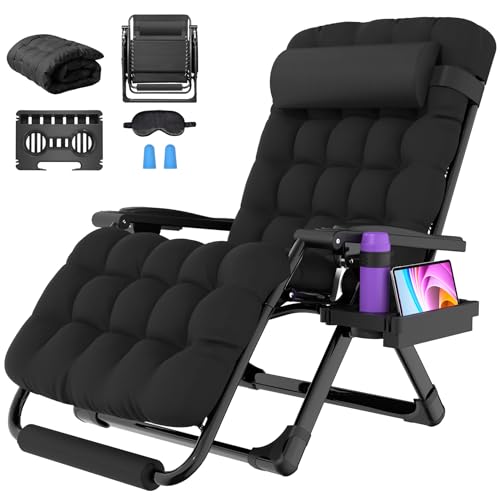
Suteck Oversized Zero Gravity Chair — Best Overall
The Suteck suits the sitter who finds standard loungers pinchy: broad shoulders, a larger frame, or simply the wish to shift position, cross a leg, or share the chair’s width with a grandchild for a story. Its listing confirms a 500 lb capacity class, a removable cushion and headrest, and an aluminum alloy locking mechanism — the three details that decide whether an oversized recliner feels like furniture or like camping gear.
Strengths
- 33-inch width gives genuine room to settle rather than perch
- Removable cushion and headrest make cleaning and seasonal storage simple
- Aluminum alloy lock holds recline angles with less flex than plastic mechanisms
Trade-offs
- Its size and weight make it the least portable pick here
- Costs more than standard-width zero-gravity chairs
- Too wide to feel snug for petite sitters, who may prefer a standard frame
| Width | 33 in XXL (per listing) |
| Headrest | Removable cushion + headrest |
| Lock | Aluminum alloy |
| Source | Confirmed listing title |
Width changes the head-resting experience in a way specifications rarely explain. In a standard lounger, a broad sitter’s shoulders are held slightly forward by the frame, which pushes the head forward too — the pillow then meets the back of the neck instead of cradling the head. The Suteck’s extra inches let shoulders drop into their natural line, so when you recline, the headrest lands where it should and the neck can actually let go.
The removable cushion system is the second half of its appeal. Padded zero-gravity chairs live outdoors and get dusty, damp, and pollen-coated; being able to strip the cushion and headrest off the frame for a proper clean, and to store the fabric indoors over winter, is what separates a chair that lasts five seasons from one that lasts two.
Best for: larger sitters and anyone who wants maximum room and support / Not suited for: petite sitters or buyers who need to carry the chair often
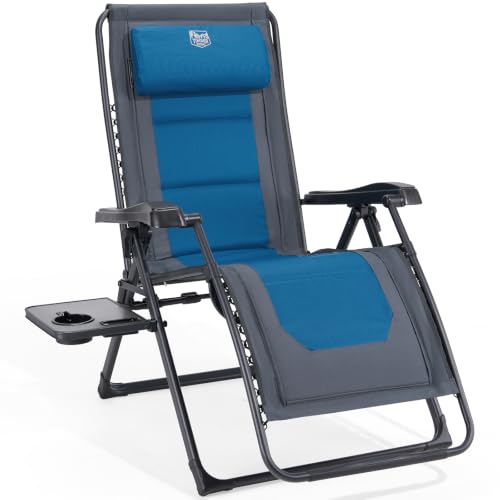
TIMBER RIDGE Zero Gravity Oversized Recliner — Best for Heavy-Duty Support
The Timber Ridge is the workhorse pick: an oversized, padded zero-gravity chair with a headrest, built for the deck, the lawn, and the campsite, with a 350 lb capacity confirmed in its listing. It suits households that want one chair to serve for afternoon naps outside, evening reading on the patio, and weekend trips, without stepping up to the XXL price class.
Strengths
- Oversized padded seat with headrest, confirmed in the listing
- 350 lb capacity covers most sitters with sensible margin
- Folds for storage and transport like the rest of the Timber Ridge line
Trade-offs
- Padding holds heat on very hot days compared with mesh models
- Heavier than basic loungers — fine for a deck, noticeable on a long carry
- Outdoor-first design; not a living-room armchair substitute
| Capacity | 350 lbs (per listing) |
| Style | Oversized padded recliner with headrest |
| Use | Patio, lawn, camping |
| Source | Confirmed listing title |
Timber Ridge built its name on oversized outdoor seating, and this recliner shows the pattern: a frame that does not creak or wander as you shift, padding thick enough to nap on, and a headrest positioned for the reclined posture rather than bolted on as an afterthought. In head-resting terms, the test is whether you can let your neck fully relax without the pillow edge pressing the base of your skull — and the padded, adjustable arrangement here passes it for average and taller sitters.
Treat the capacity figure the way engineers do: as a ceiling, not a target. A sitter well under the limit gets a chair that feels planted and locks that engage without strain; a sitter near any chair’s limit should step up to the Suteck class instead. That margin is what keeps the recline mechanism smooth in year three.
Best for: patio and camping naps for average-to-large sitters / Not suited for: indoor living-room use or ultralight portability

PHI VILLA Oversized Padded Zero Gravity Chair — Best for Tall Sitters
The PHI VILLA’s 30-inch width and padded build suit taller and larger sitters who run out of chair — in length as much as width — on standard loungers. Its listing confirms a 400 lb capacity, a cup holder, and a pillow. For a tall sitter, the critical geometry is the distance from seat to headrest top, and an oversized frame is the simplest way to buy that distance without shopping specialty tall lines.
Strengths
- 30-inch-wide frame with a 400 lb listing capacity
- Pillow included and positioned for the reclined posture
- Cup holder tray keeps a drink steady while fully reclined
Trade-offs
- Padded fabric is warm in direct summer sun
- Bulky when folded — measure your storage space
- Standard-height sitters may find the seat depth generous to a fault
| Width | 30 in (per listing) |
| Capacity | 400 lbs (per listing) |
| Extras | Cup holder + pillow |
| Source | Confirmed listing title |
Tall sitters know the failure mode this chair addresses: the headrest that ends at the neck, turning a nap into a slow headache. Oversized zero-gravity frames solve it structurally — a longer backrest arc means the pillow zone sits higher when reclined. If you are over six feet, this class of chair, or the Suteck above, is where your shortlist should start, and standard chairs should have to argue their way in.
The padding deserves one caution and one compliment. The compliment: it makes long reclines genuinely comfortable, including the head contact, which on mesh chairs can feel hammock-like and unsupportive. The caution: padded fabrics dry slowly after rain, so this chair rewards a covered porch or a habit of bringing it in — a small discipline that doubles its working life.
Best for: tall and larger sitters wanting a padded recline / Not suited for: buyers needing a compact fold or a mesh-cool seat

Amazon Basics Zero Gravity Lounge Chair — Best Budget
The Amazon Basics lounger suits the first-time zero-gravity buyer: someone who wants to rest their head on the porch or at the beach without committing to the oversized price class. Its listing confirms the essentials — a foldable reclining frame and a pillow — in a package that is easy to buy, easy to return if the style does not suit, and easy to replace years later.
Strengths
- Lowest commitment way into headrest-equipped zero-gravity seating
- Folds flat for storage, travel, and beach trips
- Pillow included for head support in the reclined position
Trade-offs
- Standard width — larger sitters should step up to the oversized picks
- Basic fabric and finish compared with the padded models
- Fewer recline lock positions than premium mechanisms
| Style | Zero gravity lounge chair with pillow |
| Frame | Foldable |
| Use | Patio and beach |
| Source | Confirmed listing title |
There is a real argument that this is the smartest first purchase in the category. Zero-gravity posture is a taste: most people love the weightless recline within minutes, and a minority never settle into it. The Amazon Basics chair lets you learn which person you are at the lowest cost, and if you are the majority, it serves perfectly well for seasons of porch naps while you decide whether an oversized padded model is worth the upgrade.
Its headrest pillow is the simple, effective kind — a padded cushion that can be slid to meet your head rather than a fixed contour. Slide it before you recline, not after: once your weight is back, friction holds everything in place and adjustments become a shuffle. That one habit makes the budget pick feel considerably more expensive than it is.
Best for: first-time buyers and budget-conscious porch napping / Not suited for: larger sitters or buyers wanting premium padding

Best Choice Products Oversized Padded Zero Gravity Chair — Best Padded Comfort
This Best Choice Products recliner suits the sitter who has tried a mesh zero-gravity chair and disliked the sag. Its oversized padded seat, confirmed in the listing with pillow and cup holder, holds the body — and the head — on a firmer, more furnished surface. It is a natural fit for covered patios, sunrooms, and three-season rooms where it will live semi-permanently.
Strengths
- Full padding supports the head and back without hammock sag
- Oversized seat suits a wide range of body sizes
- Pillow and cup holder included, per the listing
Trade-offs
- Padding and sun are not friends — best under cover
- Heavier and bulkier than mesh equivalents
- Not the pick for wet environments or poolside splashing
| Style | Oversized padded recliner |
| Color | Black/Gray (per listing) |
| Extras | Pillow + cup holder |
| Source | Confirmed listing title |
Padding changes head support from suspended to held. On a mesh lounger your head rests in a sling, which many love and some find unstable; on this padded frame the pillow sits on a solid-backed surface, so the head feels the way it does on a good sofa — supported in one place, free to turn slightly, easy to lift. Readers who nap with a book propped on their chest tend to prefer exactly this arrangement.
The ownership note is weather discipline. Padded outdoor chairs are really outdoor-room chairs: glorious under a roof or awning, quick to suffer left in open rain. If your spot is uncovered, choose a mesh pick from this list instead and add a loose cushion; if your spot is a porch, this is the comfort pick of the six.
Best for: covered patios and sitters who prefer firm, padded support / Not suited for: uncovered, rain-exposed placement

Colegence Oversized Zero Gravity Chairs Set of 2 — Best Pair
The Colegence set suits the household reality that head-resting chairs are never used alone for long: couples on a deck, a parent and an adult child, a host whose guest currently gets the bad chair. The listing confirms 29-inch-wide recliners with a 400 lb capacity each, cup holders, and pillows — a matched pair that looks intentional on a patio rather than accumulated.
Strengths
- Two matched oversized recliners in one purchase
- 400 lb capacity per chair, per the listing
- Pillows and cup holders included for both seats
Trade-offs
- You are buying two — storage space doubles as well
- If one chair is damaged, matching a replacement later can be tricky
- Set pricing makes it poor value for a confirmed single user
| Quantity | Set of 2 |
| Width | 29 in each (per listing) |
| Capacity | 400 lb each (per listing) |
| Source | Confirmed listing title |
Pairs solve a social problem that single-chair reviews ignore: the second-best seat. Anyone who has watched a partner claim the good lounger every evening understands that two matched chairs are not an extravagance but a peace treaty, and buying them as a set guarantees the same recline geometry, the same pillow position, and the same aging curve on both sides of the deck.
Check the folded dimensions before ordering and decide where the pair will live in winter. Two oversized recliners need a real storage plan — a garage wall, a deck box, a shed corner. Households that plan the storage at purchase time keep matched sets for years; households that improvise tend to lose one chair to weather and end up mismatched anyway.
Best for: couples and households that always need two good seats / Not suited for: single users or very tight storage
Comparison Table
| Pick | Badge | Key spec | Best for |
|---|---|---|---|
| Suteck Oversized Zero Gravity Chair | Best Overall | 33 in wide, removable headrest | larger sitters and anyone who wants maximum room and support |
| TIMBER RIDGE Zero Gravity Oversized Recliner | Best for Heavy-Duty Support | 350 lb capacity, padded + headrest | patio and camping naps for average-to-large sitters |
| PHI VILLA Oversized Padded Zero Gravity Chair | Best for Tall Sitters | 30 in wide, 400 lb capacity | tall and larger sitters wanting a padded recline |
| Amazon Basics Zero Gravity Lounge Chair | Best Budget | Foldable, pillow included | first-time buyers and budget-conscious porch napping |
| Best Choice Products Oversized Padded Zero Gravity Chair | Best Padded Comfort | Oversized padded, pillow + tray | covered patios and sitters who prefer firm, padded support |
| Colegence Oversized Zero Gravity Chairs Set of 2 | Best Pair | Set of 2, 29 in, 400 lb each | couples and households that always need two good seats |
The honest divider in this table is width. Standard frames serve average sitters well and cost least; every oversized model here buys its head support partly through geometry — more room for shoulders means a head that can finally settle back. Match the chair to the largest regular sitter, not the average one.
How to Choose a Chair for Resting Your Head
Head support is a geometry problem before it is a comfort problem. This guide covers the four checks — backrest height, pillow position, recline lock, and capacity margin — that predict whether a chair will cradle your head or quietly fight it.
Measure the backrest against your seated height
Sit against a wall and measure from the seat surface to the top of your head; a chair for resting your head needs a backrest that reaches at least that height in its reclined position, with the pillow zone landing at the back of your skull rather than your neck. Taller sitters should start with oversized frames — the Suteck, PHI VILLA, and Colegence class — because their longer backrest arcs are built for exactly this measurement.
Remember that reclining changes the geometry: as the backrest tips, your head travels along an arc, and a chair that feels tall enough upright can run out of backrest at full recline. Listings rarely publish the reclined height, which is why the headrest’s adjustability — a sliding or repositionable pillow — is such a valuable feature: it forgives the mismatch that fixed measurements cannot.
Pillow position matters more than pillow softness
A firm pillow in the right place beats a cloud in the wrong one. The right place is the curve where skull meets neck, supporting the head’s weight without pushing it forward. Sliding pillows, like the Amazon Basics design, let you dial this in per sitter; fixed padded headrests, like the oversized models here, rely on generous sizing to suit most people. If a household spans very different heights, adjustable wins.
Also consider removability. A pillow that comes off can be washed, replaced when its foam tires, or left off entirely by sitters who prefer direct backrest contact. Removable cushion systems — the Suteck’s is the clearest example here — extend the whole chair’s life because the fabric, not the frame, is what usually ages first.
The recline lock is a safety feature, not a detail
When your head is back and your weight is committed, the lock is the only thing between a nap and a sudden drop. Prefer mechanisms that engage positively at several angles — metal locking systems, like the Suteck’s aluminum alloy lock, generally feel more secure over years than friction-only designs. Test any new chair by reclining slowly through its range and loading each lock position with a gentle bounce before trusting it with a sleeping child or an older relative.
Zero-gravity geometry itself is part of the safety story: with knees raised to about heart level, weight distributes along the frame instead of concentrating at the hips, so locks hold less peak load and the head rests at a natural angle rather than tipped back. If you have never sat in one, the budget pick in this guide is the inexpensive way to learn the posture.
Buy capacity with margin, and width with honesty
Capacity ratings are ceilings measured on new frames. A sitter within about two-thirds of the rating gets a chair that locks cleanly, folds smoothly, and stays quiet; a sitter at the rating gets a chair working at its limit from day one. Apply the same honesty to width: if you like to shift, tuck a leg up, or hold a book wide, the standard frame will feel like a compromise every single session, and the oversized upgrade will pay for itself in use.
Finally, match the chair to its home. Padded models belong under cover; mesh and textilene models shrug off weather; folding weight decides whether the chair travels or stays. The best chair for resting your head is the one that is already where you want to rest — set up, at the right angle, with its pillow in place.
Indoor recliners versus zero-gravity loungers: the honest split
If your head-resting will happen in a living room, around other furniture, through winters, an indoor recliner with a high, supportive back is the natural format — upholstered, heavy, and permanent. Its head support comes from the backrest’s height and the headrest zone’s shaping, and its recline often articulates, so the best head position may sit at a different back-and-footrest combination than you first try. Judge it seated, at length, the way you would judge a mattress.
Zero-gravity loungers — every pick in this guide — trade that permanence for posture and practicality: the one-piece recline that raises the knees is mechanically superb for resting the head, the frames fold away, and the prices run far below furniture-grade recliners. Their territory is the porch, deck, sunroom, and garden, plus any indoor corner where a folding chair is a feature rather than an apology. Choose by where the resting will actually happen, and the format chooses itself.
How to Set Up and Adjust a Zero-Gravity Chair for Head Support
Five minutes of adjustment on day one is the difference between a chair you nap in and a chair you sit in. Work through these steps with the chair’s main sitter actually in it.
Step 1: Set the chair on level ground and unfold it fully
Open the frame until the legs sit flat and the fabric is taut, on the surface where the chair will live. A lounger on uneven ground twists slightly, and that twist shows up as one-sided head support — the pillow feels fine on the left and wrong on the right, and no adjustment fixes a crooked base.
Step 2: Sit down and find the natural recline
Have the sitter settle in, feet on the footrest bar, and lean back slowly until the chair reaches the angle where their head wants to rest. Note which lock position that is. Most people rest best a notch or two short of full recline, where the head is supported but the view — a book, a screen, a garden — is still reachable without straining the neck forward.
Step 3: Position the pillow at the skull’s curve
Slide or place the pillow so its center meets the curve where the skull meets the neck, not the middle of the head and not the shoulders. Ask the sitter to let their head’s full weight go: if the neck muscles still hold tension, move the pillow a finger’s width at a time until the tension releases. That release is the entire point of the chair.
Step 4: Lock, load, and listen
Engage the recline lock and have the sitter shift weight gently side to side. A healthy mechanism holds silently; creaks at one position usually mean grit in the joint or a lock not fully engaged. Clean the joint, re-engage firmly, and retest before deciding anything is wrong with the chair.
Step 5: Set the accessories for the reclined reach
Place the cup holder tray, side table, or book within the reach of the reclined sitter — which is shorter and lower than you expect. The goal is a full rest session without sitting up: every sit-up resets the neck tension you just adjusted away, so arrange the environment once, properly.
Step 6: Re-check after a week of real use
Fabric stretches slightly and foam settles in the first week, which can move the pillow’s effective position by enough to matter. Repeat the pillow adjustment once after the chair has been used daily for a week, and you will have the setting the chair keeps for the season.
For indoor recliners, the same routine applies with one addition: check that the headrest zone still supports the head at the sitter’s preferred recline angle, since indoor mechanisms often recline the back and raise the footrest independently, and the best head position may sit at a different combination than the first one you try.
Care and Long-Term Ownership
Outdoor recliners age at three points: the fabric, the elastic or bungee lacing that tensions it on mesh models, and the locking mechanism. Inspect all three each spring. Fabric wants a brush-down and a mild-soap wash, dried fully before folding away; lacing that has gone slack or frayed can often be replaced as a kit, restoring a chair that felt finished; and locks want their joints cleaned of grit and given the manufacturer’s recommended lubricant, because a lock that grinds in April drops in August.
Padded models add one rule: never store them damp, and never leave them folded wet after rain. Moisture inside padding becomes mildew, and mildew in a headrest — the part of the chair your face rests against — ends the chair’s useful life regardless of the frame’s condition. The removable-cushion design of the Suteck pick exists precisely to make this rule easy: cushions indoors, frame under cover, and the system survives winters that kill lesser chairs.
Weight discipline extends mechanism life more than any maintenance. Every lock engagement under a bouncing load, every recline forced past its stop, every stand-up that uses the armrests as a crane — the frame remembers all of it. Teach the household the gentle pattern: recline slowly, lock positively, rise by leaning forward and using your legs. Chairs treated this way routinely double the service of chairs treated casually, and the headrest pillow — the component this entire guide is about — keeps its shape and position through all of it.
When a chair does tire, replace by component before replacing the whole: pillows, lacing, and tray accessories are the wear items, and the frame is usually the survivor. A five-year-old recliner with a fresh pillow and new lacing sits like a two-year-old chair. That is the ownership economics that make the mid-range picks in this guide — Timber Ridge, PHI VILLA, Best Choice Products — such durable value: standard formats with replaceable soft parts, rather than sealed designs that are new or nothing.
One last ownership note concerns households rather than chairs. A head-resting chair becomes, within a month, someone’s chair — claimed, angled, pillow set just so — and the household peace is served by treating that claim as data. If two people rest at the same hours, the pair pick in this guide or a second chair bought later is not indulgence but accuracy: the entire value of the category is a seat that is ready, at your angle, with your pillow where your head expects it. A shared chair reset by another sitter every evening delivers half its promise, because the five-minute adjustment ritual from the setup guide quietly stops happening. Buy for the household you have, in the numbers it actually rests in, and every chair in it will be used the way the category intends — daily, gratefully, and with heads properly at rest.
Common Buying Mistakes
Buying a chair with no real headrest because the seat felt soft
Seat comfort and head support are different systems. A plush seat with a low back leaves your neck holding your head for the entire session, which is the fatigue this search is trying to escape. If the listing does not confirm a headrest, pillow, or high supportive back, the chair does not belong on this shortlist — or yours.
Ignoring the sitter’s height when choosing a standard frame
Standard loungers are designed around average seated height. Tall sitters run out of backrest; petite sitters can find oversized seats too deep to recline comfortably. Match the frame class to the actual sitter, using the oversized picks for tall and large frames and the standard picks for everyone else.
Testing the recline empty instead of loaded
An unloaded chair glides and locks beautifully in a showroom sense. The real test is your body weight shifting at full recline. Load every lock position before the return window closes, and treat any slip, drop, or grinding as a reason to exchange the chair, not to live with it.
Leaving padded chairs out in the weather
Padding drinks rain and dries slowly, and a damp headrest cushion against your neck ends the relaxation argument quickly. Padded picks belong under cover or in storage between uses; if your spot is open to the sky, choose a quick-drying mesh design and add a removable pillow instead.
Forgetting the second sitter
A single perfect chair in a two-person household becomes a negotiation, not a rest. If the chair will be shared or fought over, price the pair option — like the Colegence set — against two singles before deciding the single was cheaper.
Final Recommendation
For most buyers, the Suteck Oversized is the safest single recommendation: the width, the removable headrest and cushion, and the metal lock add up to the chair most likely to fit the sitter in front of it and keep fitting for seasons. If its price or size is more than you need, the TIMBER RIDGE is the same idea in a proven, slightly smaller workhorse form.
Choose the PHI VILLA if the main sitter is tall, the Amazon Basics if you are testing the zero-gravity idea on a budget, the Best Choice Products if you want firm padded support under cover, and the Colegence pair if the honest answer to ‘who will use it?’ is ‘both of us, every evening.’ Whichever you choose, spend the five adjustment minutes from the setup guide — head support is half product, half positioning.
If you are still torn between two picks after all of this, decide by the sitter who rests most. The household’s champion napper, reader, or sky-watcher is the person this purchase is really for, and their height, width, and preferred posture should break every tie. A chair chosen for its primary sitter delights daily; a chair chosen by committee compromise satisfies a spreadsheet. The picks above are all sound — let the person whose head will actually rest in it have the casting vote, and you will have bought the right chair the first time.
Related guides in this series: Best Zero Gravity Chairs Best Recliner Chairs Best Outdoor Lounge Chairs Best Camping Chairs With Headrest Best Patio Chairs
Frequently Asked Questions
What is the difference between a zero-gravity chair and a recliner for resting your head?
A zero-gravity chair reclines the whole body as one unit, raising the knees toward heart level so weight spreads along the frame and the head settles back at a supported angle. A traditional recliner articulates — back and footrest move, sometimes independently — and supports the head against its high back. Both can rest your head well; zero-gravity designs do it with a lighter, foldable, mostly outdoor-friendly frame, while indoor recliners do it with upholstery and a furniture footprint.
How do I know if a headrest pillow will land in the right place for me?
Look for adjustability first — a sliding or removable pillow forgives height differences that a fixed headrest cannot. If the pillow is fixed, choose the frame class built for your size: oversized frames place the pillow zone higher and suit taller sitters. As a rule, you want the pillow’s center at the curve where your skull meets your neck when reclined, and any chair that lets you fine-tune that contact will feel right within a minute of adjustment.
Can I use these chairs indoors?
Yes, with placement sense. Zero-gravity loungers work well in sunrooms, three-season rooms, and spare corners, and their folding frames store in a closet between uses. Check the feet on hard floors — most outdoor frames benefit from simple furniture pads indoors — and remember padded models are effectively indoor-outdoor furniture that simply prefers to stay dry.
What capacity should I choose?
Choose a chair whose confirmed capacity leaves clear margin above the heaviest regular sitter — ideally the sitter should be no more than about two-thirds to three-quarters of the rating. Margin buys smooth locks, quiet frames, and long mechanism life. The listings in this guide confirm capacities from standard duty up to the 500 lb class, so there is a correctly margined option for essentially every household.
How do I clean a removable headrest and cushion?
Remove the fabric from the frame, shake and brush off loose dirt, then wash according to the care label — most outdoor cushions accept gentle machine or hand washing with mild detergent and full air drying. Never store the cushion damp, and let it dry completely before refitting; a headrest lives against skin and hair, so it rewards the same freshness standard as a pillowcase.
Are zero-gravity chairs good for reading?
They are among the best reading seats made, provided the recline is set a notch short of full. At that angle the head is supported, the book rests naturally on the raised knees or a lap pillow, and the neck is not craned forward the way it is in an upright chair. The cup-holder trays on several picks here keep a drink inside the reclined reach, which completes the setup.

