Disclosure: airfryerkitchensupply.com is reader-supported. When you buy through links on our site, we may earn an affiliate commission at no extra cost to you.
Where to buy
Gravel changes what a good patio chair looks like: narrow feet sink, rockers dig in, and lightweight frames wander every time you stand up. Where a listing title does not state a weight capacity or a foot design, this guide says so instead of guessing.
Check KINGYES Adirondack on Amazon — check price on Amazon
Check SERWALL Adirondack Set on Amazon — check price on Amazon
Check Keter Alpine on Amazon — check price on Amazon
Check Coleman Camping Chair on Amazon — check price on Amazon
Check TIMBER RIDGE Zero Gravity on Amazon — check price on Amazon
Check PHI VILLA Zero Gravity on Amazon — check price on Amazon
Finding the best chairs for gravel patio seating is less about style and more about what happens at the four points where the chair meets loose stone. On gravel, a chair earns its place by spreading its load: wide feet, sled-style bases, chunky Adirondack legs and heavier frames all resist the slow sink and wobble that make slim-legged deck chairs miserable on stone. This guide compares six verified chairs across those stability strategies — solid HDPE Adirondacks that plant themselves, a resin chair with a cup holder, a cooler-equipped camping chair that travels, and two oversized zero-gravity recliners whose wide frames sit surprisingly well on compacted gravel. None of the listings below claims to be rated for gravel, because none of them is; gravel performance here is judged on foot width, frame weight and base geometry, and the buying guide explains exactly how to test that on your own patch before you commit to a full set.
Key Takeaways
- On gravel, base geometry matters more than cushioning: wide feet, sled bases and heavy frames sink and wobble least.
- HDPE Adirondack chairs are the plant-it-and-leave-it option; their weight is a stability feature on loose stone.
- Zero-gravity recliners work on compacted, levelled gravel but rock and shift on deep, loose stone.
- No listing here is gravel-rated — judge stability by foot width and frame weight, and test one chair before buying a set.
- Rake and compact the seating patch first; even the best chair wobbles on unlevelled gravel.
In this guide
Quick Picks — Best chairs for gravel patio
Best Overall — KINGYES Folding Adirondack Chair with Cup Holder. A heavy HDPE Adirondack whose broad legs and low stance plant it firmly on gravel, with a cup holder and a folding frame for winter storage.
Check the current price on Amazon
Best Value Set — SERWALL Modern Folding Adirondack Chairs, Set of 2. The same gravel-friendly Adirondack formula as the top pick, sold as a pair — the economical way to furnish a fire-pit circle on stone.
Check the current price on Amazon
Best Low-Maintenance — Keter Alpine Adirondack Resin Outdoor Chair. A resin Adirondack from a mainstream outdoor brand — hose it down, leave it out, and let the wide stance handle the gravel.
Check the current price on Amazon
Best Portable — Coleman Portable Camping Chair with 4-Can Cooler. The take-anywhere option: a cushioned folding chair with a built-in 4-can cooler that works on gravel for gatherings, then folds into its bag.
Check the current price on Amazon
Best for Reclining — TIMBER RIDGE Zero Gravity Chair, Oversized, 350 lbs Capacity. An oversized padded recliner with a stated 350 lbs capacity whose wide frame sits well on levelled gravel — for reading and napping, not dining.
Check the current price on Amazon
Best High-Capacity Lounger — PHI VILLA Oversized Padded Zero Gravity Chair, 400 LBS. A 30-inch-wide recliner with a stated 400 LBS capacity, cup holder and pillow — the roomiest reclined seat here for larger sitters on gravel.
Check the current price on Amazon
How These Picks Were Chosen
Chairs were then screened for gravel sense: a base that spreads load (wide or flat feet, a broad frame footprint, or a sled-like stance), a complete-chair listing rather than a part or accessory, and a construction suited to outdoor use where the title states it, such as HDPE or all-weather wording. Duplicate colour and size variants of the same model were collapsed to a single pick.
Stability scoring was deliberately conservative. Because no manufacturer title here mentions gravel, this guide never claims a chair is designed for it; instead, each review explains which physical trait helps on stone — frame mass, foot width, recline geometry — and which trait works against it, such as a rocking base or narrow folding legs. Weight capacities are quoted only where the Amazon title itself prints a figure. Price is never printed: use the check-price links to see the current figure, since outdoor furniture pricing moves with the season.
The 6 Best — Best chairs for gravel patio

KINGYES Folding Adirondack Chair with Cup Holder — Best Overall
The KINGYES is the chair most gravel owners end up happiest with, because an Adirondack’s geometry is accidentally perfect for stone: the weight sits low, the legs are wide slabs rather than points, and the HDPE body is heavy enough that it does not skate when you shift your weight. The listing title confirms HDPE construction, all-weather positioning and a cup holder, and the chair folds despite its solid feel.
Strengths
- HDPE body stated in the title — dense, heavy and weatherproof in the ordinary sense of outdoor plastic that does not rot or peel
- Wide Adirondack leg stance spreads load across the gravel instead of punching through it
- Folding design is unusual for HDPE Adirondacks and makes off-season storage realistic
Trade-offs
- The low, reclined Adirondack sit is hard for anyone with weak knees to get out of
- Heft that helps on gravel makes it tedious to drag around the garden daily
- The title does not state a weight capacity, so heavier sitters should check the listing details before ordering
| Spec | Detail (from verified listing title) |
|---|---|
| Material | HDPE (stated in title) |
| Design | Folding Adirondack with cup holder |
| Weather positioning | All-weather (stated in title) |
| Weight capacity | Not stated |
Set this chair on raked, compacted gravel and it behaves almost like it is on a deck: the rear legs form a broad footprint and the front legs are wide enough not to auger into the stone when you lean forward for a drink. The wooden-textured finish reads more like painted timber than plastic at conversational distance, and the cup holder is genuinely useful because gravel patios rarely have a side table within reach that is itself stable. Folding matters more than it sounds — HDPE chairs are the ones people leave out all winter and regret, and being able to stand this one in a shed extends its tidy years. The honest limit is the Adirondack posture itself: you sit low and laid back, which is wonderful for an evening drink and wrong for dining at a table. Buy one first, live with the sit height for a weekend, and then commit to the set.
Best for: gravel patios where chairs stay in one place all season / Not suited for: dining-height seating or anyone who struggles to rise from a low seat
Check the current price on Amazon

SERWALL Modern Folding Adirondack Chairs, Set of 2 — Best Value Set
Sold as a set of two, the SERWALL folding Adirondacks suit the way gravel patios are actually used: a loose circle around a fire pit or a pair flanking a small table. The Amazon title confirms HDPE construction, cup holders and a wood-grain finish, and the modern profile sits slightly less laid-back than a classic Adirondack, which some people find easier to get out of.
Strengths
- Pair pricing structure makes a matched gravel seating circle simpler to buy
- HDPE weight and wide legs give the same anti-sink behaviour as the top pick
- Cup holders on both chairs — small thing, big deal on a surface where drinks cannot sit on the ground safely
Trade-offs
- A set locks you into one colour and style for the whole patio
- Still a low Adirondack sit, even if marginally more upright than classic designs
- Title does not state a weight capacity
| Spec | Detail (from verified listing title) |
|---|---|
| Material | HDPE (stated in title) |
| Pack | Set of 2 |
| Design | Folding Adirondack, cup holders |
| Weight capacity | Not stated |
On gravel, matched pairs have a hidden benefit: you level the patch once, to one footprint, and both chairs behave the same. The SERWALL’s wood-grain texture hides the scuffs that gravel dust inevitably leaves on chair legs, and the teal finish in the verified listing is the kind of colour that still looks intentional after a dusty summer. Folding both chairs flat for winter takes minutes. Where the set asks for compromise is flexibility — if one chair will live by the fire pit and the other across the garden, a pair is still fine, but if your patio plan is still evolving, two singles may serve you better. As with every Adirondack here, test the rise from the seat before ordering for older guests.
Best for: couples or fire-pit circles furnishing a gravel patio in one purchase / Not suited for: mixed, evolving layouts that need single chairs in different styles
Check the current price on Amazon

Keter Alpine Adirondack Resin Outdoor Chair — Best Low-Maintenance
Keter’s Alpine takes the same wide-leg Adirondack stance in resin, from a brand many buyers already know from storage boxes and deck furniture. The title confirms the cup holder and positions the chair for beach, pool and fire-pit seating. Resin chairs tend to be a touch lighter than HDPE, which is the one gravel-relevant trade-off to weigh here.
Strengths
- Resin body shrugs off rain, dust and hose-downs with zero finishing upkeep
- Adirondack footprint gives the wide, low, anti-sink stance gravel rewards
- Cup holder included, as on the HDPE picks
Trade-offs
- Lighter than the HDPE chairs, so it can shift a little more on loose, deep gravel
- Resin can feel less substantial than HDPE in hand
- Title does not state a weight capacity
| Spec | Detail (from verified listing title) |
|---|---|
| Material | Resin (stated in title) |
| Design | Adirondack with cup holder |
| Weight capacity | Not stated |
| Colour in verified listing | Grey |
Choose the Alpine when maintenance is the deciding factor: resin does not ask for anything beyond a wash, and the grey finish hides gravel dust better than white or bright colours. On a compacted gravel patio with a levelled patch, its stance is perfectly stable; on deep, freshly laid stone it is the chair here most likely to need the occasional re-seat because it carries less mass than the HDPE pair. That is a fair trade for renters and for anyone who moves chairs between a gravel patio and a poolside slab. As ever with a listing that prints no capacity figure, heavier users should confirm details on the product page before ordering.
Best for: low-maintenance gravel patios and mixed deck-and-stone gardens / Not suited for: deep, loose gravel where maximum chair mass matters most
Check the current price on Amazon

Coleman Portable Camping Chair with 4-Can Cooler — Best Portable
Not every gravel patio needs permanent furniture. Coleman’s long-running camping chair adds a cushioned seat, side pockets, a cup holder and a 4-can cooler pouch, and it folds into a carry bag — the right answer for gravel areas that host occasional crowds, fire-pit nights and tailgate-style gatherings rather than daily sitting.
Strengths
- Built-in cooler and pockets keep drinks off the gravel entirely
- Folds into a carry bag, so gravel seating can appear and disappear as needed
- Cushioned seat and back are kinder for long evenings than bare sling chairs
Trade-offs
- Folding-chair legs are narrower than Adirondack legs and will settle into loose gravel — compact the patch first
- Fabric construction needs drying before storage, unlike HDPE or resin
- Not a leave-out-all-season chair
| Spec | Detail (from verified listing title) |
|---|---|
| Design | Portable folding camping chair |
| Extras | 4-can cooler, side pockets, cup holder, carry bag (stated in title) |
| Seat | Cushioned seat and back |
| Weight capacity | Not stated |
The Coleman earns its slot on versatility rather than gravel-specific design, and the review should be honest about that: its X-frame legs concentrate weight more than an Adirondack’s slabs, so on soft gravel you will feel it settle a few millimetres as you sit down, after which it is stable enough for an evening. On raked and rolled gravel — the preparation this guide recommends for any chair — it is a non-issue. What you get in return is the only pick that can host six extra guests on Saturday and live in a cupboard on Sunday, with cold drinks in the arm. For permanent daily seating on gravel, choose an Adirondack; for flexible seating, this is the sensible buy.
Best for: occasional gatherings, fire-pit nights and gravel areas without permanent furniture / Not suited for: daily, leave-out seating where a fixed heavy chair suits better
Check the current price on Amazon
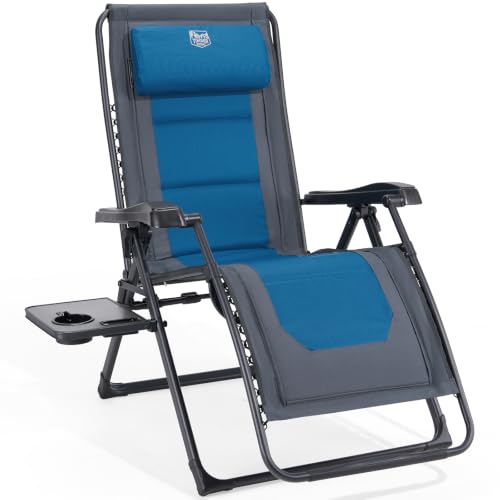
TIMBER RIDGE Zero Gravity Chair, Oversized, 350 lbs Capacity — Best for Reclining
Zero-gravity recliners spread their footprint along two long frame rails rather than four point legs, and on compacted gravel that rail base is a genuine advantage: it bridges small stones instead of sinking between them. The TIMBER RIDGE title states an oversized padded build, a headrest and a 350 lbs capacity — one of the few verified figures in this roundup, and it is quoted here only because the title prints it.
Strengths
- Long frame rails bridge gravel instead of point-sinking like narrow legs
- Stated 350 lbs capacity in the title — no guessing for larger sitters
- Padded seat with headrest suits long reclined sessions
Trade-offs
- Recliners need a level patch; on sloping or deep loose gravel the chair can creep as you recline
- Bulky even folded — plan storage space
- Useless at a dining table; this is a lounge chair only
| Spec | Detail (from verified listing title) |
|---|---|
| Design | Zero gravity recliner |
| Capacity | 350 lbs (stated in title) |
| Extras | Padded seat, headrest |
| Fabric | Polyester (stated in title) |
Recline on gravel and physics changes: your weight shifts backwards along the frame, and a chair that felt fine upright can tip or slide. The TIMBER RIDGE’s wide stance and long rails handle that shift better than most, provided the patch underneath is raked level and compacted — the how-to section walks through that ten-minute job. The padding and headrest make it the chair people fight over for afternoon reading. Accept its limits honestly: it is a single-purpose lounger, it is big, and deep loose gravel is not its friend. On a prepared patch, though, it delivers the most comfortable sit in this guide.
Best for: reclined reading and napping on a levelled, compacted gravel patch / Not suited for: dining, small patios, or deep unprepared gravel
Check the current price on Amazon

PHI VILLA Oversized Padded Zero Gravity Chair, 400 LBS — Best High-Capacity Lounger
The PHI VILLA stretches the zero-gravity formula wider: the title states a 30-inch width and a 400 LBS capacity, and includes a cup holder and pillow. Width matters twice over on gravel — the sitter gets room, and the frame gets a broader footprint that resists the sideways rock loose stone can induce in a recliner.
Strengths
- Stated 400 LBS capacity and 30-inch width, both printed in the title
- Broad frame footprint steadies the recline on compacted gravel
- Cup holder and pillow included rather than sold separately
Trade-offs
- The largest footprint here — measure your patch before ordering a pair
- Same recliner limits: level ground needed, no dining use
- Folding bulk makes it a two-hand carry
| Spec | Detail (from verified listing title) |
|---|---|
| Design | Zero gravity folding recliner |
| Width | 30 inches (stated in title) |
| Capacity | 400 LBS (stated in title) |
| Extras | Cup holder, pillow |
For larger sitters, most patio chairs fail on width before they fail on strength, and the PHI VILLA addresses both in print. On gravel its broad rails and wide stance are the most forgiving recliner base in this guide, and the included pillow saves the rolled-towel improvisation. The preparation rule still applies — level and compact the patch, and re-check after the first week as the stone beds in. If your gravel area doubles as a sun deck, this is the chair to build it around; if space is tight, the TIMBER RIDGE gives a similar sit in a slightly smaller footprint.
Best for: larger sitters who want a reclined seat on a prepared gravel sun patch / Not suited for: tight patios or anyone needing dining-height chairs
Check the current price on Amazon
Comparison Table
| Pick | Badge | Key spec | Best for |
|---|---|---|---|
| KINGYES Folding Adirondack Chair with Cup Holder | Best Overall | HDPE, all-weather, folding, cup holder | gravel patios where chairs stay in one place all season |
| SERWALL Modern Folding Adirondack Chairs, Set of 2 | Best Value Set | HDPE, set of 2, cup holders, folding | couples or fire-pit circles furnishing a gravel patio in one purchase |
| Keter Alpine Adirondack Resin Outdoor Chair | Best Low-Maintenance | Resin Adirondack, cup holder | low-maintenance gravel patios and mixed deck-and-stone gardens |
| Coleman Portable Camping Chair with 4-Can Cooler | Best Portable | Folding camping chair, built-in cooler, carry bag | occasional gatherings, fire-pit nights and gravel areas without permanent furniture |
| TIMBER RIDGE Zero Gravity Chair, Oversized, 350 lbs Capacity | Best for Reclining | Zero gravity recliner, 350 lbs capacity stated, padded, headrest | reclined reading and napping on a levelled, compacted gravel patch |
| PHI VILLA Oversized Padded Zero Gravity Chair, 400 LBS | Best High-Capacity Lounger | 30-inch wide, 400 LBS stated, cup holder and pillow | larger sitters who want a reclined seat on a prepared gravel sun patch |
Check KINGYES Adirondack on Amazon
Check SERWALL Adirondack Set on Amazon
Check Coleman Camping Chair on Amazon
Check TIMBER RIDGE Zero Gravity on Amazon
Check PHI VILLA Zero Gravity on Amazon
How to Choose Chairs for a Gravel Patio: Start at the Feet
The single most useful thing you can do is flip your thinking: on gravel you are not buying a seat, you are buying a base. Feet that present a wide, flat area to the stone — Adirondack leg slabs, recliner rails, broad sled-style frames — spread your weight across many stones, and the chair settles once, slightly, then stays put. Feet that present a point — thin tubular legs, rocker tips, narrow folding-chair ends — concentrate the same weight onto a few stones, which roll and shift, and the chair wobbles every time you move. When you shop, look at product photos from ground level, not at the cushion. If you cannot see the feet clearly, that itself is information: chairs designed for decks hide ordinary legs, while chairs that will behave on gravel show their stance proudly.
Frame weight is the second factor, and it cuts against normal furniture instincts. Indoors, lighter is easier; on gravel, heavier is calmer. A dense HDPE Adirondack barely notices a guest shifting position, while an ultralight aluminium chair skates. That is why this guide favours HDPE and resin Adirondacks and wide steel-frame recliners over elegant slim dining chairs. If you love a lighter chair’s looks, plan to park it on a stabilised patch — compacted stone dust or a ground grid under the gravel — rather than expecting the chair alone to solve physics.
Matching the Chair to How the Gravel Area Is Actually Used
Be honest about the programme for the space. A gravel circle used for morning coffee and evening drinks wants low lounge seating: Adirondacks and recliners, with cup holders doing the work a side table cannot do on stone. A gravel area used for meals wants dining-height chairs, and that is the hardest brief on gravel — dining chairs have the narrowest legs and the tallest, wobblest stance. If dining is the plan, prioritise the widest-legged dining chairs you can find, compact the patch hard, and consider a stabilising grid under the dining zone; none of the lounge picks in this guide should be pressed into table service, because their seat heights are wrong for it.
Frequency matters too. Chairs that live on the gravel permanently should be HDPE, resin or similarly indifferent to weather, because gravel holds moisture against legs and splashes grit onto finishes. Chairs that visit — the folding Coleman pattern — can be fabric and foam, because they dry indoors and never sit in a wet patch for a month. Mixing both patterns is often the smartest layout: two permanent Adirondacks for daily use, plus folding chairs in storage for the nights the circle grows.
Gravel Depth, Chair Feet and the Compromise Zone
Most patios are laid with gravel far deeper than chairs would choose. Decorative gravel at two or three inches deep behaves like ball bearings under furniture: stones roll, feet wander, and even a wide Adirondack leg will slowly trench its way down during a long evening. Seating gravel works best at the shallow end — enough stone to cover the base and look finished, over a compacted sub-base that actually carries the load. If your patio is deep, the practical fix is not new chairs but a seating zone: rake the lounge area down to a thinner layer, compact what is underneath, and let the deeper decorative stone continue around the edges where nobody sits. The chairs in this guide were chosen assuming that compromise zone — prepared, compacted, reasonably shallow gravel — because on truly deep loose stone, no honest guide can promise any chair will behave.
Within that zone, small differences in foot design still matter. A flat foot that meets the stone across its whole face settles once and stops. A foot with a rim or a slight curve keeps finding new stones to roll on. When you compare product photos, zoom in on the very bottom of the leg: you are looking for boring, flat, wide contact patches. Boring is good. Decorative ball feet, tapered points and elegant curves are deck furniture language, and on gravel they translate directly into wobble, trenching and the slow sideways drift that leaves a seating circle looking drunken by August.
Care, Cleaning and Winter Storage on a Gravel Base
Gravel is abrasive and dusty, and chairs that live on it age from the bottom up. HDPE and resin shrug off the grit itself — a hose-down restores them — but dust works into folding hinges and recliner locks, so once a season, open and close every folding mechanism, brush the grit out, and check that locks still engage fully. Fabric chairs suffer more: grit ground into a seat by a season of sitters is nearly impossible to wash out, which is another reason the fabric pick here is a store-indoors design. Recliner fabrics should be brushed before folding, never folded gritty, because the stones trapped in a fold act like sandpaper in storage.
Winter storage on gravel country follows one rule: nothing with moving parts stays out. Folding Adirondacks go in the shed standing on their edges, recliners go in folded and dry, and the permanent patch gets a spring routine — rake, top up the migrated stone, re-tamp the foot spots, and the new season starts level. Chairs left out anyway will mostly survive structurally, but hinges, locks and finishes pay for it, and the first sit of spring will tell you exactly what the winter cost.
Arranging a Gravel Seating Circle That Stays Put
Layout can defeat good chairs. A circle arranged on a slope will migrate downhill one recline at a time, and a pair of Adirondacks facing a view across a slope will never sit evenly. Arrange seating on the flattest contour of the patio, even if it means rotating the whole arrangement a few degrees from the architecturally obvious angle — your ankles will notice the slope long after your eyes stop noticing the angle. Leave a tamped path behind the chairs, because people push backwards with their feet as they stand, and that push, repeated all summer, trenches the ground exactly where the rear legs stand.
Anchor the arrangement visually with the heaviest chairs at the back of the slope and the folding chairs at the front, so the pieces most likely to be moved are the lightest ones. A low table on a wide base — or drinks in chair cup holders, as several picks here provide — completes a layout that asks nothing of the gravel surface itself. Done this way, a gravel patio stops being a compromise surface and becomes what its owners always claim it is: the most relaxed seat in the garden.
What About Dining, Rocking and Slim-Legged Chairs on Gravel?
Three chair families get asked about constantly and deserve straight answers. Dining chairs are the hardest fit: tall stance, narrow legs, and a sitter who shifts constantly while eating. They can work on a stabilised dining zone — compacted stone dust or a ground grid beneath a thin gravel dressing — but on ordinary loose gravel they will wobble through every meal, and no product choice fully fixes that. If outdoor dining on gravel is the dream, spend the money on the ground first and the chairs second; the order matters more than either purchase alone.
Rocking chairs are the second family, and gravel is simply their enemy: rockers need a hard, flat runway, and on stone they dig two trenches and then rock in the trenches, grinding grit with every swing. A rocking chair on gravel belongs on a mat, a slab or a stabilised pad, full stop. Slim-legged designer chairs are the third family — beautiful on decks, miserable on stone — and the honest advice is to give them a hard surface to live on or choose a different chair for the gravel area. The picks in this guide were chosen precisely because none of them asks the gravel to be something it is not.
Testing One Chair Before You Commit: A Weekend Protocol
Because seat height, rise effort and recline geometry are personal, the cheapest insurance in this whole category is a single-chair trial. Order one, prepare its patch properly, and live with it for a full weekend: morning coffee, a long afternoon sit, an evening with a second person in a different chair beside it. Sit down and stand up twenty times across the weekend, because the rise from a low Adirondack is the moment that decides whether older knees will veto the whole set. Notice whether the chair migrates — measure from a fixed point on day one and again on day three — and whether the patch needs a second tamp.
If the trial chair passes, order the set with confidence and prepare every patch the same way. If it fails, it fails cheaply: one chair returned or repurposed to a deck beats a set of six resented all summer. Retailers expect exactly this behaviour with outdoor furniture, and the gravel-specific variables — sink, drift, wobble — simply cannot be judged from a product page. Your own stone, your own slope and your own knees are the review panel that matters.
How Gravel Colour, Size and Base Layers Change Chair Behaviour
Not all gravel is the same product. Rounded pea gravel is the worst seating surface in the catalogue: each stone is a ball bearing, feet roll on it, and chairs wander. Angular crushed stone locks together when compacted, which is why the preparation routine in this guide works at all — angular faces bite, rounded faces roll. If you are laying a new patio with chairs in mind, choose angular stone in a modest size, lay it shallow over a compacted base, and you will have done more for seating stability than any chair purchase can. If you inherit rounded gravel, the stabilised seating zone matters even more, and the widest-footed chairs in this guide earn their keep.
Stone size interacts with foot width directly. Small stone flows around a foot and re-levels itself; large stone creates bridges and voids, so a foot can rest on two stones with air beneath the middle and rock between them. On large stone, recliner rails and Adirondack slabs — the longest contact patches here — behave best, because they span several stones at once. This is also why spot-tamping works: it crushes the voids out of exactly the ground the chair stands on, whatever the stone size.
Guests, Children and Dogs: Real Life on a Gravel Patio
Showroom stability is one thing; a patio full of people is another. Guests perch on chair arms, children rock chairs backwards onto two legs, and dogs excavate the exact patch you tamped. Heavy, low, wide chairs forgive all of this better than light tall ones, which is a practical argument for the HDPE picks beyond mere wobble: they do not tip dramatically, they do not skate when a child climbs in, and a dug-up patch is a two-minute rake-and-tamp repair rather than a furniture problem. Keep a small bucket of matching gravel and a hand tamper near the patio and every one of these incidents becomes maintenance, not damage.
Recliners deserve one guest rule: show people the lock. A zero-gravity chair that is not locked can shift as a guest leans back, and on gravel that shift feels larger than it is. A ten-second demonstration when the chair is first offered prevents the one alarming moment that makes guests distrust the furniture for the rest of the evening. Folding chairs should be opened fully and checked for grit in the hinges before a guest sits — a half-engaged lock plus loose stone is the one genuinely unsafe combination in this guide, and it is entirely preventable.
Budget Thinking for Gravel Seating: Where the Money Actually Goes
Outdoor seating budgets leak in predictable places. The first leak is buying twice: a cheap slim-legged set that wobbles, replaced within a season by the chairs that should have been bought first. The second leak is accessories bought to rescue bad chairs — stabilising feet, mats and pads that each cost a little and collectively cost a chair. The third leak is the ground itself being ignored until the furniture budget is spent, when a stabilised zone laid first would have widened the choice of chairs that work. Sequencing is the saving: prepare the ground, trial one chair, then buy the set.
Within the picks here, the money ladder is honest. Resin and HDPE Adirondacks cost more than folding fabric chairs and repay it in years of leave-out service; the set of two spreads that cost across a pair. Recliners cost for their mechanisms and should be bought for patches that are genuinely prepared. The folding cooler chair is the budget diplomat — inexpensive, useful everywhere, and honest about being a visitor rather than a resident. None of these judgements needs a printed price, and prices in this category swing with the season, so check the current figure on each listing and judge it against the seasons of use you will actually get.
How to Set Up a Gravel Patio Patch That Chairs Do Not Wobble On
Most gravel wobble is a ground problem wearing a chair costume. Ten minutes of preparation per seating spot removes most of it, and the same routine rescues chairs you already own before you spend anything on replacements.
- Choose the seating patch and rake the gravel level, pulling excess stone to the edges so the patch is firm rather than deep — chairs sink in deep loose gravel no matter how wide their feet are.
- Walk the patch down: shuffle across it in flat shoes, or tamp it with the back of a spade, until your footprints stop printing deeply.
- If the patch will host permanent chairs, work a thin layer of stone dust or sharp grit into the surface and tamp again; it locks the stones together like a weak mortar.
- Place the chair and sit in it, shifting your weight deliberately. Mark where each foot settles, lift the chair, and tamp those exact spots once more.
- Re-seat the chair and repeat the sit test. Two rounds of spot-tamping cure almost every wobble; a third means the patch is too deep and needs stone removed, not more tamping.
- After the first week of use, re-check: gravel beds in under load, and one final tamp restores the level for the season.
Keep the patch topped up as gravel migrates — a bucket of matching stone raked in each spring is the entire maintenance schedule. Chairs with wide feet on a prepared patch will feel nearly as steady as they would on a deck, and you will stop blaming the furniture for the ground.
Common Buying Mistakes
- Buying dining chairs for a lounge space. Low Adirondacks and recliners cannot be pulled up to a table, and dining chairs wobble worst on gravel. Match the chair type to the activity first, then optimise the base.
- Judging by the cushion instead of the feet. Comfort photos hide the base. On gravel the base decides whether the chair is usable at all, so inspect ground-level photos and foot width before anything else.
- Assuming a chair is gravel-rated. Listings in this category do not claim gravel ratings. Treat gravel behaviour as a judgement you make from foot width, frame weight and stance — and test one chair before buying a set.
- Skipping ground preparation. Even the best-based chair wobbles on deep, unlevelled stone. Raking, compacting and spot-tamping the patch is cheaper than any chair upgrade.
- Leaving fabric chairs out all season. Gravel splashes grit and holds moisture. Fabric and foam chairs belong in storage between uses; permanent spots deserve HDPE or resin.
- Ordering a full set untested. Seat height and rise effort vary hugely, especially in Adirondacks. Live with one chair for a weekend before committing to four or six.
Final Recommendation
Start with the KINGYES Adirondack if your gravel patio is a sit-and-stay space: its HDPE weight and wide stance are the most forgiving combination here, and it folds away for winter. Furnishing a circle on a budget, the SERWALL pair delivers the same stance twice. For pure lounging on a prepared patch, the PHI VILLA is the roomiest recline and the TIMBER RIDGE its slightly smaller rival, while the Coleman remains the flexible spare-chair champion. Whichever you choose, prepare the patch first — that ten minutes does more for stability than any single product decision. Related guides in this programme cover neighbouring outdoor seating and patio soft furnishings:
Best Colorful Adirondack Chairs
Best Outdoor Patio Chairs For Dry Climate
Best Stackable Adirondack Chairs
Best Patio Rugs Will Not Hurt Wood Deck
Frequently Asked Questions
What type of chair is most stable on gravel?
Chairs with wide, flat feet and a low, heavy stance — HDPE Adirondack chairs are the textbook example. Their leg slabs spread weight across many stones instead of punching between them. Zero-gravity recliners are the second-best pattern, because their long frame rails bridge the stone on a levelled patch.
Will patio chairs sink into gravel?
Narrow-legged chairs do, especially on deep, loose gravel. Wide-footed and heavier chairs settle a few millimetres and then stop. Reducing gravel depth over a compacted base, and tamping the exact foot spots, prevents most sinking regardless of chair.
Are zero gravity chairs OK on gravel?
Yes, on raked, compacted, level gravel. Their rails bridge small stones well. On deep or sloping gravel a recliner can creep as your weight shifts backwards, so preparation matters more for recliners than for fixed chairs.
How do I stop chairs wobbling on my gravel patio?
Level and compact the patch, tamp the exact spots where the feet land, sit-test, and tamp again. If wobble persists, the gravel is too deep — remove stone rather than adding it. Wide feet on the chair plus a prepared patch solves nearly every case.
Can I leave HDPE or resin chairs on gravel all year?
Those materials tolerate weather well, and both HDPE picks here fold for storage, which is the kinder option. Gravel holds moisture and grit against any material, so a shed or cover extends cosmetic life even when the structure would survive outside.
What should larger sitters look for on gravel?
A capacity figure printed in the listing itself — the TIMBER RIDGE states 350 lbs and the PHI VILLA states 400 LBS in their titles — plus width, since comfort fails on width before strength. Where a title states no capacity, check the product page details rather than assuming.


