Disclosure: airfryerkitchensupply.com is reader-supported. When you buy through links on our site, we may earn an affiliate commission at no extra cost to you.
Where to buy
Shopping for the best cast iron grills? Start here. Every product below links to a verified Amazon listing. Check the current price on Amazon before ordering, and use the listing title as the final word on construction — in this category, whether the iron is the body, the grates, or a cooking surface is the most important fact about the product, and each pick below states it plainly.
- Lodge Sportsman’s Pro Cast Iron Grill (Best Overall): Check on Amazon
- Char-Griller AKORN 20-Inch Kamado Charcoal Grill and Smoker (Best Versatility): Check on Amazon
- Weber Spirit E-310 Gas Grill (Best Gas Option): Check on Amazon
- Char-Griller Patio Pro Charcoal Grill and Smoker (Best for Small Patios): Check on Amazon
- IronMaster Mini Cast Iron Hibachi Grill (Best Mini Hibachi): Check on Amazon
- Lodge Reversible Cast Iron Grill/Griddle Pan (LPGI3) (Best Grill Surface for Existing Burners): Check on Amazon
The best cast iron grills earn the name three different ways, and a good shopper should know which way they are buying. Some grills are cast iron through and through — heavy bodies that hold a fire’s heat with unmatched patience. Some carry cast iron grates over gas, charcoal, or insulated fireboxes, putting iron exactly where food meets heat. And some are cast iron cooking surfaces — reversible grill and griddle plates that turn a stove or camp burner into a grill. This guide ranks the strongest verified example of each kind and tells you which kind fits your cooking.
Six picks, three philosophies of iron. A full cast iron charcoal grill leads the list, followed by a kamado with iron grates, a gas grill with enameled iron grates, a compact patio charcoal grill with iron grates, a mini cast iron hibachi, and Lodge’s reversible cast iron grill and griddle plate for stovetop and camp use. Along the way we cover what iron actually does to food, what it asks of its owner, and why — after a century of newer materials — cooks keep coming back to the heaviest option on the shelf.
In this guide
Quick Picks
- Best Overall: Lodge Sportsman’s Pro Cast Iron Grill — best for purists, couples, and campers wanting the true cast iron grill — Check on Amazon
- Best Versatility: Char-Griller AKORN 20-Inch Kamado Charcoal Grill and Smoker — best for backyard cooks wanting maximum versatility with iron grates — Check on Amazon
- Best Gas Option: Weber Spirit E-310 Gas Grill — best for families wanting iron searing with gas convenience and enamel care — Check on Amazon
- Best for Small Patios: Char-Griller Patio Pro Charcoal Grill and Smoker — best for couples and small households with patios or small yards — Check on Amazon
- Best Mini Hibachi: IronMaster Mini Cast Iron Hibachi Grill — best for couples and solo cooks wanting a true cast iron hibachi — Check on Amazon
- Best Grill Surface for Existing Burners: Lodge Reversible Cast Iron Grill/Griddle Pan (LPGI3) — best for apartment cooks and campers who already own a two-burner heat source — Check on Amazon
Want the purest cast iron grill? The Lodge Sportsman’s Pro. Want iron grates with the most versatility? The AKORN kamado. Want iron searing with gas ease? The Weber Spirit E-310. Small patio? The Patio Pro. Smallest true iron grill? The IronMaster Mini Hibachi. Already own burners? The Lodge reversible grill and griddle plate.
How These Picks Were Chosen
We defined the category by verified iron, not by marketing. Each candidate was matched through the retailer verification system for this site, and the verified listing title had to establish where the iron is: body, grates, or cooking surface. Products whose listings left the material ambiguous were excluded, and each review below states the iron placement in its first lines so no reader buys one kind expecting another.
Ranking weighed cooking effect per dollar and per pound. Iron’s benefit — stored heat delivered steadily to food — is real but scales differently across formats: a full iron body transforms a small charcoal fire, iron grates transform any fire beneath them, and an iron plate transforms a burner you already own. We credited each pick for how completely it delivers that benefit within its format.
Ownership realism was the final filter. Cast iron is a decades-long material attached to products that sometimes are not. We favored makers with track records, designs whose iron parts are cleanable and replaceable, and formats whose care routine matches their likely owners — because the best cast iron grill is the one still being seasoned, not stored, in year five.
The 6 Best Cast Iron Grills

Lodge Sportsman’s Pro Cast Iron Grill — Best Overall
The Sportsman’s Pro is the definitive cast iron grill: an iron body and grate over charcoal, with dual vents and a removable grate, from the best-known name in American cast iron. It suits purists, couples, campers, and anyone buying a grill they intend to keep for decades. It does not suit large groups, and it has no lid for roasting.
Strengths
- Full cast iron construction with the heat retention only mass provides
- Dual vents give genuine fire control in an open grill
- Simple, mechanical-free design that can be maintained forever
Trade-offs
- Personal-scale cooking surface
- Heavy relative to its size
- Bare iron requires seasoning care and dry storage
| Specification | Detail |
|---|---|
| Cooking surface | 9 x 16.75 inches per verified listing title |
| Construction | Cast iron |
| Air control | Dual air vents per verified listing title |
| Grate | Removable per verified listing title |
Everything cast iron promises is visible in this grill. A small charcoal fire becomes a steady, searing heat source because the iron itself is the reservoir; skewers, steaks, and chops cook with a consistency that thin grills cannot imitate at any price. It is the rare product that is simultaneously the budget choice over a lifetime and the premium choice on any given evening.
Lodge’s design discipline helps: vents that work, a grate that lifts out, and no features competing with the material for your attention. If the words cast iron grill describe what you actually want — not a feature on a larger grill, but the thing itself — this is the one.
Best for: purists, couples, and campers wanting the true cast iron grill / Not suited for: large groups or cooks needing a lidded roaster
Check the current price on Amazon

Char-Griller AKORN 20-Inch Kamado Charcoal Grill and Smoker — Best Versatility
The AKORN puts cast iron grates at the business end of an insulated kamado, delivering the widest cooking range in this guide: smoking, roasting, baking, and hard searing from one charcoal fire. It suits backyard cooks who want a single cooker for every outdoor job. It does not suit buyers who want the body itself in iron.
Strengths
- Cast iron grates make kamado heat into real crust
- Insulated body holds low temperatures on little fuel
- One cooker replaces a grill and a smoker
Trade-offs
- Iron is in the grates, not the body
- Vent management has a learning curve
- Patio-sized footprint
| Specification | Detail |
|---|---|
| Construction | Triple-wall insulated steel per verified listing title |
| Grates | Cast iron per verified listing title |
| Functions | Grill and smoker per verified listing title |
Versatility is a form of value that spec sheets miss. The AKORN’s iron grate is the finishing touch on a cooker that already holds any temperature a cook could ask for: the same Saturday can hold a morning of smoked ribs and an evening of steaks seared on iron at full kamado heat. Households that cook outdoors constantly extract more from this grill than from any other pick here.
The insulated steel body is the pragmatic choice that makes the package work — lighter than ceramic, tougher about accidents, and efficient with charcoal. The iron is exactly where a cook would put it: under the food.
Best for: backyard cooks wanting maximum versatility with iron grates / Not suited for: buyers wanting a cast iron body specifically
Check the current price on Amazon

Weber Spirit E-310 Gas Grill — Best Gas Option
For households whose grilling runs on propane, the Spirit E-310 is the cast iron answer: porcelain-enameled cast-iron grates delivering iron searing with enamel’s easy care, on a three-burner family grill. It suits weekly family grilling. It does not suit charcoal romantics, and its body is conventional steel and aluminum.
Strengths
- Enameled iron grates: iron heat without the seasoning routine
- Three-burner zone control for real family dinners
- Mature platform with strong parts support
Trade-offs
- Enamel requires gentle brushes and no metal scrapers
- No charcoal flavor
- Mid-size capacity for parties
| Specification | Detail |
|---|---|
| Burners | 3 |
| Grates | Porcelain-enameled cast-iron per verified listing title |
| Ignition | Snap-Jet per verified listing title |
Most people who search for a cast iron grill actually want better-seared food without a new hobby, and this is the pick that respects that. The enamel seals the iron against the two things that end iron ownership — rust and resentment — while the iron core does the thermal work that makes steaks look and taste grilled rather than warmed.
It is also the lowest-friction ownership experience in the guide: push-button ignition, predictable zones, and a manufacturer whose replacement grates will exist when you need them. Cast iron for people with busy lives looks like this.
Best for: families wanting iron searing with gas convenience and enamel care / Not suited for: charcoal purists or buyers wanting an iron firebox
Check the current price on Amazon

Char-Griller Patio Pro Charcoal Grill and Smoker — Best for Small Patios
The Patio Pro brings cast iron grates and damper control to a 250-square-inch charcoal grill sized for real patios and small yards. It suits couples and small households that grill over charcoal weekly. It does not suit entertainers, and the steel body appreciates a cover.
Strengths
- Iron grates make a small charcoal surface cook evenly
- Damper control adds gentle smoking to grilling
- Compact footprint with a useful side shelf
Trade-offs
- Capacity ceiling around four people
- Steel body needs weather protection
- Charcoal routine on every cook
| Specification | Detail |
|---|---|
| Cooking area | 250 sq. in. per verified listing title |
| Grates | Cast iron per verified listing title |
| Controls | Damper control per verified listing title |
Small grills live or die on heat distribution, and iron grates are the Patio Pro’s quiet superpower: the whole 250 square inches stays in the cooking game instead of surrendering the edges to lukewarm disappointment. That efficiency is how a patio grill feeds four without a second fire.
Add dampers that genuinely control the fire and a shelf that holds the tray, and you have the small charcoal grill most likely to be used on a Tuesday. In a category of heirloom ambitions, the Patio Pro’s ambition is humbler and rarer: to be used all the time.
Best for: couples and small households with patios or small yards / Not suited for: entertainers cooking for crowds
Check the current price on Amazon
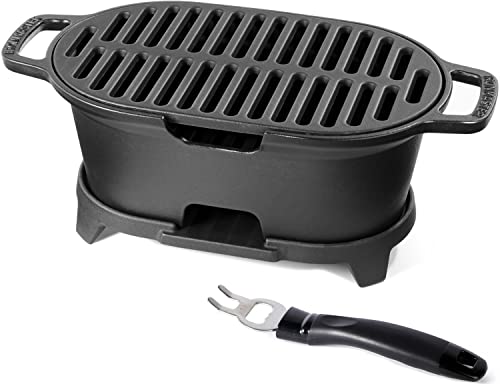
IronMaster Mini Cast Iron Hibachi Grill — Best Mini Hibachi
The IronMaster Mini is cast iron in its most concentrated form: a 100% cast iron hibachi with an 11 by 6.7 inch grate, sized for two people and a tabletop. It suits couples, solo cooks, and campers who grill small and beautifully. It does not suit anyone cooking volume, and its tiny fire needs tending.
Strengths
- Complete cast iron construction in a tabletop hibachi
- Sized honestly for two, so it lights fast and wastes no charcoal
- Japanese-style grilling format for skewers and small cuts
Trade-offs
- Smallest grate in this guide
- Open design means no roasting or smoking
- Small fuel loads burn down and need topping up on long sessions
| Specification | Detail |
|---|---|
| Construction | 100% cast iron per verified listing title |
| Grate surface | 11 x 6.7 inches per verified listing title |
| Capacity | Ideal for 2 people per verified listing title |
There is an intimacy to hibachi cooking that big grills cannot offer: the cook sits with the food, turning skewers over a small, fierce fire, eating in courses as things finish. The IronMaster’s full iron construction makes that fire steady and its small grate intensely hot — the conditions yakitori-style cooking asks for.
It is also the most portable true-iron grill here, the one that goes to the picnic, the beach, and the campsite table without negotiation. Small is not its limitation; small is its thesis, and for two-person grilling it is complete.
Best for: couples and solo cooks wanting a true cast iron hibachi / Not suited for: families or volume cooking
Check the current price on Amazon

Lodge Reversible Cast Iron Grill/Griddle Pan (LPGI3) — Best Grill Surface for Existing Burners
Honesty first: this pick is not a standalone grill but a reversible cast iron grill and griddle plate that spans two burners on a stove or camp cooker — and for many households it is the smartest cast iron purchase in this guide. It suits apartment cooks, campers with a two-burner stove, and anyone who wants iron grilling without buying or storing another appliance. It does not suit cooks who need a dedicated outdoor fire.
Strengths
- Turns existing burners into a cast iron grill and griddle
- Reversible: ridged grill side, flat griddle side
- Stores in a cabinet instead of a patio corner
Trade-offs
- Requires a suitable two-burner heat source you already own
- No lid, so no roasting or smoke capture
- Heavy plate needs two hands and dry storage
| Specification | Detail |
|---|---|
| Size | 16.75 x 9.5 inches per verified listing title |
| Design | Reversible grill and griddle per verified listing title |
| Material | Cast iron |
The plate’s argument is economic and spatial. If burners already exist in your kitchen or camp kit, the missing ingredient for cast iron grilling is only the iron — and this is excellent iron, with a ridged side that prints grill marks and drains fat, and a flat side that handles breakfast, smash burgers, and quesadillas. Many owners discover the griddle side becomes the more-used half.
Indoors, it brings grill flavor to apartments where outdoor grills are banned; at camp, it rides flat in a bin and turns a camp stove into a grill station. It will never replace a dedicated grill for a crowd, but as a second way to cook on iron it may be the most-used object in this entire guide.
Best for: apartment cooks and campers who already own a two-burner heat source / Not suited for: cooks wanting a dedicated standalone outdoor grill
Check the current price on Amazon
Comparison Table
| Pick | Badge | Key spec | Best for |
|---|---|---|---|
| Lodge Sportsman’s Pro Cast Iron Grill Check on Amazon | Best Overall | 9 x 16.75 inches per verified listing title | purists, couples, and campers wanting the true cast iron grill |
| Char-Griller AKORN 20-Inch Kamado Charcoal Grill and Smoker Check on Amazon | Best Versatility | Triple-wall insulated steel per verified listing title | backyard cooks wanting maximum versatility with iron grates |
| Weber Spirit E-310 Gas Grill Check on Amazon | Best Gas Option | 3 | families wanting iron searing with gas convenience and enamel care |
| Char-Griller Patio Pro Charcoal Grill and Smoker Check on Amazon | Best for Small Patios | 250 sq. in. per verified listing title | couples and small households with patios or small yards |
| IronMaster Mini Cast Iron Hibachi Grill Check on Amazon | Best Mini Hibachi | 100% cast iron per verified listing title | couples and solo cooks wanting a true cast iron hibachi |
| Lodge Reversible Cast Iron Grill/Griddle Pan (LPGI3) Check on Amazon | Best Grill Surface for Existing Burners | 16.75 x 9.5 inches per verified listing title | apartment cooks and campers who already own a two-burner heat source |
How to Choose the Best Cast Iron Grills: Body, Grates, or Surface?
Start by locating the iron. A cast iron body — the Lodge Sportsman’s Pro and the IronMaster in this guide — gives you the full material experience: massive heat retention, an indestructible firebox, and sizes that stay personal because iron is heavy. Choose a body when the grill itself is the ritual and your groups are small. Cast iron grates on a larger grill give you iron’s cooking effect at family scale with gas or kamado convenience; choose grates when headcount and weeknight practicality rule. A cast iron surface plate gives you iron cooking on burners you own; choose it when space, budget, or apartment rules rule out a standalone grill.
Then interrogate your care personality. Bare iron anywhere in the product means a brush, a film of oil, and dry storage — two minutes a cook, forever. Enameled iron grates reduce that to gentle brushing. Neither is hard, but the difference between a routine you enjoy and one you resent is the difference between an heirloom and a garage sale listing. Be honest now, not after the first rust spot.
Finally, think in decades. Cast iron’s entire value proposition is time: it improves with use and outlasts alternatives. That argues for buying the best-made version of your chosen format from a maker who will exist to sell you a grate in ten years. The cheapest iron is rarely cheap for long if it is badly cast; the best iron is a one-time purchase.
What Does Cast Iron Actually Do to Grilled Food?
Three things, all from stored heat. First, searing: a preheated iron surface holds its temperature when cold food lands, so crust forms immediately instead of after a steaming delay. Second, evenness: iron spreads heat laterally, softening the hot spots that burn one edge of a chicken breast while the other stays pale. Third, recovery: between batches, iron returns to temperature faster because it never fell as far. Together these produce the signature result people describe as food tasting more grilled.
Iron also changes the cook’s experience. Temperatures move gradually, so fires are calmer and timing is more forgiving. The trade is the mirror image: iron is slow to heat up and slow to cool down, so spontaneous five-minute grilling sessions are not its genre. Preheat is not a suggestion with iron; it is the price of admission, paid in minutes and repaid in crust.
How Heavy Is Too Heavy? A Practical Word on Iron and Size
Use the one-person rule: a cast iron grill you cannot comfortably move alone will be moved reluctantly, cleaned reluctantly, and eventually used reluctantly. The iron-bodied picks here are sized so one person can carry them, which is precisely why they are small. Grate-format grills distribute their iron across a wheeled or standing frame, which is how family sizes become practical.
If your life involves stairs, shared storage, or frequent transport, weight is not a footnote — it is the feature that decides whether the grill participates in your life. The tabletop irons and the Lodge plate exist for exactly those lives, and choosing them is not settling; it is fitting the tool to the terrain.
A Short, Honest History of Why Cooks Trust Cast Iron
Cast iron cookware predates the modern grill by centuries, and its survival is not sentimental. Iron was the first material that let ordinary households hold serious, steady heat over a fire, and every successor material has had to argue against the same virtues: it is nearly indestructible, it improves with use, it is repaired with oil and heat rather than parts, and it cooks food in a way people can taste. Skillets, Dutch ovens, and grills made from it outlive their makers as a matter of routine.
The grill world periodically rediscovers this. Thin steel made grills cheap and light; ceramics made kamados efficient; pellets made smoking automatic. Each wave added something real, and each wave quietly kept cast iron at the cooking surface, because the last inch between fire and food is where iron’s stored heat does work nothing else replicates at the price. The picks in this guide are that rediscovery, catalogued.
For a buyer, the history carries a practical lesson: cast iron is the low-regret purchase. Technologies date, electronics orphan, and finishes peel, but a sound piece of iron is as useful in twenty years as today. In a product category full of model years, that permanence is the rarest feature on offer.
How Do You Match a Cast Iron Format to a Cooking Life?
Consider three households. The apartment couple with a balcony where charcoal is banned needs iron without fire: the Lodge reversible plate on their stove, or an enameled-iron gas grill if the balcony allows it. The suburban family grilling four nights a week needs throughput and zones: iron grates on a three- or four-burner gas grill, or the AKORN if charcoal calls them. The camper-purist needs iron that travels and a fire that tastes like the woods: the Sportsman’s Pro or a mini hibachi. Same material, three completely different correct answers.
The pattern is that iron is a constant and format is the variable. Shoppers who fall in love with a format first and retrofit their life to it end up with beautiful, unused objects. Shoppers who start from their actual cooking — headcount, fuel rules, storage, frequency — find that the right iron format selects itself, and then gets used for years.
Frequency deserves the final word. Iron rewards the frequent cook disproportionately, because seasoning is built by cooking and because a trusted grill gets lit without deliberation. If you grill monthly, buy the format that minimizes friction. If you grill weekly, buy the format that maximizes pleasure. Both roads lead to iron; they just arrive at different grills.
What Should You Check Before Buying Any Cast Iron Grill?
First, the listing’s own words about material and placement: body, grates, or surface, and whether the iron is bare, coated, or enameled. That single paragraph predicts the cooking, the care, and the lifespan more reliably than any photograph. Second, the weight, compared honestly against who will move and clean the grill. Third, grate construction: sectioned grates you can lift, carry, and wash beat a single heroic slab on any grill large enough to have the choice.
Fourth, the maker’s horizon. Replacement grates, lids, and hardware should exist for a product designed to last decades, which favors established names — the reason this guide’s picks cluster around makers with track records. Fifth, your own storage: a dry shelf, a cover, a garage corner. Confirm the iron has a home before it has a ride home.
None of these checks require expertise, and together they take ten minutes. They are the difference between buying cast iron — a material decision with decade-long consequences — and merely buying a grill that happens to contain some.
How Does Cast Iron Compare With Ceramic and Steel Kamados?
The kamado world is the clearest place to compare materials, because the same shape exists in all three. Ceramic holds heat superbly and insulates best, but it is fragile, heavy, and expensive, and a cracked shell is a catastrophe. Insulated steel, like the AKORN in this guide, gives up a little insulation for a lot of toughness and a friendlier price, and pairs naturally with cast iron grates. Full cast iron kamado-style cookers exist at the heavy, heirloom end of the market, where the material’s durability is the entire proposition.
For most buyers the comparison resolves practically: choose ceramic for maximum efficiency and budget-no-object builds, insulated steel with iron grates for the working balance, and iron-bodied designs where longevity and simplicity outrank insulation. The food differences among well-run examples of each are smaller than the ownership differences, which is why this guide ranks ownership so heavily.
Notice where iron appears in every branch of the comparison: at the grate. Whatever the body is made of, the surface the food touches is iron in most serious designs — the market’s long experiment has converged on that inch of the cooker, and a shopper can trust the convergence.
What Accessories Complete a Cast Iron Grill Setup?
The essential list is short and finish-dependent: a brush matched to your iron — brass or nylon for enamel, stiffer for bare iron — heatproof gloves for grate handling, and a cover or storage solution that keeps the iron dry. Add a chimney starter for charcoal models and an instant-read thermometer for the cook, and the setup is complete in every way that affects food or longevity.
The second tier earns its place by menu: a griddle plate or the reversible Lodge surface for breakfasts and small foods, a grill basket for vegetables and delicate items, and a rib rack or deflector for the kamado cooks. Each addition should answer a meal you actually cook, bought when that meal enters your rotation rather than in anticipation of a hypothetical one.
Resist the gadget drawer. Cast iron’s philosophy is few things, kept well, used for decades, and its accessory kit should share the philosophy. A brush, gloves, a cover, and a thermometer will still be serving when a dozen novelty tools have been donated.
How Do You Restore a Neglected Cast Iron Grill?
Neglect looks worse than it is on cast iron, which is one of the material’s great mercies. Surface rust, old carbon, and gummy seasoning all yield to the same sequence: scrub the piece back to sound metal with a brush, scouring pad, or — for grates — a hot burn-off followed by aggressive brushing. Wash, dry with heat until bone dry, and inspect: sound iron under honest rust is the usual finding, because iron is thick and rust is thin.
Then reseason in thin layers as this guide’s how-to describes, and cook fatty, forgiving foods for the first sessions. Within weeks the piece is not restored to new — it is better than new, because its seasoning is being built by cooking from the start. Only deep pitting or cracks are true verdicts, and both are rare outside of genuine abuse.
The lesson travels beyond restoration: a used cast iron grill at a fair price is often the best value in this entire category, because the material forgives its previous owner. Buyers comfortable with an afternoon of scrubbing can own heirloom iron for the price of a season of charcoal.
How Do You Decide Between New and Vintage Cast Iron Grills?
Vintage iron — the Griswold and Wagner era and the long Lodge tradition — carries a genuine romance and, often, beautifully smooth casting. The vintage market also carries risks a new buyer should price honestly: warped grates, cracked fireboxes hidden under seasoning, and pitting that no amount of scrubbing fully redeems. Inspect vintage iron in person, in daylight, with a straightedge across the cooking surface, or buy from sellers who guarantee soundness.
New iron from established makers offers the opposite profile: full warranties, replacement parts, known seasoning, and casting quality that modern Lodge in particular has refined to a high standard. What it lacks in romance it returns in certainty, and for a first cast iron grill, certainty is the better teacher.
The wisest path for many cooks is new for the working grill and vintage for the romance — a skillet or a small piece with history, restored at leisure. Either way, the material is the same and the cooking is the same; the decision is about risk appetite, not about food.
What Is the Best Way to Learn Cast Iron Cooking?
Cook often, cook simply, and change one variable at a time. Iron teaches through repetition: the same burgers on the same grill across a month will show you the heat map, the preheat’s importance, and the exact moment food releases — lessons no article can transfer, including this one. Keep the early menu forgiving and the sessions frequent, and the learning curve compresses into a few weeks of dinners.
A notebook accelerates everything. Record the fuel or burner setting, the preheat time, the weather, and the result in a line or two. Patterns that feel like intuition in month three are usually just the notebook, memorized. Pitmasters and line cooks keep logs for a reason: fire is variable, and memory flatters itself.
Finally, cook for people. Feedback is data, and a table of eaters will tell you more about your seasoning, your timing, and your fire than any thermometer. Cast iron cooking is a social technology that has been refined at tables for centuries; the fastest way to learn it is to join the tradition at one.
How Do Cast Iron Grills Perform for Vegetarians and Mixed Tables?
A mixed table — meat eaters and vegetarians sharing one grill — is where iron quietly excels. The grate’s even heat cooks vegetable skewers, halloumi, tofu, portobellos, and corn with the same conviction it gives a steak, and a dedicated iron griddle surface or a sectioned grate keeps flavors and foods respectfully separate without separate appliances. Many households discover that the vegetarian dishes become the grill’s most requested items, because char and smoke flatter vegetables enormously.
Sequencing serves everyone: vegetables and plant-based items first on the clean, hot grate — they cook fast, hold well, and pick up no meat flavors — then the meats on the seasoned surface. Or run zones in parallel on the larger picks, with the iron’s steady edges acting as the gentle territory. Either choreography beats the apologetic foil packet cooked as an afterthought.
The deeper point is that cast iron is an ingredient-neutral technology. It stores heat and returns it to whatever sits on it, without opinion. A grill that cooks everything at the table well is the grill that gets used for every table — and frequency of use, as this guide keeps noting, is where iron’s value compounds.
What Is the One Maintenance Habit That Matters Most?
If an owner keeps only one habit, it should be this: never put the grill away dirty and damp. Every other virtue follows from it. A grill brushed warm, emptied of ash or grease, and stored dry does not rust meaningfully, does not attract pests, does not smoke out the next cook with last month’s residue, and does not present its owner with a project when a fine evening arrives. Seasoning, oiling, and inspecting all matter — but they are refinements on a foundation of clean and dry.
The habit is small because it is timed well: two minutes while the grill is warm and the cook is already standing there, instead of twenty minutes next week against cold, hardened neglect. Cast iron ownership is often described as demanding, but the demand is really this one, repeated. Owners who keep it describe iron as effortless, and they are both right — the effort is real, and it is two minutes long.
One Last Word Before You Buy
Every pick in this guide was verified the same way — iron confirmed in the listing itself, placement stated plainly, no borrowed claims — and that discipline is worth borrowing for any cast iron purchase you ever make. Read the listing’s own material sentence, decide whether the iron sits where your cooking needs it, confirm the weight against the hands that will move it, and check that the maker will answer for the product in ten years. Do those four things and the romance of cast iron becomes what it should be: not a gamble on a heavy object, but the beginning of the longest and most reliable relationship in your kitchen or on your patio. The fire, as always, is the easy part.
How to Season a New Cast Iron Grill or Grate
Most cast iron grills and grates arrive pre-seasoned, which means your job is not to build seasoning from zero but to protect and deepen what exists. The process below works for a new piece, a neglected piece you have cleaned back, and routine maintenance alike.
- Wash the iron once with hot water and a brush to remove factory residue, then dry it completely — on a warm burner or in a low oven, not with a towel alone.
- Apply the thinnest possible coat of high-heat cooking oil over the whole surface and wipe it until the iron looks almost dry. Excess oil is the cause of sticky seasoning.
- Heat the grill or grate gradually to cooking temperature and hold it there for thirty to sixty minutes. The oil bonds into a hard, dry layer.
- Let the iron cool in the grill. One layer is a start; two or three thin layers give a neglected piece a real foundation.
- Then cook — preferably something forgiving and fatty for the first sessions. Real seasoning is built by cooking, not by ceremony.
- After each cook, brush while warm, wipe with the faintest film of oil on bare iron, and store the piece dry. The routine is the seasoning program.
Do not soak cast iron, do not put it in a dishwasher, and do not fear a little soap on well-seasoned iron during a needed wash — modern dish soap is gentle; prolonged soaking is the real enemy. Dry heat after washing is the step that protects everything.
Common Buying Mistakes
Buying iron for the wrong format is the first mistake: a hibachi bought to feed a family, or a family kamado bought for a balcony. Iron formats are specialized by physics, and the reviews above state each pick’s true headcount. Believe them.
Treating seasoning as a one-time event is the second. Seasoning is a living surface that cooking builds and neglect erodes. The owners who love iron in year five are the ones who folded two minutes of care into every cook from day one.
Third, thermal shock: cold water on ripping-hot iron can warp or crack it, and even enamel dislikes the insult. Let iron cool gradually and clean it warm, not hot, with water.
Finally, storing iron outdoors uncovered because iron is tough. Iron is tough against heat and impact, not against standing water. A cover or a dry shelf is the difference between patina and rust.
Final Recommendation
The Lodge Sportsman’s Pro is the best cast iron grill in the purest sense and our top recommendation. The AKORN is the versatility pick, the Spirit E-310 the gas pick, the Patio Pro the small-patio pick, the IronMaster the mini hibachi pick, and the Lodge reversible plate the smartest iron purchase for anyone who already owns burners.
Check the current price on Amazon for the format that fits your life, confirm the iron placement in the listing, and plan the brush and the dry shelf before the grill arrives. Cast iron is a long relationship; start it properly.
Start here: Lodge Sportsman’s Pro Cast Iron Grill (Check on Amazon), Char-Griller AKORN 20-Inch Kamado Charcoal Grill and Smoker (Check on Amazon), Weber Spirit E-310 Gas Grill (Check on Amazon).
Best Cast Iron Bbq Grills Best Cast Iron Charcoal Grills Best Cast Iron Gas Grills Best Cast Iron Hibachi Grills Best Camping Portable Grills
Frequently Asked Questions
What is the difference between a cast iron grill and a grill with cast iron grates?
A cast iron grill has an iron body and firebox, giving maximum heat retention in a small, heavy package. A grill with cast iron grates has a steel or aluminum body and iron only at the cooking surface, which delivers most of the searing benefit at larger sizes and lower weight.
Are cast iron grills worth the extra weight?
For cooks who grill often and keep their gear for years, yes: the heat stability improves food noticeably and the material outlasts alternatives. For occasional cooks or frequent movers, a lighter format or an iron plate may serve better.
How long does a cast iron grill last?
With dry storage and basic care, effectively indefinitely — cast iron grills are routinely passed down. The parts that wear are grates and hardware, which is why maker support matters at purchase.
Can I use a cast iron grill indoors?
Charcoal and gas grills are outdoor-only because of carbon monoxide. A cast iron grill plate on a stovetop, like the Lodge reversible pick, is the indoor-safe way to get iron-grilled food, used with ventilation.
Does cast iron need to be seasoned if it is enameled?
No. Porcelain enamel is a glass coating that needs no seasoning and resists rust on its own. It asks instead for gentle brushes and protection from chipping.
Why do chefs and pitmasters keep choosing cast iron?
Because stored heat is control. Iron smooths the spikes and dips of real fires, sears decisively, and behaves the same in year ten as in year one — a combination no newer material has matched at the price.


