Disclosure: airfryerkitchensupply.com is reader-supported. When you buy through links on our site, we may earn an affiliate commission at no extra cost to you.
Where to buy
Shopping for the best camping portable grills? Start here. All six picks below are sold on Amazon, and the links in this section go straight to each verified listing so you can check the current price on Amazon and confirm stock before a trip. Portable grill lineups change by season, so if you are shopping close to a holiday weekend, check sooner rather than later — the most popular folding models are the first to sell through.
- Weber Traveler Portable Gas Grill (Best Overall): Check on Amazon
- Weber Q 1200N Portable Propane Gas Grill (Best Tabletop Gas): Check on Amazon
- Coleman RoadTrip 285 Portable Propane Grill (Best for Groups): Check on Amazon
- Weber Smokey Joe 14-Inch Portable Charcoal Grill (Best Charcoal Portable): Check on Amazon
- Char-Griller AKORN Jr. Portable Kamado Charcoal Grill and Smoker (Best Portable Kamado): Check on Amazon
- Cuisinart Grillster Portable Gas Grill (CGG-059A) (Best Lightweight Pick): Check on Amazon
The best camping portable grills solve a problem that has nothing to do with cooking: they have to earn their space in a loaded vehicle, survive being carried over gravel and grass, and then — only then — cook dinner. That is why this guide ranks portability features with the same seriousness as burners and grates. A grill that latches shut, carries by a real handle, and sets up in a minute will get used on every trip. A slightly larger grill that needs two hands, a loose grate, and a prayer will quietly stop being invited.
This roundup covers the full portable spectrum, because camping portable grills are not one product category but three: folding gas grills that stand on their own legs, tabletop gas grills that ride flat in a trunk, and compact charcoal grills for campers who want real fire flavor and are camping where charcoal is allowed. Six verified picks, six different answers to the portability question, and a buying guide that helps you decide which definition of portable matches the way you actually camp.
In this guide
Quick Picks
- Best Overall: Weber Traveler Portable Gas Grill — best for base campers, tailgaters, and RV travelers cooking for groups at standing height — Check on Amazon
- Best Tabletop Gas: Weber Q 1200N Portable Propane Gas Grill — best for campers wanting the best tabletop cooking surface and a grill that doubles at home — Check on Amazon
- Best for Groups: Coleman RoadTrip 285 Portable Propane Grill — best for group campers, scout and team cooks, and big tailgates — Check on Amazon
- Best Charcoal Portable: Weber Smokey Joe 14-Inch Portable Charcoal Grill — best for charcoal purists and spontaneous park-and-picnic cooks — Check on Amazon
- Best Portable Kamado: Char-Griller AKORN Jr. Portable Kamado Charcoal Grill and Smoker — best for smoking enthusiasts and base campers who cook low and slow — Check on Amazon
- Best Lightweight Pick: Cuisinart Grillster Portable Gas Grill (CGG-059A) — best for couples, solo campers, and small-car owners who value flat packing — Check on Amazon
If you already know your fuel, the shortlist is simple. Gas campers who cook for a group should start with the Weber Traveler or the Coleman RoadTrip 285. Gas campers who pack light should start with the Weber Q 1200N or the Cuisinart Grillster. Charcoal campers should compare the Weber Smokey Joe and the Char-Griller AKORN Jr., which are portable in completely different ways.
How These Picks Were Chosen
Portability was scored on evidence, not adjectives. For each candidate we looked at how it transports: does the lid latch, do the legs fold or telescope without tools, is there a handle placed where the weight actually balances, and does the packed shape waste trunk space? Grills that are merely small were distinguished from grills that are genuinely portable, because a small grill with a loose lid and a dangling grease tray is small in the store and miserable in a parking lot.
Every model here was verified through the retailer verification system for this site, with product names matched to the exact listing titles that system returned. Specifications in the mini spec boxes come from those verified titles only. Where a listing published few specifications, the spec box is short on purpose: we would rather show you less information than decorate a review with numbers we could not confirm.
We also weighted the cooking brief honestly. Camping meals are cooked outdoors, often in wind, often by someone who is also watching kids, a dog, and a sunset. So ignition reliability, lid performance, and cleanup speed counted heavily, while spec-sheet cooking area counted for less than it does in backyard grill rankings. A portable grill is a trip tool first and a cooking appliance second, and the ranking reflects that order.
The 6 Best Camping Portable Grills

Weber Traveler Portable Gas Grill — Best Overall
The Traveler is what happens when a grill is designed around transport first: it folds into a flat, wheeled package you pull like luggage, then stands up into a full-height grill with a real side table. It suits drive-up campers, tailgaters, and RV travelers who cook for groups and are tired of grilling on their knees at a picnic table. It does not suit anyone counting trunk space carefully, because folded is still a substantial package.
Strengths
- Folds and rolls like luggage, so one person moves it without a carry
- Full standing height and a side table make it cook like a backyard grill
- Capacity for fifteen burgers per the verified listing covers group meals in one round
Trade-offs
- Folded size is large for small cars already packed with camping gear
- Heavier than any tabletop here, so it is a vehicle grill, not a carry grill
- More moving parts in the folding mechanism to keep clean and free-moving
| Specification | Detail |
|---|---|
| Format | Folding cart with wheels per verified listing title |
| Capacity | Fits 15 burgers per verified listing title |
| Fuel | Propane |
The cooking experience is the least compromised of any portable here. You stand, you have a table for trays and tools, the lid is tall enough for serious food, and the grate fits a full family meal without batching. For campers who cook two or three meals a day at a base camp, that normality is transformative: people volunteer to cook instead of treating grill duty as a chore performed crouched over a tabletop.
The transport system deserves the praise it gets because it solves the actual problem. Wheels and a handle mean the walk from a parking area to a pavilion or site is a pull, not a haul, and the grill folds with the kind of one-motion logic that still works when your hands are cold. If your vehicle can carry it, this is the portable to beat.
Best for: base campers, tailgaters, and RV travelers cooking for groups at standing height / Not suited for: small-car campers or anyone who carries a grill more than a short roll from the vehicle
Check the current price on Amazon

Weber Q 1200N Portable Propane Gas Grill — Best Tabletop Gas
The Q 1200N is the tabletop benchmark: a cast-aluminum body, porcelain-enameled cast-iron grates, and electronic ignition in a package sized for two to four people. It suits campers who want the best cooking surface in the tabletop class and plan to use the grill for years. It does not suit ultralight packers, because quality materials carry real weight.
Strengths
- Porcelain-enameled cast-iron grates sear beautifully and hold heat through lid openings
- Cast body construction is built for a decade of trips, not a season
- Electronic ignition and a single intuitive dial keep operation simple
Trade-offs
- Noticeably heavier than budget tabletops of similar size
- Single burner means one heat zone
- Premium positioning in its class, so check the current price against your budget
| Specification | Detail |
|---|---|
| Burner output | 10,000 BTUs per verified listing title |
| Grates | Porcelain-enameled cast-iron per verified listing title |
| Ignition | Electronic per verified listing title |
What separates the Q from cheaper tabletops is thermal behavior. Cast-iron grates store heat, so food goes down on a surface that stays hot instead of dipping and steaming, and the domed cast lid recovers temperature quickly after you peek. Steaks get real crust, chicken skin crisps, and the whole grill feels calm and predictable in a way stamped-steel portables rarely do.
It is also the tabletop most likely to live a double life. Many owners use it as a balcony or small-patio grill at home and a camping grill on weekends, which spreads its cost across far more meals. If one grill has to do both jobs, this is the strongest candidate in the roundup.
Best for: campers wanting the best tabletop cooking surface and a grill that doubles at home / Not suited for: campers minimizing weight above all else
Check the current price on Amazon
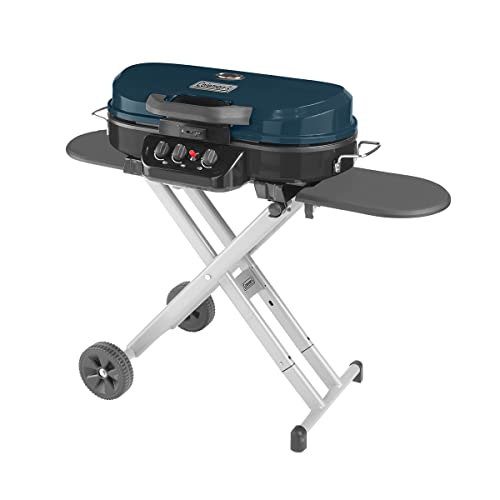
Coleman RoadTrip 285 Portable Propane Grill — Best for Groups
The RoadTrip 285 is the group cook’s portable: three burners, 20,000 BTUs, and a stand format that folds for transport while cooking at a comfortable height. It suits scout troops, extended-family camps, and tailgates where one grill feeds a crowd in shifts. It does not suit solo campers, for whom it is simply more grill than the trip requires.
Strengths
- Three burners give the most heat control of any pick in this roundup
- 20,000 BTUs is the strongest verified output here, for fast preheats and big batches
- Stand format cooks at standing height and folds for the drive
Trade-offs
- The largest and heaviest package in this guide
- Three burners mean more to clean and more to check before each trip
- Overkill for couples, who will feel its size every time they pack
| Specification | Detail |
|---|---|
| Burner output | 20,000 BTUs per verified listing title |
| Burners | 3 |
| Ignition | Instastart per verified listing title |
Group cooking is a logistics problem disguised as a cooking problem, and the 285 solves the logistics. Three burners let you run a hot zone for searing, a medium zone for cooking through, and a warm zone for holding, which means food comes off in waves and everyone eats hot food instead of the first batch going cold while the third batch cooks. That flow is why event cooks love this format.
The interchangeable-cooktop heritage of the RoadTrip line also matters for groups: griddle and stove-grate accessories exist for this platform, so one unit can griddle breakfast and grill dinner. Verify accessory compatibility for the exact listing before ordering, but the platform flexibility is real and unique in this roundup.
Best for: group campers, scout and team cooks, and big tailgates / Not suited for: solo and duo campers packing light
Check the current price on Amazon
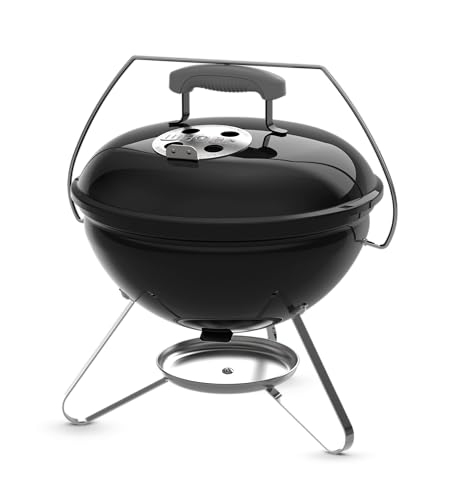
Weber Smokey Joe 14-Inch Portable Charcoal Grill — Best Charcoal Portable
The Smokey Joe is the original portable answer: a 14-inch kettle that has been cooking campsite burgers for decades. It suits campers who want genuine charcoal flavor, minimal mechanics, and a grill that can be repaired with a wire brush and stubbornness. It does not suit campers cooking under fire restrictions, or anyone who wants to be eating fifteen minutes after parking.
Strengths
- Real charcoal flavor that no gas grill in this guide can imitate
- Almost nothing to break: no ignition, no regulator, no hose
- Light, compact kettle shape packs into odd corners of a loaded trunk
Trade-offs
- Charcoal is banned in many parks during dry periods, when gas is still allowed
- Lighting and ash management add time and mess to every cook
- Temperature control is vent skill, not a dial
| Specification | Detail |
|---|---|
| Diameter | 14-inch per verified listing title |
| Fuel | Charcoal |
| Format | Portable kettle |
Cooking on the Smokey Joe is a ritual, and for many campers that is the point. You light a small chimney, arrange a modest pile of coals, and cook food that tastes like camping is supposed to taste. The kettle shape with a lid lets you do more than direct grilling: bank the coals to one side and you can roast a small chicken or finish thick chops gently.
The practical virtues are just as strong. It is cheap to run, silent, immune to the mechanical failures that end gas grill trips, and small enough to live in the car permanently for spontaneous park cookouts. Pair it with a small chimney starter and it is a complete camp kitchen for one to three people.
Best for: charcoal purists and spontaneous park-and-picnic cooks / Not suited for: campers in fire-restricted areas or anyone needing instant on-off cooking
Check the current price on Amazon

Char-Griller AKORN Jr. Portable Kamado Charcoal Grill and Smoker — Best Portable Kamado
The AKORN Jr. shrinks the kamado idea into a portable: insulated triple-wall steel, cast iron grates, and genuine low-and-slow smoking ability in a grill one person can move. It suits campers who smoke ribs at home and refuse to give that up at camp. It does not suit campers who count every pound, because insulation and cast iron are not light.
Strengths
- Insulated walls hold low temperatures for smoking and sip charcoal
- Cast iron grates deliver serious searing heat when you open the vents
- Grills and smokes in one unit, which no gas pick here can claim
Trade-offs
- Heavy for its size, so portable means car-to-table, not trail
- Kamado cooking has a learning curve with vent control
- Charcoal restrictions apply to it just as to any charcoal grill
| Specification | Detail |
|---|---|
| Construction | Triple-wall insulated steel per verified listing title |
| Grates | Cast iron per verified listing title |
| Functions | Grill and smoker per verified listing title |
The AKORN Jr. is the most versatile cooker in this guide by a wide margin. The same insulation that lets it hold smoking temperatures for hours lets it run very hot for steaks, and it uses so little charcoal doing either that a small bag lasts a long weekend. Campers who plan a smoked pork shoulder day at a base camp — a genuinely wonderful way to spend a Saturday — have exactly one portable option, and this is it.
It asks for skill in return. Kamado temperature is managed with two vents and patience, and overshooting a target temperature is easier than coming back down. Spend one home cook learning its vents before a trip and it will reward you with the best food in the campground.
Best for: smoking enthusiasts and base campers who cook low and slow / Not suited for: weight-conscious campers or beginners wanting dial-simple cooking
Check the current price on Amazon

Cuisinart Grillster Portable Gas Grill (CGG-059A) — Best Lightweight Pick
The Grillster is the portable for people whose packing list is already full: it folds flat like a briefcase, weighs thirteen pounds per its verified listing, and still offers push-button ignition and a dishwasher-safe grate. It suits couples, solo campers, and small-car owners. It does not suit group cooks, because the grate is sized for two to three servings.
Strengths
- Folds flat and latches, so it slides into packed trunks other grills cannot enter
- Thirteen pounds is carry-it-in-one-hand territory
- Dishwasher-safe grate makes home cleanup nearly effortless
Trade-offs
- Small grate requires batching for more than three people
- Single burner, single heat zone
- Low stance needs a heat mat on wooden tables
| Specification | Detail |
|---|---|
| Cooking area | 146 sq. in. |
| Burner output | 8,000 BTU |
| Weight | 13 lbs per verified listing title |
Portability is a system, and the Grillster is the best system here for small vehicles. Flat-packed, it disappears against a trunk wall or under a cargo floor panel, which means it can simply live in the car. A grill that lives in the car gets used for park lunches, beach sunsets, and trailhead dinners that a garage-stored grill never sees.
Cooking is honest tabletop cooking: quick preheat, good sear on the small grate, and simple food done well. It will not host a reunion, but for the trips most people actually take most often — two people, one or two nights — it is very hard to beat.
Best for: couples, solo campers, and small-car owners who value flat packing / Not suited for: group campers cooking for four or more
Check the current price on Amazon
Comparison Table
| Pick | Badge | Key spec | Best for |
|---|---|---|---|
| Weber Traveler Portable Gas Grill Check on Amazon | Best Overall | Folding cart with wheels per verified listing title | base campers, tailgaters, and RV travelers cooking for groups at standing height |
| Weber Q 1200N Portable Propane Gas Grill Check on Amazon | Best Tabletop Gas | 10,000 BTUs per verified listing title | campers wanting the best tabletop cooking surface and a grill that doubles at home |
| Coleman RoadTrip 285 Portable Propane Grill Check on Amazon | Best for Groups | 20,000 BTUs per verified listing title | group campers, scout and team cooks, and big tailgates |
| Weber Smokey Joe 14-Inch Portable Charcoal Grill Check on Amazon | Best Charcoal Portable | 14-inch per verified listing title | charcoal purists and spontaneous park-and-picnic cooks |
| Char-Griller AKORN Jr. Portable Kamado Charcoal Grill and Smoker Check on Amazon | Best Portable Kamado | Triple-wall insulated steel per verified listing title | smoking enthusiasts and base campers who cook low and slow |
| Cuisinart Grillster Portable Gas Grill (CGG-059A) Check on Amazon | Best Lightweight Pick | 146 sq. in. | couples, solo campers, and small-car owners who value flat packing |
How to Choose the Best Camping Portable Grills for Your Camping Style
Decide what portable means on your trips, because the word covers three different products. If portable means wheeled from the car to a nearby site, folding stand grills like the Traveler and RoadTrip 285 give you standing height and group capacity. If it means flat in a full trunk, briefcase tabletops like the Grillster win. If it means flavor-first and restrictions allow, compact charcoal kettles and kamados trade convenience for taste and versatility. Most disappointment in this category comes from buying one definition while living another.
Fuel choice is a restrictions question before it is a flavor question. Gas grills with a shut-off valve are permitted in many places and seasons where charcoal is banned, and they are always the faster, cleaner option. Charcoal delivers flavor gas cannot match and freedom from regulators and hoses. Campers who travel widely through dry western parks should default to gas. Campers cooking at humid eastern campgrounds and state parks can enjoy charcoal with fewer worries. Either way, check the rules for your specific destination each season.
Finally, weigh the grill honestly — literally. Manufacturers describe many grills as portable that are portable only in the sense that two adults can lift them. For car camping, the practical ceiling for a grill one person will happily move every trip is roughly the weight you can carry in one hand while holding a cooler handle in the other. Beyond that, wheels stop being a feature and become a requirement.
What Features Actually Matter on a Portable Grill?
A latching lid is the single most underrated portable feature. It keeps the grate, grease, and ash inside the grill during transport instead of distributed through your trunk, and it turns the grill into a sealed box you can pack around. After that, look at ignition: push-button and electronic igniters earn their keep on cold, windy mornings when matches become a comedy routine. Then examine grease management, because every portable grill produces grease and the good ones give it somewhere contained to go.
Grate material shapes your cooking more than burner numbers. Porcelain-enameled cast iron, like the Weber Q grates in this guide, holds heat for searing and resists sticking. Plated steel is lighter and fine for simple grilling. For charcoal portables, cast iron grates in the AKORN Jr. deliver kamado searing that thin steel cannot. Match the grate to your menu: sear-heavy menus deserve iron, simple menus can travel lighter.
How Much Cooking Space Do Portable Grill Campers Need?
Use people, not square inches, as the unit. A 14-inch kettle or a 146-square-inch tabletop feeds two to three. A mid-size tabletop around 280 square inches feeds four to five in one batch. The big stand portables feed six or more and exist for groups. Then adjust for menu: burgers and dogs pack tightly and forgive small grates, while bone-in chicken pieces, corn, and vegetable baskets sprawl and punish them.
Remember that batching is a legitimate strategy. A smaller grill cooking two fast batches often beats a huge grill that made you leave the camp chairs behind. Portability is a whole-vehicle equation, and the grill is only one term in it.
Gas, Charcoal, or Pellet: Which Portable Fuel Suits Your Trips?
Gas is the default for a reason: instant light, instant off, precise-enough control, and the widest permission under campground fire rules. Its costs are mechanical — regulators, hoses, igniters — and culinary, because gas contributes heat and nothing else. For campers who cook to eat and move on, gas is the rational fuel, and most portable grills sold are gas for exactly that reason.
Charcoal is the flavor fuel and the ritual fuel. It asks twenty minutes and a chimney, gives back smoke and sear that gas cannot imitate, and frees you from every mechanical part on the grill. Its costs are time, ash, and permission: charcoal is the first fuel banned when conditions dry out. Campers whose trips center on state and national parks in arid regions should treat charcoal as a sometimes fuel even if it is their favorite.
Pellet portables, represented in the wider market by models like the Traeger Tailgater in this site’s verified catalog, occupy a third niche: set-and-forget smoking and roasting with wood flavor, at the price of weight, power requirements, and moving parts. They suit base camps with vehicle power and cooks who plan long, low cooks. For most campers they are a second portable rather than a first, which is why this guide’s picks concentrate on the gas and charcoal formats that cover the widest range of trips.
How Do You Cook for a Group on a Portable Grill?
Group cooking on a portable is a flow problem, and the solution is a holding strategy. Cook in waves ordered by holding quality: foods that rest well — sausages, chicken thighs, corn in foil — go first and hold warm in a covered tray or on the grill’s low zone. Foods that punish waiting — steaks, burgers, fish — cook last and go straight to plates. Stagger the waves so something finishes every few minutes and the queue at the grill never becomes a crowd standing around raw food.
Side dishes should be planned off the grill wherever possible. Salads, slaws, bread, and cold sides carry half the meal without touching the grate, and a camp stove or a foil pack on the fire ring handles the rest. The cooks who struggle with portable grills at group camps are usually trying to cook an entire menu on one small surface out of a sense of purity. The cooks who thrive treat the grill as the protein station and build the meal around it.
Finally, recruit the group. A portable grill station runs beautifully with a runner carrying finished trays and raw batches, which also keeps the cook company. Group camping is social by design; the grill should be the social center, not the cook’s exile. The stand-format picks in this guide earn their size partly by making that gathering comfortable.
What Accessories Are Actually Worth Packing?
Four accessories earn their space on nearly every trip: a chimney starter for charcoal models, a spare fuel cylinder for gas models, an instant-read thermometer, and a proper brush sized to the grill. Together they weigh little, cost little, and remove the four most common portable-grill frustrations — slow lighting, dead fuel, guessed doneness, and a filthy grate. Everything else is negotiable.
A heat mat for tabletop models is the fifth, and it is close to mandatory on wooden tables. A small griddle plate or grill basket extends a portable’s menu more than any other single addition, turning out breakfasts and small vegetables that a bare grate handles poorly. A fitted cover or storage bag protects the grill in transit and in the garage, and pays for itself the first time a latched, covered grill rides home clean instead of perfuming the car.
What not to pack: gadget sets. Portable grilling needs tongs, a spatula, and the four essentials above. The twelve-piece tool roll stays home, because every ounce and cubic inch in a camping load should argue for its place — and the grill itself sets the standard by having argued for its own.
How Do Portable Grills Handle Altitude and Mountain Camps?
Altitude changes gas grilling in ways sea-level campers do not expect. Propane burners mix fuel with thinner air, flames burn less efficiently, and cooking times stretch — sometimes noticeably above 5,000 feet. The practical responses are patience and preheat: give the grill longer to come to temperature, cook by thermometer rather than by clock, and favor the higher-output picks in this guide if mountain camps are your regular terrain.
Charcoal has its own altitude personality: it lights normally but burns with less intensity in thin air, and kamado-style insulation — the AKORN Jr. in this guide — compensates better than open designs. Mountain campers also face tighter fire rules in dry seasons, which pushes many toward gas despite a charcoal preference at home.
Wind usually matters more than altitude in the mountains, arriving with the same afternoons as the best views. The wind rules from the rest of this guide apply double: lid down, back to the wind, vehicle as shelter, forgiving foods on the gusty days. A portable grill that behaves in mountain weather will behave anywhere, which is why experienced campers test new gear on a breezy trip before trusting it on an important one.
What Is the Best Portable Grill Setup for Tailgating?
Tailgating is camping’s louder cousin: fixed time windows, hungry crowds, asphalt instead of grass, and a hard deadline when the game starts. The winning setup prioritizes preheat speed and batch flow — which is why the stand grills in this guide, the Traveler and the RoadTrip 285, dominate serious tailgates. They arrive on wheels, cook at standing height for hours without wrecking the cook’s back, and hold finished food in zones while the next batch sears.
Menu planning follows the clock. Foods that finish early and hold well — sausages, chicken, grilled vegetables — anchor the first wave; burgers and steaks cook in the final wave so they land hot as the crowd peaks. Everything that can be prepped at home should be, because tailgate space and time are both rationed.
Pack-out discipline is the tailgater’s signature skill. The grill must be cool, latched, and loaded before the deadline, which means the last food comes off with cooling time to spare. A grill that cannot cool and pack quickly is a liability in this setting no matter how well it cooks, and it is one more reason transport design leads this guide’s rankings.
How Do You Keep a Portable Grill Working for Ten Years?
Portable grills die young from three causes: corrosion from dirty storage, transport damage, and neglected fuel systems. All three are habits, not fate. The ten-year routine is unglamorous — brush after cooks, empty grease and ash every trip, store dry and latched, inspect hoses and regulators each spring, and clean igniter contacts when they get lazy. Fifteen minutes a season, roughly, is the entire price.
Parts strategy matters at purchase. Grills from makers with long model runs and real parts catalogs — the Weber and Coleman picks in this guide are the obvious examples — can be renewed piece by piece: a grate here, an igniter there, a regulator in year seven. A grill that can be repaired is a grill that does not get replaced, which is where the true economy of a good portable lives.
Finally, use is maintenance. A grill cooked on monthly keeps its seasoning, its igniter contacts clean, and its owner familiar with its moods. The portable that sits for two years between trips is the one that fails mysteriously at a trailhead. Cook often, and the ten-year grill mostly takes care of itself.
Can a Portable Grill Handle a Whole Holiday Meal?
Within its scale, yes — and the exercise teaches the portable’s real capabilities. A stand grill like the Traveler can roast a small turkey breast or a chicken with the lid down, grill the vegetables in waves, and toast the rolls at the end, while a camp stove handles the saucier work. The keys are a meat thermometer, a rest period under foil that frees the grate for the next item, and a menu edited to what one heat source can sequence.
Tabletops contribute differently: as the second station. Many experienced outdoor cooks run a portable tabletop beside a main grill or fire precisely for holidays — one surface for the roast, one for the sides — and discover that two small grills choreograph better than one large one. The compact picks in this guide earn their keep in exactly that supporting role.
The honest limit is simultaneity. A portable cannot hold a turkey, three sides, and bread at temperature at once, and a holiday plan that requires it will wobble. Plan the sequence, use the cooler as a hot box with towels for rested items, and the meal arrives in waves that feel like courses rather than delays.
How Do You Clean a Portable Grill at a Campground With One Spigot?
The campground clean is a two-stage affair: a hot stage at the grill and a cold stage at the spigot. While the grill is still warm from cooking, brush the grate thoroughly and let the burn-off do its work; scrape the grease tray or lift the pan once things cool enough to handle. Most of the mess leaves in this stage, into the camp trash, where it belongs.
At the spigot, only the removable parts travel: the grate if it lifts out, the grease pan, and the tools. A small basin or even a doubled trash bag of water with a drop of soap handles the wash, and paper towels finish the job. Never wash a whole grill at a communal spigot — it is slow, splashy, and hard on the grill’s ignition and burner parts.
The final wipe happens back at the site: firebox walls with a damp towel, exterior with a dry one, lid latched once everything is cool and dry. Campers who run this routine find their portable arrives home needing nothing, which is the difference between gear that is ready and gear that is homework.
What Should You Do When a Portable Grill Breaks on a Trip?
Triage by function. A dead igniter is an inconvenience with a simple answer — the long lighter in your kit, used through the lighting hole or with the grate lifted, lights most gas portables safely. A clogged burner that flames weakly in one spot can often be coaxed through a trip by cooking on the working zones and scheduling the real cleaning for home.
A failed regulator or a damaged hose is a stop condition: no field repair is trustworthy, and the correct move is to close the cylinder, disconnect, and pivot the menu to the camp stove, the fire ring where permitted, or no-cook meals. This is the practical reason experienced campers carry one backup cooking method — not pessimism, but the memory of a hungry evening.
Charcoal portables almost never break, which is their quiet superpower; their failure mode is wet fuel, answered by the driest bag in the group and a longer chimney session. Whatever the fuel, a portable grill failure should cost a menu, never a trip — pack the lighter, carry the backup plan, and cook on.
How to Pack, Set Up, and Care for a Portable Grill on the Road
Portable grills die from transport and storage, not from cooking. A simple routine keeps one alive for years of trips.
- Before packing, brush the grate, empty the grease tray or ash, and let the grill cool completely. Packing a warm or dirty grill is how vehicles and gear get ruined.
- Latch the lid. If your grill has no latch, a bungee cord or strap around the body is a worthwhile substitute for transport.
- Pack the grill flat or upright in a stable position where it cannot slide, with fuel cylinders disconnected and stored upright in a ventilated spot.
- At the site, set up on level ground or a sturdy table with a heat mat under low tabletop models, away from tent fabric and overhangs.
- For gas models, connect the cylinder hand-tight and check for leaks by smell and sound before lighting. For charcoal, light in a chimney starter for speed and even coals.
- Preheat with the lid closed — five minutes for most gas tabletops, longer for kamados building a target temperature.
- After cooking, burn off or brush residue while the grill is still warm, then close vents or valves and let it cool fully before the drive home.
- At home, do the real clean: wash removable grates, wipe the firebox, and store the grill dry. Ten minutes at home saves an hour at the next campsite.
Keep a small grill kit packed with the grill itself: a brush, tongs, a spare cylinder or a bag of charcoal, and paper towels. A kit that lives with the grill means the grill is always trip-ready, and trip-ready gear gets used.
Common Buying Mistakes
Buying a backyard grill with folding legs and calling it portable is the classic error. True portables are designed around latching, carrying, and packed shape; adapted backyard grills are designed around a patio and merely tolerate travel. The difference shows up on the second trip, in the rain, in the dark.
Ignoring fire rules is the second error. Charcoal campers who do not check seasonal restrictions arrive at parks where their grill is lawn ornament. Gas campers are not immune either: some areas restrict all open flame in extreme conditions. A two-minute rule check before departure protects the whole trip.
Third, campers pack the grill last and loose. A sliding grill dents coolers, spills ash, and arrives with bent parts. Give it a fixed, latched, padded spot in your load plan, the same spot every trip, and packing becomes a solved problem.
Finally, do not judge a portable by its first cook. Kamados need a learning cook, cast-iron grates improve with use, and every grill has a hot spot you will only learn by cooking. The best camping portable grill is usually the one you know best, which is an argument for choosing a good one and keeping it for years.
Final Recommendation
The Weber Traveler is the best camping portable grill for most drive-up campers: it transports brilliantly and cooks like a real grill when it arrives. Tabletop shoppers should choose the Weber Q 1200N for cooking quality or the Cuisinart Grillster for flat, light packing. Groups should go straight to the Coleman RoadTrip 285, charcoal loyalists to the Smokey Joe, and smokers to the AKORN Jr.
Whichever direction you go, check the current price on Amazon before ordering and confirm the packed dimensions against your vehicle. A portable grill is a promise about future trips; the right one is the one that fits your car, your menu, and your campground rules all at once.
Start here: Weber Traveler Portable Gas Grill (Check on Amazon), Weber Q 1200N Portable Propane Gas Grill (Check on Amazon), Coleman RoadTrip 285 Portable Propane Grill (Check on Amazon).
Best Camping Grills Under $100 Gas Best Campsite Gas Grills Best Cast Iron Bbq Grills Best Camping Portable Grills Best Cast Iron Grills
Frequently Asked Questions
What is the difference between a portable grill and a small grill?
A portable grill is designed for transport: latching lid, folding or wheeled legs, a balanced carry handle, and contained grease or ash. A small grill is simply compact and may travel poorly despite its size. For camping, the transport design matters as much as the dimensions.
Are portable gas grills better than charcoal for camping?
Gas is faster, cleaner, and allowed in more places during fire restrictions. Charcoal gives better flavor and needs no regulator or hose, but takes longer and faces more bans. The better choice depends on where you camp and how you like to cook.
How much should a camping grill weigh?
For one person to move it happily every trip, under about twenty pounds is easy, twenty to forty pounds wants wheels or a short carry, and above that it should be a folding stand grill with wheels like the larger picks in this guide.
Can a portable grill replace my backyard grill?
A large portable like the Traveler or RoadTrip 285 can handle most backyard cooking for small households, and tabletops like the Weber Q are popular balcony grills. Full-size backyard grills still win on capacity and multi-zone space for big gatherings.
Do I need a chimney starter for a portable charcoal grill?
It is the single best accessory for charcoal camping. A small chimney lights coals evenly in about fifteen minutes without lighter fluid, and it doubles as a measure for how much charcoal a small grill needs.
How do I stop a portable grill from making my car smell?
Clean it before packing, empty grease and ash every trip, latch the lid, and store it dry. Most odor comes from old grease left in trays and fireboxes, not from the grill itself.


