Disclosure: airfryerkitchensupply.com is reader-supported. When you buy through links on our site, we may earn an affiliate commission at no extra cost to you.
Where to buy
For best can openers with bottle opener, Amazon is the practical place to buy: listings show the current configuration, included accessories, and return terms in one place, and stock on popular models turns over quickly. Our top recommendation is the OXO Good Grips Manual Can Opener & Bottle Opener. Also consider the KitchenAid Classic Multifunction Can Opener and Bottle Opener, Black and the Amazon Basics 3-In-1 Electric Can Opener, Bottle Opener and Knife Sharpener for the needs described below, the Hamilton Beach Smooth Touch Electric Can Opener 76608 with Bottle Opening Accessory as a strong alternative, the Zulay Kitchen Manual Can Opener Heavy Duty with Bottle Opener for its specific strength, and the Farberware Pro Can and Bottle Opener, Blue Haze to round out the list. Check the current price on Amazon for whichever model you choose, and confirm the exact bundle, size, and finish on the listing before ordering, because manufacturers revise bundles more often than they revise model names.
A built-in bottle opener sounds like a trivial extra until you count how often the two jobs appear together — a bottle of sauce beside a can of tomatoes, a drink opened while dinner cooks. Every pick below was verified with the bottle-opening function in its actual listing, not assumed from the brand’s other models, because combination tools are exactly where marketing blurs which version does what. Check the listing configuration when you order, and the tool that arrives will be the tool described here.
Introduction
People searching for the best can openers with bottle opener usually want one drawer slot to do two everyday jobs well, instead of a great can opener plus a separate bottle opener that migrates around the kitchen and vanishes when needed. That is a reasonable want, and the good news is that the combination is an old, proven one: several of the most durable manual openers ever sold include a bottle hook as a matter of course. The risk is not the combination itself — it is buying a flimsy opener for the sake of the extra, or assuming a model includes a bottle opener because a sibling model does.
So this guide applies two filters in sequence. First, the bottle-opening function had to be verifiable in the product’s own listing — in its title or described configuration — for every pick below, whether that is a classic built-in hook on a manual opener, a bottle-opening accessory on an electric, or a dedicated bottle function on a multi-tool design. Second, the can opener itself had to be worth owning on its own merits: wheel construction, handle design, and a cut you can trust. A bottle opener attached to a bad can opener is not a combination tool; it is two disappointments sharing a handle.
The list that survives spans the useful range: classic manual openers where the bottle hook is forged into the design, an electric countertop model with a bottle-opening accessory for hands that need assistance, and modern manual designs that integrate both functions cleanly. Each review covers both jobs — how the can cut performs and how the bottle function is implemented — with three strengths and three trade-offs, because a combination tool should be judged on the whole of what it claims to do.
In this guide
Quick Picks
- Best Overall Combination: OXO Good Grips Manual Can Opener & Bottle Opener — The proven manual opener with a built-in bottle opener in its listing title, a stainless wheel, and the soft grip weaker hands love.
- Best Value Combination: KitchenAid Classic Multifunction Can Opener and Bottle Opener, Black — A stainless wheel, soft ergonomic handles, and a bottle opener in a simple multifunction design at an accessible tier.
- Best Electric Combination: Amazon Basics 3-In-1 Electric Can Opener, Bottle Opener and Knife Sharpener — A countertop electric that opens cans, opens bottles, and sharpens knives, with a magnetic lid holder and a stainless blade.
- Best Electric for Smooth Edges: Hamilton Beach Smooth Touch Electric Can Opener 76608 with Bottle Opening Accessory — A smooth-touch electric that cuts below the rim, handles extra-tall and pop-top cans, and includes a bottle opening accessory and knife sharpener.
- Best Heavy-Duty Manual Combination: Zulay Kitchen Manual Can Opener Heavy Duty with Bottle Opener — A heavy-duty manual design with a razor-sharp stainless blade, rust-proof oversized knob, soft-touch grips, and a bottle opener.
- Best Dishwasher-Safe Combination: Farberware Pro Can and Bottle Opener, Blue Haze — An ergonomic manual combination with a high-carbon stainless blade, smooth turning, and dishwasher-safe construction.
How These Picks Were Chosen
We verified every candidate against Amazon product data. The first pass confirmed the can opener itself as a current listing worth recommending, scored on cutting wheel material, handle leverage and grip, drive smoothness, and design simplicity — the same longevity criteria as our durability guide. The second pass was specific to this search: the bottle-opening function had to appear in the verified listing itself. Models whose bottle opener existed only on a different variant, or only in a reviewer’s assumption, were excluded, however good their can cutting was.
That second filter removed several strong can openers from this particular list — they belong in our general and durability guides, not here — and it is why this list is shorter on exotic designs and longer on classics: the built-in bottle hook has been standard on proven manual openers for decades, and those are the tools that pass both filters at once. The six survivors include five manual designs at different tiers and one electric with a bottle accessory, each with a distinct reason to own it, and each reviewed for both of its jobs with the usual three strengths and three trade-offs.
The 6 Best can openers with bottle opener

OXO Good Grips Manual Can Opener & Bottle Opener — Best Overall Combination
This is the combination tool most households should buy. The can opener half is the long-running OXO manual design — sharp stainless wheel, smooth turning action, oversized soft handle that gives weaker or aging hands real leverage — and the bottle opener is built into the same tool, as its verified listing states outright. There is no compromise in either direction: the can cut is the one we recommend in our durability guide, and the bottle hook is the classic, positive-engagement type that pops caps without slipping. One drawer slot, both jobs, years of service.
Strengths
- Both functions verified in the listing itself — no variant guessing
- Proven can-cutting design with a stainless wheel and smooth drive
- Soft, oversized grip serves weaker hands for both cutting and bottle leverage
Trade-offs
- Top-cut design leaves the standard sharper lid edge
- Cushioned handle ages best with hand washing and drying
- Bottle hook is the classic style — it works on standard caps, not twist-off assistance
Key specs (verified)
- Type: manual, top-cut, combination
- Cutting wheel: stainless steel
- Handle: soft ergonomic grip
- Bottle opener: built in (per Amazon listing)
Combination tools earn trust by being boring in both jobs, and this one is. The bottle opener engages caps the way bottle openers have for generations — hook under the cap edge, lever against the top, one motion — and because the handle is the same generous grip you hold for cans, the leverage is better than on most dedicated openers. Nothing about the can mechanism was sacrificed to add it: no extra joints, no folding parts, no novelty. If your kitchen drawer has room for exactly one opening tool, this is the one we would put in it, and it is the rare case where the most popular answer is also the correct one.
Check the current price on Amazon for the OXO Good Grips Manual Can Opener & Bottle Opener.
Best for: most households, weaker hands, one-tool drawers / Not suited for: smooth-edge devotees, buyers wanting an electric tool
KitchenAid Classic Multifunction Can Opener and Bottle Opener, Black — Best Value Combination
The KitchenAid Classic Multifunction is the value expression of the same idea: its very name, confirmed in its listing, is the combination — a can opener with a stainless steel cutting wheel and soft ergonomic handles, and a bottle opener integrated into the tool. The design is simple to the point of elegance, with minimal moving parts beyond the essential wheel and gear, which is precisely why tools of this pattern last. It suits buyers equipping a kitchen properly on a budget, second kitchens, and rentals where a decent combination tool prevents the slow accumulation of disposable ones.
Strengths
- Combination function is the product’s stated design, verified in its listing
- Stainless cutting wheel with clean engagement and a simple, durable mechanism
- Soft ergonomic handles give comfortable leverage for cans and bottles alike
Trade-offs
- Top-cut lid edge, as with most manual combinations
- Finish and handle materials are a step below premium models
- No smooth-edge or assisted options — it is a manual tool, entirely
Key specs (verified)
- Type: manual multifunction
- Cutting wheel: stainless steel
- Handles: soft ergonomic
- Bottle opener: integrated (per Amazon listing)
Multifunction is a word that should make buyers careful, because it often means several mediocre tools fused together. This is the honorable exception, and the reason is historical: the can-and-bottle combination predates the marketing word by decades, and the mechanism here is that classic one, executed in decent materials by a brand with standards. Both jobs are done by simple leverage and a good wheel, and there is nothing in the housing waiting to snap. Washed and dried after use, it will outlast most of the single-purpose gadgets around it — the strongest argument a value pick can make.
Check the current price on Amazon for the KitchenAid Classic Multifunction Can Opener and Bottle Opener, Black.
Best for: value buyers, second kitchens, rentals, classic-design fans / Not suited for: smooth-edge seekers, buyers wanting premium materials
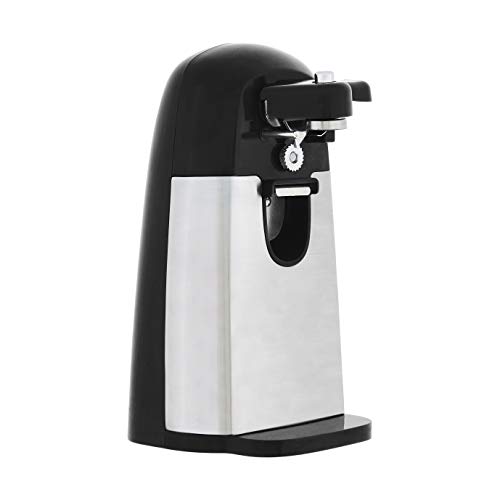
Amazon Basics 3-In-1 Electric Can Opener, Bottle Opener and Knife Sharpener — Best Electric Combination
For hands that need assistance, this Amazon Basics electric is the combination pick: a countertop unit whose verified listing specifies all three functions — electric can opening with a stainless steel blade and magnetic lid holder, a bottle opener, and a knife sharpener — in a sleek 50W design. The can opening is one-touch in practice: seat the can, engage the lever, and the machine cuts and holds the lid. It suits daily can users, arthritic hands, and households that prefer a permanent counter station to drawer tools, and its bottle function means the station covers drinks duty too.
Strengths
- All three functions — can, bottle, knife sharpening — verified in one listing
- Magnetic lid holder keeps cut lids out of the food and off fingers
- Assisted operation suits hands that cannot manage manual openers
Trade-offs
- Needs counter space and an outlet, like any countertop electric
- Electric mechanisms wear eventually and are rarely repairable
- Knife sharpener is a convenience feature, not a replacement for proper sharpening
Key specs (verified)
- Type: electric, countertop, 3-in-1
- Power: 50W (per Amazon listing)
- Blade: stainless steel, magnetic lid holder
- Functions: can opener, bottle opener, knife sharpener
Judge this machine as a station, not a gadget. Its value is consolidation at the point of use: the cook who opens cans daily, bottles regularly, and touches up a knife occasionally gets all three at one spot, with the lid held magnetically instead of fished from a can. The honest limits are the electric ones from our durability guide — keep the cutting assembly clean, seat cans properly so the mechanism is not grinding misaligned, and accept that a motor-driven tool has a service life measured in years of good use rather than the decades a simple manual can give. For the hands it serves, that trade is not close: assistance now beats theoretical longevity of a tool that hurts to use.
Check the current price on Amazon for the Amazon Basics 3-In-1 Electric Can Opener, Bottle Opener and Knife Sharpener.
Best for: arthritic and weak hands, daily can users, counter-station kitchens / Not suited for: small kitchens, drawer-tool households, low-volume users

Hamilton Beach Smooth Touch Electric Can Opener 76608 with Bottle Opening Accessory — Best Electric for Smooth Edges
The Hamilton Beach 76608 is the premium electric combination: its Smooth Touch design cuts cans from the side, below the rim, so lids lift off with smooth edges — the safest lid handling in this guide — while opening standard, extra-tall, and pop-top cans with an easy push-down lever. Its verified listing specifies the two extras that qualify it here: a bottle opening accessory and a built-in knife sharpener. It suits households that want assisted opening, safe lids for kids and guests, and the bottle function at the same station, from a mainstream brand with a long electric-opener history.
Strengths
- Side-cut, smooth-edge lids — the safest result in this guide
- Includes a bottle opening accessory and a built-in knife sharpener, per its listing
- Handles standard, extra-tall, and pop-top cans with a simple push-down lever
Trade-offs
- Accessory-based bottle opening is one more piece to keep track of than a built-in hook
- Countertop footprint and outlet requirement, as with any electric
- Premium tier among electrics — volume or hands should justify it
Key specs (verified)
- Type: electric, side-cut smooth touch
- Cans: standard, extra-tall, and pop-top
- Extras: bottle opening accessory, knife sharpener (per Amazon listing)
- Operation: push-down lever
The bottle accessory deserves a fair, specific judgment. A built-in hook on a manual opener is always there; an accessory must be kept with the machine, and households that lose accessories should weigh that honestly — a small storage habit, like keeping it in the drawer directly beneath the machine’s counter spot, solves it for most people. In exchange, you get the best lid safety in this guide plus assisted operation, a combination no manual tool here can match. For families with children old enough to open cans but young enough that sharp lids are a real worry, that exchange is usually worth making, and the mainstream brand behind it supports the machine properly.
Check the current price on Amazon for the Hamilton Beach Smooth Touch Electric Can Opener 76608 with Bottle Opening Accessory.
Best for: families prioritizing lid safety, assisted-opening households, high-volume kitchens / Not suited for: accessory-losers, minimalists, low-volume households

Zulay Kitchen Manual Can Opener Heavy Duty with Bottle Opener — Best Heavy-Duty Manual Combination
The Zulay Kitchen heavy-duty opener is the combination pick for users who open cans in volume by hand — batch cooking, preserving, big family meals — and want a manual tool built stoutly for it. Its verified listing specifies a razor-sharp stainless cutting blade, a rust-proof oversized easy-to-turn knob, soft-touch grip handles, and the bottle opener. The oversized knob is the working feature: it turns the cut into a leverage task instead of a grip-strength task, which is what fatigues hands over a dozen consecutive cans.
Strengths
- Oversized, rust-proof turning knob reduces hand fatigue over many cans
- Stainless cutting blade with soft-touch grips for controlled, comfortable cutting
- Bottle opener integrated, per its verified listing — both jobs in one heavy-duty tool
Trade-offs
- Heavier and larger than basic manual openers — a working tool, not a dainty one
- Top-cut lid handling applies
- Heavy-duty framing exceeds what light users need; they will be happier with the OXO or KitchenAid
Key specs (verified)
- Type: manual, heavy duty
- Blade: stainless steel cutting blade
- Knob: oversized, rust proof, easy-to-turn
- Handles: soft-touch grip, bottle opener included
Rust-proofing the knob is a small specification that tells you the design brief was longevity under real kitchen conditions — wet hands, splashes, frequent washing. Combined with the stainless blade, it addresses the two corrosion points that age manual openers fastest. The trade is size and weight, which are features when you are opening fifteen cans for a preserving session and pointless when you open one can of beans. Match the tool to your volume: this is the manual combination for cooks whose can opening is measured in sessions, and for them the leverage and build are worth more than elegance.
Check the current price on Amazon for the Zulay Kitchen Manual Can Opener Heavy Duty with Bottle Opener.
Best for: batch cooking, preserving sessions, strong-tool fans / Not suited for: light users, small drawers, smooth-edge seekers

Farberware Pro Can and Bottle Opener, Blue Haze — Best Dishwasher-Safe Combination
The Farberware Pro closes the list with a convenience angle the other manuals cannot claim: dishwasher-safe construction, stated in its verified listing, alongside an ergonomic handle, smooth and effortless turning, and a high-carbon stainless steel blade, in a Blue Haze finish. Its listing names cans and bottles as its twin jobs outright. It suits households whose care routine is honestly ‘everything goes in the dishwasher’ — a routine we caution against for most openers in our durability guide, which is exactly why a model built and rated for it belongs in this one.
Strengths
- Dishwasher safe per its listing — the care routine most households actually follow
- High-carbon stainless blade with smooth, low-effort turning
- Ergonomic handle and an explicit can-and-bottle design
Trade-offs
- Dishwasher detergents are harsh; even rated tools age fastest with hand washing
- Newer listing with a shorter production history than the classic picks
- Top-cut lid edge, as with the other manual combinations here
Key specs (verified)
- Type: manual combination
- Blade: high-carbon stainless steel
- Care: dishwasher safe (per Amazon listing)
- Finish: Blue Haze, ergonomic handle
There is an honesty principle in tool buying: match the tool to the care you will actually give it, not the care you aspire to. Our durability guide recommends hand washing and drying because it maximizes any opener’s life — but a household that will dishwasher-wash regardless is better served by a model designed and rated for that treatment than by a premium opener slowly ruined by good intentions. The Farberware Pro is that model in this guide. Its blade material and turning action are properly specified, its combination function is explicit, and its care requirement is the one on the box. Buy tools for the kitchen you have.
Check the current price on Amazon for the Farberware Pro Can and Bottle Opener, Blue Haze.
Best for: dishwasher-first households, convenience-focused buyers, gift purchases / Not suited for: longevity maximalists, buyers wanting a decades-long production record
Comparison Table
| Pick | Badge | Key spec | Best for |
|---|---|---|---|
| OXO Good Grips Manual Can Opener & Bottle Opener | Best Overall Combination | Type: manual, top-cut, combination | most households, weaker hands, one-tool drawers |
| KitchenAid Classic Multifunction Can Opener and Bottle Opener, Black | Best Value Combination | Type: manual multifunction | value buyers, second kitchens, rentals, classic-design fans |
| Amazon Basics 3-In-1 Electric Can Opener, Bottle Opener and Knife Sharpener | Best Electric Combination | Type: electric, countertop, 3-in-1 | arthritic and weak hands, daily can users, counter-station kitchens |
| Hamilton Beach Smooth Touch Electric Can Opener 76608 with Bottle Opening Accessory | Best Electric for Smooth Edges | Type: electric, side-cut smooth touch | families prioritizing lid safety, assisted-opening households, high-volume kitchens |
| Zulay Kitchen Manual Can Opener Heavy Duty with Bottle Opener | Best Heavy-Duty Manual Combination | Type: manual, heavy duty | batch cooking, preserving sessions, strong-tool fans |
| Farberware Pro Can and Bottle Opener, Blue Haze | Best Dishwasher-Safe Combination | Type: manual combination | dishwasher-first households, convenience-focused buyers, gift purchases |
How to Choose the Best Can Openers with Bottle Opener
Verify the combination before you admire it. The single most common disappointment in this category is a model whose bottle opener exists on a different variant — the listing photos show one version, the title describes another, and the tool that arrives does one job. Every pick in this guide had its bottle function confirmed in its own verified listing, and you should apply the same test to anything else you consider: find the bottle opener named in the product’s own title or specification, or assume it is not there. That one habit eliminates most bad purchases in this category before they happen.
Then judge the can opener as a can opener, because you will use it more. Wheel material, handle leverage, and drive smoothness — the criteria from our durability guide — decide whether the tool is a pleasure or a chore by the hundredth can, and no bottle hook compensates for a chewing wheel. Finally, decide manual versus electric by hands and volume: manual combinations are simpler, cheaper, and longer-lived, and their bottle hooks are always present; electric combinations assist hands that need help and consolidate a counter station, at the cost of space, an outlet, and an eventual motor lifespan. Households that open a few cans a week belong with the manuals. Households opening cans daily, or hands that struggle, belong with the electrics.
How the Bottle Function Is Implemented — and Why It Matters
Manual combinations almost always use the classic hook: a metal lip that catches under the cap’s edge while the tool’s head rests on the cap top, so a short lever motion pops the cap cleanly. It is a mechanism with essentially nothing to wear out, it works on standard crown caps, and it borrows the handle you already hold, which is why the best manual combinations feel like one tool rather than two. When you evaluate a manual combination, check that the hook is part of the metal head or handle structure — not a thin stamped afterthought — and that the grip gives you the leverage to use it one-handed.
Electric combinations take two forms in this guide: a bottle function built into the unit’s body, as on the Amazon Basics 3-in-1, and a bottle opening accessory supplied with the machine, as on the Hamilton Beach 76608. Built-in is foolproof — it cannot be lost. An accessory can be shaped more comfortably and keeps the function off the machine’s face, but it introduces a small storage discipline: keep it with the machine, in the drawer beneath its counter spot, and it will be there for years; toss it in a general drawer and it begins the migration all small accessories make. Neither form is wrong. Your household’s accessory track record should decide between them, honestly assessed.
One Tool or Two: The Honest Case for Separates
Fairness requires stating the alternative: a dedicated can opener from our durability guide plus a dedicated bottle opener is the maximalist’s setup, and for a household with drawer space and strong preferences — a side-cut can opener, say, which rarely includes a bottle hook — separates can be the better buy. The combination wins on consolidation: one slot, one tool to wash, one thing to pack for a rental, a cabin, or a camper, and no bottle opener wandering off. It also wins for gifting and for equipping new kitchens, where a single proven tool that covers both jobs prevents the slow accumulation of cheap singles.
Where the combination genuinely loses is at the extremes. If you need smooth-edge lids above all, the smooth-edge specialists mostly do not include bottle hooks — the Hamilton Beach electric in this guide is the exception that proves the rule. And if you open bottles professionally often — a home bar, frequent entertaining — a dedicated opener shaped for volume will out-serve any combination’s hook. Most households live in neither extreme, which is why the combination category exists and why its classics have sold for decades. Know which household yours is, and the choice between this guide and two separates makes itself.
How to Use a Combination Opener Well, for Both Jobs
Step 1: Seat the can opener fully before turning. Engage the wheel and gear completely on the rim before applying force. A half-seated start chews lids and dulls wheels unevenly on any manual combination, and mis-seating is the main cause of slipping on electrics too. If the first turn feels wrong, reseat instead of pushing through.
Step 2: Cut steadily and finish the cut. Turn with even pressure, keeping the can still on the counter and the opener in its designed plane. Complete the circuit fully so the lid is not hanging by a sliver, then lift it with the magnet, grip, or a utensil — never with fingertips along the edge.
Step 3: Hook the bottle cap positively. For the bottle function, seat the hook fully under the cap’s edge with the tool’s head resting on the cap top, then lever upward in one smooth motion. A half-hooked cap slips and can spray; a fully seated one pops cleanly with modest force, thanks to the handle’s leverage.
Step 4: Use the right grip for each job. The handle that gives you turning leverage for cans gives you levering leverage for bottles — hold it as a handle, not by the head. On electrics, use the bottle function or accessory exactly as its manual positions it, rather than improvising an angle the tool was not shaped for.
Step 5: Wash and dry the whole tool. Combination tools collect residue at both working ends — food at the wheel, sticky drips at the bottle hook. Wash both, dry both, and store the tool dry. The Farberware pick here is dishwasher rated; the others will live longest with a quick hand wash.
Step 6: Keep electric accessories with the machine. If your electric’s bottle opener is an accessory, give it a fixed home — the drawer beneath the machine’s counter position is the classic solution. An accessory with a home is a feature; an accessory without one is a future loss.
A small technique note for twist-off caps: a combination opener’s hook is designed for crown caps, and using it to wrench twist-offs is unnecessary force on both cap and tool. Twist-offs yield to grip — a dry towel or a rubber grip pad gives most hands the purchase they need. Save the hook for the caps it was made for, and both the tool and your hands will last longer in the job.
Cleaning and Care for Combination Openers
Care for a combination opener is care for two tools that share a body, and the routine is the one from our durability guide with one addition. Wash and dry the cutting wheel area after use — promptly after acidic foods — and never leave the tool soaking, which attacks wheel, gear, and handle joints together. The addition is the bottle end: sugary drips dry into a sticky film on the hook and head, which then transfers to your hand and, eventually, to the can rim area. A rinse of the whole tool, not just the wheel end, keeps both jobs clean, and a towel dry keeps both ends corrosion-free.
Storage follows the same logic: a dry drawer slot, ideally in a tray, where the tool is not rattling against heavier implements. For electric combinations, keep the counter station’s cutting assembly clean, manage the cord with its built-in storage where provided, and keep any bottle accessory in its designated drawer. End-of-life judgment is unchanged: a wheel that chews after cleaning, gears that slip, or a handle that has developed wobble means the tool has given its service in both jobs at once — which is, when you think about it, the combination’s final convenience. One replacement restores everything.
One Opening Tool, Whole Kitchen: Pantry, Bar, and Beyond
A combination opener earns its drawer slot across more of the kitchen than the dinner hour, and it is worth mapping that territory before you choose which tier of combination to buy. The pantry is the obvious ground: cans and bottled sauces, oils, and drinks live side by side there, and a cook building a weeknight meal touches both constantly — a jar’s worth of sauce from a bottle beside tomatoes from a can is the normal shape of cooking, not an exception. The combination tool’s value in that moment is not the seconds saved; it is the absence of the second search, the drawer rummage for the bottle opener that migrated. Tools that are always the same tool, in the same place, get used correctly and put back — which is also, not coincidentally, how tools come to last.
The second territory is drinks, broadly defined. Crown-capped bottles did not disappear with the craft soda, bottled juices, imported beers, and the return of glass-bottled everything have kept the bottle opener a weekly tool in most households, and the entertaining household uses it in bursts — a dozen bottles in an evening, where a hook with real handle leverage, like the manual picks here, outperforms the keychain afterthoughts that hurt hands by the sixth bottle. Households that entertain often should weight the bottle half of the combination more heavily than they expect to: it is the half your guests will use, unsupervised, and a tool that works intuitively in a stranger’s hand is worth more at a party than a marginally better wheel.
The third territory is everywhere else a household opens things away from the main kitchen: the cabin, the camper, the rental, the picnic kit, the garage fridge, the office drawer. These are the places disposable tools accumulate, because nobody equips them deliberately — and they are exactly where one proven combination tool, bought once and assigned permanently, pays for itself in avoided junk. Our honest recommendation for most readers is a two-tool strategy built from this guide: the best combination your main kitchen’s hands and volume justify, and one value combination — the KitchenAid is the natural candidate — assigned to the second location you use most. Two good tools, each in its place, will out-serve and out-last a drawer of improvisations, and you will never again open a bottle with a spoon handle while a can waits, half-cut, on the counter.
Gifting and Second Kitchens: Where a Combination Tool Shines Brightest
A combination opener is one of the rare genuinely good kitchen gifts, and the reason is structural: almost every household’s current opener is worse than it should be, nobody buys themselves a better one, and a tool that covers cans and bottles in one proven design upgrades a daily experience without requiring the recipient to learn anything. For a housewarming, a first apartment, or a parent’s kitchen where grip has quietly become an issue, the picks in this guide map cleanly: the OXO for the general case and for weaker hands, the KitchenAid for value, the Zulay for the household cook who opens cans in sessions. It is the kind of gift that gets used the same evening and mentioned, unprompted, a year later — the highest praise a kitchen tool can earn.
Second kitchens deserve the same deliberateness. The cabin, the camper, the rental you return to, the in-law suite — each has a drawer where tools go to be forgotten, and each is better served by one combination tool assigned permanently than by a rotating cast of leftovers. Buy the value pick for the second location at the same time as the main kitchen’s tool, put it in its drawer, and close the question for years. The alternative — discovering, mid-recipe at a lake house, that the opener there is a rusted novelty from a gift basket — is a small misery that recurs in households everywhere. It is also entirely preventable for the price of one honest tool, which is the most this category ever asks.
Common Buying Mistakes
Assuming the bottle opener is included. Variants differ, and marketing photos travel between them. Confirm the bottle function in the specific listing’s own title or specification before ordering — every pick in this guide passed that test, and anything you consider elsewhere should too.
Buying a weak can opener for its bottle hook. You will open far more cans than the novelty suggests, and a chewing wheel ruins the tool’s main job. Judge the can mechanism first, on wheel and handle, and let the bottle function be the tiebreaker it should be.
Losing the electric’s bottle accessory. An accessory without a fixed home migrates and vanishes, and the combination you paid for becomes a single-purpose machine. Assign it a drawer the day the machine arrives.
Soaking the tool after sticky drinks. Bottle duty leaves sugar; can duty leaves food acids. Soaking attacks both ends’ metal at once. Wash the whole tool promptly, dry it, and put it away — the twenty-second routine that doubles service life.
Using the bottle hook on twist-off caps. The hook is made for crown caps. Wrenching twist-offs with it stresses the tool and your hand for a job a towel and grip do better. Use each function for its designed task.
Forgetting the weakest hands in the house. A combination tool is often the household’s only opener, so its leverage must suit the weakest regular user — oversized grips, easy-turn knobs, or an assisted electric. A tool only one person can use is a household bottleneck, not a convenience.
Final Recommendation
For most households, the OXO Good Grips combination is the one-tool answer: a proven can opener, a built-in bottle opener, and a grip that serves every hand in the house. Start with the OXO Good Grips Manual Can Opener & Bottle Opener if you want the safest all-round choice, consider the KitchenAid Classic Multifunction Can Opener and Bottle Opener, Black for the alternative strength described above, and look at the Farberware Pro Can and Bottle Opener, Blue Haze if your priority is value within this category. Check price on Amazon for the model that matches your routine, and re-check the included accessories on the listing on the day you order.
Related guides on this site: Best Can Openers Best Can Openers That Last Best Electric Can Openers Best Manual Can Openers Best Can Openers For Seniors.
Frequently Asked Questions
Do combination can and bottle openers actually work well at both jobs?
The classic ones do, because the combination is a mature design rather than a novelty: the bottle hook adds no moving parts and borrows the handle’s leverage, while the can mechanism is unchanged from proven single-purpose models. Every pick in this guide was chosen because its can cutting stands on its own merits first. Where combinations fail is in cheap multifunction gadgets that fuse many weak tools — a category this guide deliberately avoids.
Which is better, a built-in bottle hook or an electric’s bottle accessory?
Built-in hooks cannot be lost and are always ready, which suits most households. Electric accessories exist because the machine’s face is devoted to the can mechanism; they work well if they are given a fixed home near the machine. Choose by your household’s accessory habits and by whether you need electric assistance for the cans themselves.
Can these openers handle twist-off bottle caps?
They are designed for crown caps. Twist-offs are best opened by hand with a grip aid such as a dry towel or rubber pad. Using a crown-cap hook to wrench a twist-off is unnecessary force on the tool and your hand, and no pick in this guide is sold for that purpose.
Are combination openers a good choice for arthritic hands?
The right ones are. Oversized soft grips like the OXO’s, easy-turn oversized knobs like the Zulay’s, and the fully assisted Amazon Basics and Hamilton Beach electrics all appear in this guide precisely because they reduce the grip and turning force required. Match the design to the specific difficulty — gripping, turning, or squeezing — as the reviews describe.
How do I keep a combination opener clean when it does two messy jobs?
Wash the whole tool, not just the wheel end: food residue collects at the cutter and sugary drips at the bottle hook. Dry it fully and store it dry. One model here, the Farberware Pro, is rated dishwasher safe in its listing; the manuals will live longest with a quick hand wash, and the electrics need their cutting assemblies kept clean and dry.
Is it better to buy separate can and bottle openers?
If you have drawer space and a specific preference combinations cannot meet — such as a dedicated smooth-edge can opener — separates can be the better buy, and our durability guide covers those picks. For most households, a proven combination saves space, prevents the bottle opener from wandering off, and covers both jobs with one well-made tool, which is why the format has endured.


