Disclosure: airfryerkitchensupply.com is reader-supported. When you buy through links on our site, we may earn an affiliate commission at no extra cost to you.
Where to buy
For best can openers that last, Amazon is the practical place to buy: listings show the current configuration, included accessories, and return terms in one place, and stock on popular models turns over quickly. Our top recommendation is the OXO Good Grips Manual Can Opener. Also consider the OXO Steel Can Opener and the KitchenAid Classic Multifunction Can Opener and Bottle Opener, Black for the needs described below, the Zyliss Lock & Lift Can Opener as a strong alternative, the Kuhn Rikon Auto Safety LidLifter, Red for its specific strength, and the Hamilton Beach Classic Chrome Electric Can Opener 76380J to round out the list. Check the current price on Amazon for whichever model you choose, and confirm the exact bundle, size, and finish on the listing before ordering, because manufacturers revise bundles more often than they revise model names.
Durability in a can opener is decided by boring things: the hardness of the cutting wheel, whether the gears are metal or plastic, how the handles handle being washed and dropped, and whether replacement is even necessary in a decade. Every pick below was verified as a current listing, and each one earns its place on construction, not novelty. A can opener is a tool you will use thousands of times; this guide treats it that way.
Introduction
Searching for the best can openers that last usually starts after the third cheap opener fails — the wheel dulls, the gears slip, the handles loosen, and a thirty-second job becomes a wrestling match with a half-open can and a jagged lid. The frustration is out of proportion to the price, which is exactly why it keeps happening: openers are bought as afterthoughts. This guide takes the opposite approach. It treats the can opener as what it is — a small, heavily used mechanical tool — and ranks the verified field by construction, repairability of the experience, and how each design ages over years of cans.
Two design families dominate, and they age differently. Traditional top-cut openers slice through the lid just inside the rim; their wheels take the full force of every can and are the wear point to judge. Side-cut, smooth-edge openers cut below the rim and lift the whole lid off; their mechanism is more complex, which can mean more to go wrong, but the cutting action is often less brutal on the wheel. Electric openers move the wear to gears and motors, trading manual simplicity for effortlessness. This guide includes the strongest verified examples of each family, because longevity means something slightly different in each — and because hands differ, and the opener that lasts longest is partly the one your hands will keep using correctly.
One promise before the list: we will not pretend any opener lasts forever. Cutting wheels dull eventually on every design, and a household that opens cans daily will wear any tool faster than one that opens two cans a week. What separates the picks below from the disposable tier is timescale and grace: years instead of months, a slow dulling you can plan around instead of a sudden gear failure mid-can, and — in the best cases — a design simple enough that there is very little in it that can break at all.
In this guide
Quick Picks
- Best Overall for Longevity: OXO Good Grips Manual Can Opener — A long-running manual design with a sharp stainless wheel, a smooth turning action, and a soft grip that survives years of washing.
- Best Premium Manual: OXO Steel Can Opener — A stainless-bodied upgrade of the classic manual design, with a smooth knob and a grip built for everyday use in either hand.
- Best Value Durable Manual: KitchenAid Classic Multifunction Can Opener and Bottle Opener, Black — A razor-sharp stainless wheel and soft ergonomic handles in a simple multifunction design at an accessible tier.
- Best Locking Manual Design: Zyliss Lock & Lift Can Opener — A locking mechanism that clamps the opener to the can for even cuts and reduced hand strain, with high-grade stainless wheels.
- Best Smooth-Edge for Long Service: Kuhn Rikon Auto Safety LidLifter, Red — A Swiss-engineered side-cut design that lifts lids without touching food or leaving sharp edges, with a ring-pull tool built in.
- Best Electric for Long Service: Hamilton Beach Classic Chrome Electric Can Opener 76380J — An extra-tall countertop electric with SureCut alignment, automatic shutoff, a knife sharpener, and cord storage — the durable electric format.
How These Picks Were Chosen
We verified every candidate against Amazon product data and kept only current listings in the configuration described. We then scored for longevity specifically. First, cutting-wheel construction: hardened or stainless wheels, and designs that keep the wheel out of food contact and corrosion. Second, drive construction: metal gearing and shafts over plastic where the design allows a judgment. Third, handle and body construction: riveted or single-piece designs, grips that survive washing, and bodies that tolerate drops onto hard floors. Fourth, design simplicity: fewer moving parts and no batteries is a longevity advantage in itself. Fifth, brand support: makers with long production runs of the same model, which signals a design that has already survived the market’s own durability test.
We excluded novelty openers, designs we could not verify as current, and any model whose listing suggested a recent silent redesign — a common way once-durable tools quietly become disposable ones. What remains is six openers across manual top-cut, manual side-cut, premium manual, and electric designs, each reviewed with three strengths and three trade-offs, because a tool bought for a decade deserves a teardown, not a brochure.
The 6 Best can openers that last

OXO Good Grips Manual Can Opener — Best Overall for Longevity
The OXO Good Grips manual opener is the durability benchmark for most households: a traditional top-cut design that has been in production for years with its formula intact — a sharp stainless cutting wheel, a turning knob that moves smoothly without gear slop, and the signature soft, oversized handle that gives aging or weaker hands the leverage to cut cleanly without strain. It also includes a built-in bottle opener. Choose it if you want one manual opener, bought once, that simply keeps working; choose a side-cut model below if smooth lids matter more to you than simplicity.
Strengths
- Long, stable production run — the design has already passed the market’s durability test
- Stainless cutting wheel and smooth drive action resist the dulling and slipping that kill cheap openers
- Soft, oversized grip preserves leverage as hands age, so the tool stays usable for years
Trade-offs
- Top-cut design leaves a sharper lid edge than side-cut models
- The cushioned handle should be hand-washed and dried to age at its best
- Like all manual wheels, it will eventually dull after years of heavy daily use
Key specs (verified)
- Type: manual, top-cut
- Cutting wheel: stainless steel (per Amazon listing)
- Handle: soft ergonomic grip
- Extra: built-in bottle opener
What longevity looks like in practice is unspectacular, and that is the point. This opener engages the rim the same way in year five as in week one, because the wheel geometry and knob action have not loosened into the wobble that makes cheap openers chew lids instead of cutting them. Care is minimal but real: wash and dry the wheel area after use, especially after acidic foods like tomatoes, and do not leave it soaking, because standing water is the enemy of every cutting wheel ever made. Do that, and this is the opener most households will still be using when the rest of this guide is history.
Check the current price on Amazon for the OXO Good Grips Manual Can Opener.
Best for: most households, weaker or aging hands, buy-it-once shoppers / Not suited for: buyers who require a smooth-edge lid, households wanting a fully hands-free tool

OXO Steel Can Opener — Best Premium Manual
The OXO Steel is the pick for buyers who like the manual format and want its most durable expression: a stainless steel cutting wheel in a steel-bodied opener, with a smooth turning knob and a soft non-slip grip, usable comfortably in either hand. It costs more than its Good Grips sibling and buys you body construction that shrugs off drops, dings, and decades of drawer life. If your kitchen tools live hard lives — rattling in drawers, dropped on tile, washed daily — the steel body is the longevity argument, and it is a good one.
Strengths
- Steel body construction tolerates drops and drawer abuse that crack plastic-bodied openers
- Stainless cutting wheel with a smooth, controlled turning action
- Ambidextrous-friendly design with a non-slip grip for wet hands
Trade-offs
- Premium tier for a manual opener — you are paying for construction, not features
- Top-cut lid edge, like its sibling — sharpness is managed by care, not design
- Heavier in the hand than basic openers, which some users notice over many cans
Key specs (verified)
- Type: manual, top-cut, steel body
- Cutting wheel: stainless steel
- Grip: soft non-slip, left and right handed use
- Action: smooth turning knob
The difference between this and the standard Good Grips model shows up in year three, not week one. Both cut identically when new. The steel body’s advantage is that the alignment between wheel and traction gear — the relationship that decides whether an opener cuts or chews — is held in a rigid frame that does not flex, loosen, or crack with age and impact. Households that have killed openers by dropping them, or by the slow loosening of a plastic frame, are exactly the households this model is for. It is the least exciting purchase in this guide and possibly the longest-lived one.
Check the current price on Amazon for the OXO Steel Can Opener.
Best for: hard-use kitchens, drop-prone households, buyers wanting the most durable manual form / Not suited for: budget buyers, smooth-edge devotees, anyone who wants an electric tool
KitchenAid Classic Multifunction Can Opener and Bottle Opener, Black — Best Value Durable Manual
The KitchenAid Classic is the durability value pick: a simple, proven manual layout with a stainless steel cutting wheel and soft ergonomic handles, plus a built-in bottle opener, from a brand whose kitchen tools are built to a consistent standard. Simplicity is its longevity strategy — there is very little in this design that can fail, no electronics, no complex side-cut mechanism, just a wheel, a gear, and handles. It suits buyers who want a dependable opener without paying the premium for steel-body construction, and households equipping a second kitchen or a rental properly rather than disposably.
Strengths
- Simple mechanism with minimal failure points — the classic durability strategy
- Stainless cutting wheel described as razor sharp in its verified listing, with clean engagement
- Soft ergonomic handles give good leverage without hand strain
Trade-offs
- Top-cut design leaves the standard sharper lid edge
- Handles and finish are a step below the premium steel models in long-term toughness
- No smooth-edge option — buyers wanting lifted lids should look at the Kuhn Rikon below
Key specs (verified)
- Type: manual multifunction, top-cut
- Cutting wheel: stainless steel
- Handles: soft ergonomic
- Extra: bottle opener included
There is a useful lesson in this opener: durability correlates with simplicity more than with price. The multifunction tools that fail young are usually the ones that tried to be five tools in a complicated housing. This one does two jobs — cans and bottles — with a mechanism generations old, executed in decent materials by a brand with standards to protect. Washed and dried after use, stored in a drawer rather than a damp sink caddy, it will outlast most of the gadgets around it. For the money, that is the whole argument, and it is a strong one.
Check the current price on Amazon for the KitchenAid Classic Multifunction Can Opener and Bottle Opener, Black.
Best for: value-focused buyers, second kitchens and rentals, simplicity fans / Not suited for: smooth-edge seekers, buyers wanting the toughest possible body construction
Zyliss Lock & Lift Can Opener — Best Locking Manual Design
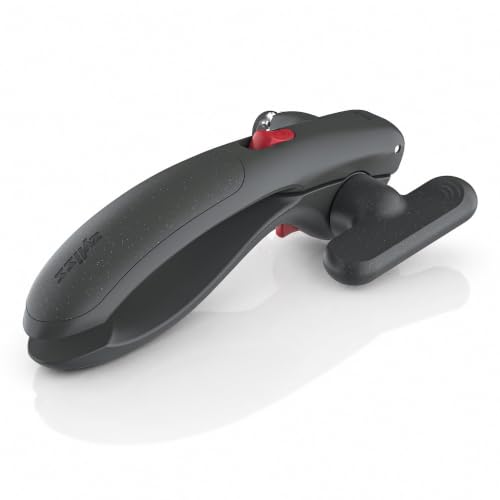
The Zyliss Lock & Lift attacks a hidden cause of opener wear and bad cuts: misalignment. Its locking mechanism clamps onto the can rim and holds the cutting geometry steady, so the wheel tracks evenly instead of wandering — wandering is what chews lids, dulls wheels unevenly, and strains hands. The listing specifies high-grade sharpened stainless steel wheels, and the lock reduces the grip force needed through the cut, which matters for weaker hands and for anyone opening many cans in a session, such as batch cooking or preserving days.
Strengths
- Locking clamp holds alignment for even cuts, reducing uneven wheel wear
- High-grade sharpened stainless wheels per its verified listing
- Reduced hand strain through the cut — good for weak grips and long sessions
Trade-offs
- The locking mechanism is one more moving part than the simplest openers have
- Takes a session or two to learn the clamp-and-release rhythm
- Top-cut style lid handling still applies
Key specs (verified)
- Type: manual, locking
- Wheels: high-grade sharpened stainless steel (per Amazon listing)
- Mechanism: lock-on for even cuts, reduced hand strain
Judge the lock by what it prevents. Most manual opener deaths are not dramatic; the wheel slowly dulls on one side because the opener habitually tilted, or the user squeezed harder to compensate for drift, bending the geometry further. A clamped cut removes that cycle. The trade is honest: a mechanism that can, in principle, wear — versus the simpler openers above whose alignment depends on your hand. For steady hands, simplicity wins. For hands that tire, shake, or simply open a lot of cans, the Lock & Lift’s controlled cut is the more durable system in practice, because tools last longest when they are used the way they were designed to be used.
Check the current price on Amazon for the Zyliss Lock & Lift Can Opener.
Best for: weaker hands, batch cooking and preserving, alignment-frustrated users / Not suited for: minimalists who want the fewest possible parts, strict budgets

Kuhn Rikon Auto Safety LidLifter, Red — Best Smooth-Edge for Long Service
The Kuhn Rikon LidLifter is the smooth-edge longevity pick. Its side-cut design slices below the rim so the lid lifts off whole — no sharp edge, no lid falling into the food, and a cutting action that keeps the wheel out of the can’s contents, which also keeps the wheel cleaner and slower to corrode. An easy-turn handle suits weaker grips, and a ring-pull tool handles pull-tab cans that defeat fingernails. Swiss-engineered and long in production, it suits households that prioritize safe lids — especially with children serving themselves — and are willing to learn the side-cut technique.
Strengths
- Side-cut action keeps the wheel out of food contact, slowing corrosion and easing cleaning
- Smooth, touch-free lid removal — no sharp edges and no lids dropped into food
- Long-running Swiss design with an easy-turn handle and a ring-pull tool
Trade-offs
- Side-cut technique must be learned; first-time users often misalign it initially
- The more complex mechanism has more to go wrong than a basic top-cut opener
- Lids lift off but the can rim itself should still be handled with normal care
Key specs (verified)
- Type: manual, side-cut smooth-edge
- Design: Swiss engineered, easy-turn handle
- Extras: ring-pull tool, touch-free lid removal
- Color: red (listing)
The longevity case here is corrosion, the quiet killer of cutting wheels. A top-cut wheel passes through food and acidic juices on every can; a side-cut wheel runs on the outside of the rim and stays comparatively clean and dry, which is why well-kept LidLifters stay sharp-feeling for years. The technique point is real but small: the opener sits on top of the can, you turn until the lid releases, and the built-in grip lifts it away. Master it once — ideally on a forgiving can of beans, not a rushed dinner — and the design’s safety advantages compound daily, especially in households where kids or guests open cans unsupervised.
Check the current price on Amazon for the Kuhn Rikon Auto Safety LidLifter, Red.
Best for: households with children, smooth-edge devotees, corrosion-conscious buyers / Not suited for: users who dislike learning a new technique, absolute minimalists
Hamilton Beach Classic Chrome Electric Can Opener 76380J — Best Electric for Long Service
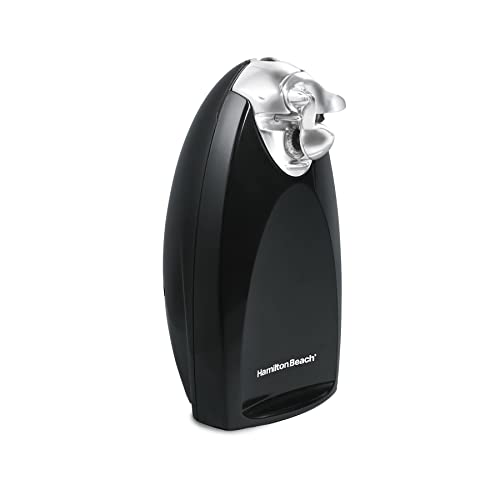
Electric openers fail differently from manual ones — motors and gears, not wheels — so the durable electric is a countertop model from a mainstream brand, not a novelty gadget. This Hamilton Beach pairs its SureCut alignment technology, which positions the can correctly and reduces the misaligned grinding that wears electric mechanisms, with automatic shutoff, an extra-tall body for large cans, a built-in knife sharpener, and cord storage. It suits households that open cans daily, hands that cannot manage a manual opener at all, and kitchens with the counter space to give a tool a permanent home.
Strengths
- SureCut alignment reduces the misaligned starts that wear electric mechanisms fastest
- Extra-tall body handles large cans that strain compact electrics
- Mainstream brand with a long-running model line, plus knife sharpener and cord storage
Trade-offs
- Needs counter space and an outlet — it is furniture, not a drawer tool
- Motor and gear wear is eventual, as with any electric, and repair is rarely practical
- Overkill for households that open a can or two a week
Key specs (verified)
- Type: electric, countertop, extra tall
- Technology: SureCut alignment, automatic shutoff
- Extras: knife sharpener, cord storage
- Model: 76380J
The honest electric longevity advice is about placement and use. A countertop opener that lives plugged in, aligned, and used as designed will outlast a handheld electric rattling in a drawer, because alignment is what its mechanism eats. The removable cutting lever on models of this class — washable after use — is the maintenance that matters: dried food on the cutter is the main cause of the slipping people blame on motors. If your household’s volume justifies an electric, buy this format, keep the cutter clean, and expect years. If your volume is two cans a week, a manual pick above will outlive it for a fraction of the commitment, and we would be doing you no favor pretending otherwise.
Check the current price on Amazon for the Hamilton Beach Classic Chrome Electric Can Opener 76380J.
Best for: high-volume households, hands that cannot use a manual opener, permanent-counter kitchens / Not suited for: small kitchens, low-volume households, drawer-storage fans
Comparison Table
| Pick | Badge | Key spec | Best for |
|---|---|---|---|
| OXO Good Grips Manual Can Opener | Best Overall for Longevity | Type: manual, top-cut | most households, weaker or aging hands, buy-it-once shoppers |
| OXO Steel Can Opener | Best Premium Manual | Type: manual, top-cut, steel body | hard-use kitchens, drop-prone households, buyers wanting the most durable manual form |
| KitchenAid Classic Multifunction Can Opener and Bottle Opener, Black | Best Value Durable Manual | Type: manual multifunction, top-cut | value-focused buyers, second kitchens and rentals, simplicity fans |
| Zyliss Lock & Lift Can Opener | Best Locking Manual Design | Type: manual, locking | weaker hands, batch cooking and preserving, alignment-frustrated users |
| Kuhn Rikon Auto Safety LidLifter, Red | Best Smooth-Edge for Long Service | Type: manual, side-cut smooth-edge | households with children, smooth-edge devotees, corrosion-conscious buyers |
| Hamilton Beach Classic Chrome Electric Can Opener 76380J | Best Electric for Long Service | Type: electric, countertop, extra tall | high-volume households, hands that cannot use a manual opener, permanent-counter kitchens |
How to Choose the Best Can Openers That Last
Start with the cutting wheel and work outward. The wheel does the work and takes the wear: hardened or stainless wheels in a rigid frame outlast soft wheels in flexing plastic bodies, and alignment — held by the frame, a lock, or your steady hand — decides whether the wheel wears evenly or chews itself dull on one side. Next, count the moving parts you are volunteering to maintain. A basic manual opener has almost none and fails slowly; a side-cut mechanism and an electric drive each add capability and add a wear path. Neither is wrong, but buy the complexity your hands and habits actually need, because unused complexity is just future failure you paid for.
Then match the tool to the hands that will use it, honestly and over time. The opener that lasts longest in a household is the one everyone can operate correctly: enough handle leverage for the weakest regular user, a turning action that does not demand grip strength the cook no longer has, or an electric drive when manual operation is genuinely difficult. A premium opener abandoned in a drawer because it hurts to use has a service life of zero. Finally, check the boring credentials: how long the model has been in production, whether the maker sells the same design across many years, and whether care is simple. Long production runs are the market’s durability data, freely available to anyone who looks.
Top-Cut vs Side-Cut: How Each Design Ages
Top-cut openers are the simpler and, mechanically, the tougher design: the wheel slices the lid inside the rim, the parts count is minimal, and the failure mode is a slow dulling over years. Their costs are a sharper lid edge and a wheel that passes through food, picking up acidic residue that must be washed and dried off if the wheel is to stay sharp. Side-cut openers slice below the rim and lift the lid whole: no sharp lid, no dropped lids, and a wheel that stays out of the food and corrodes more slowly. Their cost is a more complex head that must be aligned correctly and has more small parts working in concert.
Neither design is categorically longer-lived; they die of different causes, which means your habits should choose between them. Households that rinse and dry tools promptly neutralize the top-cut’s corrosion risk and get maximum simplicity. Households that toss tools in the sink to soak — be honest — will kill a top-cut wheel early and are better served by a side-cut design or by changing the habit for this one tool. Electric openers, the third family, die of gear and motor wear accelerated by misalignment and dried food on the cutter; their care rule is alignment plus a clean cutting assembly, and their lifespan rewards households whose volume justifies them.
The Care Routine That Doubles an Opener’s Life
Three habits decide whether any opener in this guide reaches its potential lifespan. First, wash and dry the cutting area after use — after every use involving acidic food, and regularly otherwise. Corrosion, not cutting, dulls most wheels: a wheel left wet with tomato juice overnight is being etched, slowly, every night. Second, never leave an opener soaking in the sink. It is the single most common and most destructive habit for this tool, attacking wheels, gears, and handle joints at once. A quick wash and a towel dry takes twenty seconds and is worth years.
Third, use the opener as designed. Engage the rim fully before turning, keep the can and opener aligned rather than forcing an angle, and stop fighting a can that is dented on the rim — open it from the other end or with a second tool rather than grinding your wheel across damaged metal. Store the opener dry, in a drawer or on a hook, not in a damp caddy. None of this is demanding, and that is precisely why it works: the owners whose openers last a decade are not doing anything heroic. They are doing three small things consistently, which is how most tools, honestly, are kept.
How to Open Cans So Your Opener (and Lids) Last
Step 1: Seat the opener fully before turning. Engage the wheel and gear completely on the rim — or clamp the lock, on the Zyliss — before applying turning force. A half-seated start is how wheels slip, chew the lid, and dull unevenly. If the first turn feels wrong, reseat rather than push through.
Step 2: Keep the can still and the opener aligned. Hold the can firmly on the counter, not in the air, and let the opener travel around the rim in its designed plane. Twisting the opener sideways mid-cut bends the cutting geometry and is a leading cause of the wobble that ends openers’ useful lives.
Step 3: Turn steadily, not forcefully. A sharp, aligned opener cuts with modest, even pressure. If you find yourself squeezing and straining, something is misaligned or the rim is dented — stop, reseat, and inspect, rather than muscling through and damaging the wheel on a bad rim.
Step 4: Remove the lid safely and completely. Use the opener’s magnet, grip, or a utensil to lift the lid without fingers near the edge, and make sure the cut completed fully so the lid is not hanging by a metal sliver. On side-cut models, lift the lid straight off with the built-in grip as designed.
Step 5: Deal with dented rims honestly. A can dented on its rim will defeat any opener and can damage a good one. Open it from the undamaged end if it has one, or transfer your effort to a backup tool. Sacrificing a can’s convenience is cheaper than sacrificing a decade-service opener’s wheel.
Step 6: Wash, dry, and put it away — now. Rinse or wash the cutting area, dry it with a towel rather than air-drying it wet, and return it to its dry storage place immediately. This twenty-second habit, repeated, is the entire difference between a two-year opener and a ten-year one.
If an opener you own has begun to slip or leave the lid attached in stretches, diagnose before you replace: clean the wheel and gear thoroughly, dry them, and try a clean, undamaged can with a careful, fully seated start. A surprising share of ‘dead’ openers are simply dirty or were being used half-seated. If a clean test cut still chews, the wheel has genuinely dulled — at which point replacement, not more force, is the answer, and this guide is the way to make the next one the last one for a long time.
Storage, Cleaning, and Knowing When to Replace
Storage is part of care for this tool. A dry drawer, ideally in a tray or with the wheel protected from rattling against heavier tools, preserves both the wheel’s edge and the handles’ finish. Avoid magnetic knife strips for openers — the suspended, swinging storage invites drops — and avoid the sink caddy entirely. For electric models, the equivalent rule is a permanent, aligned home on the counter with the cord managed by its built-in storage, and a cutting assembly washed and dried after messy cans rather than left to harden.
Know the genuine end-of-life signs, because using a dying opener hard is how hands get hurt. A wheel that chews instead of cuts after cleaning and careful seating, a knob or handle that has developed wobble the design did not start with, gears that slip under normal pressure, or visible rust that returns immediately after cleaning — any of these means the tool has given its service. Retire it without sentimentality and replace it from this list. The goal of buying for longevity is a long, safe service life, not an indefinite one, and the discipline of replacing at the right time is part of the same ownership habit as washing and drying.
Materials in Plain Terms: Wheels, Gears, Handles, and Bodies
Durability talk gets vague quickly, so here is the material story of a can opener in plain terms. The cutting wheel does its work by being harder than the can’s steel rim and staying that way: hardened steel and quality stainless wheels hold an edge through years of rims, while soft, thin wheels deform microscopically on every can until they stop cutting and start tearing. You cannot easily test hardness in a shop, which is why this guide leans on production history — a wheel design that has survived a decade in the market has passed the test empirically, in millions of kitchens, in a way no specification sheet can fake. When a listing names its wheel material and geometry plainly, as the picks here do, that plainness itself is a good sign; vagueness about the working part is a bad one.
Gears and shafts are the second story. The traction gear that walks the opener around the rim must mesh with the wheel’s drive without slop, and slop is what cheap openers develop as plastic gears wear and shafts loosen in soft frames. Metal gearing in a rigid body — steel, or a well-made frame that does not flex under hand pressure — holds that mesh for years. You can feel the difference in the hand before you ever open a can: a durable opener’s knob turns with a smooth, connected resistance, while a disposable one feels loose and gritty from new. Trust that first impression; it is the sound of the tolerances you are buying, and tolerances, more than any feature, are what a decade of service is made of.
Handles and bodies finish the story, because they decide whether the tool survives its environment. Kitchens are wet, soapy, and hard-surfaced: tools are dropped on tile, left in sinks, and rattled in drawers against heavier implements. Cushioned grips, like the OXO designs in this guide, trade a little ultimate toughness for leverage and comfort, and age best with hand washing. Steel bodies trade a little comfort for near-indifference to drops and dings. Neither is wrong — they are answers to different kitchens — but a thin plastic body with a cushioned sticker pretending to be a grip is wrong in every kitchen, and it is the construction of most of the disposable tier. Buy the body that matches your kitchen’s actual roughness, keep the tool dry, and the materials will do the rest.
Manual or Electric Over a Decade: The Total Ownership Picture
Project both designs across ten years and the comparison sharpens. A quality manual opener asks for washing, drying, and dry storage, and returns a decade of service with a slow, predictable dulling at the end of it — its total ownership cost is its purchase, once. An electric asks for the same cleaning discipline at its cutting assembly, plus counter space and standby presence, and returns effortlessness across the same decade with a motor-and-gear lifespan that is real but less predictable; its replacement, when it comes, is a whole machine rather than a wheel’s retirement. Neither picture is superior in the abstract. The manual wins on simplicity, cost, and certainty. The electric wins on hands, volume, and the daily experience of people for whom a manual cut is genuinely hard.
The deciding question is therefore not which lasts longer in a laboratory sense, but which will be used correctly, by every regular user, for ten years in your kitchen. A premium manual that a household member cannot grip will be forced, misaligned, and effectively short-lived regardless of its construction. A countertop electric that a low-volume household resents for its footprint will be exiled to a cupboard and die of neglect instead. Longevity, in the end, is a property of the match between tool and household as much as of the tool — which is why this guide reviews hands and habits alongside wheels and gears, and why the most durable purchase is the one you can picture, concretely, being used well in year nine.
Common Buying Mistakes
Leaving the opener soaking in the sink. Standing water attacks the wheel, the gears, and the handle joints simultaneously. It is the fastest legal way to kill a good opener. Wash it, dry it, put it away — twenty seconds, every time.
Buying novelty and multifunction complexity. Openers that promise to be five tools in one housing fail as tools in general. The durable designs in this guide do one or two jobs with minimal parts. Complexity is a wear budget; spend it only on a lock or a side-cut you will actually use.
Forcing misaligned or dented cans. Muscling through a bad start dulls wheels unevenly and bends geometry. Reseat first; if the rim is dented, change ends or change tools. Force is how a decade of service becomes a month of decline.
Ignoring the weakest hands in the household. An opener that the regular cook cannot operate without strain will be used wrong, avoided, or both — and its lifespan becomes irrelevant. Leverage, easy-turn handles, locking designs, and electrics exist on this list precisely for those hands.
Assuming electric means maintenance-free. Electric mechanisms wear fastest when misaligned and when the cutter carries dried food. Keep the cutting assembly clean and the can seated, or the most expensive opener in the kitchen becomes the first to slip.
Keeping a genuinely dead opener. A chewing, slipping opener is a cut risk, not a savings. When cleaning and a careful test cut do not restore it, replace it. Longevity buying includes knowing when the long life has, in fact, been lived.
Final Recommendation
For most households, the OXO Good Grips manual opener is the buy-once answer: a proven design, a stainless wheel, and a grip that keeps it usable for years. Start with the OXO Good Grips Manual Can Opener if you want the safest all-round choice, consider the OXO Steel Can Opener for the alternative strength described above, and look at the Hamilton Beach Classic Chrome Electric Can Opener 76380J if your priority is value within this category. Check price on Amazon for the model that matches your routine, and re-check the included accessories on the listing on the day you order.
Related guides on this site: Best Can Openers Best Can Openers With Bottle Opener Best Electric Can Openers Best Manual Can Openers Best Can Openers For Seniors.
Frequently Asked Questions
How long should a good can opener last?
With washing and drying after use and dry storage, the manual picks in this guide should serve for many years of regular household use — the best of them are routinely kept for a decade. Daily heavy use shortens any tool’s life, and electric models trade some of that lifespan for effortlessness. The disposable tier fails in months; the gap between the tiers is the entire point of this guide.
Can a dull can opener be sharpened?
In principle a wheel can be dressed, but on household openers the wheel, gear alignment, and handle condition age together, and sharpening one element rarely restores the system. Our honest advice: clean and test first, because many ‘dull’ openers are dirty or misused — and if a clean, careful cut still chews, replace the opener rather than investing in a partial fix.
Are side-cut openers really more durable?
They resist one specific killer — corrosion — better, because the wheel stays out of the food. They carry a more complex head in exchange. In a household that washes and dries promptly, a simple top-cut opener will match or exceed a side-cut’s lifespan. In a household that soaks tools, the side-cut design is the more forgiving choice.
Why does my opener leave the lid attached in one spot?
Usually an incomplete final turn, a dented rim at that point, or a wheel that is dirty or beginning to dull. Finish the cut with a steady final turn, lift the lid with a utensil rather than bending it back and forth, and clean the wheel. If it happens on every can after cleaning, the wheel is at end of life.
Is an electric opener worth it for longevity?
For households that open cans daily or hands that cannot manage a manual tool, yes — a countertop electric from a mainstream brand, kept aligned and clean, gives years of effortless service. For low-volume households, a manual opener will outlast it with less cost and no counter commitment. Volume and hands, not novelty, should make this decision.
What is the best opener for arthritic or weak hands?
Look at leverage and assistance: the OXO models’ oversized soft grips, the Zyliss Lock & Lift’s clamped, low-strain cut, the Kuhn Rikon’s easy-turn handle, and the Hamilton Beach electric for fully assisted opening. The right choice depends on whether grip, turning, or squeezing is the difficulty — this guide’s reviews name which each design helps most.


