Disclosure: airfryerkitchensupply.com is reader-supported. When you buy through links on our site, we may earn an affiliate commission at no extra cost to you.
Where to buy
The fastest way to buy any of the best camping grills portable in this guide is through Amazon, where stock, delivery options and current pricing are shown on each product page. We never print static prices in our guides because campsite-gear pricing moves with seasons and promotions, so use the links below to check price on Amazon before you commit.
- Weber Traveler Compact Portable Gas Grill — check price on Amazon
- Char-Broil Grill2Go X200 Portable Gas Grill — check price on Amazon
- Cuisinart Grillster Portable Gas Grill (CGG-059A) — check price on Amazon
- Coleman Fold N Go Portable Propane Grill — check price on Amazon
- Weber Smokey Joe 14-Inch Portable Charcoal Grill — check price on Amazon
- Kuvik Titanium Camping Grill — check price on Amazon
Portability is a spectrum, and the best camping grills portable enough to matter live at different points on it: a folding gas grill that rolls behind you like luggage, a tabletop that latches into a sealed brick, a charcoal kettle light enough to carry by its lid handle, and a titanium grate that weighs less than the food it cooks. The best camping grills portable campers actually bring are the ones whose packed shape fits the vehicle and the trip — not the ones with the most impressive grate at home.
This guide ranks six verified portable grills by the kind of portability they offer. Two fold or roll for car campers who refuse tabletop compromises. Two are compact gas tabletops for small trunks and RV bays. One is the classic budget charcoal kettle. And one is a true ultralight option for campers who walk to their site. Every linked product was verified against Amazon’s catalog data before inclusion.
Be honest with yourself about which camper you are before reading the badges. A grill that is portable for an SUV owner is furniture to a hatchback owner, and both of them will laugh at the titanium grate — right up until they carry a grill two miles to a walk-in site.
Key Takeaways
- Judge the packed object — latch, handle, wheels, grease containment — before the open grill.
- Car-to-table, festival-field and walk-in camping are three different portability problems.
- A compact grill that comes on every trip beats a big grill that stays in the garage.
- Titanium fire grills are the only truly backpackable option; everything else assumes a vehicle.
In this guide
Quick Picks
- Weber Traveler Compact Portable Gas Grill — Best Folding Portable. The Traveler’s folding, wheeled formula in a smaller package — stand-up gas grilling that packs flatter than any tabletop-plus-stand combination. Check on Amazon
- Char-Broil Grill2Go X200 Portable Gas Grill — Best for Rough Transport. A cast, latching tabletop that travels like a tool case — the portable to throw in a truck bed, boat or overland rig without a second thought. Check on Amazon
- Cuisinart Grillster Portable Gas Grill (CGG-059A) — Best Trunk-Friendly Tabletop. An 8,000 BTU tabletop the listing puts at 13 lbs, with a dishwasher-safe grate and push-button ignition — the small-car camper’s gas grill. Check on Amazon
- Coleman Fold N Go Portable Propane Grill — Best Lightweight Gas. A 6,000 BTU grill that folds into a briefcase profile with a dishwasher-safe grate — Coleman’s lightest answer to the packed-car problem. Check on Amazon
- Weber Smokey Joe 14-Inch Portable Charcoal Grill — Best Budget Portable. The 14-inch kettle that carries by its locking lid — budget-tier charcoal portability with real damper control and endless replacement parts. Check on Amazon
- Kuvik Titanium Camping Grill — Best Ultralight. An ultralight titanium grill that packs into its own carry case — the only pick here a backpacker would genuinely carry to a walk-in site. Check on Amazon
How These Picks Were Chosen
We chose these picks by packed reality: folded dimensions, whether the lid latches, whether the grill carries by a handle, rolls on wheels, or disappears into a tote. Manufacturer weight claims are easy to print and hard to verify across listings, so we judged portability by design — the features you can see in the verified listings — rather than by repeating numbers we could not confirm.
Every linked product passed the same Amazon listing data verification as the rest of this series: brand-and-model search, title match, ASIN from the listing response. Specs in the mini boxes come only from those verified listings. If a portable grill could not be verified, it did not get a link, however good its reputation.
We also required each pick to cook properly. The portable category is full of novelty grills that fold beautifully and cook terribly; every pick below is a real grill first and a packing trick second.
Portability claims are the easiest in this industry to exaggerate, so we weighted demonstrated design over marketing language throughout: a latch you can see in the listing, legs that lock, a handle placed where a hand actually goes. Where a listing’s portability story was only adjectives, the grill did not make this guide regardless of its cooking reputation.
The 6 Best Portable Camping Grills, Reviewed One by One
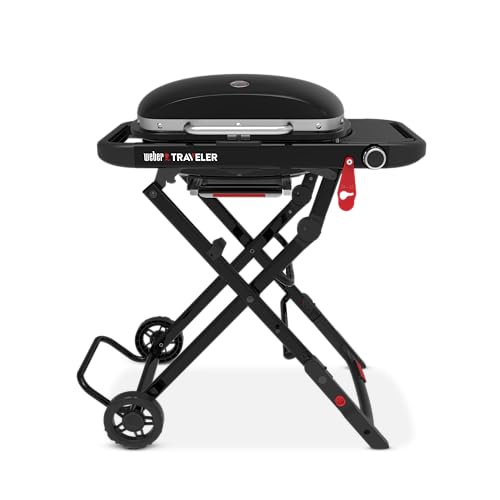
Weber Traveler Compact Portable Gas Grill — Best Folding Portable
The Traveler Compact takes the original Traveler’s idea — a real grill that folds flat and rolls — and trims it for smaller vehicles and smaller groups. Per its verified listing it keeps the easy open-and-close folding design and wheels, so setup at the site is a one-motion job and the walk from car to picnic table needs no second pair of hands.
Strengths
- Folds flat and rolls — no carrying a hot-heavy box
- Stand-up height without packing a separate stand
- Smaller footprint than the full-size Traveler for tight cargo areas
Trade-offs
- Cooking area suits couples and small families, not crowds
- Still a car-camping grill — too much for walk-in sites
- Single heat zone like its bigger sibling
| Format | Folding portable gas grill with wheels |
| Design (per listing) | Easy open and close folding frame |
| Fuel | Propane |
The Compact’s argument is the packed shape. A tabletop grill plus the folding stand campers inevitably buy for it packs worse and sets up slower than this integrated design, and the stand you forget at home is a stand the Compact can never forget. At the site it cooks with the same even, lidded heat as the larger Traveler, scaled to the two-to-four-person menus most camping trips actually involve.
Choose the full-size Traveler instead if your group regularly exceeds four or your vehicle has room to spare — the Compact deliberately trades grate area for packability. That trade is the entire portable category in miniature, and this grill makes it more gracefully than any rival.
The Compact also earns fans among apartment dwellers: folded, it stands in a storage closet or balcony corner like a folded chair, asking almost nothing of a small home between trips. Portability, for many campers, begins at the front door — and this grill is as considerate there as it is at the campsite.
Best for: couples and small families with limited cargo space / Not suited for: group campers or walk-in sites
Check the current price on Amazon

Char-Broil Grill2Go X200 Portable Gas Grill — Best for Rough Transport
Some portables are portable because they are light. The Grill2Go X200 is portable because it is tough: a cast body, a lid that latches shut, and legs that fold away, forming a sealed unit that tolerates the transport conditions that destroy lesser grills. Its infrared-style grate system cooks evenly and resists the flare-ups that plague fatty food on small grills.
Strengths
- Latching cast body — the most transport-proof design here
- Even heat and calm flare-up behavior for its size
- Sealed packing keeps grease off everything else in the vehicle
Trade-offs
- Cast construction makes it dense for its footprint
- Grate system needs regular brushing to perform
- Not the choice for campers minimizing every ounce
| Format | Portable tabletop gas grill |
| Body | Cast construction, latching lid |
| Model | Grill2Go X200 (25409200) |
Judge this grill by what happens between campsites. It rides in truck beds, cargo baskets and boat holds without bending, denting or leaking grease across your gear — the failure modes that quietly kill most portable grills within two seasons. At the site, the cooking is better than the rugged styling suggests: even, controllable, and notably calm under sausages and chicken skin.
The weight is real for a tabletop, the price of cast construction. If your portability problem is distance on foot, look at the Kuvik below. If your problem is that grills keep dying in your truck, this is the answer.
Anglers and boat campers rate the X200 for a specific reason: it tolerates being lashed on a deck or slid into a fish hold, places where a grill’s survival is about sealed construction rather than weight. If your campsite floats, this is your portable.
Best for: truck, boat and overland campers / Not suited for: backpackers counting ounces
Check the current price on Amazon

Cuisinart Grillster Portable Gas Grill (CGG-059A) — Best Trunk-Friendly Tabletop
The Grillster is engineered around the packed car. Its verified listing quotes an 8,000 BTU burner that reaches 600°F, 146 square inches of cooking space, push-button ignition and a total weight of 13 lbs — numbers that translate to a grill a small hatchback can carry without evicting the tent. The grate is dishwasher-safe, which makes home cleanup after a trip genuinely easy.
Strengths
- Light and compact per its listing — true small-car portability
- Dishwasher-safe grate simplifies post-trip cleanup
- Push-button ignition and fast preheat for its class
Trade-offs
- 146 square inches cooks for two, three at a stretch
- Lightweight construction feels less substantial than cast rivals
- Single burner, single zone
| Output (per listing) | 8,000 BTU burner, reaches 600°F |
| Cooking space (per listing) | 146 sq in |
| Weight (per listing) | 13 lbs |
The Grillster understands its job: be the grill that is always in the car. At its listed weight and size it stores in a tote with the rest of the kitchen kit, sets up on any picnic table in a minute, and cooks a couple’s dinner — two steaks, burgers for three, a round of skewers — without drama. The dishwasher-safe grate is a bigger deal than it sounds; the grill that cleans easily is the grill that gets cleaned, and therefore the grill that lasts.
It is not a group grill and does not pretend to be. Batch cooking for four is possible but slow. As a two-person portable that removes every excuse to leave the grill at home, it earns its badge outright.
The Grillster’s dishwasher-safe grate changes post-trip psychology more than any spec in this guide. The grill that can be cleaned by a machine gets cleaned the day you return; the grill that needs a scrubbing ritual gets cleaned eventually, which is to say rustily. Longevity is often just promptness, automated.
Best for: couples, solo campers and small-car owners / Not suited for: groups or high-volume cooking
Check the current price on Amazon

Coleman Fold N Go Portable Propane Grill — Best Lightweight Gas
The Fold N Go’s name is its design brief. The verified listing describes a lightweight 6,000 BTU propane grill with Instastart ignition, adjustable temperature control and a dishwasher-safe grate, all in a body that folds flat enough to slide into the gaps of a packed vehicle — beside the cooler, under the chairs, in the space round grills waste.
Strengths
- Folds genuinely flat for gap-filling packing
- Lightweight design suits small vehicles and short carries
- Dishwasher-safe grate and simple cleanup
Trade-offs
- 6,000 BTUs is modest — preheat fully and keep the lid down
- Cooking area is sized for small groups
- Less thermal mass than cast-grate rivals in wind
| Output (per listing) | 6,000 BTU |
| Ignition | Instastart |
| Grate | Dishwasher-safe, per listing |
The Fold N Go is the grill for campers whose packing is a jigsaw. Its flat folded profile is its superpower — it goes where kettles and cast tabletops cannot — and its cooking is honest small-grill cooking: burgers, dogs, thin steaks and vegetables, done well if you preheat properly and resist lifting the lid every thirty seconds.
Respect its limits and it rewards you. The modest burner output means wind and cold bite harder than on the bigger picks, and thick steaks want the full preheat. Within its design brief — the lightest, flattest real gas grill in this guide — it has few peers.
Festival campers are the Fold N Go’s secret constituency: it slides under a folded camp chair stack in a hatchback already full of tents and costumes, then grills for a small camp all weekend. When packing is a competitive sport, flat wins.
Best for: minimalist car campers and small families / Not suited for: windy exposed sites or thick-steak specialists
Check the current price on Amazon
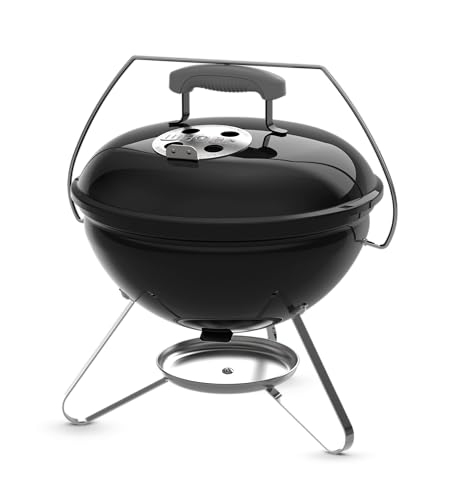
Weber Smokey Joe 14-Inch Portable Charcoal Grill — Best Budget Portable
The Smokey Joe has been the default portable charcoal grill for decades because its design wastes nothing: the lid lock that secures it for transport doubles as the carry handle and the lid rest, the dampers give genuine fire control, and the kettle shape cooks like its full-size relatives. It is the cheapest way in this guide to put real grilled flavor on a campsite table.
Strengths
- Carries one-handed by its locking lid
- Real charcoal flavor at a budget tier
- Tiny packed volume for a true kettle grill
Trade-offs
- Charcoal time, ash and fire-rule limits apply
- Cooks for two or three per batch
- No wind immunity — plan shelter on breezy sites
| Format | 14-inch portable charcoal kettle |
| Lid | Tuck-N-Carry lid lock |
| Fuel | Charcoal |
Portability here means something different: not folding, but smallness done right. The Smokey Joe rides in a footwell, a tote or a bike trailer, sets up anywhere it can sit level, and asks only for a handful of briquettes per cook — far less charcoal than a full kettle burns for two people. The damper control is real, which separates it from disposable tray grills that cook at one temperature: full blast.
Its constraints are charcoal’s constraints, covered fully in the fire-grill guides in this series. Where charcoal is allowed and time is available, no gas portable at any tier produces this flavor for this little money or space.
Bike campers and motorcyclists have adopted the Smokey Joe for decades because its round, locked body bungees to a rack without drama and its fuel can be bought — or gathered as charcoal — almost anywhere. It is the portable grill of the two-wheeled world as much as the four-wheeled one.
Best for: budget campers and charcoal fans with small vehicles / Not suited for: fire-restricted sites or impatient cooks
Check the current price on Amazon

Kuvik Titanium Camping Grill — Best Ultralight
The Kuvik is where portable stops meaning car-portable. Its verified listing describes an ultralight, compact titanium grill — corrosion-resistant, food-safe and supplied with a carrying case — designed to ride in a pack and cook over a small fire or coals at a walk-in or dispersed site. Titanium’s virtues are exactly a backpacker’s virtues: it does not rust, it shrugs off heat, and it weighs almost nothing for its strength.
Strengths
- Ultralight titanium build for walk-in and backpacking use
- Corrosion-proof — no rust in a damp pack or garage
- Packs flat in its included carry case
Trade-offs
- Small cooking surface — solo and duo cooking only
- Needs a fire or coals; no fuel system of its own
- Titanium conducts heat differently — expect a learning curve with hot spots
| Material | Titanium, per listing |
| Design (per listing) | Ultralight and compact, carry case included |
| Fuel | Campfire or charcoal |
Judge the Kuvik by pack math. Every other pick in this guide assumes a vehicle within a few yards; the Kuvik assumes your legs are the vehicle, and it is engineered accordingly. Over a modest bed of coals it grills a steak, sausages or vegetables for one or two people with a competence that surprises campers used to cooking on sticks and foil.
It is a specialist tool. The surface is small, heat management is manual — you move the grill or the coals, not a knob — and fire rules apply exactly as they do to any open flame. For the camper who walks to camp, those are acceptable terms for the lightest real grill in this guide.
The Kuvik also serves a second master: emergency and minimalist car kits, where a flat titanium grate in the trunk turns any legal fire into a kitchen. Its weight makes it the rare piece of gear that can be carried ‘just in case’ without resenting the decision.
Best for: backpackers and walk-in site campers / Not suited for: car campers feeding groups
Check the current price on Amazon
Comparison Table
| Pick | Badge | Key spec | Best for |
|---|---|---|---|
| Weber Traveler Compact Portable Gas Grill | Best Folding Portable | Folding frame with wheels, compact size | couples and small families with limited cargo space |
| Char-Broil Grill2Go X200 Portable Gas Grill | Best for Rough Transport | Cast latching body, infrared-style grates | truck, boat and overland campers |
| Cuisinart Grillster Portable Gas Grill (CGG-059A) | Best Trunk-Friendly Tabletop | 8,000 BTUs, 146 sq in, 13 lbs per listing | couples, solo campers and small-car owners |
| Coleman Fold N Go Portable Propane Grill | Best Lightweight Gas | 6,000 BTUs, folds flat, lightweight | minimalist car campers and small families |
| Weber Smokey Joe 14-Inch Portable Charcoal Grill | Best Budget Portable | 14-inch kettle, lid-lock carry | budget campers and charcoal fans with small vehicles |
| Kuvik Titanium Camping Grill | Best Ultralight | Ultralight titanium, carry case included | backpackers and walk-in site campers |
How to Choose the Best Camping Grills Portable Enough for Your Vehicle and Trips
Define your carry distance first, because it eliminates most of the category honestly. Car-to-table campers can choose anything in this guide. Campers who carry gear across a festival field or a beach should stay with latching tabletops and kettles. Anyone walking more than a few hundred yards to the site belongs on the ultralight end — the Kuvik’s territory — or should skip the grill and cook on the site’s fire ring grate.
Then judge the packed object, not the open grill. Does the lid latch? Do the legs fold or lock? Is there a handle, or wheels? Does grease stay inside during a bumpy drive? The answers to those questions, all visible in the verified listings, predict travel satisfaction better than any cooking specification.
Finally, match cooking area to your real headcount with batch honesty. A compact grill that cooks two rounds quickly beats a big grill left at home. Portability you use is worth more than capacity you admire in the garage.
Folding, Tabletop, Kettle or Ultralight: The Four Portable Formats
Folding stand-up grills like the Traveler Compact integrate the stand, so setup is one motion and cooking height is civilized; they pack flat but long. Tabletop grills like the Grill2Go and Grillster pack smallest of the gas options but borrow their height from furniture. Kettles like the Smokey Joe do not fold at all — they are simply small, light and cheap, and their round shape wastes some cargo corners. Ultralight grills like the Kuvik abandon fuel systems entirely and cook over fire, trading convenience for grams.
None of these formats is best in the abstract. Each is best at a distance from the vehicle and a size of vehicle. The campers who love their portable grill are the ones who matched the format to the trip they take most — not the trip they imagine taking someday.
Protecting a Portable Grill in Transit
Most portable grills die in vehicles, not at campsites. Latch the lid or lock it with a strap, empty the grease cup before the drive, and pack the grill so it cannot slide — a sliding cast-iron grate will find your cooler, your tent poles and your paintwork. A cheap moving blanket or the grill’s own carry bag pays for itself in one trip.
Regulators and hoses deserve their own small bag inside the grill or the kitchen tote; a bent regulator fitting is the most common reason a portable gas grill fails at a site. Charcoal grills travel best fully cold with ash removed — ash plus a damp drive equals corrosion, even on good enamel.
Portability by the Numbers: What Actually Fits Where
Think of vehicles as a series of doors a grill must pass through. A sedan trunk with a tent and two chairs already in it admits a folding-flat grill like the Fold N Go, a compact tabletop like the Grillster, or a Smokey Joe in the footwell — and nothing larger, whatever the brochure says. An SUV or wagon adds the folding stand-up class, Traveler Compact included. A pickup bed or RV bay admits everything in this guide, and the choice reverts to cooking preference.
The honest method is embarrassingly simple: measure your packed vehicle on a real trip, with the real gear in it, and note the shape of the space that remains. Match the grill’s packed shape to that leftover geometry. Campers who do this once never buy the wrong portable again; campers who skip it own a series of almost-right grills.
Carry Systems, Cases and Straps: The Unglamorous Half of Portable
How a grill is carried matters as much as how it packs. Wheels beat handles over distance; handles beat wheels over stairs and sand; a case beats both for cleanliness. The picks in this guide each commit to a system — the Traveler Compact rolls, the kettles carry by their locking lids, the Kuvik disappears into a case — and that commitment is a large part of what you are buying.
If your grill lacks a case, improvise one: a heavy tote, a moving blanket wrap, or a dedicated duffel sized to the folded grill. The point is containment — of grease, of soot, of loose parts — and protection in both directions, since a portable grill in a moving vehicle is a hazard to everything soft it touches. Thirty dollars of containment saves hundreds of dollars of gear.
Two-Grill Strategies: When Owning a Pair Beats Owning a Flagship
Experienced campers quietly converge on a heresy: two modest portable grills, specialized by trip, beat one flagship that compromises everywhere. The common pairing is a compact tabletop or kettle that lives in the vehicle permanently — always packed, always ready for the unplanned night — plus a larger folding grill that comes out for planned group trips. The small grill handles eighty percent of actual camping; the big one handles the weekends that need it; neither is ever the wrong size, because neither is asked to be.
The math surprises people: the pair often costs no more than the single premium grill, weighs less in any given vehicle load, and degrades gracefully — if one is lent, lost or broken, the season continues. The strategy fails only on storage, and even there the small grill’s permanent home is the car itself. If your camping spans solo overnights and family reunions, stop looking for one grill that does both and buy the pair that does each properly.
Portable Grills for Specific Trips: Beach, Tailgate, Boat and Bike
The beach punishes portables with sand, salt and wind: choose latching lids that keep sand out of the firebox, legs that stand on soft ground or a tabletop that rides on a cooler lid, and materials that shrug off salt air. The tailgate rewards speed and capacity in bursts — a folding stand-up that sets up in one motion and cooks for a shifting crowd, then vanishes before kickoff. The boat demands sealed, corrosion-proof construction above all, which is the Grill2Go’s home water. The bike and motorcycle camper lives by the Smokey Joe rules: round, locked, bungee-able, fueled anywhere.
The lesson generalizes: ‘portable’ is not one virtue but a family of them, and each trip type crowns a different pick in this guide. Campers with one dominant trip type should buy for it without apology; campers with several should revisit the two-grill strategy from earlier in this guide and stop asking one box to be four.
What to Check on a Used Portable Grill
The used market is full of excellent portables — campers upgrade, downsize and move — and full of quiet disasters. The checks take five minutes: on gas models, the regulator and hose first (cracks or stiffness end the negotiation), then burner flames for even blue cones, then the igniter. On all models: latches that actually latch, legs that lock without play, a lid that sits true, and a grate whose rust is surface blush rather than structural flake.
Walk away from a bent firebox, a rusted-through bottom, or any gas grill whose history includes a flare-up fire. Everything else — grates, knobs, thermometers — is a replaceable part on the major brands in this guide, which is why used Webers and Colemans are the smart-money portables: their wear items are a catalog, not a funeral.
Teaching Kids and New Campers on a Portable Grill
A portable grill is the best cooking classroom in camping, because its scale is forgiving and its lessons are the real ones. Start a new camper — child or adult — on the jobs around the grill: staging food, watching for the preheat signs, learning why the lid stays down. Move them to tongs on forgiving food: sausages, corn, vegetables, things that tolerate an extra minute and a clumsy flip. The first steak they sear themselves will do more for their outdoor confidence than a season of watching.
Safety scales with the format. A tabletop grill at a picnic table puts the hot zone at a height a supervised young cook can respect and reach properly; a kettle’s contained fire teaches charcoal discipline in its safest form; the ultralight grates are for later, when fire judgment exists. Keep the rules few and absolute — never reach across the grill, tongs are the only hands, the cook calls ‘hot’ when carrying — and repeat them every trip until they are reflexes.
There is a selfish reason to teach, beyond the pleasure of it: camps with two competent grill cooks eat better, later and more relaxed than camps with one. The portable grill you bought for its packed size turns out to be the academy’s whole campus. Many of the adults now running group campsites in this guide’s imagination started exactly here — burning their first sausage on a small grill, in good company, and being handed the next one without ceremony.
The One-Trip Test: Knowing a Portable Grill Is Right
There is a simple verdict available after any portable grill’s first trip, and it has nothing to do with the food. Ask whether packing the grill back up felt like a chore you resented or a routine you barely noticed. The right portable disappears into the trip’s rhythm — out in a minute, back in two, no Tetris, no grease anxiety, no argument about whose turn it is to carry it. The wrong portable, however beautifully it grilled, generates a small negotiation every single time, and negotiations compound into a grill that stays home by August.
If your first trip fails that test, change one variable before condemning the grill: the case, the packing order, the spot in the vehicle, the cleaning timing. Portability is a system, and systems can be tuned. But if two tuned trips still feel like friction, believe the evidence and trade formats — the guide you are reading will still be here, and the right packed shape is a real thing that exists for your vehicle. You will know it the first time you forget the grill is in the car at all.
Portability and the Planet: A Short, Honest Note
Portable grills sit at an awkward environmental crossroads that deserves a plain paragraph rather than a lecture. Disposable charcoal trays and single-use grills are the category’s waste problem, and every pick in this guide is an argument against them: durable, repairable, refillable or fire-fed tools that serve for years. Small propane canisters are the reusable grill’s own footprint — they are recyclable in many jurisdictions once properly emptied, and campers who graduate to refillable tanks for basecamp cooking cut that waste stream to nearly nothing.
Charcoal and fire grilling carry their own ledger: responsibly sourced charcoal, fires built from dead and downed wood where legal, and ash handled as this guide describes. None of the formats here is impact-free, and pretending otherwise would insult the reader. What a camper can honestly do is buy once, maintain well, waste nothing and leave every site cleaner than the grill found it — a standard the picks in this guide are built to make easy, and one worth stating in a series that hopes its readers are still camping, on open land, decades from now.
A Short Word on Testing Your Pack Before the Trip
The cheapest portability test in camping happens in your driveway, not at the trailhead: pack the vehicle exactly as you would for the real trip — tent, cooler, chairs, kitchen tote, people where people go — and then find the grill’s home in what remains. If it has a home, the grill is portable for you, whatever any reviewer says. If it rides on someone’s lap or blocks the rear window, it is not, whatever its folded dimensions claim. Do this once, honestly, before the season starts, and every purchase and packing decision afterward gets easier, because you will be working from a measured vehicle instead of an imagined one.
How to Pack, Carry and Set Up a Portable Grill Anywhere
A portable grill’s trip has three acts — packing, carrying and setup — and problems in any one of them ruin the cook. This routine keeps all three boring, which is exactly what you want from them.
- Clean before you pack, not after you arrive: brush the grate warm at the previous cook, empty grease and ash, and let everything cool completely before the grill goes near vehicle upholstery.
- Latch or lock the lid. If your grill has no latch, a strap or bungee around the body is a thirty-second fix that prevents the classic trunk-spill.
- Bag the small parts — regulator, hose, ignition battery if removable, charcoal chimney — in one pouch stored with the grill, so setup never becomes a search party.
- Pack the grill flat-side down on a stable layer, wedged so it cannot slide. Heavy grills go low and against a wall of the cargo area; ultralight grills go in the pack’s flat back panel sleeve or strapped outside.
- At the site, choose level, stable ground or a solid table away from tent fabric and dry brush, with the grill’s back to the wind. Extend and lock every leg and stand joint before connecting fuel.
- Connect fuel, leak-check gas connections, preheat fully, and cook. Small grills lose heat fast when the lid opens, so stage all food before the first item goes on.
- After cooking, brush warm, cool completely, empty grease or ash into a sealed container for the site trash, re-latch, and repack while the routine is fresh — future you, arriving home tired, will be grateful.
The campers who bring their grill every trip are not the ones with the best grill; they are the ones whose pack-cook-clean routine is frictionless. Build the routine around your grill’s latches, legs and grease system and portability stops being a spec and becomes a habit.
Common Buying Mistakes
Confusing light with portable
A light grill with no latch, no handle and loose parts is less portable than a heavier grill that seals into one carryable unit. Judge the packed object, not the scale reading.
Buying a tabletop for sites with no tables
Walk-in, beach and dispersed sites often have no picnic table. If your camping is table-free, a folding stand-up grill or a ground-stable kettle is the honest choice.
Carrying a grill by its lid handle with the lid unlatched
The handle is only a handle when the lock is engaged. One bump and the grill opens mid-carry, distributing grate, ash and grease across the campsite path.
Packing a warm grill to save ten minutes
Warm grills melt bags, warp plastic totes and scent everything in the car with old grease. The cooldown is part of the cook — plan dessert around it.
Ignoring the walk from the car
A grill that is fine for twenty feet is misery for half a mile of sand or trail. Match the grill to your longest realistic carry, not your shortest.
Storing the grill dirty between trips
Portable grills live in garages, closets and car trunks — dirty ones rust, attract pests and greet the next trip with a smell. Ten minutes at home saves the grill’s life.
Final Recommendation
If your trips are car-based and your space is tight, the Weber Traveler Compact is the portable to buy — stand-up cooking that packs like luggage. Rough-road campers should take the Grill2Go X200’s cast toughness; small-car couples, the Grillster or the Fold N Go. Charcoal loyalists on a budget cannot beat the Smokey Joe, and anyone walking to camp should stop reading at the Kuvik.
The rule underneath every badge: the most portable grill is the one whose packed shape fits your vehicle and your walk. Choose that one and it will come on every trip — which is the only portability that counts.
- Weber Traveler Compact Portable Gas Grill (Best Folding Portable) — check price on Amazon
- Char-Broil Grill2Go X200 Portable Gas Grill (Best for Rough Transport) — check price on Amazon
- Cuisinart Grillster Portable Gas Grill (CGG-059A) (Best Trunk-Friendly Tabletop) — check price on Amazon
- Coleman Fold N Go Portable Propane Grill (Best Lightweight Gas) — check price on Amazon
- Weber Smokey Joe 14-Inch Portable Charcoal Grill (Best Budget Portable) — check price on Amazon
- Kuvik Titanium Camping Grill (Best Ultralight) — check price on Amazon
Best Camping Grills Best Camping Gas Grills Best Camping Grills Under $100
Frequently Asked Questions
What makes a camping grill truly portable?
A latched or locking lid, a packed shape that fits your vehicle, a way to carry it — handle, wheels or a case — and grease containment that keeps the car clean. Cooking specifications matter only after those four travel features are satisfied.
What is the lightest type of camping grill?
Ultralight fire grills made of titanium, like the Kuvik in this guide, are the lightest real grills — they cook over a campfire or coals and pack flat in a case. Among self-fueled grills, small folding propane models like the Fold N Go are the lightest practical option for car campers.
Can a portable grill cook for a group?
Yes, with the right format. Folding stand-up portables cook for six or more in one or two batches. Compact tabletops and kettles feed two to four happily and groups only with disciplined batching. Match the grill to your usual group, not your largest-ever group.
Are portable charcoal grills allowed everywhere?
No. Charcoal rules vary by campground and fire season, and some sites restrict cooking to provided grills or ban charcoal entirely during high fire danger. Gas portables face fewer restrictions but are not exempt from all fire bans. Check before every trip.
How do I keep a portable grill from rusting?
Clean it after trips, dry it before storage, keep the lid latched in a dry place, and oil cast-iron grates lightly. Most portable-grill rust starts as old grease and ash left in a damp garage, not as a manufacturing defect.
Is a folding stand or a tabletop more portable?
A tabletop packs smaller; a folding stand-up grill sets up faster and needs no furniture. If your sites reliably have picnic tables, the tabletop wins on space. If they do not, the integrated stand is the genuinely portable choice.
Should I buy a carry case for my portable grill?
If your grill lacks a latching lid or travels in a packed vehicle, yes — a case or heavy tote contains grease and soot, protects the grill and everything around it, and turns loading into a one-hand job. It is the highest-value accessory in the portable category and the one most often bought a season too late.
Best Camping Grills Coleman Best Camping Flat Top Grills Best Camping Fire Grills


