Disclosure: airfryerkitchensupply.com is reader-supported. When you buy through links on our site, we may earn an affiliate commission at no extra cost to you.
Where to buy
The fastest way to buy any of the best camping flat top grills in this guide is through Amazon, where stock, delivery options and current pricing are shown on each product page. We never print static prices in our guides because campsite-gear pricing moves with seasons and promotions, so use the links below to check price on Amazon before you commit.
- Blackstone 1813 Original 22-Inch Tabletop Griddle with Hood — check price on Amazon
- Blackstone OTG Outdoor Tabletop Griddle, 22-Inch with Hood — check price on Amazon
- Blackstone 1666 22-Inch Tabletop Griddle — check price on Amazon
- Blackstone 2364 Camping Griddle with Side Burner (12 x 14) — check price on Amazon
- Nexgrill Tabletop 2-Burner Gas Grill & Griddle Combo — check price on Amazon
- Royal Gourmet PD1305H 3-Burner Propane Gas Grill & Griddle Combo with Lid — check price on Amazon
The best camping flat top grills have quietly taken over campsite cooking, and one breakfast explains why: bacon, eggs, pancakes and hash browns for four people, cooked on one surface in one pass, with nothing lost through a grate. The best camping flat top grills — griddles, properly — trade grill marks for versatility, and for campers whose menus run from smash burgers to fried rice to fajitas, that trade is not close.
This guide compares six verified flat tops for camping: three Blackstone tabletop griddles at different feature levels, a compact Blackstone camping griddle with its own side burner, a Nexgrill grill-and-griddle combo for campers who refuse to choose, and a Royal Gourmet combo on folding legs for groups. Every linked product was verified against Amazon’s catalog data, and spec boxes quote only what those listings state.
One ownership truth up front: a flat top is a seasoned steel surface, maintained like a cast-iron pan. Campers who oil it lightly and store it dry get a decade of service; campers who leave it wet get rust and a cautionary tale. The reviews note which designs make that ritual easiest.
Key Takeaways
- Two burners minimum: zone cooking is what separates a griddle from a big frying pan.
- A 22-inch tabletop is the camping standard; compact griddles win when they add a side burner.
- Seasoned steel is a ritual — scrape warm, oil lightly, store dry — and it repays it for a decade.
- Flat tops own breakfast and diner food; grate grills still own char and smoke.
In this guide
Quick Picks
- Blackstone 1813 Original 22-Inch Tabletop Griddle with Hood — Best Overall Flat Top. The camping griddle benchmark: 22 inches, two burners, a protective hood, and the deepest owner knowledge base of any flat top on the road. Check on Amazon
- Blackstone OTG Outdoor Tabletop Griddle, 22-Inch with Hood — Best for Two-Zone Cooking. Blackstone’s on-the-go 22-inch design: two heat zones, a built-in hood and rear grease management, per its listing — the tidiest tabletop system here. Check on Amazon
- Blackstone 1666 22-Inch Tabletop Griddle — Best Simple Flat Top. The original 22-inch tabletop formula with a stainless faceplate and no hood — fewer parts, same cooking surface, the minimalist’s Blackstone. Check on Amazon
- Blackstone 2364 Camping Griddle with Side Burner (12 x 14) — Best Compact Camping Griddle. A dedicated camping design: a 12 x 14-inch griddle plus a side burner for pots, with latches and leveling feet per its listing — a camp kitchen in one small box. Check on Amazon
- Nexgrill Tabletop 2-Burner Gas Grill & Griddle Combo — Best Grill-Griddle Combo. Grates on one side of the decision, griddle on the other: 13,500 BTUs and 263 square inches per its listing, with a thermometer and push-and-turn ignition. Check on Amazon
- Royal Gourmet PD1305H 3-Burner Propane Gas Grill & Griddle Combo with Lid — Best Combo for Groups. A three-burner, 29,000 BTU combo with 364 square inches and a lid per its listing — the group-size answer for campers who want grate and griddle together. Check on Amazon
How These Picks Were Chosen
We chose these six to span the real flat-top decision: pure griddles in 22-inch tabletop form (the camping standard), a smaller dedicated camping griddle with a side burner for pot work, and two grill-griddle combos for campers who want grates and flat top in one unit. Freestanding 28-inch class griddles appear in our wider grills coverage; for camping, the tabletop formats are what vehicles actually carry, and this guide stays honest to that.
Each product was verified — brand-and-model search, title match, ASIN from the listing response — with the Blackstone camping griddle and Royal Gourmet combo newly verified on 2026-11-21 for this batch. Specifications quoted come from those verified listings only.
We weighted the details that decide flat-top satisfaction: burner count and zoning, hood or lid for transport protection and steaming, grease management design, and whether the surface size matches the group the camper actually feeds.
We compared the shortlist against one scenario repeatedly: breakfast for five on a cold morning with a breeze. That single scenario exposes weak burners, absent zoning and bad grease design faster than any specification sheet, and it is the scenario camping griddles are actually bought for. The six picks here are the ones whose designs answer it without excuses.
The 6 Best Camping Flat Top Grills, Reviewed One by One

Blackstone 1813 Original 22-Inch Tabletop Griddle with Hood — Best Overall Flat Top
The 1813 is the flat top most camping griddles are compared to, for structural reasons: a 22-inch rolled-steel surface is the size that feeds a family without owning the picnic table, two burners create the hot-and-hold zoning that makes griddle cooking work, and the hood protects the seasoned surface in transit while doubling as a steaming and melting aid at the site.
Strengths
- Two burners for genuine zone cooking
- Hood protects the surface and speeds preheats
- Huge recipe and accessory ecosystem from the owner community
Trade-offs
- Seasoned steel needs the oil-and-dry ritual after trips
- Tabletop format needs a solid table
- No grate option — flat top only, by design
| Surface | 22″ flat top |
| Burners | 2 |
| Extras | Hood, stainless front plate |
Run a full breakfast service on the 1813 once and the category makes sense. Bacon renders on the hot zone, eggs cook in the fat at the edge, pancakes take the cleared space, and everything lands hot together — a sequence no grate grill and no single-burner griddle can reproduce. The two-burner layout is the product; the steel is just where it happens.
Ownership is the cast-iron contract: scrape while warm, wipe, oil lightly, store dry under its hood. The hood genuinely helps here, sealing the surface from garage dust and trunk knocks. Campers who keep the ritual get a surface that improves for years — the rare appliance that is better in year five than year one.
The 1813’s owner community is an accessory in itself: every recipe, modification and troubleshooting answer for this exact griddle exists in abundance, because so many campers own it. First-time griddle buyers are not just buying steel — they are buying the most documented learning curve in the category.
Best for: families and breakfast-first campers / Not suited for: campers who will not maintain seasoned steel
Check the current price on Amazon
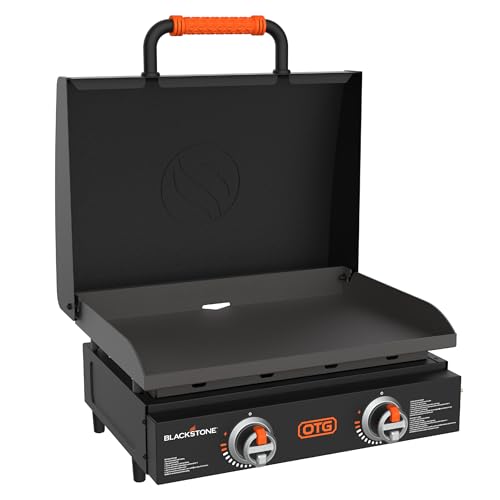
Blackstone OTG Outdoor Tabletop Griddle, 22-Inch with Hood — Best for Two-Zone Cooking
The OTG (on-the-go) version of Blackstone’s 22-inch tabletop refines the formula around travel and tidiness. Its verified listing confirms two heat zones, a protective built-in hood, and rear grease management — the design that channels grease to a rear trap instead of a front cup, keeping the cooking front cleaner at crowded campsite tables.
Strengths
- Rear grease management keeps the front workspace clean
- Two heat zones for sear-and-hold technique
- Built-in hood for transport and steaming
Trade-offs
- Same seasoned-steel maintenance as every Blackstone
- Overlaps the 1813 closely — choose on grease design and availability
- Tabletop footprint still needs its table
| Surface | 22″ flat top |
| Zones (per listing) | 2 heat zones |
| Grease (per listing) | Rear grease management |
Grease routing sounds minor until you cook a pound of bacon on a front-cup griddle at a picnic table full of people. The OTG’s rear system moves the mess behind the food, and combined with the two-zone layout it makes this the most composed cooking experience among the tabletops — the one we would choose for long, multi-item cooks where the cook also wants to remain part of the conversation.
Against its sibling 1813, the choice is taste in details: grease design, hood execution, current availability. Both are the same excellent idea. Campers who cook fatty breakfasts often will feel the rear-grease difference every single morning.
The OTG name earns itself in one scenario owners repeat: the griddle that lives in the vehicle. Its tidy grease system and hooded, self-contained design make it the Blackstone most suited to riding in an RV bay or trunk full-time, ready at any stop — the spontaneous roadside breakfast is its signature meal.
Best for: frequent griddle cooks who value a tidy station / Not suited for: campers wanting the absolute simplest griddle
Check the current price on Amazon

Blackstone 1666 22-Inch Tabletop Griddle — Best Simple Flat Top
The 1666 is the 22-inch Blackstone in its simplest form: the same class of rolled-steel surface and tabletop footprint, a stainless steel faceplate per its verified listing, and no hood — which means a lower profile in the packing stack and one less thing between you and the surface, at the cost of doing without the hood’s protection and steaming help.
Strengths
- Simplest 22-inch format — nothing extraneous
- Lower packed profile without a hood
- Stainless faceplate wipes clean easily
Trade-offs
- No hood: surface needs a cover or careful packing
- Steaming and melting need a basting dome accessory
- Same seasoning discipline as hooded models
| Surface | 22″ flat top |
| Faceplate (per listing) | Stainless steel |
| Body (per listing) | Powder-coated steel |
There is a real case for the hoodless design beyond simplicity: it packs flatter, it is the version many RV owners slide into a bay, and a cheap basting dome restores the steaming function when a recipe needs it. The cooking itself — zone management across a 22-inch steel surface — is the Blackstone experience undiluted.
Protect the surface in transit with a cover or a towel layer, since the hood is not doing it, and the 1666 gives up nothing that matters at the table. It is the flat top for campers who buy tools, not features.
Boaters and dock campers quietly favor the 1666: no hood to catch wind or corrode at the hinges in salt air, a flat profile that stows under a bench, and the same cooking surface as its dressed-up siblings. In marine-adjacent camping, simplicity is a corrosion strategy.
Best for: RV campers and minimalists wanting the core griddle / Not suited for: campers who want a hood’s protection built in
Check the current price on Amazon
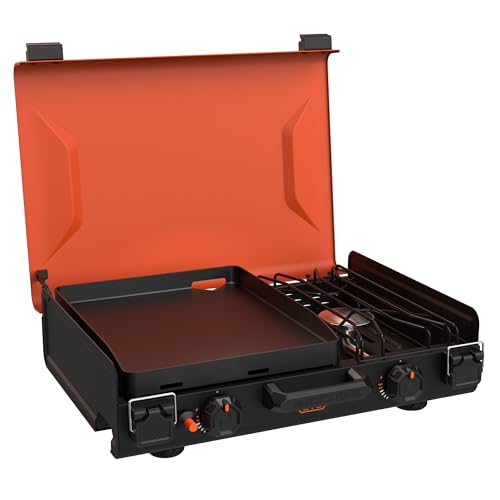
Blackstone 2364 Camping Griddle with Side Burner (12 x 14) — Best Compact Camping Griddle
Most tabletop griddles are backyard designs that travel; the 2364 is a camping design from the start. Its verified listing describes a 12 x 14-inch griddle with a side burner — so the coffee, beans or sauce happen beside the flat top instead of on a second appliance — plus latches for sealed transport and leveling feet for the uneven tables and tailgates campsites provide.
Strengths
- Side burner covers pot work — one unit, whole kitchen
- Leveling feet solve wobbly campsite tables
- Latching design packs sealed and compact
Trade-offs
- 12 x 14 surface is duo-and-small-family territory
- Side burner and griddle share one compact footprint — staging takes planning
- Newer model with a smaller owner knowledge base
| Griddle (per listing) | 12 x 14 inches |
| Extras (per listing) | Side burner, latches, leveling feet |
| Format | Portable camping griddle |
The side burner is the insight. Campsite meals are rarely griddle-only, and the usual answer — a separate stove — doubles the packing and the setup. Here the pot rides beside the pancakes, the leveling feet quietly fix the surface every other tabletop wobbles on, and the latches make the whole kitchen a single sealed carry. For couples and small families, this is the most thought-through camping griddle package in the guide.
Capacity is the honest limit: a 12 x 14 surface cooks in batches beyond three people. Groups should take a 22-inch model and a separate stove. Small crews get the smarter system.
The leveling feet deserve a second look from tailgaters, whose cooking surfaces are truck beds and folding tables of dubious honesty. A griddle that can be leveled cooks eggs that stay where they are poured — a small mercy that anyone who has chased a runny egg across a tilted plate will pay for gladly.
Best for: couples and small families wanting one-unit camp kitchens / Not suited for: groups of five or more
Check the current price on Amazon

Nexgrill Tabletop 2-Burner Gas Grill & Griddle Combo — Best Grill-Griddle Combo
Some campers will not choose between grill marks and flat top, and the Nexgrill combo exists for them. Its verified listing quotes 13,500 BTUs, 263 square inches of cooking space, a built-in thermometer and push-and-turn ignition across a two-burner tabletop that runs as a grill and griddle combination — sear the steaks on the grate, fry the onions on the plate, serve together.
Strengths
- Both cooking surfaces in one tabletop unit
- Two burners for zone flexibility across the combo
- Built-in thermometer and easy ignition included
Trade-offs
- Each surface is smaller than a dedicated unit’s
- More parts to clean — grate and plate both
- Combo griddles rarely match a full Blackstone surface for breakfast volume
| Output (per listing) | 13,500 BTUs |
| Cooking space (per listing) | 263 sq in |
| Extras (per listing) | Built-in thermometer, push-and-turn ignition |
The combo’s case is menu breadth per packed inch. A small-car camper who wants burgers with char on Friday and pancakes on Saturday otherwise packs two appliances or gives up one meal; this unit declines the dilemma. The two burners keep the surfaces independently useful, and the thermometer — approximate as lid thermometers are — helps new owners learn the plate’s behavior.
The compromise is area: neither surface matches its dedicated counterpart, so big breakfasts and big grill nights both run in batches. For campers whose groups are small and whose menus are wide, that is the right trade, honestly made.
The Nexgrill’s thermometer, approximate as lid thermometers are, serves a teaching purpose on a combo: it helps new owners learn how differently the grate side and plate side heat and cool. Combos reward cooks who understand their two surfaces as two appliances sharing burners, and this one’s instrumentation speeds the lesson.
Best for: small crews who want both surfaces in one unit / Not suited for: breakfast-for-six specialists
Check the current price on Amazon

Royal Gourmet PD1305H 3-Burner Propane Gas Grill & Griddle Combo with Lid — Best Combo for Groups
The PD1305H scales the combo idea to group size. Its verified listing confirms three burners totaling 29,000 BTUs across 364 square inches of cooking area in a 3-in-1 grill and griddle combination with a lid — enough surface to run a real mixed menu for a campsite crowd from one tabletop-class unit.
Strengths
- Three burners and the largest combo surface here
- Lid adds roasting and weather protection the open combos lack
- Grill and griddle zones run a full menu in parallel
Trade-offs
- Largest and heaviest combo — vehicle camping with table space
- More burners and surfaces to clean after group cooks
- Beyond what couples will ever use
| Output (per listing) | 29,000 BTUs, 3 burners |
| Cooking area (per listing) | 364 sq in |
| Design (per listing) | 3-in-1 grill griddle combo with lid |
Combos usually fail at scale — the surfaces shrink until neither is useful. The PD1305H avoids that trap by simply being bigger: three burners let you hold a genuine grill zone, a genuine griddle zone and a warming margin simultaneously, and the lid turns the whole unit into a passable roaster for chicken pieces and corn. For the designated cook of a six-person campsite, it is one unit instead of a grill plus a griddle plus a stove.
It earns that consolidation with size and cleanup: this is a basecamp appliance, packed deliberately, washed properly. Groups who camp together repeatedly will find it replaces a shelf of gear; occasional couples should look at the Nexgrill or the 2364 instead.
Basecamp hosts discover the PD1305H’s party pattern: griddle side running appetizers and breakfast, grill side running mains, lid down between courses to hold heat. It is the closest thing in this guide to a one-unit outdoor kitchen, and groups that camp as a standing crew will use every inch of it.
Best for: group basecamps wanting one do-everything unit / Not suited for: couples or minimalist packers
Check the current price on Amazon
Comparison Table
| Pick | Badge | Key spec | Best for |
|---|---|---|---|
| Blackstone 1813 Original 22-Inch Tabletop Griddle with Hood | Best Overall Flat Top | 22″ two-burner griddle with hood | families and breakfast-first campers |
| Blackstone OTG Outdoor Tabletop Griddle, 22-Inch with Hood | Best for Two-Zone Cooking | 22″ OTG, rear grease management | frequent griddle cooks who value a tidy station |
| Blackstone 1666 22-Inch Tabletop Griddle | Best Simple Flat Top | 22″ tabletop, stainless faceplate, no hood | RV campers and minimalists wanting the core griddle |
| Blackstone 2364 Camping Griddle with Side Burner (12 x 14) | Best Compact Camping Griddle | 12×14 griddle + side burner, leveling feet | couples and small families wanting one-unit camp kitchens |
| Nexgrill Tabletop 2-Burner Gas Grill & Griddle Combo | Best Grill-Griddle Combo | Grill + griddle combo, 13,500 BTUs | small crews who want both surfaces in one unit |
| Royal Gourmet PD1305H 3-Burner Propane Gas Grill & Griddle Combo with Lid | Best Combo for Groups | 3 burners, 29,000 BTUs, 364 sq in combo | group basecamps wanting one do-everything unit |
How to Choose a Camping Flat Top Grill
Start with surface size against your real menu. A 22-inch two-burner griddle is the camping standard because it runs a family breakfast in one pass and zones properly. Compact griddles around 12 x 14 inches suit couples and shine when they add a side burner for pot work. Combos trade surface for versatility — price that trade against how often you truly grill over grates versus cook on the plate.
Burners matter more than BTUs here. Two burners are the functional minimum for zone cooking — hot side, holding side — and three extend the idea for groups. A single-zone flat top cooks like a big frying pan: fine for one item at a time, frustrating for a meal.
Then judge the travel details: a hood or lid to protect the seasoned surface, a grease system you can empty at a campsite without a mess, and leveling or stable feet for real picnic tables. Flat tops live or die on these unglamorous points more than on any headline specification.
Seasoning and Caring for a Flat Top at Camp and at Home
A new flat top needs seasoning: thin coats of high-heat oil, heated until they polymerize, repeated until the surface darkens evenly. It is an afternoon’s light work that creates the non-stick, rust-resistant layer everything else depends on. Thereafter the rule is scrape-warm, wipe, oil-lightly after every cook — two minutes that keep the surface improving instead of rusting.
At the campsite, the grease trap is the discipline: empty it before it fills, dispose of grease in the trash sealed, and never pour it on the ground — for the site’s sake and the next campers’. At home, store the griddle dry with its hood or cover on; if rust spots appear, scrub them back to steel, re-season that area, and carry on — the surface is forgiving if you act early.
What a Flat Top Cooks Better Than a Grill — and What It Does Not
Better on the plate: breakfast in all forms, smash burgers, cheesesteaks, fajitas, fried rice, quesadillas, chopped vegetables, delicate fish, and anything small that a grate would swallow. The flat top is a short-order station, and its menu is the diner’s.
Better on the grate: anything that wants open-flame char, smoke circulation or rendered fat dripping away — thick steaks with crust, skin-on chicken finished over fire, kebabs, corn in the husk. The honest camp kitchen often ends up with both tools across a season, which is why the combo models in this guide exist and why our general camping grill guide pairs a griddle pick beside the grate grills.
Flat Top vs Grill: Planning a Camp Kitchen Around Both
The campers who cook best outdoors rarely choose between grate and griddle — they sequence them across the trip. The flat top owns mornings and the fast, social dinners: tacos, fried rice, cheesesteaks, smash burgers for a crowd in minutes. The grate grill owns the slow evenings: steaks with char, chicken over indirect heat, corn and peppers blistered by flame. Each tool rests while the other works, and the menu never repeats itself into boredom.
If the budget or the vehicle allows only one, choose by your trip’s center of gravity. Breakfast people and group cooks should buy the griddle first — it feeds more people more happily per hour. Fire-and-char people should buy the grate grill and add a griddle plate accessory later. The combo models in this guide exist for the genuinely undecided, and they are better than their reputation — but a household that camps monthly will end up with both surfaces eventually, and should not be ashamed of the shelf that results.
Griddle Cooking for a Crowd: Throughput Is a Technique
A 22-inch griddle feeds a crowd not by area but by flow. The professional pattern is batch sequencing: proteins that hold — sausages, bacon, burgers — cook first and rest on the warm zone or a tray; quick items — eggs, vegetables, tortillas — cook last in the rendered fat and the cleared space. A squeeze bottle of water for steam, a dome for melting, and a scraper working constantly between batches keep the surface at production speed.
Staging is the other half: everything chopped, seasoned and trayed before the burners light, because a hot griddle waits for no one’s knife work. Camp cooks who adopt the diner discipline — mise en place, zones, constant scraping — find a tabletop griddle out-feeds a large grate grill for group meals, which is the worst-kept secret in campsite cooking.
The Flat Top Menu Playbook: Seven Days of Campsite Cooking
A griddle earns its packing space across a whole trip, not one breakfast, so plan the week around its strengths. Day one, travel day: smash burgers and onions, fast and forgiving while camp is built around you. Day two: the full breakfast — bacon, eggs, pancakes, hash browns in sequence on one surface. Day three: fajitas or stir-fry, where the flat top’s area and zones shine. Day four: quesadillas and grilled sandwiches for a low-effort lunch culture. Day five: fried rice with the week’s leftover vegetables and protein. Day six: cheesesteaks or patty melts under the dome. Day seven: pancakes again, because nobody has ever once objected.
Notice the pattern: the griddle’s menu is the diner’s menu, and it scales from two people to eight without changing technique — only batch counts change. Camp cooks who write the week’s menu before the trip, and shop for it as one list, find the flat top replaces not just the grill but most of the camp stove’s work too. That consolidation is the deepest reason the category keeps winning converts.
Griddle Fuels and Heat: Getting Serious Sear From a Flat Top
A flat top sears by contact, and contact sears obey simple physics: a fully preheated surface, dry food, and patience. The preheat is where campers cheat themselves — a griddle that feels hot at the edge may still be climbing at the center, and food laid early steams in its own juice instead of crusting. Ten honest minutes, a water-drop test that dances, and meat patted dry: those three habits produce the crust that makes skeptics reconsider the whole category.
Smash technique is the griddle’s signature for a reason: a loose ball of ground beef pressed thin on ripping-hot steel maximizes contact, and contact is flavor. The same principle — maximize the meeting of food and hot steel — explains why the flat top beats grates for onions, mushrooms, chopped vegetables and anything else whose juices are its sauce. You are not grilling beside the flavor; you are cooking in it.
Packing a Flat Top: Protecting the Surface That Is the Product
Every other grill in this series protects its cooking surface with a lid; a hoodless flat top travels with its working face exposed, and even hooded models deserve respect for the seasoned layer. The rules are simple: the surface travels clean, oiled and covered — hood down, or a cover, or at minimum a clean towel barrier between the steel and whatever rides above it. Never stack gear directly on an uncovered plate; a sliding cooler will strip a season’s seasoning in one cornering maneuver.
Grease traps travel empty, without exception — a full trap in a moving vehicle is a spill with a schedule. And the griddle rides flat and low, since a 22-inch steel plate is exactly the wrong object to have sliding around a cargo area. Treat the surface as the product and the packing takes care of itself; the campers with decade-old griddles are simply the ones who never forgot that the top is the tool.
Griddle Breakfast, Perfected: The Full Campsite Routine
The perfect griddle breakfast is a sequence, and sequences can be learned. The night before: bacon out of the cooler last, eggs at room temperature if the morning allows, pancake batter mixed in a jar, potatoes par-cooked or planned as hash from last night’s leftovers, coffee staged. The morning of: burners lit before anyone is fully awake, because a preheating griddle is the campsite’s alarm clock and its promise. Bacon goes first, always — it seasons the surface, perfumes the camp, and its fat becomes the cooking medium for everything after it.
Hash browns next, pressed into the bacon fat on the hot zone and left alone to crust — the discipline of not touching them is the whole technique. Eggs last and fast, on the gentler zone, in the last of the fat, while pancakes take the cleared space in the final minutes so everything lands within the same five minutes. Toast happens on the cooling edge as plates are served. Total active time, practiced: under half an hour for a table of six, with one cook and one coffee assistant.
What makes this a routine rather than a recipe is the staging discipline from earlier in this guide: everything within arm’s reach before the burners light, the scraper working between every item, the warm zone holding finished food without punishing it. Run it twice and it is yours for life — and it is, more than any specification, the reason the flat tops in this guide keep converting campsites one breakfast at a time.
Small Accessories That Transform a Camping Griddle
A griddle’s accessory kit is short and mighty. A proper wide spatula and a bench scraper are the hands of the operation — buy them with the grill, not after a trip spent fighting with camp cutlery. A basting dome unlocks steaming and melting, the two techniques a bare plate cannot do. Squeeze bottles for oil and water turn seasoning and steam into reflexes. A set of parchment sheets or a silicone mat protects the surface in transit for hoodless models, and a simple cover keeps the whole unit clean in the garage.
What to skip: the themed tool sets in presentation cases, the novelty presses and molds, and any gadget whose job a spatula already does. The griddle rewards a cook with four good tools far more than a collector with fourteen. Spend the difference on a second propane canister and better bacon — the two upgrades every campsite notices.
The Second Season: When a Griddle Stops Being Gear and Starts Being Yours
Something changes in a flat top’s second season. The seasoning is deep and dark, the surface releases food with a confidence the first summer only promised, and the cook’s hands have learned the zones so thoroughly that the burners get adjusted without thought. Recipes that felt ambitious in June of the first year are weeknight routine by the second — and the griddle, properly kept, is not wearing out but wearing in, the rare appliance of which that is true.
It is worth buying with that horizon in mind. The difference between the picks in this guide is not which one cooks breakfast this weekend — they all do — but which one’s size, grease system and build will still suit your camping when the surface is black as cast iron and the routine is muscle memory. Choose for the second season, keep the two-minute ritual, and the griddle will keep its side of the bargain for a decade of mornings.
How to Cook on a Camping Flat Top Grill, From Preheat to Cleanup
Flat-top technique is zone technique: a hot side for searing, a warm side for holding, and a scraper that never leaves your hand. The routine below turns a new griddle owner into the campsite’s short-order cook in one weekend.
- Set the griddle level and stable — use leveling feet if your model has them — connect the propane, leak-check, and light all burners.
- Preheat on medium for ten minutes until the surface heats evenly. Flick a few drops of water on it: they should dance and evaporate quickly on the hot zone.
- Lay down zones before food: one burner high for searing, one low for holding. Cook fatty items like bacon first — they season the surface as they render.
- Use the scraper constantly: push grease and debris toward the trap between items, and scrape the surface clean as you change foods so flavors stay separate.
- For melting and steaming — cheese, onions, peppers — cover the item with a basting dome or use the hood, with a splash of water for steam when the recipe wants it.
- Cook in the order the meal eats: items that hold well go first and wait on the warm zone; eggs and other thirty-second foods go last, always.
- While the surface is still warm, scrape it fully clean, wipe with a cloth, and apply the thinnest coat of oil across it. Empty the grease trap once cool, into a sealed container for the trash.
- Cool completely, close the hood or cover, and pack. The two-minute warm cleanup is the entire secret of a flat top that lasts a decade.
Notice what is missing from that routine: scrubbing, soaking, and regret. A flat top maintained warm never needs any of them. The campers who hate griddles are the ones who let them go cold and dirty; the campers who love them never do.
Common Buying Mistakes
Skipping the seasoning
An unseasoned flat top sticks, rusts and cooks unevenly — and the owner blames the griddle. Season it properly before the first trip; it is the product’s foundation, not an optional ritual.
Cooking everything on high
A ripping-hot surface is for searing, not for eggs, pancakes or vegetables. Zone your burners — high for crust, low for everything delicate — or the flat top becomes a burning machine.
Letting the grease trap overflow
An overflowing trap at a campsite is a mess, a smell and a wildlife invitation. Check it before every cook and empty it into sealed trash after.
Washing the surface like a pan at home
Detergent stripping and wet storage undo seasoning and start rust. Scrape, wipe, oil, store dry — the griddle is maintained like cast iron, not like a saucepan.
Leaving the surface unprotected in transit
The seasoned layer is the appliance. A hood, lid or cover between the steel and your other gear is not an accessory; it is armor for the part that matters.
Judging a griddle by its first cook
New steel cooks sticky and pale; a seasoned surface in its second season cooks like a diner’s. Give the flat top its break-in before you judge it — everyone in this category rewards patience.
Final Recommendation
For most campers, the Blackstone 1813 is the flat top to buy: the right size, two zones, a hood, and a decade of owner knowledge behind it. Tidiness-focused cooks should take the OTG’s rear grease design; minimalists, the hoodless 1666. Couples wanting a true one-box camp kitchen belong on the 2364 with its side burner. Combo loyalists split by group size: the Nexgrill for small crews, the Royal Gourmet PD1305H for basecamps.
Whichever you choose, commit to the two-minute warm cleanup and the light coat of oil. A flat top repays small rituals with the most versatile cooking surface at the campsite — breakfast included, every single morning.
- Blackstone 1813 Original 22-Inch Tabletop Griddle with Hood (Best Overall Flat Top) — check price on Amazon
- Blackstone OTG Outdoor Tabletop Griddle, 22-Inch with Hood (Best for Two-Zone Cooking) — check price on Amazon
- Blackstone 1666 22-Inch Tabletop Griddle (Best Simple Flat Top) — check price on Amazon
- Blackstone 2364 Camping Griddle with Side Burner (12 x 14) (Best Compact Camping Griddle) — check price on Amazon
- Nexgrill Tabletop 2-Burner Gas Grill & Griddle Combo (Best Grill-Griddle Combo) — check price on Amazon
- Royal Gourmet PD1305H 3-Burner Propane Gas Grill & Griddle Combo with Lid (Best Combo for Groups) — check price on Amazon
Best Camping Grills Best Camping Gas Grills Best Camping Grills Portable
Frequently Asked Questions
Is a flat top grill better than a regular grill for camping?
For breakfast, diner-style meals and feeding groups quickly, yes — nothing beats a flat top for eggs, pancakes, smash burgers and fried rice. For char, smoke and thick steaks, a grate grill wins. Many campers eventually own both, or choose a combo model from this guide.
How do I season a new camping griddle?
Clean the surface, heat it, and apply several very thin coats of high-heat oil, letting each coat heat until it stops smoking and darkens. The surface should end up evenly bronzed to dark. Cook fatty foods like bacon and onions for the first meals to build the layer further.
Can a flat top grill get hot enough to sear steak?
Yes — a preheated two-burner griddle sears steaks well, with full-surface contact that gives an even crust edge to edge. What it cannot give is open-flame char and smoke flavor. For crust lovers it is excellent; for fire flavor, use a grate grill.
How do I clean a flat top at a campsite?
Scrape it warm, wipe it down, oil it lightly, and empty the grease trap into a sealed container for the trash once cool. That is the whole campsite routine. Deep cleaning is rarely needed if the warm routine is never skipped.
What size flat top do I need for a family?
A 22-inch two-burner griddle handles a family of four to five in one pass for most meals. Couples can drop to a compact griddle, especially with a side burner for pots. Groups beyond six should consider the larger combo in this guide or cook in two relaxed batches.
Do flat top grills work in wind and cold?
They work, with the usual propane caveats: shield the unit from direct wind where you can, preheat longer, and keep the hood down between tasks if your model has one. The steel’s thermal mass actually makes flat tops steadier than thin grate grills once fully heated.
Can I use a flat top griddle in the rain?
Light rain, under an awning or canopy with safe clearance, is manageable — the surface stays hot and cooks on, though steam and splatter increase. Heavy rain and wind together defeat any open cooking and soak the cook; that is a night for the no-cook backup meal every camp kitchen should carry. Never use any propane appliance inside a tent or enclosed space.
Best Camping Grills Under $100 Best Camping Fire Grills Best Camping Grills Coleman


