Disclosure: airfryerkitchensupply.com is reader-supported. When you buy through links on our site, we may earn an affiliate commission at no extra cost to you.
Where to buy
The fastest way to check current configurations, sizes and availability for the best built dining room chairs shortlist is Amazon, where each verified pick below carries its own product link. Use the links in Quick Picks, in each review and in the comparison table to land on the exact listing we verified, then check price on Amazon on the day you buy — we do not print static prices, because listings change too often for a printed number to stay honest. If a pick is marked as unlinked, it has no link yet by design: its specification is the shopping target, not a specific listing.
Key Takeaways
- For dining chairs, ‘built’ should mean a stated load number and a named frame material — every pick here except one states a 400 lb or higher capacity in its verified listing title, and the one exception is flagged honestly.
- Solid rubber wood and solid oak frames dominate this shortlist because dense hardwoods hold fasteners and resist racking better than hollow or purely decorative frames.
- A set count is part of the build decision: sets of four suit most tables, sets of two suit extensions and replacements, and mixing the two is how budgets quietly double.
- Non-slip foot pads and adjustable footpads appear again and again on the stronger designs — small hardware, but it is what keeps a solid chair from wobbling itself loose on hard floors.
Shoppers searching for the best built dining room chairs are usually not chasing a look — they are replacing a set that wobbled, cracked at a leg joint, or sagged within a couple of years, and they want the next set to be the last one for a long while. That is a reasonable goal, but ‘built’ is a word listings use loosely, so this guide treats it strictly: a chair earns its place here only when its verified listing title states something checkable about construction, such as a maximum load figure, a solid wood frame, a steel folding mechanism, or commercial-grade positioning. Where a title states a number, we print the number. Where it does not, the spec box says Not stated rather than guessing.
The honest shape of this market is that genuinely overbuilt dining chairs cluster in a few construction families. Solid rubber wood ladder-back and Windsor-style chairs carry most of the stated 400 lb capacities. Upholstered parson-style chairs trade some of that raw frame emphasis for comfort and looks, and only some of them publish a capacity at all. One pick below, a fabric armchair design, states a 500 LBS capacity in its title — unusually high for an upholstered dining chair — and we report it exactly as stated, as a title claim to confirm on the listing, not as something we load-tested. Nothing in this article is a lab result; it is a disciplined reading of what manufacturers themselves put in writing.
A second honesty note: several strong designs are sold as sets of two, four or six, and the per-chair build quality does not change with the box size, but your total commitment does. We flag set size in every spec box so you can compare like with like. If your household includes heavier sitters, daily use by children who climb and lean, or a table that hosts long working sessions as well as meals, weight your choice toward the stated-capacity solid wood picks and treat upholstery-first designs as the comfort option rather than the durability option.
In this guide
Quick Picks
Best Overall — NAFORT Walnut Wood Dining Chairs, Set of 4: A farmhouse ladder-back set of four in walnut with solid rubber wood legs and a stated 400 lb maximum load — the most complete build statement on this list. Check on Amazon
Best Heavy-Duty Frame — POWERSTONE Wood Dining Chairs, Set of 4: A high-back set of four whose title leads with heavy-duty positioning, a solid rubber wood frame and a 400 lb capacity — built for daily, hard use. Check on Amazon
Highest Stated Capacity — Fabric Dining Chairs with Arms, Set of 2: An upholstered armchair pair in dark blue with solid wood legs, high backs and nailhead trim — and a title that states a 500 LBS capacity, the highest figure in this roundup. Check on Amazon
Best Commercial-Grade Build — Mid Century Modern Walnut Dining Chairs, Set of 4: A mid-century set of four in walnut with FAS-grade oak, a solid curved back and upholstered seat — and explicit heavy-duty, commercial-grade, 400 lb claims. Check on Amazon
Best Farmhouse Alternative — GIANTEX Wood Dining Chairs, Set of 4: A black farmhouse ladder-back set of four with solid rubber wood legs, non-slip foot pads and a stated 400 lb maximum load. Check on Amazon
Best Built Folding Option — Stakmore Shaker Ladderback Folding Chairs, Set of 2: A Shaker ladderback folding pair with a steel folding mechanism and padded seats — the storage-friendly option, included with an honest caveat: its title states no load capacity. Check on Amazon
How These Picks Were Chosen
Only listing-confirmed products carry a dp link. Construction claims in the reviews below come only from those titles — a capacity, a frame material, a leg material — and anything a title does not state is written as Not stated in the spec box instead of being filled in from imagination or from a different model’s listing.
Within that verified shortlist we prioritised, in order: a stated maximum load of 400 lbs or more; a frame or legs explicitly described as solid wood (rubber wood, oak) or steel; a complete finished chair rather than parts or accessories; and variety of set size and style so the shortlist serves farmhouse, mid-century and upholstered tastes without repeating the same chair in different colours. Colour and size variants of one model were deduplicated — one model, one slot. Chairs whose titles made no construction statement at all were only considered if the design family itself (for example a long-running solid wood folding chair) is the story, and that exception is labelled where it happens.
The 6 Best Built Dining Room Chairs
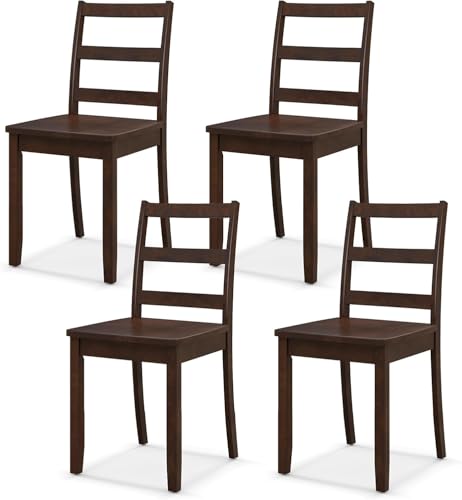
NAFORT Walnut Wood Dining Chairs, Set of 4 — Best Overall
This is the chair set for a household that wants one purchase to settle the dining room for years: four matching chairs, a ladder-back farmhouse profile that hides wear gracefully, and a construction statement that names both the leg material and the load the frame is built for. It suits families who eat at the table daily, host often, and would rather buy density and joinery than styling tricks.
Strengths
- Stated 400 lb maximum load — the joint-highest verified figure among the wood sets here
- Solid rubber wood legs: a dense hardwood that holds screws and resists splitting at joints
- Non-slip foot pads stated, which protect floors and stop the micro-movement that loosens joints over time
Trade-offs
- Armless design — no arm support for long, lingering meals
- Ladder-back farmhouse styling will not blend with a formal or ultra-modern table
- Set of four only in this listing; a six-seat table needs a second purchase decision
Key specs
- Set size: Set of 4
- Stated max load: 400 lbs
- Leg material: Solid rubber wood
- Foot pads: Non-slip foot pads stated
Rubber wood deserves a word of explanation, because it is the workhorse hardwood of this category: it is dense, dimensionally stable, and takes a walnut finish evenly, which is why so many high-capacity dining chairs are built from it. The ladder-back shape matters structurally too — horizontal rails tie the rear legs together at several heights, so sideways racking forces are shared instead of concentrating at one joint. For the buyer, the practical checks are simple: confirm the seat height suits your table apron, decide whether armless chairs are acceptable for your longest meals, and plan the foot pads as consumables to inspect yearly. As a default recommendation for a four-seat table, this set is where we would start.
Best for: Families wanting a stated-capacity solid wood set of four / Not suited for: Formal dining rooms or anyone who needs armchairs
Check on Amazon — check price on Amazon before you decide, since listings and configurations change.

POWERSTONE Wood Dining Chairs, Set of 4 — Best Heavy-Duty Frame
POWERSTONE pitches this design at restaurant-style duty, and the title backs the pitch with the two facts that matter: a solid rubber wood frame and a 400 lb capacity. It fits households that treat dining chairs as working furniture — homework, laptops, board games, long dinners — and multi-generational homes where chairs get pulled, leaned on and rearranged constantly.
Strengths
- Frame itself, not just the legs, is stated as solid rubber wood
- 400 lb capacity stated in the title, matching the strongest wood sets here
- High-back side chair profile gives shoulder-height support for longer sits
Trade-offs
- Restaurant side-chair look is utilitarian rather than decorative
- No upholstery mentioned in the title — expect a harder seat for very long meals
- Armless, like most high-capacity wood designs
Key specs
- Set size: Set of 4
- Stated capacity: 400 lbs
- Frame: Solid rubber wood frame stated
- Style: High back, restaurant side chair positioning
The distinction between ‘solid wood legs’ and ‘solid wood frame’ is worth paying attention to: on many chairs only the legs are hardwood while the seat rails and back posts are a lesser material, and failures usually start at those rails. A title that claims the whole frame in rubber wood is making the stronger statement, which is why this set takes the heavy-duty badge. Pair it with seat cushions if your household lingers — cushions are replaceable, frames are not, and this buying strategy (hard frame, soft consumable on top) is the cheapest way to own chairs for a decade. Check the stated dimensions against your table’s apron height before ordering a full set.
Best for: Hard daily use and restaurant-style durability at home / Not suited for: Buyers who want a padded, upholstered sit
Check on Amazon — check price on Amazon before you decide, since listings and configurations change.

Fabric Dining Chairs with Arms, Set of 2 — Highest Stated Capacity
Most upholstered dining armchairs publish no capacity at all, which is why this pair stands out: the listing title states 500 LBS alongside solid wood legs. Treat that figure as a manufacturer title claim to confirm on the live listing before you rely on it — but as written, it makes this the natural pick for a host chair or a two-chair small table where comfort and a high stated capacity need to coexist. It suits buyers who want arms and upholstery without giving up a written capacity number.
Strengths
- 500 LBS capacity stated in the title — the highest figure among these six picks
- Arms and a high upholstered back: the most comfortable sit in this roundup
- Solid wood legs stated beneath the upholstery
Trade-offs
- Sold as a set of two, so a full table costs several pairs
- Fabric upholstery needs more care around food spills than bare wood
- The 500 LBS figure is a title claim; verify it on the listing and in the product documents before depending on it
Key specs
- Set size: Set of 2
- Stated capacity: 500 LBS (as stated in title)
- Legs: Solid wood legs stated
- Details: Upholstered, high back, nailhead trim
Position these as the head-of-table chairs alongside a plainer wood set, and the economics work: two statement armchairs where people sit longest, simpler chairs along the sides. The nailhead trim and dark blue fabric are doing decorative work that the wood sets in this list do not attempt, so this is also the pick for a dining room that doubles as a Zoom background or a reading corner. Because upholstery hides the frame, your inspection on arrival matters more here: check leg solidity, sit and shift your weight to feel for flex, and keep the packaging until you are satisfied the chairs match the written claims.
Best for: Host chairs and small tables wanting arms plus a high stated capacity / Not suited for: Large tables on a tight budget, or spill-prone households avoiding fabric
Check on Amazon — check price on Amazon before you decide, since listings and configurations change.

Mid Century Modern Walnut Dining Chairs, Set of 4 — Best Commercial-Grade Build
Commercial-grade is another phrase listings abuse, but here it arrives with specifics: a named timber grade (FAS-grade oak), a stated 400 lb capacity and a heavy-duty label in the same title. This set fits design-conscious buyers who refuse to choose between a mid-century silhouette and a written durability claim, and small cafés or rental properties furnishing for strangers’ use.
Strengths
- FAS-grade oak named in the title — a specific, checkable timber claim
- Commercial-grade and heavy-duty positioning with a 400 lb stated capacity
- Solid curved back plus an upholstered seat balances structure and comfort
Trade-offs
- Armless mid-century profile will not suit traditional rooms
- Upholstered seat adds a cleaning consideration the all-wood sets avoid
- Walnut finish is a specific look; mixing with other woods takes care
Key specs
- Set size: Set of 4
- Stated capacity: 400 lbs
- Material: FAS-grade oak stated
- Positioning: Heavy-duty, commercial grade stated
FAS is the top commercial grade of hardwood lumber, selected for long clear cuttings with minimal defects — exactly what you want in chair parts that are bent, joined and stressed. Whether every production run honours the grade is something only inspection can confirm, but a manufacturer willing to print the grade in the title is at least inviting the comparison. The curved solid back is the other structural story: a one-piece curved back distributes leaning loads more evenly than a ladder of thin rails. For a design-led dining room that still gets used hard every day, this is the most defensible splurge in the list.
Best for: Design-led rooms that still need commercial-style durability / Not suited for: Traditional or farmhouse rooms, or buyers avoiding any upholstery
Check on Amazon — check price on Amazon before you decide, since listings and configurations change.

GIANTEX Wood Dining Chairs, Set of 4 — Best Farmhouse Alternative
On paper this GIANTEX set is the closest cousin to our Best Overall pick: same construction family, same stated 400 lb maximum load, same solid rubber wood legs and non-slip pads — in a black finish instead of walnut. It is the right choice when the black farmhouse look is the point, or when one of the two listings is unavailable in your size run. Two near-identical spec sheets from different brands is normal in this category; buy on finish, price on the day, and delivery terms.
Strengths
- Stated 400 lb maximum load, matching the strongest wood sets here
- Solid rubber wood legs with non-slip foot pads stated
- Black finish hides scuffs and suits modern farmhouse schemes
Trade-offs
- Armless ladder-back design, like its walnut counterpart
- Black shows dust and flour-dust kitchen marks more than mid-tone wood
- Spec-for-spec overlap with the NAFORT set means the choice is finish and terms, not build
Key specs
- Set size: Set of 4
- Stated max load: 400 lbs
- Leg material: Solid rubber wood
- Foot pads: Non-slip foot pads stated
Because this set and the NAFORT set state nearly identical construction, the useful advice is about verification rather than preference: whichever you order, do the arrival inspection properly. Check each leg for hairline cracks at the joints, rock each chair on a hard floor to find any twist in the frame, and tighten any assembly hardware after the first week of use, when joints settle. A 400 lb stated load is a claim about a well-assembled chair; your ten minutes with a hex key is what makes the claim real in your house. Keep the second set of foot pads, if included, as spares.
Best for: Black farmhouse schemes wanting the same stated build as the top pick / Not suited for: Anyone wanting arms, upholstery or a non-farmhouse look
Check on Amazon — check price on Amazon before you decide, since listings and configurations change.
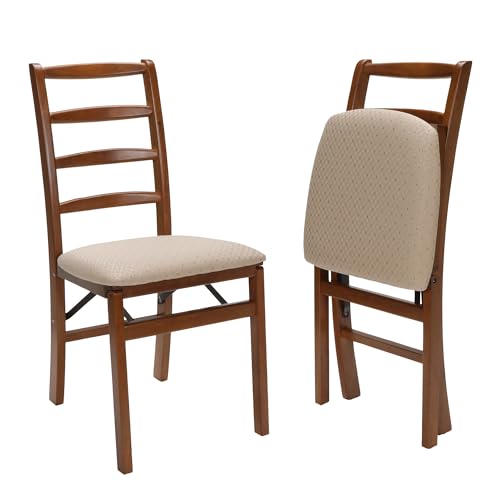
Stakmore Shaker Ladderback Folding Chairs, Set of 2 — Best Built Folding Option
Every dining room eventually needs two more chairs than it owns — holidays, guests, a card table in the corner. Folding chairs solve that, but most are flimsy; this Stakmore design is the long-running exception buyers reach for, a wooden Shaker ladderback that folds via a steel mechanism and stores flat. We include it as the folding specialist with a clear caveat: unlike the five picks above, its verified title states no capacity figure, so if a written load number is your priority, choose one of the fixed-frame sets and treat these as overflow seating.
Strengths
- Steel folding mechanism stated — the part that decides a folding chair’s life
- Real wood ladderback design that matches a dining set instead of looking like rental furniture
- Padded upholstered seat, unusual in folding chairs
Trade-offs
- No capacity stated in the title — the spec box says Not stated, honestly
- Folding mechanisms need periodic checks that fixed frames do not
- Set of two; large gatherings need multiple sets
Key specs
- Set size: Set of 2
- Frame: Wood frame with steel folding mechanism stated
- Seat: Padded, upholstered seat stated
- Stated capacity: Not stated
Judge a folding chair by its hinge and its storage footprint, and this design is built around both: the steel mechanism does the moving work while the wood does the sitting work, and the pair folds flat enough for a closet or under a bed. The padded seat matters more than it sounds — guests sit longest at exactly the meals where folding chairs come out. Inspect the mechanism on arrival, work it a dozen times, and store the chairs dry; a folding chair that lives in a damp garage will age faster than its frame deserves. As overflow seating that respects the room’s look, it earns its slot despite the unstated capacity.
Best for: Overflow and guest seating that stores flat and still looks like furniture / Not suited for: Primary seating for anyone who requires a stated capacity figure
Check on Amazon — check price on Amazon before you decide, since listings and configurations change.
Comparison Table
The table compresses each pick down to the one verified specification that matters most for this category, plus the job it does best. Read it as a shortlist filter, then go back to the full review of the two or three rows that survive — the detail paragraphs are where the honest limitations live.
| Pick | Badge | Key spec | Best for |
|---|---|---|---|
| NAFORT Walnut Wood Dining Chairs, Set of 4 | Best Overall | Set of 4 | Families wanting a stated-capacity solid wood set of four |
| POWERSTONE Wood Dining Chairs, Set of 4 | Best Heavy-Duty Frame | Set of 4 | Hard daily use and restaurant-style durability at home |
| Fabric Dining Chairs with Arms, Set of 2 | Highest Stated Capacity | Set of 2 | Host chairs and small tables wanting arms plus a high stated capacity |
| Mid Century Modern Walnut Dining Chairs, Set of 4 | Best Commercial-Grade Build | Set of 4 | Design-led rooms that still need commercial-style durability |
| GIANTEX Wood Dining Chairs, Set of 4 | Best Farmhouse Alternative | Set of 4 | Black farmhouse schemes wanting the same stated build as the top pick |
| Stakmore Shaker Ladderback Folding Chairs, Set of 2 | Best Built Folding Option | Set of 2 | Overflow and guest seating that stores flat and still looks like furniture |
How to Choose the Best Built Dining Room Chairs for Your Table
Start with the two numbers a serious listing should give you: a stated maximum load and a seat height. The load figure is your durability proxy — in this roundup the credible wood sets state 400 lbs, and one upholstered pair states 500 LBS — while seat height decides whether the chair actually works with your table. Most dining tables sit around a standard height that pairs with a seat in the high-teens of inches; a chair that is too tall traps thighs against the table apron, and one that is too low makes eating feel like sitting in a hole. Measure your table’s apron clearance, not just its top, before you fall for any design.
Next, read the frame claim like an inspector. ‘Solid wood frame’ is stronger than ‘solid wood legs’, which is stronger than a listing that names no material at all. Rubber wood and oak are the two hardwoods that recur in high-capacity designs because both are dense and hold fasteners well. Metal frames can be excellent too, particularly steel, but in the dining category the stated-capacity leaders are wood. Then look at the back construction: ladder backs and curved solid backs spread load across multiple rails or a single strong piece, while a single thin top rail is a styling choice, not a structure. Finally, check the small hardware — non-slip or adjustable foot pads keep a chair planted, and a planted chair does not rack its joints loose.
Reading Capacity Claims Without Being Fooled
A capacity figure in a title is a manufacturer’s claim, not an independent test result, and this guide treats it that way: we print exactly what the title states and tell you to confirm it on the live listing and in the included documentation. That discipline matters because the honest response to a claim you cannot verify is not cynicism — it is inspection. When any chair in this article arrives, sit, shift, lean back on two legs’ worth of angle (carefully, once), and look at the joints. A chair that matches its written claim feels boring: no creak, no flex, no twist. Boring is the goal.
Also understand what capacity does not tell you. It says nothing about comfort over a two-hour meal, nothing about finish durability against keys and belt buckles, and nothing about how the chair ages in sunlight. That is why the reviews pair every number with the human factors — arms or armless, padded or bare, fabric or wood — and why the verdict lines separate ‘strongest claim’ from ‘best for you’. A 400 lb stated farmhouse chair you hate sitting in is a worse purchase than a slightly lesser spec you enjoy daily; the art is finding the overlap, and for most households the overlap is a stated-capacity solid wood set with cushions added where wanted.
Sets, Sizes and the Real Cost of a Dining Room
Dining chairs are sold in sets of two, four and six, and the set structure quietly decides your budget. A six-seat table filled with sets of two needs three purchases; the same table filled from a set of four plus a set of two lets you put the pair — perhaps the upholstered armchairs — at the heads. Mixing is not a compromise; it is the classic dining room formula. What you must not mix carelessly is seat height and style family: keep seat heights matched across the table, and let finish, not silhouette, be the variable if you combine brands.
Buy one chair more than the table needs if storage allows. Chairs get damaged singly — a cracked leg, a ruined seat — and designs are discontinued; a spare from the same production run is the cheapest insurance in this whole category. If a spare is impossible, photograph the label under the seat of one chair on day one, so a future replacement search starts from facts rather than memory. And keep the assembly hardware and any spare foot pads in a labelled bag in the sideboard; future-you, mid-dinner-party with a wobbling chair, will be grateful.
How to Set Up and Break In New Dining Chairs
A well-built chair can still disappoint if it is assembled carelessly or placed badly. This short routine — the same one we would run on any set in this article — takes about ten minutes per chair and is the difference between a frame that lasts and one that works itself loose.
- Assemble on a soft, flat surface: Build each chair on a rug or blanket, not bare concrete or a deck. Hard surfaces twist frames during assembly and scratch finishes before the chair is ever sat on.
- Tighten in stages, not all at once: Start every bolt finger-tight, then work around the chair tightening each a quarter-turn at a time, like a wheel. This pulls the frame square instead of racking it toward the first tightened corner.
- Do the rock test on hard floor: Place the finished chair on the hardest floor you have and press down on two diagonal corners. Any rock means a leg length or frame twist issue — address it now with the foot pads or the maker, not after a month of use.
- Match chair to table before unboxing all: Fully finish one chair and live with it at the table for a day: seat height, apron clearance, arm clearance if applicable. Only then assemble the rest, while a return is still simple.
- Re-tighten after the first week: Wood joints settle under real use. A two-minute pass with the hex key after seven days locks in the frame’s geometry for the long term.
- Fit or replace foot pads: Confirm every leg has its pad, and keep spares. A missing pad concentrates load, scratches floors, and lets the chair skate — the motion that loosens joints fastest.
- Position away from heat and sun where possible: Radiators and direct sun dry wood and finishes unevenly. You cannot always avoid them, but rotating chairs between spots evens the ageing across a set.
After this routine, care is mostly housekeeping: wipe spills promptly (especially on upholstered seats), lift chairs rather than dragging them, and give the set a joint-and-pad inspection twice a year. Five minutes, twice a year, is the entire maintenance contract of a well-built dining chair — which is precisely the point of buying the build quality in the first place.
Joinery, Finishes and the Ten-Year View
Since ‘built’ is this article’s whole brief, it is worth going one level deeper into what actually fails on dining chairs, because the failure list is short and predictable. Legs loosen at the seat rail first, because sitting down is a repeated sideways-and-down load and chairs are dragged more than their makers admit. Back posts crack at the point where they meet the seat, because leaning back concentrates force there. Stretchers — the rungs between legs — split or pull out, because feet rest on them with real weight. A well-built chair is simply a chair whose maker has thought about those three addresses: generous rail stock, posts that run deep into the seat frame or are tied by multiple ladder rails, and stretchers joined to survive being used as footrests. When you inspect any chair in this roundup on arrival, those are the three places your hands should go: grip the leg and rail and twist gently, lean on the back, press a stretcher. Nothing should move, creak or feel hollow.
Finishes deserve the same long view, because a structurally perfect chair with a failed finish still leaves the room. Walnut and black finishes on the wood sets here are doing practical work: mid and dark tones hide the scuffs, ring marks and small dents that dining chairs collect from buckles, keys, children’s shoes and vacuum cleaners. Bare or pale wood shows every one of them. Upholstered seats invert the problem — the finish is fabric, and its enemy is not impact but absorption: food, drink and dye transfer from jeans. If your household eats messily, and most honest households do, treat the upholstered picks as occasional-luxury chairs and the sealed wood sets as the daily workhorses, or budget for washable seat cushions as a sacrificial layer over the fabric.
The ten-year arithmetic is the final argument for buying build quality in this category. A dining set is used three times a day by every member of a household; no other furniture except beds and sofas accumulates comparable cycles. A set that lasts ten years at a higher price is cheaper per year than a set replaced at year three, and it spares you the disposal, the re-shopping and the months of wobble in between. That arithmetic only works if the first purchase is genuinely built — stated capacity, named solid materials, inspectable joints — which is why this article was so strict about evidence. Buy the evidence, do the two-minute maintenance twice a year, and the dining room stops being a recurring problem and becomes what it should be: the room where the house gathers, on chairs nobody thinks about at all.
Matching Chairs to the Way Your Household Actually Eats
It is easy to furnish for the dinner party and forget the Tuesday. Most dining chairs earn their living at breakfast with a laptop, at homework hour, at the long Sunday lunch that becomes cards, and at the weeknight meal eaten in fifteen minutes — and each of those uses stresses a chair differently. Breakfast-and-laptop use rewards a supportive back and a seat that does not numb; homework rewards wipeable surfaces and chairs light enough for children to move without dragging; long lunches reward arms and padding, which is why the upholstered pair in this roundup exists. When you read the six reviews, read them against your household’s real week rather than its best occasion: the chair that serves eighty percent of your sittings is the right chair, and the dinner party will forgive it.
Households with children should weight two things more heavily than style guides admit: cleanability and climbability. Children will stand on these chairs, rock on them, and use the stretchers as steps, whatever the house rules say — so the stated-capacity solid wood sets are not over-engineering for a family, they are the correct engineering, and sealed finishes that wipe clean will save more evenings than any other feature. Households with elderly relatives should think about arms and seat height at the table’s ends: an armchair that an older person can push up from is a genuine accessibility feature disguised as a style choice, and it is one more reason the mixed formula — armchairs at the heads, armless along the sides — has survived for centuries. It is not tradition for its own sake; it is ergonomics that predates the word.
Renters and frequent movers face a different calculus: chairs get disassembled, trucked and reassembled, and every move is a fresh chance for joints to loosen and hardware to vanish. For them, the advice in this article sharpens rather than changes — keep the hardware bagged and labelled per chair, photograph one assembled chair from several angles before the first move, and re-run the arrival inspection and staged tightening at every new address as if the chairs were new. A well-built chair survives moves that destroy lesser ones, which is precisely why build quality is the renter’s friend too: the cheapest chair to move three times is the one that never needs replacing between moves.
Common Buying Mistakes
Buying the look and skipping the spec box. If a listing will not state a load or a frame material, that silence is information. Every pick in this article was chosen because its title states something checkable; shop with the same rule.
Assuming a set count matches the table. Sets of two, four and six change the real price of a room. Count seats, count chairs, and plan the head chairs deliberately instead of discovering the gap at delivery.
Dragging chairs instead of lifting them. Dragging racks legs sideways — the exact force joints are worst at resisting. Most ‘my chairs went wobbly’ stories are dragging stories.
Skipping the one-week re-tighten. Assembly-day tight is not settled tight. The follow-up pass is two minutes and prevents the slow loosening that owners later blame on build quality.
Mixing seat heights across one table. Chairs from different sets can differ enough in seat height to make a table feel wrong for half the sitters. Match the number, vary the finish if you must vary something.
Final Recommendation
If you want one decision: the NAFORT set of four is the default — stated 400 lb load, solid rubber wood legs, foot pads, and a farmhouse profile that forgives daily life. The POWERSTONE set is the alternative when the whole frame being solid rubber wood matters more than finish choice, and the GIANTEX set is the same idea in black. Choose the Mid Century Modern oak set when the room’s look is non-negotiable but you still want a commercial-grade claim in writing, and add the fabric armchair pair at the table heads when arms and the highest stated capacity in this roundup are worth paying for by the pair. Keep the Stakmore folders for guests, and your dining room is solved at every seat.
Whichever set you choose, do the arrival inspection and the one-week re-tighten. Build quality is a partnership between the maker’s claim and the owner’s ten minutes — the picks above hold up their side in writing, and the routine in this guide holds up yours.
Shortlist links, for convenience: Check on Amazon Check on Amazon Check on Amazon Check on Amazon Check on Amazon Check on Amazon — check price on Amazon for each before you decide.
Best Constructed Dining Chairs
Best Dining Chairs For Home With Pets
Going Deeper on Best Built Dining Room Chairs
It is worth pausing on how a shortlist like this should be used, because the difference between a good purchase and a regretted one in this category is rarely the product — it is the match. Every pick in this article was verified the same way, against the same listing record, under the same rules about what may and may not be claimed. That uniformity is deliberate: it means the differences that remain between the picks are real differences of construction, size, format and fit, rather than differences in how generously each listing was read. When you compare two picks above and find their spec boxes nearly identical, that is information, not a failure of the research — it tells you the category has settled on a standard answer to the brief, and that your decision should be made on the secondary factors: the finish you prefer, the size run that includes you, the care routine you will actually keep, and the terms on the day you buy.
The second habit worth adopting is to treat the first week with any pick as a trial with a structure, not a first impression. The how-to section of this article gives that structure for this category specifically, but the principle is general: use the product in the real conditions it was bought for, change nothing else at the same time, and judge on the pattern of days rather than the novelty of the first one. Products bought this way tend to stay bought — the return rate of a well-trialled purchase is a fraction of an impulse one — and the products that do go back teach you something precise about your own requirements, which makes the next choice better. Keep the notes you make, even if they are two lines in a phone: your future self, shopping this category again in three years, will be glad of them.
Finally, hold on to the spec discipline this article models. A stated figure — a height, a capacity, a size, a material — is a commitment a maker can be held to; an adjective is not. Wherever this guide could quote a number from a verified title, it did, and wherever it could not, it wrote Not stated and told you to check the listing. Shop that way everywhere and the whole category becomes easier: you will find yourself comparing commitments instead of comparing adjectives, and commitments can actually be compared. That, more than any single pick above, is the skill this roundup hopes to leave with you.
Frequently Asked Questions
What does a 400 lb capacity on a dining chair actually mean?
It is the manufacturer’s stated maximum load for the chair as designed and assembled. Treat it as a written claim to confirm on the listing and in the product documents, and as a useful comparison signal: sets that state 400 lbs are, as a group, built to a heavier-duty brief than sets that state nothing.
Is rubber wood a real hardwood or a compromise?
Rubber wood is a genuine hardwood — dense, stable, and widely used in high-capacity chairs precisely because it holds fasteners well. Its plain grain is usually hidden under finishes like walnut or black, which is a cosmetic choice, not a structural one.
Should I choose arms or armless dining chairs?
Arms add comfort for long meals but need clearance under the table apron and add width per seat, so fewer chairs fit along a side. A common solution is the one this roundup supports: armchairs at the two heads, armless chairs along the sides.
How many chairs should I buy for a six-person table?
Six for the table, plus one spare if storage allows. Sets of four plus two, or three sets of two, both work — keep seat height consistent across everything you combine.
Are folding dining chairs a false economy?
Cheap ones are. A wooden folding chair with a steel mechanism, like the Stakmore pick here, is a legitimate overflow solution — but note that its title states no capacity, so it should not replace a stated-capacity set as your primary seating.
How do I make dining chairs last longer?
Lift rather than drag, keep foot pads intact, re-tighten hardware after the first week and then twice a year, and keep chairs out of constant direct sun and radiator heat where you can. That is the whole programme.


