Disclosure: airfryerkitchensupply.com is reader-supported. When you buy through links on our site, we may earn an affiliate commission at no extra cost to you.
The best browning toasters are not the most expensive toasters or the ones with the most buttons — they are the ones that colour a slice evenly, edge to edge and top to bottom, and then do exactly the same thing to the next slice, and to a frozen slice, and to a bagel half. Browning sounds simple until you watch a cheap toaster work: stripes where the elements glow hottest, a pale band at the top where the bread rose above the heat, one side dark and the other blonde because the slice leaned against one wall of the slot. Every one of those failures is an engineering failure, and this roundup is organised around the engineering that prevents them.
Three things decide browning quality. Element design comes first: broad, evenly powered elements — or smart power management that compensates for a hot chamber on the second round — produce even colour, while cheap wire elements stripe. Slot geometry comes second: a slot that centres the slice, wide enough for thick bread but not so wide that thin slices lean, keeps both faces at the same distance from the heat. Control comes third: the best machines adjust for the bread’s starting state — fresh, frozen, a second consecutive round — instead of running the same blind timer every time.
The six picks below span the honest range of solutions: Breville’s sensor-driven flagships, Hamilton Beach’s Sure-Toast approach to the second-round problem, GE’s high-wattage even-heat design, and Cuisinart’s proven dial-controlled machines in two and four slices. Prices are deliberately not printed — check price on Amazon for each — because the point of this guide is the browning, and the right tier for you is decided in the buying guide, not by a number in a review.
Where to buy
All six picks are mainstream Amazon models — check price on Amazon on the exact model number named in each review, because several of these lines include lookalike variants with different slot counts and controls. If even browning is your priority, resist retailer-exclusive spin-offs: the model numbers below are the ones whose browning behaviour this guide is actually describing.
- Breville ‘A Bit More’ BTA720XL 2-Slice Toaster (Best Overall) — Check the current price on Amazon
- Breville Die-Cast Smart Toaster BTA820XL 2-Slice (Best Premium Browning) — Check the current price on Amazon
- Hamilton Beach Gourmet 2-Slice Toaster 22996 with Sure-Toast (Best for Second-Round Browning) — Check the current price on Amazon
- GE 2-Slice Stainless Steel Toaster (Best High-Power Browning) — Check the current price on Amazon
- Cuisinart CPT-160P1 Metal Classic 2-Slice Toaster (Best Dial-Control Browning) — Check the current price on Amazon
- Cuisinart CPT-180P1 4-Slice Toaster (Best Browning for Families) — Check the current price on Amazon
In this guide
Quick Picks
Two Brevilles for buyers who want the machine to think, one Hamilton Beach that specifically fixes second-round over-browning, a high-power GE, and two Cuisinarts for dial-control traditionalists in two sizes.
- Best Overall: Breville ‘A Bit More’ BTA720XL 2-Slice Toaster — The browning benchmark for most kitchens: wide self-centring slots, even element coverage, a Lift & Look lever to check without cancelling, and the ‘A Bit More’ button that fixes under-done toast in one press. — Check price on Amazon
- Best Premium Browning: Breville Die-Cast Smart Toaster BTA820XL 2-Slice — Breville’s die-cast flagship: motorised one-touch lowering, intelligent one-touch browning control, and the most even, repeatable colour in this roundup — at a flagship price. — Check price on Amazon
- Best for Second-Round Browning: Hamilton Beach Gourmet 2-Slice Toaster 22996 with Sure-Toast — Sure-Toast technology exists to solve the oldest browning complaint — the second slice comes out darker than the first. Add extra-wide slots, Toast Boost for small items and seven shade settings. — Check price on Amazon
- Best High-Power Browning: GE 2-Slice Stainless Steel Toaster — 1,500 watts of even-toasting power with measured extra-wide slots and seven shades. The choice for people who like dark, fast, decisive browning and wide slots for bagels. — Check price on Amazon
- Best Dial-Control Browning: Cuisinart CPT-160P1 Metal Classic 2-Slice Toaster — The dial-control classic: 1.5-inch slots, a six-setting browning dial, brushed stainless — and a browning reputation earned over a very long production life. For people who distrust sensors. — Check price on Amazon
- Best Browning for Families: Cuisinart CPT-180P1 4-Slice Toaster — Four slices, two independent control sets, extra-wide slots. The family answer: two people toast two different breads at two different shades, simultaneously, each browning properly. — Check price on Amazon
How These Picks Were Chosen
Picks were chosen on browning evidence and browning engineering, not feature lists: element coverage, slot geometry and centring, chamber-heat behaviour across consecutive rounds, and the presence of a genuine mid-cycle correction feature. Every model was verified through the Amazon catalogue data available to this site, matching the exact model number in each review to its listing, because toaster lines are full of lookalike variants whose browning hardware differs from the model people actually praise.
We deliberately included three control philosophies — sensor-managed (Breville), consistency-managed (Hamilton Beach Sure-Toast) and manual dial (Cuisinart) — because ‘best browning’ means different things to a cook who wants the machine to decide and a cook who wants to decide personally. High-wattage even heating (the GE) is the fourth legitimate route to good colour, and it is represented on its merits.
Excluded: any toaster whose browning reputation rests on a single viral video, glass-sided novelty designs whose element geometry cannot colour evenly, and budget models whose slots are too narrow to centre a standard slice — the most common hidden cause of one-side-dark toast.
The 6 Best Browning Toasters

Breville ‘A Bit More’ BTA720XL 2-Slice Toaster — Best Overall
The BTA720XL earns Best Overall because it attacks every browning failure mode at once. The slots are wide and self-centring, so thick artisan slices and thin sandwich bread both sit at an even distance from the elements. The element coverage runs the full height of the slot, which kills the pale-top problem on tall slices. And the controls solve the human problems: Lift & Look lets you raise the toast to inspect it without cancelling the cycle — the single most useful browning feature ever fitted to a toaster — and if the verdict is ‘nearly’, the A Bit More button adds a short, calibrated increment instead of restarting a full cycle and incinerating the slice.
Strengths
- Lift & Look and A Bit More fix under-done toast without ruining the cycle
- Wide self-centring slots and full-height elements colour evenly, edge to edge
- Bagel and frozen functions handle different bread states properly
Trade-offs
- Two slices only — batch households will queue
- Premium-mainstream price for a two-slice toaster
- Brushed steel finish shows fingerprints and needs a wipe-down habit
| Capacity | 2 slices, wide slots (per Amazon listing) |
| Construction | Brushed stainless steel (per Amazon listing) |
| Features | ‘A Bit More’ and Lift & Look functions (per Amazon listing) |
Consistency across rounds is where it separates from cheaper machines. Successive slices come out close in colour because the toaster’s power delivery is managed rather than a dumb timer slapped on a hotter and hotter chamber. Bagels get their own setting that balances the two faces properly, frozen bread gets a dedicated function, and the LED progress indicator quietly removes the guesswork that makes people open — and ruin — cycles on lesser machines.
The compromises are size and price within the mainstream tier. It is a two-slice machine with a footprint that suits its wide slots, so family-batch households should look at the four-slice Cuisinart below or Breville’s larger siblings. It is also a premium-mainstream purchase, not a budget one. But judged purely on the keyword — browning — nothing at its tier colours more evenly or recovers from human indecision more gracefully.
Best for: browning perfectionists in one- to three-person households / Not suited for: families who toast four-plus slices every morning
Check on Amazon — check price on Amazon for the current listing, configuration options and delivery terms before you order.

Breville Die-Cast Smart Toaster BTA820XL 2-Slice — Best Premium Browning
The Smart Toaster is what happens when a manufacturer treats browning as a control-systems problem. The motorised carriage lowers and raises the bread with one touch — no lever slam, no half-lowered slices leaning at an angle — and the intelligent browning system manages power through the cycle so the colour you select is the colour you get, on the first slice and the fourth. The die-cast body is not jewellery: its thermal mass and solidity are part of why the chamber behaves consistently, and it makes the machine feel like equipment rather than an appliance.
Strengths
- Most even and repeatable browning in the roundup, round after round
- Motorised one-touch carriage keeps slices perfectly positioned
- Die-cast build quality and calm, precise controls
Trade-offs
- Flagship price for a two-slice machine
- Motorised mechanism is a long-term moving-parts consideration
- Overkill for households that toast basic sliced bread
| Capacity | 2 slices, wide slots (per Amazon listing) |
| Construction | Die-cast body, brushed stainless steel (per Amazon listing) |
| Controls | One-touch motorised, variable browning control (per Amazon listing) |
In daily use the difference shows in repeatability. Variable browning control with clear feedback means your setting becomes a known quantity; the machine reproduces it across bread types better than anything else here, and the one-touch bagel and frozen functions integrate into the same calm interface. For a household where one person wants pale-gold sourdough and another wants dark rye, this is the toaster that ends the arguments.
The price is the argument it starts. This is a flagship-tier two-slice toaster, and its motorised mechanism is inherently a longer-term reliability question than a spring and a lever — Breville supports the line well, but the honest buyer weighs moving parts against the BTA720XL’s simpler excellence. If browning quality is genuinely your top criterion and budget is secondary, this is the best browning toaster in the roundup. If value matters at all, the model above it is the smarter buy.
Best for: buyers who want the best browning available and will pay flagship prices / Not suited for: value shoppers — the BTA720XL covers most of the ground for less
Check on Amazon — check price on Amazon for the current listing, configuration options and delivery terms before you order.

Hamilton Beach Gourmet 2-Slice Toaster 22996 with Sure-Toast — Best for Second-Round Browning
Every toaster owner knows the pattern: the first slice at your usual setting is perfect, the second — into an already hot chamber — comes out a shade darker, and by the third you are adjusting the dial down and guessing. Hamilton Beach’s Sure-Toast technology is engineered directly at that problem, managing the cycle so consecutive slices land at a consistent colour. In a guide about browning, a machine whose headline technology is browning consistency deserves its badge, and in family or batch use the benefit is immediate and obvious.
Strengths
- Sure-Toast directly fixes second- and third-round over-browning
- Extra-wide slots, bagel function and seven shade settings cover daily needs
- Toast Boost lifts muffins and small items safely clear
Trade-offs
- Single-slice evenness a half-step behind the Breville pair
- No mid-cycle checking feature like Lift & Look
- Two-slice capacity only
| Capacity | 2 slices, extra-wide slots (per Amazon listing) |
| Technology | Sure-Toast browning consistency (per Amazon listing) |
| Controls | 7 shade settings, bagel, defrost, Toast Boost (per Amazon listing) |
The rest of the package is sensibly complete: extra-wide slots for bagels and thick bread, a bagel function, seven shade settings with a defrost option, Toast Boost to lift small items clear of the slots, and auto-shutoff for safety. The Gourmet trim also looks and feels a step above the brand’s budget lines, which matters in a machine that lives on the counter.
Set against the Brevilles, the absolute evenness across a single slice — the last degree of edge-to-edge uniformity on a tall artisan slice — is a half-step behind, and the controls are conventional rather than clever: no Lift & Look equivalent. But for households whose browning frustration is specifically round-to-round drift, this is the most targeted solution in the roundup, at a mid-range tier the Brevilles do not contest.
Best for: batch toasters whose second slice always comes out darker / Not suited for: artisan-bread perfectionists chasing the last degree of evenness
Check on Amazon — check price on Amazon for the current listing, configuration options and delivery terms before you order.
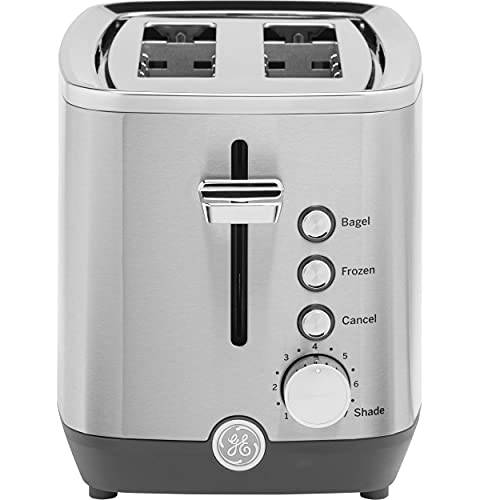
GE 2-Slice Stainless Steel Toaster — Best High-Power Browning
Power is a browning feature when it is controlled, and the GE’s 1,500-watt output is the headline here: the listing itself promises even toasting, and the wattage backs it with fast, decisive colour development — the kind that crisps the surface of a thick slice while the interior stays soft, rather than slowly desiccating the whole slice the way underpowered toasters do. Seven shade settings give the range to use that power gently or fully.
Strengths
- 1,500W power develops colour fast without drying the crumb
- Honestly specified extra-wide slots fit bagels and thick slices
- Seven shades and simple, durable mainstream design
Trade-offs
- Top settings are fierce — delicate items need care
- No anti-drift consistency technology for consecutive rounds
- No mid-cycle inspection feature
| Power | 1,500 watts (per Amazon listing) |
| Slots | Extra wide, 1.38 x 5.50 in (per Amazon listing) |
| Controls | 7 shade settings (per Amazon listing) |
| Care | Removable crumb tray (per Amazon listing) |
The slots are specified with unusual honesty — 1.38 by 5.50 inches — wide enough for bagels and thick-cut bread, and the stainless body with a removable crumb tray keeps the machine easy to live with. For households whose browning complaint is the opposite of most — toast that takes forever and dries out — this is the corrective pick, and its mainstream tier makes it the value entry among the roundup’s serious browning machines.
High power cuts both ways: the darker settings are genuinely dark, and frozen or delicate items need a lighter hand than on gentler machines. There is also no consistency technology of the Sure-Toast kind and no mid-cycle check feature, so consecutive-round management is yours. Buy it for speed and decisive colour; buy the Hamilton Beach if drift between rounds is your enemy instead.
Best for: fast, dark, decisive browning and bagel households / Not suited for: gentle, pale-toast preferences or hands-off batch consistency
Check on Amazon — check price on Amazon for the current listing, configuration options and delivery terms before you order.

Cuisinart CPT-160P1 Metal Classic 2-Slice Toaster — Best Dial-Control Browning
The CPT-160P1 represents the analogue school of browning, and it represents it well. A six-setting dial, 1.5-inch slots that centre standard and thick slices properly, and a brushed stainless body in a retro design that has been in production long enough for its behaviour to be thoroughly understood — including by Cuisinart, whose shade calibration on this model is a known quantity rather than a marketing claim. Owners learn their number, and the machine repeats it.
Strengths
- Proven, well-calibrated six-setting dial with a long production history
- 1.5-inch slots centre bread properly for even faces
- Bagel, defrost and reheat functions without any digital complexity
Trade-offs
- Mild second-round darkening — dial compensation is manual
- No mid-cycle check or consistency technology
- Slots are generous, not the widest in the roundup
| Capacity | 2 slices, 1.5 in slots (per Amazon listing) |
| Controls | 6-setting browning dial (per Amazon listing) |
| Construction | Brushed stainless steel (per Amazon listing) |
Its browning character is even and honest rather than technologically assisted. There is no chamber-heat compensation, so the second-round drift that the Hamilton Beach exists to fix is present here in mild form — experienced owners nudge the dial down a fraction for consecutive rounds, a habit as old as toasting itself. Bagel, defrost and reheat functions round out a control set that covers real life without a single menu or display.
Against the Brevilles it gives away the last word in evenness and all the convenience features, and its slots, while generous, are not the widest here. What it offers instead is durability of design, a mid-range tier, and the confidence of a model with a very long track record. For dial loyalists — and browning traditionalists who believe the cook, not the sensor, should decide — it is the pick.
Best for: dial-control traditionalists who want proven, repeatable browning / Not suited for: set-and-forget users who hate adjusting between rounds
Check on Amazon — check price on Amazon for the current listing, configuration options and delivery terms before you order.
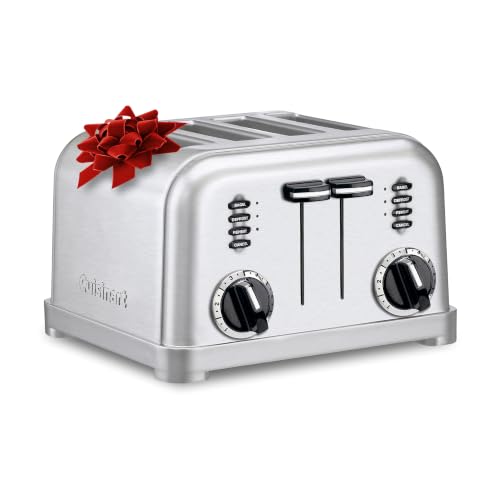
Cuisinart CPT-180P1 4-Slice Toaster — Best Browning for Families
Family browning fails in a specific way: one control set forces two people’s preferences — and often two different breads — through a single setting, so somebody’s toast is always wrong. The CPT-180P1’s dual independent controls are the direct fix: each pair of extra-wide slots has its own six-setting dial and its own bagel, defrost and reheat functions, so dark rye on the left and pale white on the right proceed in parallel, each browned as intended.
Strengths
- Dual independent controls brown two breads at two shades simultaneously
- Extra-wide slots across all four positions
- Same proven dial calibration as the CPT-160
Trade-offs
- Large counter footprint for smaller households
- Manual second-round adjustment, like all dial machines
- Two control sets to learn instead of one
| Capacity | 4 slices, extra-wide slots (per Amazon listing) |
| Controls | Dual independent controls, 6-setting dials (per Amazon listing) |
| Construction | Brushed stainless steel (per Amazon listing) |
The browning itself is the same proven Cuisinart character as the two-slice CPT-160: even, honestly calibrated, and dependent on the user for second-round adjustments. In a four-slice machine that matters less, because most family rounds are single batches rather than consecutive cycles. The brushed stainless body matches the two-slice, and the whole machine has the same long-production-run confidence.
Footprint is the cost: this is a wide machine that claims real counter territory, and households that toast two slices daily are hauling capacity they never use — the two-slice picks above exist for them. But for the household that genuinely runs four slices every morning, dual-control browning is the difference between a toaster that serves the family and one that serves half of it.
Best for: families with split browning preferences at one breakfast table / Not suited for: solo and couple households — buy the two-slice instead
Check on Amazon — check price on Amazon for the current listing, configuration options and delivery terms before you order.
Comparison Table
Browning quality is not a spec-sheet number, so this table compares the things that produce it: the control philosophy, the slot design and the correction features each machine gives you when a slice is heading the wrong way.
| Pick | Badge | Key spec | Best for |
|---|---|---|---|
| Breville ‘A Bit More’ BTA720XL 2-Slice Toaster | Best Overall | 2-slice, Lift & Look, A Bit More | browning perfectionists in one- to three-person households |
| Breville Die-Cast Smart Toaster BTA820XL 2-Slice | Best Premium Browning | 2-slice die-cast, motorised smart browning | buyers who want the best browning available and will pay flagship prices |
| Hamilton Beach Gourmet 2-Slice Toaster 22996 with Sure-Toast | Best for Second-Round Browning | 2-slice with Sure-Toast consistency tech | batch toasters whose second slice always comes out darker |
| GE 2-Slice Stainless Steel Toaster | Best High-Power Browning | 2-slice, 1,500W, extra-wide slots | fast, dark, decisive browning and bagel households |
| Cuisinart CPT-160P1 Metal Classic 2-Slice Toaster | Best Dial-Control Browning | 2-slice, 1.5in slots, 6-setting dial | dial-control traditionalists who want proven, repeatable browning |
| Cuisinart CPT-180P1 4-Slice Toaster | Best Browning for Families | 4-slice, dual independent controls | families with split browning preferences at one breakfast table |
How to Choose a Toaster for Browning Quality
Start by naming your actual browning problem, because the picks split by problem. Striped or pale-topped slices mean element coverage and slot height — buy Breville or the GE. Second slices darker than the first mean chamber-heat drift — buy the Sure-Toast Hamilton Beach or a sensor Breville. One face dark and one pale means the slice is leaning — buy wide, self-centring slots. Two people fighting over one setting means dual controls — buy the four-slice Cuisinart. A toaster bought against a named problem satisfies; a toaster bought on general praise often does not.
Then be honest about your bread. Thick artisan and sourdough slices need wide slots and full-height elements; standard sliced loaf toasts well almost anywhere; bagels need a true bagel function that balances the cut face and the crust side, not just a longer timer. Match the machine to the loaf you actually buy weekly.
- Judge slots by geometry, not adjectives: look for stated slot dimensions and self-centring racks.
- Treat ‘shade settings’ as meaningless without calibration — a proven model’s six settings beat a novelty model’s nine.
- A mid-cycle check feature (Lift & Look, Peek & Pop) is worth real money to anyone who has ever cremated a ‘quick extra blast’.
- Consecutive-round behaviour matters if you toast in batches — ask how the machine handles a hot chamber.
Why Does the Second Slice Always Brown More?
Because the first slice heats the chamber, the elements and the slot walls, and a simple timer does not know that. The second slice starts its cycle surrounded by stored heat, absorbs more energy in the same time, and emerges darker. Every manufacturer handles this differently: sensor machines measure and compensate, Sure-Toast manages the cycle profile, and dial machines leave the compensation to you — a quarter-step down on the dial for round two is the traditional, effective fix.
The same physics explains the opposite complaint on the first slice of the day in winter: a cold-soaked machine under-browns. If your first slice is always pale and the rest are fine, your toaster is not broken — it is honest. Either run an empty warm-up cycle or accept a first-slice setting one step higher. Understanding this one piece of physics resolves most ‘inconsistent toaster’ complaints without a purchase at all — and tells you exactly which technology to buy if you do purchase.
What Do Bagel and Defrost Settings Actually Do to Browning?
A real bagel setting changes the heat balance between the two faces: the cut side gets full browning power while the outer crust side gets gentler heat, so the interior crisps and colours without the crust scorching or drying. On machines without it, the workaround is a lower shade setting and accepting a paler cut face. A defrost setting adds a gentle first phase that thaws the slice before the browning phase begins; without it, frozen bread browns on the surface while the centre stays cold and gummy — the classic frozen-toast failure.
Both settings matter to a browning guide because they are where marketing most often outruns engineering. A bagel button that merely extends the timer is not a bagel function. The picks above were chosen from lines where these functions are implemented as genuine heat management, which is part of why established manufacturers dominate this particular roundup.
How Should You Test a New Toaster’s Browning?
Run a simple, repeatable test in the first week, while returns are easy. Toast three consecutive slices of your everyday bread at the middle setting, laying them side by side: you are looking for even colour within each slice, matching colour across the three, and no pale band at the top. Repeat with your thickest regular bread and with a frozen slice on its function. Photograph the results — memory flatters and forgets, photographs do not.
If the machine fails the consecutive test but aces a single slice, decide whether your household toasts singly or in batches before blaming it; you may have bought a single-slice specialist for a batch household. If it fails within-slice evenness on your everyday bread at several settings, that is a genuine defect of geometry or elements, and the correct move is an exchange, not a lower expectation.
Does Slot Width Really Change Browning?
Yes, through simple geometry. A slice browns according to its distance from the elements and the evenness of that distance across its whole face. In a narrow slot, a thick slice sits close to both elements and can scorch at the centre while its edges lag; a thin slice in a wide slot without centring leans, putting one face near an element and the other far away — the classic one-dark-side result. Self-centring racks exist precisely to hold any thickness at the optimal, equal distance, which is why they feature in this guide’s top picks and why stated slot dimensions, like the GE’s, are worth more than the phrase ‘extra wide’ alone.
Height matters as much as width. Tall artisan slices in short slots emerge with the familiar pale band at the top, because that band never entered the heated zone. If your household’s bread is tall, treat slot height and element coverage as primary specifications — they, not wattage or shade count, decide whether your favourite loaf can be toasted properly at all.
Fresh, Frozen or Day-Old: How Bread State Changes Browning
Bread is not a constant, and browning settings that ignore its state will always disappoint someone. Fresh bread carries surface moisture that must evaporate before colour develops, so it toasts slower and benefits from the full setting you have learned. Day-old bread has already lost moisture and colours noticeably faster at the same setting — the same dial position that perfected Monday’s fresh loaf can over-brown Thursday’s remainder. Frozen bread needs the two-phase treatment a defrost function provides; blasted directly, its surface colours while the centre stays cold.
Sweet and enriched breads — brioche, fruit loaf, cinnamon swirl — brown fastest of all because their sugars caramelise eagerly, and they should always start a setting or two below your standard. Dense, moist rye and pumpernickel sit at the opposite pole, tolerating and needing more heat. The practical system is a small chart: your learned setting for each of your regular breads, adjusted by state. Five entries on a fridge note will do more for your browning than any single feature a manufacturer can sell you.
What Role Does Wattage Play in Browning Quality?
Wattage sets the speed of colour development, and speed changes texture. A higher-power toaster like the 1,500-watt GE drives surface browning quickly, crisping the exterior while the crumb stays soft — the result most people describe as ‘proper toast’. A lower-power machine reaches the same surface colour slowly, by which time heat has penetrated and dried the whole slice, producing something closer to a rusk. That is why underpowered budget toasters disappoint even when their colour looks right in a photograph.
Power is not a substitute for evenness, though: a powerful toaster with poor element coverage simply stripes faster. The correct reading order is geometry first (slots and centring), coverage second (elements), power third (speed and texture), controls last (how precisely you can command the other three). The picks in this guide were ranked in exactly that order.
How Does Crumb Build-Up Quietly Ruin Browning?
A toaster’s browning degrades so gradually that owners blame the machine’s age instead of its housekeeping. Crumbs accumulate on the slot floors and against the lower elements, where they insulate patches of the heating surface, shadow the bread unevenly and eventually smoulder — adding both off-flavours and a faint scorch note that gets attributed to the bread. The effect is asymmetric, which is why ‘one side browns more than it used to’ is so often a cleaning report rather than an element failure.
The remedy is embarrassingly cheap: empty the crumb tray weekly, and monthly — machine unplugged and fully cool — turn it over a bin and shake gently, then brush the slots with a soft brush. Never use water inside a toaster, and never probe with metal. Owners who keep this routine routinely find that a ‘tired’ toaster was a dirty one, and that the browning they were shopping to replace was sitting under a layer of last month’s breakfast.
Should You Match Browning Settings to Bread Colour?
It sounds obvious once stated: pale bread shows browning, dark bread hides it. A shade that produces deep golden colour on white sliced loaf will take rye or pumpernickel to the edge of burnt while looking barely changed — the sugars and the dark crumb conspire to disguise how far the toasting has gone. Wholemeal sits between, colouring honestly but faster than white because of its lower moisture at the surface.
The practical system is to judge dark breads by texture and aroma rather than by eye: the surface should feel dry and crisp, and the smell should be toasted, never acrid. Set dark-bread shades by the clock of experience — start a full setting below your white-bread number and walk up across days. This single adjustment resolves most ‘my toaster burns rye’ complaints, which are almost never the toaster’s fault.
Browning for One: Why Single Slices Misbehave
Solo toasters know the phenomenon: one slice in a two-slice machine browns differently — often darker on the side facing the centre element, sometimes unevenly overall. The physics is straightforward: an empty slot changes the chamber’s heat balance, the lone slice sits in a rack designed to centre pairs, and radiant heat that would have been shared arrives undivided. Better machines answer with engineering — Breville’s single-slice intelligence in its wider range, Cuisinart’s explicit single-slice function on its long-slot models — and the rest answer with technique.
The technique, for any machine: use the slot your manual designates for single slices if it designates one, drop the shade a fraction below your pair setting, and centre the slice with unusual care, because a lone slice leans more readily than a supported pair. Judge the result by the centre-facing side, which is the side that over-browns first. Households that toast singly most of the time should weight this section heavily in their choice — it is a daily behaviour, not an edge case, and the machines that manage it automatically earn their premium one breakfast at a time.
A Note on Altitude, Voltage and Other Quiet Variables
Two households can own the same toaster and report different browning, and sometimes both are telling the truth. Supply voltage varies slightly by home and by hour, and a resistive heating appliance feels every volt of it: a machine on a lower-voltage supply browns a shade slower than its twin across town. Altitude changes boiling, not toasting, but the dry mountain air changes the bread itself — loaves dry faster, and drier bread browns faster, which is the variable actually at work. Even the room plays a part: a toaster against a cold external wall in January starts every first cycle colder than the same machine in July. None of these variables is large, but together they explain why your learned settings are yours, why a friend’s ‘perfect number’ disappoints in your kitchen, and why the only browning calibration that matters is the one performed on your counter, with your bread, in your home.
How to Get Even Browning From Any Toaster
Technique fixes half of all browning complaints. These habits, in order, get the best from every pick in this guide — and from the toaster you already own.
- Centre the slice. If your slots do not self-centre, place slices deliberately in the middle of the slot rather than letting them slump against one wall; distance from the element is browning.
- Match the setting to the bread’s sugar and moisture, not your habit: sweet and enriched breads colour fast, dense rye colours slow, and yesterday’s dry loaf colours faster than today’s fresh one.
- Adjust for the round: first slice of the day slightly higher, consecutive slices slightly lower — unless your machine compensates automatically, in which case trust it and stop helping.
- Use defrost for frozen bread and bagel mode for bagels; improvising with the main setting produces exactly the pale-centre and scorched-crust results those functions exist to prevent.
- Check before you re-blast: lift and look, or remove and inspect. A whole extra cycle is almost always too much; short increments are the difference between golden and gone.
- Keep the crumb tray empty and the slots brushed out — a crumb layer insulates, smoulders and unevenly shadows the elements, and it is the cheapest browning fault to fix.
Keep a note of your winning settings for your three regular breads — on the fridge, in a phone note, anywhere. Browning mastery is mostly memory, and the cook who writes it down stops guessing within a week.
Common Buying Mistakes
Buying by shade-setting count. Nine uncalibrated settings brown worse than six proven ones. Calibration and element coverage decide colour, not the number printed on the dial.
Judging browning on the first slice only. Showroom tests and first impressions use a cold machine. Your life is mostly second and third slices — judge those.
Toasting artisan bread in narrow slots. A squeezed or leaning slice cannot brown evenly no matter the machine’s quality. Slot width is a browning specification.
Using one setting for every bread. Sugar, moisture and density all change browning speed. One-setting households manufacture their own inconsistency.
Skipping the defrost function for frozen bread. Full power on a frozen slice scorches the surface and leaves the centre cold. The function exists because the physics demands two phases.
Replacing a toaster for a dirty one’s faults. Crumb build-up and a bent slice cause more ‘uneven browning’ than failed elements. Clean first, shop second.
Final Recommendation
For most buyers the Breville BTA720XL is the answer: the most complete browning toolkit — even elements, self-centring wide slots, Lift & Look, A Bit More — at a premium-mainstream tier. The Die-Cast Smart Toaster is the upgrade for buyers who want the absolute best repeatability and one-touch operation. Choose the Hamilton Beach Gourmet if consecutive-round drift is your specific enemy, the GE if you want fast, powerful, decisive colour, and the Cuisinarts if you trust a dial and your own judgement — the CPT-180P1 when the family toasts together.
Whichever you buy, run the three-slice test in the first week and write your settings down. Browning is a system of machine plus habits, and this guide has now given you both halves.
Related guides on this site: Best Bread Toasters Best Artisan Toasters Best Digital Toasters Best Home Toasters Best Electric Toasters
Frequently Asked Questions
What makes a toaster brown evenly?
Three things working together: elements that deliver uniform heat across the full height of the slot, slot geometry that centres the slice at an equal distance from both elements, and controls that account for the bread’s state — fresh, frozen or entering a hot chamber. Stripes, pale tops and one-dark-side toast each trace back to one of those three failing.
Why does my second slice of toast come out darker?
The first slice heats the chamber and elements, so the second slice absorbs more energy in the same timed cycle. Sensor toasters compensate automatically, Hamilton Beach’s Sure-Toast manages the cycle profile, and on dial toasters the fix is a small downward adjustment for consecutive rounds.
Are more expensive toasters actually better at browning?
Up to a point, yes — the premium buys better elements, centring slots and heat management, and the difference is visible in side-by-side slices. Beyond the premium-mainstream tier, extra money buys build, design and automation more than additional browning quality, which is why this roundup’s Best Overall is not its most expensive pick.
Is a bagel setting necessary for good bagels?
For properly browned bagels, effectively yes: a genuine bagel function heats the cut face more strongly than the crust side, crisping the interior without scorching the outside. Without one, use a lower shade setting and accept a paler cut face, or finish bagel halves under a grill for the best result.
How wide should toaster slots be for artisan bread?
Look for slots around 1.4 to 1.5 inches wide with self-centring racks, and check the stated dimensions where a listing provides them, as the GE in this roundup does. Width alone is not enough — the slice must also sit centred and upright, which is why centring mechanisms matter as much as the measurement.
Can I fix uneven browning on the toaster I already own?
Often, partly: centre slices deliberately, empty the crumb tray, brush the slots, use defrost for frozen bread, and adjust the dial between rounds. If slices still stripe badly on your everyday bread after cleaning and centring, the element geometry is the limit and a replacement from this list is the real fix.


