Disclosure: airfryerkitchensupply.com is reader-supported. When you buy through links on our site, we may earn an affiliate commission at no extra cost to you.
Where to buy
This is a how-to guide about learning, so the picks are the books that teach the skill itself — method-first titles verified through the site’s Amazon catalog data, each confirmed by its listing before earning a link. If you want the recipe-led shelf instead, the companion guide linked at the end covers it. Check the current price on Amazon on each listing before ordering.
- The Beginner’s Guide to Dehydrating Food, 2nd Edition — Check the current price on Amazon
- Food Dehydrating for Beginners: How to Dehydrate Food and Cook with It — Check the current price on Amazon
- The Ultimate Dehydrator Cookbook: The Beginner’s Guide to Dehydrating Food — Check the current price on Amazon
- The Home Food Dehydrator Cookbook: 100+ Easy Recipes with Charts — Check the current price on Amazon
- Dehydrator Cookbook for Beginners: Master the Art of Dehydrating — Check the current price on Amazon
- Dehydrator Cookbook: 1300+ Days of Recipes, A Complete Guide — Check the current price on Amazon
The best books on how to use food dehydrators are not really recipe books at all — they are instruction manuals for a craft your machine’s leaflet only sketches. Learning how to use food dehydrators well means mastering a handful of judgements: how thick to slice, which temperature for which food, how to test doneness with your fingers, how to condition and store the results, and how to handle meat safely. The best books on how to use food dehydrators teach those judgements in order, so that by the last chapter you can dry a food you have never seen in print.
This guide takes the how-to angle seriously: a Key Takeaways box up front, six verified teaching titles sorted by learning style, a step-by-step method for working through any of them, and a troubleshooting section for the problems every beginner meets. If your goal is skill rather than a stack of recipes, you are in the right guide.
In this guide
Quick Picks
Key Takeaways: Learn the five core judgements — thickness, temperature, airflow, doneness, storage — and every food becomes dryable. A teaching guide beats a recipe collection for your first season. Keep a batch log from day one; it becomes your most personal manual. Meat drying is the one area where the book’s numbers must be cross-checked against current official food-safety guidance. The six verified books below are ordered from the most structured teaching to the most practice-led learning.
- The Beginner’s Guide to Dehydrating Food, 2nd Edition — Best Structured Course: Workman Publishing’s second-edition teaching guide to preserving vegetables, fruits, meats, and herbs — the closest thing to a proper course in book form. Check the current price on Amazon.
- Food Dehydrating for Beginners: How to Dehydrate Food and Cook with It — Best Plain-Language Teacher: A beginner title whose verified listing promises the full loop — how to dehydrate food, make easy recipes, store dehydrated foods, and cook with them at home. Check the current price on Amazon.
- The Ultimate Dehydrator Cookbook: The Beginner’s Guide to Dehydrating Food — Best Method-Plus-Recipes Teacher: A beginner’s guide wrapped around jerky, fruit, vegetables, herbs, and meat — the teaching text for learners who want recipes carrying the lessons. Check the current price on Amazon.
- The Home Food Dehydrator Cookbook: 100+ Easy Recipes with Charts — Best Learn-by-Cooking with Charts: A hundred-plus beginner recipes backed by complete drying time, temperature, and storage charts — the practice-led route that still teaches the numbers. Check the current price on Amazon.
- Dehydrator Cookbook for Beginners: Master the Art of Dehydrating — Best Confidence Builder: A beginner cookbook promising mastery of the art through recipes for fish, meat, vegetables, fruit, and more — note the fish coverage, rare in this category. Check the current price on Amazon.
- Dehydrator Cookbook: 1300+ Days of Recipes, A Complete Guide — Best Long-Haul Practice Companion: A complete-guide cookbook organised around a huge bank of recipes for fruits, vegetables, meats, and fish — the practice volume for after the teaching books have done their work. Check the current price on Amazon.
How These Picks Were Chosen
Titles were verified against live Amazon catalog data, listing by listing, and then judged purely as teaching: does the book explain why a temperature is chosen, does it give doneness tests rather than blind times, does it cover conditioning and storage, and does it treat meat and jerky safety as the serious topic it is. Recipe-led titles were deliberately ranked below method-led ones here — the companion guide in this series covers the recipe shelf; this one is about learning the craft.
One scope note, honestly stated: no book replaces your machine’s manual for model-specific settings, and no book replaces official food-safety guidance for meat. The best teaching books say exactly that themselves, and the picks below were favoured partly because their approach respects those boundaries.
The 6 Best Books That Teach You How to Use a Food Dehydrator
The Beginner’s Guide to Dehydrating Food, 2nd Edition — Best Structured Course
If you learn best in order, start here. The Beginner’s Guide is structured as instruction: the verified listing promises a guide to preserving vegetables, fruits, meats, and herbs, from Workman Publishing, now in a second edition. A second edition matters in a teaching book — it means the method has been tested by a readership, corrected, and clarified, which is exactly what a learner needs.
Strengths
- Curriculum structure: concepts arrive in the order you need them
- Full coverage — produce, meats, and herbs — so no major category is left mysterious
- Revised second edition from an established publisher
Trade-offs
- Methodical pace; impatient cooks may prefer to learn by cooking
- Less recipe volume than the practice-led titles below
- Generalist settings still need translating to your machine’s manual
| Specification | Detail |
|---|---|
| Title | The Beginner’s Guide to Dehydrating Food, 2nd Edition |
| Publisher | Workman Publishing (per verified listing) |
| Stated scope | Preserving vegetables, fruits, meats, and herbs |
Work through it seasonally and it becomes a genuine education: spring herbs teach low temperatures and delicacy, summer fruit teaches thickness and doneness testing, autumn vegetables teach blanching judgement, and a careful jerky chapter teaches the safety discipline that governs all meat drying. By the end you are not following the book anymore — you are using it as a reference, which is what graduation looks like.
Problem: your first herb batch came out tasting like hay. → The cause is almost always heat: herbs dried too hot lose the volatile oils that are their entire flavour. The fix the teaching books give is the lowest setting, patience, and drying herbs away from strong-smelling companions. Problem: your fruit leather cracked like glass. → It dried too long or too thick at the edges; spread the puree thinner in the middle than feels right, and pull the leather while it is still pliable, not crisp. Both fixes illustrate why a method book earns its shelf: the recipes never mentioned your problem, but the principles solve it.
Best for: Orderly learners who want the craft taught properly from the start / Not suited for: Cooks who only learn by doing and dislike structured reading
Check on Amazon — check price on Amazon before ordering, and confirm the listing details match the verified model described here.

Food Dehydrating for Beginners: How to Dehydrate Food and Cook with It — Best Plain-Language Teacher
Most teaching books stop at the storage jar; this one’s verified title keeps going — how to dehydrate food, make easy dehydrator recipes, store dehydrated foods, and cook with them at home. That last clause is the mark of a book written by someone who has actually lived with a dehydrator: the rehydration and cooking chapter is where a pantry of dried food turns back into dinners, and it is the chapter beginners never know they need until the shelves are full.
Strengths
- Teaches the complete loop: dry, store, and cook with the results
- Plain beginner language without dumbing down the method
- Easy recipes used as teaching vehicles rather than filler
Trade-offs
- Newer title with a shorter track record than the Workman guide
- Introductory depth on advanced topics like large-batch preserving
- Settings remain generalist — your manual still has the final word
| Specification | Detail |
|---|---|
| Title | Food Dehydrating for Beginners |
| Stated scope | How to dehydrate food, easy recipes, storage, cooking with dehydrated foods |
| Audience | Beginners |
The cook-with-it angle changes how you dry: you start slicing tomatoes with a sauce in mind, drying mushrooms for the risotto they will enrich, and treating the dehydrator as the first step of future meals rather than a snack machine. For households whose goal is a working pantry rather than a hobby, that framing is the most useful one in this guide.
Problem: your pantry of dried food is growing but your cooking is not using it. → This is the failure this book exists to prevent, and its answer is to plan backwards: dry tomatoes when you know a sauce is coming, dry mushrooms with a risotto in mind, and keep a running list on the pantry door of what is stored and what it is for. Problem: rehydrated vegetables taste flat. → They were probably rehydrated in plain water and seasoned after; the cook-with-it method seasons the soaking liquid and treats the dried ingredient as the start of a dish, not a substitute begrudgingly revived.
Best for: Beginners whose goal is a usable pantry, not just snacks / Not suited for: Readers wanting an exhaustive technical reference
Check on Amazon — check price on Amazon before ordering, and confirm the listing details match the verified model described here.

The Ultimate Dehydrator Cookbook: The Beginner’s Guide to Dehydrating Food — Best Method-Plus-Recipes Teacher
This title positions itself exactly at the teaching-recipe border: a beginner’s guide to dehydrating food built around the core projects — jerky, fruit, vegetables, herbs, and meat. Its verified listing describes a how-to core with recipes as the practice field, which suits the large group of learners who absorb method fastest when their hands are busy.
Strengths
- Method taught through the core projects every beginner actually runs
- Balanced coverage of produce and meat categories
- Beginner framing keeps the early wins coming while the judgement builds
Trade-offs
- Less structured than the Workman course-style guide
- Advanced preserving topics are introductions, not treatments
- As with all generalist titles, machine-specific translation is on you
| Specification | Detail |
|---|---|
| Title | The Ultimate Dehydrator Cookbook |
| Stated scope | Jerky, fruit, vegetables, herbs, meat and more |
| Framing | The beginner’s guide to dehydrating food (per verified listing) |
Use it project by project: each category chapter is a lesson wearing a recipe’s clothes. The jerky project teaches marinade, thickness, and safety discipline; the fruit project teaches ripeness judgement and doneness by touch; the herb project teaches low-temperature patience. Finish the book and you have both a stocked pantry and the underlying skill — the definition of learning by doing, done well.
Problem: one side of every tray dries faster than the other. → Your machine has a hot side, as most do; the method fix is tray rotation halfway through the batch, a habit this class of book drills early. Problem: your jerky is delicious but you are unsure it is safe. → That uncertainty is the correct instinct: re-read the safety guidance, verify your temperatures against official recommendations, and treat confidence as something earned by process, not by taste. A teaching book that leaves you more careful has done its most important work.
Best for: Hands-on learners who want method and recipes in one volume / Not suited for: Readers who prefer a formal, chart-first reference
Check on Amazon — check price on Amazon before ordering, and confirm the listing details match the verified model described here.

The Home Food Dehydrator Cookbook: 100+ Easy Recipes with Charts — Best Learn-by-Cooking with Charts
The chart promise in this book’s verified listing is what earns it a place in a how-to guide: complete drying time, temperature, and storage charts behind its hundred-plus easy recipes for fruit, vegetables, herbs, and jerky. Recipes teach your hands; charts teach your judgement; a book that insists on both is a teacher, whatever its cover calls it.
Strengths
- Charts included, so every recipe doubles as a numbers lesson
- Storage charts teach the forgotten half of the craft
- Beginner recipes keep early batches successful and motivating
Trade-offs
- Recipe-led order means concepts arrive as you meet them, not in a syllabus
- Depth on technique is lighter than the course-style picks
- Chart values are starting points to calibrate against your machine
| Specification | Detail |
|---|---|
| Title | The Home Food Dehydrator Cookbook |
| Contents | 100+ easy recipes for beginners (per verified listing) |
| Charts | Drying time, temperature, and storage charts (per verified listing) |
The working method with this book is to cook a category, then read its chart row until the pattern clicks — fruit times cluster one way, herbs another, jerky carries its own rules entirely. That pattern recognition is the actual skill of dehydrating, and it arrives faster through ten batches than through ten chapters of theory.
Problem: the chart said eight hours and your batch took twelve. → Before doubting the book, audit the variables in order: slice thickness first, because a millimetre doubles drying time faster than any other factor; then tray loading, then your room’s humidity, then the machine’s calibration. Problem: everything dries at the edges and stays damp in the middle of each piece. → The pieces were likely cut unevenly — thick centres, thin edges. The charts assume the uniform thickness the method chapters describe, which is why the two halves of this book belong together.
Best for: Practical learners who want charts and recipes teaching together / Not suited for: Theory-first readers who want the method before the cooking
Check on Amazon — check price on Amazon before ordering, and confirm the listing details match the verified model described here.
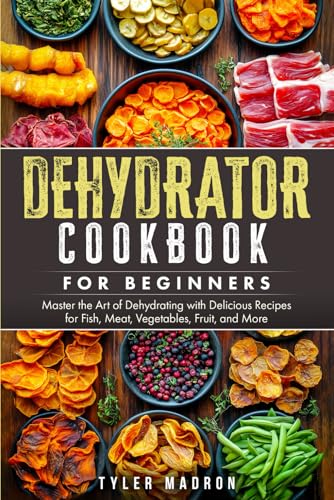
Dehydrator Cookbook for Beginners: Master the Art of Dehydrating — Best Confidence Builder
The verified listing for this beginner title makes two promises worth noticing: mastering the art of dehydrating, and coverage that includes fish alongside meat, vegetables, and fruit. Fish is the category most dehydrator books quietly skip, and a teaching book that includes it — with the care fish demands — widens a learner’s craft in a direction the others in this guide do not.
Strengths
- Fish coverage alongside the standard categories — a genuine differentiator
- Mastery framing: recipes sequenced to build skill, not just fill pages
- Broad protein and produce range suits households that preserve seriously
Trade-offs
- Fish and meat chapters demand the strictest cross-checking against official safety guidance
- Beginner ceiling applies, as with all starter titles
- Newer title; its structure, not its reputation, earns its place here
| Specification | Detail |
|---|---|
| Title | Dehydrator Cookbook for Beginners |
| Stated scope | Fish, meat, vegetables, fruit, and more |
| Framing | Master the art of dehydrating (per verified listing) |
Treat its protein chapters with the respect they require: read them fully before the first batch, follow the safety discipline exactly, and verify temperatures against current official guidance. Done that way, learning to dry fish and meat properly is one of the most satisfying expansions of a home preserver’s range — and one of the least served by the wider book market, which is precisely why this title is here.
Problem: your first dried fish came out oily and strong. → Fish selection is the lesson: lean fish dry cleanly, oily fish resist drying and carry strong flavours, and a mastery-minded book steers beginners to the right species and preparation first. Problem: you want to scale up to preserving a whole garden glut. → Work in the book’s order — master single trays of each food, log the times, then run full loads with confidence. Scaling a craft is a sequencing problem, and the sequence is the skill.
Best for: Beginners who want protein coverage, including fish, from the start / Not suited for: Produce-only households and readers wanting a formal reference
Check on Amazon — check price on Amazon before ordering, and confirm the listing details match the verified model described here.

Dehydrator Cookbook: 1300+ Days of Recipes, A Complete Guide — Best Long-Haul Practice Companion
Once the method is learned, the bottleneck becomes ideas — and that is this book’s verified proposition: a complete guide built around an extensive bank of recipes spanning fruits, vegetables, meats, and fish, framed as a long-haul supply of daily projects. In a how-to guide it plays a specific role: the practicum. Skills consolidate through volume and variety, and this is the volume.
Strengths
- Enormous project bank keeps skills sharp through sheer variety
- Complete-guide framing includes guidance alongside the recipes
- Fruits through fish coverage matches a serious household’s range
Trade-offs
- Not the first book to buy — its value unlocks after a teaching title
- Recipe-bank format means method is embedded rather than taught in order
- Sheer size can overwhelm a true beginner
| Specification | Detail |
|---|---|
| Title | Dehydrator Cookbook: 1300+ Days of Tasty and Healthy Recipes |
| Stated scope | Fruits, vegetables, meats, fish, and more |
| Framing | A complete guide to easy homemade dehydrating (per verified listing) |
The right way to use a book like this is as a training schedule: pick a project a week, log the results, and let repetition across categories turn book knowledge into instinct. Six months of that rhythm produces a genuinely skilled dehydrator — one whose own notebook has quietly become the real textbook, with this volume as its syllabus.
Problem: a book this size can paralyse a learner with choice. → The practicum method fixes it: choose by season, not by browsing — whatever is abundant and cheap this month is the curriculum. Problem: your results vary batch to batch and you cannot tell why. → At this volume of practice, the log becomes the diagnostic tool: compare the entries, find the variable that changed, and the inconsistency usually confesses. Volume plus records is how a hobby quietly becomes expertise.
Best for: Learners past the basics who want a long, varied practice programme / Not suited for: True beginners as a first and only book
Check on Amazon — check price on Amazon before ordering, and confirm the listing details match the verified model described here.
Comparison Table
| Pick | Badge | Key spec | Best for |
|---|---|---|---|
| The Beginner’s Guide to Dehydrating Food, 2nd Edition | Best Structured Course | 2nd edition teaching guide, Workman | Orderly learners who want the craft taught properly from the start |
| Food Dehydrating for Beginners: How to Dehydrate Food and Cook with It | Best Plain-Language Teacher | Full-loop beginner guide: dry, store, cook | Beginners whose goal is a usable pantry, not just snacks |
| The Ultimate Dehydrator Cookbook: The Beginner’s Guide to Dehydrating Food | Best Method-Plus-Recipes Teacher | Beginner guide across jerky, fruit, veg, herbs, meat | Hands-on learners who want method and recipes in one volume |
| The Home Food Dehydrator Cookbook: 100+ Easy Recipes with Charts | Best Learn-by-Cooking with Charts | 100+ recipes with full charts | Practical learners who want charts and recipes teaching together |
| Dehydrator Cookbook for Beginners: Master the Art of Dehydrating | Best Confidence Builder | Beginner mastery incl. fish and meat | Beginners who want protein coverage, including fish, from the start |
| Dehydrator Cookbook: 1300+ Days of Recipes, A Complete Guide | Best Long-Haul Practice Companion | Large complete-guide recipe bank for practice | Learners past the basics who want a long, varied practice programme |
The Five Judgements Every Dehydrator Book Should Teach
Thickness first: uniform slices dry evenly, and a book should give you target thicknesses per food rather than leaving you to guess. Temperature second: delicate herbs, fruits, vegetables, and meats each live at different settings, and the reasoning — moisture, safety, quality — should be explained, not just tabulated. Airflow third: tray rotation, spacing, and not overloading are machine-handling skills every teaching book should cover.
Doneness fourth, and it is a touch skill: leathery versus brittle, the cool-and-test ritual, the difference between surface dryness and a truly dry centre. Storage fifth: conditioning in a jar with daily shaking, honest containers, labels with dates, and realistic shelf-life expectations. A book that teaches all five has taught you the craft; the recipes are then just well-chosen homework.
How Long Does It Take to Learn Dehydrating?
Basics in a weekend: fruit leathers, apple chips, and herbs forgive nearly everything. Judgement in a season: thickness, doneness, and storage become instinct after a dozen varied batches. Meat confidence last and slowest, because it should — the safety discipline is learned deliberately or not at all. The books above are ordered to match that arc, and your batch log is the thread that ties the stages together.
Reading a Dehydrator Book Critically: Five Checks
First, does it give doneness tests or only times? Times vary; tests travel. Second, does it discuss thickness as a variable, or pretend slices cut themselves? Third, does the storage advice include conditioning, or does food go from tray to jar with no inspection step? Fourth, is meat treated with visible seriousness — separate guidance, clear temperatures, no casual tone? Fifth, does the book ever admit uncertainty, ranges, and variation? A book that admits the craft’s variables is a book written by someone who has actually dried food.
Apply those five checks to any title — including the ones in this guide, whose verified listings and structures passed them — and the dehydrator shelf separates itself into teachers and filler within minutes. It is the fastest quality filter a new preserver can learn.
The Batch Log: The Chapter You Write Yourself
Every teaching book in this guide will, in its own way, tell you to keep notes; few learners do, and the difference shows within a season. A useful log entry is five fields: food and variety, slice thickness, temperature, total time, and a one-line verdict. Thirty seconds per batch. With it, your second year starts from knowledge; without it, your second year starts from memory, and memory is a notoriously unreliable preserving partner.
Keep the log in the book you use most — margins, a notebook rubber-banded to it, whatever survives contact with your kitchen habits. In time the log’s authority exceeds the printed charts’, because it describes your machine in your climate drying your food. That is not a rejection of the books; it is their graduation ceremony.
From Snacks to System: How Skills Compound
The beginner dries snacks. The intermediate dries ingredients — the tomato, mushroom, and herb building blocks of future meals. The advanced preserver dries with a system: garden gluts planned against pantry space, proteins handled with disciplined safety, powders and leathers converting surplus and scraps into value, and a log that makes the whole operation repeatable. The books in this guide are sequenced along exactly that path, and none of them is wasted money if you walk it in order.
Notice what the path does not require: a bigger machine. Skill compounds faster than equipment, and most households discover their first dehydrator had headroom they could not see when they bought it. Learn the craft on the machine you have; the books will tell you honestly if and when you have outgrown it.
Learning Curves: What Week One, Month One, and Year One Look Like
Week one is calibration: one fruit, one herb, a notebook opened, and the discovery that your machine runs its own version of the printed times. Everything in week one is supposed to be simple, and the teaching books are structured to keep it that way. Month one is range: vegetables, leathers, a first careful jerky, and the first storage lessons — including, for most learners, one batch lost to under-drying, which teaches more than ten successes.
Year one is system: the harvest calendar anticipated, the pantry rotating, the log thick with your own numbers, and the books demoted from teachers to references — consulted for the unfamiliar mushroom, the new cut of meat, the neighbour’s glut of plums. That demotion is the goal. A how-to book that has made itself mostly unnecessary has done the finest work a book can do, and the six in this guide were chosen because they are built to be graduated from.
Teaching Someone Else: The Books as a Curriculum
These teaching titles double as the curriculum when the student is not you — a teenager taking over the garden glut, a partner who wants the jerky project, a community preserving class. The order this guide recommends works unchanged: structured guide first, chart-backed practice second, volume last. Add the safety conversation early and explicitly for any new learner, especially around meat, and supervise the first protein batch whoever the student is.
The social dimension is real: preserving is historically a communal craft, and a dehydrator running through a harvest weekend with two people slicing, logging, and tasting is a different — better — activity than the same work alone. The books give the group a shared method and a shared vocabulary, which is most of what teaching ever is.
When the Book and the Internet Disagree
It will happen: a video insists on a temperature your book forbids, a forum swears by a time your chart calls unsafe. The resolution rule taught implicitly by every good book in this guide is hierarchy — official food-safety guidance outranks print, print outranks posts, and your own logged results outrank everyone for quality questions on your own machine. For safety questions, never let a logged result overrule the safety guidance: a batch that seemed fine is an anecdote, not a standard.
That hierarchy, internalised, is arguably the most valuable thing a how-to book teaches — more durable than any chart, because charts date and principles do not. It is also the answer to give the friend who asks why you bought a book in the age of free videos: because judgement, unlike recipes, is hard to search for.
Core Temperatures and Times: How to Think About the Numbers
Teaching books organise drying around a simple physical picture: warm air moves moisture from the food’s surface, and the food’s interior moisture migrates outward to replace it. Temperature is chosen per category — gentle for herbs whose oils are volatile, moderate for fruits and vegetables, and governed by strict safety guidance for meats — and time is the outcome, not the input. That is why good books print ranges and doneness tests: the number on the dial is a decision, the number on the clock is a consequence.
Thickness bends every rule in the learner’s favour or against it: halve the thickness and you roughly halve the time, while doubling it can more than double the wait and risks a damp centre in a dry-looking piece. When a batch misbehaves, the teaching habit is to interrogate thickness before temperature — a discipline the books in this guide instil early and often.
Pre-Treatments Explained: Blanching, Dips, and Marinades
Three pre-treatments recur through every teaching text, and understanding them is a milestone. Blanching — a brief heat bath for vegetables — stops enzyme action that would otherwise dull colour, flavour, and nutrition in storage. Acidulated dips for pale fruits hold their colour against oxidation during the long dry. Marinades for jerky are flavour and cure in one step, and the only pre-treatment where the recipe is also a safety component, to be followed exactly rather than improvised.
None of the three is busywork; each solves a named failure the learner will otherwise meet by Christmas. A book that explains the why behind them — as the method-led picks here do — converts three chores into three tools you will reach for with understanding.
Advanced Topics Your Second Year Will Ask About
By the second season, learners start asking questions the beginner shelf only gestures at, and it is worth knowing the map. Drying for backpacking meals — complete dishes, rehydrated at altitude — is a discipline of its own, with fat content as its central problem. Drying flowers, crafts, and pet foods extends the machine sideways into the household’s other economies. Large-batch preserving raises throughput questions: tray rotation systems, load planning, and the honest arithmetic of electricity per jar.
The teaching books in this guide handle the threshold of each topic well enough to tell you whether it is for you; the reference shelf from the companion guide then carries you deeper. What matters at the beginner stage is not mastering these branches but knowing they exist, so your first-season habits — the log, the safety discipline, the storage rigour — are built to scale into them.
Notice, too, what does not change at the advanced level: thickness, doneness, conditioning, and records decide results in year five exactly as in week one. The craft’s foundations are its ceiling as well as its floor, which is the deepest reason this guide insists on learning them properly from books that teach them properly.
A Word on Machine Manuals, Forums, and Contradictory Advice
Every learner eventually meets three authorities disagreeing: the book says one time, the manual another, a forum a third. The working resolution is to separate the question types. Machine operation — tray order, vent settings, maximum loads — belongs to the manual, which knows your hardware. Food method — preparation, doneness, storage — belongs to the book, which knows the craft. Enthusiast forums belong to inspiration: flavours, combinations, and projects you had not imagined, all to be run through the book’s method before they touch your trays.
Safety questions exit this system entirely and go to official guidance, as this guide has said at every relevant point. Keep those lanes clear and contradictory advice stops being confusing — it becomes a library with a catalogue, each source shelved where its authority actually runs.
Confidence, Calibrated: The Real Graduation
There is a moment in every learner’s second season when a tray of something unfamiliar goes in without a recipe — sliced by judgement, set by principle, tested by touch — and comes out right. That moment is the true product of every book in this guide. Not the snacks, not the pantry, but a cook whose judgement can be trusted with food nobody wrote instructions for.
Calibrated is the operative word: the graduate is not careless, but careful in the right places — exact about safety, relaxed about flavour, rigorous about records, unbothered by a substituted herb. The books teach that calibration by modelling it: firm where firmness protects, flexible where flexibility teaches. If you finish your first season with that temperament installed, the shelf has done everything a shelf can do.
After that, the craft becomes generous: you will teach it, lend the books, and give the jars away. Start where this guide starts — one teaching book, one honest batch, one page of notes — and the rest follows with the reliability of a well-dried apple: slowly, and then all at once, it keeps.
Your First Solo Batch: A Confidence Checklist
Before your first unsupervised batch, run this short list the teaching books build toward: the food is sliced uniformly and you could say why that thickness; the temperature is chosen from the book’s reasoning, not copied blindly; the doneness test for this food is one you can describe before the trays go in; the conditioning jar is washed and waiting; and the log is open with the first line written. Five checks, two minutes — and every one of them is a habit your second year will run unconsciously. That is the whole method of this guide compressed into a doorway ritual: small, complete, and repeatable, exactly like the craft itself.
How to Work Through a Dehydrator Book: A Four-Week Starter Plan
Week one — read and calibrate. Read your teaching book’s opening method chapters, then run one simple batch it recommends — apple or banana slices — logging thickness, temperature, and your machine’s actual finishing time against the book’s estimate.
Week two — produce range. A vegetable batch and an herb batch teach blanching judgement and low-temperature patience. Practise the book’s doneness tests on every tray, and condition and jar the results exactly as the storage chapter directs.
Week three — leathers and snacks. Fruit leather teaches puree thickness and even spreading; a snack batch teaches seasoning before drying. Log what you would change — that column of the log is where learning lives.
Week four — protein, carefully. Read the meat chapter fully, cross-check its temperatures against current official food-safety guidance, and only then run a small jerky batch. Small, careful, logged: that is the correct first protein project.
Troubleshooting, in the pattern every beginner meets. Problem: edges dry, centres damp → slices were uneven or the batch was overloaded; slice uniformly and give trays air space. Problem: fruit darkened → it needed a pre-treatment the book describes, or a lower temperature. Problem: dried food went soft in storage → it was jarred before it was truly dry or skipped conditioning; return it to the dehydrator promptly or discard if mould is present. Problem: jerky texture is wrong → thickness and marinade time are the usual levers; adjust one variable per batch and log it.
Common Buying Mistakes
Buying a recipe collection when you need a teacher. If you cannot yet judge doneness by touch, method comes first — recipes second.
Reading the whole book before drying anything. Alternate chapters with batches. The craft is learned at the trays, with the book open beside them.
Treating book times as guarantees. Humidity, thickness, and your machine all move the finish time. Times are starting points; doneness tests are the verdict.
Skipping the safety reading for meat. The one unforgivable shortcut in this craft. Read it, cross-check it, then dry.
Never logging a batch. Without a log, every batch is your first batch. Two lines per tray is enough.
Final Recommendation
Learn in the order this guide is built: the Workman Beginner’s Guide or Food Dehydrating for Beginners for structured teaching, a chart-backed recipe title for practice with numbers, and the big complete-guide volume as your long-haul practicum. Add the brand and recipe shelves from the companion guide when your skills want feeding. Above all, keep the log — in a year it will be the best book on how to use your food dehydrator ever written, because it will be about your machine and your kitchen.
Check the format and the current price on Amazon for the titles you choose, then start week one this weekend: one book, one batch of apples, one page of notes.
Related guides in this series: Best Book For Food Dehydrators, Best Food Dehydrators, Best Dehydrator Cookbooks.
Frequently Asked Questions
What is the single best book to learn dehydrating from?
For structured teaching, The Beginner’s Guide to Dehydrating Food. For plain-language, pantry-focused learning, Food Dehydrating for Beginners. Both are verified picks above; choose by learning style, not by cover.
Can I learn dehydrating from recipes alone?
You can learn operations from recipes, but judgement — thickness, doneness, storage, safety — comes from method teaching. The strongest route pairs one teaching book with one recipe-led book, as this guide recommends.
How do I know dried food is actually done?
Use your book’s doneness tests: cool a piece fully, then bend and tear it. Fruit should be leathery with no moisture beads when squeezed; vegetables brittle; jerky should bend and crack without snapping or feeling wet. When in doubt, dry longer — under-dried food fails in storage.
Is dehydrating meat at home safe to learn from a book?
It is a well-established practice when the safety discipline is followed exactly: correct temperatures, proper preparation, and full reading of the safety guidance. Cross-check any book’s meat numbers against current official food-safety recommendations before your first batch.
What is conditioning, and why do the books insist on it?
Conditioning means packing cooled dried food loosely in a jar for several days, shaking daily, and watching for condensation. It equalises moisture between pieces and reveals under-dried batches while they can still go back into the dehydrator. It is the cheapest insurance in the whole craft.
Do I need a different book for my specific dehydrator brand?
Only when the machine’s format changes the cooking — large square-tray machines are the main case. Otherwise a good generalist teaching book plus your machine’s manual covers you fully.


