Disclosure: airfryerkitchensupply.com is reader-supported. When you buy through links on our site, we may earn an affiliate commission at no extra cost to you.
The best boat toilets — marine heads, in the language of the water — divide into two honest families, and choosing between them is the real decision in this guide. Fixed marine toilets plumb into the boat: a manual pump model or a 12-volt electric model with a macerator, discharging to a holding tank or, where legal, overboard. Portable cassette toilets like the Porta Potti line sit anywhere, need no plumbing or power, and are emptied ashore. Everything else — size, noise, comfort, cost — is refinement of that first choice, and it depends on your boat, your cruising, and whether a holding-tank system already exists aboard.
Why not simply fit a household toilet? Because a boat moves, heels, and lives on 12-volt power and limited fresh water. Marine heads are built for that world: compact bowls that fit a heads compartment measured in inches, pumps and macerators that move waste through small-bore hose to a tank, seals and valves that keep seawater and smells where they belong, and materials that shrug off a marine environment. A household fixture aboard would fail on size, water demand and dignity within a weekend. The six picks below are all genuine marine products, verified as such.
A word on the unglamorous essentials before the picks. Whatever you choose must work with your discharge reality: holding tank capacity, pump-out access at your marina, and the no-discharge rules of the waters you cruise — several picks here are portable precisely because they sidestep that system entirely. Ventilation, hose quality and a vented loop where the maker requires one decide whether a marine head smells like a boat or like a bathroom. This guide treats those as first-order topics, because on the water they are.
Where to buy
All six confirmed picks are sold through Amazon, where you can check the current price on Amazon for each model, confirm the voltage, bowl size and included fittings on the listing, and have it delivered to home or marina. Start with these confirmed options:
- Thetford Porta Potti 365 Portable Toilet — Best Overall for Small Boats: Check the current price on Amazon
- Jabsco 37010-4092 Electric Marine Toilet, Regular Bowl — Best Electric Fixed Head: Check the current price on Amazon
- SEAFLO 12V Electric Marine Toilet, Compact — Best Compact Electric: Check the current price on Amazon
- SEAFLO Quiet Flush Electric Marine Toilet, Fresh Water — Best Quiet Flush: Check the current price on Amazon
- Jabsco Twist n’ Lock Manual Marine Toilet, Compact Bowl — Best Manual Fixed Head: Check the current price on Amazon
- Thetford Porta Potti 565E Curve Portable Toilet — Best Premium Portable: Check the current price on Amazon
Always re-check the listing for the exact configuration — 12-volt versus other voltages, compact versus regular bowl, and what hose, switches and fittings are included. Marine heads share model names across variants, and the wrong variant discovered at the dock is a season’s annoyance.
In this guide
Quick Picks
- Best Overall for Small Boats: Thetford Porta Potti 365 Portable Toilet — The benchmark portable head — sealed cassette, real flushing action, and no plumbing, power or holding tank required. Check price on Amazon
- Best Electric Fixed Head: Jabsco 37010-4092 Electric Marine Toilet, Regular Bowl — The long-serving 12-volt electric head with a regular bowl — push-button flushing and a parts network everywhere boats are used. Check price on Amazon
- Best Compact Electric: SEAFLO 12V Electric Marine Toilet, Compact — Compact ceramic bowl, self-priming macerator and switch-panel control — electric flushing sized for small heads compartments. Check price on Amazon
- Best Quiet Flush: SEAFLO Quiet Flush Electric Marine Toilet, Fresh Water — Fresh-water rinse, quiet-flush design, soft-close seat and a macerator pump — the civilised electric head for boats that sleep aboard. Check price on Amazon
- Best Manual Fixed Head: Jabsco Twist n’ Lock Manual Marine Toilet, Compact Bowl — The classic hand-pump head — no electricity, total control, and a twist-lock handle that guards against backflow mishaps. Check price on Amazon
- Best Premium Portable: Thetford Porta Potti 565E Curve Portable Toilet — The Curve flagship portable — taller, styled, with battery-powered flushing and a 4-gallon fresh / 5.5-gallon waste split per its nameplate figures. Check price on Amazon
How These Picks Were Chosen
Every linked model was verified through the airfry site Amazon listing data — fixed heads from a dedicated marine search, portables from the verified cache — with each Amazon title confirming the marine format stated here. From that pool, picks were ranked on the criteria that decide life aboard: fit in a real heads compartment, flushing and macerating competence, power and water demand, noise, serviceability with parts that actually exist, and honesty about what the system needs around it — tank, hoses, vents and pump-outs.
The list deliberately spans the marine market’s real structure: one manual fixed head, three electric fixed heads at different sizes and noise levels, and two portable cassette models from the range that dominates small-boat use. Composting heads — a legitimate fourth family — are covered in this site’s composting coverage rather than padded in here, because their verified champions belong to that cluster; the buying guide explains where they fit in the decision.
Two filters removed otherwise plausible products. Household and RV-only toilets with no marine rating were cut — a boat head must tolerate heel, marine hoses and seawater-adjacent conditions. And electric models with no stated macerator or pump arrangement were cut, because an electric head that cannot move waste to the tank is a seat with a button. What survived is the working core of the marine market.
The 6 Best Boat Toilets

Thetford Porta Potti 365 Portable Toilet — Best Overall for Small Boats
For the majority of small boats, the best boat toilet is not plumbed in at all. The Porta Potti 365 is the reference portable: a proper two-part cassette toilet with a freshwater flush, a sealed waste tank you carry ashore to empty, and a seat height and bowl that feel like equipment rather than camping improvisation. Thetford lists it for marine use outright in its Amazon title. It suits day boats, small cruisers, trailer sailors and any boat whose heads ‘compartment’ is a locker — which is to say, most boats under thirty feet that were not built with a plumbed head.
Strengths
- No installation: no plumbing, wiring, tank or through-hulls
- Sealed cassette empties cleanly at any marina facility
- A genuine flush and a usable seat height, unlike basic bucket-style portables
Trade-offs
- Capacity is finite — a weekend for a crew, less for a crowd
- You carry the cassette ashore; someone has to own that job
- It must be secured in place aboard, or it will travel in a seaway
| Format | Portable cassette toilet (per Amazon title) |
| Use | RV, marine, camping and more (per Amazon title) |
| Model | 92820 (per Amazon title) |
The 365’s dominance of this category is earned in the details of emptying, which is where portable toilets are truly judged. The cassette separates with a sealed valve, pours through a rotating spout without drama, and rinses clean at a standard facility — a five-minute, dignity-preserving routine that owners of lesser portables, with their splash-prone openings, describe with feeling. The flush is a real rinse from an onboard freshwater reservoir rather than a hopeful drizzle, and the waste tank’s capacity is sized for genuine weekend use by a small crew.
Aboard, the discipline is placement and restraint. Site it where it can be lashed or bracketed — a portable that slides in a chop is a hazard and a mess — with ventilation if the locker allows, and treat the cassette chemicals honestly per the maker’s guidance, choosing holding-tank-friendly treatments where your marina requires them. Used that way, the 365 delivers 90 percent of what a plumbed head delivers, with none of the system: no tank to pump out, no hoses to permeate, no winterising beyond a rinse and dry storage.
Choose it unless your boat already has, or genuinely needs, a plumbed system. For a boat bought this season, it is also the correct first head even for owners planning a plumbed install later — it gets you on the water immediately, teaches the crew the routines, and retires to camping and emergency duty afterwards without resentment.
Best for: small boats, day boats and trailer sailors wanting a real head with zero installation / Not suited for: larger cruising boats with existing holding-tank systems and high crew throughput

Jabsco 37010-4092 Electric Marine Toilet, Regular Bowl — Best Electric Fixed Head
When a boat has a holding-tank system and wants push-button simplicity, the Jabsco 37010 series is the default answer, and the 4092 pairs it with the regular — full-size — bowl on 12 volts. Jabsco’s marine heads are the industry’s reference point: the macerating electric flush is a single-button event, the bowl is a size adults recognise, and seals, pumps and service kits exist in every chandlery on every coast. It suits cruising boats with a proper heads compartment, a tank, and owners who value a system the next mechanic will know on sight.
Strengths
- One-button macerating electric flush on 12V boat power
- Regular bowl size — the comfort of a household fixture
- Unmatched parts and service availability through Jabsco’s network
Trade-offs
- Electric macerators are audible — the whole boat knows
- Draws real current; battery capacity must be budgeted
- Requires a complete system: tank, hoses, venting and pump-out routine
| Power | 12 volt (per Amazon title) |
| Bowl | Regular bowl (per Amazon title) |
| Series | 37010 (per Amazon title) |
The case for the 37010 is the case for the standard. Marine heads are maintained for decades, often by owners far from home ports, and the Jabsco ecosystem — exploded diagrams in every manual, service kits on every chandlery shelf, mechanics who have rebuilt a hundred of them — converts breakdowns from season-enders into afternoon jobs. The macerator handles waste and marine-grade tissue and moves it through small-bore hose to the tank, which is what makes compact heads compartments and flexible tank placement possible in the first place.
Honesty about noise and power is required. An electric macerating head announces itself; light sleepers in the next cabin will hear a 3 a.m. flush, and the current draw, while brief, belongs in the boat’s power budget alongside the fridge and the anchor light. Boats that cruise quietly at anchor for days should weigh the manual pick below, or the quiet-flush pick, with that lifestyle in mind. Boats that marina-hop or motor regularly will never notice either cost.
Install it — or have it installed — with the unglamorous parts done properly: quality sanitation hose, a vented loop where the maker specifies, a vent filter on the tank, and seacocks you can actually reach. The head itself will then do its decade. In this guide’s ranking, the 37010 is the electric head against which the others are measured, and for a cruising boat with a tank, it remains the one to beat.
Best for: cruising boats with holding tanks wanting the standard, serviceable electric head / Not suited for: quiet-anchor sailors sensitive to flush noise, or boats without a tank system

SEAFLO 12V Electric Marine Toilet, Compact — Best Compact Electric
Small heads compartments are where electric heads usually fail the tape measure, and the SEAFLO compact exists for exactly that space: a compact-size ceramic bowl with a self-priming macerator, switch-panel control and 12-volt operation. Ceramic matters in a small compartment — it cleans like a household bowl and does not hold odours the way some plastics do. It suits compact cruisers and refits where the compartment was designed around a small manual head and the owner wants electric convenience without enlarging the room.
Strengths
- Compact footprint fits small heads compartments
- Ceramic bowl cleans easily and resists odour absorption
- Self-priming macerator with simple switch-panel control
Trade-offs
- Compact bowl is a smaller seat than a regular-bowl head
- SEAFLO’s service network is thinner than Jabsco’s
- Still needs the full tank, hose and vent system around it
| Bowl | Compact size, ceramic (per Amazon title) |
| System | Self-priming macerator, switch panel control (per Amazon title) |
| Power | 12V (per Amazon title) |
| Warranty | 4 year (per Amazon title) |
Measure twice is the compact-head mantra, and this pick rewards it: bring the compartment’s dimensions — depth from bulkhead, width for knees, height for the seat and lid arc — to the listing’s footprint before ordering, because compact heads differ by inches that matter. Where it fits, the SEAFLO delivers the full electric proposition in miniature: a macerator that clears the bowl and pushes waste to the tank through small hose, a self-priming pump that does not need coaxing after layup, and a panel switch simple enough for guests to use without a briefing.
The ceramic bowl deserves its emphasis. In the small, warm, ventilated-imperfectly space of a boat’s heads, bowl material is an odour decision as much as a cleaning one; glazed ceramic rinses clean and stays neutral in a way that rewards a quick wipe-down routine. Paired with decent sanitation hose — the true source of most ‘head smells’, as the buying guide explains — a ceramic compact head keeps a small boat smelling like a boat should.
Choose the SEAFLO compact when the compartment decides against the Jabsco’s regular bowl but the cruising style still wants electric. Its maker’s four-year warranty, stated in the Amazon title, softens the newer-brand calculation, and for trailerable cruisers and compact sailboats it is the difference between an electric head and no head at all.
Best for: compact cruisers and refits with small heads compartments wanting electric flushing / Not suited for: larger crew boats where a compact bowl will feel undersized daily

SEAFLO Quiet Flush Electric Marine Toilet, Fresh Water — Best Quiet Flush
Noise is a genuine buying criterion on a boat where the heads shares a bulkhead with a berth, and this SEAFLO is built around reducing it: a quiet-flush design with a fresh-water rinse — plumbed from the boat’s fresh water via a solenoid valve rather than raw-water intake — a ceramic bowl, a soft-close seat that cannot slam in a seaway, and a macerator pump behind a three-way switch panel. It suits liveaboards, family cruisers and charter-style boats where the head is used at all hours by people trying not to wake each other.
Strengths
- Quiet-flush design suits boats that sleep aboard
- Fresh-water rinse avoids raw-water odour and growth in the bowl
- Soft-close seat and ceramic bowl raise the civilised quotient
Trade-offs
- Fresh-water flushing spends the boat’s drinking water — tank maths required
- Most complex install here: solenoid, panel and macerator plumbing
- Premium tier among this guide’s electric picks
| Rinse | Fresh water, via solenoid valve (per Amazon title) |
| Bowl | Ceramic, soft-close seat (per Amazon title) |
| System | Macerator pump, 3-way switch panel, 12V (per Amazon title) |
| Warranty | 4-year (per Amazon title) |
Fresh-water flushing solves the marine head’s oldest smell at its source. Raw-water heads draw harbour or sea water into the bowl, and the microorganisms in that water die in the hose and bowl and announce themselves — the classic ‘first flush of the weekend’ odour. A fresh-water rinse removes that biology from the system entirely; combined with the quiet-flush design brief, the result is a head that behaves like a household fixture in both sound and smell, which is precisely what a family sleeping aboard is paying for.
The cost is written in the water tank. Every flush spends fresh water that the boat also drinks, showers and cooks with, so the cruising maths must be honest: tank capacity, crew size, days between refills. Boats with watermakers or marina-heavy itineraries will never feel it; a small boat stretching a small tank across a dry week should choose a raw-water or manual model instead. This is not a flaw — it is a budget, and this pick is for boats whose budget balances.
The soft-close seat and three-way panel complete the liveaboard brief: no slamming at anchor, and flush control options at the panel rather than a single committed blast. Installed with the same hose and venting discipline as any fixed head, the Quiet Flush is the pick that makes guests ask why their own boat’s head cannot be like this — the highest compliment marine plumbing receives.
Best for: liveaboards and family cruisers prioritising quiet, low-odour flushing with fresh water to spare / Not suited for: small-tank boats on long dry stretches where every fresh-water gallon is rationed

Jabsco Twist n’ Lock Manual Marine Toilet, Compact Bowl — Best Manual Fixed Head
The manual head is the sailor’s traditional answer, and Jabsco’s Twist n’ Lock compact is its reference model: a hand-pumped marine toilet with a compact bowl and a pump handle that twists to lock — a safety action that prevents the handle being knocked and guards the system against back-siphoning mishaps. It draws no electricity, uses raw water, and gives the user complete control of rinse and flush volume. It suits sailing boats that guard their batteries, long-distance cruisers who want a head they can service with hand tools anywhere on earth, and traditionalists who distrust a button for this job.
Strengths
- Zero electrical draw — kind to batteries on passage
- Fully user-controlled flush and rinse volumes
- Simple, globally serviceable pump mechanics
Trade-offs
- Hand pumping is a learned technique guests must be taught
- Compact bowl is a modest seat
- Raw-water rinse carries the classic marine odour management duties
| Format | Manual pump marine toilet (per Amazon title) |
| Bowl | Compact bowl (per Amazon title) |
| Model | 29090-3000 (per Amazon title) |
| Safety | Twist ‘n’ Lock handle (per Amazon title) |
The manual head’s virtues compound offshore. No current draw means the head works in a flat-battery emergency; hand pumping means the flush is exactly as long as the waste requires and not a pump-cycle more, which stretches holding-tank capacity on passage; and the mechanism — piston, valves, joker valve — can be stripped, serviced and rebuilt on a saloon table with a kit that fits in a sandwich bag. For a boat that leaves marina networks behind, that serviceability is not nostalgia, it is the specification.
The Twist n’ Lock detail matters more than its size suggests. A manual pump handle left unlocked can be lifted by motion or a careless knee, and the lock also disciplines the crew into the correct shutdown state for the system — handle locked, seacocks as briefed. On a boat, the head’s operating ritual is part of seamanship, and this model builds the ritual’s most important step into the hardware.
Teach guests properly and the manual head’s reputation for difficulty evaporates: a short demonstration, a laminated card, and the rule that nothing goes in that has not been eaten, marine tissue excepted. Choose it for sailing boats, expedition styles and any owner who wants the head to be the most repairable system aboard — which, at sea, is a serious ambition.
Best for: sailing boats, long-distance cruisers and battery-conscious owners wanting a serviceable manual head / Not suited for: guests-heavy motorboats where one-button electric convenience is the brief
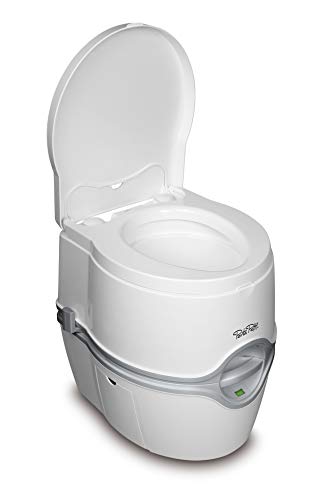
Thetford Porta Potti 565E Curve Portable Toilet — Best Premium Portable
The 565E Curve is the portable for owners who want the cassette life without the camping aesthetic: a taller, sculpted unit with battery-powered flushing, sized at 4 gallons of fresh water and 5.5 gallons of waste capacity per its model figures. In a small cruiser’s heads space it looks like a fixture rather than equipment, and the powered flush rinses more thoroughly than a bellows pump. It suits style-conscious small-boat owners, older users who appreciate the taller seat, and anyone whose portable will live in view rather than in a locker.
Strengths
- Taller, fixture-like design suits permanent placement in a heads space
- Battery-powered flush rinses more effectively than manual bellows
- Generous waste capacity for a portable — longer between marina trips
Trade-offs
- Batteries join the maintenance list
- Larger and heavier than basic portables, especially full
- Premium tier for the portable format
| Format | Portable cassette toilet (per Amazon title) |
| Capacities | 4 gal fresh / 5.5 gal waste (per Amazon title) |
| Model | 565E Curve (per Amazon title) |
The Curve’s design insight is that on many small boats the portable is not stored — it is installed, in a dedicated heads nook, for the season. A unit shaped and finished for that role changes how the space feels and how owners treat it: it gets cleaned like a fixture, its tank gets serviced on schedule, and guests use it without the apologetic briefing basic portables require. The battery flush supports that fiction with a real rinse at a button press, and the taller profile suits adult users over long weekends in a way low camping portables never do.
Capacity is the practical half of the premium: the 5.5-gallon waste tank stretches the interval between pump-out-facility visits, which on a cruising itinerary is a routing freedom — one less marina detour per week. The trade is weight when full; a full cassette is a serious carry, and smaller crew members should plan the marina routine around a half-full habit rather than heroic full-tank lifts.
Choose the Curve when the portable is a permanent resident and the boat’s style matters to you, or when seat height and flush quality rule out the basic models. Keep spare batteries aboard, secure the unit against motion as with any portable, and it will serve as the heads department of a small cruiser with surprising dignity.
Best for: small cruisers fitting a portable permanently, wanting fixture looks, height and a powered flush / Not suited for: minimalists who want the lightest, simplest portable to stow away between trips
Comparison Table
| Pick | Badge | Key spec | Best for |
|---|---|---|---|
| Thetford Porta Potti 365 Portable Toilet | Best Overall for Small Boats | Portable cassette, marine-rated | small boats, day boats and trailer sailors wanting a real head with zero installation |
| Jabsco 37010-4092 Electric Marine Toilet, Regular Bowl | Best Electric Fixed Head | 12V electric macerator, regular bowl | cruising boats with holding tanks wanting the standard, serviceable electric head |
| SEAFLO 12V Electric Marine Toilet, Compact | Best Compact Electric | Compact ceramic, 12V macerator | compact cruisers and refits with small heads compartments wanting electric flushing |
| SEAFLO Quiet Flush Electric Marine Toilet, Fresh Water | Best Quiet Flush | Quiet fresh-water flush, soft-close | liveaboards and family cruisers prioritising quiet, low-odour flushing with fresh water to spare |
| Jabsco Twist n’ Lock Manual Marine Toilet, Compact Bowl | Best Manual Fixed Head | Manual pump, Twist n’ Lock, compact | sailing boats, long-distance cruisers and battery-conscious owners wanting a serviceable manual head |
| Thetford Porta Potti 565E Curve Portable Toilet | Best Premium Portable | Premium portable, battery flush | small cruisers fitting a portable permanently, wanting fixture looks, height and a powered flush |
How to Choose the Best Boat Toilets for Your Boat and Cruising
Start with the boat, not the toilet. Does a holding tank, deck pump-out fitting and heads compartment already exist? If yes, the fixed heads — manual or electric — are your shortlist, and the choice between them is lifestyle: electric for push-button ease on boats with power to spare, manual for sailing boats and service-anywhere cruising. If no system exists, price the whole installation honestly before dismissing portables: a fixed head is a toilet plus tank, hoses, vent, through-hulls or deck fittings and labour, while a portable is a toilet. Many small-boat owners who do that maths honestly buy the portable and go sailing.
Then size the compartment with a tape measure and humility. Heads compartments are the smallest rooms in the world; measure depth, width at knee height, and the lid’s swing, and compare against compact versus regular bowls. A regular bowl in a compartment where your knees meet the door is worse than a compact bowl you can actually sit on. Crew size and cruising pattern finish the sizing: a couple weekend-sailing needs a fraction of the capacity a family of five at anchor for a week needs, and cassette capacity or tank size should be chosen for the longest realistic stretch between pump-outs, not the average trip.
Finally, decide your discharge reality. Know your marina’s pump-out situation, your cruising grounds’ no-discharge rules, and whether cassette emptying ashore fits your routine. Composting heads deserve a mention here as the fourth family: they need no tank or pump-out and suit long-term cruisers willing to manage the medium — they are covered in depth in this site’s composting coverage, linked at the end, rather than ranked here, because their verified champions live in that cluster. Whichever family you choose, choose it for the waters and facilities you actually use.
The System Around the Head: Tanks, Hoses, Vents and Smells
Most marine head misery is not the toilet’s fault. Permeated hoses are the classic culprit: waste sits in low hose runs, the hose wall absorbs odour over seasons, and the whole compartment smells regardless of the head’s quality. The defences are quality sanitation hose, runs that drain fully to the tank with no low sags, and replacing hose on a realistic schedule. If a boat smells, test by wiping a hot damp cloth along the hose and smelling the cloth — the answer will redirect your spending from the toilet to the plumbing, where it belongs.
Venting is the second system that decides everything. A holding tank without adequate venting builds pressure, starves the bacteria that would digest waste aerobically, and produces the worst version of tank odour — then vents it through the head itself. A clear, generous tank vent, ideally with a vent filter, converts the tank’s biology to the aerobic kind that barely smells. Many ‘toilet problems’ are vent problems wearing a disguise, and the fix costs less than any pick in this guide.
The third element is routine. Pump out before the tank is brim-full, rinse the tank when facilities allow, use holding-tank treatments compatible with your marina’s rules, and keep seacocks exercised and accessible. For portables, the routine is simpler — empty before full, rinse the cassette, dry-store seals with a dab of the maker’s recommended care — but no less decisive. A marine head is a small system with a weekly rhythm; owners who keep the rhythm forget the system exists, which is the goal.
Power, Water and Noise: Living With a Marine Head
Electric heads spend two currencies: battery charge and, for fresh-water models, drinking water. The macerator’s draw is brief but real, and on a sailing boat at anchor for days, the honest accounting includes it alongside the fridge and lights. Fresh-water flushing spends the tank with every use — civilised and odour-free, but a rationed resource on passage. Raw-water electric and manual heads spend neither drinking water nor (for manual) electricity, at the cost of raw-water odour management and, for manual, effort. There is no correct answer, only a correct match to the boat’s resources and the crew’s habits.
Noise deserves the same honest treatment. A macerator at 3 a.m. in a quiet anchorage is a social event. If the boat sleeps family or guests within a bulkhead of the heads, weight the quiet-flush design or the manual head — which is silent apart from pumping — accordingly. Charter and marina-based boats can ignore this paragraph; boats that anchor out with light sleepers cannot.
Winterising and layup close the ownership loop. Fixed systems need their water drained or protected per the maker’s instructions, pumps run with the approved antifreeze type where specified, and seacocks left in the maker’s recommended state. Portables need a rinse, a dry, and seals stored unstressed. Ten years of good layups is the difference between a head that serves a boat’s whole life and one that becomes a refit line item — plan the autumn routine when you install, not when the first frost threatens.
How to Install and Set Up a Boat Toilet
Whether the head is plumbed or portable, setup discipline decides how it behaves for seasons. These steps cover the shared ground and flag where the families diverge — and any through-hull or seacock work beyond your competence belongs to a marine professional, without exception.
- Choose and prepare the location: for a fixed head, confirm the compartment dimensions against the bowl size, the tank position, and hose runs that fall continuously toward the tank with no low sags where waste can sit. For a portable, choose a level spot where it can be secured against motion and reached comfortably.
- For fixed installs, fit or inspect the system in order: seacocks and through-hulls sound and accessible, vented loop where the maker requires one, tank vent clear and filtered, and quality sanitation hose throughout. Do not connect a new head to tired hose and blame the head for the smell.
- Mount the head on a sound, level base, bolting through solid structure with backing where the maker specifies. A head that flexes under load will work its seals loose — rigidity is a plumbing feature.
- Connect discharge and intake lines with double clamps where specified, route the flush control or switch panel within easy reach of the seated user, and for electric heads wire to the boat’s panel with the maker’s specified protection — never a casual tap into an unrelated circuit.
- For portables, set the unit in its secured position, fill the flush reservoir, add the maker-recommended treatment to the cassette, and brief the crew on the slide valve and flush routine before the first outing, not during it.
- Commission the system with clean water first: flush repeatedly, check every joint, clamp and the base for leaks underway-style — engine off, boat quiet, listening as well as looking. For electric heads, time a flush and note the sound; that baseline is how you will recognise a future problem early.
- Brief every user, in writing on a small card in the compartment: what may go in (nothing that has not been eaten, plus marine tissue only), how to flush, how much water to use, and the shutdown state — pump locked or panel off, seacocks as your boat’s routine dictates.
- Log the maintenance rhythm from day one: pump-out or cassette schedule, vent filter changes, joker valve and seal inspections for fixed heads, and the layup routine. The head that gets a rhythm gets a decade.
Common Buying Mistakes
Buying the toilet and ignoring the system. A fixed head is tank, hoses, vent and pump-out routine. Budget and inspect the whole system, or a portable — which has no system — is the honest purchase.
Skimping on sanitation hose. Cheap or perished hose is the leading cause of heads smell. Fit quality hose with runs that drain, and replace it on schedule.
Letting waste sit in a low hose run. A sagging discharge hose holds waste permanently. Route runs to drain fully toward the tank, even if it means a longer path.
Putting household tissue and worse down a marine head. Marine heads handle waste and marine tissue. Wipes, sanitary products and kitchen paper are unblocking jobs — the card in the compartment exists for a reason.
Neglecting the tank vent. A blocked or undersized vent creates pressure, odour and miserable pump-outs. Keep it clear and filtered; it is the cheapest quality-of-life part on the boat.
Leaving a portable unsecured. A cassette toilet that slides or tips in a seaway is a catastrophe in a small space. Bracket it, strap it, or stow it — every time, not just offshore.
Final Recommendation
Match the family to the boat and the rest follows. Small boats without systems should take the Porta Potti 365 and go boating; small boats wanting a permanent, civilised portable take the 565E Curve. Boats with tanks take the Jabsco 37010 for the standard electric answer, the SEAFLO compact where the compartment is small, the SEAFLO Quiet Flush where sleep and fresh water allow, and the Jabsco Twist n’ Lock where batteries, silence and serviceability rule. Every one of those is a genuine marine head with a defensible reason to exist.
Whichever you fit, spend your discipline on the system around it — hose, vent, routine, briefing — because that is where marine heads succeed or fail over seasons. The toilet itself, chosen from this list for the boat you actually sail, will do its part quietly for years. Which, on the water, is the highest praise any equipment earns.
One last sizing thought for buyers between families: count your crew nights honestly. A portable’s cassette that is generous for a couple’s weekend is a daily chore for five people at anchor, and a fixed system installed for a marina-hopping couple is capital sleeping in a locker. The right head is the one whose emptying rhythm — cassette trips ashore, or pump-out stops — fits the cruising you actually did last season. Choose for that logbook, not the brochure version of your boating, and the head will feel correctly sized from the first trip.
- Thetford Porta Potti 365 Portable Toilet — Best Overall for Small Boats: Check the current price on Amazon
- Jabsco 37010-4092 Electric Marine Toilet, Regular Bowl — Best Electric Fixed Head: Check the current price on Amazon
- SEAFLO 12V Electric Marine Toilet, Compact — Best Compact Electric: Check the current price on Amazon
Keep researching the cluster: Best Portable Toilets Best Composting Toilets Best Books On Composting Toilets Best Toilets Best Bidets For Long Toilets Best Macerating Toilets
Frequently Asked Questions
What is the difference between a marine toilet and a regular toilet?
A marine head is built for a moving boat: compact dimensions, a pump or macerator that moves waste through small hose to a holding tank or discharge, valves and seals designed for marine plumbing, and operation on hand power or 12 volts. A household toilet needs a cistern’s gravity flush and a large soil pipe — neither exists on a boat — and would fail on size, water use and function.
Do I need a holding tank with a boat toilet?
Fixed marine heads discharge to a holding tank (or overboard only where local rules allow), and many cruising areas are no-discharge zones where a tank and pump-out routine are mandatory. Portable cassette toilets need no tank — the cassette is the tank, emptied ashore — which is a major reason small boats choose them.
How much power does an electric marine toilet use?
The macerator draw is significant but brief — seconds per flush — so daily consumption is modest for marina and motoring boats. On a sailing boat at anchor for many days it belongs in the power budget alongside refrigeration and lighting; boats that count every amp-hour often choose a manual head, which uses none.
Why does my boat’s head smell, and is it the toilet’s fault?
Usually not. The common causes are permeated discharge hose, a blocked or undersized holding-tank vent, and waste sitting in a low hose run. Test the hose with a hot damp cloth wipe; if it smells, replace the hose and clear the vent before blaming or replacing the toilet itself.
Can I use regular toilet paper in a marine head?
Use marine or rapid-dissolve tissue only. Household tissue — especially the strong, quilted kinds — is a leading cause of macerator and manual-pump blockages. Nothing else goes in at all: no wipes of any kind, even those labelled flushable, no sanitary products, no kitchen paper.
Are portable toilets legal and acceptable at marinas?
Yes. A sealed cassette portable is a self-contained system; you empty the cassette at the marina’s designated facility, never into the water. Carry the cassette upright, rinse it at the facility rather than at a drinking-water tap, and leave the facility cleaner than you found it — the portable-toilet community’s access to marina facilities depends on exactly that courtesy, and it costs nothing. Marinas are accustomed to Porta Potti-style cassettes, and for boats without holding tanks a portable is the compliant way to have a head aboard in no-discharge waters.


