Disclosure: airfryerkitchensupply.com is reader-supported. When you buy through links on our site, we may earn an affiliate commission at no extra cost to you.
Where to buy
Shoppers comparing the best blenders for pureeing baby food will find every pick in this guide on Amazon. Pureeing baby food is a weekly production job with a texture standard set by your baby’s stage — silky for first tastes, textured for growing eaters — and a workflow that must fit between naps. Every pick below is a dedicated baby food maker that steams and blends, verified for this exact job, and all are sold on Amazon, where you can confirm bowl sizes and included storage before buying.
The six machines in this guide are: BEABA Babycook Solo 4-in-1 Baby Food Maker, BEABA Babycook Neo Baby Food Maker, nutribullet Baby Steam + Blend NBY50200, NutriBullet Baby Complete Food-Making System NBY-50100, Momcozy AutoMeal Baby Food Maker, Grownsy Baby Food Maker. Check the current price on Amazon for the model you choose, and check price on Amazon again before ordering if you are comparing configurations, because jar sizes, included cups and colors vary by listing.
Introduction: Homemade Baby Food Is a Workflow Before It Is a Recipe
The best blenders for pureeing baby food are not really blenders in the countertop sense — they are small production systems that steam the sweet potato, blend it to the texture your baby’s stage requires, and portion it into storage, all in a footprint that survives on a crowded counter for the better part of a year. Judged as kitchen appliances they look simple; judged as the tool you will use twice a week while holding a baby, their design details matter enormously.
Texture is the technical heart of the job, and it changes under you. First foods want to be genuinely silky — thinner than you expect, without lumps. Within months, the same baby needs texture: soft lumps, then mashed consistencies that teach chewing. The machines in this guide were chosen for how gracefully they cover that progression, from steam-and-blend automation to pulse control that stops exactly where you tell it.
A note on scope: this guide covers equipment and texture technique only. Questions about when to start solids, which foods to introduce and how to handle allergens belong to your pediatrician’s guidance, and nothing here substitutes for it. What we can do — and what every pick was verified by brand and model to support — is make the mechanical part of homemade baby food as easy, safe and repeatable as it deserves to be.
One more expectation to set honestly: no machine in this guide makes baby food ‘effortless’ in the advertising sense. There is still washing, peeling, portioning and labeling. What the best machines do is compress the work into one vessel, one hand and one short session — and in the arithmetic of new parenthood, that compression is the difference between a sustainable homemade routine and a well-intentioned appliance in a cupboard. Every judgment below is made on that arithmetic.
In this guide
Quick Picks
Six dedicated steam-and-blend systems, from one-handed Béaba classics to a fully automatic maker that runs the whole cycle itself.
- BEABA Babycook Solo 4-in-1 Baby Food Maker — Best Overall: The 4-in-1 original: steams, blends, defrosts and reheats in a 37 oz bowl, one-handed, with batches up to 27 servings as listed. Check the current price on Amazon.
- BEABA Babycook Neo Baby Food Maker — Best Premium Pick: The premium Béaba: a 42 oz bowl, one-handed use and dishwasher-safe cleanup, growing from purees to solids with your baby. Check the current price on Amazon.
- nutribullet Baby Steam + Blend NBY50200 — Best All-in-One Value: Steam basket, pulse control and 2 oz and 4 oz storage cups included — the all-in-one that thinks about portioning, not just blending. Check the current price on Amazon.
- NutriBullet Baby Complete Food-Making System NBY-50100 — Best Batch-and-Store System: A 32 oz complete food-making system built around batching and storing — the meal-prep parent’s format. Check the current price on Amazon.
- Momcozy AutoMeal Baby Food Maker — Best Automatic Pick: One-step automatic steam and blend with 3-stage texture settings and self-cleaning — the set-it-and-walk-away pick. Check the current price on Amazon.
- Grownsy Baby Food Maker — Best Simple Steamer-Blender: A straightforward steamer-blender with an elevated steam basket, designed for purees, starting solids and baby-led weaning prep. Check the current price on Amazon.
How These Picks Were Chosen
Candidates had to be dedicated baby food systems, not general blenders with a baby claim: steam-and-blend in one vessel, texture control appropriate to stages, portioning or storage logic, and cleaning simple enough for a sleep-deprived parent at 10 p.m. General countertop blenders appear in the sibling puree guides; this list is specialists only.
Every product was verified — searched by brand and model, title matched — before any ASIN was used, and the spec boxes quote only those verified listings, including capacities, functions and included storage as the listings state them.
We weighted one-handed operation and automation heavily, because the realistic user of this appliance has a baby in the other arm. A machine that demands two hands, constant supervision or complex disassembly fails the actual job however beautifully it blends.
We also checked the unglamorous logistics: whether bowls and blades disassemble without tools, whether parts nest for storage, and whether the machine’s season of heavy use — roughly the first year of solids — is matched by a design that can then serve smoothies, soups or a next child. Single-purpose equipment earns its space by intensity of use, and these six are the category’s most defensible claims on a crowded counter.
The 6 Best Blenders for Pureeing Baby Food — Reviewed in Detail

BEABA Babycook Solo 4-in-1 Baby Food Maker — Best Overall
The Béaba Babycook Solo is the reference design for this category: a 4-in-1 machine that steams, blends, defrosts and reheats in one 37 oz bowl, operated one-handed, producing anything from silky purees to soft solids. For most families, it is simply the answer.
Strengths
- True 4-in-1: steam, blend, defrost and reheat in a single bowl
- One-handed operation designed for a parent holding a baby
- 37 oz bowl makes up to 27 servings per batch as listed — real freezer stock
Trade-offs
- Premium-of-category commitment for an appliance with a defined season of use
- Texture control is manual — you learn your baby’s stages by timing the blend
- A single bowl means steam and blend happen in sequence, not parallel
| Specification | Detail (as listed) |
|---|---|
| Capacity | 37 oz |
| Functions | Steam, blend, defrost and reheat (4-in-1) |
| Operation | One-handed operation |
| Textures | Purees to soft solids (as listed) |
The batch economics are the Solo’s quiet triumph: one bowl of sweet potato becomes a week of portions, and the defrost-and-reheat functions mean the same machine serves the food it made, months of freezer trays later. That closed loop — make, store, serve — is what separates a baby food system from a small blender with good marketing.
Texture progression is handled by blend duration and liquid: short blends with the steaming liquid retained give first-food silk; longer rests and less liquid give the chunkier stages. It rewards a parent who keeps simple notes per food, and most do within two batches.
Solo workflow refinement: steam a double batch of two vegetables in sequence using the same water session, blending each separately, and your freezer gains variety without a second cleanup. The defrost function also reheats a parent’s portion of the same puree as a soup base with seasoning added — the machine quietly serves the whole family’s table, not only the high chair.
Best for: Most families starting homemade baby food, especially batch-and-freeze planners / Not suited for: Parents who want fully automatic texture programs
Check on Amazon — check the current price on Amazon at the listing.

BEABA Babycook Neo Baby Food Maker — Best Premium Pick
The Béaba Babycook Neo is the premium sibling: a larger 42 oz bowl, the same one-handed philosophy, and dishwasher-safe cleanup as listed. If the Solo is the answer, the Neo is the answer with headroom and easier evenings.
Strengths
- 42 oz bowl is the largest dedicated capacity in this guide
- One-handed use preserved from the classic design
- Dishwasher-safe cleanup as listed — a real nightly difference
Trade-offs
- The premium pick of the category; budget families should weigh the Solo
- Shares the manual texture learning curve of its sibling
- Counter presence is noticeable for a single-purpose appliance
| Specification | Detail (as listed) |
|---|---|
| Capacity | 42 oz |
| Operation | One-handed use |
| Cleanup | Dishwasher-safe cleanup (as listed) |
The extra capacity matters for twins, for big batchers, and for families pureeing family-food adaptations alongside baby portions. The Neo’s design brief, as its listing presents it, is freshness with minimal effort — meals in minutes, one hand, and a cleanup that the dishwasher absorbs.
Choose the Neo if your batch sizes run large or your tolerance for hand-washing baby equipment at night runs low. Both are legitimate, common, and honestly served by this machine.
Neo owners with twins or close siblings should exploit the capacity for parallel flavors: one large batch blended half plain and half with a second ingredient added for a shorter second blend produces two varieties in one session. The dishwasher-safe cleanup matters most on exactly these big production days, when the alternative is hand-washing between every batch.
Best for: Large-batch families, twins, and parents prioritizing easy cleanup / Not suited for: Minimalist kitchens wanting the smallest possible footprint
Check on Amazon — check the current price on Amazon at the listing.

nutribullet Baby Steam + Blend NBY50200 — Best All-in-One Value
The nutribullet Baby Steam + Blend is the portioning thinker: an all-in-one system with a steamer basket, a pulse cycle for texture control, and 2 oz and 4 oz storage cups included in the box — the sizes first foods are actually served and frozen in.
Strengths
- Steamer basket and pulse cycle give deliberate texture control
- Included 2 oz and 4 oz storage cups match real portion sizes
- BPA-free and dishwasher safe as listed
Trade-offs
- Batch capacity is portion-scale rather than freezer-stock scale
- Pulse control means you supervise texture rather than selecting a stage
- Storage cup count in the box covers a start, not a full freezer system
| Specification | Detail (as listed) |
|---|---|
| System | All-in-one steam and blend with steamer basket |
| Controls | Pulse cycle |
| Extras | 2 oz and 4 oz storage cups |
| Cleaning | Dishwasher safe |
Pulse control is arguably the right texture interface for baby food: stages are a continuum, and short pulses with checks between them land exactly on today’s consistency, whether that is first-week silk or month-three texture. The included storage cups close the loop from blend to freezer without decanting into improvised containers.
This is the pick for parents who cook smaller and fresher — a few days at a time rather than a month — and who enjoy the control of pulsing to texture themselves.
Steam + Blend portioning practice: freeze in the included small cups first, then graduate to trays as appetites grow — the cups’ sizes track the early weeks when portions are genuinely tiny. The pulse cycle also makes an excellent reheating-adjacent tool: a few pulses re-smooth a thawed puree that has separated slightly in storage, restoring its fresh texture before serving.
Best for: Small-batch, fresh-first parents who want pulse-level texture control / Not suited for: Big freezer-stock batchers
Check on Amazon — check the current price on Amazon at the listing.

NutriBullet Baby Complete Food-Making System NBY-50100 — Best Batch-and-Store System
The NutriBullet Baby Complete Food-Making System is built around the batch-and-store philosophy: a 32 oz capacity system designed, as its name says, as a complete making system — the format for the Sunday-afternoon parent who produces the week’s food in one session.
Strengths
- 32 oz system capacity suits weekly batch production
- Complete-system format designed around making and storing
- Familiar nutribullet operation for households that already use the brand
Trade-offs
- Listing detail is leaner than rivals — confirm included components before buying
- Batch philosophy means more freezer organization demanded of the parent
- Less emphasis on automatic steaming than the Béaba and Momcozy designs
| Specification | Detail (as listed) |
|---|---|
| Capacity | 32 oz |
Systems thinking is this pick’s strength: baby food is a supply chain of one — production, portioning, freezing, thawing, serving — and a complete system addresses the chain rather than the single blend. Parents who meal-prep their own food will recognize and appreciate the logic immediately.
Choose it if your style is scheduled production with labeled trays, and if your kitchen already speaks nutribullet. It is the planner’s pick in a list full of good options.
System users should label at the tray stage, not the bag stage: a strip of tape on each tray with food and date survives freezing better than good intentions, and rotating trays oldest-first keeps the stock honest. The complete-system format rewards this small bureaucracy disproportionately, because its whole value is a freezer that behaves like a pantry.
Best for: Meal-prep parents producing weekly batches in one session / Not suited for: Parents wanting the most automated steam-and-blend cycle
Check on Amazon — check the current price on Amazon at the listing.
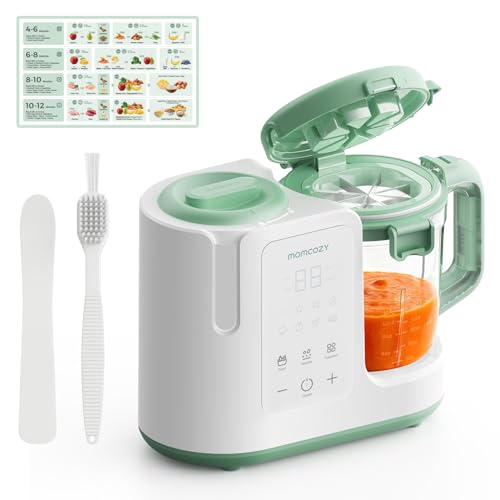
Momcozy AutoMeal Baby Food Maker — Best Automatic Pick
The Momcozy AutoMeal is the automation maximalist: one-step automatic steam and blend, auto 3-stage texture settings, a 15 oz cup with a 6-blade design, and self-cleaning as listed. You load it, choose the stage, and it runs the production while you do literally anything else.
Strengths
- One-step auto steam-and-blend cycle — the least supervision here
- Auto 3-stage texture settings map to baby’s progression
- Self-cleaning function as listed reduces the nightly wash burden
Trade-offs
- 15 oz cup is the smallest batch capacity in this guide
- Automation means trusting the program’s texture rather than pulsing your own
- Newer design with a shorter ownership track record than the Béaba classics
| Specification | Detail (as listed) |
|---|---|
| Cup | 15 oz cup |
| Blades | 6-blade design (as listed) |
| Programs | Auto 3-stage texture settings |
| Cleaning | Self-cleaning (as listed) |
The 3-stage texture concept deserves credit for naming the real problem: parents do not need infinite control, they need the right three consistencies at the right months, reliably. Automatic staging delivers that without a learning curve, and the self-cleaning cycle addresses the other real problem, which is the sink at 10 p.m.
The trade is batch size: 15 oz is a few days’ food, not a freezer campaign. For parents who prefer fresh, frequent, hands-off production over monthly batching, that trade is not a compromise at all — it is the point.
AutoMeal rhythm: because its batches are small and automatic, it suits a twice-weekly fresh cadence — load it while you make your own breakfast, and the baby’s next two days are produced by the time you finish eating. The self-cleaning cycle should be run immediately after each use; automatic machines stay automatic only when their cleaning is not deferred into a scrubbing session.
Best for: Parents who want automatic, fresh, small-batch production with minimal effort / Not suited for: Freezer-stock batchers who cook monthly
Check on Amazon — check the current price on Amazon at the listing.

Grownsy Baby Food Maker — Best Simple Steamer-Blender
The Grownsy Baby Food Maker is the straightforward steamer-blender: an elevated steam basket design, BPA-free as listed, presented for purees, starting solids and baby-led weaning prep. It does the category’s core job without the premium systems’ price posture or the automaton’s complexity.
Strengths
- Elevated steam basket design keeps foods steaming evenly above the water
- Covers purees through starting solids and BLW-style prep as listed
- Simple, focused design brief — the essentials without feature sprawl
Trade-offs
- Fewer listed functions than the 4-in-1 and automatic rivals
- Texture work is manual, by blend time and added liquid
- Confirm the exact included accessories at the listing before buying
| Specification | Detail (as listed) |
|---|---|
| System | Steamer and blender food processor |
| Basket | BPA-free elevated steam basket (as listed) |
Simplicity is a genuine feature in baby equipment, which accumulates in a kitchen like weather. A machine that steams and blends well, cleans without a diagram, and handles both the puree months and the soft-solids transition covers the season of use most families actually have.
Choose the Grownsy if you want the dedicated-system benefits — one vessel, steam-then-blend, right-sized batches — at the most accessible posture in this guide, and you are comfortable steering texture yourself.
Grownsy simplicity pays a second dividend: visiting grandparents and caregivers can operate it without a manual or a briefing, which is not true of every system in this guide. In households where feeding help rotates, an appliance that explains itself is a genuine feature — the puree gets made, correctly, by whoever is holding the baby that day.
Best for: Value-conscious parents wanting a dedicated steamer-blender without extras / Not suited for: Parents wanting automatic programs or 4-in-1 reheating functions
Check on Amazon — check the current price on Amazon at the listing.
Comparison Table
All six steam and blend; they divide on automation, batch size and how texture is controlled. Match the machine to your production style — freezer campaign, weekly batch, or fresh and frequent.
| Pick | Badge | Key spec | Best for |
|---|---|---|---|
| BEABA Babycook Solo 4-in-1 Baby Food Maker | Best Overall | 37 oz | Most families starting homemade baby food, especially batch-and-freeze planners |
| BEABA Babycook Neo Baby Food Maker | Best Premium Pick | 42 oz | Large-batch families, twins, and parents prioritizing easy cleanup |
| nutribullet Baby Steam + Blend NBY50200 | Best All-in-One Value | All-in-one steam and blend with steamer basket | Small-batch, fresh-first parents who want pulse-level texture control |
| NutriBullet Baby Complete Food-Making System NBY-50100 | Best Batch-and-Store System | 32 oz | Meal-prep parents producing weekly batches in one session |
| Momcozy AutoMeal Baby Food Maker | Best Automatic Pick | 15 oz cup | Parents who want automatic, fresh, small-batch production with minimal effort |
| Grownsy Baby Food Maker | Best Simple Steamer-Blender | Steamer and blender food processor | Value-conscious parents wanting a dedicated steamer-blender without extras |
How to Choose the Best Blenders for Pureeing Baby Food
Start with your production style, because it decides capacity. Freezer-stock batchers need the big bowls — the Béaba machines and the NutriBullet system. Weekly producers fit the middle. Fresh-and-frequent parents are best served by the automatic small-batch designs. Buying capacity you will not use costs counter space every day; buying too little costs you a second batch every session.
Then choose your texture interface: automatic stages if you want the machine to decide, pulse or timed manual blending if you want to decide. Both philosophies produce excellent food; they suit different parents. Finally, audit cleanup honestly — parts count, dishwasher safety, and whether the bowl design traps puree in corners you cannot reach with a sponge and one free hand.
Texture Stages: From First Silk to Soft Lumps
Stage thinking keeps pureeing simple. First foods should be thin and completely smooth — blend long, use the steaming liquid, and check by tilting the spoon: the puree should ribbon off it. The middle stage thickens: blend shorter, add less liquid, leave a body that coats the spoon. The later stage keeps soft lumps and mashed textures that encourage chewing — at this point some families stop blending certain foods entirely and mash with a fork instead.
Whatever stage you are at, consistency within a food matters more than perfection: babies learn textures by repetition. Keep a simple note — food, liquid amount, blend time — for each success, and your second batch of anything will match the first.
Budget Tiers for Baby Food Makers, in Plain Terms
The value tier buys a competent steamer-blender that covers the puree season’s core job. The mid tier buys systems: storage included, pulse control, batch-and-store design. The premium tier buys the closed loop — steam, blend, defrost and reheat in one one-handed machine — or full automation with staged textures and self-cleaning.
Remember the season: for most families this appliance works hard for six to twelve months. That argues for matching spend to how central homemade food is to your plans — daily and freezer-filling justifies the premium loop; occasional purees alongside family food argues for the honest value pick.
Batching, Freezing and Serving: The Practical System
Freeze purees in small portions — ice-cube trays and the 2 oz and 4 oz cups in this guide exist for this — then transfer frozen cubes to labeled bags with the food and date. Small portions thaw quickly, waste little, and let you combine flavors at serving time: a cube of pear loosens a cube of sweet potato beautifully. Thaw in the refrigerator or with the defrost and reheat functions where your machine provides them, stir well to even out temperature, and always check the temperature before serving.
Hygiene basics carry the system: clean jars and trays before filling, cool food promptly before freezing, and follow your pediatrician’s and standard food-safety guidance on storage times. The machines make the food; the system keeps it safe and convenient.
Introducing Textures Alongside Family Meals
As the puree months progress, the most sustainable pattern is adaptation rather than separation: the family’s roasted vegetables, soft fruits and grains become the baby’s portions with texture adjusted — blended smooth early, pulsed shorter later, eventually fork-mashed. The machines in this guide support that arc because their texture control is continuous rather than fixed, and cooking one meal with two textures is far easier to sustain than cooking two meals.
Keep the baby’s portion unseasoned where your pediatrician advises, seasoning the family’s share after the baby’s is portioned out. The workflow takes seconds and preserves both the guidance and the household’s sanity.
Cleaning Baby Food Equipment Properly
Baby food equipment deserves a stricter cleaning standard than the general kitchen’s: wash bowls, blades and storage promptly in hot soapy water or the dishwasher where the manufacturer allows, scrub the gasket and blade-base areas where puree hides, and dry parts fully before reassembly so nothing sits damp. Steam functions help, but they do not replace washing — residue left in a blade base is the common failure.
Inspect silicone seals and small parts regularly for trapped residue and wear, and replace worn components rather than working around them. The season of use is short but intense, and equipment kept scrupulously clean for that season serves both this baby and, often, the next.
When the Puree Season Ends: What These Machines Do Next
A fair question at purchase is what happens in month thirteen. Steam-and-blend bowls continue as small-batch soup, sauce and smoothie makers in most kitchens; the Béaba format reheats and defrosts family portions; the nutribullet system joins the household’s general blending. None of the six becomes useless — they demote from daily baby duty to weekly small-batch duty, which is a respectable second career for a counter appliance.
Households expecting more children often store the machine cleaned and complete, with its cups and accessories nested, rather than passing it on — the second tour of duty tends to arrive sooner than expected, and a complete, ready system is a genuine gift to your future, sleep-deprived self.
First Foods: A Texture-First Tour of the Usual Starters
The classic first purees share a mechanical profile: they steam soft and blend smooth. Sweet potato and carrot reward the machines here with naturally silky results and a sweetness babies tend to accept. Avocado needs no steaming at all — it mashes and blends raw, thinned as needed. Pear and apple steam briefly and puree thin; banana blends raw and thick, best loosened with another fruit. Peas and green beans carry skins and fibers that test a machine’s finish — blend them long, and sieve for the earliest stage if your machine leaves flecks.
None of this is feeding advice — your pediatrician guides what and when — but as a texture tour it explains the equipment: a machine that handles both the easy silk of sweet potato and the fibrous honesty of green beans covers the first-foods repertoire completely, and that range is what this guide’s picks were chosen against.
Combining Purees and Building a Small Recipe Repertoire
Single-ingredient purees are the starting point; combinations are where the freezer becomes a kitchen. Apple loosens pear, pear loosens sweet potato, carrot sweetens parsnip, and a cube of each in the serving bowl lets you compose at mealtime rather than at the machine. The portion-freezing system in this guide exists for exactly this compositional style: small cubes, many varieties, mixed at serving.
Keep the combination notes with the batch notes — which pairings your baby accepted, which textures worked at which week — and the repertoire builds itself. Within two months most parents have six to ten proven combinations in rotation, and the machine work shrinks to a calm, known routine.
Travel, Grandparents and Feeding Away from Home
Homemade purees travel in small sealed portions, thawed in a bag of warm water or served from the refrigerator section of a day bag within safe windows — follow standard food-safety guidance for times and temperatures. The storage-cup formats in this guide, particularly the included 2 oz and 4 oz cups, double as travel vessels, which is another quiet argument for systems that include them.
At grandparents’ houses and caregivers’ kitchens, the simplest machine wins: a steamer-blender that explains itself gets used correctly by whoever is feeding that day. When you buy for a household with rotating caregivers, operability by a first-time user is a specification, and the simpler picks in this guide hold a real advantage there.
Vegetables Babies Resist, and Texture Tricks That Help
Some vegetables meet resistance for texture as much as taste: green beans can stay stringy, peas can stay skin-flecked, and broccoli can go grainy. The equipment answers are longer blending, blending while hot from the steam, sufficient liquid, and — for the earliest stage — a sieve pass that removes what the machine leaves. Mixing a resisted vegetable with an accepted fruit puree, in gradually shifting ratios, is the classic kitchen strategy the portion system supports elegantly.
What not to do is force a texture verdict from one attempt: babies’ acceptance changes week to week, and a puree rejected at one stage may be welcomed at the next texture up. The machines’ adjustable textures let you re-present the same food differently, which is often the whole solution.
Second Child, Second Tour: Storing the System
Families between babies should store the machine cleaned, fully dry, with every cup, blade and accessory nested together and the cord loosely coiled — a complete kit that can return to duty in one washing. Photograph the parts laid out before boxing if your household is prone to losing small pieces; the photo is the inventory. Silicone seals store best unlatched, and a note in the box with your batch timings is a genuine kindness to your future self.
When the machine returns for a second tour, inspect seals and blades before the first batch and replace anything worn. The systems in this guide are built for this multi-tour life, and a small inspection ritual is all that separates a stored appliance from a ready one.
Twins, Siblings and Doubling the System
Households feeding two babies at once — twins, or a baby and a toddler still in the soft-food stage — should read this guide’s capacity notes with doubled weight: the larger Béaba bowl and the batch-system formats earn their premiums immediately, while the small automatic batches become a twice-run chore. The portion system also doubles gracefully: two trays in rotation, two sets of cups, and labels that distinguish stages when the children are at different textures.
The workflow advice doubles too: one production session, two textures where needed — blend the full batch to the younger stage, portion that share, then blend the remainder shorter for the elder. The machines’ continuous texture control makes that two-stage batch practical, and it is the single most valuable technique in a multi-baby kitchen.
What to Do with Leftovers and Refusals
Refused purees are data, not waste: return the portion to the refrigerator promptly if it has not been in the serving bowl, and re-present the food at a different texture or in a combination within its safe storage window. Food that has been in the baby’s bowl should be discarded for hygiene — portion small from the storage container instead, so the reserve stays clean and reusable.
Leftover puree also has a family afterlife: vegetable purees stir into soups, sauces and grains for the adults’ table, and fruit purees top yogurt and oatmeal. A household that routes its surplus this way wastes almost nothing, and the batch sizes in this guide become easier to justify — the freezer is feeding everyone, in different bowls.
One Last Thing: You Are Building More Than Puree
It is worth saying plainly at the end of a long equipment guide: the parents who make baby food at home are building a small, kind system — food whose ingredients they chose, textures that grow with their child, and a freezer that turns a chaotic season into a series of calm, prepared moments. The machines in this guide are just the enabling tools, chosen to make that system as light as possible to run. Whichever you pick, keep the notes, freeze in small portions, and trust the routine you build; the season is short, the work is worth it, and you are closer to the easy part than it feels on the hard days.
A Final Word for the Person Holding the Baby
Every specification in this guide was weighed by someone imagining the actual user: one hand occupied, attention divided, standards high anyway. That is why one-handed bowls, automatic cycles, self-cleaning and portion cups recur in these reviews — they are not features, they are respect for the user’s circumstances. Whichever machine you choose, it should disappear into the routine within a week, leaving only the visible results: a freezer of small, labeled portions, a baby meeting new textures calmly, and a parent who feels — accurately — that this part of the day is handled.
Before You Buy: A Ten-Second Checklist
Run this checklist against your real life with a baby: Can you operate it one-handed at your most tired? Does its batch size match how you will actually produce — freezer campaign, weekly session, or fresh and frequent? Does cleanup fit into an evening that already has none to spare? Does its texture control reach from first-food silk to the lumpier stages ahead? Four honest yes answers point to your machine in this guide, and the right answer is the one that makes the homemade routine feel sustainable on the hardest day, not the easiest one.
How to Puree Baby Food at Home, Step by Step
A general method for any machine in this guide, using sweet potato as the example. Adapt timing to the food and always follow your pediatrician’s guidance on introducing solids.
- Wash, peel and cut the vegetable into even, small pieces so it steams uniformly.
- Add water to the machine’s reservoir as its instructions direct, and load the pieces into the steam basket or bowl.
- Steam until completely tender — a fork should slide through with no resistance; undercooked pieces will not puree smooth.
- Keep the steaming liquid: it carries nutrients and is the right thinner for your puree.
- Blend in the same vessel, starting with short pulses or the first texture stage, checking consistency as you go.
- Add steaming liquid a spoon at a time until the puree ribbons off a spoon for first foods, or coats it thickly for later stages.
- Check texture carefully for lumps, skins or strings — blend longer or pass through a sieve for first-stage foods if needed.
- Cool the batch promptly, then portion into clean trays or storage cups.
- Refrigerate what you will use soon and freeze the rest in labeled portions with the food and date.
- Before serving, thaw and warm gently, stir thoroughly to even the temperature, and test the temperature yourself.
Keep a small notebook or phone note per food — steam time, liquid added, blend time, baby’s verdict. Within a month you will have a personal recipe book that makes every future batch faster and more consistent.
Common Buying Mistakes
Blending before the food is fully tender. Firm pieces leave lumps no home machine fully erases. Steam until completely soft — tenderness is the first texture ingredient.
Throwing away the steaming liquid. That liquid is your texture adjuster and carries flavor and nutrients. Puree with it first; add water only if you run short.
Making first foods too thick. New eaters need thin, smooth purees. Err thinner for early stages — you can thicken the next batch as skills grow.
Freezing in large containers. A big frozen block wastes food and thaws slowly. Small portions match small appetites and thaw in minutes.
Skipping the temperature stir. Warmed puree heats unevenly and can hide hot spots. Stir thoroughly and test before every serving.
Final Recommendation
For most families, the Béaba Babycook Solo remains the best overall of the best blenders for pureeing baby food — the complete 4-in-1 loop in one one-handed bowl. The Neo adds capacity and dishwasher ease, the nutribullet Steam + Blend adds pulse control and portion cups, the NutriBullet System serves weekly batchers, the Momcozy automates the whole cycle in small fresh batches, and the Grownsy covers the essentials at the gentlest commitment.
Compare the neighboring guides as your baby grows into family textures: Best Blenders For Puree, Best Blenders For Pureeing Food, Best Blenders For Baby Food, Best Blenders For Baby Puree, Best Blenders For Baby.
Start here: BEABA Babycook Solo 4-in-1 Baby Food Maker, BEABA Babycook Neo Baby Food Maker, nutribullet Baby Steam + Blend NBY50200. Check the current price on Amazon for each before you decide.
Best Blenders For Puree Best Blenders For Pureeing Food Best Blenders For Baby Food Best Blenders For Baby Puree Best Blenders For Baby
Frequently Asked Questions
Do I need a dedicated baby food maker, or will a regular blender do?
A regular blender purees cooked food well, and the sibling puree guide covers those machines. A dedicated maker earns its place by steaming and blending in one vessel, sizing batches to baby portions, and — in several picks here — defrosting and reheating what you froze. It is a workflow purchase, not a texture purchase.
How smooth should first baby purees be?
Thin and completely smooth — the puree should ribbon off a tilted spoon without lumps, skins or strings. Use the steaming liquid liberally at this stage and blend longer than you expect. Texture thickens as your baby progresses; your pediatrician can advise on timing for your child.
How long can homemade baby food be stored?
Follow standard food-safety guidance and your pediatrician’s advice: refrigerate promptly and use within a short window, freeze portions for longer storage in labeled containers with dates, and thaw safely in the refrigerator or with gentle reheating. When in doubt about a stored portion, discard it — batches are cheap to remake.
Can these machines handle meats and grains, or only fruits and vegetables?
The steam-and-blend systems here are designed around fruits and vegetables, which are the bulk of early purees. Fully cooked meats and grains can be pureed with sufficient liquid in the stronger systems, but always follow the manufacturer’s guidance for your model and your pediatrician’s guidance on introducing those foods.
What is the advantage of steaming over boiling for baby food?
Steaming keeps the food out of a large volume of water, so more of what leaches during cooking stays in the food or in the small amount of steaming liquid — which these machines let you blend right back in. It also makes the steam-to-blend single-vessel workflow possible.
How do I move from purees to lumpier textures?
Shorten blend times, reduce added liquid, and use pulse control or earlier texture stages where fitted. Introduce one texture step at a time with familiar foods, and remember that fork-mashing becomes a legitimate tool as your baby progresses — the machine’s job gradually hands over to the table’s.


