Disclosure: airfryerkitchensupply.com is reader-supported. When you buy through links on our site, we may earn an affiliate commission at no extra cost to you.
Where to buy
Every pick in this guide to the best blenders for making smoothies with ice is sold through Amazon, and high-power blender lineups are refreshed regularly. Use the links below to confirm the exact model, pitcher size and control style before you buy:
- Ninja Professional Blender BL610 — Check the current price on Amazon
- Vitamix 5200 Professional-Grade Blender — Check the current price on Amazon
- Blendtec Classic 575 Blender — Check the current price on Amazon
- Ninja Professional Plus Blender BN701 — Check the current price on Amazon
- KitchenAid K400 Variable Speed Blender — Check the current price on Amazon
- CRANDDI Professional Smoothie Blender K96 — Check the current price on Amazon
Ice-capable blenders often sit beside weaker look-alike models in the same range. If the listing’s wattage or pitcher size does not match the pick named here, it is a different machine with different ice behaviour — back out and search the exact model.
Introduction
The best blenders for making smoothies with ice are defined by a single violent moment: a hard cube meeting a spinning blade at full load, hundreds of times per drink. Machines that survive that moment gracefully — and turn the cube into uniform snow instead of a few surviving shards in a warm smoothie — share strong motors, blade geometry designed to pull ice down rather than knock it upward, and pitchers shaped to keep the whole load circulating. This guide ranks six of them, from a value-priced ice specialist to the premium machines that define the category.
Why does ice deserve its own guide instead of a line in a general smoothie roundup? Because ice is the ingredient that exposes every shortcut. Frozen fruit is forgiving — it softens as it blends. Ice does not soften on schedule; it either shatters completely or it survives as gritty, tooth-threatening chunks floating in an otherwise finished drink. Ice also punishes weak couplings, thin pitcher walls and motors that cannot hold speed under impact load. If a blender aces ice, the rest of the smoothie menu is easy for it.
One technique truth runs through every review below: even the best ice blender needs the load loaded properly. Liquid first, soft ingredients next, ice last and in reasonable piece sizes, with enough total volume for the vortex to form. The picks differ in how much they forgive bad loading — the premium machines forgive almost anything, the value picks reward a little care — and the reviews say plainly which is which.
Key Takeaways
- Sustained power under load beats headline wattage for ice work.
- Ice goes in last, on top of a liquid body — never first onto dry blades.
- Blend until the sound turns from rattling to a smooth roar, plus ten seconds.
- Pitcher shape decides circulation; size should match your usual batch, not your biggest.
- Pre-crushed or ordinary cubes are kinder to every machine than giant moulded ice.
In this guide
Quick Picks
The six picks in brief. Ice performance is the headline, but each review also covers pitcher size, control style and the ownership compromises that matter after the first week.
- Best Overall — Ninja Professional Blender BL610: A 1000W blender with Total Crushing technology and a 72 oz pitcher that turns ice to snow for family-size smoothies. Check the current price on Amazon
- Best Premium Texture — Vitamix 5200 Professional-Grade Blender: A professional-grade 64 oz blender with a variable speed dial that reduces ice to a perfectly uniform snow with no grit. Check the current price on Amazon
- Best for Large Batches — Blendtec Classic 575 Blender: A professional-grade blender with a WildSide+ jar and four preprogrammed cycles that processes very large icy batches at once. Check the current price on Amazon
- Best With Presets — Ninja Professional Plus Blender BN701: A 1400 peak-watt blender with a 72 oz pitcher and three Auto-iQ presets, including a smoothie program tuned for frozen loads. Check the current price on Amazon
- Best Design and Dial Control — KitchenAid K400 Variable Speed Blender: A variable speed blender with dedicated Ice Crush and Icy Drinks presets, Intelli-Speed motor control and an included tamper. Check the current price on Amazon
- Best Value High-Power Pick — CRANDDI Professional Smoothie Blender K96: A 1500W countertop blender with an 80 oz pitcher and stainless blade, bringing commercial-style ice power to a value tier. Check the current price on Amazon
How These Picks Were Chosen
Picks were chosen from models verified through Amazon listing held for this site. Only machines whose Amazon title confirmed the exact model, motor class and pitcher configuration received a purchase link, and the spec boxes quote those verified listings. Models marketed for smoothies but without genuine ice-crushing design — small personal blenders with light motors — were excluded from this particular guide, however good they are at softer work.
The selection criteria put sustained ice performance first: the machine must hold blade speed while cubes are breaking, not just survive a strong first second. Blade and pitcher circulation came second, because ice that rides above the blades never gets crushed. Third was batch practicality — pitcher sizes that suit real households — and fourth, control style, from set-and-forget presets to full manual dials, because ice blending rewards both approaches for different users.
- Sustained ice power: blade speed must hold while cubes break, not fade after the first impacts.
- Pull-down circulation: pitcher and blade geometry must keep drawing ice into the cutting zone until none survives.
- Impact durability: drive, coupling and pitcher must be built for repeated ice loads as a routine, not an occasion.
- Batch fit: pitcher sizes matched to real servings, from family rounds to single large smoothies.
- Control style: presets for walk-away users, manual control for texture tinkerers — both represented honestly.
The 6 Best Blenders for Making Smoothies With Ice
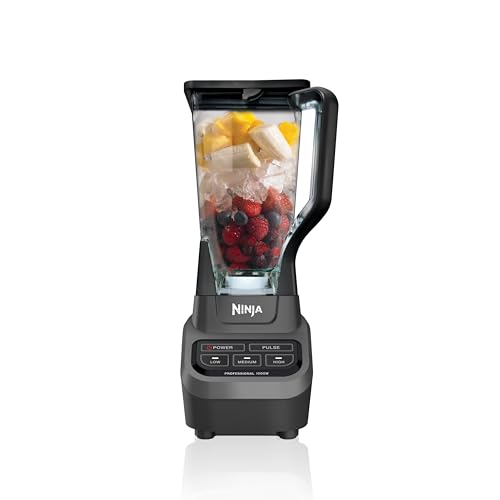
Ninja Professional Blender BL610 — Best Overall
The Ninja BL610 is the ice smoothie benchmark at a sensible price because its stacked Total Crushing blade column attacks ice at several heights at once. Where a conventional bottom blade waits for cubes to fall to it, the Ninja’s blade tower meets them throughout the pitcher, so a full load of ice and frozen fruit collapses into the vortex quickly and evenly. The 1000W motor holds its pace through that collapse, and the result is the thing ice smoothie drinkers actually want: a uniformly cold, thick drink with no surviving shards hiding at the bottom of the glass.
Strengths
- Stacked blade column crushes ice throughout the pitcher
- 72 oz pitcher handles family batches in one cycle
- Dishwasher-safe parts keep cleanup fast
Trade-offs
- Loud at full power
- Greens texture is very good, not premium-smooth
- Pitcher is bulky in small kitchens
| Specification | Detail |
|---|---|
| Motor | 1000 watts |
| Pitcher | 72 oz XL pitcher |
| Technology | Total Crushing blade stack |
| Care | Dishwasher-safe parts |
The 72 oz pitcher makes this a family machine — a full round of smoothies in one cycle — and the dishwasher-safe parts keep the cleanup proportionate. Controls are simple speed settings rather than elaborate programs, which suits ice work well: start the load moving, then let the machine run at full pace until the sound changes from rattling impacts to a smooth roar, the reliable sign the ice is done.
The compromises are texture ceiling and noise. On fibrous greens the BL610 is good rather than silky, and like every Ninja it announces itself loudly at full power. But judged on the specific job in this guide’s title — smoothies with ice, for a household, without premium money — it is the pick to beat.
The BL610’s pitcher markings deserve a word: with icy loads, ingredients expand in apparent volume as air incorporates, so a batch that starts at the smoothie line can finish above it. Load to a sensible two-thirds for frozen recipes and the lid stays a lid rather than becoming a fountain.
Best for: families making icy smoothies regularly / Not suited for: solo users or silence seekers
Check the current price on Amazon

Vitamix 5200 Professional-Grade Blender — Best Premium Texture
If the question is purely how smooth an ice smoothie can become, the Vitamix 5200 is the answer in this guide. Its variable speed dial lets you start the load gently — settling ice onto the blades instead of launching it at the lid — then climb to full speed, where the container’s vortex pulls every fragment through the cutting zone until the texture is uniform from top to bottom. Ice does not survive as grit in this machine; it becomes part of the drink’s body, giving that thick, soft-serve consistency café smoothies are judged by.
Strengths
- Finest, most uniform ice texture in this guide
- Variable dial allows gentle starts and full-power finishes
- Built and cooled for hard daily use over years
Trade-offs
- Premium tier price — check price on Amazon
- 64 oz container is oversized for single small smoothies
- Tall profile needs cabinet clearance
| Specification | Detail |
|---|---|
| Container | 64 oz |
| Control | Variable speed dial plus high-speed switch |
| Blades | Stainless steel |
| Cleaning | Self-cleaning cycle |
The supporting details match the headline. The stainless blade assembly and motor cooling are built for hard daily use, the self-cleaning cycle clears smoothie residue with warm water and a drop of soap, and the tamper-compatible design philosophy means thick loads can be guided rather than abandoned. For households that blend far more than smoothies — soups, nut butters, frozen desserts — the 5200’s ice mastery is one skill among many.
The costs are the premium tier price and the scale: a 64 oz container wants a proper batch, and the machine is tall and serious on the counter. For a dedicated ice-smoothie household that blends daily and values texture above all, it justifies itself; for occasional use, the Ninja above delivers most of the result for far less commitment.
For ice work specifically, the 5200 rewards a short learning investment: practice the ramp on a pitcher of plain ice and water twice, listening for the circulation point, and every smoothie after that is calibrated. Few appliances repay ten minutes of practice so completely.
Best for: daily blenders who judge a smoothie by its texture / Not suited for: occasional users or small-batch solo drinkers
Check the current price on Amazon

Blendtec Classic 575 Blender — Best for Large Batches
The Blendtec Classic 575 approaches ice from the jar side. The WildSide+ jar’s five-sided profile creates a powerful circulation pattern that keeps a large, icy load moving as one mass, so the blunt, high-force blade can do its work on every pass instead of only on the ingredients at the bottom. The practical result is batch capacity: this machine turns out big rounds of icy smoothies for a crowd without the second and third cycles smaller pitchers demand.
Strengths
- WildSide+ jar circulates very large icy loads evenly
- Preprogrammed cycles give walk-away convenience
- Pulverising blade action leaves no ice slivers
Trade-offs
- Loud at full power
- Large jar is inefficient for single servings
- Premium tier positioning — check price on Amazon
| Specification | Detail |
|---|---|
| Jar | WildSide+ jar (90 oz marked capacity) |
| Control | 5 speeds plus pulse |
| Programs | Four preprogrammed blending cycles |
| Cleaning | Self-cleaning |
Four preprogrammed cycles, including smoothie-style patterns, give walk-away convenience, while five manual speeds and pulse keep control available when a recipe needs it. Blendtec’s design philosophy uses a blunt blade that pulverises rather than slices, which is part of why its ice results are so consistent — cubes are smashed to snow instead of being shaved into persistent slivers.
Ownership notes: the jar’s marked capacity is generous but real working volume for icy loads should stay sensible to avoid lid drama, and the machine is, like all high-power blenders, emphatically loud at work. For entertainers and large families, those are easy trades for the batch power on offer.
The Classic 575’s preprogrammed cycles include patterns that suit icy loads without supervision, which makes it the entertainer’s pick as much as the family’s: start the cycle, return to your guests, and the machine conducts the pulse-and-blast sequence itself.
Best for: large families and entertainers blending big icy batches / Not suited for: single-serving routines or quiet households
Check the current price on Amazon

Ninja Professional Plus Blender BN701 — Best With Presets
The BN701 is the preset-driven evolution of the BL610 formula: more peak power, the same stacked-blade ice philosophy, and Auto-iQ programs that run the pulse-pause-blast pattern ice loads respond to, without the user conducting. Press the smoothie program and the machine alternates bursts that settle the load with sustained runs that finish it — the exact rhythm an experienced user applies manually, automated. For busy households, that automation is the difference between a smoothie that happens and one that gets postponed.
Strengths
- Auto-iQ smoothie program automates the ideal ice pattern
- Extra peak power handles the thickest frozen loads
- Large pitcher and dishwasher-friendly parts suit daily family use
Trade-offs
- Programs reduce the fine manual control some users prefer
- Loud under full load
- Bulky footprint for small counters
| Specification | Detail |
|---|---|
| Motor | 1400 peak watts |
| Pitcher | 72 oz |
| Programs | Three Auto-iQ presets including smoothie |
| Technology | Total Crushing blades |
The 72 oz pitcher and 1400 peak-watt motor give the BN701 headroom for the thickest icy recipes in this guide: full loads of ice and frozen fruit with modest liquid still circulate and finish. The pitcher, lid and blade parts follow Ninja’s dishwasher-friendly pattern, and the control panel wipes clean — small mercies in a machine destined for daily frozen work.
Choose it over the BL610 if you value the programs and the extra headroom; choose the BL610 if you prefer simple speeds and the lower tier. Either way the ice result is emphatic — this guide’s two Ninjas bracket the value end of serious ice blending, and the BN701 is the more capable, more convenient of the pair.
Owners upgrading from the BL610 will find the BN701’s Auto-iQ most valuable on exactly the recipes that used to need supervision — the thick, low-liquid icy blends where circulation is reluctant. The program’s pauses let the load settle onto the blades instead of spinning an air pocket.
Best for: busy households wanting one-button icy smoothies / Not suited for: manual-control enthusiasts or tiny kitchens
Check the current price on Amazon

KitchenAid K400 Variable Speed Blender — Best Design and Dial Control
The KitchenAid K400 is the design-conscious ice pick: a solid, handsome machine whose control scheme is unusually well thought through for frozen work. The five-speed variable dial gives genuine manual authority, while the dedicated Ice Crush and Icy Drinks presets handle the two frozen jobs directly. Intelli-Speed motor control senses the load and holds the chosen speed as ice resistance changes — the moment cubes begin breaking is exactly when lesser motors bog down, and the K400 is engineered to push through it.
Strengths
- Dedicated Ice Crush and Icy Drinks presets
- Intelli-Speed control holds speed as ice resistance changes
- Tamper included for guiding thick frozen loads
Trade-offs
- Less raw crushing force than the Ninja models
- Jar capacity suits households, not crowds
- Premium-mid tier — check price on Amazon
| Specification | Detail |
|---|---|
| Control | 5-speed variable speed dial |
| Presets | Ice Crush, Icy Drinks and Smoothie programs |
| Motor control | Intelli-Speed Motor Control |
| Accessory | Tamper included |
The included tamper is a meaningful accessory for ice smoothies, letting you press a stubborn frozen corner down into the vortex without stopping the cycle. KitchenAid’s asymmetric blade and ribbed jar geometry are designed to fold ingredients from the top of the jar down, which shows in even results on mixed loads of ice, fruit and greens.
Against the Ninjas, the K400 trades a little raw crushing spectacle for control, finish and motor manners; against the Vitamix, it offers much of the dial experience at a lower tier. Buyers who want their blender to look like a considered appliance and behave like one will find this the most satisfying middle path in the guide.
The K400’s jar design keeps icy mixtures moving visibly, which makes it a satisfying teaching machine: you can watch circulation begin and learn what a working vortex looks like. That visibility is part of why its manual dial feels so effective — the feedback loop between hand, eye and load is complete.
Best for: buyers wanting dial control, presets and design in one machine / Not suited for: maximum batch size or lowest price seekers
Check the current price on Amazon

CRANDDI Professional Smoothie Blender K96 — Best Value High-Power Pick
The CRANDDI K96 is the value disruptor of this guide: a 1500W motor and an 80 oz pitcher — commercial-style specifications — at a tier well below the famous names. For ice smoothies, the formula works: strong sustained power, a big pitcher that lets a frozen load circulate, and a stainless blade built for crushing work. Households that blend for a crowd and cannot justify premium money will find the K96’s output-per-cost hard to argue with.
Strengths
- 1500W motor and 80 oz pitcher at a value tier
- Genuine sustained ice-crushing authority
- Commercial-style build prioritises work over decoration
Trade-offs
- Smaller brand and parts ecosystem than the big names
- Functional rather than refined controls and finish
- Large footprint on the counter
| Specification | Detail |
|---|---|
| Motor | 1500W |
| Pitcher | 80 oz |
| Blade | Stainless steel |
| Class | Compact commercial-style countertop blender |
The machine’s commercial styling is honest about its priorities. Controls are workmanlike rather than elegant, the pitcher is built for volume, and the whole unit feels like equipment rather than décor. In return you get genuine ice authority: full pitchers of icy smoothies finish without the stalling and second cycles that expose underpowered budget machines.
The trade-offs are brand depth and refinement. CRANDDI does not offer the decades-long parts ecosystem or resale familiarity of the big names, and fit-and-finish details are functional rather than polished. As a performance-first value pick for ice, though, it earns its place — buy it for the motor and the pitcher, and it will not disappoint on either.
The K96’s commercial sizing has one domestic caveat: an 80 oz pitcher used for a single small smoothie under-circulates, as all oversized pitchers do. Its value appears at family scale and above — households blending for one should size down to the 64–72 oz picks instead.
Best for: crowd-sized icy smoothies on a value budget / Not suited for: buyers who prioritise brand support and polish
Check the current price on Amazon
Comparison Table
Line the six up by motor class, pitcher and control style. For ice, circulation and sustained power matter more than any single figure, so use the table to shortlist and the reviews to decide.
| Pick | Badge | Key spec | Best for |
|---|---|---|---|
| Ninja Professional Blender BL610 | Best Overall | 1000W motor, Total Crushing blades, 72 oz pitcher | families making icy smoothies regularly |
| Vitamix 5200 Professional-Grade Blender | Best Premium Texture | 64 oz container, variable speed dial, high-speed switch, stainless blades | daily blenders who judge a smoothie by its texture |
| Blendtec Classic 575 Blender | Best for Large Batches | WildSide+ jar, five speeds, four preprogrammed cycles, self-cleaning | large families and entertainers blending big icy batches |
| Ninja Professional Plus Blender BN701 | Best With Presets | 1400 peak watts, 72 oz pitcher, three Auto-iQ presets | busy households wanting one-button icy smoothies |
| KitchenAid K400 Variable Speed Blender | Best Design and Dial Control | 5-speed variable dial, Ice Crush / Icy Drinks / Smoothie presets, tamper included | buyers wanting dial control, presets and design in one machine |
| CRANDDI Professional Smoothie Blender K96 | Best Value High-Power Pick | 1500W motor, 80 oz pitcher, stainless steel blade | crowd-sized icy smoothies on a value budget |
How to Choose a Blender for Smoothies With Ice
Choosing among the best blenders for making smoothies with ice means prioritising three things ordinary smoothie guides treat as footnotes: what happens in the first five seconds of the blend, how the pitcher keeps ice circulating, and whether the drive train is built for impact as a daily routine.
The decisions below translate those priorities into shopping terms — power class, pitcher size, control style and the honest limits of each tier — so you can match a machine to the icy drinks you actually make rather than the ones in the brochure photograph.
Sustained power beats peak numbers
Ice blending is a sustained-load job disguised as a short one. A motor that flashes a big peak figure but fades as resistance rises will leave the bottom of the pitcher over-blended and the top full of surviving cubes. Look for machines with a record of holding speed — the professional and Total Crushing classes in this guide — and treat any single wattage number as a rough class indicator rather than a ranking. Blade design and pitcher circulation routinely beat a few hundred paper watts.
Pitcher size and shape decide circulation
Ice needs room to move and a shape that returns it to the blades. Tall, tapered and ribbed jars fold the load downward; wide flat jars let ice raft at the surface. Size follows servings: 64–72 oz pitchers suit family rounds, and the 80 oz class suits crowds, but an oversized pitcher used for one small smoothie under-blends because the vortex never forms. Match the pitcher to your typical batch, not your biggest imaginable one.
Presets, dials and the sound test
Both control philosophies work for ice. Presets like Auto-iQ and dedicated Ice Crush programs automate the pulse-settle-blast rhythm and suit busy users. Dials suit tinkerers who adjust by ear — and the ear is a real instrument here: rattling impacts mean ice is still breaking, a smooth roar means it is done, and a strained whine means the load needs liquid or a pause. Choose the interface you will actually enjoy using daily.
Ice technique: piece size and liquid floor
Even the best machine has a liquid floor: enough liquid for the vortex to form and carry fragments down. As a working pattern, liquid first to cover the blades, soft ingredients next, ice last, and cubes of ordinary freezer size rather than giant moulded blocks. If circulation stalls, stop, add a splash, and restart — a ten-second intervention that protects the motor and finishes the drink properly.
Glass, plastic and the ice impact question
Ice is the ingredient that has opinions about jar material. Glass shrugs off the scratching that clouds plastic over a year of frozen work, and it never holds the smell of yesterday’s green smoothie — but it is heavy at 72 oz scale and unforgiving of drops and thermal shock. Modern pitcher polymers are lighter, survive the drop, and cloud gradually where ice scours them. Neither material changes the blend itself. Choose glass if the machine lives on the counter and careful adults run it; choose polymer if the pitcher travels to dishwashers, children and crowded sinks. The picks in this guide span both, labelled in their spec boxes.
Duty cycle: how much ice is too much ice?
Every blender has a comfortable working rhythm, and ice defines it. A single full icy batch is light work for the machines here; the strain arrives with the third and fourth back-to-back batches at a party, when motor heat accumulates faster than it sheds. The working rule is simple: blend the round, serve the round, and let the machine rest while glasses empty. If your household regularly blends for crowds, that rhythm argues for the larger pitchers and commercial-style picks in this guide — capacity is, among other things, a cooling strategy.
How to Blend a Smoothie With Ice and No Surviving Chunks
This sequence works on every pick in this guide and is the difference between an icy smoothie and a smoothie with ice in it.
- Liquid first: add juice, milk or water to cover the blades. Ice dropped onto dry blades just bounces and stresses the drive.
- Soft and fresh ingredients second: yogurt, banana, fresh fruit and greens form the liquid body that will carry ice fragments down.
- Frozen fruit third: it chills the mixture and begins the vortex before the hardest ingredient arrives.
- Ice last, in ordinary cubes: add ice on top so it is drawn down progressively. Avoid oversized moulded cubes; split them or let them temper for a few minutes.
- Start controlled, finish at full power: a few seconds at low speed or a pulse settles the load; then run at high speed until the sound smooths from rattling to a roar.
- Blend to the sound, then ten seconds more: the last surviving fragments disappear just after the drink sounds finished. Give it those extra seconds.
- Serve immediately: icy smoothies separate as they sit. Pour at once for the texture you blended for.
If chunks persist, the cause is almost always one of three things: too little liquid, ice added first, or the cycle stopped at the first smooth sound. Fix the sequence before blaming the machine.
The Physics of Crushing Ice in a Blender
Ice blending is a controlled avalanche. In the first seconds, whole cubes are too large to circulate, so the blade works on whatever gravity delivers, fracturing cubes into shards. Those shards, mixed with liquid, form a slurry that begins to move as a body — and that movement is the turning point of every icy smoothie. Once the load circulates, each fragment passes the blade zone repeatedly and is milled progressively smaller; before circulation, the bottom over-blends while the top waits untouched. Everything in a good ice blender serves that transition: blade stacks that engage the load at several heights, pitcher ribs and tapers that fold the top down into the stream, motors that hold speed while the impacts are at their most violent. It also explains the technique rules in this guide. Liquid first gives the avalanche its medium. Ice last lets the slurry form before the hardest material arrives. And the sound change — rattling to roaring — is literally the sound of circulation beginning, which is why experienced blenders trust their ears more than any timer.
Ice, Frozen Fruit and the Blended Middle Ground
Many smoothie recipes live between the poles of this guide’s title — part ice, part frozen fruit — and the blend behaves differently from either extreme. Frozen fruit brings sugar, fibre and water that release as it breaks, so a frozen-fruit load effectively makes its own liquid as it goes and forgives a dry start. Ice brings only cold and structure: it dilutes as it melts, thins the drink if the cycle runs long, and contributes nothing to flavour. The practical art is proportion. Fruit-forward blends need less added liquid than the recipe’s first draft suggests, because the fruit contributes it mid-blend. Ice-forward blends need their liquid measured honestly at the start, because nothing is coming to help. Texture goals steer the ratio too: for a thick, spoonable result, frozen fruit is the better thickener since it adds body along with cold; for a lighter, frostier drink, ice is the tool. Every machine in this guide handles the full spectrum — the Ninjas with brute circulation, the Vitamix with finesse — but the cook’s proportioning decides whether the machine gets to show it.
What Ice Does to a Blender Over a Year
Daily ice is a wear regime, and it is worth buying with that in mind. The components that age are predictable: blade edges micro-dull against thousands of impacts, couplings absorb the shock of every cube, and pitcher walls cloud with fine scratching where ice has scoured them. None of this is failure — it is the honest cost of the work, spread differently by design. Machines built for ice, like every pick in this guide, put their material where the wear lands: hardened blade assemblies, metal or reinforced drive parts, pitcher polymers or glass chosen for impact. The owner’s contribution is smaller and simpler: ordinary cubes instead of giant moulded blocks, enough liquid to cushion the first seconds, and cycles that stop when the drink is done rather than running on from habit. Bought in the right class and used with that much sense, an ice blender’s performance a year in should be indistinguishable from its first week — which is the real test this category sets.
Why Restaurants Blend Ice Differently
Watch a café or bar make frozen drinks and a pattern emerges that home guides rarely teach: they blend in a house style, with the recipe engineered around the machine rather than the machine struggling around the recipe. Liquid ratios are fixed by the scoop and the pump, ice comes from a machine that makes one consistent cube size, and the pitcher is filled to a marked line that guarantees circulation. Home blenders can steal all three disciplines without buying anything. Standardise your ice — one tray, one cube size — so the load behaves the same way every day. Measure the liquid for your standard recipe once, properly, and write it on the recipe rather than judging by eye. And find your pitcher’s circulation line, the fill level where the vortex forms reliably, and treat it as law. What looks like professional magic is mostly professional consistency, and it transfers completely to the machines in this guide.
The Frozen Smoothie as a Make-Ahead Problem
Icy smoothies resist making ahead more stubbornly than any other blend, and the physics explains why: the texture is a suspension of ice crystals that begin melting and refreezing into a solid block from the moment the cycle stops. Freezing a finished smoothie and re-blending it later works, after a fashion, but the second blend never quite recovers the first one’s lightness. The working solutions are structural. Prep the solid ingredients in freezer bags — fruit, greens, ice measured per serving — and blend from frozen each morning, which is make-ahead at the ingredient level where it belongs. Or blend the non-ice base ahead, refrigerate it, and add ice at serving time for a thirty-second finish. Both approaches respect what ice is: a texture with a lifespan of minutes. The machines in this guide make that lifespan as good as it gets — the rest is scheduling, and scheduling, unlike texture, is entirely within the cook’s control.
Common Buying Mistakes
Buying a smoothie blender that is not an ice blender
Many capable smoothie machines are designed around fresh and frozen fruit and treat ice as an occasional guest. Daily ice will expose them within months. If ice is in your title, buy a machine designed for it, like the picks here.
Adding ice first
Ice at the bottom jams the blade at startup and launches the rest of the load upward when it breaks free. Ice goes last, on top of a liquid body, every time.
Using giant craft-ice cubes
Oversized moulded cubes are engineered to melt slowly — the opposite of what a blender wants. Use ordinary freezer cubes for blending and save the spheres for the glass.
Stopping at the first smooth sound
The drink sounds finished before it is finished; the last fragments need a few more seconds in the vortex. Blend past the sound change briefly for a uniform result.
Running thick icy loads with too little liquid
A stalled, air-pocketed blend is hard on motors and worse for texture. A splash more liquid restarts circulation instantly and costs nothing in flavour at smoothie scale.
Final Recommendation
For most households the Ninja BL610 is the right answer: emphatic ice crushing, a family pitcher and a sensible tier. Texture perfectionists should step up to the Vitamix 5200, batch blenders to the Blendtec Classic 575, and one-button households to the BN701. The KitchenAid K400 is the design-and-control choice, and the CRANDDI K96 is the value route to commercial-style power.
Whichever pick you take, the technique section above is half the result: liquid first, ice last, blend past the smooth sound. The best blenders for making smoothies with ice make that technique easy to follow — and impossible to taste past.
- Ninja Professional Blender BL610 — Check the current price on Amazon
- Vitamix 5200 Professional-Grade Blender — Check the current price on Amazon
- Blendtec Classic 575 Blender — Check the current price on Amazon
Best Blenders For Making Protein Shakes Best Blenders For Making Smoothies Under Hundred Bucks Best Blenders For Making Snow Cones
Frequently Asked Questions
What actually makes a blender good with ice?
Three things working together: a motor that holds speed under impact load, blade geometry that pulls ice down instead of knocking it up, and a pitcher shape that keeps the whole load circulating. Any one of them missing shows up as surviving chunks.
Can I put ice in any blender if I add enough liquid?
Enough liquid helps any machine, but light-duty blenders are not built for repeated ice impact — couplings strip and motors overheat. Occasional small amounts are fine; daily ice deserves a machine designed for it, like the picks in this guide.
Is crushed ice from the fridge easier than cubes?
Yes. Pre-crushed ice and small cubes break down faster and more evenly, and they are kinder to mid-tier machines. If your freezer offers crushed ice, budget picks perform noticeably better with it.
Why does my smoothie have a layer of unblended ice on top?
The vortex never reached it — usually too little liquid, too full a pitcher, or the cycle ended early. Add a splash of liquid, blend on high for another twenty seconds, and load ice last rather than first next time.
How long should I blend an icy smoothie?
Until the sound changes from rattling impacts to a smooth roar, plus roughly ten seconds. On the machines here that is typically under a minute and a half for a full pitcher.
Are the big pitchers dishwasher safe?
Several picks here, including the Ninja models, have dishwasher-safe parts per their verified listings. Check the exact model’s guidance — and note that a quick rinse right after blending is usually faster than loading the dishwasher anyway.
Does blending ice dull blender blades?
Very gradually, in any machine — ice is abrasive at the microscopic level. In practice, the ice-class machines in this guide are built with that wear in mind, and the effect over normal home use is measured in years, not months. What dulls performance faster is running dry, empty or stalled loads.
Can I blend ice without any liquid?
That is snow-cone work rather than smoothie work, and it needs either a pulverising-class blender used in bursts or a dedicated shaver. Our snow cone guide covers exactly that job; for smoothies, keep the liquid floor — the drink and the machine both prefer it.
Why does my icy smoothie separate after a few minutes?
Separation is the physics of the format: ice crystals melt from the outside in, and the liquid phase drifts from the solids as the drink sits. It is not a blending failure. Serve icy smoothies immediately, give a separated one a quick stir or a five-second re-blend, and treat the texture’s short life as the price of its freshness.
Are metal or plastic blades better for ice?
The material matters less than the design and the drive behind it. The ice-class machines here use hardened blade assemblies shaped to engage the load at several points, backed by couplings built for impact. A well-designed assembly in either material out-crushes a poorly designed one — judge the system, as this guide’s picks were judged, rather than the metal.
Should I thaw frozen fruit before blending it with ice?
No — thawing defeats the purpose twice over, thinning the drink and removing the frozen structure that makes it thick. Blend fruit straight from frozen, keep the ice as the final addition, and let the machine’s circulation do the work. The only exception is fruit frozen into a single solid block, which should be broken into chunks first so the load can move.
Do icy smoothies damage a pitcher’s finish over time?
Cosmetically, gradually: ice scours pitcher walls at a microscopic level, and plastic pitchers cloud faster than glass under a daily frozen regime. It is wear to the appearance, not the function — the blend is unaffected — and it is one reason several households choose glass for a dedicated ice machine and keep plastic for travel and gentler work.
Best Blenders For Manual Control Best Blenders For Making Frozen Drinks Best Blenders For Kale Smoothies


