Disclosure: airfryerkitchensupply.com is reader-supported. When you buy through links on our site, we may earn an affiliate commission at no extra cost to you.
Where to buy
Choosing the best blenders for kale smoothies starts with one requirement: the kale must disappear. A kale smoothie is the lighter, brighter sibling of the kale shake: fruit-forward, properly liquid, and meant to drink like juice’s heartier cousin rather than eat like a meal. Its one non-negotiable is smoothness — kale that survives as flecks turns a refreshing drink into a chore. The six blenders below were verified through Amazon listing and chosen for the blend quality that makes kale disappear into a fruit smoothie, across premium, mid-range, single-serve, and budget tiers. Check price on Amazon and confirm what is in the box, since cup and jar configurations vary by listing.
- Vitamix Ascent X5, 48 oz, Brushed Stainless (Best Overall) — check price on Amazon
- Vitamix Ascent X3, 48 oz, Shadow Black (Best Simpler Premium) — check price on Amazon
- Breville Fresh & Furious BBL620, Silver (Best Mid-Range) — check price on Amazon
- KitchenAid Pure Power Blender KSB2078, 1700W Peak, 68 oz + Personal Jars (Best for Mixed Households) — check price on Amazon
- nutribullet Turbo Tumbler Edition NB30400SG, 1000W, 24 oz Tumbler (Best Single-Serve) — check price on Amazon
- Oster Vortex Plus Glass Blender, 1200W, 76 oz + Blend-N-Go Cup (Best Budget Big Jar) — check price on Amazon
The best blenders for kale smoothies are chasing a specific glass: cold, pourable, fruit-sweet, and green — with the kale present as color and nutrition but absent as texture. That last clause is the whole game. Kale is a tougher leaf than spinach, and in a smoothie, where there is plenty of liquid and the drink is thin, a half-blended leaf shows up as a floating fleck in every sip rather than hiding in thickness the way it can in a shake. The smoothie drinker therefore needs a blender that finishes kale completely, and a technique that gives the leaf a head start.
The good news is that a kale smoothie is an easier load than a kale shake: more liquid, less density, and fruit doing much of the carrying. That widens the honest range of machines — this page can recommend a mid-range and even a friendlier tier with confidence, provided the two-stage technique in the how-to is used: greens and liquid first, fruit second. Where this guide draws its line is sustained blade speed and jar circulation; a smoothie blender that slows and surges will leave the last flecks unblended no matter how long you run it.
The picks run from two premium Vitamix models that make kale smoothies effortlessly silky, through a well-mannered Breville mid-ranger and a versatile KitchenAid that serves mixed households, to a single-serve tumbler blender for the solo morning smoothie and a big budget Oster for family rounds. If your kale drinks are thick and protein-led instead, the sibling kale shake guide is the stricter page you want; if your greens range wider than kale, the leafy green smoothie guide broadens the lens. This page is for the bright, drinkable kale smoothie, done properly.
In this guide
Quick Picks
Six machines ranked on one outcome: a pourable, fruit-forward kale smoothie with zero leaf flecks — at every tier from premium to family-budget.
- Best Overall: Vitamix Ascent X5, 48 oz, Brushed Stainless — ten programs, a 48 oz container, and SELF-DETECT convenience — the flagship route to a perfectly silky kale smoothie with the least technique demanded. Check the current price on Amazon.
- Best Simpler Premium: Vitamix Ascent X3, 48 oz, Shadow Black — the same Ascent platform and 48 oz container with three programs instead of ten — premium kale smoothie performance without the menu. Check the current price on Amazon.
- Best Mid-Range: Breville Fresh & Furious BBL620, Silver — a high-torque motor, multiple speeds, and an easy auto-clean — the well-mannered mid-range blender that handles kale smoothly without flagship money. Check the current price on Amazon.
- Best for Mixed Households: KitchenAid Pure Power Blender KSB2078, 1700W Peak, 68 oz + Personal Jars — 1700W peak power, a 68 oz jar for family rounds, and two 16 oz personal jars for solo smoothies — one base that serves both smoothie formats. Check the current price on Amazon.
- Best Single-Serve: nutribullet Turbo Tumbler Edition NB30400SG, 1000W, 24 oz Tumbler — a 1000W personal blender built around a 24 oz tumbler cup — blend your kale smoothie in the vessel you carry out the door. Check the current price on Amazon.
- Best Budget Big Jar: Oster Vortex Plus Glass Blender, 1200W, 76 oz + Blend-N-Go Cup — 1200W, reversible blades, four auto programs including Smoothie, a 76 oz jar, and a Blend-N-Go cup — family-scale kale smoothies at a budget-friendly tier. Check the current price on Amazon.
How These Picks Were Chosen
For kale smoothies the filter was finish quality in a liquid load. Every candidate was verified through Amazon listing, then judged on whether its motor and jar could sustain the full-speed circulation that erases kale flecks from a pourable drink — with the two-stage method assumed, because no machine was going to be excused from the category’s basic technique, and none was going to be credited for results the technique produces.
The final six were chosen to represent the tiers truthfully: two flagships that make the result effortless, a mid-ranger that achieves it with ordinary care, a dual-format system for split households, a single-serve tumbler for commuters, and a family-budget big jar. Premium and budget picks alike were held to the same endpoint — no visible flecks in the poured glass — and where a machine needs help reaching it, the review says exactly what help and how much.
The 6 Best Blenders for Kale Smoothies

Vitamix Ascent X5, 48 oz, Brushed Stainless — Best Overall
The Vitamix Ascent X5 is the no-compromise kale smoothie machine: a professional-grade 48-ounce blender with ten programs, variable speed, pulse, and a self-cleaning program, from the line that defines high-performance blending. For kale smoothies its value is simple to state — it holds maximum blade speed through a liquid load indefinitely, and kale given thirty to forty-five seconds at that speed does not survive as texture. It disappears.
Strengths
- Ten programs plus full manual control cover every smoothie style
- 48 oz container is the ideal household smoothie size
- Self-cleaning program and SELF-DETECT container recognition simplify daily use
Trade-offs
- Premium tier positioning, the highest commitment on this page
- More machine than a fresh-fruit-only drinker will ever use
- Programs are plentiful enough that most owners use two and ignore eight
| Container | 48 oz |
| Programs | 10 programs including self-cleaning (per Amazon listing) |
| Controls | Variable speed and pulse |
| Technology | SELF-DETECT container recognition (per Amazon listing) |
What the X5 buys a kale smoothie drinker is certainty. The classic failure — a smoothie that is 95% smooth with a confetti of kale flecks in the last sips — comes from blades that cannot sustain the finish. The Ascent’s motor and container pairing sustains it, and the two-stage method becomes a formality rather than a rescue: greens and liquid, a short stage one, fruit, and a full-speed finish that leaves the glass uniformly green and pourable. The 48-ounce size also fits how kale smoothies are actually consumed — a generous one or a standard two — without the thin-load problem of oversized jars. If the budget stretches and the habit is daily, this is the machine that ends the search.
The two-stage blend is the kale smoothie technique, full stop. Stage one: liquid plus kale alone, 15–30 seconds depending on the machine, until the liquid is a uniform green with no visible leaf fragments. Stage two: everything else. Kale blended with the fruit from the start hides among the chunks and survives; kale liquefied first has nowhere to hide. Every pick on this page does stage one well; skipping it is how good blenders get blamed for flecked smoothies.
Best for: daily kale smoothie drinkers who want flagship smoothness and programs / Not suited for: occasional smoothie makers, who will never use its ceiling
Check on Amazon — check the current price on Amazon before you decide, since listings and included accessories change over time.

Vitamix Ascent X3, 48 oz, Shadow Black — Best Simpler Premium
The Ascent X3 is the X5’s calmer sibling: same professional-grade platform, same 48-ounce container, three programs rather than ten, plus variable speed, pulse, and self-cleaning. For kale smoothies specifically, almost nothing is lost — the smoothie outcome depends on the motor, the container, and one good program or a manual finish, all of which are present — and the simpler control set suits drinkers who found flagship interfaces more impressive than useful.
Strengths
- Ascent-class power and container at a simpler control set
- Three programs cover the smoothie routine without menu fatigue
- Self-cleaning program keeps the daily habit light
Trade-offs
- Still premium tier positioning
- Fewer presets for households that also blend soups and frozen desserts heavily
- Same daily pitcher-washing reality as any full-size machine
| Container | 48 oz |
| Programs | 3 programs including self-cleaning (per Amazon listing) |
| Controls | Variable speed and pulse |
| Finish | Shadow Black |
Think of the X3 as the connoisseur’s edit of the flagship: the parts that touch the smoothie are identical in spirit — the drive, the container geometry, the sustained speed that erases kale — and the parts removed are the ones most owners use twice. A kale smoothie routine on the X3 is a pleasure of repetition: liquid, kale, thirty seconds of stage one while you rinse the board, fruit, finish, self-clean, done. Households choosing between the two Ascents should decide by their other blending: heavy program users (soups, nut butters, frozen desserts on rotation) take the X5; smoothie-led households take the X3 and feel no deficit in the glass.
Choose your kale like a smoothie maker, not a salad maker. Lacinato kale is the smoothie variety — flatter leaves, milder flavor, less rib. Baby kale is gentler still and needs almost no prep. Curly kale is the toughest and most bitter, and in a smoothie it should lose its ribs and get the longest stage one. Frozen kale blends easier than raw in most machines and keeps the drink colder; it is the weekday-practical choice.
Best for: premium buyers whose blending life is smoothie-led and who prefer simple controls / Not suited for: program collectors who blend across every category weekly
Check on Amazon — check the current price on Amazon before you decide, since listings and included accessories change over time.
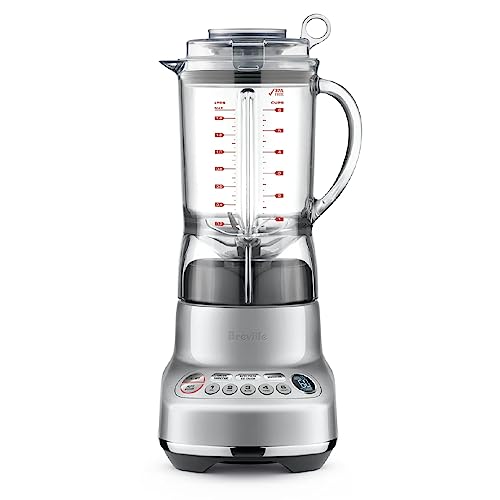
Breville Fresh & Furious BBL620, Silver — Best Mid-Range
The Breville Fresh & Furious occupies the sensible middle: a high-torque motor, multiple speed settings, and an auto-clean function, in a blender designed to be pleasant to live with. For kale smoothies — a liquid, fruit-led load — its power is comfortably sufficient, and its manners (sensible controls, easy cleaning) suit the weekday-morning reality of smoothie making better than raw specification one-upmanship does.
Strengths
- High-torque motor handles kale and frozen fruit in smoothie loads
- Auto-clean function lowers the daily friction meaningfully
- Mid-range positioning with premium-brand design and controls
Trade-offs
- Ultimate fibrous finish is a step below the Vitamix pair on the toughest kale
- Fewer programs and less manual range than the flagships
- Very thick, low-liquid blends are not its home ground — that is the shake page’s brief
| Motor | High-torque motor (per Amazon listing) |
| Controls | Multiple speed settings |
| Cleaning | Auto-clean functionality (per Amazon listing) |
| Model | BBL620SIL |
The Fresh & Furious is the pick for the smoothie drinker who wants quality without a flagship commitment, and kale smoothies flatter it: with the standard two-stage method, its high-torque drive keeps the liquid load circulating and finishes kale cleanly, especially lacinato and baby kale. Curly kale with ribs in will ask for the full stage-one treatment and an extra ten seconds — technique the how-to spells out — and the result is a properly smooth drink. Where the Vitamix pair pull ahead is margin: they forgive sloppy prep. The Breville asks for decent prep and rewards it fully, which for most home smoothie makers is the right bargain at its tier.
Acid and sweetness are kale’s finishing school. A squeeze of lemon or lime does more for a kale smoothie’s flavor than any other single addition — it brightens the green note from ‘lawn’ to ‘fresh.’ Sweetness should come from fruit with presence: mango, pineapple, and ripe banana all stand up to kale; delicate berries get bullied by it. If a kale smoothie tastes like a chore, the fix is almost always in this paragraph, not in the blender aisle.
Best for: mid-budget smoothie households wanting brand quality and easy cleaning / Not suited for: thick-shake makers or anyone wanting flagship margin for error
Check on Amazon — check the current price on Amazon before you decide, since listings and included accessories change over time.

KitchenAid Pure Power Blender KSB2078, 1700W Peak, 68 oz + Personal Jars — Best for Mixed Households
The KitchenAid Pure Power is the two-formats answer: a 1700W peak-power base with a big 68-ounce blending jar and two 16-ounce personal jars, a precision speed control knob, and a dedicated smoothie cycle. Households split between a solo morning kale smoothie and a family weekend round usually end up compromising one format; this machine’s jar set is designed to refuse that compromise.
Strengths
- Personal jars and a family jar on one powerful base
- Dedicated smoothie cycle plus a precision speed knob
- 1700W peak power gives frozen fruit and kale plenty of headroom
Trade-offs
- Two jar systems to store and wash across the week
- Peak-power rating flatters; technique still governs the kale finish
- Big jar is oversized for a single smoothie — use the personal jars for that
| Motor | 1700W peak power (per Amazon listing) |
| Vessels | 68 oz blending jar and (2) 16 oz personal blending jars |
| Controls | Precision speed control knob; smoothie cycle |
| Model | KSB2078BM |
The personal jars are the story for kale. A solo kale smoothie blended in a 16-ounce jar gets the small-vessel advantage — the leaves cycle through the blades relentlessly — and this base has the power to finish them completely, which is a combination the budget personal blenders cannot match. Then the same base takes the 68-ounce jar for the weekend family batch, where the smoothie cycle handles the ramp. It is a genuinely flexible system, and the knob-based control will please drinkers who dislike touch panels with wet hands. The discipline it asks is vessel discipline: blend each batch in the jar sized for it, and both formats perform; blend a solo smoothie in the big jar and you recreate the thin-load problem this machine was bought to avoid.
Watch the foam. Long full-speed blending of a liquid smoothie whips in air, and kale smoothies foam more than most because of the leaf proteins. A smoothie that pours like a milkshake’s frothy cousin has usually just been over-run: blend to smooth, then stop — an extra thirty seconds adds air, not smoothness. A brief rest and a stir settle a foamed smoothie back to drinkable.
Best for: households split between solo smoothies and family batches / Not suited for: single-format drinkers, who can spend less on a dedicated machine
Check on Amazon — check the current price on Amazon before you decide, since listings and included accessories change over time.

nutribullet Turbo Tumbler Edition NB30400SG, 1000W, 24 oz Tumbler — Best Single-Serve
The nutribullet Turbo Tumbler Edition strips the kale smoothie to its weekday essence: a 1000W base and a 24-ounce tumbler that is both blending vessel and drinking bottle. For the solo drinker whose smoothie travels — commute, desk, gym — eliminating the decant-and-wash-a-second-vessel step is not a small thing; it is the difference between a routine that survives busy weeks and one that quietly stops.
Strengths
- 1000W is strong for a personal format — kale and frozen fruit both finish well
- Tumbler format means blend, swap lid, go — one vessel total
- 24 oz is the right size for a standard kale smoothie with fruit
Trade-offs
- One format only: no pitcher for sharing or batches
- Thick, low-liquid blends need a mid-blend shake, as in all personal cups
- Tumbler-centric design suits drinkers who actually carry their smoothie
| Motor | 1000W |
| Vessel | 24 oz tumbler cup (per Amazon listing) |
| Model | NB30400SG |
| Finish | Sage Green |
Judge this machine by the morning it creates: kale and liquid whirred for fifteen seconds while the kettle boils, fruit added, thirty seconds more, blade off, lid on, out the door — and the only washing waiting at home is one tumbler and a blade base. The 1000W motor is the enabler; personal blenders at half this power leave kale flecks that a commuter cannot fix at the office, while the Turbo Tumbler finishes the leaf properly in stage one. Its ceiling is format, not quality: it will not make smoothies for three, and it will not pretend to. For the solo kale smoothie as a daily transportable habit, it is arguably the most honest machine on this page.
Temperature is a texture tool. Frozen fruit in a kale smoothie does three jobs: it chills, it sweetens, and its density helps pull the leaves through the blades in stage two. A kale smoothie at room temperature tastes more bitter and feels thinner than the same recipe properly cold. If your fruit is fresh, add a handful of ice; the drink will taste better and the blend will behave better.
Best for: solo kale smoothie drinkers who carry their smoothie to work or training / Not suited for: families or anyone blending for more than one person
Check on Amazon — check the current price on Amazon before you decide, since listings and included accessories change over time.

Oster Vortex Plus Glass Blender, 1200W, 76 oz + Blend-N-Go Cup — Best Budget Big Jar
The Oster Vortex Plus is the family-budget route to kale smoothies: a 1200W motor, reversible steel blades, four iBlend auto programs (Frozen Drink, Milkshake, Salsa, Smoothie), a large 76-ounce dishwasher-safe jar, and a Blend-N-Go cup in the box. Big households making a morning round of green smoothies need capacity and a program that handles the ramp; this delivers both without leaving the budget tier’s neighborhood.
Strengths
- 76 oz jar makes a full family round of kale smoothies in one run
- Smoothie auto program manages the pulse-and-ramp pattern for you
- Reversible blades help keep a leafy load circulating; Blend-N-Go cup covers solo days
Trade-offs
- Kale finish on curly, rib-in leaves trails the premium picks — strip ribs and use stage one
- Glass-style large jar is heavy to pour and to wash
- A solo smoothie in the big jar underfills it; the cup exists for a reason
| Motor | 1200W |
| Jar | 76 oz, dishwasher safe (per Amazon listing) |
| Programs | 4 iBlend auto programs including Smoothie |
| Extras | Blend-N-Go cup included (per Amazon listing) |
Family kale smoothies are a logistics problem as much as a blending one: four servings is a lot of kale, fruit, and liquid, and a machine that makes it in one programmed run — while someone packs lunches — earns its counter space. The Vortex Plus’s Smoothie program handles the early pulsing that seats a leafy load, and its reversible blades re-engage leaves that climb the walls. Its kale ceiling is honest: baby and lacinato kale vanish; curly kale wants its ribs stripped and the full two-stage treatment, after which the result is smooth and entirely drinkable, if a half-shade less silken than the Vitamix glass. At its tier, for its batch size, that is a fair and useful trade.
Rinse order matters with kale pigment. Kale smoothies stain and set: an unrinsed jar develops a green film that survives casual washing and flavors the next blend faintly. Rinse immediately, and use the self-clean or a drop-of-soap blend cycle the same day. It is a thirty-second habit that keeps a daily smoothie machine pleasant to open every morning — and pleasant machines are the ones that stay in the routine.
Best for: families making a shared round of kale smoothies on a budget / Not suited for: solo drinkers or texture perfectionists focused on curly kale
Check on Amazon — check the current price on Amazon before you decide, since listings and included accessories change over time.
Comparison Table
| Pick | Badge | Key spec | Best for |
|---|---|---|---|
| Vitamix Ascent X5, 48 oz, Brushed Stainless | Best Overall | 48 oz; 10 programs; SELF-DETECT | Silkiest kale smoothies, daily |
| Vitamix Ascent X3, 48 oz, Shadow Black | Best Simpler Premium | 48 oz; 3 programs; variable speed | Premium kale smoothies, simpler interface |
| Breville Fresh & Furious BBL620, Silver | Best Mid-Range | High-torque; multi-speed; auto-clean | Mid-range kale smoothies with manners |
| KitchenAid Pure Power Blender KSB2078, 1700W Peak, 68 oz + Personal Jars | Best for Mixed Households | 1700W peak; 68 oz jar + (2) 16 oz jars | Solo and family kale smoothies on one base |
| nutribullet Turbo Tumbler Edition NB30400SG, 1000W, 24 oz Tumbler | Best Single-Serve | 1000W; 24 oz tumbler | Blend-and-carry solo kale smoothies |
| Oster Vortex Plus Glass Blender, 1200W, 76 oz + Blend-N-Go Cup | Best Budget Big Jar | 1200W; 76 oz jar; 4 programs; Blend-N-Go cup | Family-batch kale smoothies, budget tier |
The kale smoothie choice narrows quickly once format is set: solo carriers take the tumbler, couples take a 48-ounce premium, families take the KitchenAid system or the big Oster, and the quality-per-tier sweet spot for a standard household is the Breville. The Vitamix pair sit above the argument for drinkers who want the finish guaranteed. What all six share is the ability to make kale vanish — provided stage one gets its thirty seconds.
How to Choose the Best Blenders for Kale Smoothies
Start from the drink’s liquid nature. A kale smoothie is a high-liquid load, which means jar circulation and sustained speed matter more than brute crushing force. Machines that excel here keep a thin load moving in a continuous vortex at full speed without surging — the high-performance class does this best, good mid-range machines do it well, and the weakest budget motors surge and leave flecks. If you test one thing when comparing, it is this: how the machine behaves at full speed with a jar of liquid and leaves, not how loudly it crushes ice.
Then size the vessel to the serving, as always. Solo drinkers: a personal format (the tumbler here, or the personal jars in the KitchenAid system) blends a single kale smoothie more violently and washes in seconds. Two-person households: 48 ounces is the sweet spot the Vitamix pair occupy. Family rounds: the 68–76 ounce class. Oversizing is the silent killer of kale smoothie texture, because a thin load in a huge jar spreads across the base and the leaves surf instead of submerging.
Kale Smoothie Architecture: Building a Drink People Finish
A kale smoothie people actually finish follows a loose architecture: a liquid base (water, coconut water, milk, or juice), a handful of kale, a dominant sweet fruit (mango, pineapple, banana), a supporting fruit (apple, pear, berries in modest amounts), a brightener (citrus or ginger), and optionally a softener (yogurt, avocado in small amounts, or a spoon of nut butter). Kale is one voice in that chord. Recipes that make kale the dominant flavor are where beginners quit — not because kale is bad, but because balance is a recipe skill that has to be learned like any other.
Greens rotation keeps the habit sustainable and the flavor interesting: kale most days, spinach when you want the mildest possible green, chard or romaine in season. This guide’s sibling on leafy green smoothies covers the wider rotation in depth. For kale specifically, freshness matters more than variety loyalty — tired, yellowing kale is bitter in a way no fruit fully fixes, so buy smaller amounts more often, or keep frozen kale as the reliable baseline and fresh as the upgrade.
How Kale Smoothies Differ from Kale Shakes — and Why It Changes the Machine
This page and the kale shake page recommend overlapping brands at different strictness, deliberately. A shake is thick and protein-led; its blender must hold speed in a dense, low-liquid load, and its budget tier is unforgiving. A smoothie is liquid and fruit-led; its blender must circulate and finish, and its mid tiers are genuinely capable. If your kale drink is a meal with a scoop of protein powder and nut butter, shop the shake page’s stricter list. If it is a bright breakfast drink, this page’s list — including its friendlier tiers — is the honest specification.
Budget guidance follows from that. For kale smoothies, the mid tier (the Breville here) is the value destination: full kale competence with the two-stage method, pleasant controls, easy cleaning. Premium money buys margin and silence of mind — sloppy prep forgiven, flecks impossible. Budget-family money buys capacity (the Oster) with technique required. None of these is the wrong door; they are priced versions of the same drink, and your prep habits should choose among them as much as your wallet does.
Sweetness calibration is the skill that separates a household recipe from a café copy. Fruit varies — a January mango is not a June mango — so a kale smoothie recipe written in exact fruit quantities will drift in and out of balance across the year. Learn instead to taste for the balance point: the drink should read sweet first, green second, bright third. Adjust with what the season lacks — a date or a spoon of honey when the fruit is lean, extra lime when it is lush — and the smoothie stays itself all year. The blender cannot do this for you; it is the one part of the process that remains gloriously manual.
How to Make a Kale Smoothie with No Flecks and No Bitterness
The method below is written for a standard two-serving kale smoothie and scales down to a personal tumbler unchanged — only the quantities halve.
- Prep the kale: strip the thick ribs from curly or lacinato leaves, tear the leaves, and measure a packed handful per serving. Rinse well — kale holds grit.
- Add liquid first: about 1 to 1.5 cups for two servings (water, coconut water, milk, or a juice base).
- Stage one: add the kale to the liquid and blend 15–30 seconds until the base is a uniform green liquid with no visible leaf pieces. Do not rush this stage.
- Add the dominant sweet fruit (mango, pineapple, or banana), the supporting fruit, and the brightener — a squeeze of lemon or lime, or a slice of ginger.
- Add frozen fruit or a handful of ice for cold and body, staying below the max line.
- Stage two: blend 30–45 seconds at full speed until the smoothie pours in one smooth ribbon and the surface shows no flecks.
- Stop as soon as it is smooth — extra time adds foam, not smoothness. Rest one minute, stir, and pour over the last of the ice if you like it colder.
- Rinse the jar or tumbler immediately; kale pigment sets fast and a green film is tomorrow’s off-flavor.
A baseline recipe that flatters every machine here: one and a half cups of coconut water or water, a packed handful of lacinato kale with ribs stripped, one cup of frozen mango, half a banana, half an apple, and a squeeze of lime. It is sweet first and green second, cold, and completely smooth with the two-stage method. From that baseline, tune one variable a week — more ginger, a spinach swap, pineapple for mango — and you will find your household’s version within a few iterations, which is the real destination of any smoothie guide.
If children are part of the audience, presentation is a legitimate technique. The same kale smoothie poured into a fun glass with a straw, or frozen into ice-pop molds for an hour, meets a different reception than the identical drink in a plain tumbler — and the frozen pop version, incidentally, is where a slightly over-sweet batch goes to be redeemed. None of this changes the nutrition conversation, which belongs to your family’s own judgment; it simply acknowledges that a smoothie nobody drinks has a nutritional value of exactly zero, whatever the recipe promised.
Kale Smoothies Beyond Breakfast
The kale smoothie has a second life outside the breakfast slot that this guide would be incomplete without. As an afternoon drink it replaces the sweet snack with something cold, substantial, and genuinely refreshing — a smaller, brighter version of the morning recipe, heavier on the citrus and ice. As a post-training drink it takes a scoop of protein gracefully, provided the powder goes in at the end with a short blend, as the shake guide describes. And as a vehicle for using up the market’s gluts — the mango flats, the pineapple on special — it is the most forgiving recipe in the kitchen, because the kale and citrus frame flatters almost any ripe fruit.
There is also a hosting version worth knowing: a pitcher of kale smoothie, made bright with pineapple and lime and served over ice in small glasses, is a genuinely good non-alcoholic party drink — vivid, cold, and interesting without trying too hard. Make it with the two-stage method, hold it no longer than an hour, and stir before each pour. Guests who would never order a ‘green smoothie’ drink it happily, which tells you most of what you need to know about how much of this category is framing and how much is flavor.
Common Buying Mistakes
Mistake one: blending everything at once from the start. Kale that enters with the fruit hides among the chunks and survives as flecks. Stage one — greens and liquid alone — is not optional technique; it is the mechanism that makes kale smoothies smooth.
Mistake two: using kale as the dominant flavor and expecting the blender to fix it. Bitterness is a recipe problem. Dominant sweet fruit, a brightener, and milder kale varieties solve it; a more expensive blender only makes a bitter smoothie smoother.
Mistake three: over-blending into foam. Once the smoothie is smooth, more time whips in air and dulls both texture and flavor. Blend to smooth and stop — then let the drink rest a minute before judging it.
Mistake four: oversizing the vessel. A single kale smoothie in a 76-ounce jar spreads too thin to circulate, and the leaves surf unblended. Use the jar that matches the batch — personal formats exist precisely for solo smoothies.
Mistake five: sweetening with juice by default. Building a kale smoothie on a cup of sweetened juice stacks sugar under the fruit and flattens the drink’s freshness; the kale gets blamed for a heaviness that arrived in the base. Water or coconut water with whole fruit almost always tastes brighter, because the fruit’s own acidity survives. If a smoothie tastes dull, reach for citrus before sugar — nine times in ten, brightness was the missing ingredient.
Final Recommendation
For most kale smoothie drinkers, the choice is between the two Vitamix Ascents: the X5 if you want every program and the flagship experience, the X3 if you want the same smoothie with a simpler interface. The Breville Fresh & Furious is the mid-range sweet spot, the KitchenAid Pure Power serves households split between solo and family formats, the nutribullet Turbo Tumbler owns the commute, and the Oster Vortex Plus makes the family round affordable.
Whichever you choose, the drink is made by the method as much as the machine: ribs stripped, greens first, fruit second, blend to smooth and stop. Every pick was verified against Amazon listing — check price on Amazon, confirm the vessel set in the box, and give stage one its thirty seconds. The flecks were never the kale’s fault, and after this guide they will not be yours either.
Close with the simplest advice on this page: make the same smoothie ten times before you judge either it or the machine. The first attempt is a draft — too thick, too bitter, too foamy are all one-variable fixes — and by the tenth you will have a personal standard recipe tuned to your kale, your fruit, and your blender’s exact stage-one timing. That recipe, repeated without thought on weekday mornings, is the real product every machine here is selling.
On blenders and counter permanence, one observation from how these habits actually live: the kale smoothie machine that gets stored in a cupboard gets used on weekends; the one that lives on the counter gets used on Tuesdays. When choosing between the picks here, weigh the footprint and the look honestly — the Ascents and the Breville were designed to be looked at, the tumbler disappears into a corner, and the big Oster earns a family counter. A machine you are pleased to see every morning is a machine whose smoothie you will still be drinking in a year, and that is a specification no wattage table captures.
The flagship answer is the Vitamix Ascent X5 — kale smoothies at their silkiest, with every program in reserve.
For the same platform with simpler controls, the Vitamix Ascent X3 is the connoisseur’s edit.
For the solo commute smoothie, the nutribullet Turbo Tumbler Edition blends in the bottle you carry.
Keep exploring the shortlist: Best Blenders For Kale Shakes Best Blenders For Leafy Green Smoothies Best Blenders For Green Drinks And Smoothies Best Blenders For Individual Smoothies Best Blenders For Healthy Smoothies.
Frequently Asked Questions
Why is kale harder to blend than spinach in smoothies?
Kale leaves are thicker and more fibrous, and their central ribs are tough cables compared to spinach’s tender stems. Spinach essentially dissolves in any decent blender; kale needs sustained blade speed and the two-stage method to fully break down. Variety helps: lacinato and baby kale are noticeably more tender than curly kale, and frozen kale breaks down easier than raw.
How long should I blend a kale smoothie?
Plan on about 15–30 seconds for stage one (kale and liquid alone) and 30–45 seconds for stage two with the fruit — roughly a minute total on a capable machine. The endpoint is visual: a uniform green with no flecks riding the surface. Blending far beyond smooth adds foam and air rather than quality, so stop when it pours in one ribbon.
Can a budget blender make a smooth kale smoothie?
Yes, with technique and the right kale. A budget or family-tier machine like the Oster here handles lacinato or baby kale smoothly using the two-stage method, ribs stripped. Curly kale with ribs in is where budget machines show their tier. If your household drinks kale smoothies daily and prep patience is low, the mid and premium tiers buy you forgiveness — that, more than raw smoothness, is what the money is for.
What fruit hides kale best in a smoothie?
Mango and pineapple are the strongest maskers — sweet, assertive, and texturally smooth. Ripe banana is close behind and adds body. Apple and pear support quietly. Delicate berries tend to lose the argument with kale and turn an unappealing color besides. A squeeze of citrus does not hide kale but transforms it, shifting the flavor from bitter-green to fresh-green, which most drinkers prefer once they try it.
Should I cook or blanch kale before blending it into a smoothie?
It is optional. Raw kale blends completely with the method in this guide, and most smoothie drinkers use it raw or frozen. Blanching mellows bitterness and softens the leaf further, at the cost of an extra step and some freshness of flavor. Frozen kale — usually blanched before freezing — is the practical middle path and the weekday choice of many experienced smoothie makers.
Can I make a kale smoothie the night before?
You can, with modest expectations: store it in a filled, sealed jar in the refrigerator, and shake or stir before drinking. The flavor dulls slightly and the color darkens a touch by morning, and foamy smoothies separate. It remains a perfectly decent drink. If mornings allow three minutes, fresh is better; if they do not, last night’s smoothie beats no smoothie by a wide margin.


