Disclosure: airfryerkitchensupply.com is reader-supported. When you buy through links on our site, we may earn an affiliate commission at no extra cost to you.
Where to buy
Shopping for the best blenders for indian recipes? Every pick in this guide was verified against Amazon listings before writing, and you can check price on Amazon for each one before you decide: Vitamix 5200 Professional-Grade Blender, 64 oz, Black · nutribullet Full-Size Blender Combo NBF50500, 1200W, 64-oz pitcher, 24-oz tumbler cup · Blendtec Classic 575, WildSide+ Jar · Ninja Professional Plus Blender BN701, 1400W peak, 72 oz, 3 Auto-iQ presets · Preethi Eco Plus Mixer Grinder, 110-Volt for USA/Canada · KitchenAid K400 with Tamper KSB4028, Contour Silver. Prices and stock move often, so the live listing — not any number printed in a guide — is the figure to trust on the day you buy.
The best blenders for indian recipes are not chosen the way smoothie blenders are chosen, because an Indian recipe list is a workload, not a drink. Across a single week it can mean silky tomato-onion curry bases, coconut chutneys ground nearly dry, ginger-garlic paste with almost no added water, dosa and idli batters from soaked rice and lentils, palak and dal purees, mango lassi, and the dry spice mixes that season all of it. Each task stresses a blender differently: thick pastes cavitate, batters heat up, fibrous greens resist, and small chutney batches vanish inside oversized pitchers. This guide ranks six verified machines against that whole workload — not one demo smoothie — and says plainly where each one shines and where it will annoy you.
A note on scope: this article is the recipe-workflow companion to our spice-mix guide. There, dry grinding ruled the ranking. Here, the centre of gravity is wet work — pastes, purees, chutneys and batters — with dry grinding treated as an important secondary skill. The pick order changes accordingly, and so does the advice: if you already own a small grinder for spices, the all-rounders below become even more attractive.
Everyday practicality counts as much as peak power. Indian home cooking is daily cooking, often twice a day, so jar washing, lid design, storage footprint and how a machine behaves at half-load all matter. A blender that is brilliant for a litre of batter but miserable for a small green chutney will not be loved in a real kitchen, and the reviews below weigh that daily friction honestly.
In this guide
Quick Picks
Vitamix 5200 Professional-Grade Blender, 64 oz, Black — Best Overall. The most complete single answer for Indian recipes: batters, curry bases, chutneys and purees all come out right, with variable speed control that respects delicate and heavy loads alike. Check the current price on Amazon
nutribullet Full-Size Blender Combo NBF50500, 1200W, 64-oz pitcher, 24-oz tumbler cup — Best Versatility. A 1200W combo system pairing a 64 oz pitcher with a 24 oz single-serve cup, so big curry bases and small chutneys each get a right-sized vessel in one box. Check the current price on Amazon
Blendtec Classic 575, WildSide+ Jar — Best for Big Family Batches. A wide-jar professional blender that processes festival-scale quantities — batter for a crowd, curry base for freezing, lassi by the jug — in single, even batches. Check the current price on Amazon
Ninja Professional Plus Blender BN701, 1400W peak, 72 oz, 3 Auto-iQ presets — Best Value Power. A 1400 peak-watt, 72 oz blender with Auto-iQ presets that delivers most of the premium machines’ recipe performance — purees, batters, frozen drinks — at a mid-range tier. Check the current price on Amazon
Preethi Eco Plus Mixer Grinder, 110-Volt for USA/Canada — Best for Authentic Grinding Tasks. The traditional Indian mixer grinder in North American voltage: unbeatable for spice mixes, coconut chutney and small pastes, with jars sized the way Indian recipes actually portion them. Check the current price on Amazon
KitchenAid K400 with Tamper KSB4028, Contour Silver — Best for Smooth Purees. A variable-speed blender with a tamper that produces the smoothest curry bases and pastes here, with motor control that holds speed under thick, heavy loads. Check the current price on Amazon
How These Picks Were Chosen
Verification came first: every model was confirmed through Amazon listing, so the configurations described — pitcher sizes, included cups, tampers and programs — are the ones actually sold. We then scored the long list against five recipe tasks that define Indian home cooking: curry-base purees, coconut and herb chutneys, low-water pastes, fermented batters from soaked grains and lentils, and dry spice grinding as a secondary test.
Machines fell off the list for predictable reasons: pitchers too large to process a small chutney, motors that faded under thick batter loads, lids that leaked with hot purees, and controls with no low-speed finesse for delicate herb chutneys that turn bitter when overworked and overheated. What survived is a deliberately varied six — a premium all-rounder, a flexible combo system, a big-batch specialist, a value powerhouse, a grinding specialist and a paste specialist — because Indian kitchens themselves vary.
The 6 Best Blenders for Indian Recipes

Vitamix 5200 Professional-Grade Blender, 64 oz, Black — Best Overall
For the full sweep of Indian recipes, the Vitamix 5200 is the safest single purchase. Its 64 oz container, variable speed dial and high-speed switch cover the whole map — silky curry bases, properly aerated dosa batter, smooth palak, and lassi — with the control to start slow on a thick load and finish fast.
Strengths
- Variable speed handles both thick batters and delicate herb chutneys
- Powers through fibrous greens and coconut without straining
- Self-cleaning cycle suits a two-meals-a-day cooking rhythm
Trade-offs
- Small chutney batches need the load pushed down or a little patience
- Premium tier pricing
- Tall container needs storage clearance
| Container | 64 oz |
| Controls | Variable speed dial plus high-speed switch |
| Blades | Stainless steel |
Batter is the test that separates serious blenders from drink machines. Soaked rice and urad dal make a heavy, sticky load that climbs the jar walls and traps air; the 5200’s vortex pulls it back down steadily, and the variable dial lets you work up in speed so the batter aerates without overheating — overheated batter ferments sullenly and makes dense dosas. Work in two batches for a big weekend quantity and the texture rivals stone-grinder results closely enough that most home cooks stop noticing the difference.
On curry bases, the high-speed finish gives that restaurant smoothness where onion, tomato, ginger and cashew become one glossy sauce with no straining. For green chutney, short low-speed pulses keep the herbs bright; run any blender too long and friction heat dulls the colour and flavour. Dry spice work is competent at moderate batch sizes, covered in depth in our spice-mix guide. As one base for an entire Indian kitchen, nothing else in this list covers as much ground this well.
Best for: households cooking a wide range of Indian recipes daily / Not suited for: cooks who mostly make one small chutney at a time
Check the current price on Amazon

nutribullet Full-Size Blender Combo NBF50500, 1200W, 64-oz pitcher, 24-oz tumbler cup — Best Versatility
The nutribullet Full-Size Blender Combo solves the two-vessel problem in one purchase: a 64 oz pitcher for batters and family-size purees, and a 24 oz tumbler cup for the small jobs — a cup of green chutney, a ginger-garlic paste, a single lassi — that big pitchers handle badly.
Strengths
- Two vessel sizes cover both family batches and small daily jobs
- 1200W motor handles curry bases and frozen fruit without drama
- Dishwasher-safe parts keep daily cleanup quick
Trade-offs
- Cup blending is single-direction — thick pastes need a shake midway
- Not the finest dry-spice grinder in this list
- More parts to store than a pitcher-only machine
| Motor | 1200W |
| Pitcher | 64 oz |
| Cup | 24 oz tumbler cup included |
The small cup quietly becomes the most-used vessel in an Indian kitchen. Chutney for two, a paste for one curry, a quick tadka-ready tomato puree — these are small, frequent jobs, and processing them in a right-sized cup is faster, smoother and easier to wash than hauling out a big pitcher. Because the cup seals to the blade base, thick mixtures stay in the blade path instead of smearing up pitcher walls, which is exactly why small chutneys come out smoother here than in oversized jars.
Switch to the pitcher and the same base handles the weekend work: idli batter in sensible batches, a family pot of dal makhani base, mango lassi for guests. Power is ample rather than extreme, so very hard dry grinding — big loads of whole spices — is better left to the specialists elsewhere in this guide. As a one-box answer for a mixed household where Indian cooking shares the week with smoothies and soups, the Combo is the most flexible buy here.
Best for: mixed households wanting one system for big and small jobs / Not suited for: dry-spice specialists grinding large batches weekly
Check the current price on Amazon

Blendtec Classic 575, WildSide+ Jar — Best for Big Family Batches
When Indian cooking scales up — weekend guests, festival sweets and savouries, a freezer restock of curry bases — batch size becomes the bottleneck. The Blendtec Classic 575 with its wide WildSide+ jar is built for that scale, circulating large, thick loads without the tamper work smaller jars demand.
Strengths
- Wide jar folds large thick loads back into the blades evenly
- Preprogrammed cycles repeat a perfect batter or puree exactly
- Capacity suits cooking for gatherings and batch-freezing
Trade-offs
- Oversized for a two-person daily chutney
- Premium tier cost
- Small loads are not its strength
| Jar | WildSide+ (90 oz total capacity marking) |
| Controls | 5 speeds, preprogrammed blending cycles |
| Design | Self-cleaning |
Freezer cooks will understand this pick instantly. A double batch of onion-tomato masala, a litre and a half of dosa batter, a full jar of mango pulp for shrikhand — the WildSide+ jar’s width keeps these volumes moving as one mass, so the bottom does not over-process while the top waits its turn. Evenness across a big batch is the unglamorous quality that decides whether frozen base cubes thaw into consistent curries, and it is this jar’s signature strength.
The preprogrammed cycles help in a subtler way: batter consistency. Once you dial in the cycle that gives your idli batter the right aeration, every weekend’s batch matches, and fermentation behaves predictably — a real quality-of-life gain for households that make breakfast from batter three times a week. Small daily jobs are its weak side, so pair it mentally with the reality of your kitchen: if most of your blending is for six people, this is the top pick; if most is for two, look above.
Best for: large families and batch cooks who freeze bases / Not suited for: small households blending small amounts daily
Check the current price on Amazon

Ninja Professional Plus Blender BN701, 1400W peak, 72 oz, 3 Auto-iQ presets — Best Value Power
The Ninja Professional Plus BN701 is the value argument in this guide: 1400 peak watts, a 72 oz pitcher and three Auto-iQ presets, at a tier well below the premium pair. For Indian recipes it covers the core workload — curry bases, batters, purees, lassi — with very little compromise.
Strengths
- Strong motor performance on batters and fibrous purees for the tier
- Auto-iQ presets simplify smoothies and frozen drinks for the whole family
- Large pitcher suits family-size cooking
Trade-offs
- Presets are drink-oriented — pastes still need manual pulse work
- Small chutney batches are awkward in the big pitcher
- Dry spice fineness trails the grinding specialists
| Motor | 1400W peak |
| Pitcher | 72 oz |
| Programs | 3 Auto-iQ presets |
Run a soaked rice-and-lentil load through the BN701 and the value case makes itself: the stacked blades and motor headroom keep the batter moving and the texture comes out fine and pourable, ready for fermentation. Curry bases blend smooth without the motor labouring, and the pitcher size means a family quantity happens in one round. The compromises are about finesse, not power — you will pulse manually for pastes rather than relying on a program, and small chutneys need enough volume to engage the blades.
For households where the blender also serves smoothies, frozen drinks and ice cream for kids and guests, the Auto-iQ presets earn their keep on the non-Indian side of the menu, which is a legitimate part of a value judgement. Dry spice grinding works at medium batches with the pulse-and-shake method described in our spice guide. If the budget will not stretch to the Vitamix but the cooking ambition is real, this is the machine that respects both.
Best for: budget-conscious families wanting near-premium recipe performance / Not suited for: cooks who need small-batch chutney finesse daily
Check the current price on Amazon
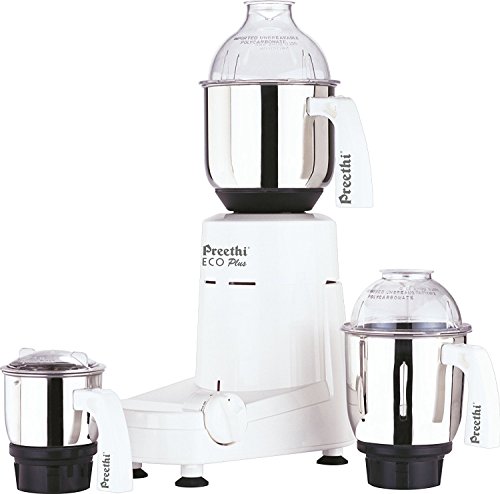
Preethi Eco Plus Mixer Grinder, 110-Volt for USA/Canada — Best for Authentic Grinding Tasks
Some Indian recipes assume a mixer grinder the way Western recipes assume an oven. The Preethi Eco Plus — the 110-volt USA and Canada version — is that machine: multiple small steel jars that grind dry spices to powder, coconut chutney to the right coarse-smooth, and pastes in the small quantities recipes actually call for.
Strengths
- Jar sizes match real Indian recipe quantities, including small ones
- Dry spice grinding is the best in this guide
- Wet chutneys and pastes keep their texture without excess water
Trade-offs
- Not built for large smoothies, soups or frozen drinks
- Batter quantities per batch are modest
- Purely functional design and storage needs
| Format | Mixer grinder, 110V for USA/Canada |
| Jars | Multiple stainless steel jars including small grinding jar |
| Primary use | Grinding, chutney and paste work |
Recipe fidelity is this machine’s argument. A coconut chutney in a mixer grinder comes out with the slight body that makes it cling to idli; the same chutney in a big blender often needs extra water to move at all, and arrives thin. Ginger-garlic paste grinds in the two-hundred-gram quantities a week of cooking needs, not the litre a pitcher wants. Dry spices, covered fully in our companion guide, are simply in a different league from pitcher blenders at small batch sizes.
The limits are equally clear: this is not your soup, smoothie or party-drink machine, and large batter volumes mean several batches. Kitchens that cook Indian food most days and Western blended food rarely will not care. Kitchens in the opposite position should take the all-rounders above and treat this as the specialist it is. For authenticity per dollar on the grinding-centred tasks, nothing else in the list is close.
Best for: cooks centred on traditional grinding, chutney and paste work / Not suited for: households wanting one machine for smoothies and soups too
Check the current price on Amazon

KitchenAid K400 with Tamper KSB4028, Contour Silver — Best for Smooth Purees
If your standard is the puree — the curry base that pours like silk, the palak with no fibre, the makhani with no grain — the KitchenAid K400 is your pick. Its variable speed dial, tamper and Intelli-Speed motor control are tuned for exactly the thick, resistant loads Indian purees and pastes present.
Strengths
- Tamper keeps thick pastes and bases moving without extra water
- Motor control holds consistent speed under heavy loads
- Preset programs cover smoothies and icy drinks for the rest of the menu
Trade-offs
- Dry spice grinding is a moderate-batch secondary skill
- Heavier base suits a permanent counter position
- Premium-mid tier pricing
| Controls | 5-speed variable dial plus preset recipe programs |
| Included | Tamper |
| Motor control | Intelli-Speed |
The tamper changes what is possible with low-water recipes. Onion-tomato masala fried down to a thick paste, or a cashew-based korma base, will cavitate in a tamper-less blender — the blades spin in an air pocket while the mass sits still. Working the tamper folds the load continuously, so you reach a glossy, uniform puree at the consistency the dish wants, not a watered-down version that then needs twenty minutes of extra frying to dry out again. That saved step, repeated across a week of cooking, is a genuine quality difference.
Speed control matters at the other end of the menu too: herb chutneys pulsed gently stay green and fresh-tasting, while the same load run flat-out turns army-coloured and bitter from heat and over-oxidation. Batters and lassis are handled confidently. Dry spices are a competent side skill at moderate volumes. Choose the K400 when puree quality is your headline requirement and the rest of the workload is a supporting cast.
Best for: cooks who prize silky curry bases and thick pastes / Not suited for: dry-grinding-first kitchens on a tight budget
Check the current price on Amazon
Comparison Table
| Pick | Badge | Key spec | Best for |
|---|---|---|---|
| Vitamix 5200 Professional-Grade Blender, 64 oz, Black | Best Overall | 64 oz container, variable speed, high-speed switch | households cooking a wide range of Indian recipes daily |
| nutribullet Full-Size Blender Combo NBF50500, 1200W, 64-oz pitcher, 24-oz tumbler cup | Best Versatility | 1200W, 64 oz pitcher plus 24 oz tumbler cup | mixed households wanting one system for big and small jobs |
| Blendtec Classic 575, WildSide+ Jar | Best for Big Family Batches | WildSide+ jar, 5 speeds, preprogrammed cycles | large families and batch cooks who freeze bases |
| Ninja Professional Plus Blender BN701, 1400W peak, 72 oz, 3 Auto-iQ presets | Best Value Power | 1400W peak, 72 oz pitcher, 3 Auto-iQ presets | budget-conscious families wanting near-premium recipe performance |
| Preethi Eco Plus Mixer Grinder, 110-Volt for USA/Canada | Best for Authentic Grinding Tasks | 110V mixer grinder, small steel grinding jars | cooks centred on traditional grinding, chutney and paste work |
| KitchenAid K400 with Tamper KSB4028, Contour Silver | Best for Smooth Purees | Variable speed dial, tamper included, preset programs | cooks who prize silky curry bases and thick pastes |
Match the machine to your dominant task. Batter and puree households should start at the Vitamix or KitchenAid; mixed households with many small jobs should start at the nutribullet Combo; big-batch cooks at the Blendtec; grinding-centred kitchens at the Preethi; and value hunters at the Ninja BN701, which gives up the least for its tier.
How to Choose a Blender for Indian Recipes
List your five most-cooked recipes and judge every blender against them, not against a showroom smoothie. If dosa or idli batter appears weekly, motor stamina under thick loads and a jar that circulates heavy batter are non-negotiable. If your list is chutney-and-curry, vessel size for small batches and puree smoothness matter more than peak wattage. The right blender is the one whose strengths sit exactly under your list.
Vessel size is the most underrated specification in this category. Big pitchers need volume to work: a small chutney in a 72 oz pitcher smears up the walls and blends unevenly. Cups and small jars fix small jobs; wide jars fix big ones. Households that cook at both scales should either choose a combo system or accept a two-machine future — a truth the industry rarely prints, but your daily cooking will teach you within a month if you ignore it.
Controls deserve a final look. Variable speed is not a luxury for Indian cooking: pastes need slow, powerful folding, herb chutneys need gentle pulses, and purees need a fast finish. Presets are convenient for drinks, but a good dial plus a pulse you control will serve more recipes, more precisely, for more years.
Matching the Blender to Batter, Chutney and Curry Work
Batters reward patience and load management. Soak grains and lentils fully — under-soaked loads are the top cause of gritty batter and strained motors. Blend in batches that fill the jar no more than two-thirds, rest the motor between batches on big quantities, and stop while the batter is still cool to the touch; a warm batter jar means friction is already changing your fermentation. A slightly coarse finish is fine for idli; dosa batter wants it smoother.
Chutneys reward restraint. Coconut chutney should keep a little body; herb chutneys should be pulsed, not run, and ground with the minimum water that lets the blades catch — add a spoon at a time. Grind roasted dals and spices before adding wet ingredients when a recipe layers both, and scrape the vessel once midway rather than adding water to compensate for poor circulation.
Curry bases reward a two-stage blend: a first pass to break everything down, a rest so steam escapes if the base is hot, then a fast finish for silkiness. Never fill a sealed jar with boiling liquid; blend hot bases in batches with the lid vented and a towel over the top, and let pressure settle before opening. These habits protect both the machine and the cook, and they cost nothing.
Sequencing a Full Indian Meal With One Blender
Owning one blender for an entire cuisine is a sequencing problem, and good cooks solve it by ordering tasks from driest and mildest to wettest and strongest. Start with any dry spice grinding for the meal, while the jar is clean and dry. Move next to mild wet work — a coconut chutney base, a batter top-up — then to the assertive pastes: ginger-garlic, green chilli blends, onion masalas. Finish with drinks like lassi, which rinse the jar nearly clean as a side effect. Followed in that order, a single wash at the end of cooking replaces four washes between tasks, and flavours never travel in the wrong direction — nobody’s mango lassi should remember the garlic paste.
Batch thinking helps the same way. Ginger-garlic paste keeps for a week refrigerated in a clean jar, and most households use it daily; grinding a week’s supply in one session converts seven small annoying jobs into one satisfying one. Curry bases freeze in portions and thaw into weeknight dinners that taste cooked-from-scratch. Batters ferment on their own schedule regardless. The blender’s role in a well-run Indian kitchen is less about any single recipe than about these quiet multiplications of effort — which is why jar size, cleanup speed and durability outrank novelty features in this guide’s ranking.
There is also a social sequence worth naming: the blender as the household’s shared tool. A machine simple enough for a teenager to make a chutney in, or for a grandparent to run a lassi through, spreads the cooking labour that Indian meals can concentrate on one person. When you choose among the picks above, weigh not only your own technique but who else will realistically use the machine — the best recipe blender for a household is the one the whole household will actually run.
Troubleshooting Indian Cooking Blender Problems
Gritty batter is the most common complaint, and it is almost never the blender’s fault. Under-soaked rice is the first suspect — grains should crush easily between fingernails before blending — followed by overloading, which leaves the top of the load unprocessed, and insufficient blending time at the finish. Blend the urad dal to a fluffy smoothness first, then the rice, and if grit persists, give the rice a second pass after a ten-minute rest; the grains continue absorbing water and soften further between passes.
Pastes that will not move are a geometry problem: the load has cavitated, spinning an air pocket around the blades. The fixes in order are stopping to scrape the walls down, adding liquid a teaspoon at a time — not a quarter cup — and reducing the batch or moving it to a smaller vessel where the load cannot escape the blade path. A tamper, where fitted, prevents the problem outright, which is why the KitchenAid earns its paste reputation in this guide.
Bitter chutneys and dull spice flavours share a cause: heat and time. Herb chutneys blended long and hot oxidise and turn bitter; spice powders ground in marathon bursts lose their top notes to friction. Work in pulses, keep loads cool, and stop the moment the texture arrives rather than polishing it further. Finally, the lingering-garlic jar: wash immediately after strong pastes, and if a plastic jar holds the smell, a warm-water blend with lemon usually clears it. Persistent ghosts are the universe suggesting a dedicated jar — listen to it.
Regional Workloads: How Different Indian Cuisines Use a Blender
Indian cooking is many cuisines sharing a name, and their blender workloads differ enough to change which pick suits a household. South Indian kitchens lean on fermented batters and coconut chutneys — high-frequency, medium-volume work where a machine’s batter stamina and small-batch chutney handling decide daily happiness, and where the mixer grinder tradition is strongest. North Indian kitchens lean on onion-tomato masalas, dal purees and lassi — puree smoothness and pitcher volume matter most, with dry grinding a weekly rather than daily event. A household should locate its own cooking on that map before choosing; the same blender is not optimal at both poles, and this guide’s varied six exists precisely because of it.
Western and coastal kitchens add their own signatures: green masalas and coconut-based curries that demand herb freshness and gentle pulsing, chaats that want small chutneys in several varieties at once, and Indo-Chinese and tandoori nights that call for marinades and pastes in modest quantities. The pattern across all of them is frequency — Indian home cooking asks small things of a blender constantly rather than large things occasionally. That is why this guide weighted cleanup speed, vessel fit and control so heavily: a machine that is pleasant for the fifth small job of the day is worth more than a marginally stronger one that makes every job a production.
Building the Habit: A Month of Blender-Assisted Indian Cooking
New machines change kitchens only when they change routines, so it helps to picture the first month concretely. Week one is discovery: grind a first spice mix, make the household’s standard chutney, learn where your machine’s load limits and pulse rhythms sit. Week two is batching: a jar of ginger-garlic paste for the week, a freezer portion of curry base, the discovery that Wednesday’s dinner can be half-made on Sunday. Week three is batter confidence — the first idli or dosa cycle where soaking, blending and fermenting click into a rhythm. By week four, the machine has a permanent home and a set of jobs it simply owns.
Two habits separate households that reach week four from those that stall at week one. The first is immediate rinsing, which keeps the machine perpetually ready; a blender that is always clean gets used for small jobs, and small jobs are where the value compounds. The second is a small notebook or phone note with the household’s proven settings — load sizes, pulse counts, water amounts for the standard chutney, paste and batter. Machines are consistent, memories are not, and three lines of notes convert early experiments into permanent household knowledge.
Keeping a Blender Alive in a Two-Meals-a-Day Kitchen
Indian home cooking is among the hardest domestic workloads a blender faces: multiple sessions daily, abrasive spices, acidic tomato and tamarind loads, sticky batters. Longevity under that regime is a care practice with three pillars. The first is thermal honesty — motors heat under thick loads, and the cook who blends batter in two cool batches instead of one punishing one, who rests the machine between heavy sessions, is rewarded with years of extra service. Heat is the silent currency of motor life; spend it slowly.
The second pillar is seal and gasket care. Acidic and oily Indian preparations work on rubber seals over time, and the defence is the familiar one: rinse promptly, dry fully, store jars unsealed so gaskets rest uncompressed and dry. Inspect the seal line monthly for nicks or flattening, because a failing gasket announces itself first as a faint weep during batter work — far better caught at the sink than inside a cupboard of stored appliances. Blade assemblies deserve the same prompt rinse; turmeric and chilli oils stain and season metal left sitting.
The third pillar is load honesty, the theme running through this whole guide. Every failure story in a heavy-use kitchen begins with a load the machine was never sized for — the litre of batter in the small cup, the double batch of paste in the family pitcher. The picks above were chosen with real headroom for Indian workloads, but headroom is a margin, not an invitation. Cooks who respect it find these machines still performing in year five; that durability, in a cuisine that cooks twice a day, is worth more than any single feature in the ranking.
A Note on Water, Spice and Other Small Variables
Two batches of the same recipe can differ for reasons that hide in plain sight, and Indian cooking has two favourite hiding places. The first is water: batters and pastes are hydration-sensitive, and the water clinging to drained rice, soaked dal or washed herbs is an unmeasured ingredient in every batch. Drain soaked ingredients consistently — the same colander time, the same shake — and a whole category of mysterious variation disappears. The second is spice freshness: a curry base blended from a fresh-ground mix and one from a jar opened for six months are different dishes wearing the same name, and no blender setting closes that gap.
Heat management is the third quiet variable. Onions fried to pale gold and onions fried to deep bronze produce bases of different sweetness and colour from identical blending; the blender homogenises, it does not develop flavour. The lesson across all three variables is the one this guide keeps returning to: the machine guarantees consistency of process, and the cook who standardises the inputs — draining, freshness, frying — is rewarded with the consistency of result that makes a cuisine feel mastered.
Final Word on Matching Machine to Household
If the choice still feels open after the reviews, decide by elimination using your own week as the evidence. Write down the last ten things you blended or wished you could blend. Count how many were small — chutneys, pastes, single drinks — and how many were large. That ratio, honestly counted, selects between the small-vessel champions and the big-jar all-rounders more reliably than any ranking, including this one. Then check the winner against your storage: a machine that fits the cupboard you actually have will be used; a marginally better one that lives in the garage will not.
And remember that the second-machine future is normal in serious Indian kitchens. Starting with the all-rounder and adding a small grinder later, or starting with the grinder and adding a pitcher blender later, are both respectable paths that end in the same well-equipped place. Buy for the cooking you do this year, at the quality level this guide’s verified picks represent, and the kitchen will grow in the right order.
How to Make Silky Curry Base and Perfect Batter in a Blender
Two foundational preparations cover most of what an Indian kitchen asks of a blender. Master these sequences and every pick in this guide will perform better.
- For curry base: fry onions until properly golden, add ginger-garlic paste, then tomatoes and powdered spices, and cook until the oil separates at the edges. Cool the mixture for ten minutes — blending it steaming hot builds dangerous pressure in a sealed jar.
- Blend in batches filling the jar half to two-thirds full. Start on low speed to pull the load down, then finish on high for thirty to sixty seconds until the base pours in a smooth ribbon. For a makhani-style finish, add soaked cashews before the final pass.
- For batter: soak rice and urad dal separately until fully softened, then drain. Blend the dal first with just enough cold water to make a fluffy, aerated batter; blend the rice second to a fine, slightly flowing consistency.
- Combine the two batters with salt, mixing by hand to incorporate air, and rest the blender between batches so the motor stays cool. Warm batter at this stage means the next batch should be smaller.
- Ferment the combined batter in a large vessel in a warm spot until risen and lightly sour. Refrigerate what you will not use within a day; cold batter keeps well and makes crisp dosas.
Rinse jars immediately after batter work — dried batter sets like cement and makes the next cleanup miserable. A quick self-clean cycle with warm water right after pouring is the habit that keeps a daily-use blender pleasant to own.
Common Buying Mistakes
Buying peak wattage instead of the right vessel. A huge motor with a pitcher that cannot process your daily chutney quantity is the wrong machine at any price. Vessel fit decides daily satisfaction; wattage decides occasional extremes.
Blending batter in one giant, overheated batch. Overfilled jars blend unevenly and friction heat damages fermentation before it starts. Two cool batches beat one hot one every time.
Adding water to make thick pastes move. Extra water is sometimes necessary, but reach for the tamper, the pulse button or a smaller vessel first. Watery ginger-garlic paste spits in hot oil and dilutes every dish it seasons.
Running herb chutneys on high until smooth. Smooth is not the goal; bright and fresh is. Over-blended coriander and mint chutneys heat up, darken and turn bitter. Pulse, scrape, pulse again, and stop while the colour is still vivid.
Sealing a jar of boiling curry base. Steam pressure can force a lid off mid-blend. Cool hot mixtures briefly, blend in smaller batches, vent the lid and hold it down with a folded towel.
Final Recommendation
Start with the Vitamix 5200 if one machine must do everything well — it is the most complete recipe blender here. The nutribullet Combo is the smartest buy for mixed households with many small jobs, the Blendtec owns big-batch cooking, the Ninja BN701 owns value, the Preethi owns authentic grinding work, and the KitchenAid K400 owns puree quality. If your cooking is spice-led, go deeper with Best Blenders For Indian Cooking Spices Mix; for the single-drink side of the kitchen, Best Blenders For Individual Servings and Best Blenders For Smoothies are the relevant shortlists, and chutney specialists should see Best Blenders For Chutneys.
Ready to decide? Start with the top three picks and check price on Amazon for each before you buy: Vitamix 5200 Professional-Grade Blender, 64 oz, Black · nutribullet Full-Size Blender Combo NBF50500, 1200W, 64-oz pitcher, 24-oz tumbler cup · Blendtec Classic 575, WildSide+ Jar.
Frequently Asked Questions
What matters more for Indian recipes: power or jar size?
Jar fit matters daily; power matters at the extremes. A right-sized vessel processes small chutneys and pastes properly, which is most of the week’s work. Power decides how the machine copes with thick batter and fibrous loads. The picks in this guide were chosen so you do not have to sacrifice either beyond what your budget requires.
Can one blender really make dosa batter well?
Yes, if it sustains speed under a thick load and you blend in cool, right-sized batches. Soak the rice and dal fully, blend the dal fluffy and the rice fine, and keep the batter cool. High-performance blenders and good combo systems both manage this; weak drink blenders produce gritty batter and overheated motors.
Why does my green chutney turn dark and bitter?
Heat and over-processing. Long high-speed blending warms the herbs and oxidises them. Pulse in short bursts, use minimal cold water, add a little lemon juice, and stop as soon as the texture comes together. A smaller vessel also helps, because the load finishes faster with less blade time.
How do I blend a thick paste without adding much water?
Use a tamper if your machine has one, or stop and scrape down twice during blending. A smaller cup or jar keeps the load in the blade path. Add water a teaspoon at a time only when the load truly stops moving — most pastes need far less than cooks instinctively pour in.
Should I buy a mixer grinder instead of a blender?
If your cooking is dominated by dry grinding, chutneys and small pastes, a mixer grinder is the more faithful tool. If batters, purees, soups and drinks share the workload, a blender or combo system serves more of the week. The Preethi in this guide is the mixer-grinder option; the other five are blender-format answers.
Can I blend hot curry base safely?
Yes, with care: let it cool for about ten minutes, fill the jar no more than half, vent the lid, hold it with a towel, and start on the lowest speed. Never seal a jar of boiling liquid and run it on high — steam pressure is the hazard, and it is entirely avoidable.


