Disclosure: airfryerkitchensupply.com is reader-supported. When you buy through links on our site, we may earn an affiliate commission at no extra cost to you.
Where to buy
The best blankets for hammocks are sold through Amazon in two distinct forms — underquilts that hang beneath the hammock and blankets that lie on top of you — and listings do not always make the distinction obvious. Every pick below is labelled by type in its review, so use the links to land on the exact product described.
- Wise Owl Outfitters Hammock Underquilt — check price on Amazon
- OneTigris Hideout Hammock Underquilt — check price on Amazon
- Onewind Hammock Underquilt — check price on Amazon
- AYAMAYA Single & Double Hammock Underquilt — check price on Amazon
- Get Out Gear Down Camping Blanket — check price on Amazon
- CROSSHIP Camping Hammock Underquilt — check price on Amazon
Anyone pricing the best blankets for hammocks learns the category’s central secret quickly: in a hammock, the blanket on top of you is only half the insulation. Lying in a hammock compresses whatever is beneath your body to near-zero loft, and moving air strips heat from the exposed underside — the effect campers call cold butt syndrome. That is why the strongest picks in this guide are underquilts, insulated shells that hang under the hammock where their loft survives, paired with packable top blankets for the layer above.
This guide therefore ranks both halves of a working hammock sleep system. Four picks are dedicated underquilts spanning premium, mid-range and budget tiers; two are top-layer blankets and quilt-blankets that also serve porch and patio hammocks, where an underquilt is overkill and a washable, weather-tolerant blanket is the honest answer. Every pick was verified against its Amazon listing before receiving a link.
Temperature honesty matters in this category more than most. Ratings below are the manufacturers’ own, quoted as orientation rather than promise: personal warmth varies with clothing, wind, humidity and how well the quilt is hung. The buying guide explains how to read those numbers, and the setup section explains the hanging technique that decides whether any of these products performs near its rating.
A note on who this guide serves: dedicated hammock campers will find their system here, but so will the much larger group who hang a hammock in the garden, on the porch or at a campsite twice a year and simply want to be warm doing it. The picks are tiered so that both readers can stop at their level — nobody needs a four-season underquilt for a July garden, and nobody should take a fashion throw onto an October ridge.
Key Takeaways
- In a hammock, warmth is lost from underneath first — bottom insulation matters more than the blanket on top.
- Underquilts hang below the hammock so body weight cannot crush their loft; that is why they outperform pads and blankets beneath you.
- Treat the warm end of any temperature range as your planning number, and rehearse cold setups in the backyard first.
- Down wins on packability for top layers; synthetics win on damp tolerance for underquilts.
- A complete system is two purchases: an underquilt below and a blanket or top quilt above.
In this guide
Quick Picks
Wise Owl Outfitters Hammock Underquilt — Best Overall. The default recommendation for hammock campers: an ultralight, water-resistant underquilt that packs small and fits standard gathered-end hammocks. Check the current price on Amazon
OneTigris Hideout Hammock Underquilt — Best for Cold Weather. A full-length, four-season underquilt with a quick-setup suspension, aimed at campers who hang in shoulder season and winter. Check the current price on Amazon
Onewind Hammock Underquilt — Best Lightweight. A full-length underquilt in 20D recycled nylon with Sorona insulation, sized generously at 82 by 52 inches for single and double hammocks. Check the current price on Amazon
AYAMAYA Single & Double Hammock Underquilt — Best for Double Hammocks. A full-length underquilt sized to serve single and double hammocks, positioned for four-season and winter use, backyard included. Check the current price on Amazon
Get Out Gear Down Camping Blanket — Best Top Blanket. The top half of the system: a 650 fill power down blanket that packs small, sheds water, and doubles as your camp blanket everywhere else. Check the current price on Amazon
CROSSHIP Camping Hammock Underquilt — Best Budget. The budget entry point: a full-length underquilt with a stated 41–68°F range, for new hammock campers testing the concept. Check the current price on Amazon
How These Picks Were Chosen
Picks were chosen to cover the real use cases rather than to list six near-identical underquilts: three-season backpacking, cold-weather hammock camping, budget first setups, gathered-end versus spreader-bar hammocks, and relaxed backyard lounging. Each candidate needed a verifiable Amazon listing, a stated insulation approach (down or synthetic fill, with the fill identified in the listing), and a size that plausibly fits standard hammocks.
We favoured full-length underquilts for the camping picks because partial-length designs demand a foot pad to work — a legitimate ultralight technique, but a poor default recommendation. For the top-layer picks we required packability and weather tolerance, since a hammock blanket that cannot handle dew or be stuffed into a pack solves only the patio half of the problem.
Warmth ratings are reported as manufacturers state them and are never converted into guarantees in the reviews. Where a listing gives a temperature range, the spec box repeats it as the manufacturer’s figure; the buying guide explains why you should treat the warm end of any range as the comfortable planning number.
We also required honest labelling from listings themselves: products that called themselves hammock blankets while being generic throws with no hammock-specific design were excluded, however warm they looked. Every pick here either hangs beneath a hammock by design or earns its place as a top layer with packable, weather-tolerant construction — the two jobs this category actually contains.
The 6 Best Blankets for Hammocks

Wise Owl Outfitters Hammock Underquilt — Best Overall
Wise Owl Outfitters built its name on accessible hammock gear, and its underquilt is the balanced centre of this category: light enough for backpacking, water-resistant enough for damp sites, and priced in the mid-range tier where most hammock campers actually shop. It hangs beneath the hammock on the standard shock-cord suspension, preserving its loft exactly where your body weight would otherwise crush it.
Strengths
- Under-hammock design keeps insulation loft uncompressed where it matters most
- Ultralight and packable, so it earns its place in a backpacking kit
- Water-resistant shell shrugs off dew and light ground splash
Trade-offs
- Synthetic-class insulation is bulkier than down at equal warmth
- Like all underquilts, performance depends on a snug, gap-free hang
- Top insulation still required — this is the bottom half of the system
| Type | Underquilt (hangs beneath hammock) |
| Shell | Water-resistant |
| Carry | Packable, ultralight class |
The Wise Owl is the pick we would hand a first-time hammock camper because it removes decisions. It fits the gathered-end hammocks most people own, the suspension is the familiar clip-and-cord arrangement, and the warmth suits the three-season window in which most hammock camping actually happens. Paired with any decent top quilt or the Get Out Gear blanket further down this list, it makes a complete, forgiving sleep system.
Its honest limits are the class limits: synthetic fills pack larger than down, and on genuinely cold nights you will want the heavier-duty AYAMAYA or a higher-rated system. But warmth-per-money and ease of use are the metrics most buyers should optimise first, and on those the Wise Owl leads this list.
A word on fit across hammocks: the Wise Owl’s standard gathered-end sizing covers the hammocks most campers own, including the longer travel hammocks, and its shock-cord suspension tolerates a range of lengths without modification. If you later move to a bridge hammock or an extra-long expedition model, check the quilt’s stated fit range again — underquilts are the one hammock accessory where an inch of mismatch shows up as a cold stripe at 3 a.m.
Best for: Three-season hammock campers wanting one proven underquilt / Not suited for: Winter campers or ultralighters counting every gram and litre
Check the current price on Amazon
OneTigris Hideout Hammock Underquilt — Best for Cold Weather
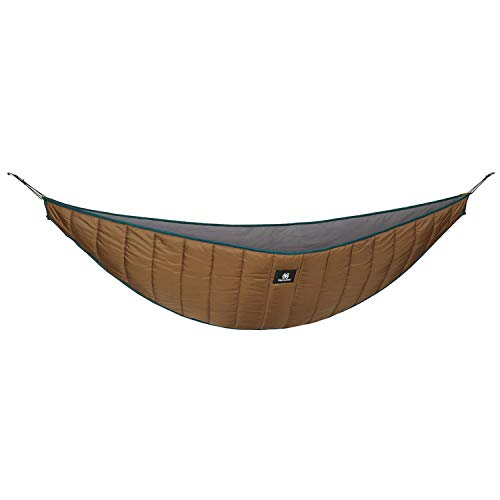
The OneTigris Hideout is the cold-weather anchor of this list: a full-length underquilt the maker positions for four-season use, with a quick-setup suspension designed to minimise the fiddly, cold-fingered adjustment that makes people hate underquilts. Full length matters in winter — there is no foot-pad improvisation at the temperatures this quilt targets.
Strengths
- Full-length coverage protects feet and shoulders without extra pads
- Four-season positioning suits shoulder-season and winter hanging
- Quick-setup suspension reduces adjustment time at camp
Trade-offs
- Warmth comes with packed bulk — not the choice for fast-and-light summer trips
- Four-season claims still depend on your top insulation and clothing
- Heavier class than the three-season picks in this guide
| Type | Underquilt, full length |
| Season rating | 4 season (manufacturer positioning) |
| Setup | Quick-setup suspension |
Cold-weather hammock camping fails at the edges — literally. Shoulders slip off insulation, feet press against the hammock fabric beyond a short quilt’s end, and gaps at the quilt ends funnel cold air. A full-length design with a suspension you can tension properly addresses all three, and the Hideout’s emphasis on fast setup is a genuine cold-weather feature: the less time spent adjusting with bare hands, the better the hang tends to be.
Treat the four-season label as the manufacturer’s positioning and plan your system conservatively: pair it with a top quilt rated for your expected low, wear your insulating layers, and test near home before a remote trip. Within those honest bounds, this is the pick for campers extending their hammock season into the cold months.
OneTigris built its reputation in the bushcraft and military-adjacent world, and the Hideout’s construction reflects it: this is a quilt meant to be hung in rough camps, brushed against bark and packed without ceremony. Campers who treat gear kindly will find it overbuilt; campers whose kit lives a hard outdoor life will find that exactly right. Its warmth headroom also makes it the forgiving choice for campers still learning to hang a quilt gap-free.
Best for: Hammock campers pushing into cold shoulder seasons and winter / Not suited for: Summer-only campers who will resent its packed size
Check the current price on Amazon
Onewind Hammock Underquilt — Best Lightweight
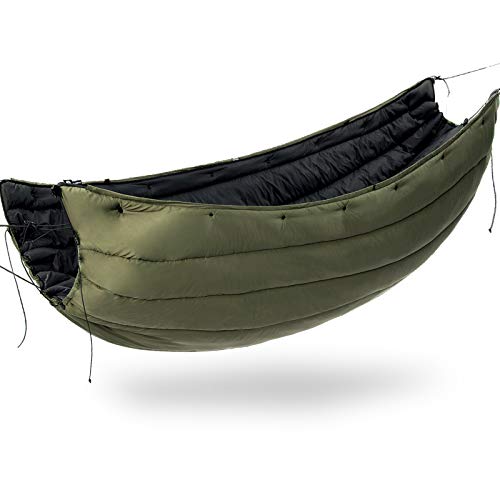
Onewind’s underquilt stands out on materials: Sorona insulation — a partially plant-based synthetic fill known for resilient loft — inside a 20D recycled nylon shell, cut to a generous 82 by 52 inches that covers double hammocks without the shoulder squeeze narrower quilts impose. The manufacturer quotes a 35F–50F working range, which squarely targets spring and autumn nights.
Strengths
- Generous 82″×52″ cut fits double hammocks and restless sleepers
- Sorona fill offers resilient synthetic loft with a lighter footprint story
- 20D recycled nylon shell keeps weight down for backpacking
Trade-offs
- The quoted range tops out at mild temperatures — not a winter quilt
- Lightweight 20D fabric rewards careful handling around snags
- Synthetic fill still packs larger than equivalent down
| Type | Underquilt, full length |
| Size | 82″ × 52″ |
| Insulation | Sorona synthetic |
| Shell | 20D recycled nylon |
| Maker range | 35F–50F |
The dimensions are the story here. Underquilts fail wide sleepers and double-hammock users first: roll slightly and a shoulder finds cold fabric. At 52 inches wide, the Onewind keeps insulation under you through normal sleep movement, and the full 82-inch length covers feet without a pad. For couples sharing a double hammock or anyone who found standard underquilts claustrophobic, that geometry is worth more than a few saved grams.
Read the 35F–50F range the way the buying guide below advises: plan on the warmer portion for comfort unless you sleep hot and dress warm. Inside that window, the combination of modern fill, light shell fabric and honest sizing makes this the technical pick of the list.
Sorona deserves a sentence of explanation, since it is less familiar than down or generic polyester: it is a synthetic insulation partly derived from plant-based feedstock, engineered for resilient, springy loft that recovers well from compression. In an underquilt — compressed in a pack by day, lofted under a hammock by night — that recovery is the property that matters, and it is why this quilt holds its warmth rating through a season of stuffing and hanging.
Best for: Backpackers and double-hammock users wanting a light, wide underquilt / Not suited for: Anyone camping regularly below freezing
Check the current price on Amazon

AYAMAYA Single & Double Hammock Underquilt — Best for Double Hammocks
AYAMAYA’s underquilt is built around versatility of fit: one full-length quilt intended to serve both single and double hammocks, positioned by its maker for four-season and winter cold-weather use. For households with more than one hammock — or one double hammock used by one or two people depending on the trip — a single quilt that covers both avoids buying insulation twice.
Strengths
- One quilt fits single and double hammocks — economical for mixed setups
- Full-length, cold-weather positioning extends the camping season
- Equally at home in the backyard, where trying winter setups is safest
Trade-offs
- A fit-everything cut can need more careful tensioning on narrow singles
- Cold-weather insulation means warm-weather bulk
- Top insulation and wind protection still determine real-world comfort
| Type | Underquilt, full length |
| Fit | Single and double hammocks |
| Season positioning | 4 season / winter (manufacturer) |
The AYAMAYA’s appeal is practical. Double hammocks are the default purchase for couples and for solo campers who like room, yet many underquilts are cut for narrow singles and leave the edges of a double exposed. This quilt’s brief starts from the wider hammock and adapts down, which is the safer direction: excess width on a single can be gathered by the suspension, while missing width on a double cannot be added.
Its maker positions it for winter, and the backyard mention in the listing is more significant than it looks — cold-weather hammock setups should always be rehearsed at home first, where a retreat indoors is steps away. Buy it as a season-extender, test it in the garden on a cold night, and you will learn its true comfort range for your body before it matters.
The AYAMAYA’s single-and-double brief also suits a common household pattern: one partner hammock-camps, the other joins for backyard hangs and car camping in a double. One quilt covering both hammocks simplifies the kit shelf and the budget. When hanging it on a narrow single, take up the extra width evenly with the suspension rather than letting it bunch to one side — bunched insulation is warm in one stripe and cold in the next.
Best for: Double-hammock owners and households with mixed hammock sizes / Not suited for: Gram-counting solo backpackers with a single narrow hammock
Check the current price on Amazon

Get Out Gear Down Camping Blanket — Best Top Blanket
Every underquilt above still needs a top layer, and the Get Out Gear blanket is the strongest verified top-layer pick: 650 fill power down in a waterproof, packable blanket that drapes over you in the hammock and then goes on to serve at camp, in the car and on the sofa. Down’s warmth-to-weight is why it anchors the top of the system, where loft is not crushed by body weight the way it would be underneath.
Strengths
- 650 fill power down gives the best warmth-per-weight in this guide
- Packs compactly — the top layer stops dominating your pack volume
- Waterproof shell handles dew and damp hammock fabrics
Trade-offs
- A top blanket alone cannot fix cold underside — pair with an underquilt for camping
- Down needs proper storage (loose, dry) between trips to keep its loft
- Premium-tier positioning reflects the down fill
| Type | Top blanket / camp quilt |
| Insulation | Down, 650 fill power |
| Shell | Waterproof (manufacturer) |
Used in a hammock, this blanket plays the role a top quilt plays in a dedicated sleep system, with one ergonomic quirk: a blanket’s open edges can draft where a footboxed top quilt seals. In mild-to-cool conditions that hardly matters, and the blanket’s versatility — stadium nights, campervan stops, guest bedding — makes it the easiest purchase in this guide to justify year-round.
It is also the right answer for the porch-hammock reader: on a spreader-bar hammock on a cool evening, nobody needs an underquilt, but a warm, water-tolerant blanket that packs away small is exactly right. Buy it as a top layer for camping or a standalone for lounging; just do not expect it, alone, to make a cold camping night warm from beneath.
Care is the down blanket’s one recurring task: wash rarely and gently with down-appropriate detergent, dry thoroughly with low heat and patience until the clusters loft again, and store it hanging or in its loose storage bag. Done that way, a 650-fill blanket like this is a decade-scale purchase, which reframes its premium tier — few items in this guide will still be in service as long.
Best for: Campers needing the top half of a hammock sleep system; porch loungers / Not suited for: Anyone hoping one blanket alone solves cold-weather hammock camping
Check the current price on Amazon

CROSSHIP Camping Hammock Underquilt — Best Budget
The CROSSHIP underquilt is the low-commitment way to learn whether underquilts are for you. It is a full-length design — the right architecture, not a cut-down pad — with a manufacturer-stated working range of 41–68°F, which honestly describes the mild-weather window where most people start hammock camping. Its tier position makes the experiment cheap.
Strengths
- Full-length architecture at a budget tier — the correct design, not a compromise shape
- Stated temperature range sets honest expectations for mild-weather use
- Lightweight and portable across hiking, beach and travel use
Trade-offs
- The stated range excludes genuinely cold nights
- Budget construction rewards gentle handling and careful storage
- Experienced winter campers will outgrow it quickly
| Type | Underquilt, full length |
| Maker range | 41–68°F |
| Season positioning | 3–4 season (manufacturer) |
There is a sensible way to read this pick: it is tuition. Hammock insulation involves new habits — hanging, tensioning, venting — and learning them on a budget quilt in mild weather is far better than learning them on a premium quilt in serious cold. The CROSSHIP covers the learning season, works for backyard hangs and summer trips, and tells you whether you want to invest further up this list.
Its stated range is also a model of how to read every rating in this category: 41–68°F describes survival-to-comfort across conditions, and most sleepers will find their comfort in the upper half. Plan accordingly, pair it with the Get Out Gear blanket or a sleeping bag on top, and it performs the job its listing promises.
The CROSSHIP also makes a sensible second quilt for a household: the loaner for a friend’s first hammock trip, the kids’ quilt, the one that lives in the car for unplanned beach and park hangs. Budget insulation earns its keep in roles where a premium quilt would be babied, and its mild-weather range honestly covers the conditions those roles happen in.
Best for: New hammock campers and mild-weather or backyard hangers on a budget / Not suited for: Cold-weather camping or as a long-term four-season solution
Check the current price on Amazon
Comparison Table
| Pick | Badge | Key spec | Best for | Price |
|---|---|---|---|---|
| Wise Owl Outfitters Hammock Underquilt | Best Overall | Full underquilt, ultralight, water-resistant, packable | Three-season hammock campers wanting one proven underquilt | Check price |
| OneTigris Hideout Hammock Underquilt | Best for Cold Weather | Full-length 4-season underquilt, quick setup | Hammock campers pushing into cold shoulder seasons and winter | Check price |
| Onewind Hammock Underquilt | Best Lightweight | Full length 82″×52″, Sorona insulation, 20D recycled nylon, 35F-50F maker range | Backpackers and double-hammock users wanting a light, wide underquilt | Check price |
| AYAMAYA Single & Double Hammock Underquilt | Best for Double Hammocks | Full-length underquilt for single and double hammocks, 4-season positioning | Double-hammock owners and households with mixed hammock sizes | Check price |
| Get Out Gear Down Camping Blanket | Best Top Blanket | Top blanket, 650 fill power down, packable, waterproof shell | Campers needing the top half of a hammock sleep system; porch loungers | Check price |
| CROSSHIP Camping Hammock Underquilt | Best Budget | Full-length budget underquilt, maker range 41-68°F, 3-4 season | New hammock campers and mild-weather or backyard hangers on a budget | Check price |
How to Choose the Right Blanket or Quilt for Your Hammock
Buying hammock insulation well means unlearning sleeping-bag thinking. On the ground, your weight compresses the insulation beneath you too — but a sleeping pad replaces it. In a hammock there is no pad unless you add one, and pads in hammocks shift, bunch and narrow your sleeping surface. The underquilt exists precisely to hang the insulation where compression cannot reach it. The sections below cover the decisions that follow from that one idea.
Underquilt, pad or blanket alone: choosing your bottom insulation
Three architectures compete. An underquilt hangs beneath the hammock and preserves full loft; it is the warmest and most comfortable option and the one this guide recommends for camping. A sleeping pad inside the hammock works in a pinch and suits people who also sleep in tents, but it narrows the lay, can slip, and insulates only where it stays. A blanket beneath you inside the hammock is the weakest option — your weight flattens it to a sheet — which is why no pick here is sold as bottom insulation in blanket form.
For porch and patio spreader-bar hammocks, the calculus flips: sessions are short, retreat is near, and a good top blanket like the Get Out Gear pick is genuinely sufficient. Match the architecture to the exposure, not to the marketing.
Reading temperature ratings without fooling yourself
Hammock insulation has no universal enforced rating standard, so treat every number as the manufacturer’s estimate under their assumptions. A range like 41–68°F usually spans “survivable in full clothing” to “comfortable in light layers”. Plan trips around the warmer portion of any range, then adjust with clothing, a wind-blocking setup, and site selection — a sheltered hang out of the wind is worth several degrees by itself.
Your top layer, hat and socks are part of the system the rating assumes. An underquilt rated for your target temperature paired with a thin summer blanket will still leave you cold, from the top. Budget for both halves or reuse a sleeping bag opened as a top quilt, which works well.
Length, width and hammock fit
Full-length underquilts insulate heel to head and are the forgiving default; partial-length designs save weight but require a pad under your feet and more skill to keep sealed. Width matters for double hammocks and restless sleepers — the Onewind’s 52-inch cut exists for exactly that case. Check your hammock type too: gathered-end hammocks take standard underquilts beautifully, while spreader-bar hammocks hold quilts poorly and are usually better served by a pad-and-blanket or a dedicated hammock pad set.
Suspension compatibility is rarely an issue — most underquilts clip to the hammock’s end loops — but confirm the quilt’s stated fit range against your hammock’s length before ordering, especially for extra-long hammocks.
Down versus synthetic fill
Down, like the 650 fill power blanket in this guide, wins on warmth-per-weight and packed size, and lasts for years if stored loose and dry; it loses loft when wet and sits at premium tiers. Synthetic fills — including modern options like Sorona — cost and weigh more for the same warmth but keep insulating when damp, dry faster, and suit wet climates and budget builds. For underquilts, which live outside the hammock exposed to dew and splash, synthetic’s damp tolerance is a real argument; for top blankets, down’s packability usually wins.
Wind, tarps and site selection: the free warmth
An underquilt’s rating assumes still air. Wind moving under a hammock strips heat continuously, and no fill fully compensates. Hang your tarp low and close on windy nights, pitch the hammock in natural shelter — behind a rise, in tree cover rather than a clearing — and orient the hammock so the wind meets its side, not its open ends. These choices are worth more warmth than the difference between adjacent picks in this guide.
Site selection helps from below too: avoid frost-pocket hollows where cold air pools, and in shoulder seasons a simple foam sit-pad under your feet inside the hammock adds a surprising amount of warmth for its weight, complementing even a full-length quilt.
Layering the top half properly
The top blanket is half a system, and layering it well matters: a base layer you sleep in, the blanket or top quilt over you, and a hat — hammock sleepers lose notable heat from the head, which no blanket covers. Opened sleeping bags work as top layers, though their zips and hoods are dead weight; a dedicated blanket like the Get Out Gear pick is lighter for the same warmth.
On borderline nights, wear your insulated jacket to bed rather than buying a warmer quilt for two nights a year. Systems thinking — quilt, top layer, clothing, shelter — is how experienced hammock campers stay warm without carrying a different quilt for every month.
From Porch to Backcountry: Matching the Blanket to the Hang
It is worth stepping back to the two ends of hammock life, because they want opposite products. The backcountry hang is a sleep system: insulation below, insulation above, shelter overhead, everything chosen by weight and temperature. The porch hang is a pleasure object: a spreader-bar hammock, a long evening, and a blanket whose job is comfort and atmosphere. Confusing the two is how people end up with a technical underquilt for a patio — or a fashion throw for a frosty ridge.
This guide’s picks map cleanly onto that spectrum. The Get Out Gear blanket alone serves the porch and doubles as the top half of the backcountry system. The underquilts serve the trail and the cold backyard test-night. The CROSSHIP serves the learner in between. Buying in that order — top blanket first if you lounge, underquilt first if you camp — keeps every purchase immediately useful.
And if you are buying a gift: hammock campers almost always need the underquilt they have not bought yet, while porch hammock owners almost always want the beautiful blanket. The keyword that brought you here covers both people; the reviews above tell you which is which.
Underquilt Suspension, Explained Simply
Every underquilt in this guide hangs from two things: a primary suspension that carries its weight along the hammock’s length, and end cinches that gather its ends against the hammock’s body. The primary suspension is shock cord for a reason — it stretches as you move, keeping the quilt hugged against the hammock without crushing loft when you settle. If a quilt feels cold in stripes, the cause is almost always a loose primary line on one side, not a lack of fill.
Two adjustments solve most problems. The first is overall tension: the quilt should visibly lift the empty hammock a little, which preloads it against your weight. The second is differential tension at the ends — snug enough to seal the cold-air funnels, loose enough not to compress the end baffles into ropes. Adjust one variable at a time, lie in the hammock between changes, and the system teaches you its own settings within one backyard session.
Some campers add a secondary suspension — prusik loops that stop the quilt migrating along the hammock’s ridge during the night. If you wake to find your quilt bunched toward one end, that migration, not the quilt’s rating, is your problem, and it is a ten-minute fix with cord you probably already own. Mastering these three adjustments is worth more warmth than upgrading one tier of fill.
A Brief History of Sleeping Warm in a Hammock
Sailors slept in hammocks for centuries with nothing but a blanket, and mostly near the equator of their routes or in the fug below decks; the modern cold problem belongs to campers who took the hammock uphill and into autumn. The solutions evolved in order: first the sleeping pad borrowed from tent camping, tolerated despite its slipping; then early underquilts from cottage makers in the 2000s, which proved the hanging-insulation principle; then the mainstream designs in this guide, which made the principle a product anyone can buy.
That history explains the category’s present shape: underquilts look unusual because they are young, and their ratings lack a common standard because no standards body has caught up. It also predicts the direction of travel — lighter fills, better suspensions, more honest temperature communication. Buying into the category now means buying its mature-enough present: the picks here are not experiments, they are the established answer, refined to the point where a first-time buyer can simply choose a tier and hang it correctly.
How to Hang an Underquilt and Set Up a Hammock Blanket System
An underquilt’s warmth is decided less by its fill than by its hang. Gaps leak heat; crushing kills loft. This sequence works for every underquilt in this guide.
- Hang the hammock first, at your normal sleeping tension. Set up the hammock exactly as you sleep in it. The underquilt is fitted to this hang, so changing hammock tension afterwards means refitting the quilt.
- Clip the quilt to both hammock ends. Attach the quilt’s suspension to the hammock’s end loops or continuous loops so the quilt hangs centred beneath, running the full length of the hammock body.
- Tension until the quilt just lifts the empty hammock. Tighten the shock cord until the quilt snugly supports the hammock fabric without compressing the quilt’s loft. It should hug, not squeeze.
- Get in and check for gaps. Lie in your sleeping position. A partner — or a hand swept along your back and shoulders — should find no air gap between quilt and hammock, especially at the shoulders and feet.
- Adjust the end cinches. Snug the quilt’s end cords so the ends gather against the hammock, sealing the funnels where cold air enters. Small adjustments here are worth several degrees.
- Add the top layer and vent as needed. Lay your top blanket or opened sleeping bag over you. On mild nights, loosen the quilt or push the top blanket down rather than sweating — damp insulation sleeps cold later.
- Rehearse cold setups in the backyard first. Before any cold trip, sleep one night at home with the full system. You will learn your true comfort range with a warm house metres away as the safety net.
Storage is part of setup: keep down and synthetic insulation stored loose in a large cotton bag, not compressed in its stuff sack, and hang it to air after trips. Loft is the product you bought; compression storage slowly spends it.
Keep a small repair and spares kit with your hammock gear: a patch for the quilt’s shell fabric, spare shock cord and a couple of mini carabiners. Underquilts live outdoors, where a snagged branch or a lost clip can end a trip’s warmth; the kit weighs almost nothing and converts most field failures into ten-minute repairs. Check it when you air the insulation after each trip, the same moment you check the quilts themselves for damp or damage, and restock whatever the last trip used.
Common Buying Mistakes
Buying only a top blanket for camping. The classic beginner error. Your crushed underside loses heat all night regardless of how warm the blanket on top is. Camping needs bottom insulation — an underquilt or a pad.
Trusting the coldest number in a temperature range. Ranges span survival to comfort. Planning a trip at the extreme low figure, in light clothing, is how miserable nights happen.
Hanging the underquilt with gaps. A loose quilt with air channels beneath you performs far below its fill. Ten minutes of tensioning and gap-checking is the cheapest warmth upgrade available.
Storing insulation compressed. Months in a tight stuff sack permanently flatten loft. Store quilts and down blankets loose, and only compress them for the trip itself.
Using a gathered-end underquilt on a spreader-bar hammock. Spreader-bar hammocks hold underquilts badly. For those, choose a top blanket for lounging or a pad set designed for the bar style.
Final Recommendation
For most hammock campers the Wise Owl Outfitters underquilt is the right first purchase, paired with the Get Out Gear down blanket as the top layer — together they form a complete, verified system. Cold-weather campers should start from the OneTigris Hideout or the AYAMAYA instead; double-hammock owners and backpackers who move in their sleep should look at the wide Onewind. On a budget, the CROSSHIP teaches the whole technique honestly in mild weather.
Whichever combination you choose, rehearse it in the backyard before it counts, and check the current price on Amazon for each half of the system before ordering — insulation is a system purchase, and it is the pair, not either piece, that keeps you warm.
Before your first cold trip, do the backyard rehearsal with the exact system you will carry — quilt, top layer, clothing, tarp — and write down the overnight low and how you slept. That single data point calibrates every manufacturer rating in this guide to your body, and it is the most valuable page in your camping notebook.
And if the budget stretches to only one purchase this season, sequence it by your next trip: campers facing a cold night buy the underquilt first, because top layers can be improvised from home bedding for one season in a way bottom insulation cannot. Loungers buy the blanket. The other half of the system keeps — it will be exactly as good next season, and so will the hammock.
Keep researching with these related guides from our site: Best Camping Blankets Best Hammocks Best Sleeping Bags For Camping Best Throw Blankets Best Quilts
Frequently Asked Questions
Why do I need an underquilt if I already have a warm blanket?
Because the blanket beneath your body is compressed flat by your weight and insulates almost nothing, while air moving under the hammock strips heat continuously. An underquilt hangs below the hammock where its loft survives, which is why it — not a thicker top blanket — fixes cold nights.
Can I use a sleeping pad in a hammock instead of an underquilt?
Yes, and it is a reasonable dual-purpose choice if you also tent camp. Expect a narrower feel, some slipping, and less comfort than an underquilt; partially inflating the pad helps it conform to the hammock’s curve.
How do I know what temperature rating I need?
Take the coldest night you realistically plan, then choose insulation whose stated range has that temperature in its warmer half. Add margin with clothing, a hat, and a sheltered hang out of the wind.
Will these underquilts fit a double hammock?
The Onewind (82″×52″) and AYAMAYA are chosen specifically for single-and-double coverage. Standard-width quilts like the Wise Owl fit doubles but can feel narrow for two sleepers; check the fit notes in each review.
How should I store a down blanket or underquilt at home?
Loose, in a large breathable storage bag, in a dry place. Compression is for transport only; long-term compression permanently reduces the loft you paid for.
What is the best setup for a backyard spreader-bar hammock?
Skip the underquilt — spreader-bar hammocks hold them poorly. A warm, water-tolerant top blanket such as the Get Out Gear down blanket is the comfortable, honest choice for evening lounging.
Can I use a regular camping blanket under me inside the hammock?
You can, but expect little insulation from it: your weight compresses it flat, which is the entire problem underquilts exist to solve. As a top layer, a regular camping blanket is fine; underneath, use an underquilt or a pad.
How do I wash a hammock underquilt or down blanket?
Gently, rarely, and per the maker’s label: mild or down-specific detergent, a thorough rinse, and complete drying — down needs patient low-heat tumble drying until the clusters loft again. Store loose and dry afterwards, never compressed and damp.


