Disclosure: airfryerkitchensupply.com is reader-supported. When you buy through links on our site, we may earn an affiliate commission at no extra cost to you.
Where to buy
Every blanket in this guide to the best blankets for flying was cross-checked against the live Amazon catalogue before it earned a place here. Most flyers should start with the EverSnug Travel Blanket and Pillow; tall passengers on long sectors should go straight to the BlueHills Premium Soft Long Travel Blanket Pillow. We never print product prices — they change too often to stay honest — so use the check-price links throughout instead.
Why a Flying Blanket Is a System, Not Just a Blanket
The best blankets for flying are not the warmest blankets you own shrunk down — they are travel systems that happen to include a blanket, and the first thing to understand is why. An airplane cabin at altitude is cold in a specific way: the air is dry, the ventilation is constant, and you are sitting still for hours, generating little body heat of your own. The blanket an airline hands you, when it hands you one at all, is thin, small and shared-laundered. A blanket you bring solves the warmth problem, but it creates a logistics problem — it has to fit your personal item, stay clean, not be forgotten in the seat pocket, and ideally do something useful during the other ten hours of the travel day.
That is why nearly every serious pick in this roundup folds into its own case. Packed, the blanket becomes a pillow or cushion; clipped or sleeved to your luggage, it rides outside the bag and cannot be left behind. The differences between the six are in the details that matter at 38,000 feet: open size (a few inches of length decide whether a tall passenger sleeps), fabric warmth, packed bulk, and how the thing carries between flights.
Our six span the honest range — a complete all-round system, an oversized long-haul blanket, a convertible design from a pillow specialist, a value 2-in-1, a warmth-first plush, and the original budget compact — and every one was verified against Amazon’s catalogue, with sizes taken from the listings themselves.
One more piece of honesty before the picks: a flying blanket will not fix a bad seat, a loud cabin or a short night. What it does is remove the cold-and-uncovered problem completely, and for most passengers that problem is the difference between arriving merely tired and arriving wrung out. Judge these picks by how completely they remove it for your kind of trip — the hops, the hauls and the red-eyes ask for different blankets, and this list is organised by trip, not by brand prestige.
In this guide
Quick Picks
Best Overall — EverSnug Travel Blanket and Pillow: A 65×40-inch blanket that folds into its own carry case to become a pillow, with a luggage sleeve and backpack clip — the most complete flying-blanket system in this roundup.
Best for Tall Flyers and Long Flights — BlueHills Premium Soft Long Travel Blanket Pillow (70 x 48): An oversized 70×48-inch travel blanket that packs into its own pillow case, with a luggage belt and carabiner — real coverage for tall passengers on long sectors.
Best Dual-Purpose: Blanket, Lumbar and Neck Support — Cabeau Fold ‘n Go Travel Blanket: Cabeau’s French microfiber blanket folds into a compact case and converts to lumbar support or a neck cushion, from the brand that built its name on travel pillows.
Best Value 2-in-1 — PAVILIA Travel Blanket Pillow 2-in-1: A 60×43-inch blanket that packs into its own pillow case with luggage and backpack straps, at the friendliest tier of the full-featured picks.
Best for Warmth on Cold Cabins — BOACAY Soft & Warm Travel Blanket: A plush, warmth-first travel blanket that packs into a compact pillow with a luggage sleeve and backpack clip — made for passengers who are always cold at altitude.
Best Budget Classic — Cloudz Cozy Compact Airplane Travel Blanket: One of the original compact airplane blankets: a simple, light fleece that rolls small, costs little and has been riding in personal items for years.
How These Picks Were Chosen
We chose these six by starting from the failure modes of travel blankets rather than from brand lists. A flying blanket fails by being too small (the most common failure), too bulky to pack, too thin for a cold cabin, or too easy to leave behind. Each pick here is the strongest answer we could verify to at least one of those failures, and each is labelled with the failure it does not solve — because a blanket that is wrong for your trip is worse than none: it takes bag space and gives back a shiver.
Verification was strict: every product was confirmed with its title and stated dimensions matched to the blanket we describe. We excluded blankets whose listings gave no dimensions (an unverifiable blanket is a guess), weighted blankets marketed for travel (a heavy blanket is a poor use of a baggage allowance and a worse seat companion), and full-size home throws with travel language pasted onto the listing. Sizes in this guide come from the manufacturers’ listings; where a brand sells several sizes, we name the one we picked.
We also tested each pick’s claims against its own listing rather than its marketing name. A blanket calling itself “large” with dimensions below 55 inches did not make the long-haul slot; a “2-in-1” whose case could not plausibly serve as a cushion did not make the value slot. The badges in this guide describe what the verified product actually does.
The 6 Best Blankets for Flying

1. EverSnug Travel Blanket and Pillow — Best Overall
EverSnug thought about the whole journey, not just the seat. The blanket itself is a generous 65 by 40 inches — long enough to cover legs and torso in an economy seat — and when the flight ends it folds into its carry case, which then works as a pillow, slips over a suitcase handle via the luggage sleeve, or clips to a backpack. Nothing dangles, nothing gets left on the plane.
Strengths
- Full 65×40-inch coverage, larger than most packable rivals
- Case converts to a pillow and carries a luggage sleeve and backpack clip
- Soft, warm fabric that packs down without a fight
Trade-offs
- As a pillow it is a folded blanket, not a shaped neck pillow
- The case-plus-blanket bundle is bulkier than the slimmest budget options
- One colour family dominates availability at times
| Open size | 65 x 40 inches |
| Packed form | Carry case / pillow |
| Carry | Luggage sleeve + backpack clip |
| Use | Plane, car, train |
The test of a travel blanket is the whole trip: the cold gate area, the colder cabin at altitude, the nap you actually manage, and the walk to baggage claim with your hands full. EverSnug is the only pick here designed for all four. In the seat, the size matters most — 65 inches of length means the blanket reaches from chin to past the knees for most adults, so it stays put instead of riding up every time you shift. As a pillow, honesty requires a caveat: folded fleece is a fine cushion against the cabin wall or under an elbow, but it is not a neck-support pillow, and side-sleepers who lean on a window will still want their usual support. The carry system is the closer: a blanket that clips to your bag cannot be forgotten in the seat pocket, which is where most travel blankets end their careers.
Frequent flyers develop one more habit worth copying: the case lives clipped to the same bag every trip, so packing the blanket is never a decision. Travel gear fails by being forgotten far more often than by wearing out, and EverSnug’s clip-and-sleeve design is best understood as an anti-forgetting system that also happens to keep you warm.
Best for: frequent flyers who want one complete blanket system / Not suited for: travellers who need structured neck support to sleep
Check on Amazon: EverSnug Travel Blanket and Pillow — check the current price on Amazon.
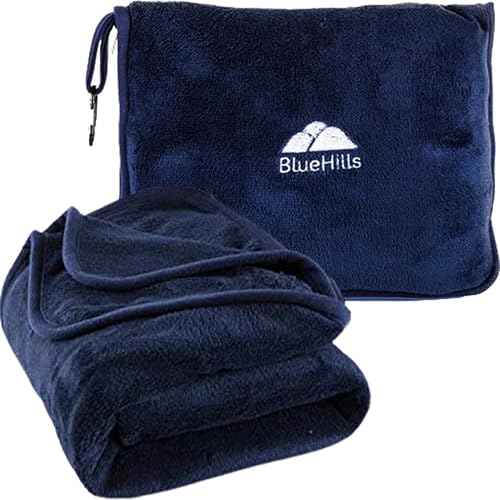
2. BlueHills Premium Soft Long Travel Blanket Pillow (70 x 48) — Best for Tall Flyers and Long Flights
Most travel blankets are sized for an average passenger on a short hop, and tall flyers know the result: a blanket that covers either the chest or the feet, not both. BlueHills’ long version opens to 70 by 48 inches, the largest footprint in this roundup, then packs back into its soft case with a luggage belt and carabiner for the carry.
Strengths
- 70×48-inch size genuinely covers tall passengers head-to-toe
- Wide as well as long, so it wraps shoulders instead of perching on them
- Packs into its own case with luggage belt and carabiner included
Trade-offs
- Packed size is the largest here; ultralight packers should look below
- The extra fabric is surplus for short domestic hops
- Case-as-pillow is soft and unstructured, like its rivals
| Open size | 70 x 48 inches |
| Packed form | Soft case / pillow |
| Carry | Luggage belt + carabiner |
| Colour shown | Navy blue |
On a long-haul night flight, blanket size stops being a luxury and becomes the difference between sleeping and dozing in fragments. Every time a too-short blanket slips off a shoulder, the cold cabin air wakes you; a 70-inch blanket can be tucked, and a 48-inch width means it wraps rather than balances. BlueHills also sells smaller versions, which tells you the long one exists for a reason — it is the answer to the most common complaint in this category. The trade is packed bulk, and it is real: this is the pick for checked-bag travellers, carry-on-plus-personal-item travellers, and anyone whose personal item is a roomy backpack. If you fly with a slim tote and a strict personal-item sizer, the EverSnug or PAVILIA will fit your life better. For the six-foot-plus flyer on a nine-hour sector, no other pick here is close.
A sizing note for couples and families: one long BlueHills can cover two children sharing a row’s middle and window seats on a daytime flight, which saves packing a second blanket. At night, give each sleeper their own — shared blankets in separate sleep schedules end with one warm passenger and one resentful one.
Best for: tall passengers and long-haul night flights / Not suited for: ultralight packers with small personal items
Check on Amazon: BlueHills Premium Soft Long Travel Blanket Pillow (70 x 48) — check the current price on Amazon.

3. Cabeau Fold ‘n Go Travel Blanket — Best Dual-Purpose: Blanket, Lumbar and Neck Support
Cabeau comes at the flying blanket from the pillow side of the aisle: the Fold ‘n Go is a soft microfiber blanket whose case and folding system let it serve as lumbar support behind your back or as a neck cushion, then open out into a full blanket when the cabin cools. For travellers whose problem is backache as much as cold, it is the cleverest design here.
Strengths
- Converts between blanket, lumbar support and neck cushion roles
- French microfiber feels a class above basic fleece
- Compact case keeps it clean and contained between uses
Trade-offs
- Open blanket coverage is smaller than the EverSnug and BlueHills
- Conversion involves folding steps that take a flight or two to learn
- Premium brand tier among these picks
| Fabric | French microfiber |
| Roles | Blanket / lumbar pillow / neck support |
| Packed form | Compact travel case |
| Brand | Cabeau |
Airline seats are hard on lower backs, and the gap between the seat back and your lumbar curve is where the ache starts at hour three. A blanket that can be folded into that gap — and then unfolded into a blanket when you finally recline — solves two problems with one item in the bag, which is the kind of economy that matters in a personal item. The microfiber is genuinely pleasant against skin, softer than the standard fleece of the category, and it washes without pilling as quickly. The compromises are coverage and complexity: opened out, it will not swaddle a tall passenger the way the BlueHills does, and the folding ritual, while simple, is one more thing to learn. Travellers who already carry a Cabeau neck pillow may find this redundant; travellers who carry neither will find it the most versatile single purchase in the roundup.
The conversion also changes how the blanket packs: folded to its case dimensions it is denser and more pillow-like than rivals that simply stuff into a sack. Travellers who use the lumbar mode for the first half of a flight and the blanket for the second get the most from it; travellers who never convert it are paying for cleverness they do not use, and the EverSnug is their simpler answer.
Best for: backache-prone flyers and minimalist packers / Not suited for: tall passengers wanting maximum blanket coverage
Check on Amazon: Cabeau Fold ‘n Go Travel Blanket — check the current price on Amazon.

4. PAVILIA Travel Blanket Pillow 2-in-1 — Best Value 2-in-1
PAVILIA’s 2-in-1 is the value benchmark of the category: a 60 by 43 inch blanket — respectably sized, wider than many — that folds into its own case to serve as a pillow, with both a luggage strap and a backpack strap so it rides outside your bag instead of competing for space inside it.
Strengths
- 60×43-inch blanket is wider than the budget norm
- Both luggage strap and backpack strap included
- Friendly tier makes it an easy gift and a low-risk first travel blanket
Trade-offs
- Fabric is a standard fleece feel rather than a premium microfiber
- Pillow mode is a soft cushion, not structured support
- Less blanket length than the EverSnug for taller users
| Open size | 60 x 43 inches |
| Packed form | Pillow case |
| Carry | Luggage strap + backpack strap |
| Colour shown | Navy blue |
What PAVILIA gets right is proportion. Many budget travel blankets are cut so narrow that they function as lap throws; at 43 inches wide, this one covers shoulders and stays tucked at the sides, which is what keeps a sleeping passenger covered through the small movements of sleep. The dual straps sound like a spec-sheet flourish until you have clipped the blanket to a backpack for a connection and walked past everyone juggling loose bedding at the gate. It is also the pick we suggest for families equipping several children at once: the tier makes multiples painless, the colours help each child identify their own, and the blanket is forgiving of the spills and drops of family travel. It does not beat the EverSnug on system completeness or the BlueHills on size; it beats everything on the ratio of usefulness to cost.
For children, the pillow mode is the right size as a seat cushion that buys a little extra height at the tray table as well as a nap pillow — an unadvertised use parents discover quickly. The straps also mean a child can carry their own blanket clipped to their own backpack, which distributes the family’s carrying and, experience suggests, dramatically reduces the leaving-it-on-the-plane rate.
Best for: families, gift buyers and first-time travel-blanket owners / Not suited for: tall flyers needing maximum length
Check on Amazon: PAVILIA Travel Blanket Pillow 2-in-1 — check the current price on Amazon.

5. BOACAY Soft & Warm Travel Blanket — Best for Warmth on Cold Cabins
Some passengers run cold on every flight, on every airline, in every season — the cabin at cruising altitude is simply their enemy. BOACAY built its blanket for them: a soft, warm, plush-feeling blanket that prioritises insulation over shaving the last gram, then packs into a compact pillow with the luggage sleeve and backpack clip that keep it attached to your kit.
Strengths
- Warmth-first fabric suits genuinely cold cabins and winter routes
- Packs into a compact pillow with luggage sleeve and backpack clip
- Soft plush hand-feel that passengers describe as comforting on red-eyes
Trade-offs
- Warmth means a little more packed bulk than the lightest options
- Too warm for some travellers on short, warm daytime sectors
- Pillow mode is cushioning, not neck support, as with its rivals
| Focus | Warmth / plush feel |
| Packed form | Compact pillow |
| Carry | Luggage sleeve + backpack clip |
| Use | Plane and car |
Warmth in a travel blanket is a fabric-weight decision, and BOACAY spends its weight budget there rather than on features. The result is the blanket passengers reach for on winter routes, older aircraft with enthusiastic air conditioning, and the window seats that run coldest. It also earns its keep beyond the plane: as a car blanket for passengers on long drives it is arguably better than it is in the air, because the car has no personal-item limit and the plush weight is pure comfort. The honest trade is packed size — warmth you can pack into nothing does not exist — so ultralight travellers should weigh the EverSnug’s balance instead. But if your travel history is a series of flights spent shivering under a tissue-thin airline blanket, this is the pick that ends that story.
On multi-sector trips the plush fabric earns a second mention: it tolerates being the blanket, the pillow and the seat cushion across a long day without looking crushed, and it shakes out at the destination ready for the hotel’s over-enthusiastic air conditioning — a second cold environment where travel blankets quietly do as much work as they do in the air.
Best for: cold-natured passengers, winter routes and red-eye flights / Not suited for: warm-natured travellers on short daytime hops
Check on Amazon: BOACAY Soft & Warm Travel Blanket — check the current price on Amazon.

6. Cloudz Cozy Compact Airplane Travel Blanket — Best Budget Classic
Cloudz was selling compact airplane blankets before the category had a name, and its Cozy blanket remains the simple, honest budget option: a lightweight fleece blanket that packs small, weighs little and asks nothing of the traveller. No conversion system, no straps-and-clips architecture — just a blanket, done plainly, at a budget tier.
Strengths
- Very light and compact; disappears into a personal item
- Budget tier makes it a no-regret purchase and an easy spare
- Simple fleece is easy to wash and quick to dry on the road
Trade-offs
- No pillow conversion, luggage sleeve or carry system
- Coverage is modest for tall passengers
- Thin fleece is the least warm option here
| Type | Compact fleece blanket |
| Packed form | Rolls/folds small |
| Carry | None — packs inside bag |
| Colour shown | Black |
There is a traveller this blanket is perfect for: the one who flies twice a year, packs light, and wants insurance against a cold cabin without reorganising their bag around a blanket system. The Cloudz lives in the bottom of a personal item for months, weighs almost nothing, and is there the one flight in five when the cabin is freezing or the airline’s own blankets run out. It will not wrap a tall passenger, it will not double as a pillow, and its thin fleece is the least warm here — all stated plainly because at this tier those are acceptable trades, not hidden flaws. It is also the sensible second blanket: the one that lives in the car, the one lent to a child, the one that comes to outdoor evening events in summer. Categories need an honest floor, and this is it.
Longevity expectations should be set honestly: a fleece blanket at this tier, washed after trips, will serve for years of occasional flying, and its low cost means a lost one is an annoyance rather than a disaster. That replaceability is part of the design brief — the Cloudz is the blanket you can lend, lose and rebuy without a meeting about it.
Best for: occasional flyers and ultralight packers wanting cheap insurance / Not suited for: long-haul comfort seekers and tall passengers
Check on Amazon: Cloudz Cozy Compact Airplane Travel Blanket — check the current price on Amazon.
Comparison Table
| Pick | Badge | Key spec | Best for |
|---|---|---|---|
| EverSnug Travel Blanket and Pillow | Best Overall | 65 x 40 inches | frequent flyers who want one complete blanket system |
| BlueHills Premium Soft Long Travel Blanket Pillow (70 x 48) | Best for Tall Flyers and Long Flights | 70 x 48 inches | tall passengers and long-haul night flights |
| Cabeau Fold ‘n Go Travel Blanket | Best Dual-Purpose: Blanket, Lumbar and Neck Support | French microfiber | backache-prone flyers and minimalist packers |
| PAVILIA Travel Blanket Pillow 2-in-1 | Best Value 2-in-1 | 60 x 43 inches | families, gift buyers and first-time travel-blanket owners |
| BOACAY Soft & Warm Travel Blanket | Best for Warmth on Cold Cabins | Warmth / plush feel | cold-natured passengers, winter routes and red-eye flights |
| Cloudz Cozy Compact Airplane Travel Blanket | Best Budget Classic | Compact fleece blanket | occasional flyers and ultralight packers wanting cheap insurance |
How to Choose a Blanket for Flying
Four decisions, in order: how much blanket you need open, how much room you have packed, how cold you run, and how you will carry it. Answer those and the shortlist builds itself.
Open size: length first, then width
For a passenger of average height, 60 inches of length is the working minimum for chin-to-feet coverage in a reclined seat; taller passengers should look at 65 inches and above, which is why the BlueHills long blanket and the EverSnug lead this list. Width matters more than people expect: a narrow blanket falls off shoulders all night, while 43 inches or more wraps and stays. If you sleep curled on your side, width matters even more than length.
Packed size versus your personal item
Every blanket here packs into itself, but the packed bundles differ. If your personal item is a slim tote, choose from the compact end (Cloudz, Cabeau, PAVILIA). If it is a backpack or a roomy under-seat bag, the larger systems fit easily. The smarter question is whether the blanket needs to be inside at all: luggage sleeves and backpack clips let a blanket ride outside the bag, which is effectively free capacity.
Warmth: match the fabric to your routes
Thin fleece suits short daytime sectors and warm-natured travellers. Plush, weightier fabrics — the BOACAY approach — suit night flights, winter routes and passengers who are always cold. Remember that you can layer a travel blanket over the airline’s blanket on long-haul, and that a blanket also serves in cold terminals and air-conditioned trains at both ends of the flight.
The pillow question, honestly
A folded blanket in a case is a cushion: good against a cabin wall, under an elbow, behind a lower back. It is not a neck pillow and will not hold your head upright. If you sleep sitting bolt upright and need head support, carry a real neck pillow as well — or choose the Cabeau, whose folding system gives the most pillow-like behaviour of the blankets here.
Window, middle or aisle changes the answer slightly
Window passengers lean and sleep against the wall, run coldest, and get the most from a larger, warmer blanket that can cushion the wall gap. Aisle passengers are brushed by trolleys and passing travellers, and do better with a compact blanket that stays tucked within the seat’s footprint. Middle-seat passengers, with the least space of all, benefit most from a blanket that converts to lumbar support, because posture is their main enemy. None of this overrides size and warmth — it breaks ties between close picks.
Buying for children is a different calculation
Children need less blanket and lose more of them. A mid-size 2-in-1 in a bright colour, clipped to the child’s own backpack, outperforms a premium blanket in every practical sense: it is identifiable, carryable by its owner, and cheap to replace when the inevitable happens. Buy adult-grade blankets for adults; buy systems and colours for children.
What about the airline’s own blanket on long-haul?
On long-haul routes many airlines still provide a blanket, and the smart play is not pride — it is layering. Use the airline blanket as the base layer over your legs and your own blanket where it matters most: shoulders, neck and the window-side gap. Your blanket stays cleaner (it is not the layer touching the seat and floor), you are warmer than either blanket alone achieves, and at descent you hand theirs back and walk off with yours, already folded, while everyone else is still untangling.
Fabric, briefly and honestly
Nearly every blanket in this category is polyester fleece or microfiber, and that is correct engineering for travel: synthetics insulate when slightly damp, wash easily, dry fast and pack small. Natural fibres feel luxurious at home and punish you in a cabin bag — cotton is heavy and slow to dry, wool is warm but bulky and care-sensitive. The differences that matter within synthetics are weight and surface: plush piles feel warmer at the same weight, smooth microfiber packs smaller and sheds spills better. Choose by your routes and your packing style, not by fibre snobbery.
Flying Blanket Hygiene and Care, Taken Seriously
An airplane seat is a shared surface, and your blanket spends hours against it, against the floor during boarding shuffles, and against your face while you sleep. This is the unglamorous argument for owning your own blanket rather than using the airline’s: you know its history. It is also an argument for washing discipline. Wash your travel blanket after every trip, not every few trips — the case keeps it clean in the bag, but the blanket itself has done a full shift in a public space.
Practical care is simple. All six picks are synthetic fleece or microfiber family fabrics: machine washable, quick to dry, and forgiving of travel laundry. Wash cool, dry low or line-dry (they dry fast), and pack the blanket only when fully dry — a damp blanket sealed in its case for a week will smell like it. Frequent flyers who wash after every sector find the premium microfiber of the Cabeau holds its softness longest, while basic fleece gradually roughens; at the budget end, treat the blanket as a consumable with a long life rather than an heirloom.
One more hygiene habit: on the plane, keep the packed blanket off the floor. Use the luggage sleeve on your bag or the clip on your backpack, and stow it in the seat pocket or on your lap rather than under the seat in front, where shoes and spills live. The carry systems in this roundup are not just convenience features; they are how the blanket stays clean enough to sleep against.
Storage between trips deserves the same discipline. A travel blanket stored clean, dry and in its case, inside the travel bag, stays fresh for months. The same blanket stored loose in a cupboard absorbs household smells and gets forgotten; stored in a car boot through a damp winter it can come out musty enough to need a wash before it can be used — which, discovered the night before a flight, means it does not fly. The case is not packaging. Keep it, use it, and the blanket’s whole hygiene system works.
A word about static and dryness: cabin air is extremely dry, and synthetic blankets can build a static charge that makes them cling and crackle, especially in winter. A wash with ordinary fabric conditioner before a trip reduces it noticeably, and natural-fibre clothing layers under the blanket reduce it further. It is a small discomfort with a simple fix, but passengers who fly dry winter routes weekly rate it as the difference between a blanket they love and one they tolerate.
Finally, retire a travel blanket by condition, not sentiment: when the fabric has pilled and thinned to the point that it no longer insulates, or the case zip and straps have failed, its system is broken even if the blanket still exists. Several picks here are inexpensive enough that replacement is painless; the premium microfiber Cabeau is the one most likely to be repaired and kept, which is its own kind of value.
How to Pack and Use a Flying Blanket Through a Whole Trip
- Before the airport: wash and fully dry the blanket, fold it into its case, and clip or sleeve it to the outside of your personal item. It travels as a pillow in the car or train, and it is not using bag volume.
- At the gate: keep it attached. Gate areas are cold and delays happen; the blanket over your legs in the terminal is the first dividend.
- Boarding: take the blanket to your seat with you rather than leaving it in an overhead bag. Once the door closes, overhead access is a negotiation; your blanket should already be at your feet or behind your back.
- In the seat: decide its first job. Cold passengers open it immediately; backache-prone passengers start with it folded behind the lumbar curve and open it when the cabin cools at altitude, which it reliably does about an hour in.
- Sleeping: tuck the bottom edge under your legs or feet so the blanket cannot slide to the floor, and bring the top edge over the shoulder on your window side, where cabin air runs coldest.
- Descent: refold it into its case before the seatbelt sign chaos. A blanket folded at leisure at cruising altitude is neat; a blanket stuffed anywhere during descent is the one that gets left behind.
Between trips, store the blanket in its case, clean and dry, inside the bag you fly with. The whole system works because the blanket lives where the trip starts — travellers who store it in a linen cupboard forget it roughly half the time, which is a statistic no one needs to verify twice.
Problem: the blanket keeps sliding to the floor while you sleep → tuck the foot end under your legs and sit on the edge; friction, not clips, is what holds a blanket in a seat. Problem: you are warm on the ground and cold at altitude → keep the blanket packed until the cabin cools rather than opening it at boarding and overheating before takeoff. Problem: the case-as-pillow feels too firm → unfold one fold of blanket from the case; the pillow softens by exactly that layer, and you lose almost no coverage.
For train and car legs of the same trip, the system adapts without repacking: the blanket rides clipped to the bag between modes, serves as a cushion on a hard station bench, and covers a passenger in an air-conditioned carriage exactly as it did in the cabin. Multi-modal travellers get the most from these picks, because the blanket never re-enters the bag from the moment the trip starts until the wash at the end of it.
Common Buying Mistakes
- Buying by packed size alone. The tiniest packed blanket is usually the smallest open blanket. Check the open dimensions first; a blanket that does not cover you is not compact, it is just small.
- Assuming the case is a neck pillow. It is a cushion. Passengers who need head support and rely on a folded blanket wake with a cricked neck and blame the blanket for a job it never claimed.
- Packing it inside a full bag. If your pick has a luggage sleeve or clip, use it. A blanket inside a stuffed personal item either displaces something else or gets left at home at the last minute.
- Choosing a weighted or heavy home throw. Weight is the enemy of travel. Even the warmth-first pick here is a fraction of a home throw’s weight; anything heavier belongs on a sofa, not in a cabin bag allowance.
- Forgetting it is a system. Buyers who compare only fabric miss the point: case, carry and conversion are what separate a flying blanket from a small blanket, and they are why the picks above cost what they do.
- Judging warmth by how the fabric feels in a warm shop. Cabin cold is still, dry and hours long. A blanket that feels light and pleasant at room temperature may be exactly right for a daytime hop and wholly inadequate at 2 a.m. over an ocean; match the fabric to the sector, not the shop.
- Buying one blanket for two people. Two passengers sharing one travel blanket in two seats is a recipe for one covered passenger. Blankets are personal items in every sense; equip each flyer.
- Leaving the blanket in the overhead bin. Anything stowed above is effectively gone once the flight is full and the seatbelt sign is on; the blanket belongs at your seat from boarding.
Final Recommendation
Buy the EverSnug for the complete system, the BlueHills Long if you are tall or fly long-haul, the Cabeau Fold ‘n Go if your back matters as much as warmth, and the PAVILIA or Cloudz if the budget leads. The BOACAY is the cold passenger’s answer. Whichever you choose, wash it after every trip and store it in the bag you fly with — the best blanket for flying is the one that is actually with you at the gate, on the coldest night sector of the year, with the air vent stuck open above your seat. Judge the purchase after one full trip rather than at the door: a flying blanket proves itself at the coldest hour of the coldest sector, and every pick here has been chosen to be at its best exactly then.
Related guides in this series: Best Airplane Blankets · Best Airplane Pillows Travel · Best Affordable Travel Pillows · Best Bags For Blankets
Frequently Asked Questions
Are travel blankets allowed in carry-on and personal items?
Yes. A blanket is ordinary personal clothing-like gear; it counts only as part of your bag’s volume or weight if packed inside. Blankets carried via a luggage sleeve or clip, or worn/carried over an arm, are treated leniently by most airlines, though a strict personal-item sizer is easier to satisfy with the blanket packed or clipped neatly.
What size travel blanket do I need?
For average heights, at least 60 inches long and 40-plus inches wide. Taller passengers should choose 65 inches or more — in this roundup, the EverSnug at 65×40 and the BlueHills at 70×48. When in doubt, size up: surplus blanket tucks away, missing blanket cannot be added at altitude.
Is a blanket-pillow combo as good as a real neck pillow?
No, and any guide that says otherwise is selling. The packed case works as a cushion for leaning, lumbar support or an armrest pad. Upright sleepers who need head support should carry a dedicated neck pillow too, or pick the Cabeau for the most pillow-like conversion.
How do I keep a travel blanket clean on a trip?
Keep it in its case whenever it is not in use, off the floor, and attached to your bag rather than loose. Wash it after every trip. The case is the hygiene system: it separates the blanket from seat pockets, terminal floors and the inside of your bag.
Can I use a travel blanket in the car and at home too?
Absolutely — car passengers, train travellers and anyone in an over-air-conditioned office will use it constantly. The warmth-first BOACAY is arguably a better car blanket than plane blanket. Just keep the wash-after-travel habit if it goes back into flying service.
Why not just use the airline’s blanket?
On many short and medium routes there isn’t one, or it is available only on request in limited numbers. Where provided, it is small and thin. Your own blanket is sized for you, clean by your standards, and there for the terminal and the journey home as well.
Which of these is best for a child?
The PAVILIA 2-in-1: mid-size, colourful, cheap to replace, and clippable to the child’s own backpack. For a tall teenager on long-haul, step up to the BlueHills long blanket; children over about five feet tall outgrow standard travel blankets exactly as adults do.


