Disclosure: airfryerkitchensupply.com is reader-supported. When you buy through links on our site, we may earn an affiliate commission at no extra cost to you.
Where to buy
Every blanket in this guide to the best blankets for 1 year old is sold through Amazon and was verified against the live Amazon catalogue before it earned a place here. Start with the Burt’s Bees Baby Organic Cotton Reversible Blanket for the safest all-round first blanket, or the CLoucl Muslin Crib Comforter if your child is moving to a toddler bed. Prices are never printed here because they change too often to stay honest — use the check-price links throughout.
The Best Blankets for 1 Year Old: The First Blanket Is a Milestone, Not Just a Purchase
The search for the best blankets for 1 year old usually begins at a genuine turning point. For the first year of life, safe-sleep guidance is unambiguous: a bare crib, no loose blankets. Somewhere around the first birthday, that changes — a small, lightweight blanket becomes an acceptable part of the sleep space, and parents go shopping for an object that is part comfort item, part developmental tool, part keepsake. The six blankets in this guide were chosen for exactly that moment: light enough to be safe for a one-year-old, sized for cribs, toddler beds, strollers and laps, and made from fabrics that survive the washing rhythm of toddler life.
Two honest boundaries before the picks. First, nothing here overrides your paediatrician’s guidance or your child’s individual readiness; a blanket at twelve months is a general milestone, not a switch that flips for every baby on the same day, and small or premature toddlers may need longer with a bare sleep space or a wearable blanket. Second, a blanket for a one-year-old is not a smaller adult blanket. Weight, size and fabric behaviour matter differently: the blanket should be light enough for a small child to push away, breathable enough not to trap heat, and small enough not to pool and bunch around a toddler who moves all night.
Every product below was cross-checked against the manufacturer’s Amazon listing, and only listing-confirmed blankets carry buying links. Where a listing verified a size or fabric, it appears in the spec box; where it did not, we left the box out rather than guess.
On tiers: baby blankets span a wide range, but the money mostly buys fabric quality and construction rather than safety — a correctly sized cotton blanket at an accessible tier is a safer purchase than a heavy designer blanket at a premium one. Spend first on the right size and fabric for your child’s room, then on a duplicate for the wash rotation, and only then on heirloom upgrades. That ordering keeps both the baby and the budget comfortable.
In this guide
Quick Picks
- Best Overall: Burt’s Bees Baby Organic Cotton Reversible Blanket, 30 x 40 in — breathable organic cotton quilted blanket sized right for the first-blanket stage. Check the current price on Amazon
- Best Knit Heirloom: Bleu La La 100% Organic Cotton Heritage Knit Baby Quilt Blanket — a textured knit that works from tummy time to toddler bed. Check the current price on Amazon
- Best Breathable Muslin: HardNok Ultra Soft Muslin Baby Blanket, 43 x 43 in — six-layer organic cotton blend muslin for warm sleepers and warm rooms. Check the current price on Amazon
- Best for Toddler Beds: CLoucl 100% Cotton Muslin Crib Comforter/Quilt, 41 x 48 in — an all-season toddler blanket sized for the crib-to-bed transition. Check the current price on Amazon
- Best Comfort Blanket: Lukeight Toddler Blanket, Plush Dinosaur 30 x 40 in — a soft plush blanket toddlers adopt as a comfort object for couch, car and nap time. Check the current price on Amazon
- Best Sensory Soft: HOMRITAR Minky Baby Blanket with Dotted Backing — super-soft minky with a tactile dotted side toddlers love to hold. Check the current price on Amazon
How These Picks Were Chosen
Safety characteristics came first, ahead of softness, cuteness or price tier. Every pick is lightweight for its size, in a fabric that breathes — cotton, muslin, or light plush used in small formats — and sized in the crib-and-toddler range rather than adult throw dimensions. Heavy weighted blankets were excluded outright: weighted blankets are not appropriate for children this young. Thick, lofty comforters designed for older children’s beds were excluded for the sleep picks. Second came washability, because a one-year-old’s blanket will be washed constantly — after illnesses, spills, travel and the general archaeology of toddlerhood — and a blanket that cannot survive weekly washing is a blanket you will stop using.
Third, we weighed the different jobs a first blanket does. A sleep blanket for the crib or toddler bed is one job. A comfort object that travels to the car, the stroller and the sofa is another, and plush textures earn their place there. A breathable muslin for warm rooms and warm sleepers is a third. The six picks spread across those jobs deliberately, each badged for the one it does best, rather than pretending one blanket wins all three. Finally, every pick had to be a real, verified listing from a brand whose product matched its description — in a category full of adorable stock photos, that verification step mattered.
The 6 Best Blankets for 1 Year Old

Burt’s Bees Baby Organic Cotton Reversible Blanket, 30 x 40 in — Best Overall
If you buy one blanket from this guide, this is the default. The Burt’s Bees Baby blanket is a quilted organic cotton blanket in the classic 30 x 40 inch first-blanket size, reversible, breathable, with a light polyester fill that gives it body without weight. It suits first-time parents who want the safest, most versatile answer: crib layer once your child is past twelve months, stroller blanket, tummy-time mat, car blanket. It does not suit families who want a large toddler-bed covering — at 30 x 40 it is a crib and lap size, and a tall toddler on a toddler bed will outgrow its coverage.
Strengths
- Organic cotton shell breathes and softens with washing — the fabric profile you want against toddler skin.
- Quilted construction with light fill: warm enough for a nursery, never heavy.
- 30 x 40 in is the textbook first-blanket size — covers a one-year-old without excess fabric pooling.
Trade-offs
- Crib/lap size only; plan on a larger blanket when the toddler bed arrives.
- Light fill means cold rooms still need appropriate sleep clothing underneath.
- Reversible prints are charming but the palette is nursery-soft — not a bold design statement.
- Fabric: Organic cotton, quilted, light polyester fill
- Size: 30 x 40 inches
- Uses: Crib (12 months+), stroller, tummy time
The reason this blanket tops the list is balance. Cotton is the fabric pediatric common sense keeps returning to for this age: breathable, washable, free of the heat-trapping behaviour of heavy synthetics, and softer with every wash rather than pilling into roughness. The quilting matters more than it looks — it keeps the light fill evenly distributed so the blanket drapes flat instead of bunching into lumps a small sleeper can tangle in, and it gives the blanket enough structure to be tucked lightly at the foot of a toddler bed. Burt’s Bees Baby’s organic positioning is a bonus rather than the point; the point is a correctly sized, correctly weighted, endlessly washable first blanket from a maker whose baby textiles are consistently true to their listings.
Best for: the first crib blanket and everyday all-purpose use / Not suited for: full toddler-bed coverage or very cold rooms as the only layer

Bleu La La 100% Organic Cotton Heritage Knit Baby Quilt Blanket — Best Knit Heirloom
Some first blankets are equipment; this one is also a keepsake. Bleu La La’s Heritage Knit is a 100% organic cotton knitted baby quilt with a textured weave, positioned by its maker as an heirloom nursery piece. It suits parents and gift-givers who want the blanket that appears in photographs and stays in the family — while still being a genuinely usable, breathable cotton blanket for a one-year-old’s crib, stroller and lap. It does not suit anyone shopping purely on utility per wash, because knit construction asks for slightly gentler care than a flat quilted cotton blanket.
Strengths
- Knitted organic cotton breathes naturally through the weave — warm without sealing in heat.
- Textured knit gives little fingers something to hold, aiding its second career as a comfort object.
- Heirloom build and look: the blanket most likely to be kept after it is outgrown.
Trade-offs
- Knits can snag on rough hardware and benefit from gentler washing than flat cotton.
- Premium tier within this guide — you are paying for craft and longevity of sentiment.
- Open knit texture means it is a layer, not a wind-blocker, in a cold stroller.
- Fabric: 100% organic cotton knit
- Style: Heritage textured knit baby quilt blanket
- Uses: Crib (12 months+), stroller, nursery, gifts
Knit is an underrated structure for this age group. A woven blanket is a sheet of fabric; a knit is a fabric with air built into it, and that architecture is why a cotton knit can feel warm at bedtime yet not stifling at nap time in a warm room. For a one-year-old learning to self-soothe, the texture is functional too — toddlers famously attach to the blanket they can knead, rub and carry, and a heritage knit gives that attachment a target that is also a safe, breathable sleep layer. Buy it as the blanket you intend to keep. Photograph it, wash it gently, mend it if it ever needs mending; it is the one pick here designed to outlast its job.
Best for: gift-givers and families wanting a keepsake-quality first blanket / Not suited for: buyers wanting the toughest, most carefree wash cycle

HardNok Ultra Soft Muslin Baby Blanket, 43 x 43 in — Best Breathable Muslin
For warm rooms, warm sleepers and summer birthdays, muslin is the fabric answer, and the HardNok is a generous take on it: a 43 x 43 inch blanket in a six-layer organic cotton blend muslin with a jacquard weave. It suits parents whose one-year-old runs hot, sleeps in a warm nursery, or needs a blanket that works as a swaddle-graduate layer, a stroller shade-side drape, and a nap blanket in one. It does not suit cold-climate winter sleeping as the only layer — muslin’s breathability is its virtue and its limit.
Strengths
- Six-layer muslin balances real coverage with exceptional breathability.
- Large 43 x 43 in format covers a toddler fully and doubles for floor and stroller duty.
- Muslin softens dramatically with washing — it improves through its hardest-working months.
Trade-offs
- Not a winter blanket on its own in cold rooms.
- Muslin’s open weave can catch on sharp-edged toys and rough Velcro.
- The larger size needs a light tuck or fold for small cribs to avoid excess fabric.
- Fabric: Organic cotton blend muslin, 6-layer jacquard weave
- Size: 43 x 43 inches
- Uses: Warm-room sleeping, stroller, layering
Muslin earns its place in this guide through physics. The open weave lets air move, which is what keeps a small sleeper’s temperature stable — overheating is a more common nursery problem than chilling in centrally heated homes, and it is the one a blanket choice can actually influence. Six layers sounds heavy until you hold it: layered muslin traps just enough still air for warmth while remaining the lightest-feeling coverage here. The 43-inch square is also the most adaptable shape in the guide — folded for the crib, spread for the floor, draped for the stroller. If your home runs warm or your toddler kicks off anything heavier, this is the pick that will actually stay on.
Best for: warm sleepers, warm rooms and summer / Not suited for: sole-layer winter use in cold nurseries
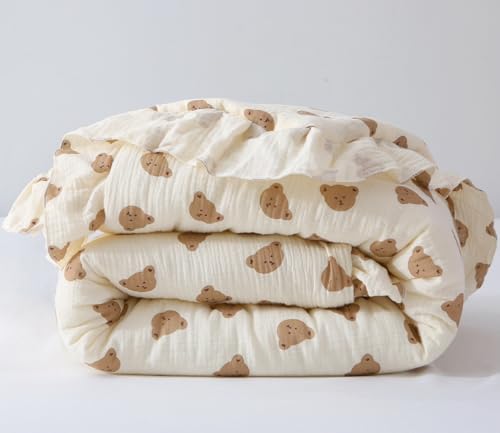
CLoucl 100% Cotton Muslin Crib Comforter/Quilt, 41 x 48 in — Best for Toddler Beds
The CLoucl is the blanket for the next transition: at 41 x 48 inches, its 100% cotton muslin build is sized as a crib comforter and toddler blanket rather than a lap blanket, and its all-season positioning matches how it will actually be used — the main blanket on a toddler bed. It suits families whose one-year-old is tall, restless, or approaching the crib-to-bed move, and who want one purchase to cover both stages. It does not suit the smallest cribs if you dislike any draping over the mattress edge, and strict minimalists may prefer to buy the small size now and size up later.
Strengths
- Toddler-bed dimensions — the only pick here that fully covers a child on a toddler bed.
- 100% cotton muslin: breathable, reversible, machine washable.
- All-season weight works across the year with sleep clothing adjusted underneath.
Trade-offs
- Generous size means more fabric in a small crib — introduce it when your child is ready for it.
- Muslin care rules apply: watch sharp edges and rough fasteners in the wash.
- As a comforter-style piece it is a bed blanket first, less handy as a stroller or car blanket.
- Fabric: 100% cotton muslin
- Size: 41 x 48 inches
- Uses: Crib comforter (12 months+), toddler bed
Sizing up is the decision this pick makes easy. Parents often buy the textbook 30 x 40 blanket at twelve months and replace it at twenty months when the toddler bed arrives and the old blanket leaves feet uncovered — and uncovered feet are the leading cause of 2 a.m. parental summons. The CLoucl skips that second purchase for children who are ready for a bigger blanket, while its muslin build keeps it light enough to remain appropriate at this age. The reversible design quietly doubles its nursery life too: when one side’s print starts to feel babyish, flip it. For families on the taller, faster-growing end of the curve, this is the most economical pick in the guide over a two-year horizon.
Best for: tall toddlers and the crib-to-toddler-bed transition / Not suited for: tiny cribs or as a travel blanket

Lukeight Toddler Blanket, Plush Dinosaur 30 x 40 in — Best Comfort Blanket
Not every blanket in a one-year-old’s life is for sleeping. The Lukeight is a plush, thick-feeling toddler blanket in a friendly dinosaur design at 30 x 40 inches — the blanket a toddler drags to the sofa, demands in the car, and cuddles at nap time on a lap. It suits families who want a designated comfort object: soft, characterful, and inexpensive enough in tier that its inevitable adventures hold no anxiety. It does not suit parents looking for the primary crib blanket in a warm room — plush synthetics sleep warmer than the cotton picks, and we badge it for comfort duty rather than all-night crib duty for that reason.
Strengths
- Plush softness toddlers actively seek out — high comfort-object potential.
- Playful dinosaur design makes it the blanket children choose for themselves.
- 30 x 40 in is the right scale for laps, car seats and strollers.
Trade-offs
- Plush synthetic sleeps warmer than cotton or muslin — supervise use in warm rooms.
- Character design is a phase; your child may age out of dinosaurs before the blanket wears out.
- Thick plush feel means it is a cuddle blanket, not the lightest crib layer here.
- Fabric: Plush (synthetic)
- Size: 30 x 40 inches
- Uses: Comfort object, couch, car, supervised naps
Comfort objects do real developmental work at this age — a familiar, soft, portable piece of home that helps a toddler manage separations, travel and new environments. The Lukeight is built for that job: plush enough to invite attachment, sized to be carried by small arms without trailing into a tripping hazard, and designed with a character that gives it an identity in the child’s mind. Keep its role clear in your own routine — cotton or muslin for the crib at night, the plush friend for the day — and it will be the best-used blanket in the house even though it is never the main sleep blanket. Buy two if it becomes the chosen one; every parent of a toddler with a lost comfort blanket understands why.
Best for: comfort-object duty, travel, car and couch / Not suited for: primary all-night crib blanket in warm rooms

HOMRITAR Minky Baby Blanket with Dotted Backing — Best Sensory Soft
The HOMRITAR pairs a printed minky front with the dotted backing that has become a toddler favourite: rows of soft raised dots that little hands find and rub almost involuntarily. At around 30 inches it is a nursery and toddler size made for cuddling, stroller rides and lap naps. It suits parents whose child responds to texture — the self-soothers who rub a blanket edge or dot field as they settle — and gift-givers who want something irresistibly soft. Like the other plush pick, it sleeps warmer than the cotton options, so we badge it for sensory comfort rather than warm-room crib duty.
Strengths
- Dotted minky backing is a genuine self-soothing texture for toddlers.
- Super-soft hand feel on both sides; the print side adds nursery colour.
- Compact size travels well — stroller, car, daycare nap mat.
Trade-offs
- Synthetic plush warmth — pair with a cool room or lighter sleepwear.
- Minky pile needs gentle washing to keep its softness at its best.
- Smaller format will be outgrown as a bed blanket sooner than the toddler-bed pick.
- Fabric: Minky with dotted backing
- Size: ~30 inches (nursery/toddler)
- Uses: Comfort, stroller, lap naps, daycare
The dotted backing is the entire argument, and it is a good one. Watch a tired one-year-old with a minky dot blanket and you will see the settling ritual happen in the hands before the eyes close. That tactile loop is why these blankets punch above their size in actual household use: they become the nap cue, the car cue, the daycare cue. The HOMRITAR executes the format cleanly — soft dots, a cheerful printed face, edges finished for daily dragging. Treat it as the Lukeight’s alternative rather than its rival: choose the dinosaur plush if your child attaches to characters, the dotted minky if your child attaches to textures. Many households end up with one of each, in different stations of the day.
Best for: texture-driven self-soothers and daycare nap kits / Not suited for: hot rooms as the main sleep layer
Comparison Table
| Pick | Badge | Key spec | Best for |
|---|---|---|---|
| Burt’s Bees Baby Organic Cotton Reversible Blanket | Best Overall | Organic cotton quilted, 30 x 40 in | First crib blanket, all-purpose |
| Bleu La La Heritage Knit Baby Quilt | Best Knit Heirloom | 100% organic cotton knit | Keepsake quality, gifts |
| HardNok Muslin Baby Blanket | Best Breathable Muslin | 6-layer muslin, 43 x 43 in | Warm sleepers and warm rooms |
| CLoucl Cotton Muslin Crib Comforter | Best for Toddler Beds | 100% cotton muslin, 41 x 48 in | Crib-to-bed transition |
| Lukeight Toddler Blanket Dinosaur | Best Comfort Blanket | Plush, 30 x 40 in | Comfort object, car and couch |
| HOMRITAR Minky Blanket Dotted Backing | Best Sensory Soft | Minky dots, ~30 in | Texture self-soothers, daycare |
How to Choose a Blanket for a 1 Year Old
Start with the safety frame, because it eliminates most of the catalogue. The blanket must be lightweight for its size, small enough not to pool excessively, and breathable. At twelve months a light blanket in the crib is a widely accepted milestone, but the qualifiers matter: light, small, and a child who is developing typically. Weighted blankets are out at this age, full stop. Heavy duvets and adult throws are out. If your child was premature or your paediatrician has advised a longer bare-crib period, a wearable blanket (sleep sack) remains the right answer until they clear the change — no purchase in this guide outranks that advice.
Fabric is the second decision, and it is mostly a temperature decision. Cotton in its forms — quilted, knitted, muslin — breathes, washes hard and suits the widest range of rooms; that is why four of six picks here are cotton. Muslin is cotton at its airiest, for warm rooms and hot sleepers. Plush synthetics are the warmth and comfort specialists: wonderful for cuddles, cars and cool rooms, but they trap more heat, so assign them the comfort-object role or pair them with a cooler sleep environment. Whichever fabric you choose, check the care label before buying — a blanket for this age that cannot go through a normal wash is a blanket with a short career.
Size is the third decision, and it follows the furniture. For a crib at twelve months, 30 x 40 inches is the standard that covers the child without surplus. For a toddler bed, step up to the 41 x 48 class. For strollers, cars and laps, smaller is better — a blanket that drags on the ground or trails into stroller wheels is a blanket that gets left at home. Many families rationally end with two blankets: a cotton sleeper in the right bed size, and a plush comfort blanket for the day. That pairing, not any single product, is what most one-year-olds actually live with.
Construction details repay a quick check before you buy. Look for quilting or stitching that keeps any fill evenly distributed, binding or edging that will not unravel into loose threads, and prints achieved with the fabric rather than stiff surface coatings that crack in the wash. Avoid blankets with sewn-on buttons, ribbons or appliqué pieces that can work loose — at this age, everything attached to a beloved object gets pulled, chewed and stress-tested. A plain, well-finished blanket in a good fabric beats a decorated one in a poor fabric every single time, and it photographs just as sweetly once there is a toddler wrapped in it.
Blanket Safety at 12 Months: What Changes and What Does Not
What changes at the first birthday is the risk profile of a typically developing child: stronger, mobile, able to push fabric away and reposition through the night. That is why guidance that forbids loose blankets in the first year relaxes to permit a small, light blanket after twelve months. What does not change is everything else about safe sleep. The sleep surface stays firm and flat. The blanket stays light and small — this is not the moment for the big sibling hand-me-down duvet. Pillows and soft toys follow their own guidance and timelines; a blanket milestone is not a general soft-stuff amnesty. And back-sleeping habits you built in year one remain the default.
Practical habits matter as much as the object. Place the blanket over the lower body rather than up at the face, keep the room at a comfortable temperature rather than compensating with heavier bedding, and dress the child in appropriate sleepwear so the blanket is a comfort layer, not the only thing between the toddler and a cold room. Check the blanket regularly for loose threads, worn seams and thinning patches — a loved blanket gets inspected like any other piece of safety-adjacent equipment. If your child consistently kicks the blanket off and sleeps happily, believe them: some one-year-olds simply prefer a sleep sack for another season, and that preference is fine.
How to Introduce the First Blanket (and Keep It Clean)
Introduce the blanket in daylight first. Let your child play with it on the floor, carry it, and nap with it under supervision on a lap or mat, so its first night in the crib is a reunion rather than an experiment. For the first nights, place it over the legs and lower body after your child is asleep or settling, and check its position at your own bedtime. Most toddlers adopt the blanket within a week; some ignore it for a month and then claim it fiercely. Both timelines are normal.
Washing is where first blankets live or die. Wash before first use to remove manufacturing residue and soften the fabric. Then settle into the toddler rhythm: wash after illness, after any major spill or accident, and otherwise on a regular rotation — weekly is typical for the main sleep blanket. Cotton and muslin take warm washes and tumble drying in stride and genuinely improve with washing. Knits prefer a gentler cycle and reshaping while damp. Minky keeps its plush best with cool, gentle washing and low heat. Whatever the fabric, skip heavy fabric softeners, which coat fibres and reduce breathability — the property you bought the blanket for. Having a second blanket in rotation is not indulgence; it is how the wash cycle and the comfort-object attachment both survive a stomach bug at 2 a.m.
Blanket vs Sleep Sack at 12 Months: You Do Not Have to Choose Tonight
Parents often frame the first birthday as a handover: sleep sack out, blanket in. Reality is gentler. The sleep sack remains a perfectly good option well into toddlerhood — it cannot be kicked off, it moves with the child, and many toddlers sleep better in the thing they have always known. The blanket’s advantages are different: it is the child’s own object, it works outside the crib (sofa, car, daycare mat), and it begins the transition toward ordinary bedding that the toddler bed will complete. Nothing requires both changes in the same month.
A sensible sequence many families use: keep the sleep sack for night sleep, introduce the blanket at naps and for daytime comfort, and let the child’s attachment decide the timing of the night swap. Children who run warm often prefer the blanket sooner because it can be half-on, half-off in a way a sack cannot. Children who thrash may keep the sack longest — a blanket they kick off at midnight is a blanket that wakes them at one. Judge by your child’s sleep, not by the calendar, and treat the two products as overlapping tools rather than rivals. If you do run both, the blanket in the crib should still be the light, small kind this guide recommends — the sack’s presence does not license a heavier blanket.
Buying a First Blanket as a Gift: What Actually Lands
Blankets are among the most gifted baby items, and among the most duplicated — many families receive five and use two. If you are buying for someone else’s one-year-old, the picks that land best are the ones that fill a gap rather than repeat the basics. The Bleu La La knit lands because it is clearly a keepsake, a category above the everyday blankets the parents already own. A comfort blanket like the Lukeight or the HOMRITAR lands because it serves the day, not the crib the parents have already equipped. The CLoucl lands surprisingly often because it anticipates the toddler bed the parents have not shopped for yet.
What to avoid as a gift: anything weighted, anything adult-sized, anything with long pile or detachable decorations, and anything whose care label demands special treatment from already busy parents. Include the receipt, choose washable over precious unless you are deliberately buying the heirloom, and if the child already has a beloved blanket, do not compete with it — gift for the car, the stroller or the grandparents’ house instead. A blanket that fills an empty station in the child’s day gets used daily; a sixth crib blanket gets folded.
Reading the Room: Matching Blanket Weight to Nursery Temperature
The most common blanket problem at this age is not the blanket — it is a mismatch between blanket, room and sleepwear that parents try to solve by swapping only one variable. Think of warmth as a system with three dials. The room temperature is the base. Sleepwear is the middle layer: a footed sleeper in winter, a light romper in summer. The blanket is the top layer and should be the lightest of the three decisions, because it is the one the child can kick off — and a blanket that is doing all the warming work alone will either overheat the child at bedtime or chill them at 3 a.m. when it lands on the floor.
In a warm nursery, the muslin picks carry the night almost alone over light sleepwear; their job is comfort and a sense of coverage more than insulation. In a typical heated room, the quilted cotton Burt’s Bees or the knit Bleu La La over standard sleepwear is the balanced middle. In a genuinely cold room, resist the urge to solve it with a heavy blanket: warm the sleepwear layer instead — a fleece sleeper or a higher-warmth sleep sack under a light blanket keeps the sleep space both warm and appropriately light. The plush comfort blankets fit this system as daytime warmth — car rides, stroller walks, sofa naps — where an adult is present and the environment is being actively managed.
A simple check ties it together: feel the child’s chest or back, not hands and feet, which run cool normally. Warm and dry means the system is right. Sweaty or hot means remove a layer — usually the blanket first. Cool chest means add to the sleepwear layer before reaching for a heavier blanket. Run that check for the first few nights with any new blanket and you will know its true weight class in your home, which no product description can tell you.
Durability: What a Year of Toddler Life Does to Each Fabric
A one-year-old’s blanket gets washed more in a month than an adult throw gets washed in a year, and the fabrics age differently under that regime. Quilted cotton, like the Burt’s Bees pick, is the marathon runner: the quilting holds the fill in place through hundreds of cycles, the fabric softens without thinning quickly, and fading is gradual and even. It is the fabric to choose when you want one blanket to serve a child and then a sibling. Muslin is the surprise athlete — it looks delicate and actually thrives on washing, growing softer each cycle; its weakness is mechanical, not chemical: snags from Velcro, rough zips and sharp-edged toys in the same load. Wash muslin with smoother company and it lasts beautifully.
Knitted cotton ages gracefully but asks for respect: repeated hot, rough cycles can stretch the weave and relax the texture that makes it special, so the Bleu La La rewards the gentle cycle with a much longer prime. Minky and plush synthetics start the softest and change the most — the pile gradually loses its loft and silkiness, fastest with heat, so cool washes and low drying temperatures preserve the very quality you bought them for. None of this is a reason to avoid any fabric here; it is a reason to match the fabric to the job. Workhorse sleep blanket: quilted cotton or muslin. Keepsake: knit, gently handled. Comfort object: plush, washed cool, replaced or duplicated without heartbreak when its season peaks.
Common Buying Mistakes
- Buying a weighted blanket. Weighted blankets are not appropriate for one-year-olds. Choose light, breathable blankets only.
- Buying an adult throw. Oversized blankets pool, bunch and overwhelm a crib. Buy the crib or toddler-bed size for the furniture you have.
- Prioritising plush over breathability for the crib. The softest blanket is not automatically the best sleep blanket; warm rooms call for cotton or muslin.
- Ignoring the care label. A blanket that cannot survive frequent washing will not survive toddlerhood. Check before you buy.
- Introducing the blanket too early. The twelve-month milestone is general guidance, not a deadline; premature or delayed-development toddlers may need longer, and your paediatrician’s word governs.
- Buying only one of the chosen comfort blanket. When a blanket becomes the comfort object, a duplicate in rotation is cheap insurance against loss and laundry emergencies.
Final Recommendation
For most families, start with the Burt’s Bees Baby Organic Cotton Blanket as the crib blanket — right size, right fabric, endlessly washable. Choose the HardNok muslin instead if your home runs warm, and step up to the CLoucl muslin comforter when the toddler bed enters the picture. Add the Bleu La La knit as the keepsake layer or gift, and pick one comfort specialist — the Lukeight dinosaur plush for character-lovers or the HOMRITAR dotted minky for texture-lovers — for days, cars and cuddles. For the wider nursery, see Best Baby Blankets, Best Toddler Blankets, Best Muslin Blankets, Best Crib Sheets, Best Blankets For 2 Year Old and Best Wearable Blankets For Toddlers.
Frequently Asked Questions
When can a baby start sleeping with a blanket?
General safe-sleep guidance treats twelve months as the point where a small, lightweight blanket becomes acceptable in the crib for a typically developing child. Before that, the crib should stay bare and a wearable blanket (sleep sack) provides warmth. Your paediatrician’s advice for your individual child always comes first, especially for premature babies.
What size blanket is right for a 1 year old?
For a crib, around 30 x 40 inches covers a one-year-old without excess fabric. For a toddler bed, look at roughly 41 x 48 inches. Smaller formats suit strollers and laps. The guiding principle is coverage without pooling: enough blanket to cover the child, not so much that it bunches into piles.
Are weighted blankets safe for toddlers?
No — weighted blankets are not recommended for children this young. A one-year-old needs a blanket light enough to move and push away freely. Every pick in this guide is a lightweight blanket; if a product’s selling point is added weight, it does not belong in a one-year-old’s bed.
Which fabric is best for a baby’s first blanket?
Cotton is the safest default: breathable, washable and gentle on skin, in quilted, knitted or muslin forms. Muslin suits warm rooms and hot sleepers. Plush synthetics like minky are excellent comfort blankets but sleep warmer, so they suit cuddles, cars and cooler rooms better than a warm nursery crib.
How many blankets does a 1 year old need?
Practically, two in rotation for the main sleep blanket — one in use, one in the wash or standing by — plus, optionally, one comfort blanket for the day. That rotation covers laundry, illness and the lost-blanket emergency without excess.
How often should I wash a toddler’s blanket?
Wash before first use, after any illness or accident, and otherwise roughly weekly for the main sleep blanket. Cotton and muslin handle regular washing well and soften with it; knits and minky prefer gentler cycles. Avoid heavy fabric softeners, which coat the fibres and reduce breathability.
Can a 1 year old use a blanket in a stroller or car seat?
Yes, with placement care. In a stroller, a small blanket over the legs is a standard comfort — keep it clear of the wheels and brakes. In a car seat, place the blanket over the harness, never under the child or behind the straps, since padding between the child and the harness compromises how the harness fits. The compact picks here — the minky and the plush — are sized for exactly this duty.
Is organic cotton worth it for a baby blanket?
For the main sleep blanket, it is a reasonable preference rather than a necessity: organic cotton avoids certain finishing chemicals, washes identically to conventional cotton, and the two organic picks here earned their places on size and construction first. If the budget forces a choice, a well-made conventional cotton blanket in the right size beats an organic one in the wrong size.
What if my toddler refuses the blanket or kicks it off?
Both are common and neither is a problem to solve by force. A child who kicks the blanket off and sleeps soundly is telling you the room and sleepwear are already right; leave the blanket at the foot of the bed as an option. A child who ignores the blanket for weeks may adopt it suddenly later. If night waking from cold is the issue, warm the sleepwear layer or return to a sleep sack for a season rather than escalating to a heavier blanket.


