Disclosure: airfryerkitchensupply.com is reader-supported. When you buy through links on our site, we may earn an affiliate commission at no extra cost to you.
Where to buy
Every linked pick in this guide to the best big toasters was verified against Amazon catalog data for this storefront before writing, and each link goes straight to that model’s Amazon product page. Check the live listing for the exact finish, size, and configuration you want, and check price on Amazon at checkout rather than trusting any number printed in a review, because prices shift with promotions too often for a printed figure to stay honest. Big toasters earn their footprint only if they fit yours, so check the listed dimensions against your counter and cabinet clearance before ordering — and confirm the slot count on the listing, because some ‘big’ models are wide two-slice machines, not four-slice ones.
- PYY Professional Commercial 6 Slice Toaster, 1800W — Check the current price on Amazon
- Cuisinart CPT-180P1 4-Slice Stainless Steel Toaster — Check the current price on Amazon
- KitchenAid KMT4115 4-Slice Manual Lift Toaster, Empire Red — Check the current price on Amazon
- Mecity 4 Slice Long Slot Toaster with Countdown Timer — Check the current price on Amazon
- bella Fits-Anywhere Slim Toaster, 4 Slice, Oatmilk — Check the current price on Amazon
- YUNLAIGOTOP 6 Slice Toaster, 1680W — Check the current price on Amazon
The best big toasters exist for a simple reason: breakfast for four should not take four sequential rounds. Whether ‘big’ means four slices at once, six slices for a crowd, or long slots that swallow oversized bread whole, a big toaster turns the morning queue into a single cycle — but only if its elements recover fast enough that the last slice browns like the first, and only if it fits the counter it will live on. This guide separates genuine capacity from mere bulk.
Six verified models cover the honest meanings of big. True six-slice commercial-style machines anchor the crowd end. Strong four-slice home models handle the family standard. A long-slot four-slice and a slim four-slice answer the two common objections — oversized bread and tight counters — without giving up multi-slice throughput. Each review states the capacity in practical terms: how many people, eating what, in how many cycles.
One warning that applies to the whole category: a big toaster with weak recovery is worse than a small toaster used twice. Elements that cool after the first load and brown the second load pale will make you babysit breakfast, which is the opposite of the point. Recovery, slot honesty, and controls that treat each side of the machine fairly are weighted heavily in the picks below — ahead of headline slice counts.
In this guide
Quick Picks
PYY Professional Commercial 6 Slice Toaster, 1800W — Best Overall Big Toaster. A true six-slice, 1800W commercial-style machine in stainless steel — the most slices per cycle on this list, built for households and small cafés that toast in volume. Check price on Amazon.
Cuisinart CPT-180P1 4-Slice Stainless Steel Toaster — Best Family 4-Slice. The classic family answer: four extra-wide slots with dual independent controls and six-setting browning dials, so two people toast two different breads at two different shades at once. Check price on Amazon.
KitchenAid KMT4115 4-Slice Manual Lift Toaster, Empire Red — Best Premium 4-Slice. KitchenAid’s premium four-slice with extra-wide slots, dual independent controls, and a manual lift lever — the big toaster for buyers who want build and finish to match the capacity. Check price on Amazon.
Mecity 4 Slice Long Slot Toaster with Countdown Timer — Best Big for Oversized Bread. Big in the other direction: long, extra-wide slots that take four standard slices or long artisan loaves whole, plus a countdown timer and a warming rack on top. Check price on Amazon.
bella Fits-Anywhere Slim Toaster, 4 Slice, Oatmilk — Best Big Toaster for Small Counters. Four slices from an extra-long, extra-wide single slot in a slim body — the capacity of a big toaster with the counter footprint of a small one. Check price on Amazon.
YUNLAIGOTOP 6 Slice Toaster, 1680W — Best Budget 6-Slice. Six slices and a stated 1680W at the value end of the commercial style, with five shade settings and precise timing — crowd capacity without the crowd price tier. Check price on Amazon.
How These Picks Were Chosen
Picks were chosen against the three honest definitions of big — most slices per cycle, family four-slice capacity with independent controls, and oversized-bread capacity — with stated wattage treated as a first-class criterion, because a large chamber without power is a pale-toast machine. Every linked model was verified against Amazon catalog data for this storefront before writing; slice counts, slot claims, and power figures come from those listings, and no prices or rating figures are printed because both change too often to stay honest.
Two-slice machines, however wide, were excluded from the top ranks unless they solved a capacity problem another way; the slim four-slice bella earned its place because it delivers four-slice throughput in a two-slice-class footprint, which is a genuine capacity answer for small kitchens.
The 6 Best Big Toasters

PYY Professional Commercial 6 Slice Toaster, 1800W — Best Overall Big Toaster
When big means big, this is the reference: six slices in one cycle from an 1800W commercial-style stainless machine, per the listing. Six slices is a different morning — a family of four eats together with two slices to spare, a brunch for six happens in one pass, and a small café or office kitchen stops forming a line. The wattage matters as much as the count: 1800W is the power budget that lets a chamber this size brown decisively and recover between loads.
It suits volume households, multigenerational homes, brunch hosts, and light commercial corners — anyone whose toast demand regularly exceeds four slices at a sitting.
Strengths
- Six slices per cycle — the highest throughput in this guide
- 1800W gives a large chamber the power to brown and recover properly
- Stainless commercial-style build suits heavy daily use
Trade-offs
- The largest footprint here; measure counters and cabinet clearance first
- Commercial styling is plain compared with designer home models
- Overkill for one- or two-person households, who pay in counter space
| Spec | Detail |
|---|---|
| Format | 6-slice commercial-style pop-up |
| Power | 1800W (per listing) |
| Build | Stainless steel, heavy duty |
| Certification | ETL listed (per listing) |
Judge a six-slice machine on its second and third consecutive loads, not its first. A chamber this size sheds heat every time the carriage rises, and only real wattage replaces it fast enough to keep browning consistent across a brunch service. The PYY’s stated power is the reason it leads this guide rather than merely tying on slice count: it is specified like a machine expected to work continuously, because in its intended settings, it does.
Ownership is correspondingly practical. It wants a permanent counter position with clearance above it, a crumb routine equal to its volume, and a household whose demand justifies both. Given those, it is the end of the breakfast queue — the machine you stop thinking about because toast simply keeps up.
Best for: Big households, brunch hosts, and light commercial use toasting in volume / Not suited for: Small households short on counter space
Check the current price on Amazon
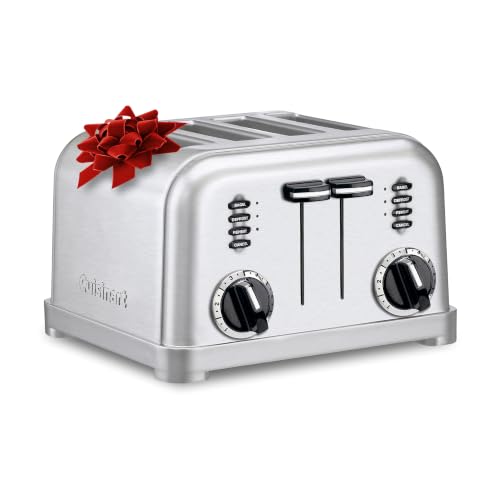
Cuisinart CPT-180P1 4-Slice Stainless Steel Toaster — Best Family 4-Slice
Most ‘big toaster’ shoppers actually need this: a proper four-slice home machine. The CPT-180P1’s defining feature is dual independent controls, per the listing — each pair of slots runs its own six-setting browning dial — which solves the real family problem, where one person wants pale sandwich toast and another wants dark bagels, simultaneously, without a queue or a compromise setting.
It suits families of three to five and shared kitchens: the standard breakfast load in one cycle, with extra-wide slots that also take bagels and thicker bakery slices.
Strengths
- Dual independent controls run two shades or breads at once
- Extra-wide slots cover bagels and thick slices, not just sandwich bread
- Brushed stainless build and a long-established model line
Trade-offs
- Four slices is the ceiling — true crowds still need two cycles
- Dial controls are classic, not countdown-precise
- Standard slot length still limits very long artisan slices
| Spec | Detail |
|---|---|
| Format | 4-slice, extra-wide slots |
| Controls | Dual independent, 6-setting browning dials |
| Build | Brushed stainless steel |
| Model | CPT-180P1 (per listing) |
Dual controls sound like a small thing until you live with a shared toaster. In practice they halve morning friction more than raw capacity does, because most queues are not about slice count — they are about two people wanting different results at the same time. This machine makes those two breakfasts one cycle. Its extra-wide slots also keep it honest as a ‘big’ pick: capacity here is about fitting real bread, not just counting thin slices.
As an established Cuisinart line model, it is also the low-drama purchase in this guide: predictable behavior, familiar controls, and a footprint most counters already know how to hold. If your household’s definition of big is ‘everyone eats at once, the way they like it,’ this is the pick to beat.
Best for: Families who want four slices with two independent shade controls / Not suited for: Crowds regularly needing more than four slices per cycle
Check the current price on Amazon

KitchenAid KMT4115 4-Slice Manual Lift Toaster, Empire Red — Best Premium 4-Slice
The KMT4115 matches the Cuisinart’s family formula — four extra-wide slots, dual independent controls — and raises the presentation: KitchenAid build, an Empire Red finish in this listed configuration, and a manual lift lever that keeps small items like English muffins easy to retrieve. The listing also calls out bagel handling designed to toast the cut side properly.
It suits design-conscious family kitchens where the toaster lives permanently on display, gets used hard every day, and is expected to look like part of the kitchen rather than an appliance tolerated in it.
Strengths
- Four extra-wide slots with dual independent controls
- Manual lift lever retrieves small items without fishing
- Premium KitchenAid build and finish for a permanent counter spot
Trade-offs
- Premium tier pricing among four-slice home models
- Colored finishes demand a kitchen palette they agree with
- Still a four-slice ceiling for very large gatherings
| Spec | Detail |
|---|---|
| Format | 4-slice manual lift |
| Slots | 4 extra-wide slots (per listing) |
| Controls | Dual independent, adjustable shade control |
| Finish | Empire Red (listed configuration) |
The manual lift lever is the functional detail worth paying attention to, beyond the finish. In big four-slice machines, small items sit deep; a lever that raises them into easy reach prevents the fork-fishing that damages elements and annoys everyone. Combined with dual controls, the KMT4115 is the family machine with the fewest daily irritations in this guide.
Buy it as the long-term counter resident it is designed to be. If your toaster lives in a cupboard between uses, its build and finish are wasted and its size is a storage problem. If it lives out, works daily, and anchors a family breakfast routine, the premium is buying years of pleasant, queue-free mornings.
Best for: Families wanting premium build with four wide slots and dual controls / Not suited for: Cupboard-stored toaster users or the tightest budgets
Check the current price on Amazon

Mecity 4 Slice Long Slot Toaster with Countdown Timer — Best Big for Oversized Bread
Some kitchens do not need more slices; they need longer ones. The Mecity’s long-slot format fits four standard slices or swallows long artisan and sourdough slices that defeat every standard four-slice machine in this guide, and its countdown timer makes the long chamber’s behavior easy to reproduce. A warming rack handles the croissants and rolls that accompany a big breakfast but fit no slot.
It suits artisan-bread households and brunch cooks whose ‘big’ problem is slice size as much as slice count, and who value the timer’s feedback for repeatable results.
Strengths
- Long extra-wide slots fit oversized and artisan slices whole
- Countdown timer supports consistent, repeatable browning
- Warming rack covers pastries and rolls beyond the slots
Trade-offs
- 1300W is modest for a large chamber; heavy back-to-back use slows
- Long footprint needs a deeper counter position
- Value-tier finish compared with the premium four-slice picks
| Spec | Detail |
|---|---|
| Format | 4-slice long slot |
| Power | 1300W (per listing) |
| Controls | Countdown timer, 6 browning settings |
| Extras | Warming rack; bagel/defrost/reheat/cancel |
Long-slot capacity is real capacity: a bâtard slice that needs two half-cycles and a flip in a standard machine is one-and-done here, which doubles effective throughput for artisan households even at the same nominal slice count. The countdown timer complements that, because long dense slices benefit from a mid-cycle check at a known remaining time rather than a guess.
The power figure sets the boundary. For family breakfasts and brunch in reasonable waves, it keeps up; for continuous commercial-style cycling, the six-slice PYY above is the honest tool. As the big-bread answer at a value tier, the Mecity is exactly placed.
Best for: Artisan and brunch households whose bread runs long as well as numerous / Not suited for: Continuous heavy cycling that needs commercial recovery
Check the current price on Amazon

bella Fits-Anywhere Slim Toaster, 4 Slice, Oatmilk — Best Big Toaster for Small Counters
The bella Fits-Anywhere attacks the big-toaster dilemma directly: capacity usually costs counter, and counters are the scarcest resource in small kitchens. Its slim body holds a four-slice extra-long and wide slot, per the listing, so a small kitchen gets family throughput — or two long artisan slices — without surrendering the worktop.
It suits apartments, small family kitchens, and anyone whose current four-slice machine dominates the counter: full capacity, fraction of the visual and physical bulk.
Strengths
- Four-slice capacity in a genuinely slim footprint
- Extra-long and wide slot also fits artisan slices
- Modern finish designed to live on small counters
Trade-offs
- One shared slot means no dual independent shade controls
- Slim body offers less thermal mass for marathon back-to-back sessions
- Light-colored Oatmilk finish needs regular wiping in busy kitchens
| Spec | Detail |
|---|---|
| Format | 4-slice slim, single long slot |
| Slot | Extra long and wide (per listing) |
| Finish | Oatmilk (listed configuration) |
| Design | Fits-Anywhere slim body |
The shared-slot trade is the one to understand: everyone in a cycle gets the same shade setting, so households split between pale and dark toast take turns in a way dual-control machines avoid. In exchange, the counter math is transformed — this machine fits where no other four-slice pick here fits, including between other appliances and under lower cabinets where depth is the constraint.
For the small-kitchen family, that trade is usually right. Toast for four in one cycle, a slot that still respects a long sourdough slice, and a counter that remains a counter. It is the big toaster for people who were sure they had no room for one.
Best for: Small kitchens that need four-slice capacity without the bulk / Not suited for: Households needing two different shades in the same cycle
Check the current price on Amazon

YUNLAIGOTOP 6 Slice Toaster, 1680W — Best Budget 6-Slice
The YUNLAIGOTOP offers the six-slice format at a budget tier: a commercial-style stainless machine with a stated 1680W, five bread shade settings, and timing controls, aimed by its listing at homes, restaurants, and bakeries alike. For a big household or a breakfast-heavy small business watching spend, it is the cheapest route here to genuine six-at-once throughput.
It suits value-driven volume users — large families, shared houses, small cafés — who prioritize slices per cycle and acceptable consistency over premium finish and refinement.
Strengths
- Six-slice capacity at the budget end of the commercial style
- Stated 1680W supports the large chamber credibly
- Five shade settings with timing for repeatable batches
Trade-offs
- Value-tier fit, finish, and long-term polish versus the PYY
- Large footprint, like all true six-slice machines
- Five shade steps give coarser control than finer home dials
| Spec | Detail |
|---|---|
| Format | 6-slice commercial style |
| Power | 1680W (per listing) |
| Controls | 5 bread shade settings, timing |
| Use | Home, restaurant, bakery (per listing) |
The comparison with the PYY is instructive: same six-slice idea, slightly less stated power, coarser shade steps, and a value tier’s fit and finish. For a household that toasts six slices twice a morning, those differences are minor and the saving is real. For continuous service, the PYY’s heavier specification earns its tier. Know which user you are and the choice makes itself.
As with every big machine here, feed it a fair test: run two full back-to-back loads of your actual bread during your first days with it, note the shade drift between loads, and write your settings down. A budget six-slice that you understand beats a premium one you never calibrated.
Best for: Large families and small cafés wanting six-slice throughput on a budget / Not suited for: Continuous commercial service or finish-focused buyers
Check the current price on Amazon
Comparison Table
| Pick | Badge | Key spec | Best for |
|---|---|---|---|
| PYY Professional Commercial 6 Slice Toaster, 1800W | Best Overall Big Toaster | 6 slices, 1800W, stainless commercial style | Big households, brunch hosts, and light commercial use toasting in volume |
| Cuisinart CPT-180P1 4-Slice Stainless Steel Toaster | Best Family 4-Slice | 4-slice, dual independent controls, extra-wide slots | Families who want four slices with two independent shade controls |
| KitchenAid KMT4115 4-Slice Manual Lift Toaster, Empire Red | Best Premium 4-Slice | 4 extra-wide slots, dual controls, manual lift | Families wanting premium build with four wide slots and dual controls |
| Mecity 4 Slice Long Slot Toaster with Countdown Timer | Best Big for Oversized Bread | Long extra-wide slots, countdown timer, warming rack | Artisan and brunch households whose bread runs long as well as numerous |
| bella Fits-Anywhere Slim Toaster, 4 Slice, Oatmilk | Best Big Toaster for Small Counters | Slim body, 4-slice extra-long wide slot | Small kitchens that need four-slice capacity without the bulk |
| YUNLAIGOTOP 6 Slice Toaster, 1680W | Best Budget 6-Slice | 6 slices, 1680W, 5 shade settings | Large families and small cafés wanting six-slice throughput on a budget |
How to Choose the Best Big Toasters: Capacity, Power, and Footprint
Count your real peak load. The biggest breakfast your household actually makes — guests included, ordinary weekends weighted more than holidays — sets the slice count you need. Four slices covers most families; six earns its footprint only when five-plus slices are a routine event, not an annual one. Oversized bread rewrites the arithmetic: a long-slot four-slice can out-serve a standard six-slice for an artisan household, because slices that fit whole do not need repeat cycles.
Then check power against chamber size. As a rule of thumb in this guide’s listings, serious four-slice home machines and six-slice commercial styles publish their wattage proudly — 1800W and 1680W on the six-slice pair — because recovery between loads is what separates a big toaster from a big disappointment. Finally, measure the counter: width, depth, and the clearance above, since a big toaster vents serious heat upward and needs room to breathe under cabinets.
- Peak load 4 slices: Cuisinart CPT-180P1 or KitchenAid KMT4115, with dual controls.
- Peak load 6 slices: PYY 1800W for service, YUNLAIGOTOP for budget volume.
- Oversized slices: Mecity long slot; small counter: bella slim four-slice.
- Shared shades in one cycle: dual independent controls beat raw slice count.
- Continuous cycling: prioritize stated wattage and commercial-style build.
Do You Actually Need Six Slices?
Six-slice toasters are commercial machines wearing home listings, and they make sense in exactly two homes: the genuinely large household, and the serial brunch host. Everyone else tends to discover that a four-slice machine with dual controls serves their actual mornings — two rounds of a two-slice machine is a queue, but one round of a well-controlled four-slice is breakfast. The six-slice footprint is also permanent: it does not tuck away, so be sure the counter it claims is a price your kitchen can pay every day, not just on toast-heavy Sundays.
The honest middle path many households land on is a strong four-slice for daily life plus a warming strategy for crowds — a low oven or the Mecity’s warming rack holding finished toast while a second cycle runs. That combination serves twelve people gracefully without a commercial machine owning the counter all year.
What Does Recovery Mean, and Why Does It Decide Big Toasters?
Recovery is how fast a toaster returns to full browning power after a load. Every cycle sheds heat — into the bread, out of the slots — and a big chamber sheds more. A machine with strong recovery browns load three like load one; a weak one drifts paler with each load, tempting you to raise the shade, after which the rested machine scorches the next morning’s first slice. It is the single most common big-toaster complaint, and it is a wattage-and-build issue, not a settings issue.
You can test recovery in your first week: run three identical back-to-back loads of the same bread at the same setting and compare. Note the drift, adjust your working shade for rounds two and three, and write it on a card near the machine. Every toaster in this guide rewards that small discipline; the commercial pair simply need the least of it.
Feeding a Crowd With Toast: A Workflow That Works
Big breakfasts fail on workflow more than equipment. Set the table and start the slowest items first — eggs and meats hold better than toast — and run toast last, in waves matched to seating. Keep finished slices on a rack, not a plate, so steam escapes and crusts stay crisp; a low oven or warming rack holds a wave gracefully for the few minutes a second wave needs. Assign one person to the toaster during service: toast quality collapses when three people adjust settings by mood.
Butter and toppings belong in a station away from the toaster, so the machine’s operator is never blocked by someone dressing a slice. It sounds like café thinking because it is — and a six-slice machine run with a café workflow will make a home brunch feel effortless.
Big Toasters and Kitchen Power: What 1800 Watts Asks of Your Wiring
A six-slice toaster drawing a stated 1800 watts is one of the heavier loads in a home kitchen, and it deserves a sentence of electrical respect. Run it on a properly rated kitchen circuit, plugged directly into a wall outlet rather than a lightweight extension lead or a crowded power strip, and avoid sharing its circuit, at the same moment, with the other heavy hitters — a kettle or a microwave running simultaneously is how breakers trip mid-brunch. None of this is exotic; it is the same discipline any high-draw appliance asks, scaled to a machine many buyers underestimate because it ‘only makes toast.’
The good news is duration. Even a high-draw toaster runs for minutes, not hours, so total energy use stays modest — one big cycle generally uses less than the string of small cycles it replaces. The practical takeaway is placement: choose the big toaster’s permanent counter spot with its outlet in mind, give its cord a clear run that never drapes across a hot body or a sink, and the electrical story of owning a big toaster becomes a non-story, which is exactly what it should be.
Home Big Versus Commercial Big: Where the Line Actually Runs
The six-slice machines in this guide wear commercial styling, and the four-slice machines are domestic designs, but the line between the classes is not the slice count — it is duty cycle. A commercial-style machine is built to cycle continuously: elements, carriage, and body specified for load after load without a rest, in a café rhythm. A domestic four-slice is built for intense but brief service: a family breakfast, then hours of rest. Both are honest specifications, and confusing them is expensive in both directions — a domestic machine run as a café unit ages fast, and a commercial unit bought for two slices a day wastes counter and money for a decade.
Small cafés, offices, and breakfast-heavy rentals should therefore read this guide from the top: the PYY’s stated power and heavy-duty brief, or the YUNLAIGOTOP’s value version of the same idea. Homes should read it from the middle: dual controls and family throughput, in a machine designed to be loved twice a day rather than worked all day. The rare household that genuinely straddles the line — the serial brunch host — already knows who they are, and the six-slice section was written for them.
One more boundary worth naming: commercial-style machines assume commercial habits, including a cleaning rhythm. A six-slice run daily fills crumb trays at a rate that surprises home users. Build the tray into the weekly routine from the first week and the machine stays a pleasure; let it slide and even the best-specified big toaster starts to smoke, drift, and disappoint for reasons that have nothing to do with its build.
When Big Is Too Big: Honest Signs to Size Down
This guide exists to sell you capacity, so it should also be the guide that talks you out of it when the fit is wrong. Size down if your peak real load is two slices on most days and four on Sundays — a strong two-slice or the slim bella serves that life better than a six-slice monument. Size down if the only available counter spot puts a large hot chamber under a low cabinet or beside a walkway where elbows meet it daily. And size down if the machine would live in storage: a toaster too big to leave out is a toaster that gets used monthly, and monthly appliances should be small, cheap, or both.
The subtler sign is shade politics. If your household’s real problem is that two people want different toast at the same time, capacity is not your problem at all — independence is, and a dual-control four-slice solves it in less space than any six-slice. Diagnose the actual breakfast friction before shopping: queue, shade conflict, oversized bread, or counter shortage. Each has a different correct machine in this guide, and three of the four are not the biggest one.
Storing and Moving a Big Toaster Without Regret
Big toasters are awkward freight: wide, surprisingly heavy for their job, and full of crumbs the moment they are used. If yours must move between counter and storage, empty and shake out the crumb tray first, let the body cool completely, and lift from the base with both hands rather than by the carriage lever or cord — the two grips that damage big machines in transit. Keep the cord loosely coiled, never wound tight around a warm body, and store the machine dry; a damp cupboard ages elements and finishes faster than daily use does.
For households that host seasonally — the six-slice that appears for holiday brunches and retreats afterward — a labeled storage spot with the manual and your calibration notes taped inside the lid saves the relearning curve every December. Write down your working shades per bread while you know them. Future you, facing twelve guests and a cold machine, will be grateful for the card.
Big Toasters in Real Service: Rentals, Offices, and Community Kitchens
Beyond homes and cafés, big toasters quietly serve the shared kitchens where breakfast is a logistics problem: vacation rentals sleeping eight, office kitchens at nine in the morning, community halls, team houses, and bed-and-breakfasts that promise a proper breakfast. Those settings reward a different reading of this guide. Controls must be operable by a stranger in ten seconds, which favors the clear dials and labeled functions of the family four-slices and the commercial pair over anything clever. Durability means surviving users who will never calibrate, never empty a tray on schedule, and never once think about recovery — which favors stated wattage, metal bodies, and the simplest possible crumb routine.
Rental owners in particular should buy one size up from the sleeping capacity’s breakfast math, because guests toast in waves that coincide exactly, and a six-slice machine turns a rental’s most common minor complaint — morning bottlenecks — into a non-event. Add a small printed card with the house settings for bread and bagels, and even a commercial machine becomes guest-proof. Offices should weight the dual-control four-slices: two shade camps exist in every workplace, and a machine that serves both at once ends the only toaster politics that matter.
Community and volunteer kitchens should weight cleanability above all, because their machines are cleaned by rota rather than by love. Removable trays, wipe-clean stainless, and slots that shed crumbs into the tray instead of trapping them are the features that decide whether a shared big toaster is still pleasant in its second year. Every pick in this guide was chosen with a removable or accessible crumb path for exactly this reason — capacity gets a machine bought, but cleanability gets it kept.
Accessories and Companions That Earn Their Place Beside a Big Toaster
A big toaster anchors a breakfast station, and three companions genuinely earn their counter space beside it. A simple wire rack — the kind finished toast rests on — prevents the steam-softening that undoes good browning in the minutes between cycles and plates, and it costs almost nothing. A pair of wooden toast tongs retrieves small or stubborn slices safely at the scale big machines demand, replacing the utensil habit that damages elements. And a covered butter dish that lives at room temperature, because cold butter tears good toast no matter how perfectly the machine browned it — the cheapest upgrade to a big breakfast is spreadable butter.
What does not earn its place: novelty crumb gadgets for machines whose trays already remove in seconds, covers that trap heat and moisture over a warm body, and any accessory that lives between the toaster and its ventilation. A big chamber needs air the way it needs power. Keep the station around it to the rack, the tongs, the butter, and the settings card, and a big toaster’s counter footprint — the thing everyone worries about at purchase — shrinks to its honest, useful size.
A Note on Noise, Heat, and Living With a Big Machine
Two ownership details surprise big-toaster buyers and deserve a plain paragraph each. Heat first: a four- or six-slice chamber at full load warms the kitchen corner it lives in and will set off a smoke alarm placed directly above it when a sugary item over-browns, so give the machine the ventilated, alarm-aware spot you would give a kettle. This is ordinary appliance physics, and the ventilated placement the setup section recommends solves nearly all of it before it starts.
Noise and light second: big machines announce themselves — carriages that clunk, elements that tick as they heat, indicator lights in dark kitchens at dawn. None of the picks in this guide is unusually loud, but a household with a light sleeper beside the kitchen should know that a six-slice cycle is a small event, not a silent one. Run the first cycle of the day as the household’s gentle alarm clock, and even that becomes a feature. The machines earn their footprint in throughput; these are simply the terms of the tenancy, stated in advance so nobody is surprised in week one.
How to Set Up and Run a Big Toaster for Consistent Results
A big toaster rewards a short commissioning routine. Run it once, properly, and it will behave predictably for years.
- Position it with clearance. Give the machine air space on all sides and never run it under a low cabinet edge or near curtains — big chambers vent serious heat upward.
- Run two empty or sacrificial cycles first. New elements carry manufacturing residues; burn them off with the room ventilated before the first real slice.
- Calibrate with your bread. Toast single slices at successive shade settings, note where your bread hits your color, and record the setting — per bread type if your household rotates.
- Test recovery. Run a full back-to-back double load and note any shade drift; record a round-two setting if your machine needs one.
- Assign slots habits. If your machine has dual controls, fix a household convention (left dark, right light) so nobody re-dials by guesswork.
- Set a crumb routine. Volume toasting fills trays fast; empty weekly in daily use, and shake out the chamber monthly.
- Keep the cord and plug healthy. Big toasters draw serious current — plug directly into a wall outlet, not a lightweight extension lead, and keep the cord clear of the hot body.
Common Buying Mistakes
Buying slice count without checking wattage. A large chamber on low power browns slowly and recovers worse. In this category, stated wattage is as important as the number of slots.
Ignoring the footprint until delivery day. Six-slice machines are furniture. Measure width, depth, and overhead clearance first, or the big toaster becomes a garage resident.
Assuming big means better for two people. A couple gains nothing from six slots but loses counter daily. Capacity you do not use is a cost, not a feature.
Skipping dual controls in a shared kitchen. Two shades at once ends more morning arguments than two extra slots. Shared households should weight independent controls heavily.
Stacking finished toast on a plate. Piled toast steams itself soggy. Rack it, space it, or hold it warm and dry — never in a steaming pile.
Final Recommendation
If big truly means volume, the PYY 1800W six-slice is the answer, with the YUNLAIGOTOP as its budget shadow. Most families should land on the Cuisinart CPT-180P1 or the KitchenAid KMT4115 — four wide slots, dual controls, breakfast done in one cycle. Oversized-bread homes belong with the Mecity long slot, and small kitchens that refused to compromise get the bella slim four-slice. Match the machine to your peak load, your bread, and your counter — in that order — and a big toaster stops being a gamble and becomes the hardest-working box at breakfast.
Keep exploring the cluster: Best Artisan Toasters Best Bread Toasters Best Black Toasters 4 Slice Best 6 Slice Toasters Best 4 Slot Toasters Best 4 Slice Toasters Today
Frequently Asked Questions
What is considered a big toaster?
Four slices and up, or a long-slot format that fits oversized bread whole. The useful definition is throughput: a big toaster serves a family’s whole breakfast in one cycle, or handles slices that standard machines cannot fit at all. Two-slice machines, however wide, are not big in this sense unless — like the slim bella — they hold four slices in a compact body.
Are 6-slice toasters worth it for home use?
For genuinely large households and regular brunch hosts, yes — one cycle feeds everyone. For typical families, a four-slice with dual controls is usually the better buy: smaller footprint, finer control, and capacity that matches real mornings. Judge by your routine peak, not your biggest-ever breakfast.
Why does toast from a big toaster brown unevenly across loads?
Recovery. Each load sheds heat, and a large chamber that cannot replace it quickly browns later loads paler. Strong stated wattage, commercial-style build, and a brief rest between marathon loads all help; so does recording a slightly higher working shade for later rounds once you know your machine’s drift.
Can a big toaster handle artisan bread?
The right big toaster can. Long-slot models like the Mecity fit long slices whole, and extra-wide four-slice slots take thick slices — but a standard six-slice commercial machine has ordinary slot dimensions despite its size. Check slot format, not just slice count, if artisan bread is part of your routine.
Do big toasters use a lot of electricity?
They draw more power while running — the six-slice machines here are listed at 1680–1800W — but they run for minutes, and one big cycle usually uses less total energy than several small ones. The real cost of a big toaster is counter space, not electricity.
Where should a big toaster live?
On a stable counter with clearance above and around it, plugged directly into a wall outlet. Big chambers vent significant heat, so avoid low overhanging cabinets, and never operate one inside a closed appliance garage. If it must be stored, be honest: a machine this size that lives in a cupboard tends to stay there.


