Disclosure: airfryerkitchensupply.com is reader-supported. When you buy through links on our site, we may earn an affiliate commission at no extra cost to you.
Where to buy
Every linked pick in this guide to the best big green egg like grills was confirmed against Amazon’s catalogue data for this site before publication. Kamado grills are heavy ceramic or insulated-steel cookers whose listings and freight arrangements change with stock, so use the links below to check the current price on Amazon for the exact model rather than relying on any figure printed elsewhere.
- Kamado Joe Classic Joe Series II 18-Inch Ceramic Charcoal Grill — Check on Amazon
- GRILLA Kong Ceramic Kamado Grill — Check on Amazon
- Char-Griller AKORN 20-Inch Kamado Charcoal Grill and Smoker — Check on Amazon
- Kamado Joe Classic Joe I 18-Inch Ceramic Charcoal Grill — Check on Amazon
- London Sunshine 15-Inch Ceramic Kamado Charcoal BBQ Grill and Smoker — Check on Amazon
- Char-Griller AKORN Jr. Portable Kamado Charcoal Grill and Smoker — Check on Amazon
A note on the name in the search: the original Big Green Egg is sold primarily through its dealer network rather than Amazon, so it appears in this guide as the reference point — the ceramic egg that defined the category — rather than as a linked pick. Everything ranked below is a genuine “egg-like” alternative you can actually buy through the links here: ceramic kamados that match or exceed the original’s cooking system, and insulated-steel kamados that deliver the same sealed, vent-controlled cooking at a fraction of the weight and cost. Each was verified in catalogue data, and the differences between ceramic and insulated steel are explained honestly rather than smoothed over, because that choice — not brand — is the real decision in this category.
The best big green egg like grills all exploit the same beautiful piece of physics. An egg-shaped, thick-walled, fully sealed cooker burning lump charcoal, with air admitted only through two adjustable vents, is astonishingly efficient and stable: a single load of lump can hold low smoking temperatures for a very long cook or climb to steakhouse-searing heat, and the ceramic mass evens out the swings that plague thin steel grills. Food cooks in a humid, convection-rich environment that keeps roasts and poultry moist, and the fuel bill per cook is a fraction of a kettle’s. The category’s honest costs are equally consistent: weight, fragility in ceramic form, a round grate that fits less food than the headline diameter suggests, and a learning curve around vent control — overshoot your temperature on a kamado and bringing it back down is slow, because all that thermal mass works against you. This guide ranks the six egg-style cookers worth buying and teaches the vent discipline that makes them sing.
In this guide
Quick Picks
Short on time? These are the six best big green egg like grills, each matched to the job it does best. Full reviews below carry the trade-offs and ownership details.
- Kamado Joe Classic Joe Series II 18-Inch — Best Overall Egg Alternative: 18-inch ceramic kamado with cart, side shelves, stainless steel grates and 250 cooking square inches. Check on Amazon
- GRILLA Kong Ceramic Kamado — Best Large Capacity: ceramic construction with 600 sq inch cook space, adjustable vent and a 700°F max temperature. Check on Amazon
- Char-Griller AKORN 20-Inch — Best Value Kamado: triple-wall insulated steel with cast iron grates and 445 sq. in. of cooking area. Check on Amazon
- Kamado Joe Classic Joe I — Best Classic Kamado Joe Value: premium 18-inch ceramic with a 2-tier cooking system, grill gripper and ash tool included. Check on Amazon
- London Sunshine 15-Inch Ceramic Kamado — Best Compact Ceramic: a true ceramic egg with locking casters, foldable side shelves and stainless steel grates on a tall stand. Check on Amazon
- Char-Griller AKORN Jr. — Best Portable Kamado: a portable insulated-steel kamado with cast iron grates, locking lid and 155 sq. in. of cooking area. Check on Amazon
How These Picks Were Chosen
Mini spec boxes use only specifications present in those verified titles. The shortlist applied four tests. First, genuine kamado function: a sealed, insulated, vent-controlled cooker — not a kettle wearing an egg costume. Second, material honesty: ceramic and insulated steel are both legitimate, but they differ in weight, durability and heat behaviour, so the guide includes the strongest verified example of each and labels them clearly. Third, capacity realism: kamado cooking area is quoted from verified titles, and the reviews discuss what round grates actually fit. Fourth, ecosystem and ownership: hinge quality, gasket and cart design, ash handling, and the availability of heat deflectors and tiered grates, because a kamado is a decade-scale purchase whose accessories you will actually buy.
The original Big Green Egg is discussed as the category reference but is not a linked pick, because it is distributed through dealers and could not be presented here as a verified Amazon catalogue pick for this site. That is a distribution fact, not a quality judgement — the Egg remains an excellent cooker, and the alternatives below were chosen because they match its cooking system in forms you can buy through this guide.
The 6 Best Big Green Egg Like Grills

Kamado Joe Classic Joe Series II 18-Inch — Best Overall Egg Alternative
The Classic Joe Series II is the alternative most often cross-shopped against the original egg, and the comparison flatters it: an 18-inch ceramic kamado with 250 cooking square inches, stainless steel grates, a cart and side shelves included rather than sold as the first of many extras. The Series II generation is the refined one — a better hinge, better gasketing, better ash management than the original design language it descends from — and it cooks with the full kamado repertoire: low-and-slow smoking, roasting, baking, and fierce searing, all on lump charcoal in a sealed ceramic chamber. It suits serious home cooks who want the complete ceramic kamado experience in the classic 18-inch class. It does not suit cooks who regularly feed twelve at once — look at the Kong’s capacity — or anyone who needs to move their grill often, because ceramic kamados are heavy and should be moved rarely and carefully.
Strengths
- Full ceramic kamado cooking: smoke, roast, bake and sear in one cooker
- Cart and side shelves included in the verified configuration
- Stainless steel grates and refined Series II hardware
Trade-offs
- 250 square inches is the classic class — big food needs planning or tiers
- Ceramic weight demands a permanent home and careful moving
- Premium tier within the kamado category
| Mini spec box — verified from catalogue title | |
|---|---|
| Size | 18-inch ceramic charcoal grill and smoker |
| Cooking area | 250 cooking square inches |
| Grates | Stainless steel grates |
| Included | Cart and side shelves |
| Model | KJ-23RHC |
On the grate, the Series II behaves like the category benchmark it is. Temperature, once settled through the vents, holds with the stubborn stability ceramic is famous for; a pork shoulder rides a single load of lump through the night with minimal intervention, and the same cooker, vents opened, sears steaks with a ferocity thin steel cannot match. The two-level cooking possibilities and the brand’s deep accessory range — deflectors, rotisseries, expanded grates — mean the grill grows with your ambitions rather than being replaced by them. New kamado owners should learn the golden rule on this cooker early: approach your target temperature slowly from below, because the ceramic will not forgive a big overshoot quickly.
Ownership is a long, calm relationship: keep the gasket clean, brush the grates hot, empty ash through the drawer system, and protect the ceramics from knocks and thermal shock — never douse a hot kamado with water. Check the current price on Amazon, and confirm the Series II designation on the page, since the Classic I below shares the family name.
Best for: cooks who want the complete, refined ceramic kamado experience in the classic size class. / Not suited for: very large crowds or frequent movers. Check on Amazon

GRILLA Kong Ceramic Kamado Grill — Best Large Capacity
The Kong answers the kamado category’s most common complaint — not enough room — with 600 sq inches of cook space in a ceramic body, an adjustable vent system, an EZ Glide wheel system for the moves a big ceramic still occasionally needs, and a 700°F maximum temperature that covers the full kamado range from gentle smoking to serious searing. It suits entertainers, large families, and cooks who smoke whole briskets and multiple racks on an egg and were tired of playing grate Tetris. It does not suit small patios or solo cooks, for whom this much ceramic is pure overhead.
Strengths
- 600 sq inch cook space is genuinely large for a ceramic kamado
- 700°F max temperature covers smoking through high-heat searing
- EZ Glide wheels acknowledge the reality of moving big ceramics
Trade-offs
- The largest, heaviest footprint in this guide
- More lump charcoal per cook than the 18-inch class
- Brand ecosystem is younger than Kamado Joe’s
| Mini spec box — verified from catalogue title | |
|---|---|
| Construction | Ceramic construction |
| Cook space | 600 sq inch cook space |
| Maximum temperature | 700°F max temperature |
| Control | Adjustable vent |
| Mobility | EZ Glide wheel system |
Capacity changes kamado cooking from careful packing to relaxed abundance: a brisket lies flat with room around it, two tiers of ribs stop being a puzzle, and a spatchcocked turkey roasts without touching the dome. The ceramic mass at this size is also a stability asset — once the Kong is settled at temperature, weather and small vent changes barely move it, which makes long cooks genuinely restful. The discipline it demands in return is the standard kamado discipline, amplified: build temperature patiently, because a big ceramic that overshoots takes a long time to forgive you, and keep the fuel load proportionate to the cook rather than filling the firebox for a pair of chops.
Check the current price on Amazon before buying; large ceramics are freight items, and the delivered listing details matter as much as the headline price.
Best for: entertainers and large families who want true kamado cooking at crowd capacity. / Not suited for: small spaces, small households, or frequent relocation. Check on Amazon

Char-Griller AKORN 20-Inch Kamado — Best Value Kamado
The AKORN is the kamado for people who love the cooking system and question the ceramic price: a 20-inch kamado built from triple-wall insulated steel instead of ceramic, with cast iron grates, a warming rack and an EasyDump ash pan, delivering 445 sq. in. of cooking area. Insulated steel changes the ownership equation completely — the cooker is far lighter than ceramic, will not crack if knocked or moved carelessly, and costs a fraction of the ceramic class — while the sealed, insulated, vent-controlled cooking remains recognisably kamado: efficient, stable, and capable from smoking to searing. It suits value-focused cooks, first-time kamado buyers testing the format, and anyone whose grill must survive moves, kids, and campsite-adjacent abuse. It does not suit buyers who want ceramic’s ultimate thermal mass and heirloom lifespan.
Strengths
- Triple-wall insulated steel: light, tough and crack-proof
- 445 sq. in. cooking area with cast iron grates and warming rack
- EasyDump ash pan simplifies the least pleasant kamado chore
Trade-offs
- Steel holds heat very well but not with ceramic’s absolute mass
- Paint and steel need cover discipline to stay ahead of rust
- Accessory ecosystem is smaller than Kamado Joe’s
| Mini spec box — verified from catalogue title | |
|---|---|
| Size | 20-inch kamado charcoal grill and smoker |
| Construction | Triple-wall insulated steel |
| Grates | Cast iron grates |
| Cooking area | 445 sq. in. cooking area |
| Features | Warming rack and EasyDump ash pan |
Cooking on the AKORN converts sceptics quickly. It lights fast, settles willingly, sips charcoal compared with a kettle, and produces smoked and roasted food that blind-tastes far closer to ceramic output than the price gap suggests. The cast iron grates sear beautifully and, kept oiled, will outlast the cooker. Where the steel body does ask for partnership is protection: keep it covered, touch up chips before they rust, and empty the ash pan promptly — the EasyDump design makes that a ten-second habit rather than a chore. As a first kamado it is close to unbeatable, because it lets you learn vent cooking and discover whether the format suits you before committing ceramic money; many owners simply never feel the need to upgrade.
Check the current price on Amazon — the AKORN’s value case is strong at its usual tier and overwhelming when it is promoted, so verify the live price against the ceramic picks before deciding.
Best for: value-focused and first-time kamado cooks who want the system without ceramic weight or price. / Not suited for: buyers seeking maximum thermal mass and heirloom ceramic lifespan. Check on Amazon

Kamado Joe Classic Joe I — Best Classic Kamado Joe Value
The Classic Joe I is the original premium recipe: an 18-inch ceramic kamado with 250 cooking square inches, a 2-tier cooking system that doubles your layout options, and the grill gripper and ash tool included in the box. Against its Series II sibling, it gives up the newer generation’s refinements in hinge, gasket and ash handling, and in return it is usually the keener-priced way into a genuine Kamado Joe ceramic — with the same fundamental cooking chamber doing the same excellent work. It suits Kamado Joe loyalists on a budget, cooks who value the 2-tier system for mixed loads, and buyers happy to trade the latest hardware for a lower tier. It does not suit buyers who want the most refined current model, who should take the Series II.
Strengths
- Genuine Kamado Joe ceramic chamber and cooking performance
- 2-tier cooking system expands layout flexibility
- Grill gripper and ash tool included
Trade-offs
- Earlier-generation hinge, gasket and ash design than the Series II
- Same 250 sq in classic-class capacity as its sibling
- Ceramic weight and care requirements apply in full
| Mini spec box — verified from catalogue title | |
|---|---|
| Size | 18-inch ceramic charcoal grill and smoker |
| Cooking area | 250 cooking square inches |
| System | 2-tier cooking system |
| Included | Cart, side shelves, grill gripper and ash tool |
| Model | KJ23RH |
The cooking itself is pure kamado: the 2-tier system is the detail to appreciate, because it lets a main protein ride low over the deflector while sides, second proteins or a finishing item ride high — the layout flexibility that round grates otherwise lack. Everything the Series II does thermally, this chamber does too; the differences live in the hardware you touch, not the food you taste. For many buyers that is the right trade, and the money saved buys the deflectors, lump supply and accessories that complete a kamado setup.
Decide between the two Kamado Joes on the live price gap: check the current price on Amazon for both, and if the Series II’s refinements cost only a little more on the day, take them; if the gap is wide, the Classic I is the smart buy and you will not taste the difference.
Best for: buyers who want genuine Kamado Joe ceramic cooking at the keener tier. / Not suited for: buyers who want the newest-generation hardware refinements. Check on Amazon
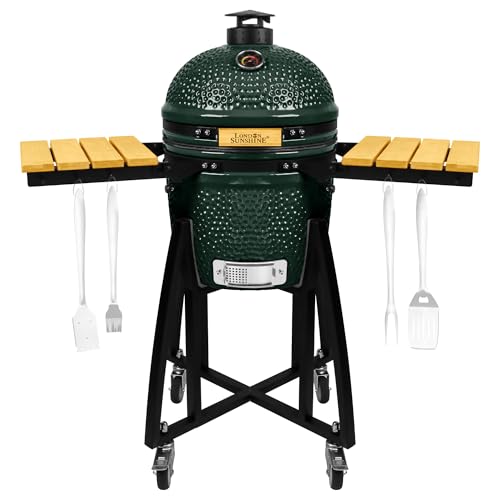
London Sunshine 15-Inch Ceramic Kamado — Best Compact Ceramic
The London Sunshine 15-inch is the true ceramic egg in miniature: a ceramic kamado and smoker with stainless steel grates, mounted on a tall stand with locking casters and foldable side shelves. Fifteen inches sounds small until you remember what kamado efficiency means — this is a cooker for two to four people that roasts a whole chicken, smokes ribs cut to fit, and sears steaks with genuine ceramic authority, while living happily on a small patio or balcony where an 18-inch egg on a cart would dominate. It suits small households, couples, and cooks who want real ceramic as a second, everyday grill alongside a larger cooker. It does not suit crowd cooking or whole briskets.
Strengths
- Genuine ceramic kamado construction in a compact footprint
- Tall stand with locking casters for stable, movable placement
- Foldable side shelves add prep space without permanent bulk
Trade-offs
- 15-inch grate limits large items — briskets and big rib racks need adapting
- Smaller brand with a thinner accessory range
- Ceramic care rules apply despite the friendly size
| Mini spec box — verified from catalogue title | |
|---|---|
| Size | 15-inch ceramic kamado charcoal BBQ grill and smoker |
| Grates | Stainless steel grates |
| Stand | Tall stand with locking casters |
| Shelves | Foldable side shelves |
Small kamados have a charm the big ones cannot match: they light quickly, sip lump charcoal, and come to temperature in the time a large ceramic is still warming, which makes weeknight kamado cooking realistic. A chicken roasted in the London Sunshine on a Tuesday, with that humid ceramic-roasted quality no oven reproduces, is the case for this pick in a single meal. Manage expectations on size honestly — this is a cooker for households, not parties — and keep the standard ceramic disciplines: no thermal shock, gentle handling despite the casters, gasket kept clean.
Check the current price on Amazon, and note the colour options on the listing; the verified configuration here is the green model on the tall stand.
Best for: small households wanting genuine ceramic kamado cooking in a compact, movable format. / Not suited for: crowds, whole briskets, or party-scale batches. Check on Amazon

Char-Griller AKORN Jr. Portable Kamado — Best Portable Kamado
The AKORN Jr. shrinks the insulated-steel kamado formula into a portable cooker: triple-wall insulated steel, cast iron grates, a locking lid for transport, and 155 sq. in. of cooking area. It is the kamado you can actually take somewhere — tailgates, campsites, balconies too small for anything else — and because the kamado system is sealed and efficient, it cooks far above its size class, smoking, roasting and searing on a handful of lump where an open portable grill would merely grill. It suits travellers, tailgaters, solo and couple cooks, and apartment households with minimal outdoor space. It does not suit family-volume cooking.
Strengths
- True kamado cooking in a portable, locking-lid format
- Insulated steel body is light and knock-resistant for travel
- Extremely fuel-efficient — long cooks on very little lump
Trade-offs
- 155 sq. in. is a two-to-three-person cooking area
- Small firebox means smaller fuel loads and closer attention on long cooks
- Steel body needs the same cover-and-care discipline as its big sibling
| Mini spec box — verified from catalogue title | |
|---|---|
| Construction | Triple-wall insulated steel kamado |
| Grates | Cast iron grates |
| Cooking area | 155 sq. in. cooking area |
| Transport | Locking lid |
The Jr. is the pick that surprises people at tailgates: ribs smoked properly in a parking lot, a tri-tip roasted while the game is on, steaks seared over a tiny, fierce lump fire. Its efficiency is the story — the insulated body holds heat so well that cooks which would empty a portable kettle’s fuel twice over happen here on one small load. At home it doubles as the weeknight kamado for two, heating fast and wasting nothing. Keep it covered, keep the cast iron oiled, and it will travel for years.
Check the current price on Amazon; at its tier the Jr. is often the most affordable route into kamado cooking of any kind, which makes it a legitimate first kamado as well as a portable one.
Best for: travellers, tailgaters and small households wanting portable kamado cooking. / Not suited for: family-volume or crowd cooking. Check on Amazon
Comparison Table
| Pick | Badge | Key spec | Best for |
|---|---|---|---|
| Kamado Joe Classic Joe Series II 18-Inch | Best Overall | Ceramic, 250 sq in, cart included | Complete classic kamado |
| GRILLA Kong Ceramic Kamado | Best Capacity | Ceramic, 600 sq in, 700°F max | Crowd-size kamado cooking |
| Char-Griller AKORN 20-Inch | Best Value | Insulated steel, 445 sq in | Kamado system, budget tier |
| Kamado Joe Classic Joe I | Best Classic Value | Ceramic, 250 sq in, 2-tier system | Kamado Joe at keener tier |
| London Sunshine 15-Inch Ceramic | Best Compact Ceramic | Ceramic, tall stand, casters | Small patios, couples |
| Char-Griller AKORN Jr. | Best Portable | Insulated steel, 155 sq in, locking lid | Travel and tailgating |
How to Choose a Big Green Egg Style Grill
Decide the material first, because it governs everything else. Ceramic offers the greatest thermal mass, the most stubborn temperature stability, and heirloom lifespan, at the price of weight, fragility and cost. Insulated steel offers ninety percent of the cooking behaviour at a fraction of the weight and price, with rust discipline as its only real demand. First-time kamado buyers unsure they will love the format should start with the AKORN and let the format prove itself; committed cooks who already know they want an egg for a decade should buy ceramic once.
Size second, and size by diameter class rather than square-inch claims, which vary in how they count tiers and warming racks. The 18-inch class is the classic household kamado: whole chickens, trimmed briskets, two-tier rib layouts. The Kong’s class is for entertainers. The 15-inch and Jr. classes are household-of-two and portable tools, excellent within their brief and frustrating outside it. Third, consider the system around the cooker: heat deflectors for indirect cooking are essential, not optional, on any kamado; tiered or split grates multiply layout options; and a sturdy cart or stand matters because these cookers should be placed once and moved rarely. Finally, budget honestly for the full setup — deflector, lump charcoal, a cover, and a good thermometer belong in the same purchase decision as the grill itself.
One further consideration is where the cooker will be bought and delivered. Large ceramics are freight items: inspect the carton on arrival, photograph any damage before signing, and assemble on the spot where the grill will live rather than carrying a built ceramic cooker across the garden. Keep the packaging until the first successful cook is behind you. Insulated steel models arrive lighter and more forgiving, but the same inspection habit applies — check the body for transit dents around the vents and lid seal, because a kamado’s entire control system depends on that seal being true. Buying through the verified listings in this guide keeps the model identity certain, which matters in a category where similar names cover very different cookers.
Finally, think about who else will cook on it. A kamado’s vent discipline is simple but not intuitive to a guest cook raised on gas knobs, and households where several people grill should expect a short teaching moment — or accept that the kamado becomes one person’s beloved instrument while a simpler grill handles casual use. Neither outcome is a failure; knowing which household you are prevents buying the wrong badge from this list.
Ceramic vs Insulated Steel: What Actually Differs at the Table
Buyers ask whether insulated steel “tastes” different, and the honest answer is: barely, and only at the edges. Both systems cook in the same sealed, humid, vent-controlled environment, and the food cannot tell what the walls are made of. The differences are in behaviour, not flavour. Ceramic’s mass smooths temperature through long cooks and windy nights a touch more completely, and recovers more slowly after the lid opens. Steel heats and cools faster, which beginners often find friendlier — a vent mistake is corrected in minutes rather than half an hour — and steel travels, survives knocks, and costs far less to replace if the worst happens. Ceramic wins the twenty-year ownership story; steel wins the five-year value story and every portability contest. Choose by your horizon and your household’s clumsiness, not by food mythology.
How to Run a Kamado: Vent Discipline for Smoking and Searing
Every kamado in this guide runs on the same two controls — the bottom intake vent and the top exhaust vent — and one governing idea: the fire can only burn as hard as the air you allow it. Light a modest amount of lump charcoal in the centre of the firebox, leave both vents open while the fire establishes, and then begin closing the vents down as the temperature climbs toward your target, arriving at small openings well before the target is reached. Kamado temperature is approached from below, always, because the insulated body stores heat so effectively that an overshoot takes a long time to undo. For low-and-slow smoking, the settled position is a small intake opening and a modest exhaust; for roasting, roughly double both; for searing, open them wide and let the cooker climb, grate in place, until the whole chamber is fiercely hot.
Two habits separate good kamado cooks from frustrated ones. The first is patience with adjustments: change one vent, wait ten minutes, and read the result, because thermal mass means every input arrives late. The second is “burping” the lid at high temperatures — cracking it an inch or two for a few seconds before opening fully — so the sudden rush of oxygen does not flare the fire into the rush of flame old kamado hands call a flashback. Add a heat deflector for indirect cooks, keep the gasket sealing properly, and never use lighter fluid or instant-light charcoal in a kamado, whose porous ceramics absorb chemical flavours permanently. Master those few rules and any pick here will hold a temperature more faithfully than any other charcoal cooker you have owned.
The Kamado Accessories That Actually Matter
Kamado accessory catalogues are enormous, but four items do ninety percent of the work, and they should be budgeted with the grill rather than discovered after it. The heat deflector — a ceramic plate that sits between fire and food — is non-negotiable: it creates the indirect environment for smoking, roasting and baking, and without it a kamado is only a very good direct grill. A quality instant-read thermometer is second, because kamado cooking is judged by the food’s internal temperature, and the dome thermometer — on any brand — reads the air at the top of the cooker, not the grate and never the meat. Third, a cover that actually fits your model, because ceramics dislike standing water in their vents and steel bodies dislike weather entirely. Fourth, a supply of good lump charcoal in two sizes of piece if you can get it: large pieces for long low cooks, mixed pieces for everyday grilling.
Beyond the essentials, buy in the order your cooking demands. A raised or tiered grate is the first upgrade most households feel, because it answers the round-grate capacity problem directly. A cast iron grate or searing surface serves steak-focused cooks. Pizza stones rated for kamado temperatures turn the cooker into a genuine high-heat oven — one of the format’s party tricks, and a legitimate reason many owners fire the egg on Fridays. Rotisserie kits, plancha plates and wok rings are wonderful and entirely optional; let three months of cooking tell you which one your household actually wants, rather than buying the catalogue on day one. The discipline matters because kamado money compounds: the cooker is the beginning of the spend, and a thoughtful accessory path costs less and cooks better than an impulsive one.
Your First Month With a Kamado: A Sensible Progression
Week one, grill simply: burgers, sausages and vegetables with the vents wide-ish and no deflector, learning how your cooker climbs and how the grate behaves. The goal is not a masterpiece; it is calibration — how long your kamado takes to reach grilling heat, how the vents map to temperature, how the lid feels when you burp it. Week two, roast a chicken indirectly with the deflector in place at a moderate temperature. Roasting is where the kamado’s humid, even environment first announces itself, and a chicken is cheap, fast and brutally honest about temperature control.
Week three, go low: ribs or a small pork shoulder, vents nearly closed, deflector in, and a full lesson in patience. Expect to overshoot once and correct slowly; expect the cook to take longer than the recipe promised; expect the result to convince you anyway. Week four, go high: steaks or a pizza at the top of the range, learning the flashback discipline and the sheer theatre of a kamado at full heat. By the end of the month you will have used the cooker across its entire range, broken in the gasket, seasoned the grates, and formed the vent instincts that make the second month feel effortless. Owners who follow a progression like this keep their kamados for years; owners whose first cook is a twelve-hour brisket for guests often blame a fine cooker for a scheduling decision. Learn the egg in private, then perform with it in public — and expect the public part to arrive quickly, because food from a kamado has a way of creating its own audience, invitations and expectations within a single season of cooking.
Keeping a Kamado Cooking Like New
Kamado maintenance is light but specific. Ash is the daily item: an efficient kamado produces little of it, but what remains should be removed regularly — through the ash drawer where fitted, or with an ash tool once the cooker is fully cold — because ash restricts the airflow the whole control system depends on. The fire itself is the cleaning cycle for the interior: an occasional hot burn with the vents open burns off accumulated residue from the ceramics and grates, after which a brush of the grates and a wipe of the gasket completes the job. Never use water inside a hot kamado, never use oven cleaner on the ceramics, and never scrape the interior walls — the dark, seasoned surface is protection, not dirt.
The gasket deserves its own habit, because it is the seal your temperature control stands on. Keep food and sauce off it, wipe spills while they are fresh, and replace it when it flattens, frays or starts leaking smoke at the seam — a leaking gasket announces itself as a cooker that will not hold low temperatures, and owners often misdiagnose it as a vent problem for months. Check hinge bolts and band tension each season, since thermal cycling loosens hardware slowly; keep exterior steel oiled or covered against rust; and store lump charcoal dry, because damp lump is the hidden cause of half the “my kamado won’t light / won’t climb” complaints in the category. Do these small things and a kamado — ceramic or steel — remains the most faithful cooker on the patio.
Weather deserves a sentence of its own in a kamado guide, because the format is famously weather-resistant once lit: the insulated body shrugs at cold and wind that would torment a thin kettle, and winter smoking is a kamado party trick. The cautions are at the extremes of the routine — light the fire in shelter, keep rain out of an open vent during a cook, and never let a hot ceramic meet cold water. Within those lines, an egg-style grill is the most all-season charcoal cooker in this entire programme.
Common Buying Mistakes
The first mistake is buying ceramic without a permanent home for it: kamados are heavy, and owners who plan to move them regularly eventually drop, crack or simply stop using them. Place it once, on a stable surface, and let the casters or cart be for rare, careful repositioning. The second is skipping the heat deflector to save money, then discovering that indirect cooking — half of what a kamado exists for — is compromised. The third is judging capacity by diameter alone and forgetting that round grates fit rectangular food poorly; plan tiers and trimming accordingly, or size up to the Kong class.
Fourth, beginners overfill the firebox for small cooks and then fight the stored heat all afternoon; kamados need surprisingly little lump for ordinary meals. Fifth, owners use briquettes with additives or, worse, lighter fluid, and flavour the ceramics permanently. Sixth, they neglect the gasket, whose seal is the whole control system — a leaking gasket is a kamado that will not stay low. Finally, many buyers compare only the cooker price and forget the setup costs — deflector, cover, lump supply, thermometer — which belong in the budget from the start.
Final Recommendation
For most buyers, the Kamado Joe Classic Joe Series II is the egg alternative to buy: the complete, refined ceramic experience in the classic class, with cart and shelves included. If the live price gap is wide, the Classic Joe I cooks the same food for less. Entertainers should step up to the GRILLA Kong and enjoy having room. Value-first and first-time kamado cooks should start with the AKORN and may never need more; small households get genuine ceramic from the London Sunshine; and travellers get the whole kamado idea in portable form from the AKORN Jr. The original egg defined this category — these six are how you buy into it today.
More from the grill cluster: Best Kamado Grills · Best Charcoal Grills · Best Grills · Best Ceramic Grills · Best Smoker Grills
Frequently Asked Questions
Are these grills as good as a real Big Green Egg?
They cook by the identical system — sealed, insulated, vent-controlled lump charcoal cooking — and the best of them, the Kamado Joe models, are considered peers of the original rather than copies. The Egg is sold through dealers, which is why it is the reference point here rather than a linked pick; the alternatives above are the ones verifiable and purchasable through this guide.
Ceramic or insulated steel — which should I choose?
Ceramic for maximum thermal stability, longevity and the classic ownership story; insulated steel for value, light weight, toughness and portability. Food quality is effectively equal. First kamado buyers often start with steel (the AKORN) and upgrade only if the format becomes a passion.
What fuel does a kamado use?
Lump charcoal, always. It burns cleanly at both low and very high temperatures and leaves little ash. Never use lighter fluid or instant-light briquettes in a kamado: porous ceramics absorb the chemical taste permanently. Light with a chimney, electric starter or natural fire starters.
Why did my kamado overshoot its temperature?
Because kamados store heat in their walls, temperature must be approached slowly from below, closing vents early as the target approaches. If you overshoot, close the vents down and wait — opening the lid to “let heat out” feeds the fire oxygen and usually makes it worse. Small vent changes and ten-minute waits are the whole discipline.
Can a kamado really both smoke and sear?
Yes — that range is the format’s defining talent. The same sealed cooker holds low smoking temperatures on a single lump load for very long cooks and, with vents open, climbs to the 700°F class for steakhouse searing, as the Kong’s verified maximum illustrates. A heat deflector handles the indirect work in between.
How fragile is a ceramic kamado, really?
The ceramics are strong in use but vulnerable to drops, hard knocks and thermal shock — never pour water into a hot kamado or move it carelessly. Placed permanently, handled gently, and protected from impacts, a ceramic kamado lasts for many years. Households that cannot promise that treatment should choose insulated steel.
How much lump charcoal does a kamado use per cook?
Far less than a kettle — that efficiency is the format’s signature. A low-and-slow cook typically uses a modest firebox load and leaves reusable charcoal behind; always let unburned lump cool and reuse it next time, topping up rather than starting over. Only high-heat searing sessions consume a full load quickly.
Can I bake bread and pizza in a kamado?
Yes — with a heat deflector and a suitable stone, a kamado is an excellent wood-fired oven, holding baking temperatures evenly and climbing high enough for properly blistered pizza. It is one of the strongest reasons households choose an egg-style grill over a conventional one.


