Disclosure: airfryerkitchensupply.com is reader-supported. When you buy through links on our site, we may earn an affiliate commission at no extra cost to you.
Where to buy
Battery vacuums split into two species that listings deliberately blur: cordless robotic cleaners that drive themselves around an inground pool, and handheld rechargeable vacuums you push on a pole for spot cleaning and leaf pickup. Both are in this guide, labelled honestly, because each is the right tool for a different pool owner. Every model below was verified against its Amazon listing before receiving a link.
- AIPER Seagull Pro Cordless Robotic Pool Cleaner (Best Overall Robot) — Check the current price on Amazon
- WYBOT C1 Cordless Robotic Pool Vacuum (Best Value Robot) — Check the current price on Amazon
- WYBOT C2 Cordless Robotic Pool Vacuum (Best Filtration Robot) — Check the current price on Amazon
- POOL BLASTER Max Cordless Pool Vacuum (Best Handheld for Spot Cleaning) — Check the current price on Amazon
- KOKIDO Rechargeable Heavy Duty Pool Leaf Vacuum XV910 (Best for Leaf Storms) — Check the current price on Amazon
- VOLTERA 120 Cordless Pool Vacuum (Best Pro Handheld) — Check the current price on Amazon
The best battery pool vacuums for inground pools free you from the two historic annoyances of pool cleaning: the cord that tangles and limits reach, and the suction cleaner that lives off your pump and plumbing. Battery robots have matured into the real thing — the leading pick below runs a quad-motor system with wall climbing and a runtime measured in hours, sized for inground pools up to a genuinely large footprint. At the other end, handheld battery vacuums remain the fastest way to deal with a leaf dump, a sand patch, or the steps and swim-outs robots climb past.
Be clear about the division before spending: a robot is a maintenance system — drop it in on a schedule and it keeps floors and walls clean between your visits. A handheld is a tool — it cleans what you aim it at, when you aim it, and it is unmatched for spot work but will never maintain a whole inground pool by itself. Most inground owners eventually own one of each; this guide ranks three robots and three handhelds, each labelled, so you can buy the species your pool actually needs first.
One expectation to set honestly: battery robots suit inground pools best when the debris load is ordinary — dust, sand, leaves in reasonable numbers. Pools under heavy tree cover that fill with leaf drifts after every storm still benefit, but the baskets fill fast, and the big handheld leaf vacuum in this guide exists precisely for that first pass after a storm.
Every model here was verified against its live listing before earning a link, and the runtimes, coverage figures and filtration details in the spec lines are drawn from those listings. Where a product’s marketing stretches toward a job it is not built for, the review narrows it back — a handheld is a handheld, however heroic its name.
In this guide
Quick Picks
AIPER Seagull Pro Cordless Robotic Pool Cleaner — Best Overall Robot. Quad-motor drive, WavePath navigation and wall climbing with a long runtime — the flagship cordless robot for inground pools. Check price on Amazon
WYBOT C1 Cordless Robotic Pool Vacuum — Best Value Robot. A 4-in-1 cordless robot for inground pools that covers the core job — floor, walls, waterline — without the flagship tier. Check price on Amazon
WYBOT C2 Cordless Robotic Pool Vacuum — Best Filtration Robot. Dual-layer filtration with a fine stage, app control and coverage for large pools — for water that needs polishing, not just picking up. Check price on Amazon
POOL BLASTER Max Cordless Pool Vacuum — Best Handheld for Spot Cleaning. The long-running handheld standard: rechargeable, hoseless, pole-mounted, and faster than any robot for a targeted mess. Check price on Amazon
KOKIDO Rechargeable Heavy Duty Pool Leaf Vacuum XV910 — Best for Leaf Storms. A commercial-power leaf vacuum with standard and fine filter bags — the first pass after the trees empty themselves. Check price on Amazon
VOLTERA 120 Cordless Pool Vacuum — Best Pro Handheld. A full-coverage handheld with PowerBlade technology, built for large pools whose owners clean by hand on purpose. Check price on Amazon
How These Picks Were Chosen
Robots were judged on inground credentials first: stated coverage area, wall climbing, runtime against pool size, and navigation — a robot that wanders randomly in a large inground pool leaves crescent moons of dirt in the corners. Filtration came second, because fine dust and sand are the inground pool’s daily debris, and a coarse basket alone just relocates them. Handhelds were judged on suction honesty, debris capacity, and pole reach, since a handheld’s job is targeted power, not coverage.
Every model was cross-checked on this site: brand and model searched, the returned listing title matched to the product, and only confident matches linked. Runtimes, coverage figures and motor configurations quoted in the spec lines come from those verified titles — and where a title markets a handheld toward small pools, the review says so rather than dressing it up as an inground solution.
The final six: three cordless robots spanning flagship to value, a heavy-duty handheld leaf vacuum, a professional handheld for large pools, and the classic Pool Blaster Max for spot duty — a spread that covers inground ownership from weekly maintenance to storm recovery.
A final filter separated the list from the much longer field of search results: inground honesty. Products whose own listings aim them at small or above-ground pools were not promoted into this guide on the strength of hopeful marketing, and corded cleaners — however excellent — were excluded from a battery guide on principle. What remains is a list where every product’s stated job matches the job in the title, which is the least a buyer spending real money on pool equipment should expect.
The 6 Best Battery Pool Vacuums for Inground Pools

AIPER Seagull Pro Cordless Robotic Pool Cleaner — Best Overall Robot
The Seagull Pro is what the cordless category has been promising for years: a robotic cleaner for inground pools with a quad-motor system, WavePath navigation that plans a route instead of bouncing randomly, wall climbing for the full floor-to-waterline circuit, and a runtime long enough — up to 150 minutes per the verified listing — to cover large inground pools in a single session. If your pool is the centrepiece of the garden and your weekends are not for pushing a vacuum, this is the pick.
Strengths
- Planned navigation covers large inground pools systematically
- Wall climbing and waterline scrubbing included
- Long runtime suits big pools in one session
Trade-offs
- Flagship pricing for the cordless category
- Must be charged and stored out of the water
- Fine baskets need regular emptying in leaf season
Key specs: Cordless robotic, WavePath navigation, wall-climbing, quad-motor, up to 150 min runtime, for inground pools (per verified listing title)
Navigation is the specification that separates flagship robots from toys, and it shows in the corners: a planned path reaches the deep end, the steps’ edges and the wall base systematically, where random-pattern cleaners leave visible misses that you end up hand-vacuuming anyway — defeating the purchase. The quad-motor layout gives it the traction to climb and scrub at the waterline, the band where sunscreen and pollen collect. Battery discipline is the ownership cost: charge it after each run, store it out of the pool between cycles, and the runtime you bought is the runtime you keep.
Seagull Pro ownership is a rhythm: drop it in after breakfast twice a week, lift it out at lunch, rinse the basket, charge. The navigation means you stop inspecting corners — the robot’s pattern covers them, and the waterline band stays scrubbed without your involvement. Keep the charging contacts dry, store it in the shade of the pool house or garage, and the flagship earns its tier by making pool maintenance a background process rather than a Saturday.
Keep a spare basket rinse in the routine after storm weeks even if the water looks clear; fine grit hides in the filter pleats and taxes the motors you paid flagship money for.
Best for: inground owners wanting full cordless automation / Not suited for: pools needing only occasional spot cleaning

WYBOT C1 Cordless Robotic Pool Vacuum — Best Value Robot
WYBOT has become the value name in cordless robots, and the C1 is its inground argument: a 4-in-1 robotic cleaner — floor, walls, waterline and the transitions between — with a long runtime per the verified listing and a design aimed at owners who want automation without paying for the flagship’s navigation computer. For the typical rectangular inground pool, the C1’s coverage pattern and wall ability handle the weekly maintenance cycle completely.
Strengths
- 4-in-1 cleaning: floor, walls, waterline
- Strong value for genuine inground automation
- Lighter lift-out than flagship rivals
Trade-offs
- Navigation less refined in freeform pools
- Smaller debris capacity in heavy leaf season
- Value tier fit and finish
Key specs: Cordless robotic, 4-in-1 cleaning for inground pools, long runtime (per verified listing title)
The honest difference from the Aiper flagship is path intelligence: the C1 works harder and a little less elegantly, which in a regular-shaped pool amounts to the same clean floor by the end of the cycle. In freeform pools with tight curves and features, the flagship’s navigation earns its premium; in rectangles and ovals, it mostly earns admiration. WYBOT’s filtration handles the sand-and-dust daily load well, and the unit’s lighter build makes the lift-out at the wall — the moment every robot owner repeats weekly — noticeably easier on the back.
The C1’s owners are value hunters who got the automation without the flagship bill, and the lived experience matches the promise in regular-shaped pools: a clean floor, climbed walls, and a lift-out light enough to do one-handed while holding a coffee. Keep its filter rinsed and its schedule regular, and the difference from the flagship is mostly visible to people who watch robots for fun. In a rectangle, clean is clean, however the path was drawn.
Rectangular-pool owners can help it further with a pre-run skim; the C1 spends its battery best on the floor and walls rather than on surface leaves a net removes in a minute.
Best for: rectangular and oval inground pools on a budget / Not suited for: complex freeform pools needing smart navigation

WYBOT C2 Cordless Robotic Pool Vacuum — Best Filtration Robot
The C2 steps up from the C1 where it matters for many inground pools: filtration. Its dual filter system pairs a standard basket with a fine stage rated in the verified listing down to fine particles, which is what stands between a pool that looks clean and a pool whose water is actually clear after the robot passes — fine dust and dead algae are the debris that coarse baskets recirculate. App control and a stated coverage over two thousand square feet complete a package aimed at larger, finish-conscious pools.
Strengths
- Dual filtration with a genuinely fine stage
- App control and large stated coverage
- Strong on dust, sand and fine sediment
Trade-offs
- Fine filter needs frequent rinsing
- App features add setup the C1 skips
- Mid-tier pricing between value and flagship
Key specs: Cordless robotic, dual filter with fine stage, app control, coverage to 2152 sq ft (per verified listing title)
Fine filtration has a maintenance price: the fine stage clogs faster and wants rinsing more often, especially in pollen season. That is not a flaw; it is the physics of catching smaller dirt, and the C2 makes the filter accessible enough that the rinse is a two-minute job at the garden tap. Choose the C2 over the C1 when your pool’s problem is hazy water and fine sediment rather than leaves; choose it over the flagship when filtration matters more to you than navigation finesse. It is the thinking owner’s middle path in this guide.
The C2 suits the owner who water-tests by eye and hates haze. Its fine filtration shows up as clarity — the pool looks polished, not just picked up — and the app scheduling means it runs whether or not you remember. Its ritual is the fine-filter rinse, more frequent than other robots here, which owners in dusty regions accept as the price of catching dust at all. In pollen season, that trade stops looking like a chore and starts looking like the whole point.
In pollen season, rinse the fine stage mid-week as well as at lift-out. The C2’s clarity advantage is entirely a function of that filter staying open, and it rewards the attention visibly.
Best for: pools plagued by fine dust and hazy water / Not suited for: owners who want zero filter maintenance
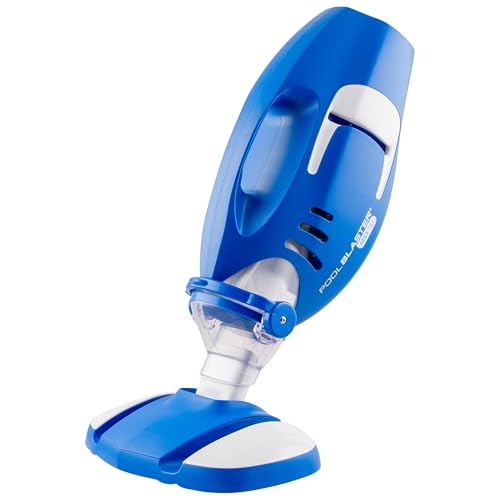
POOL BLASTER Max Cordless Pool Vacuum — Best Handheld for Spot Cleaning
The Pool Blaster Max has been the handheld answer for so long because the formula is right: a self-contained rechargeable vacuum with its own motor and debris chamber, mounted on your pool pole, needing no hose, no pump and no setup. For inground pools its kingdom is the places robots serve worst — steps, swim-outs, tanning ledges, spa spillways, and the leaf cluster that landed an hour before guests arrive. The verified listing confirms it for inground and above-ground pools alike.
Strengths
- Instant spot cleaning with no hose or pump setup
- Perfect for steps, ledges and swim-outs
- Long-proven design with available parts and filters
Trade-offs
- Handheld — you are the navigation system
- Debris chamber is spot-sized, not storm-sized
- Runtime suits sessions, not whole-pool marathons
Key specs: Cordless handheld, rechargeable, for inground and above ground pools (per verified listing title)
Judge a handheld by honesty of role: the Max will not maintain your pool, and pretending otherwise is how handhelds get unfair reviews. What it does is collapse a twenty-minute hose-and-net production into a five-minute walk around the edge. The debris chamber handles sand, grit and leaves in spot quantities; empty it when suction softens and it recovers immediately. As the second device beside any robot in this guide — or the only device for a small inground pool with light debris — it has earned its institution status honestly.
Pool Blaster ownership is measured in saved productions: the leaf cluster before guests, the sand patch after a windy night, the steps that always need attention — five minutes each, no hoses, no pump priming, no drama. Keep it charged on its hook in the pool shed and it is always ready. The chamber empties in seconds and the filter rinses at the tap. It is the tool owners lend to neighbours, which is why so many neighbours end up owning one.
Keep a second filter bag drying while one is in use and the Max never sits out a session; for a tool whose whole value is readiness, the spare is the cheapest insurance in this guide.
Best for: spot cleaning and robot-resistant areas / Not suited for: whole-pool maintenance on its own

KOKIDO Rechargeable Heavy Duty Pool Leaf Vacuum XV910 — Best for Leaf Storms
The Kokido XV910 is a different tool from everything above: a heavy-duty leaf vacuum built to inhale the debris load that chokes robots and spot vacuums alike. After a storm, an inground pool under trees can hold a carpet of leaves that would fill a robot basket in four feet of travel. The XV910’s large-capacity filter bags — standard and fine included per the verified listing — are sized for that job, moving bulk leaves fast so the water can be finished by finer tools afterward.
Strengths
- Large filter bags swallow storm debris loads
- Standard and fine bags included
- Commercial-power suction for bulk leaves
Trade-offs
- Bulk tool — not a fine-finish cleaner
- Bag emptying is part of the workflow
- Unnecessary for pools without tree cover
Key specs: Rechargeable heavy duty leaf vacuum, standard and fine filter bags, commercial power (per verified listing title)
Leaf vacuuming is about volume per pass, and the XV910’s commercial positioning shows in its bag capacity and suction appetite. Work it methodically from the deep end, empty the bag before it becomes a sail, and a storm-hit pool comes back in one session instead of a weekend. It is not a fine cleaner — pair it with a robot cycle or the Pool Blaster for the finish — and it is overkill for pools without tree cover. For the inground pool under oaks, though, it is the difference between dreading autumn and shrugging at it.
The XV910 lives in the shed until the weather turns, and then it is the most valuable object on the property. Storm owners learn its rhythm fast: slow passes, deep end first, bag emptied before it drags. Between storms it handles the weekly leaf drift of a tree-covered pool in minutes. It asks for storage space and a charged battery kept ready in leaf season — a small standing order that converts autumn from a pool-closing argument into a routine.
Store it charged in leaf season rather than charging it after the storm; the storm is precisely when you will not want to wait, and batteries hold a working charge happily for weeks.
Best for: inground pools under heavy tree cover / Not suited for: fine dust or small spot jobs

VOLTERA 120 Cordless Pool Vacuum — Best Pro Handheld
Some inground owners prefer driving: they know their pool’s dirty corners and would rather clean thoroughly by hand than trust a robot’s route. The Voltera 120 is built for them — a cordless, rechargeable handheld positioned for large pools, with PowerBlade cleaning technology and a full-coverage design brief per the verified listing. It bridges the handheld category upward: more capacity and endurance than spot tools, aimed at owners who treat vacuuming as a weekly ritual rather than an emergency response.
Strengths
- Built for large pools, not adapted from spa tools
- Full-coverage handheld cleaning power
- Total control over pace and problem areas
Trade-offs
- Your time is the automation
- Premium handheld pricing approaches robot territory
- Heavier in hand over a long session
Key specs: Cordless rechargeable handheld, PowerBlade technology, for large pools (per verified listing title)
The case for a pro handheld over a robot is control: you decide the pace over the algae patch, the extra pass on the steps, the pause at the drain. The case against is your afternoon, weekly, forever. The Voltera makes the pro-handheld case as strongly as the category allows — if that is your temperament, it will satisfy; if you are buying it hoping it becomes a robot, buy the WYBOT C1 instead and be happier. As with all battery gear, its endurance depends on charging discipline and storing it dry between sessions.
Voltera ownership suits the methodical: the owner who knows the pool’s dirty map and enjoys erasing it. Its endurance covers a large pool’s full manual session, and the control means problem areas get exactly the passes they need. It asks more of your afternoon than any robot here and gives back the satisfaction of a job done by hand, thoroughly. For its people, that is not a compromise — it is the hobby, with a clean pool as the by-product.
Work the pool in lanes like mowing a lawn and the manual method’s coverage rivals a robot’s; the Voltera rewards system, and its owners tend to be systematic people.
Best for: hands-on owners of large inground pools / Not suited for: anyone wanting set-and-forget cleaning
Comparison Table
Species first: the table separates the self-driving robots from the handheld tools, because comparing them on the same axis is how buyers end up disappointed with a good product.
| Pick | Badge | Key spec | Best for |
|---|---|---|---|
| AIPER Seagull Pro Cordless Robotic Pool Cleaner | Best Overall Robot | Robotic, quad-motor, 150 min | inground owners wanting full cordless automation |
| WYBOT C1 Cordless Robotic Pool Vacuum | Best Value Robot | Robotic, 4-in-1, value tier | rectangular and oval inground pools on a budget |
| WYBOT C2 Cordless Robotic Pool Vacuum | Best Filtration Robot | Robotic, dual fine filtration, app | pools plagued by fine dust and hazy water |
| POOL BLASTER Max Cordless Pool Vacuum | Best Handheld for Spot Cleaning | Handheld spot vacuum | spot cleaning and robot-resistant areas |
| KOKIDO Rechargeable Heavy Duty Pool Leaf Vacuum XV910 | Best for Leaf Storms | Handheld leaf vacuum, large bags | inground pools under heavy tree cover |
| VOLTERA 120 Cordless Pool Vacuum | Best Pro Handheld | Pro handheld, large pools | hands-on owners of large inground pools |
How to Choose a Battery Pool Vacuum for an Inground Pool
Decide the job before the device. Weekly maintenance of the whole pool is a robot’s job — full stop — and the choice among robots is then about navigation, filtration and runtime against your pool’s size and shape. Spot duty, steps and ledges, and storm recovery are handheld jobs, and no robot roadmap changes that. Most inground pools generate both jobs; the budget question is only which one you buy first, and the answer is whichever problem currently costs you more weekends.
Size the robot to the pool honestly. Runtime must cover your pool’s floor area with margin — a robot that dies at eighty percent has cleaned eighty percent, and the dirty crescent will always be the deep end where you swim. Wall climbing matters if your walls grow the biofilm line most inground pools develop; floor-only robots are cheaper and fine for pools whose walls stay clean, but know which pool you own. Filtration fineness matters most in dusty, windy or high-pollen regions, where the C2’s dual-stage approach earns its keep.
Battery Ownership: Runtime, Charging and Storage That Keep the Specs True
Every runtime in this guide is a new-battery, clean-filter number, and your ownership habits decide how long it stays true. Charge after each use rather than letting the unit sit flat; a battery stored discharged ages in dog years. Rinse filters after every cycle — a clogged filter makes the motor work harder, the suction weaker and the battery shorter, all at once, and owners routinely blame the battery for the filter’s sins. Store the cleaner dry, shaded and out of the water between runs; permanent residence in the pool is the fastest route to a tired battery and faded housing.
Seasonal rhythm helps too. Run robots on a schedule — twice weekly in season beats one marathon after a fortnight of neglect — because light, frequent passes keep the debris load inside the basket’s comfort zone. Handhelds earn their keep between those runs. The system, not any single device, is what a clear inground pool actually consists of.
Inground Realities: Steps, Ledges, Drains and Other Robot-Resistant Geography
Inground pools are architecture, and architecture has edges robots negotiate imperfectly. Steps and swim-outs are shallow, interrupted surfaces where robots climb, hesitate and sometimes beach; tanning ledges are wide shallows many robots treat as optional. Main drains and raised fittings can high-centre a robot whose clearance was designed for flat floors. None of this is a scandal — it is why the handheld exists, and why this guide insists the two species are partners.
Walk your pool before buying and list its features: benches, ledges, a spa spillway, a beach entry. Beach entries in particular defeat many robots at the shallow end. The list tells you how much handheld duty your pool will always need, and therefore whether the handheld is a later accessory or a same-day purchase. Buying both eyes-open beats discovering the geography lesson with guests arriving at four.
Saltwater, Vinyl and Fibreglass: Battery Cleaners on Different Inground Surfaces
Inground pools wear three common skins, and battery cleaners meet each differently. Plaster and pebble finishes give robot wheels and brushes the grip they were designed around — the flagship climbing in this guide is at its most confident there. Vinyl liners ask for gentleness: confirm any robot or handheld you choose is liner-safe, avoid aggressive brush action on seams and patterns, and never let a heavy unit sit in one spot on a liner floor. Fibreglass shells are smooth enough that some robots find climbing purchase harder; wall performance there rewards the stronger drive systems.
Saltwater systems add a rinsing clause: salt is kind to swimmers and unkind to stored equipment, so the rinse-at-lift-out habit in this guide’s routine matters doubly — rinse the cleaner itself, not just its filter, and dry the charging contacts before the unit goes on charge. None of these surfaces disqualifies any pick here; they simply tune how you run it. Surface first, schedule second, and the battery fleet will treat your particular pool as the one it was designed for.
Understanding Suction, Flow and Filtration Claims Without a Physics Degree
Pool vacuum marketing speaks three languages at once, and translating them prevents most disappointments. Suction claims describe how hard a unit pulls at its intake — the number that matters for sand in a corner and debris stuck to a step. Flow describes how much water moves through the machine, which governs how fast bulk debris like leaves is processed. Filtration describes what size of particle stays captured instead of returning to the pool. A great leaf vacuum is a flow machine; a great finishing robot is a filtration machine; confusing the two is how owners end up with a powerful unit that leaves the water hazy, or a fine-filtering unit that chokes on acorns.
The picks in this guide were assigned by that translation: the Kokido sells flow and capacity, the WYBOT C2 sells filtration fineness, the AIPER sells coverage intelligence, and the handhelds sell directed suction where you point them. When a listing leads with a single enormous number, ask which of the three languages it is speaking and whether that is the language your pool’s problem is written in. Dust problems are filtration problems. Leaf problems are flow problems. Step and corner problems are access problems, and they belong to the handhelds.
Runtime claims deserve the same translation: a runtime is only meaningful against your pool’s area and debris load, with a clean filter, on a healthy battery. Read it as a budget to be spent by the pool, not a promise made by the box. Owners who think in these terms stop being disappointed by specifications and start predicting their own results — which is the moment pool equipment stops being a gamble and becomes a system.
Seasonal Playbook: Spring Opening, Summer Rhythm, Autumn Leaves, Winter Rest
Spring opening is the battery fleet’s hardest week and should be sequenced honestly: net and leaf-vacuum the bulk first, brush everything, shock the chemistry back to life, and only then introduce the robot to maintain what you have rescued. Owners who send a robot into an opening-week swamp conclude robots do not work; owners who sequence conclude they cannot live without one. The device did not change — the job description did.
Summer is rhythm: robots twice a week, handheld rounds for steps and ledges, filters rinsed as reflex. Autumn is the Kokido’s season, when the playbook flips to leaf-first and the robot’s role narrows to finishing. Winter, for pools that close, is storage discipline — everything cleaned, charged to a healthy level, and kept dry and frost-free — and for pools that stay open in mild climates, a slower version of the summer rhythm. Batteries age by calendar as much as by cycles, and a winter stored correctly is worth a season of runtime.
Across all four seasons the constant is the five-minute habit stack: rinse, charge, store dry, note anything changing. Pool equipment rarely fails suddenly; it declines audibly, visibly, in suction and stamina, weeks before it stops. The seasonal playbook works because it builds the noticing into the routine, while the pool is still a pleasure and not yet a project.
What Battery Robots Still Cannot Do — and How Owners Work Around It
Honesty about limits makes the picks above more useful, not less. Robots struggle with beach entries, where the shallows strand them; with very tight radius corners in freeform pools; and with the first clean of a neglected pool, where algae-slick walls defeat climbing traction. The workarounds are established practice: brush a neglected pool and run a manual pass before introducing the robot, hand-vacuum the beach entry as part of the weekly handheld round, and treat the robot as the maintainer of a clean pool rather than the rescuer of a green one.
Water chemistry is the invisible partner: a robot removes debris, but sanitizer and balance keep the water itself healthy, and no vacuum in this guide changes that. Owners who understand the division — chemistry for the water, battery tools for the surfaces — get pools that look professionally kept. Owners who expect the robot to compensate for chemistry get a very clean floor under cloudy water, and a mystery that was never the robot’s to solve.
How to Run a Battery Pool Vacuum Routine That Keeps an Inground Pool Clear
Devices do not keep pools clear; routines do. This is the weekly pattern that makes any combination of the picks above perform at its best.
- Skim and empty first. Net the surface debris and empty skimmer and pump baskets before vacuuming. A robot should spend its battery on the floor, not on leaves a net removes in a minute.
- Brush the waterline and steps. A quick brush loosens biofilm and pushes step debris onto the floor where the robot can reach it. Two minutes of brushing saves twenty of vacuuming.
- Drop the robot in on schedule. Twice weekly in season, at a consistent time. Lower it gently, let it sink and purge air, and start the cycle sized to your pool.
- Storm protocol: leaves first, robot second. After heavy leaf fall, run the Kokido leaf vacuum or a net pass before the robot, so its basket is spent on dirt, not bulk.
- Handheld the geography. While the robot works the open floor, take the Pool Blaster or Voltera to steps, ledges and the swim-out — the areas you listed before buying.
- Rinse filters at lift-out. Every cycle, at the garden tap, until the water runs clear. This single habit preserves suction, runtime and motor life simultaneously.
- Charge, dry, store. Recharge the same day, store the unit shaded and dry, and leave it out of the water between runs. Batteries reward routine and punish storage in the pool.
Follow that loop and the pool stays in the state where cleaning is maintenance rather than rescue. Rescue cleaning is always available — it just costs the weekend the routine was designed to protect.
Common Buying Mistakes
Buying a handheld to maintain a whole inground pool. Spot tools clean spots. A season of whole-pool hand-vacuuming is how handhelds get blamed for a robot-shaped problem.
Ignoring runtime against pool size. A robot that cannot finish your pool in one charge will leave the same dirty crescent every week. Size with margin.
Letting the filter clog and blaming the battery. Weak suction and short runtime are usually a dirty filter talking. Rinse after every cycle before diagnosing anything else.
Storing the cleaner in the pool. Permanent immersion ages batteries, seals and housings. Out, dry and shaded is the storage rule for everything in this guide.
Sending a robot into a leaf storm. Bulk leaves fill baskets in minutes and stall the cycle. Leaf vacuum or net first, robot for the finish.
Final Recommendation
For full cordless automation of an inground pool, the AIPER Seagull Pro is the flagship done right — navigation, climbing and runtime in one unit. The WYBOT C1 delivers the same weekly result for regular-shaped pools at a value tier, and the C2 is the pick when fine dust and water clarity are the battle. Handhelds complete the system: the Pool Blaster Max for instant spot duty, the Kokido XV910 for leaf storms, and the Voltera 120 for owners who prefer to drive a serious tool themselves.
Buy the species your pool needs first, run the routine, rinse the filters, and battery cleaning stops being an experiment and becomes what it should be — the quiet background system of a pool that is simply always ready.
Whichever combination you start with, start this week rather than at the perfect moment: a pool on a battery routine improves every week it runs, and the routine — not the tier of robot — is what separates the pools that always look ready from the ones that need a rescue before every gathering.
A closing note on expectations for the first month: the first two weeks with any new cleaner are a calibration period, not a verdict. You will learn your pool’s debris rhythm, the filter’s real rinsing interval, and the schedule that keeps the water ahead of the dirt instead of behind it. Judge the system at week four, when the routine has settled — that is the performance you actually bought, and for the combinations in this guide it is a pool that simply stays ready.
Start with the AIPER Seagull Pro Cordless Robotic Pool Cleaner if its badge matches your situation — check price on Amazon.
Start with the WYBOT C1 Cordless Robotic Pool Vacuum if its badge matches your situation — check price on Amazon.
Start with the WYBOT C2 Cordless Robotic Pool Vacuum if its badge matches your situation — check price on Amazon.
Best Affordable Pool Vacuums Best Pool Vacuums Best Robotic Pool Cleaners Best Cordless Pool Vacuums Best Pool Vacuum For Leaves Best Automatic Pool Cleaners
Frequently Asked Questions
Are battery pool vacuums powerful enough for inground pools?
The current cordless robots are, yes. Flagship models such as the AIPER Seagull Pro in this guide are built specifically for inground pools, with wall climbing, planned navigation and runtimes long enough to cover large pools in one session. Handheld battery vacuums are a different tool — excellent for spot cleaning, not a whole-pool maintenance system.
Robotic or handheld — which should I buy first?
Buy for the job that costs you more time. If the whole pool needs regular cleaning, a robot is the first purchase. If your pool stays mostly clean but the steps, ledges and post-storm leaves drive you mad, a handheld is the smarter first buy. Most inground owners eventually run one of each, as this guide’s routine section describes.
How long do cordless pool robots run?
It varies by model and pool, and the verified listings state each model’s figure — the flagship pick here runs up to 150 minutes. Treat any runtime as a clean-filter, healthy-battery number: rinse filters after every cycle and charge the same day, and the runtime you bought is the runtime you keep.
Can a battery robot climb inground pool walls?
The robots in this guide can — wall climbing and waterline scrubbing are listed features of the AIPER and WYBOT models. Floor-only robots are cheaper and suit pools whose walls stay clean, but most inground pools develop a biofilm line at the waterline that only a climbing robot addresses.
What is the best battery vacuum for leaves?
For bulk leaves, a dedicated leaf vacuum such as the Kokido XV910, whose large filter bags swallow storm loads that would choke a robot basket in minutes. Run it as the first pass after heavy leaf fall, then let a robot or handheld finish the fine work.
How do I make a cordless pool vacuum last?
Four habits: rinse the filter after every cycle, charge the same day rather than storing it flat, store the unit dry and shaded out of the water, and run it on a regular schedule instead of marathon rescue sessions. Most early failures blamed on batteries are actually filters, storage and neglect.
Can I leave a cordless pool robot in the pool all the time?
You can, but you should not. Permanent immersion ages batteries, seals and housings faster than any other habit, and it is the storage mistake this guide warns about most. Lift the robot out after each cycle, rinse its filter, charge it the same day, and store it shaded and dry — the routine takes minutes and is worth seasons of service.


