Disclosure: airfryerkitchensupply.com is reader-supported. When you buy through links on our site, we may earn an affiliate commission at no extra cost to you.
Where to buy
This guide verifies the best barrel charcoal grills to rotisserie shortlist model by model. Rotisserie on a barrel grill is a narrow, real niche: a few barrels ship with a spit, a few spit roasters borrow the barrel’s open-fire spirit, and most ordinary barrels need an add-on kit. The six verified picks below are the models whose listings genuinely involve rotisserie cooking — no imaginary compatibility claims.
- KEYO GRILL 29-Inch Barrel Charcoal Grill with Rotisserie & Ash Collector — Check the current price on Amazon
- BRANDMAN 2 in 1 Portable Charcoal BBQ Rotisserie Grill, Motorized Kit 21 Inch — Check the current price on Amazon
- VEVOR Rotisserie Grill 52-Inch Electric Rotisserie Grill Kit — Check the current price on Amazon
- DEWOSEN 50W Rotisserie Grill With Wind Screen, 51-Inch Spit Roaster — Check the current price on Amazon
- VEVOR Rotisserie Grill 46-Inch Electric Rotisserie Grill Kit — Check the current price on Amazon
- Small Barrel Charcoal Grill with Thermometer and Central Rotisserie Rack — Check the current price on Amazon
Rotisserie cooking is barbecue’s oldest trick: meat turning slowly over fire, basting itself, browning on every side. Finding the best barrel charcoal grills to rotisserie with, though, means being honest about a thin market. Most barrel grills do not include a spit, and many ‘rotisserie-ready’ claims dissolve when you read the fine print. So this guide verified every pick against its actual catalog listing: two are true barrel grills with rotisserie built into the listing, others are dedicated charcoal spit roasters — the machines buyers in this niche genuinely cross-shop — and each review states plainly which form you are getting.
Why rotisserie at all? Because rotation solves the barrel grill’s one weakness: uneven exposure. A turning chicken or roast cooks in its own juices, needs no flipping, and frees the grate for sides. The trade is setup — balancing a load on a spit is a skill — and this guide’s how-to section teaches that skill step by step.
Choose your scale before your model. A whole chicken or a pork loin suits the barrel-integrated picks. Whole lamb, pig or party-size roasts need the dedicated spit roasters with rated capacities and motors built for the load. The picks are ordered from the most barrel-like to the most roaster-like so you can find your scale quickly.
A word about what this guide refused to do: it did not take ordinary barrel grills and declare them rotisserie machines because a universal kit might fit, and it did not pad the list with grills whose listings never mention a spit. In a niche this easy to exaggerate, the shortlist is deliberately built only from listings that name rotisserie themselves. Where a pick is a dedicated spit roaster rather than a lidded barrel, the review says so in its first lines — the two forms cook differently and store differently, and pretending otherwise would waste your money.
Scale honesty matters just as much. Rotisserie listings borrow capacity language loosely, so this guide repeats only the capacities the listings themselves state, and frames them by menu — a chicken, a lamb, a pig — rather than by weight alone. If your celebration is a whole animal, the event picks are your shortlist; if it is a Sunday chicken with theatre, the barrel picks will make you happier for a tenth of the storage.
Key Takeaways
- True barrel grills with integrated rotisserie are rare — this guide lists only models whose listings name a spit.
- Lidded barrels roast with smoke and shelter; open spits are event machines for large loads.
- Balance and trussing decide rotisserie success more than any motor or feature.
- Manual forks suit small, attended cooks; motors suit heavy loads and hosting.
- Cook to thermometer temperature, rest before carving — rotation changes evenness, not food safety.
In this guide
Quick Picks
Best True Barrel With Rotisserie — KEYO GRILL 29-Inch Barrel Charcoal Grill with Rotisserie & Ash Collector: A 29-inch lidded barrel that lists a manual rotisserie fork and a windproof ash collector, and doubles as a smoker combo — the closest thing to the exact keyword that the catalog offers. Check the current price on Amazon
Best Motorized Portable — BRANDMAN 2 in 1 Portable Charcoal BBQ Rotisserie Grill, Motorized Kit 21 Inch: A folding 21-inch charcoal grill with a motorised rotisserie kit and three height levels — rotisserie that travels to campsites and tailgates. Check the current price on Amazon
Best for Whole Large Roasts — VEVOR Rotisserie Grill 52-Inch Electric Rotisserie Grill Kit: A 52-inch stainless electric spit roaster with a 132 lb listed capacity, wheels and four height levels — the whole-pig, whole-lamb class machine. Check the current price on Amazon
Best Heavy-Duty Spit With Wind Screen — DEWOSEN 50W Rotisserie Grill With Wind Screen, 51-Inch Spit Roaster: A 51-inch stainless spit roaster with a 50W motor, a listed 132 lb capacity and — the detail veterans appreciate — a wind screen for the fire. Check the current price on Amazon
Best Mid-Size Electric Spit — VEVOR Rotisserie Grill 46-Inch Electric Rotisserie Grill Kit: The 52-inch formula at a backyard-party scale: 46 inches, automatic electric rotation and adjustable height for lamb, large chickens and party roasts. Check the current price on Amazon
Best Budget Compact Barrel — Small Barrel Charcoal Grill with Thermometer and Central Rotisserie Rack: A compact barrel with a thermometer and a central rotisserie rack in a double-sided smoker-grill layout — the budget, small-space entry into barrel rotisserie. Check the current price on Amazon
How These Picks Were Chosen
Every candidate was checked against Amazon’s catalog through this site’s product data, and a model only qualified if its own listing named rotisserie cooking — a spit, a rotisserie rack or a motorised kit — rather than relying on third-party compatibility claims. That rule shrank the field and made the guide honest.
Within the field we balanced drive types (manual and motorised), capacities from a single chicken to whole-animal roasts, and forms from lidded barrels to open spit roasters. Prices and ratings are excluded as they change constantly; check the current price on Amazon, and use the capacity and drive guidance in the buying sections to choose.
The 6 Best Barrel Charcoal Grills to Rotisserie
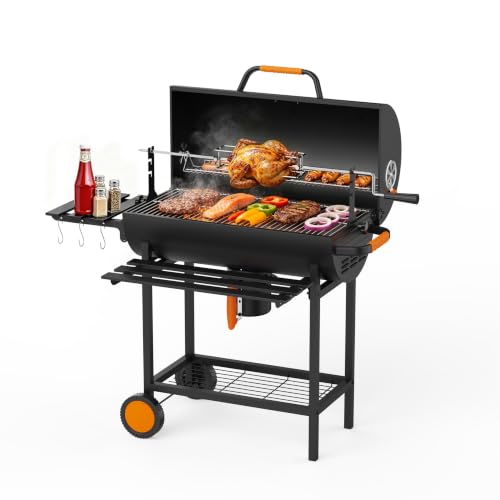
KEYO GRILL 29-Inch Barrel Charcoal Grill with Rotisserie & Ash Collector — Best True Barrel With Rotisserie
The KEYO suits the buyer who wants one barrel that grills, smokes and rotisseries without a separate machine. Its manual rotisserie asks you to turn the fork — meditative for some, a chore for others. Whole-animal cooks need the dedicated roasters below.
Strengths
- True barrel form with rotisserie in the listing, not an aftermarket hope
- Manual rotisserie fork gives full control of turning and pausing
- Detachable windproof ash collector tackles the barrel’s messiest chore
Trade-offs
- Manual turning means you are the motor for long cooks
- Lesser-known brand: check parts and support before buying
- Capacity suits chickens and roasts, not whole large animals
| Style | 29-inch barrel grill / smoker combo |
| Rotisserie | Manual rotisserie fork (per listing) |
| Ash | Detachable windproof ash collector (per listing) |
Most barrel-plus-rotisserie searches end in disappointment or a universal kit gamble. The KEYO is the rare listing that integrates the spit into the barrel itself, with the lid and smoker-combo layout that make rotisserie practical: close the lid and the turning meat roasts in smoky, even heat instead of drying in open air.
Manual drive is the honest compromise at this form. You turn the fork in slow intervals, which suits chickens and small roasts cooked with attention, and the ash collector — windproof and detachable — removes the barrel chore everyone hates. As an all-in-one backyard barrel, it is the niche’s most complete answer.
Manual rotisserie technique: turn a quarter rotation every few minutes rather than continuously, and baste at the turns. The meat still self-bastes from rotation, and the pauses let the skin set and crisp instead of staying perpetually wet.
KEYO ownership is barrel ownership plus a spit: keep the fork and mounts clean and dry, empty the ash collector while it is still a convenience rather than a corrosion source, and store the barrel covered so its lid and hinges stay true. The manual drive has no motor to fail — its maintenance is a wipe and an occasional check that the fork turns smoothly in its mounts.
Best for: one-barrel households wanting grilling, smoking and rotisserie / Not suited for: whole-animal roasts or hands-free cooking
Check the current price on Amazon to see the exact configuration, included parts and current availability for this model.

BRANDMAN 2 in 1 Portable Charcoal BBQ Rotisserie Grill, Motorized Kit 21 Inch — Best Motorized Portable
The Brand-Man suits mobile cooks who want a motor to do the turning: set the spit, adjust the height, and let the kit work while you enjoy the site. Its portable scale caps loads at chickens and modest roasts.
Strengths
- Motorised rotisserie kit included for hands-free turning
- Three height levels adjust heat distance precisely
- Folding, lightweight build travels and stores easily
Trade-offs
- 21-inch scale limits load size
- Motor needs power source planning outdoors
- Lightweight build wants careful handling
| Style | Portable folding charcoal grill, 21-inch |
| Rotisserie | Motorized kit (per listing) |
| Heights | 3 levels (per listing) |
Portable rotisserie is a delightful absurdity until you taste a campsite chicken that basted itself while you swam. The Brand-Man’s motorised kit makes it practical: the motor handles rotation, the three height levels handle heat, and the whole grill folds flat for the car.
Brand-Man’s long history in portable grills shows in the concept’s completeness — this is a system, not a grill with a stick. Respect its scale and it delivers rotisserie cooking in places no barrel will ever go.
Height is your temperature dial on open rotisserie: start high while the fire is fierce, lower as coals settle, and raise again rather than adding charcoal mid-cook. The three levels exist to be used in sequence, not set once.
Brand-Man ownership is portable-kit care: the motor stored dry indoors, the spit and forks washed and dried after every cook, and the folding frame’s joints kept grit-free so they stay smooth. Its lightness is its travel virtue and its storage instruction — this is a grill to be shelved, not weathered. Kept as kit, it will travel for years.
Best for: camping and tailgate rotisserie / Not suited for: large roasts or permanent patio duty
Check the current price on Amazon to see the exact configuration, included parts and current availability for this model.

VEVOR Rotisserie Grill 52-Inch Electric Rotisserie Grill Kit — Best for Whole Large Roasts
The big VEVOR is for event cooks: weddings, reunions and serious whole-animal roasts over charcoal. It is far more machine than a family chicken needs, and its open-spit form is a roaster, not a lidded barrel — know which you want.
Strengths
- 132 lb listed capacity handles whole large animals
- Electric motor turns heavy loads steadily for hours
- Four height levels and wheels suit event setups
Trade-offs
- Open spit design: no lid, so weather and wind matter
- Large footprint and serious setup for big cooks
- Overkill — in size, cost tier and effort — for family dinners
| Style | 52-inch open spit roaster |
| Capacity | 132 lbs (per listing) |
| Drive | Electric motor, 4-level height (per listing) |
Whole-animal rotisserie is event cooking with no shortcuts: the load must balance, the motor must not strain, and the fire must be managed for many hours. The 52-inch VEVOR is built to that brief — stainless construction, a motor and spit rated in the listing for serious weight, and height adjustment to ride the fire’s rise and fall.
Buy it as a roaster, not a grill. There is no lid and no grate-based versatility to speak of; there is a turning animal over coals, rendered unforgettable by exactly that simplicity. For the cook who hosts the annual roast, it is the right specialist.
Balance is everything at this scale: centre the load on the spit, secure with forks at both ends, and hand-turn a full rotation before lighting the fire to confirm it turns without a heavy side. A balanced 100 lb load cooks evenly; an unbalanced one fights the motor all day.
The big VEVOR’s ownership is event-equipment discipline: spit, forks and motor cleaned and stored dry after every roast, the stainless firebox brushed out once ash is fully cold, and the whole frame inspected before each event rather than during it. Motors dislike damp storage more than work; a dry shelf is its pension. Treat it like the catering equipment it is.
Best for: whole pig or lamb event roasts / Not suited for: family chickens or lidded-barrel cooking
Check the current price on Amazon to see the exact configuration, included parts and current availability for this model.

DEWOSEN 50W Rotisserie Grill With Wind Screen, 51-Inch Spit Roaster — Best Heavy-Duty Spit With Wind Screen
The DEWOSEN suits outdoor event cooks whose sites are breezy: the wind screen keeps charcoal burning evenly instead of gusting. Like the big VEVOR it is a dedicated roaster for whole animals, not a family barrel.
Strengths
- Wind screen stabilises the fire in exposed locations
- 50W motor and stainless build for heavy, long roasts
- Listed 132 lb / 60 kg capacity for pig and lamb class loads
Trade-offs
- Open roaster form: no lid, no grilling versatility
- Event-scale setup, storage and cleaning
- Requires a level, fire-safe site with room to work
| Style | 51-inch open spit roaster |
| Motor | 50W (per listing) |
| Capacity | 132 lbs / 60 kg (per listing) |
Anyone who has roasted outdoors knows wind is the enemy: it strips heat from one side, fans the other, and turns an even cook into a negotiation. The DEWOSEN’s wind screen is the rare feature that addresses the real problem, sheltering the charcoal bed so the fire — and therefore the turning meat — stays steady.
Everything else matches the class brief: stainless construction, a motor with real wattage for heavy loads, and capacity for the pig-and-lamb repertoire. If your roasts happen on farms, beaches and fields rather than sheltered patios, this is the roaster shaped for your life.
Even with a screen, site the roaster with its back to the prevailing wind and keep a charcoal reserve burning in a separate chimney or fire basket. Feeding settled, glowing coals — never fresh cold charcoal — keeps the roast’s heat curve smooth for hours.
DEWOSEN ownership adds the wind screen to the same event rhythm: the screen cleaned of ash and grease so it stays a shield rather than a sail of residue, hinges and mounts checked seasonally, and the motor stored indoors. Stainless at this scale rewards a wipe-down; left crusted after a roast, it will remind you at the next one. Clean it while the stories are still being told.
Best for: windy-site whole-animal roasting / Not suited for: sheltered small cooks or lidded grilling
Check the current price on Amazon to see the exact configuration, included parts and current availability for this model.
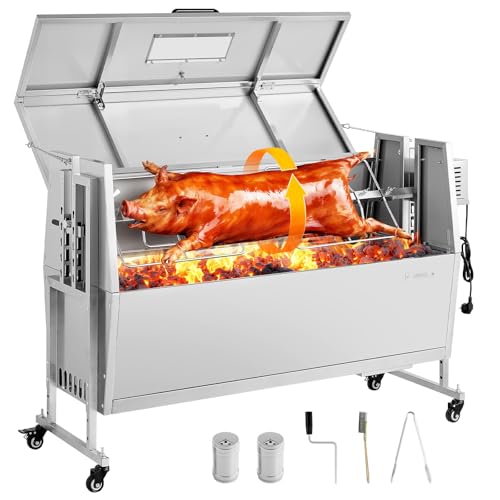
VEVOR Rotisserie Grill 46-Inch Electric Rotisserie Grill Kit — Best Mid-Size Electric Spit
The 46-inch VEVOR suits hosts whose biggest cook is a lamb, a turkey or a stack of chickens rather than a whole pig. It keeps the electric convenience with a smaller footprint and an easier storage conversation.
Strengths
- Automatic rotation frees the cook for hosting
- Height adjustment manages heat across the cook
- Stainless build suits outdoor event use
Trade-offs
- Open spit: no lid for smoking or weather protection
- Capacity is party scale, not whole-large-animal scale
- Still a specialist: limited use outside rotisserie days
| Style | 46-inch open spit roaster |
| Drive | Electric, automatic rotation (per listing) |
| Height | Adjustable (per listing) |
Mid-size is where rotisserie gets used most: a lamb for Easter, chickens for a birthday, a turkey outside at Thanksgiving to free the oven. The 46-inch VEVOR is sized for that calendar — big enough for celebration loads, small enough to store without a dedicated shed bay.
Automatic rotation matters more as loads grow: a motor does not get distracted by guests. Combined with height adjustment for heat control, the kit turns a technically demanding cook into a supervise-and-baste routine.
Truss party loads tightly — wings, legs and loose skin flap, catch and burn. Butcher’s twine and tight spit forks are not fussiness; on a turning roast they are the difference between even browning and a scorched flag of skin.
The mid-size VEVOR asks the same as its larger sibling at friendlier scale: spit kit washed and dried, firebox brushed once cold, motor sheltered, and a pre-party inspection of forks and fasteners while there is time to fix anything. Its size makes storage realistic in a garage corner — use that, rather than a tarp in the rain, and it stays event-ready.
Best for: lamb, turkey and party chicken roasts / Not suited for: whole pig scale or lidded smoking
Check the current price on Amazon to see the exact configuration, included parts and current availability for this model.

Small Barrel Charcoal Grill with Thermometer and Central Rotisserie Rack — Best Budget Compact Barrel
This compact barrel suits apartment patios, picnics and first-time rotisserie experiments: small loads, small footprint, small commitment. Its unbranded nature means checking the listing details and seller support carefully before buying — the guide flags that honestly rather than dressing it up.
Strengths
- Rotisserie rack built into a compact lidded barrel
- Thermometer supports controlled, lid-down cooking
- Double-sided layout separates direct and indirect zones
Trade-offs
- Unbranded: parts and support are the buyer’s homework
- Compact capacity: single chicken class loads
- Light construction wants sheltered storage
| Style | Compact barrel grill / smoker |
| Rotisserie | Central rotisserie rack (per listing) |
| Features | Lid thermometer (per listing) |
Not everyone can start with a flagship, and this little barrel is the honest entry point: a lidded barrel, a rotisserie rack at its centre, and a thermometer to cook by numbers instead of hope. For a first rotisserie chicken on a small patio, that is a complete and genuinely fun package.
The caveats are the budget caveats: unknown-brand support, lighter steel, and a lifespan that depends on sheltered storage and gentle handling. Treat it as an affordable way to learn whether rotisserie cooking owns your heart — many cooks start exactly here and upgrade with knowledge.
Small barrels heat fast and overshoot easily. Light less charcoal than instinct suggests, keep the lid down, and let the thermometer — not the clock — run the cook. In a compact chamber, patience with fuel is the whole technique.
The compact barrel’s ownership is the budget rhythm: ash out after every cook, the rotisserie rack brushed and oiled lightly, and sheltered storage without exception, because light steel and weather are enemies with a short fuse. Its small size makes every chore minutes long. Owners who keep the rhythm get a charming little cooker; the review’s honesty about support stands — buy it as a learner, keep it as a favourite.
Best for: small patios and first rotisserie attempts / Not suited for: heavy loads or brand-support seekers
Check the current price on Amazon to see the exact configuration, included parts and current availability for this model.
Comparison Table
| Pick | Badge | Key spec | Best for |
|---|---|---|---|
| KEYO GRILL 29-Inch Barrel Charcoal Grill with Rotisserie & Ash Collector — Check the current price on Amazon | Best True Barrel With Rotisserie | 29-inch barrel, manual rotisserie fork | one-barrel households wanting grilling, smoking and rotisserie |
| BRANDMAN 2 in 1 Portable Charcoal BBQ Rotisserie Grill, Motorized Kit 21 Inch — Check the current price on Amazon | Best Motorized Portable | 21-inch folding, motorized rotisserie | camping and tailgate rotisserie |
| VEVOR Rotisserie Grill 52-Inch Electric Rotisserie Grill Kit — Check the current price on Amazon | Best for Whole Large Roasts | 52-inch electric spit, 132 lb capacity | whole pig or lamb event roasts |
| DEWOSEN 50W Rotisserie Grill With Wind Screen, 51-Inch Spit Roaster — Check the current price on Amazon | Best Heavy-Duty Spit With Wind Screen | 51-inch spit, wind screen, 50W motor | windy-site whole-animal roasting |
| VEVOR Rotisserie Grill 46-Inch Electric Rotisserie Grill Kit — Check the current price on Amazon | Best Mid-Size Electric Spit | 46-inch electric spit, adjustable height | lamb, turkey and party chicken roasts |
| Small Barrel Charcoal Grill with Thermometer and Central Rotisserie Rack — Check the current price on Amazon | Best Budget Compact Barrel | Compact barrel, rotisserie rack | small patios and first rotisserie attempts |
How to Choose the Best Barrel Charcoal Grills to Rotisserie With
First, decide which of the two families you actually want. Lidded barrel grills with integrated rotisserie — the KEYO and the compact pick here — roast with the lid down in smoky heat and still grill normally on other days. Open spit roasters — the VEVOR and DEWOSEN picks — are single-purpose event machines for large loads, with no lid and no everyday role. Confusing the two families is the most common disappointment in this niche, so choose the family before the model.
Second, choose the drive honestly. Manual forks suit small loads and attentive cooks. Motors suit everything else, and motor quality — wattage, steady turning under load — is worth more than any other spec on a spit roaster. Third, match capacity to your real biggest cook, and check the listing’s own capacity claim rather than assuming. Every capacity figure in this guide comes from the model’s listing, and yours should too.
What about universal rotisserie kits for ordinary barrels?
Universal kits exist for popular barrel and kettle grills and can be excellent — but compatibility is model-specific, and this guide does not assert it for any grill whose listing does not claim it. If you already own a barrel, measure the lid line and spit mounting points, and buy a kit sold for your exact model. If you are buying new for rotisserie, the integrated picks here remove the gamble entirely.
Fire management for rotisserie
Rotisserie fires want even, settled coals spread wider than the load, never a bonfire beneath it. Drips will flare; a wide, moderate bed plus the meat’s rotation keeps flares brief and harmless. Keep a spray bottle for genuine flare-ups and a reserve of lit coals for long roasts.
Rotisserie Capacity, Translated
Capacity claims describe the spit, not your appetite. A single chicken class load suits the barrel-integrated picks and the portable. Lamb, turkey and multiple chickens suit the mid-size electric spit. Whole pig and large lamb — the 132 lb class in the listings here — is event cooking with event logistics: two people to load, hours of fire, and a site with room. Buy for the roast you will actually host twice a year, not the one you daydream about once.
Balancing and Trussing: The Rotisserie Skills That Matter
More rotisserie failures come from loading than from equipment. Centre the meat on the spit so its weight sits mid-barrel, drive the forks in firmly from both ends, and truss poultry tightly so wings and legs cannot flap into the heat. Then turn the loaded spit by hand through two full rotations before the fire is lit: a heavy side will announce itself immediately, and rebalancing on a cold spit is a minute’s work instead of a crisis over coals.
During the cook, baste at intervals rather than constantly — every opening and pause costs heat — and rest the finished roast at least as long as you would a grilled one. Rested rotisserie meat, carved at the table, is the entire argument for the method, and it never fails to make the cook look like a genius.
How to Rotisserie a Chicken on a Barrel Grill
The chicken is the rotisserie’s teaching load: cheap, forgiving and spectacular when done right. The sequence below works on the lidded barrel picks in this guide.
- Truss the chicken tightly: legs tied, wings tucked, cavity seasoned. A compact bird turns evenly and bastes itself instead of flapping.
- Thread the spit through the cavity’s centre, seat both forks firmly, and hand-turn to confirm balance. Rebalance now, not over the fire.
- Build a moderate, wide bed of settled coals — wider than the bird — with a drip pan beneath the spit’s line to catch juices and calm flares.
- Set the chicken turning (or begin manual quarter-turns), close the lid, and cook by thermometer: the bird is done when the thickest thigh reaches safe temperature and juices run clear.
- Baste in the final third of the cook if you like; early basting washes seasoning and cools the skin.
- Rest the bird, still on the spit or tented on a board, for 15 minutes before carving. The rest is where the juiciness is decided.
Once chicken is routine, the same sequence scales: pork loin, leg of lamb and turkey all follow balance, moderate fire, thermometer, rest. Rotisserie is one skill with many menus.
Rotisserie Menus Beyond the Chicken
The chicken is the teacher, not the destination. Pork loin turns into a self-basting roast with a crisped exterior that sliced thin feeds a crowd from one spit load. Leg of lamb, boned and tied, is the celebration classic — rosemary, garlic, a moderate fire and a rest, then carving at the table while the fat is still glistening. Turkey moves outside at Thanksgiving on the mid and large spits, freeing the oven and producing the bird everyone photographs.
Beef has its rotisserie glories too: a tied rib roast or a marinated top sirloin in the Brazilian churrasco spirit, sliced directly from the spit in passes as each layer crisps. That service style — carve, return to the fire, carve again — turns one roast into an evening’s entertainment, and it is only possible with rotation keeping the surface moist between passes.
Even vegetables join: whole cauliflower, trussed and spiced, or a pineapple turning until its sugars caramelise for dessert. The principle never changes — rotation plus moderate fire plus patience — and the menu is limited mainly by what can be balanced and trussed. Balance, as the how-to section insists, is the real recipe.
Motors, Mounts and Spits: The Hardware That Decides Rotisserie
Rotisserie hardware fails in predictable places, and buyers should inspect them in listings and on arrival. The spit rod should be substantial enough not to flex under the rated load; flex becomes wobble, and wobble becomes uneven cooking and motor strain. Forks should bite and lock positively — a load that slips and free-rotates to its heavy side is the classic ruined roast, preventable with forks that grip and a balance test on cold meat.
Motors are rated by the loads they turn, and honest listings state capacity, as the event picks here do. A motor that strains audibly on a balanced load is undersized for it; a motor that turns silently and steadily will outlive the grill around it. Mounts and brackets deserve the same eye: they carry the whole system over fire for hours, and play in a mount becomes sway in the roast.
Manual systems trade all of that for simplicity: no motor to strain or store, and a fork whose only failure mode is a cook who stops turning. For chickens and small roasts at a sheltered patio, that simplicity is a feature. The guide’s spread — manual barrel, motorised portable, electric event spits — exists so the hardware matches the load you honestly plan to turn.
Fire and Site Setup for Spit Roasting
A rotisserie site is a small stage: level ground that will not mind ash or drips, room to load and carve without crossing the fire, and a work surface for twine, thermometer and resting board. Set it before the meat is trussed, because a loaded spit in your hands is no time to discover the table is across the yard. Event roasters should also plan the audience line — guests gather, and a marked hot zone keeps the gathering safe.
The fire itself wants breadth over intensity: coals spread wider than the load, in a bed that can be raked thinner under dripping sections and thicker under pale ones. Keep a reserve fire or chimney cycling for long roasts so additions arrive already glowing; cold charcoal dumped mid-roast smokes bitterly and stalls the heat. A spray bottle handles flare moments; a drip pan under the load handles the rest.
Weather planning is part of the site: wind direction decides where the roaster’s back goes, rain decides whether the event picks are usable at all, and cold decides how much extra fuel the day will burn. None of this is advanced — it is the quiet logistics that separate the roast people remember from the one they politely forget.
Rotisserie Versus Grilling and Smoking: When Rotation Wins
Rotation wins when the food is whole, round and self-basting by nature: chickens, roasts, legs of lamb, whole fish in a basket. Turning exposes every surface to the fire in rhythm, renders fat gradually over the meat itself, and produces the even, lacquered exterior that static cooking achieves only with constant flipping. For those foods, a spit is not an accessory; it is the correct instrument, older than the grill itself.
Grilling wins for flat, fast foods — steaks, chops, burgers — where direct contact and a hard sear in minutes is the whole point, and where rotation would only slow the crust. Smoking wins for the big, tough cuts whose hours of low heat and smoke a spit cannot improve. The mature outdoor kitchen holds all three methods without ranking them, and the barrel picks in this guide are valuable precisely because they grill and smoke respectably on the days they are not turning.
Choose the rotisserie purchase, then, by your celebration menu: the foods you cook for occasions, not Tuesdays. If those foods are whole and round, rotation will make you look brilliant several times a year for many years — the definition of a worthwhile specialist.
Storing and Transporting Rotisserie Gear
Rotisserie equipment lives awkwardly: long spits, sharp forks, motors with cords. Store the spit kit as a kit — a long tube or a dedicated shelf spot, forks capped or boxed, motor indoors in the dry — so event day begins with assembly, not archaeology. A kit that takes five minutes to gather gets used; a kit scattered across three cupboards quietly retires.
Transport rewards the same system thinking. The portable Brand-Man exists for cooks whose rotisserie travels, but even the barrel picks’ spits travel to picnics and family yards when they are packed as a unit with twine, thermometer and gloves. Wrap the spit, cap the forks, and coil the motor cord with the motor — the unglamorous logistics that separate cooks who rotisserie often from cooks who rotisserie once.
After every cook, the wash-and-dry ritual decides the gear’s life: fat and salt are corrosive houseguests, and a spit stored dirty seasons the next roast with the last one’s neglect. Clean, dry, complete, shelved — four words that keep a specialist tool ready for its few, glorious outings a year.
Accessories and Consumables for Rotisserie Cooks
Butcher’s twine is the rotisserie’s founding consumable: food-grade, kept in a dry tin at the station, used without rationing. Trussing is not decoration, and the cook who skimps on twine meets the consequences as a flapping wing over open coals. Beside the twine live the spit forks’ spares and any counterbalance your kit uses — small parts whose absence on event day cannot be improvised, checked in the pre-cook inspection this guide keeps recommending.
The thermometer is the second founding item, and for rotisserie it earns a specific technique: probe the load at a pause in rotation, in the thickest part, away from the spit rod itself, which conducts heat and flatters the reading. A long-probe instant-read thermometer reaches safely over the fire; oven mitts rated for real heat, not kitchen towels, handle everything else the day involves.
Drip management consumables — heavy foil pans sized to your barrel or roaster — catch the juices that become gravy and prevent the flares that become scorch marks. Keep a small stack at the station; running out mid-roast and improvising with a baking sheet is a rite of passage best skipped. Charcoal, as always, wants its dry store and its chimney, with a reserve pile for the long event cooks.
Finally, the carving kit: a board with a juice groove, a long slicing knife kept genuinely sharp, and a resting tent of foil. Rotisserie theatre ends at the carve, and dull knives mangle what hours of rotation perfected. The whole accessory list for this niche is short, cheap and specific — which is why there is no excuse for meeting event day without it.
Common Buying Mistakes
Assuming any barrel accepts any rotisserie kit. Compatibility is specific. Buy integrated models, or a kit sold for your exact grill.
Skipping the balance test. An unbalanced load strains motors, cooks unevenly and can stall mid-cook. Two cold hand-turns prevent all of it.
Building the fire too hot and too narrow. A fierce, concentrated bed scorches the downward side. Wide, moderate and settled wins.
Leaving poultry untrussed. Flapping wings and legs burn and tear. Twine is the cheapest rotisserie upgrade in existence.
Carving without resting. Rotisserie juices need their rest like any roast’s. Fifteen minutes protects the whole cook.
Final Recommendation
If you want the search’s exact promise — a barrel that rotisseries — take the KEYO 29-inch: integrated spit, lid, smoker combo and sane capacity. Travellers get the motorised Brand-Man, event cooks choose between the two big spits by wind exposure, party hosts take the 46-inch VEVOR, and small patios start with the compact barrel and learn the craft cheaply.
Whatever you choose, truss tightly, balance cold, and cook to the thermometer. Rotisserie rewards those three habits with the most forgiving, self-basting barbecue there is.
Ready to compare the leading options directly? Start with Check the current price on Amazon for our top pick, Check the current price on Amazon for the runner-up, and Check the current price on Amazon for the third-ranked model — each link opens the exact listing this guide verified.
Related guides in this series: Best Barrel Charcoal Grills Under $100, Best Barbecue Smoker Grills, Best Barbeque Grills To Buy, Best Barrel Grill Smokers, Best Bargain Bbq Grills Propane.
Frequently Asked Questions
Can any barrel charcoal grill use a rotisserie?
Not automatically. The spit needs mounting points, lid clearance and a balanced load path. Buy a barrel whose listing includes rotisserie, like the KEYO here, or a kit made for your exact model.
Is manual or motorised rotisserie better?
Motors turn steadily for hours and handle heavy loads — better for most cooks. Manual forks suit small loads and cooks who enjoy tending. The portable and event picks here are motorised for that reason.
What size load can a barrel rotisserie handle?
Barrel-integrated spits suit chickens and modest roasts. Whole lamb and pig need the dedicated spit roasters, whose listings rate capacity explicitly — 132 lbs on the two largest picks here.
Do I need a lid for rotisserie cooking?
A lid gives smoky, oven-like roasting and weather protection — the barrel picks have one. Open spit roasters cook by radiant heat and rotation alone, which is traditional and excellent for large loads, but weather-dependent.
How do I stop rotisserie meat from drying out?
Truss it, keep the fire moderate, baste late rather than early, cook to temperature instead of time, and rest before carving. Rotation itself is the main defence: the meat bastes in its own juices.
Is rotisserie good for beginners?
A chicken on a balanced spit is one of barbecue’s most forgiving cooks. Start there, learn balance and fire, and scale up to the celebration roasts.
What temperature should rotisserie meat reach?
Cook to the same safe internal temperatures as any roast — poultry to a safe reading in the thickest part of the thigh, pork and beef to your preferred doneness verified by probe. Rotation changes evenness, not food safety; the thermometer remains the judge.
Can I rotisserie without a motor on a long cook?
For small loads, yes, with disciplined quarter-turns at intervals, as the KEYO’s manual fork intends. For heavy loads or multi-hour roasts, a motor is not a luxury — fatigue and distraction are real, and the roast notices every forgotten turn.
How do I stop a rotisserie load from slipping on the spit?
Truss tightly, seat both forks deep and firm, counterbalance if your kit provides one, and always pass the cold hand-turn test before lighting the fire. Slippage is a loading error, and loading errors are fixable — on a cold spit, in a minute.


