Disclosure: airfryerkitchensupply.com is reader-supported. When you buy through links on our site, we may earn an affiliate commission at no extra cost to you.
Where to buy
Every linked pick in this guide to the best audio mixers under 500 was verified against Amazon’s catalog on 2026-11-21, so the model names and specifications below are the models you will actually land on. Start with Yamaha MG12XU 12-Input Mixer with Effects, Mackie ProFX12v3 12-Channel Mixer with USB, Allen & Heath ZED-16FX 16-Channel Analog Mixer. Any pick described without a link is flagged honestly as unlinked in our notes. Check the current price on Amazon from any pick’s link, because finishes, bundles and stock rotate often.
The best audio mixers under 500 dollars are where small-format mixing gets serious: professional preamp families, real bus routing, stage-grade effects and USB recording, in boards that serve working bands, churches, schools and serious studios. Every pick here was verified by brand and model, and the API’s price data was used internally to confirm each board’s place in this tier.
This is a tier of legitimate specialisations rather than a single winner. Yamaha’s MG pair bring routing depth and neutral reliability; Mackie’s ProFX pair are tuned for the stage; Allen & Heath sells channel-strip quality and count; Soundcraft sells the finest built-in reverb in the class. The reviews match each board to the work it was plainly designed for.
Key Takeaways
- Count XLR microphone inputs, not headline channels.
- USB on small mixers sends a stereo mix — not multitrack recording.
- Set gain before faders; gain structure decides hiss and distortion.
- Match the mixer to its destination: speakers, stream, or both.
In this guide
Quick Picks
- Best Overall: Yamaha MG12XU 12-Input Mixer with Effects — D-PRE preamps, 4-bus routing and USB — the complete mid-size default.
- Best for Small Bands: Mackie ProFX12v3 12-Channel Mixer with USB — Onyx preamps and GigFX voiced for the stage, with USB capture.
- Best Channel Count: Allen & Heath ZED-16FX 16-Channel Analog Mixer — sixteen Allen & Heath channel strips for lineups that outgrew 12.
- Best Built-in Effects: Soundcraft EFX12 12-Channel Mixer with Lexicon Effects — a real Lexicon effects engine — the vocal specialist’s board.
- Best for Growing Acts: Mackie ProFX16v3 16-Channel Mixer with USB — sixteen Mackie channels for the band that is still adding members.
- Best Bus Routing: Yamaha MG16XU 16-Input Mixer with Effects — 6-bus routing for bands whose monitor needs are as big as their channel count.
How These Picks Were Chosen
Every mixer in this guide was verified against Amazon’s catalog for airfryerkitchensupply.com on 2026-11-21: we searched by brand and model, matched the returned listing title, and only then took the ASIN used in the links. For budget-tier guides we also used the API’s returned price data as an internal sanity check that each pick genuinely sits in the tier the search names — those figures move constantly, which is why this guide discusses tiers rather than printing prices.
Ranking weighed the things that decide whether a small mixer gets used or gets sold: microphone preamp quality and noise, how many genuinely usable mic inputs there are (headline channel counts include line inputs you may never use), EQ that can fix a real room problem, clean headphone monitoring, and whether the USB connection — where fitted — behaves as a proper audio interface for recording and streaming.
We discounted marketing arithmetic. A ’12-channel’ mixer with two mic preamps is a two-microphone mixer with extra line inputs, and we describe it that way. Effects counts were treated similarly: a handful of usable reverbs and delays beat a long list of novelty presets. Build quality, knob feel and the availability of a proper power supply all counted toward the final order.
The 6 Best Audio Mixers Under $500

Yamaha MG12XU 12-Input Mixer with Effects — Best Overall
The MG12XU is the benchmark mid-size analog mixer: Yamaha’s D-PRE microphone preamps, a 4-bus layout, built-in effects and a USB interface in a board that serves small bands, houses of worship, schools and serious podcast rigs equally well. It suits buyers who want one mixer that stays correct as their needs grow.
Strengths
- D-PRE preamps are clean and quiet at this tier
- 4-bus routing handles monitors and subgroups properly
- USB interface records the stereo mix without extra hardware
Trade-offs
- Stereo USB rather than multitrack
- Size and weight assume a semi-permanent home or a proper case
- Effects are good, not a substitute for outboard for studio work
| Inputs | 12 (4-bus) |
| Preamps | D-PRE |
| Connection | USB audio interface |
| Effects | Built-in FX |
Yamaha’s MG series earned its position by being boring in the right ways: the preamps do not hiss, the EQ behaves predictably, the faders feel consistent, and the board keeps working for years. The 12XU’s bus structure is the step up that matters for live use — a separate monitor mix and subgroup control turn a competent board into a workable band mixer. The USB interface captures rehearsals and gigs in stereo, which is how most owners actually document themselves. In the under-500 tier this is the complete, defensible default.
The MG12XU’s 4-bus architecture quietly changes what rehearsals can be: record the stereo mix on USB while a subgroup of drums sits under one fader pair, and the band hears its balance mistakes immediately. Churches and schools — the other natural owners — value the same board for opposite reasons: it can be locked into a simple configuration that volunteers cannot easily ruin, yet opened up by an engineer when the occasion demands. Few products serve the novice and the expert simultaneously; this one manages it.
Long-term, the Yamaha MG12XU 12-Input Mixer with Effects asks for the standard courtesies of analog equipment: faders and knobs exercised occasionally so they stay clean, dust kept out of the channel strips, and transport in a bag or case rather than loose in a boot. None of this is burdensome, and the reward is a board that sounds at year five exactly as it did at month one — analog mixers, treated kindly, are among the longest-lived tools in music.
Best for: Small bands, churches, schools and serious home studios / Not suited for: Anyone needing multitrack recording — that is interface territory. Check on Amazon to check the current price on Amazon.

Mackie ProFX12v3 12-Channel Mixer with USB — Best for Small Bands
Mackie’s ProFX12v3 pairs Onyx microphone preamps with the GigFX effects engine and USB recording in a 12-channel board aimed squarely at working small bands and singer-songwriters. It suits acts that gig weekly and want their live board to double as their demo recorder.
Strengths
- Onyx preamps deliver strong, clean gain for stage microphones
- GigFX effects are voiced for live vocals and instruments
- USB recording captures gigs and rehearsals in stereo
Trade-offs
- Stereo USB capture only
- Effects are shared across the mix rather than per-channel inserts
- Larger footprint than the MG12XU class rivals in some setups
| Channels | 12 |
| Preamps | Onyx |
| Connection | USB recording |
| Effects | GigFX engine |
The ProFX line is voiced for the stage: the effects are the kind singers actually ask for, the preamps take hot stage levels gracefully, and the layout is readable in bad light by tired people — a real specification in live sound. USB recording closes the loop for working bands, turning every rehearsal into reviewable evidence. Against the Yamaha, the choice is flavour: Mackie’s stage-first tuning against Yamaha’s all-round correctness. Neither is wrong; bands that gig first and record second will lean Mackie.
A practical ProFX12v3 note for bands: the GigFX effects are at their best used as one shared vocal space — set the reverb for the lead singer, send the harmonies a little less, and leave the instruments mostly dry. Bands upgrading from a budget board consistently report the Mackie’s effects as the first thing the audience notices, which is another way of saying the first thing worth paying for at this tier. The USB capture then preserves the improvement for the band’s own ears.
Owners also find that the Mackie ProFX12v3 12-Channel Mixer with USB teaches its own replacement criteria: the day you consistently need one more microphone input, one more monitor send or a cleaner print of a quiet source, you will know precisely which tier to buy next and why. Equipment that educates its owner that clearly has done more than its job, whatever its price class.
Best for: Gigging small bands and singer-songwriters / Not suited for: Studio-first users wanting the most neutral preamps and routing. Check on Amazon to check the current price on Amazon.

Allen & Heath ZED-16FX 16-Channel Analog Mixer — Best Channel Count
The ZED-16FX brings Allen & Heath’s live-sound pedigree to this tier with sixteen channels, onboard effects and USB I/O. It suits larger bands, church teams and venues whose microphone count has outgrown 12-channel boards and who refuse to compromise on channel-strip quality to get there.
Strengths
- 16 channels cover full band plus playback and spares
- Allen & Heath channel strips are a step up in feel and EQ quality
- Onboard effects and USB I/O included
Trade-offs
- The largest and heaviest board in this guide
- Sits high in the under-500 tier
- Overkill for solo and duo acts
| Channels | 16 |
| Connection | USB I/O |
| Effects | Onboard FX |
| Type | Analog mixer |
Channel count is the headline, but the channel strip is the story: the ZED’s EQ and faders come from a company whose large consoles define professional live sound, and the discipline shows in how musical the corrections feel. Sixteen channels end the input-count negotiation for most bands — full drum miking becomes possible, guests stop requiring a repatch. The board asks for space, a case and a budget near the top of the tier in return. For a band or venue buying once for years, that exchange is the point.
Sixteen channels also buy calm: the channel you are not using is the channel that absorbs the surprise — the guest percussionist, the second keyboard, the playback laptop that appears at the Christmas show. Allen & Heath’s strip quality means those spare channels are as good as the used ones, which is not true of every large small board. Venues buying the ZED-16FX are really buying the end of the input-count conversation, and anyone who has run a venue knows what that peace is worth.
Long-term, the Allen & Heath ZED-16FX 16-Channel Analog Mixer asks for the standard courtesies of analog equipment: faders and knobs exercised occasionally so they stay clean, dust kept out of the channel strips, and transport in a bag or case rather than loose in a boot. None of this is burdensome, and the reward is a board that sounds at year five exactly as it did at month one — analog mixers, treated kindly, are among the longest-lived tools in music.
Best for: Full bands, churches and venues needing 16 real channels / Not suited for: Solo acts, duos and anyone short on storage and transport space. Check on Amazon to check the current price on Amazon.

Soundcraft EFX12 12-Channel Mixer with Lexicon Effects — Best Built-in Effects
The EFX12’s calling card is in its name: a genuine Lexicon effects processor built into a 12-channel Soundcraft board. It suits vocal-led acts — worship teams, acoustic bands, theatre — where the quality of the reverb is not a garnish but part of the sound.
Strengths
- Lexicon reverbs are a class above typical built-in effects
- Soundcraft preamps and EQ are gig-proven
- 12 channels cover most small-band lineups
Trade-offs
- No USB recording on this model
- One shared effects processor, as with all boards in this class
- Design is an older generation than some rivals
| Channels | 12 |
| Effects | Lexicon effects processor |
| Type | Analog mixer |
Reverb is where budget mixers usually embarrass themselves, with metallic, washy presets that engineers switch off. Lexicon’s algorithms are the exception — the same family of reverbs that built a studio reputation — and on vocals the difference is audible to an audience, not just to engineers. The rest of the board is Soundcraft-sensible: honest preamps, usable EQ, a layout that makes sense. The missing USB is the trade to note; pair it with a small interface if recording matters. For live vocal sound per dollar in this tier, the EFX12 remains a connoisseur’s pick.
The EFX12 rewards a specific listening test: put a single voice through its Lexicon reverb at a modest send and compare it with any budget board’s effects at the same level. The difference — depth without muddiness, a tail that decays like a room rather than a spring — is the whole product. Worship leaders and acoustic acts, whose entire sound is voices in a space, will hear it instantly. Everyone else should still hear it before deciding the premium belongs elsewhere.
Owners also find that the Soundcraft EFX12 12-Channel Mixer with Lexicon Effects teaches its own replacement criteria: the day you consistently need one more microphone input, one more monitor send or a cleaner print of a quiet source, you will know precisely which tier to buy next and why. Equipment that educates its owner that clearly has done more than its job, whatever its price class.
Best for: Vocal-led bands, worship teams and acoustic acts / Not suited for: Users who need USB recording built into the same box. Check on Amazon to check the current price on Amazon.
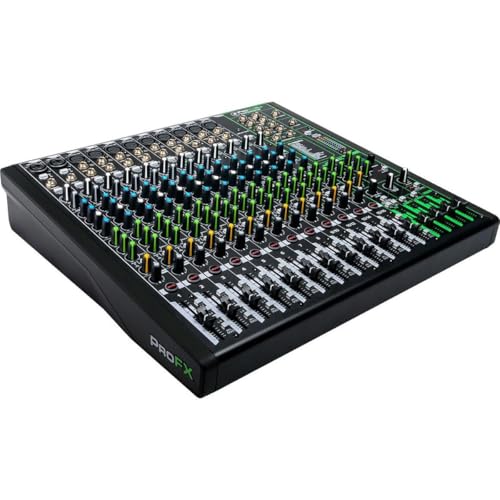
Mackie ProFX16v3 16-Channel Mixer with USB — Best for Growing Acts
The ProFX16v3 scales the ProFX formula to sixteen channels: Onyx preamps, GigFX effects and USB recording for bands whose lineup — or ambitions — exceed twelve channels. It suits growing acts that want to buy their next board now rather than twice.
Strengths
- 16 channels end input rationing for most bands
- Onyx preamps and GigFX as per the 12-channel model
- USB recording for rehearsals and gig capture
Trade-offs
- Big board — transport and setup space required
- Near the top of the tier
- Stereo USB only, as with the class
| Channels | 16 |
| Preamps | Onyx |
| Connection | USB recording |
| Effects | GigFX effects |
Buying ahead of your channel count is usually waste; with bands it is often wisdom, because lineups grow and guest musicians appear. The ProFX16v3 gives a five-piece the spare channels for a full drum kit, a second vocalist and playback without a repatch, in the same stage-friendly layout as its smaller sibling. The GigFX effects and Onyx preamps carry over unchanged, so the sound of the act does not change as the board grows. If the choice is between the 12 and 16, count your future inputs, not your present ones.
Growth insurance has a second face with the ProFX16v3: it is also the board a band can hire out. Sixteen channels with friendly effects and USB is a rentable specification for small events, and more than one band has let its mixer pay for its own case that way. Even without hire income, the arithmetic of buying once at sixteen channels beats buying at twelve and again at sixteen within two years — the commonest false economy in band equipment.
Long-term, the Mackie ProFX16v3 16-Channel Mixer with USB asks for the standard courtesies of analog equipment: faders and knobs exercised occasionally so they stay clean, dust kept out of the channel strips, and transport in a bag or case rather than loose in a boot. None of this is burdensome, and the reward is a board that sounds at year five exactly as it did at month one — analog mixers, treated kindly, are among the longest-lived tools in music.
Best for: Growing bands and multi-instrumentalist acts / Not suited for: Compact rigs and small-venue acts with fixed small lineups. Check on Amazon to check the current price on Amazon.

Yamaha MG16XU 16-Input Mixer with Effects — Best Bus Routing
The MG16XU is the routing champion of the tier: sixteen inputs on a 6-bus architecture with D-PRE preamps, effects and USB. It suits bands and venues whose monitor and subgroup needs are as real as their channel count — the step from ‘mixer’ to ‘small live sound system’.
Strengths
- 6-bus layout supports multiple monitor mixes and subgroups
- D-PRE preamps across a full 16-input frame
- Yamaha reliability record in installed and touring use
Trade-offs
- Largest learning curve in this guide
- Size and cost sit at the tier’s ceiling
- More board than small acts can justify
| Inputs | 16 (6-bus) |
| Preamps | D-PRE |
| Connection | USB audio interface |
| Effects | Built-in FX |
Buses are the unglamorous specification that separates boards that cope from boards that merely connect. Six buses mean the drummer and the singer can have different monitor mixes while the main mix stays untouched — the everyday reality of a working band. The MG16XU delivers that flexibility on Yamaha’s dependable platform, with the same clean D-PRE preamps and sensible effects as the 12XU. It is the biggest commitment in this guide in size and learning curve, and the one that removes the most ceilings.
The MG16XU’s six buses also serve recording-adjacent tricks: a subgroup of backing vocals under one fader, a separate feed for a livestream distinct from the room mix, a monitor world that does not disturb the front of house. This is the board in the guide that most rewards an engineer who reads the manual — its ceiling is set by the operator’s imagination rather than by missing features. Bands with such an engineer, or willing to become one, will not outgrow it quickly.
Owners also find that the Yamaha MG16XU 16-Input Mixer with Effects teaches its own replacement criteria: the day you consistently need one more microphone input, one more monitor send or a cleaner print of a quiet source, you will know precisely which tier to buy next and why. Equipment that educates its owner that clearly has done more than its job, whatever its price class.
Best for: Bands and venues with real monitor-mix requirements / Not suited for: Small acts who will never use the routing — the MG12XU serves them better. Check on Amazon to check the current price on Amazon.
Comparison Table
| Pick | Badge | Key spec | Best for |
|---|---|---|---|
| Yamaha MG12XU 12-Input Mixer with Effects | Best Overall | D-PRE | Small bands, churches, schools and serious home studios |
| Mackie ProFX12v3 12-Channel Mixer with USB | Best for Small Bands | Onyx | Gigging small bands and singer-songwriters |
| Allen & Heath ZED-16FX 16-Channel Analog Mixer | Best Channel Count | USB I/O | Full bands, churches and venues needing 16 real channels |
| Soundcraft EFX12 12-Channel Mixer with Lexicon Effects | Best Built-in Effects | Lexicon effects processor | Vocal-led bands, worship teams and acoustic acts |
| Mackie ProFX16v3 16-Channel Mixer with USB | Best for Growing Acts | Onyx | Growing bands and multi-instrumentalist acts |
| Yamaha MG16XU 16-Input Mixer with Effects | Best Bus Routing | D-PRE | Bands and venues with real monitor-mix requirements |
How to Choose an Audio Mixer: Count Microphones, Not Channels
The first discipline of mixer shopping is translating headline channels into microphone inputs. A mixer advertised as 8-channel may offer two XLR microphone preamps and three stereo line inputs — perfect for a podcaster with playback sources, useless for a four-vocal band. Find the XLR count in the listing and plan around it: every singer, miked instrument and drum overhead consumes one.
Next, decide the destination. If the mix goes to a computer for streaming or recording, a built-in USB interface removes a whole device from the desk. If it goes to speakers, the USB may never be used and the money is better spent on preamps and build. Neither choice is wrong; buying for a destination you do not have is.
Preamps, Phantom Power and EQ: The Sound-Shaping Core
The microphone preamp decides how clean your quietest source sounds. Named preamp families in this guide — XENYX, Onyx, D-PRE — exist because gain without hiss is genuinely hard at budget prices. If you use condenser microphones, confirm 48V phantom power is present; dynamic microphones do not need it, but the day a condenser arrives you will.
EQ is the second core tool. Three-band EQ with a sweepable or well-chosen midrange can rescue a boxy room or a nasal voice; simple bass/treble shelves cannot. For voices, the midrange is where intelligibility lives, so treat mid control as a near-requirement for speech and singing alike.
Effects, Monitoring and the Headphone Test
Built-in effects in this class are shared: one processor, sent to from each channel. For live vocals a usable reverb matters; for podcasting, effects are usually added later in software and a dry, clean recording is worth more. Decide which world you live in before paying for the other’s features.
Monitoring deserves equal weight. You need to hear the mix as the audience or the recording hears it, on headphones, without the main speakers — every pick here supports headphone monitoring, but check the routing suits you: streamers often need to hear themselves with zero latency, which analog mixers provide naturally.
Budget Tiers and When to Step Up
Within a budget tier, the money buys preamp quality, channel count and build — in that order of audibility. Step up a tier when you run out of microphone inputs, when preamp hiss appears in quiet recordings, or when the board’s physical survival is in doubt from weekly transport. Do not step up for features you cannot name a use for; a mixer that fits the act beats a mixer that impresses the catalogue.
What the Under-$500 Tier Buys Over the Budget Tier
Three things, in order of importance: preamps with more clean gain and less hiss, routing — buses and aux sends that allow separate monitor mixes and subgroups — and build quality that survives weekly transport. Channel counts rise too, but the routing is what changes what a band or venue can actually do on a night.
What it still does not buy is multitrack USB: every board here records a stereo mix to computer. Studios needing per-channel capture should budget for an interface or a digital multitrack mixer as a separate decision, and treat these analog boards as the live and front-end tools they are.
How to Set Up an Audio Mixer for the First Time
Connect in the right order
With everything powered off, connect microphones and instruments to the inputs, the main outputs to speakers or your computer, and headphones to the phones output. Power up the mixer first and speakers last to avoid thumps.
Set gains before faders
Bring channel faders to unity, then raise each channel’s gain while the source performs at its loudest until the level meter peaks healthily without clipping. Gain structure set here decides the noise floor of everything downstream.
EQ after gain
With gain set, use EQ sparingly: cut the frequencies that offend before boosting the ones that flatter. For voices, a gentle low cut removes rumble and handling noise immediately.
Add effects by send
Raise the effects send on vocal channels a little at a time until the reverb is felt rather than heard as an echo. Effects are seasoning; the dry voice stays in charge.
Balance the mix
Bring faders up one source at a time, loudest foundation first, and check the result on headphones and speakers. Save or photograph the settings once it sounds right — your future self at the next gig will be grateful.
Record a test
If your mixer has USB, record thirty seconds and listen back critically for hiss, hum and clipping. Fixing a ground-loop hum now — by moving a power supply or cable — beats discovering it in a published episode.
Common Buying Mistakes
Counting channels instead of microphone inputs
The classic first-mixer mistake. Count XLR preamps; that is your real microphone capacity.
Buying USB multitrack expectations from a stereo mixer
Most small mixers send a stereo mix to the computer, not separate tracks. If you need per-channel recording, you need an interface-class device.
Setting faders first and gain wherever
Bad gain structure means hiss or distortion no fader can fix. Gain first, always.
Drowning vocals in effects
Shared reverb is easy to overdo. If the audience can hear the effect as an effect, it is probably too much.
Ignoring phantom power until a condenser arrives
Check for 48V before you need it; adding it later means a new mixer or extra boxes.
Skipping the headphone check
Mixing only on room speakers hides hum, hiss and imbalance that headphones expose instantly.
A Last Word on Choosing Between Equals
Notice how little separates the boards in this guide on paper, and how much separates them in a room. That is the nature of the professional end of small-format mixing: specifications converge, and identity — a preamp’s flavour, an effect’s character, a layout’s logic under pressure — becomes the product. It is also why confident general advice ends here and auditioning begins: if a retailer or a fellow engineer can put your two finalists side by side with your microphone and your voice, that hour is worth more than another ten reviews.
If no audition is possible, fall back on the matching this guide has done throughout: destination first, routing second, channels third, flavour last. A board chosen on those priorities will not be the wrong board, even if a different room might have crowned a different winner. Buy it, case it, learn it deeply — and then judge it at the end of the first year, which is when serious mixers tell the truth about themselves, their owners and the rooms they serve.
Troubleshooting the Three Noises Every Small Mixer Makes
Hiss is a gain-structure confession: somewhere a stage is set too low and a later stage is compensating. Find it by muting channels one at a time until the hiss localises, then raise that channel’s preamp gain and lower its fader until the balance returns without the noise. If the hiss survives with every channel muted, it lives in the output stage or the monitoring chain — swap the headphone or speaker feed before blaming the board.
Hum is almost always a connection story: an unbalanced cable run beside a power supply, two devices powered from distant sockets forming a ground loop, or a guitar with single-coil pickups sitting near a transformer. Shorten and balance the signal cables first, power the whole chain from one strip second, and only then suspect the mixer itself — in practice, it is almost never the mixer itself.
Crackle is mechanical: a dirty fader, a worn jack, a cable whose conductor is letting go strand by strand. Exercise the suspect control through its travel a dozen times, substitute cables one at a time, and note which channel misbehaves. These three noises account for nearly every small-mixer complaint ever filed, and all three are diagnosable in ten minutes with the method above — before any purchase, return or repair is contemplated.
Installed Sound: Churches, Schools and Halls
A large share of this tier’s boards live installed lives — fixed in a church, school or hall, operated by rotating volunteers, and expected to work every time for a decade. Installed duty changes the ranking criteria in ways this guide has weighted throughout: layout legibility beats feature density, because the operator changes weekly; robust connectors and a lockable or at least stable configuration beat flexibility the volunteers will never use; and brand support matters because the board will outlive the committee that bought it.
For installed buyers, the practical advice is to configure once, document the configuration on a laminated card kept with the board, and mark the volunteer-safe controls in a colour. The Yamaha MG boards are the natural installed picks for exactly these reasons, with the Allen & Heath the choice where channel count in a hall genuinely demands it. The Mackie ProFX boards, by contrast, earn their premium in the hands of a consistent operator who travels with them.
Whichever board an institution chooses, the total cost should include the installation itself — cables run properly, a rack or shelf that ventilates, and an hour of training for the first rota of operators. A serious board installed casually underperforms a modest board installed well, and at this tier the difference is entirely avoidable.
Owning a Serious Board: The First Year
The first year with an under-$500 board separates owners into two kinds: those who learn the routing and those who use a serious mixer as a volume knob with accessories. The boards in this guide repay the first kind extravagantly — monitor mixes that transform a band’s confidence, subgroups that tame a drum kit, effects that make a singer ask what changed. The manual is not optional reading at this tier; it is the product’s second half.
Maintenance is the other first-year lesson. Faders and knobs that are exercised stay clean; boards stored in damp garages and transported loose develop the crackles that owners then blame on the brand. A case, a cover and a dry shelf are the difference between a ten-year board and a three-year one, and at this tier that difference is worth real money.
Buy once, learn deeply, transport kindly — the under-$500 class is where that advice starts paying compound interest, because these are the boards musicians keep for a decade and lend to friends they actually like.
Cables, Microphones and the Rest of the Budget
A mixer is the centre of a system, and the system fails at its cheapest cable. Budget for balanced XLR cables for microphones — balanced connections are what reject the hum and interference that plague home studios — and keep cable runs as short as the room allows. A mixer upgrade spent on cables first is a cliché because it keeps being true.
Microphone choice interacts with the mixer more than with any recorder: a low-output dynamic microphone needs the clean gain that separates the named preamps in this guide from anonymous ones, while a sensitive condenser needs phantom power and less gain. Buy the mixer and microphone as a pair on paper before buying either in fact, checking output, required gain and power against each other.
Finally, headphones are part of the mixer purchase in practice: you cannot judge gain, EQ or effects without hearing them honestly. A closed-back pair that isolates the room lets you monitor at low level without the speakers colouring your decisions — the cheapest accuracy upgrade in the whole chain.
One Mixer, Two Disciplines: Live Sound and Recording
A mixer used live and a mixer used for recording look identical and are operated almost oppositely. Live, you mix for a room that changes as it fills, you ride faders constantly, and effects are part of the performance. Recording, you mix for a fixed listener, you print as clean a signal as possible, and effects are usually deferred to software where they can be undone.
The boards in this guide straddle both worlds deliberately: analog immediacy for the room, a USB stereo send for the record. The discipline is to know which world you are in on a given night. Bands that record their live mix should accept the compromise knowingly — the mix that flatters a room rarely flatters headphones — and engineers who do both keep two sets of notes, one per discipline.
Whichever world dominates your use, buy for that one. The recurring theme of this guide — destination first, features second — is simply this section compressed into a sentence.
Where the Under-$500 Boards Actually Work
The working covers band plays two functions a week, mixes from the stage and records every show to USB for the demo reel. The ProFX boards were designed in that diary. The church across town runs volunteers of varying confidence through the same services weekly; the MG12XU’s forgiving layout and the option to keep the configuration simple serve it better, and its engineer uses the buses the band never touches.
The third workplace is the school hall and community venue, where the ZED-16FX’s channel count ends the annual negotiation about whose microphone gets unplugged. Same tier, three institutions, three correct boards — the under-$500 class is professional enough that the matching, not the money, decides satisfaction.
Gain Structure: The Skill That Makes Any of These Mixers Sound Good
Every mixer in this guide can sound clean or dreadful depending on one discipline: gain structure. Each stage — microphone preamp, channel, bus, output, recorder — has a range where it is quiet and undistorted. Set each stage to work in the middle of that range and the whole chain stays clean; push one stage into distortion to compensate for another set too low and no downstream adjustment can repair it.
The practical routine is simple. Set the loudest source first, raise its preamp gain until the meter peaks healthily on the loudest passage, then leave the gain alone and mix with faders. Quiet sources get more gain; loud sources get less; the faders end up in a similar row, which is how you know the structure is right. Hiss means a gain somewhere is too low and a fader too high; distortion means the reverse.
This is also why named preamps matter at budget prices: they forgive imperfect gain structure with more clean headroom. But no preamp forgives everything, and the ten minutes spent learning gain staging will improve your sound more than the next tier of equipment would.
Final Recommendation
The full shortlist, for convenience: Yamaha MG12XU 12-Input Mixer with Effects, Mackie ProFX12v3 12-Channel Mixer with USB, Allen & Heath ZED-16FX 16-Channel Analog Mixer, Soundcraft EFX12 12-Channel Mixer with Lexicon Effects, Mackie ProFX16v3 16-Channel Mixer with USB, Yamaha MG16XU 16-Input Mixer with Effects. Each link lands on the exact model verified for this guide; check the current price on Amazon there before you decide.
The Yamaha MG12XU is the default recommendation: correct, quiet, flexible and durable. Bands that gig from the stage should audition the Mackie ProFX12v3 alongside it; bands that have outgrown twelve channels should go straight to the ZED-16FX or ProFX16v3; engineers with monitor-mix ambitions should take the MG16XU; and vocal-led acts should hear the EFX12’s Lexicon reverb before deciding anything.
Compare the tier below in Best Audio Mixers Under $100, and the band-specific shortlist in Best Band Mixers, where several of these boards reappear ranked purely on live criteria.
Related guides
Frequently Asked Questions
Is a mixer under $500 good enough for professional work?
For live sound at small-to-mid venues, yes — these are the boards working bands and churches actually use. For studio recording, they serve as excellent front ends and summing points, but the stereo USB limit means multitrack work still needs an interface or digital mixer.
Yamaha MG or Mackie ProFX — which family is better?
Neither, absolutely. Yamaha leans neutral and routing-rich; Mackie leans stage-tuned with singer-friendly effects. Engineers with monitor and subgroup needs lean Yamaha; self-mixing bands lean Mackie. Both preamp families — D-PRE and Onyx — are clean and proven.
How many channels does a five-piece band need?
Count microphones and stereo sources: a fully miked kit can take six to eight inputs alone. Most five-pieces land between twelve and sixteen channels once vocals, instruments and playback are counted — which is why this guide includes three 16-channel options.
Are built-in effects good enough for live vocals?
In this tier, yes — and the Soundcraft’s Lexicon processor is genuinely excellent. The discipline is dosage: a shared reverb, sent sparingly, flatters; the same reverb flooded buries the words the audience came to hear.
Can I record my band with these mixers?
You can record a stereo mix of the whole band via USB on the Yamaha, Mackie and Allen & Heath picks — ideal for demos, rehearsal review and live albums. You cannot remix individual channels afterwards; that requires multitrack capture, a different product class.
Passive mixer — what else do I need to budget for?
Speakers (powered, with a passive mixer), stands, cables and a case. The mixer is the brain of the system, roughly half the total cost of a working small PA. Price the whole chain before choosing the board.


