An attic ladder folds into the ceiling and unfolds when you need access to the space above. Most are wood or aluminum, with folding sections that stow in a hatch frame. They are built to fit a specific rough opening and a range of ceiling heights.
This guide suits homeowners who want easier access to storage. We have not used these products ourselves; we compare the information in each listing, so verify sizes and load notes on the product page and consider professional installation.
As an Amazon Associate we earn from qualifying purchases. Links on this site are affiliate links, and they do not change the information we give.
In this guide
Quick Picks
Five attic ladders for the standard rough openings in the guide: an aluminium Werner, insulated steel Fakro models including a scissor design, and two insulated wooden Fakro ladders.
| Product | Type | Best For |
|---|---|---|
| Werner AA1510 Aluminum Attic Ladder, 250 lb Capacity | Aluminium folding ladder | Standard openings on a budget of effort |
| FAKRO LMS 66866 Insulated Steel Attic Ladder for 25″ x 47″ Rough Openings | Insulated steel ladder | Shorter ceiling heights |
| FAKRO LST 66823 Insulated Steel Scissor Attic Ladder for 25″ x 54″ Rough Openings | Steel scissor ladder | Tight landing spaces |
| FAKRO LWT 66891 Wooden Thermo Attic Ladder for 22″ x 47″ Rough Openings | Insulated wooden ladder | Energy-conscious homes |
| FAKRO LWS-PL 66853 Insulated Attic Ladder for 22″ x 54″ Rough Openings | Insulated wooden ladder | The common 22 x 54 opening |
Our Picks
Top pick
1. Werner AA1510 AA1510B Aluminum Attic Ladder, 250 lb Capacity
The Werner AA1510 is the straightforward aluminium option: a folding attic ladder rated at 250 pounds in the listing, which covers one person plus a modest carried load, but check that figure honestly against your own weight plus storage boxes, as the guide insists. Aluminium keeps the unit lighter to handle during installation than a comparable wooden ladder and resists attic moisture, and Werner’s wide retail presence makes the model easy to research and source parts for. This is a no-frills design, so do not expect the thick insulated hatch of the Fakro models; in a conditioned home the ceiling opening can leak warm air, and an add-on insulation cover may be worth budgeting for. Confirm the rough opening size and ceiling height range on the product page against your own measurements twice before ordering, because aluminium ladders offer less on-site trimming flexibility than wood. Best for straightforward storage access where weight and simplicity matter more than thermal performance.
2. FAKRO LMS 66866 Insulated Steel Attic Ladder for 25-Inch x 47-Inch Rough Openings
The Fakro LMS pairs a steel ladder with an insulated hatch for a 25 by 47 inch rough opening, a shorter opening size suited to homes where the standard 54 inch frame will not fit between joists. Listing information for this model describes an insulated steel design for ceiling heights around eight feet eleven inches, so measure your floor-to-ceiling height carefully, since steel sections cannot be trimmed the way wooden ones sometimes can. Steel treads feel solid underfoot when carrying boxes, and the insulated door addresses the heat-loss path the guide flags at every ceiling hatch. The downsides are weight during installation, definitely a two-person job with the frame fixed exactly as the maker specifies, and a premium over basic wooden ladders. Availability of this older model can vary between sellers, which is another reason to confirm the exact size on the listing. It suits smaller openings where you still want insulation and a sturdy climb.
View FAKRO LMS 66866 on Amazon
3. FAKRO LST 66823 Insulated Steel Scissor Attic Ladder for 25-Inch x 54-Inch Rough Openings
Scissor ladders solve a specific problem: instead of long folding sections swinging down and needing attic clearance for the folded stack, the LST concertinas in a compact steel mechanism for a 25 by 54 inch opening, which the guide identifies as the attraction of scissor-style designs. The listing describes an insulated steel scissor ladder, so the hatch still helps seal the ceiling, and the staircase-like action can feel steadier underfoot than a basic folding ladder when you are carrying storage boxes. The mechanism has more moving parts, which means the annual hinge and pivot checks in the guide matter even more, and the unit is heavy, so plan a helper and read the frame fixing steps before the box arrives. Scissor models also sit at the higher end of the range. Choose this one if your landing space below the hatch is tight, your attic clearance is limited, or you simply prefer the scissor action.
View FAKRO LST 66823 on Amazon
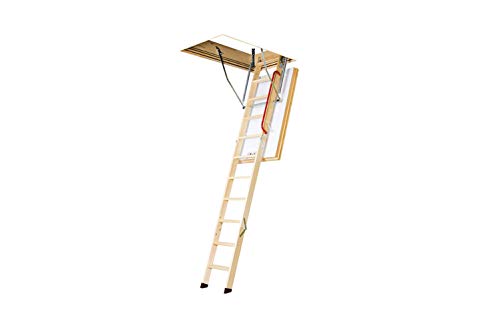
4. FAKRO LWT 66891 Wooden Thermo Attic Ladder with 12.5 R-Value for 22-Inch x 47-Inch Rough Openings
If heat loss through the hatch is your main concern, the LWT is the specialist: a wooden thermo ladder whose listing highlights a 12.5 R-value insulated door for a 22 by 47 inch rough opening, far beyond a standard thin hatch panel. Wooden sections also bring the practical benefit the guide mentions: they are often easier to adjust on site for an exact fit, and the finished look suits a hallway ceiling better than bare metal. The smaller 47 inch opening will not suit every home, so the rough opening measurement decides this one before any other feature. As with all insulated models, the seal only performs if the frame is installed square and the gasket sits evenly, which argues for a careful two-person installation or a professional. Expect it to cost more than basic ladders and to reward you every heating season. Best for energy-conscious owners with the shorter opening size.


5. FAKRO LWS-PL 66853 Insulated Attic Ladder for 22-Inch x 54-Inch Rough Openings
The LWS-PL targets the most common replacement scenario: a 22 by 54 inch rough opening, the size used by many existing wooden ladders in North American homes, with an insulated wooden ladder and hatch as the upgrade. The listing describes an insulated design, so swapping a worn, uninsulated ladder for this one improves both the climb and the ceiling seal in one job, and wooden construction keeps open the option of fine on-site adjustment during fitting. Before ordering, do the full measurement set from the guide: rough opening width and length, floor-to-ceiling height within the listed range, attic clearance for the folded sections, and clear floor where the ladder lands. This is still a heavy overhead installation that needs a helper and the maker’s specified fixings, not substitutes. It suits homeowners replacing a same-size ladder who want insulation without changing the framing, and who will check hinges, springs and treads annually as the guide recommends.

What to Look For
| Factor | Why it matters | What to check |
|---|---|---|
| Rough opening | The ladder must fit the cut-out between joists. | Measure width and length of the opening. |
| Ceiling height range | Each ladder suits a range of floor-to-ceiling heights. | Compare the listed range with your ceiling. |
| Material | Wood and aluminum differ in weight and feel. | Read the material description. |
| Load note | Makers state a weight capacity. | Check the listed capacity against your needs. |
| Folding design | Two-section, three-section and scissor styles differ in footprint. | Compare folded and unfolded dimensions. |
| Hatch panel | A tight panel helps with the look of the ceiling. | Check panel material and insulation notes. |
| Install needs | Most units are heavy and need two people. | Read the install steps and tool list. |
Setup and Care Tips
- Measure the rough opening twice before you order.
- Plan for a helper, as the unit is heavy and awkward to hold.
- Follow the maker’s frame and fixing steps closely.
- Check hinges and springs once a year.
- Keep the area beneath the hatch clear when it opens.
Mistakes to Avoid
- Ordering without checking ceiling height.
- Cutting the opening before reading the maker’s size notes.
- Using the wrong screws or fixings.
- Overlooking the clearance needed when the ladder unfolds.
- Attempting a heavy install alone.
Folding, Sliding and Telescoping Designs
Attic ladders fold or slide into the ceiling opening and come down when needed. The main designs behave differently, and the right one depends on the space above and below the hatch.
- Folding (concertina) ladders: The most common type. Sections fold over each other in the attic. They need clearance in the attic for the folded stack.
- Sliding ladders: Sections slide along each other rather than folding. These can take a different footprint in the attic, so check the listing for the space needed.
- Telescoping ladders: Sections extend and retract like a tube. Some people choose them for narrow openings, though the design and weight limits vary.
- Scissor-style or pull-down stairs: A staircase-like fold-out design that can feel more stable underfoot. They often need a larger opening.
Check how each design uses space in the room below when the ladder is open. The swing path of the hatch and the ladder’s landing position both need clear floor. Measure both the attic side and the room side before you decide.
Measuring the Opening, Ceiling Height and Attic Clearance
The key numbers to gather are the rough opening size, the ceiling height and the attic clearance. Start with the width and length of the rough opening between the framing. Do not rely on a nearby ceiling hatch or existing sizes. Measure twice and write the figures down.
Next, measure the floor-to-ceiling height in the spot where the ladder will land. Listings give a height range that the ladder suits, and the ladder must reach the floor correctly when unfolded. Choosing a ladder outside the range can mean awkward angles or steps that do not sit flat.
Finally, check the attic side. The folded ladder needs space above the opening, and some designs need extra clearance for the door to swing up. Look at roof pitch, rafters and any items stored nearby that could block the path.
Questions to answer before ordering:
- Does the rough opening match the ladder’s required size?
- Are the floor-to-ceiling heights within the listed range?
- Is there enough room in the attic for the folded ladder?
- Does the open ladder angle suit the floor space below?
If an opening needs enlarging, it may involve cutting framing. Ask a qualified person before you cut, because joists can carry load.
Materials, Load Rating and Insulation
The ladder body usually comes in wood, aluminum or steel. Wood is common, can look more finished in a living area, and is often easier to adjust on site. Aluminum is lighter and resists moisture, while steel can be very sturdy. Each has trade-offs, so check the listing for what is used in the frame and treads.
Look closely at the load rating. Ratings usually cover the person plus anything carried, and the maker sets them. Compare the figure with your own weight and the loads you plan to haul up, including boxes and tools. Do not stretch beyond the number given.
Think about thermal performance. A standard hatch is a gap in the ceiling, and it can let warm air escape into the attic. Some ladders come with insulated doors or can accept add-on covers. If your attic is unconditioned, look for a design that sealed well, and check the listing for the insulation details offered.
Finally, consider the hardware. Hinges, springs and fixings need to be strong and easy to inspect. Handrails, wide treads and non-slip surfaces make climbing safer, especially when carrying items.
Installation and Ongoing Checks
Installation is the part many buyers underestimate. The unit is heavy and awkward, the work happens overhead, and the frame must be fixed solidly to the ceiling structure. Read the maker’s instructions before you start and prepare the tools and fixings that they specify. Using the supplied hardware matters, since substitutes may not carry the load.
Many people hire a qualified installer, especially when the opening needs to be cut or framed. This is a good idea if you are unsure about the structure above, local rules for the work, or working at height with a heavy item. At the very least, have a helper.
Once installed, plan regular checks:
- Look over hinges, springs and fixings once a year.
- Tighten any loose bolts and replace damaged parts as the maker advises.
- Check treads and rails for cracks or wear.
- Test the folding and opening action for smooth movement.
- Keep the area under the hatch clear when it opens.
Signs it is time to replace a ladder include cracked wood, bent metal, springs that no longer hold, wobble that tightening cannot fix, and any damage near the hinges. Budget tiers are easy to describe: basic ladders cover simple needs, mid-range ones add better materials and handrails, and higher tiers offer insulation and heavier ratings.
A Measuring and Planning Checklist for Attic Access
An attic ladder fits into a ceiling opening, so accurate measurements come first. Use this checklist before you compare the five ladders above, and write down every number you collect.
- Measure the rough opening width and length between the framing members.
- Measure the ceiling height at the spot where the ladder will unfold.
- Check the distance from the opening to the nearest wall or door.
- Confirm the load limit stated by the maker and compare it with your needs, including what you carry.
- Look at whether the ladder is insulated, since the opening can lose or gain heat.
- Read the maker guidance on installation and framing requirements.
The folded ladder rests in the attic, and the unfolded one reaches the floor at an angle, so you need clear space below. A ladder that fits the opening but swings into a doorway is an annoying discovery after installation. Mark the landing area on the floor with tape before you decide.
Folding, Scissor and Sliding Ladders Compared
Attic ladders use different mechanisms. The table compares the common types.
| Type | How it moves | Space needed |
|---|---|---|
| Folding ladder | Sections fold in the opening | More floor space below when open |
| Scissor ladder | Frame compresses like an accordion | Tighter landing area |
| Sliding telescoping ladder | Sections slide together | Compact but different feel |
| Wooden or insulated model | Varies | Check the weight and hatch design |
A scissor design can suit tight hallways, while a folding ladder is common and familiar. Match the style to the space beneath the opening and the headroom above it.
Steps for Planning the Installation
Installing an attic ladder involves heavy parts and structural work, so many people hire a professional. These steps describe the planning, and the maker instructions come first.
- Locate the joists and any wiring or pipes before cutting or altering framing.
- Confirm that the rough opening matches the ladder size, or plan the framing changes.
- Arrange help for lifting the ladder, since it is heavy and awkward.
- Follow the maker steps for fixing the frame to the joists with the hardware supplied.
- Adjust the legs and trim as the manual directs so that the ladder rests firmly on the floor.
- Check that the door closes fully and seals the opening.
Cutting or changing ceiling framing is structural work, and local building rules may apply. If you are not experienced, use a licensed contractor. Never use a ladder that has not been installed according to the maker instructions.
Using an Attic Ladder Safely Day to Day
Good habits matter every time you climb. Face the ladder, keep three points of contact and carry only what you can manage with one hand free. Pass bulky items up or down using a rope or have someone help. Follow the weight limit of the ladder, counting the person and the load together.
Keep the area below clear and well lit, and make sure the ladder is fully extended and locked before climbing. Inspect hinges, springs and bolts a couple of times each year, and tighten what is loose according to the manual. If anything looks bent, cracked or worn, stop using the ladder until it is checked.
Insulation and Sealing Around the Opening
A ceiling hatch can be a draft path between the living space and the attic. Insulated ladders and covers reduce this, and weatherstripping around the door helps close gaps. Check the maker information on insulation values and how the hatch is built, and think about the climate where you live.
Choosing attic ladders With Confidence: A Deeper Look
Start with the job, not the product. Before comparing any attic ladders, write down what yours actually has to do in a normal week: who uses it, how often, for how long at a stretch, and what has frustrated you about the option you are replacing. That short list becomes the filter for everything else in this guide. Features that do not serve your list are decoration, while the two or three things on it deserve most of your attention and most of your budget. Readers who skip this step usually end up with an attic ladder that is impressive on paper and slightly wrong in daily life, which is the most common reason good products get returned.
Next, audit the space and the routine it has to fit. Measure where the attic ladder will live and where it will be stored, note the surfaces, light, moisture, heat or traffic it will face in the ceiling, between hallway and roof space, and think about who else will handle it. A choice that fits the room but fights the routine still fails, so picture the busiest, messiest, most rushed version of your day rather than the tidiest one. If other people in the household will use it, their habits count too: the best attic ladder for homeowners who need safe, regular access to attic storage is the one everyone can use correctly without a lesson every time.
Rough opening and ceiling fit first
Attic ladders are built for specific ceiling openings and heights. Measure your existing opening or the joist layout where a new one would go before looking at models, because the opening decides the shortlist absolutely. Changing an opening is carpentry; choosing a ladder to fit it is shopping.
Load rating for real trips
You will climb this ladder carrying boxes, often one-handed. Choose a rating with honest margin for the heaviest person plus the heaviest load in the house, and consider how the ladder feels underfoot. A ladder that flexes and creaks discourages the two-handed caution it demands.
Insulation and sealing at the hatch
The attic opening is a hole in your home’s thermal envelope. Insulated doors and proper seals keep heated and cooled air where it belongs and dust where it belongs too. In homes that fight summer attic heat or winter draughts, the hatch quality matters every day, not just on climbing days.
Mechanism and unfolding space
Folding and scissor mechanisms need clear floor space below and headroom above. Walk the choreography: where do you stand to pull it down, where does it land, and can you carry a box through the swing zone? A ladder that unfolds into a doorway or over stairs is a daily argument.
Tread comfort and handholds
You climb in socks, slippers and work boots, sometimes carrying awkward loads. Wide, non-slip treads and a handrail or grab points transform confidence, especially on the descent, which is where attic ladders earn their reputation. Judge the ladder by climbing down it in your mind, loaded.
Compatibility is the quiet deal-breaker. Check the requirements that sit around the attic ladder itself: the fittings, power, mounting points, accessories, consumables or companion pieces it assumes, and whether your current setup already provides them. Confirming these details before ordering is dull and decisive in equal measure. It is far cheaper to discover a mismatch on a listing page than on the floor with the packaging open. Keep the product manual or listing open while you check, and measure twice wherever a dimension decides whether something fits, connects or closes properly.
Attic ladders in Real Life: Common Situations
Seasonal storage runs
Decorations, suitcases and archive boxes travel this ladder a few times a year, usually in a hurry. A smooth mechanism, a hatch that seals well between trips and treads you trust in slippers make the ritual painless. Keep a torch and a clear landing zone in the attic as part of the system.
Regular access for a usable attic
If the attic hosts a hobby space, a water tank or equipment you service, the ladder becomes a staircase substitute used weekly. Invest in the sturdiest mechanism and the best treads, and keep the access route in the attic itself boarded and safe. Frequency justifies quality here more than anywhere.
A first ladder in an older home
Older homes bring joist surprises, lath ceilings and openings that match nothing modern. Expect some carpentry, get the structure checked, and treat the project as joinery with a ladder attached. The result, safe access instead of a wobbling stepladder through a hatch, transforms how the home stores things.
Replacing a tired ladder
A worn ladder with loose joints and a warped hatch is a safety item, not a cosmetic one. Replacement usually reuses the opening, which simplifies everything. Measure the old unit carefully and the new ladder can be chosen from a shortlist in minutes.
How the Picks in This Guide Compare
Use the picks in this guide as a shortlist, not a ranking to obey blindly. Read the review of each option with your own list beside it, and notice which pick keeps answering your specific frustrations. The first pick in a list is rarely the right pick for every reader; it is simply a strong starting point. Cross off options that miss a requirement entirely, however appealing their other qualities are, then compare what remains on the two or three criteria you care about most. That process usually leaves one obvious candidate and one sensible runner-up, which is exactly where a buying decision should end up.
The shortlist above, Werner AA1510 AA1510B Aluminum Attic Ladder, 250 lb Capacity, FAKRO LMS 66866 Insulated Steel Attic Ladder for 25-Inch x 47-Inch Rough Openings, FAKRO LST 66823 Insulated Steel Scissor Attic Ladder for 25-Inch x 54-Inch Rough Openings, FAKRO LWT 66891 Wooden Thermo Attic Ladder with 12.5 R-Value for 22-Inch x 47-Inch Rough Openings, and FAKRO LWS-PL 66853 Insulated Attic Ladder for 22-Inch x 54-Inch Rough Openings, covers the main directions a buyer in this category usually faces. Rather than treating them as a ladder from best to worst, treat them as answers to different priorities. Work through them in the order of your own list: find the pick whose review speaks to your biggest frustration first, then check whether its trade-offs touch anything you care about. A trade-off that lands on something you never do is free; a trade-off that lands on your daily routine is a reason to move to the next pick, whatever its position in the list.
Who should start with the Werner AA1510 AA1510B Aluminum Attic Ladder, 250 lb Capacity
Start with the Werner AA1510 AA1510B Aluminum Attic Ladder, 250 lb Capacity if its review above matches the way you actually live with attic ladders: the setting it suits, the routine it fits and the compromises it makes. Read its limitations as carefully as its strengths, because every pick in this guide gives something up to be good at something else. If its limitation sits in an area you barely use, it may be your best value in the list. If its strength duplicates something you already own or never need, keep moving, since the right pick is the one whose strengths land on your week, not the one with the longest feature list.
Who should start with the FAKRO LMS 66866 Insulated Steel Attic Ladder for 25-Inch x 47-Inch Rough Openings
Start with the FAKRO LMS 66866 Insulated Steel Attic Ladder for 25-Inch x 47-Inch Rough Openings if its review above matches the way you actually live with attic ladders: the setting it suits, the routine it fits and the compromises it makes. Read its limitations as carefully as its strengths, because every pick in this guide gives something up to be good at something else. If its limitation sits in an area you barely use, it may be your best value in the list. If its strength duplicates something you already own or never need, keep moving, since the right pick is the one whose strengths land on your week, not the one with the longest feature list.
Who should start with the FAKRO LST 66823 Insulated Steel Scissor Attic Ladder for 25-Inch x 54-Inch Rough Openings
Start with the FAKRO LST 66823 Insulated Steel Scissor Attic Ladder for 25-Inch x 54-Inch Rough Openings if its review above matches the way you actually live with attic ladders: the setting it suits, the routine it fits and the compromises it makes. Read its limitations as carefully as its strengths, because every pick in this guide gives something up to be good at something else. If its limitation sits in an area you barely use, it may be your best value in the list. If its strength duplicates something you already own or never need, keep moving, since the right pick is the one whose strengths land on your week, not the one with the longest feature list.
Who should start with the FAKRO LWT 66891 Wooden Thermo Attic Ladder with 12.5 R-Value for 22-Inch x 47-Inch Rough Openings
Start with the FAKRO LWT 66891 Wooden Thermo Attic Ladder with 12.5 R-Value for 22-Inch x 47-Inch Rough Openings if its review above matches the way you actually live with attic ladders: the setting it suits, the routine it fits and the compromises it makes. Read its limitations as carefully as its strengths, because every pick in this guide gives something up to be good at something else. If its limitation sits in an area you barely use, it may be your best value in the list. If its strength duplicates something you already own or never need, keep moving, since the right pick is the one whose strengths land on your week, not the one with the longest feature list.
Who should start with the FAKRO LWS-PL 66853 Insulated Attic Ladder for 22-Inch x 54-Inch Rough Openings
Start with the FAKRO LWS-PL 66853 Insulated Attic Ladder for 22-Inch x 54-Inch Rough Openings if its review above matches the way you actually live with attic ladders: the setting it suits, the routine it fits and the compromises it makes. Read its limitations as carefully as its strengths, because every pick in this guide gives something up to be good at something else. If its limitation sits in an area you barely use, it may be your best value in the list. If its strength duplicates something you already own or never need, keep moving, since the right pick is the one whose strengths land on your week, not the one with the longest feature list.
Setup, First Use and Everyday Technique
The first days with a new attic ladder tell you most of what you need to know, so treat them as a test period rather than a honeymoon. Set it up properly, use it for its real jobs instead of gentle trials, and notice where you hesitate, adjust or work around it. Small annoyances in week one rarely shrink with familiarity; they usually grow. If something feels wrong, check fit, setup and technique before blaming the product, because a surprising share of disappointments trace back to one skipped step in the instructions or one assumption carried over from the old one.
Care, Cleaning and Storage That Protect Your Attic ladder
Lubricate and tighten on a schedule
Hinges, springs and pivot points work hard and live in dust. A seasonal wipe, light lubrication as the maker directs and a check of every bolt keep the action smooth and the ladder trustworthy. A ladder that deploys stiffly is asking for this attention before something bends.
Keep the hatch seal clean and intact
Dust and damage defeat the seal that keeps attic air and insulation dust out of the house. Wipe the seal, check it closes evenly, and replace perished sealing material. If you can feel a draught at the hatch on a windy day, the seal is telling you something.
Inspect treads and feet
Check treads for cracks or looseness and the feet for wear, especially after any heavy project using the ladder. A ladder that rocks on its feet should be adjusted or repaired before the next loaded climb. Small defects on a ladder matter more than small defects almost anywhere else.
Keep the landing zones clear
The floor where the ladder lands and the attic floor where you step off should stay clear as a house rule. Most ladder accidents are really clutter accidents at the top or bottom. A painted outline or a simple family agreement keeps the zones honest.
Operate it the slow way, every time
Pull the ladder down fully, confirm it is locked and planted before climbing, face the ladder on the descent, and keep one hand free for the rail. Rushing the mechanism, or climbing a half-deployed ladder, is how a good ladder gets a bad name.
Keep a simple ownership rhythm. A quick wipe, check or tidy after use, a slightly deeper clean on a regular cycle, and a periodic inspection for wear will keep most attic ladders performing the way they did when they arrived. Problems caught early, a loose fitting, a fraying edge, a strange noise, a part that no longer moves freely, are almost always cheaper and easier to fix than the same problems discovered months later. Tie the routine to something you already do, like a weekly clean or a seasonal clear-out, so it actually happens instead of living on a list of good intentions.
Storage is part of ownership, not an afterthought. Where an attic ladder rests between uses decides how fast it ages: damp, heat, crushing weight and direct sun quietly undo good materials, while a clean, dry, sensible spot preserves them. Keep the parts that belong together actually together, including the small accessories that vanish into junk drawers and are only missed mid-task. If the original packaging or a simple labelled container suits the shape, use it. Future you, searching at the moment of need, will be grateful for every boring storage decision you make now.
Mistakes That Quietly Ruin a Good Choice
Carrying loads that need two hands
If a box needs both hands, it does not belong on a ladder trip. Use smaller boxes, a rope and bucket system from the attic hatch with a helper, or make two trips. The one-handed rule feels slow and is exactly how people keep using their attic safely for decades.
Cutting a new opening without checking structure
Ceiling joists are structure, not obstacles. Cutting or moving them without proper framing and, where needed, professional advice weakens the ceiling. Plan the opening with the joists, not against them, and let a carpenter judge anything beyond the straightforward.
Ignoring ceiling height in the choice
A ladder made for a lower ceiling forced into a higher one reaches the floor at a bad angle or not at all; the reverse wastes money and space. Ceiling height is a first-order measurement in this category, taken twice, from finished floor to finished ceiling.
Letting the hatch become a draught you accept
An uninsulated, unsealed hatch leaks conditioned air all year and invites condensation and dust. Owners often blame the heating system for what the hatch is doing. Sealing and insulating the opening is among the cheapest comfort fixes in a house with an attic.
Problems, Safety and Getting Years of Use
When something goes wrong, troubleshoot in a ladder instead of jumping to replacement. First, check the obvious: correct setup, correct supplies, nothing blocked, worn or installed backwards. Second, return to the manual section for that symptom, because makers document the common failures for their own designs. Third, change one thing at a time so you know what fixed it. If a problem affects safety, involves damage you cannot explain, or keeps returning after honest troubleshooting, stop and get professional help or contact the maker rather than improvising around it.
Safety deserves a deliberate pass with any attic ladder. Read the warnings that apply to your household, especially where children, older relatives, pets, water, heat or heights are involved, and set the attic ladder up so the safe way is also the easy way. Store accessories and any sharp, hot or heavy parts out of casual reach, and never defeat a guard, lock or limit because it slows you down. Most accidents with household gear happen during rushed, familiar routines, not during careful first uses, so build the habit while you are still paying attention.
Finally, know what finished looks like. An attic ladder has done its job when it fades into your routine: it works, it is maintained without drama, and it no longer asks for thought. Replace or upgrade when wear changes performance, when your needs genuinely change, or when repairs stop making sense, not simply because a newer version exists. Keeping notes on what you bought, when, and what you liked or disliked about it turns the next purchase into a five-minute decision instead of a fresh research project, and that, more than any single feature, is what a good guide is for.
One More Round of Practical Checks
A useful extra test is the two-week question: imagine living with this choice on an ordinary, slightly chaotic day a fortnight from now, not on the day it arrives. Novelty hides flaws; routine exposes them. Picture the cleaning, the storage, the other people involved and the moment something small goes wrong. If the choice still looks easy under those conditions, it is probably right. If your imagination keeps adding workarounds, believe it, and look again at the pick you crossed off earlier, because the runner-up often wins once daily reality gets a vote.
Budget thinking works better in reverse. Instead of asking what the cheapest acceptable version costs, ask what failure would cost you: a replacement within the year, a repair, damage to something the product touches, or simply a chore you stop doing because the tool makes it unpleasant. Spending a little more to avoid a likely failure is usually the economical move, while spending more on features your routine never touches is not. The picks in this guide sit at different levels for a reason, and matching the level to your actual frequency of use is the whole game.
If you are choosing for more than one person, gather the complaints before you gather opinions on products. Everyone describes the problem differently, and the shared frustration underneath is the real specification. A choice that answers the shared problem tends to satisfy the whole household, even where tastes differ on looks or extras. Where one person will use the item far more than anyone else, weight their experience heaviest, but do not ignore the person who cleans, stores or maintains it, because their friction decides whether the routine survives.
Reading individual reviews well matters as much as reading our picks. Look for reviewers whose situation resembles yours, in household size, space, experience and the job they bought for, and discount praise or complaints rooted in situations nothing like your own. Patterns repeated across many owners are signal; a single dramatic story is weather. Pay special attention to comments written after months of ownership rather than on delivery day, because durability, upkeep and the slow annoyances only appear with time, and those are exactly the qualities you are trying to predict.
FAQ
What size attic ladder do I need?
Begin with the rough opening size and your ceiling height, then match them to the ranges in each listing.
Can I fit an attic ladder myself?
Some people do, but the job involves a ceiling opening and heavy parts. Consider a qualified installer if you are not sure.
How do I measure for an attic ladder?
Measure the width and length of the rough opening, the floor-to-ceiling height and the clearance in the attic. Compare these with the ranges in each listing before buying.
Can an attic ladder be installed in any ceiling?
Not always. The ceiling structure, joist layout and attic space all matter. A qualified person can check whether your ceiling suits the ladder you have in mind.
Are attic ladders safe for carrying heavy boxes?
Check the load rating and remember that it covers the person plus what they carry. Carry boxes in smaller loads, and use the handrails as the maker advises.
Do attic ladders let heat escape?
A hatch can be a path for air movement. Some ladders offer insulated doors or covers, so look for these features if comfort and energy use matter.
How often should I inspect the ladder?
Many makers suggest checking at least once a year, and after any impact. Follow the manual for your ladder.
Can I replace an old attic ladder with a new one?
Often, but the new ladder must fit the existing opening. Measure the rough opening and compare it with the new listing before you remove the old unit.
Should I leave the ladder open while working in the attic?
Follow the maker's guidance, and keep the ladder stable and the area below clear. Never overload it, and let someone know where you are if you work alone.
Can I install an attic ladder myself?
Competent DIYers with a helper install many models into existing openings, following the maker’s instructions exactly. Creating a new opening, altering joists or working with high ceilings raises the stakes and often justifies a professional. The honest test is whether the structural steps, not the ladder steps, are within your skills.
How much weight can I carry up it?
Stay within the ladder’s stated rating counting yourself plus the load, and keep individual loads modest enough to carry one-handed with your balance centred. Heavy or bulky items deserve a different method entirely: a helper and a rope, or storage that lives downstairs. The rating is a ceiling, not a target.
Why does my attic ladder feel bouncy?
Some flex is normal in folding designs, but increasing bounce, creaks or looseness at joints suggest wear or fixings that need attention. Check the installation is still square and tight in the opening. A ladder whose character changes is asking for inspection before the next season of use.
Does an insulated ladder really matter?
In homes where the attic gets very hot or cold, yes: the hatch is a large, thin patch in the ceiling, and insulation plus sealing there measurably reduces draughts and heat transfer. In mild climates with conditioned attic space it matters less. Judge by your attic’s temperature extremes.
What ceiling heights suit scissor versus folding designs?
Each design has a height range it serves, and scissor mechanisms often suit situations where folding sections are awkward. The maker’s range for the specific model decides. Measure your ceiling height first and let that number filter the catalogue before style preferences get a vote.
How do I make attic trips safer for older family members?
Choose the sturdiest ladder with the best treads and a handrail, keep both landing zones clear and lit, and move the heaviest storage downstairs so nobody needs to carry it. For some households the right answer is that certain members do not use the ladder, and the storage plan should respect that.
The Short Version
Choose an attic ladder by opening size, ceiling height range and build material. Measure carefully, read the install notes, and bring in a professional when the job feels beyond you.