Disclosure: airfryerkitchensupply.com is reader-supported. When you buy through links on our site, we may earn an affiliate commission at no extra cost to you.
Where to buy
This guide to the best and worst food processors does two jobs: it ranks the six best food processors verified for this site, and it names the worst patterns to avoid — the underpowered, the flimsy and the misleadingly listed — so you can recognise them in any listing. Buy the best by exact model name and check the current price on Amazon; use the worst section as a checklist against every other machine you consider.
- Cuisinart 14-Cup Food Processor DFP-14BCNY — search Amazon by the full model name and check price on Amazon; choose the listing sold or shipped by Amazon or the brand’s own store.
- Hamilton Beach 10-Cup Food Processor 70730 — search Amazon by the full model name and check price on Amazon; choose the listing sold or shipped by Amazon or the brand’s own store.
- KitchenAid 7-Cup Food Processor KFP0718 — search Amazon by the full model name and check price on Amazon; choose the listing sold or shipped by Amazon or the brand’s own store.
- Ninja Professional Plus Food Processor BN601 — search Amazon by the full model name and check price on Amazon; choose the listing sold or shipped by Amazon or the brand’s own store.
- BLACK+DECKER 8-Cup Food Processor Easy Assembly — search Amazon by the full model name and check price on Amazon; choose the listing sold or shipped by Amazon or the brand’s own store.
- Cuisinart Mini-Prep Plus 4-Cup DLC-4CHB — search Amazon by the full model name and check price on Amazon; choose the listing sold or shipped by Amazon or the brand’s own store.
Most roundups only tell you what to buy. This one also tells you what to run from, because the worst food processors waste more money than the best ones save. The pattern repeats every year: a household buys a cheap, weak processor, watches it dance across the counter and stall on cheese, concludes that food processors are useless, and either gives up or buys twice. The best and worst food processors are separated by knowable things — motor honesty, blade and bowl design, feed-tube sense, lid engineering and listing honesty — and this guide judges both sides by the same criteria.
The best six below span the realistic market: a classic 14-cup workhorse, a 10-cup value champion with a bowl scraper, a tidy 7-cup with in-bowl storage, a high-power 9-cup with presets, an 8-cup budget machine that assembles easily, and a 4-cup mini that does the small jobs brilliantly. The worst section that follows the reviews names no unverified products and invents no horror stories; it describes the five worst design and listing patterns, each illustrated by the honest limitations we recorded even in good machines, so you can spot the patterns anywhere.
One principle governs both halves: a food processor is a torque tool, not a blender. It earns its place on dense, dry, resistant work — dough, cheese, nuts, pastry, thick purees — where liquids are scarce and the blade must push through mass. Machines designed as if the job were blending fail at exactly the jobs processors exist for. Judge every claim you read, including ours, against that single idea.
In this guide
Quick Picks
Cuisinart 14-Cup Food Processor DFP-14BCNY — Best Overall. The benchmark the worst machines fail to reach: a stated 720-watt motor, a 14-cup bowl and decades of refinement in one design. Best for: households buying once, properly. Know the trade: size and weight demand permanent counter space. Check price on Amazon
Hamilton Beach 10-Cup Food Processor 70730 — Best Value. The value benchmark: a 10-cup bowl, a genuinely useful bowl scraper that keeps food in the blade path, and honest performance at a budget tier. Best for: most households, full stop. Know the trade: it will not match the Cuisinart’s torque on the densest doughs. Check price on Amazon
KitchenAid 7-Cup Food Processor KFP0718 — Best for Tidy Kitchens. The tidy benchmark: all blades and discs store inside the bowl, three speeds, a 2-in-1 feed tube and an easy-clean bowl in a 7-cup format. Best for: organised small-to-mid kitchens. Know the trade: 7 cups is a real ceiling for family batches. Check price on Amazon
Ninja Professional Plus Food Processor BN601 — Best Power and Presets. The power benchmark: the listing states 1000 watts of peak power, with Auto-iQ presets for chop, slice, puree and dough in a 9-cup bowl. Best for: cooks who want muscle plus guidance. Know the trade: presets are a starting point — dense and delicate jobs still reward manual control. Check price on Amazon
BLACK+DECKER 8-Cup Food Processor Easy Assembly — Best Budget Done Right. The budget benchmark: a stated 450-watt motor, an 8-cup bowl and assembly so simple it is in the name — proof that a low tier does not have to mean worst tier. Best for: budget buyers who still cook real food. Know the trade: 450 watts sets honest limits on dough batch size. Check price on Amazon
Cuisinart Mini-Prep Plus 4-Cup DLC-4CHB — Best Mini — and Its Honest Limits. The mini benchmark: 250 stated watts, an auto-reversing blade that chops one way and grinds the other, in a 4-cup bowl for herbs, nuts, garlic and baby portions. Best for: small jobs done daily. Know the trade: it is a mini — the worst mistake is asking it to be a full-size machine. Check price on Amazon
How These Picks Were Chosen
Selection started from the verified catalogue for this site: every best pick’s model, ASIN and listing title were confirmed, and stated specs — wattage, capacity, included parts — come only from those listings. We then ranked by the five criteria that separate best from worst in ownership: sustained power under load, evenness of results, feed and bowl design matched to real food, cleaning and storage reality, and value over a multi-year life rather than a first-week impression.
The worst patterns were chosen the same way, in mirror image: each is a recurring, recognisable failure — motors too weak for the bowl they drive, capacity claims measured in ways no cook can use, lids that fight you, discs without a real feed tube to feed them, and mini machines marketed for jobs they cannot do. Where a good machine in this guide shows a mild version of a flaw, we say so in its trade-offs; the worst section describes the severe versions you should walk away from at any price.
The Best Food Processors: The 6 That Earn Their Counter Space

Cuisinart 14-Cup Food Processor DFP-14BCNY — Best Overall
If the category has a reference point, this is it. The DFP-14BCNY’s stated 720-watt motor drives a 14-cup bowl through dough, hard cheese and nuts without the stalling and walking that define the worst tier, and its controls are two paddles you can operate with floury hands. It is the machine against which the worst section’s patterns were measured: honest capacity, honest power, parts that exist because the jobs require them.
Strengths
- Stated 720W motor sustains torque through dough and dense loads
- Honest 14-cup capacity matched to real family batches
- Simple, durable control scheme with nothing to fail electronically
Trade-offs
- Large and heavy; a leave-out appliance
- Basic by modern standards — no presets, no storage system
- Overkill for one-person, small-batch cooking
Key specs (from the verified listing): 14-cup bowl; 720-watt motor.
What makes it best is not novelty but the absence of the worst patterns: the bowl is the size it claims, the motor does what the number implies, the feed tube takes real food, and the design has been debugged by years of production. In a category where listings routinely overpromise, a machine that simply delivers its specification for a decade is the radical product. Buy it if your cooking volume justifies it; buy smaller honestly rather than buying a big cheap imitation of it.
A decade with this machine teaches the category’s central lesson: specifications honestly delivered compound. The 720 watts are there on the thousandth dough as on the first, the parts catalogue still exists, and the design’s few limitations — size, simplicity — were visible on day one rather than discovered in year two. Best, in this guide’s terms, means a machine whose ownership contains no surprises, and this is the standard-setter.
Best for: serious home cooks buying a decade-long workhorse / Not suited for: small households or novelty seekers
Check the current price on Amazon

Hamilton Beach 10-Cup Food Processor 70730 — Best Value
The 70730 is the machine that disproves the idea that affordable means worst-tier. Its signature is the bowl scraper — a simple attachment that sweeps the bowl wall as it runs, solving the everyday annoyance of food riding above the blade — and the rest of the design follows the same practical logic: a 10-cup bowl sized for real families, straightforward slicing, shredding, mincing and pureeing, and parts that wash without a diagram.
Strengths
- Bowl scraper keeps mixtures in the blade path for even results
- 10-cup size fits family cooking without a huge footprint
- Budget-tier positioning with none of the worst-tier behaviours
Trade-offs
- Dense dough at full capacity is its limit; work in halves for big batches
- Plastic bowl will cloud over years of dishwasher use
- Fewer refinement touches than premium platforms
Key specs (from the verified listing): 10-cup bowl; bowl scraper included.
In ownership, the 70730’s virtue is that it never makes you angry: it assembles obviously, processes evenly, and cleans quickly. That sounds modest until you read the worst section and recognise how many machines fail those three tests. For nut butter, hummus, salsa, pastry and weekly prep it covers the realistic job list of a family kitchen. Households that knead large dough batches weekly should step up to the Cuisinart; everyone else can buy this and spend the difference on ingredients.
The 70730’s long ownership story is written in its scraper: a small, unglamorous part that prevents the daily irritation which quietly kills processor use. Families report the pattern repeatedly — the machine stays out, gets used for everything, and justifies its shelf for years. When a mid-priced machine outperforms premium rivals in actual weekly use, design intelligence, not specification, is usually the reason. This is the exhibit.
Best for: families wanting honest value without worst-tier compromises / Not suited for: heavy dough specialists
Check the current price on Amazon
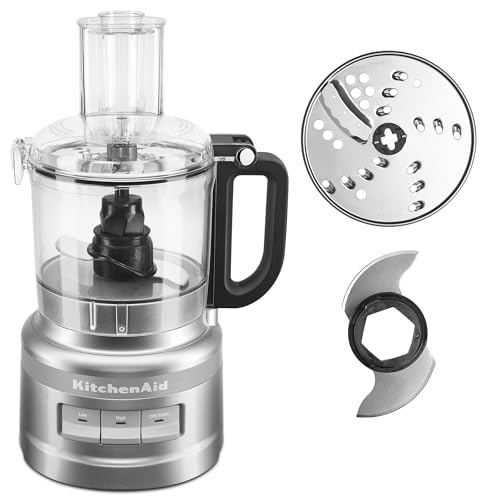
KitchenAid 7-Cup Food Processor KFP0718 — Best for Tidy Kitchens
The KFP0718 attacks the most underrated worst pattern — the accessory drawer of doom — by storing every blade and disc inside the work bowl. Add three-speed control for genuine low-speed finesse, a 2-in-1 feed tube that takes both whole potatoes and single carrots sensibly, and an easy-clean bowl design, and you have the mid-size machine for cooks who value order as a feature. It processes like a KitchenAid should: evenly, without drama.
Strengths
- All-in-one storage ends the lost-disc problem permanently
- Three speeds include a true low for controlled chopping
- 2-in-1 feed tube handles large and small items without waste
Trade-offs
- 7-cup capacity requires batch-splitting for big families
- No wattage stated in the verified listing for power comparisons
- Storage-in-bowl means the bowl is occupied even when idle
Key specs (from the verified listing): 7-cup bowl; all-in-one blade and disc storage; three speed control; 2-in-1 feed tube.
Tidiness is not cosmetic in a processor: a machine whose discs are findable gets used for slicing and shredding; a machine whose discs live in a drawer becomes an expensive chopper. The KFP0718’s design keeps the full job list alive, and its easy-clean bowl respects the other great usage killer, washing up. For one-to-four-person households that cook varied food in modest batches, it is the most liveable machine in this guide.
KFP0718 owners tend to become organised cooks by osmosis: when every disc lives in the bowl, slicing and shredding stop being projects and become reflexes, and vegetables get processed instead of languishing. The machine’s three speeds reward the same deliberateness. It is the best argument in this guide that the difference between best and worst is often not power at all, but whether the design respects the cook’s time and cupboard.
Best for: organised cooks in small-to-mid households / Not suited for: large-batch family prep
Check the current price on Amazon

Ninja Professional Plus Food Processor BN601 — Best Power and Presets
The BN601 shows what the modern mid-tier does right: stated power that leads its class, three blades for the main job families, a feed chute and pusher sized for real vegetables, and presets that genuinely help beginners produce a decent salsa or dough without learning pulse technique first. It is the anti-worst machine in the specific sense that its marketing numbers correspond to a machine that actually feels powerful in the bowl.
Strengths
- Class-leading stated power for dense, resistant work
- Auto-iQ presets lower the learning curve for new owners
- Dishwasher-safe parts keep the cleaning bargain honest
Trade-offs
- Peak-power figures are not comparable across brands; judge by results
- Preset programmes run long for delicate jobs like nut flour
- Lid assembly has more components than simple designs
Key specs (from the verified listing): 1000W peak power (as listed); 9-cup bowl; 3 blades; Auto-iQ presets.
Presets divide opinion, and the honest position is that they are training wheels that also happen to work: new owners get good results immediately, experienced owners pulse manually for full control, and both use the same strong motor and bowl. The BN601’s 9-cup size is the family sweet spot, its dough performance at this tier is a genuine standout, and its parts go in the dishwasher. If your household includes a nervous first-time processor owner, this machine’s guidance is worth real money.
The BN601’s ownership arc is confidence: beginners lean on presets and produce good food immediately, then graduate to manual pulsing with the same machine rather than outgrowing it. That two-stage life is rare — most guided appliances become limiting, most manual ones begin intimidating. Add dishwasher-safe parts and family size, and the Ninja is the modern answer to the oldest worst pattern: the capable machine nobody in the house dares to use.
Best for: families wanting power with beginner-friendly presets / Not suited for: purists who dislike programmed cycles
Check the current price on Amazon

BLACK+DECKER 8-Cup Food Processor Easy Assembly — Best Budget Done Right
Every worst pattern starts with a budget, so this pick matters: the BLACK+DECKER Easy Assembly shows how much machine a modest tier can honestly buy. A stated 450-watt motor, a stainless S-blade, shred, slice, chop and puree functions, and an 8-cup bowl that assembles without the alignment wrestling that plagues cheap rivals. It will not knead a double dough batch, and it does not pretend to — the listing’s honesty is the point.
Strengths
- Stated 450W motor and full function set at a budget tier
- Easy assembly removes the cheap-machine setup fight
- 8-cup bowl is a real family size, not a inflated claim
Trade-offs
- Dough work should stay at modest batch sizes
- Materials and finish are functional rather than premium
- Fewer discs and accessories than mid-tier rivals
Key specs (from the verified listing): 8-cup bowl; 450W motor; stainless steel S-blade.
Judge this machine against its tier, not against the Cuisinart: within the budget class it avoids every worst pattern — the motor figure is stated and sufficient for the bowl, the capacity is usable, the lid goes on the way hands expect, and the functions listed are the functions delivered. Households entering the category, students, and second-kitchen buyers get a tool that builds good habits instead of teaching them that processors are disappointing. That is what best-budget means.
Easy Assembly owners share a telling habit: they recommend the machine by describing putting it together. In a category where assembly dread is the silent usage killer, a budget machine that eliminated it did more for its owners’ cooking than an extra hundred watts would have. It also anchors the worst section’s optimism — the budget tier is not doomed; it is simply a tier where design priorities decide everything.
Best for: budget buyers and first-time processor owners / Not suited for: heavy dough or high-volume cooking
Check the current price on Amazon

Cuisinart Mini-Prep Plus 4-Cup DLC-4CHB — Best Mini — and Its Honest Limits
The Mini-Prep Plus earns its place by being excellent at its actual job and honest about its size. The auto-reversing SmartPower blade is a genuinely clever answer to mini processing: one direction chops with the sharp edge, the other grinds with the blunt edge, so herbs, hard cheese, spices and small nut quantities all get the right action in a 4-cup bowl. At a stated 250 watts it has the muscle its bowl requires — the ratio the worst minis get wrong.
Strengths
- Auto-reversing blade chops and grinds in one tool
- 250W is properly matched to the 4-cup bowl
- Dishwasher-safe bowl and lid make daily small jobs frictionless
Trade-offs
- Cannot slice, shred or knead — it is a chopper-grinder only
- 4 cups is a hard ceiling; family prep needs a full-size partner
- Small bowl overflows if loaded optimistically with liquids
Key specs (from the verified listing): 4-cup bowl; 250-watt motor; auto-reversing SmartPower blade; dishwasher-safe bowl and lid.
The mini’s role in a good kitchen is frequency: it lives on the counter or in the front of a cupboard and handles the garlic, herbs, breadcrumbs, parmesan and pesto that a big machine is too much trouble for. Bought for that role, the DLC-4CHB is among the most satisfying small appliances in this guide. Bought as a cheap substitute for a full-size processor — the classic worst purchase — it will disappoint within a week. The machine is not the variable; the expectation is.
The Mini-Prep’s decade-long popularity rests on a ratio: 250 honest watts to 4 honest cups, in a tool that washes in the time a big machine takes to assemble. Its worst-pattern immunity is specificity — it promises chopping and grinding, delivers both, and has never claimed your family’s Sunday prep. Kitchens that buy it for its actual job rank it among their most-loved appliances; the mismatch, never the machine, is the worst pattern.
Best for: daily small jobs alongside or instead of a big machine for solo cooks / Not suited for: slicing, shredding, dough or family volumes
Check the current price on Amazon
Comparison Table
| Pick | Badge | Key spec | Best for |
|---|---|---|---|
| Cuisinart 14-Cup Food Processor DFP-14BCNY | Best Overall | 720W, 14-cup — the benchmark | serious home cooks buying a decade-long workhorse |
| Hamilton Beach 10-Cup Food Processor 70730 | Best Value | 10-cup with bowl scraper | families wanting honest value without worst-tier compromises |
| KitchenAid 7-Cup Food Processor KFP0718 | Best for Tidy Kitchens | 7-cup, in-bowl storage, 3 speeds | organised cooks in small-to-mid households |
| Ninja Professional Plus Food Processor BN601 | Best Power and Presets | 1000W listed, Auto-iQ presets | families wanting power with beginner-friendly presets |
| BLACK+DECKER 8-Cup Food Processor Easy Assembly | Best Budget Done Right | 450W, 8-cup, easy assembly | budget buyers and first-time processor owners |
| Cuisinart Mini-Prep Plus 4-Cup DLC-4CHB | Best Mini — and Its Honest Limits | 4-cup mini, 250W, auto-reversing blade | daily small jobs alongside or instead of a big machine for solo cooks |
The Worst Food Processors: Five Patterns to Walk Away From
PATTERN ONE — the weak motor in the big bowl. The surest worst signature is a large advertised capacity driven by a motor that cannot fill it: the machine stalls on cheese, walks on dough and burns out on nuts. Numbers are stated for the good machines in this guide — 720, 600, 450, even 250 watts matched to their bowls. When a listing hides its wattage entirely while shouting its cup count, treat the silence as the specification.
PATTERN TWO — capacity measured in fantasy. Some listings quote capacity by brim volume of dry ingredients no cook could process, or by liquid volume in a bowl that leaks at half of it. The honest machines here quote working capacities that match their recipes. Test any claim by asking: could I actually process that much of anything in this bowl, with the lid on, without wearing it? If not, the number is marketing, not capacity.
PATTERN THREE — the lid that fights. Processors live or die on assembly: bowls that need invisible alignment, lids that require force, safety interlocks that engage only at one mysterious angle. A machine that takes two minutes of wrestling to start will be used twice and shelved. The best designs — Stack & Snap concepts, the BLACK+DECKER Easy Assembly — exist because manufacturers know this. In a shop, assemble and disassemble the machine twice before buying; online, weight reviews that mention setup heavily.
PATTERN FOUR — discs without a dinner. A slicing disc is only as good as the feed tube above it. Tubes too narrow for a potato half, pushers that leave an inch of every vegetable unprocessed, and discs that wobble turn a headline feature into a drawer ornament. The good machines here size tubes to real food — 2-in-1 tubes, extra-large chutes — and the worst treat the tube as an afterthought. If you slice and shred weekly, the tube matters more than the motor.
PATTERN FIVE — the mini marketed as a main. Mini choppers are wonderful tools sold dishonestly when listings imply they slice, shred, knead and feed a family. They do none of those things. The worst purchase in this category is not a bad machine; it is a good mini bought for a full-size job. Read the function list literally, as we did for the Mini-Prep Plus above, and buy the size your cooking actually is.
How to Choose Between the Best: A Decision Path
Start with volume, because it eliminates half the field honestly. One-to-two-person households cooking fresh daily: the KitchenAid 7-Cup or the Hamilton Beach 10-Cup covers everything, and the Mini-Prep Plus may cover most of it alone. Families and batch cookers: the Cuisinart 14-Cup or the Ninja BN601, sized for the biggest job you do monthly, not the average job you do daily — processors are bought for their peaks.
Next, name your hardest job and buy for it. Dough weekly means torque: Cuisinart first, Ninja second, modest batches on the BLACK+DECKER. Slicing and shredding weekly means feed-tube design: KitchenAid’s 2-in-1 tube or the Hamilton Beach’s straightforward chute. Small daily jobs mean the mini, possibly instead of a big machine entirely. A processor bought for its hardest job handles its easy jobs incidentally; the reverse is never true.
Then weigh the ownership features that predict use: storage (KitchenAid’s in-bowl system), cleaning (dishwasher-safe parts, the Hamilton Beach bowl scraper), and guidance (Ninja’s presets for beginners). Finally, sanity-check the listing itself with the worst-pattern checklist: wattage stated, capacity believable, functions literal. A machine that passes its own listing’s honesty test is already in the better half of the market.
How to Test a New Food Processor in Its First Week
The cheese test. Shred a block of firm cheddar with the shredding disc. A good machine produces even shreds quickly with a small, acceptable remainder on the disc; a weak one labours, smears and leaves a slab. Cheese exposes motor, disc and tube in one minute.
The dough test. Make a basic pizza or bread dough at the manufacturer’s stated dough capacity — not beyond it. The machine should bring the dough together and knead without stalling or walking. Note how much flour dust escapes the lid; good lids seal, worst lids decorate the counter.
The puree test. Make hummus or a thick soup base. Evenness here exposes blade sweep and bowl shape: you should not find whole chickpeas hiding under a smooth surface layer after the stated processing time, and the bowl scraper class of designs should shine.
The small-job test. Chop an onion and a handful of herbs. Overprocessing an onion to water or failing to catch herb stems shows control quality — pulse response and low-speed behaviour — better than any specification sheet.
The wash test. Time the full clean: bowl, lid, blade, discs, pusher. If honest cleaning exceeds ten minutes for a simple job, the machine will lose to the knife on busy nights, and that — not power — will decide whether it was a best or worst purchase for your kitchen.
Common Buying Mistakes
Buying capacity instead of capability. A big bowl on a weak motor is the worst combination in the category. Match stated power to stated size, and be suspicious when either number is missing.
Expecting a mini to be a main machine. Minis chop and grind; they do not slice, shred or knead. The disappointment is in the expectation, and it is avoidable in one minute of listing reading.
Ignoring the feed tube. If you shred and slice, the tube decides your results more than the motor does. Narrow tubes and wasteful pushers turn a headline feature into a chore.
Judging by week one alone. The best machines here are ten-year tools and the worst often feel fine for a month. Weight durability signals — platform history, parts availability, honest specs — over first impressions.
Skipping the assembly test. A lid you fight is a machine you shelve. Favour designs that advertise easy assembly and storage; manufacturers build those features because returns taught them to.
Paying for functions you will never use. Dicing kits, spiralizers and juicing attachments you use once are the worst value in the category. Buy the core machine that fits your weekly cooking; add attachments only when a habit demands them.
The Worst Listings: Reading a Product Page Like a Detective
Before the worst machine is a machine, it is a listing, and listings confess. The confessions to hunt: a capacity in the headline with no wattage anywhere on the page; a function list in the title that the box contents quietly shorten; photographs of whole vegetables entering a tube that the dimensions reveal as ordinary; and a disc set photographed in full but itemised as partially optional. Each is legal, common and diagnostic — a listing that hedges its numbers is telling you how the machine will hedge its performance.
Reviews confess too, if you read the right ones. Skip the glowing first impressions and the delivery complaints; read the middling, detailed reviews from owners at six months. That is where lids that loosened, bowls that cracked at the handle, discs that dulled and motors that tired describe themselves in plain language. The best machines in this guide draw middling reviews about size and noise — preferences. The worst show them about function — failures. The distinction is the whole review-reading skill.
Finally, check the parts page. A manufacturer that sells replacement bowls, lids, blades and discs for a model is planning for its tenth year; a model with no parts presence is planned as a disposable. In a category of decade tools, parts availability is the most honest specification of all, and it is printed in public for anyone who looks.
Best vs Worst by Job: A Task-by-Task Scorecard in Words
Dough separates the field most brutally. Best: the Cuisinart’s torque brings dough together and kneads without protest, the Ninja follows with preset assistance, and the mid-size machines handle modest batches. Worst pattern: any machine that lists dough in its functions while its motor figure — if stated at all — belongs to a chopper. Dough is where overstated machines go to smell of hot electrics.
Cheese is the second separator. Best machines shred firm blocks evenly with a small remainder; the Hamilton Beach’s scraper keeps even the puree-adjacent jobs tidy, and wide, well-fed tubes on the classic platforms make blocks a non-event. Worst pattern: discs that flex and smear, tubes that demand pre-cutting into sticks, and motors that slow audibly by the second block.
Purees and small jobs invert the hierarchy, which is why a mini sits among the best: the Mini-Prep Plus and the tidy KitchenAid outperform the giants on herbs, garlic, crumbs and sauces, where big bowls throw food around their walls. The worst pattern here is the household that owns only a giant and therefore processes nothing small — the best kitchen is often a best big machine plus a best small one, and this guide’s six were chosen to allow exactly that pairing.
The Repair, Replace or Upgrade Decision
Owners of worst-pattern machines face a recurring question: persist, repair or replace? Persist when the flaw is a mismatch you can route around — a mini asked to do big jobs can be demoted to small jobs and a sensibly sized machine bought beside it, which is cheaper than replacing both roles. Repair when the platform is sound and the failure is a wear part: blades, lids and bowls on the established platforms in this guide are replaceable, and a fresh blade resurrects more processors than any other intervention.
Replace when the flaw is structural: a motor too weak for its bowl, a lid design that was never right, a model with no parts support. Money spent coaxing a structural flaw is the worst purchase compounding itself. Upgrade — to the Cuisinart class — when your cooking volume has genuinely outgrown a good machine, which is a happy reason and the only one that justifies the premium tier on its own.
Whichever decision you take, extract the lesson the worst machine was trying to teach: the specification or design detail whose absence you felt weekly. That detail — stated wattage, assembly design, tube size, storage — is your first filter for the next purchase, ahead of brand, colour and every headline feature. Worst machines are tuition; the best outcome is only paying it once.
A Word on Safety: What the Best Designs Get Right
The best machines treat safety as engineering rather than warnings: lids that will not let the motor start until they are genuinely locked, bowls that seat with a positive action rather than a hopeful twist, blades that lock for pouring or sit in caddies rather than loose in drawers. The Cuisinart mini’s BladeLock cousin in the Elemental line, the stack-and-snap assembly philosophies, the interlocks on every machine here — these are the visible surface of a design culture that assumes tired, wet-handed, distracted users, because kitchens contain nothing else.
The worst pattern in safety is the defeated interlock: the lid sensor taped, the bowl forced, the pusher replaced by a spoon. Every one of those improvisations exists because a design made the correct action annoying. When you shop, perform the assembly twice in the store or study it in the listing media; a machine you can assemble kindly with wet hands is a machine whose safety system you will never be tempted to defeat.
Discs deserve their sentence: they are the sharpest objects in most kitchens, they should be washed held by the hub, dried immediately, and stored in their case, the bowl or a designated slot — never loose in a drawer and never soaking invisibly in a sink of suds. The best ownership stories in this category are boring on the subject of injuries, and boring is achieved by exactly these habits.
Counter Space: The Specification Nobody Lists
Every machine in this guide must earn a rectangle of the most contested real estate in the home, and the worst purchases often fail on geometry before they fail on power. Measure three things before ordering anything: the footprint with the lid open and the bowl lifted clear, the cupboard or counter height where the machine will live, and the distance to the sink, because a processor’s life is a loop between counter and sink and every extra step taxes each use. The tidy KitchenAid’s in-bowl storage and the minis’ cupboard manners are, in this light, headline specifications.
The leave-out test is the honest one: a machine with permanent counter residence gets used for small jobs; a machine fetched from a cupboard gets used for planned jobs only. Neither is wrong, but they are different appliances in practice, and the purchase should match the residence you can actually offer. The best machine for a small kitchen is routinely the smaller good machine, permanently present — and the worst is the magnificent one exiled to a high shelf, however fine its motor.
One Last Filter: The Hand Test
Before any processor in this guide is bought, its listing should survive the hand test: imagine assembling it with wet hands, at speed, mid-recipe. If the imagined sequence involves searching for an alignment mark, forcing a lid, or holding a part with your chin, the design will tax every use for a decade. The best machines here were all designed by people who performed that imagination honestly. It is a fitting final filter for a guide about best and worst, because the worst machines are, almost without exception, the ones that failed it.
Final Recommendation
Buy the Cuisinart 14-Cup if you want the category’s benchmark with no qualifications, the Hamilton Beach 70730 if you want the best value in a family size, and the KitchenAid KFP0718 if tidy storage and mid-size finesse fit your kitchen. The Ninja BN601 serves power-and-presets households, the BLACK+DECKER proves budget can be honest, and the Mini-Prep Plus is the best small-job tool here — as a mini, proudly.
And keep the worst checklist with you for every future listing: stated power matched to size, believable capacity, a lid that assembles kindly, a feed tube sized for food, and functions described literally. Any machine — at any price — that fails two of those five is a worst-pattern machine wearing a best-pattern price tag.
The shortlist, with live pricing for each pick: Cuisinart 14-Cup Food Processor DFP-14BCNY (Best Overall); Hamilton Beach 10-Cup Food Processor 70730 (Best Value); KitchenAid 7-Cup Food Processor KFP0718 (Best for Tidy Kitchens); Ninja Professional Plus Food Processor BN601 (Best Power and Presets); BLACK+DECKER 8-Cup Food Processor Easy Assembly (Best Budget Done Right); Cuisinart Mini-Prep Plus 4-Cup DLC-4CHB (Best Mini — and Its Honest Limits).
Keep exploring the same shelf before you decide: Best Affordable Food Processors Best Bargain Food Processors Best Food Processors Best Big Mouth Food Processors Best Affordable Food Processors For Nut Flour
Frequently Asked Questions
What makes a food processor one of the worst?
The combination of a weak motor, an inflated capacity claim and a lid or feed design that fights real food. Any one flaw is survivable; the worst machines stack them, then hide the wattage so you cannot check the most important number before buying.
Is a more expensive food processor always better?
No. The Hamilton Beach 70730 and the BLACK+DECKER Easy Assembly outperform many pricier machines on honesty and everyday results. Money reliably buys torque, capacity and refinement; it does not reliably buy sense, and several expensive machines ship with worse feed tubes than the value picks here.
How long should a good food processor last?
The best platforms here are decade-class appliances with available parts and accessories. Life is shortened most by chronic overloading — dough and dense loads beyond stated capacity — and by dishwasher heat on bowls over many years. Buy the size above your typical load and the machine will repay you.
Can a food processor replace a blender?
For thick, dry and dense work, the processor is better; for smooth liquids, soups and drinks, the blender wins. The worst kitchen setups force one tool to do both jobs. Systems like the Ninja BL770 exist for households that genuinely need both in one purchase.
Are wattage numbers comparable between brands?
Only loosely. Brands measure differently, and peak figures flatter. Use stated wattage as a floor check — a machine with no stated wattage at all is the red flag — and weight platform reputation and the first-week tests in this guide over small numerical differences.
What is the single best first test of a new processor?
The cheese test in this guide: shredding firm cheddar exposes motor strength, disc quality and feed-tube design in about a minute. Follow it with a dough at stated capacity. A machine that passes both will pass your cooking.

