Disclosure: airfryerkitchensupply.com is reader-supported. When you buy through links on our site, we may earn an affiliate commission at no extra cost to you.
Where to buy
Cheapest only means something if the pans still cook safely and evenly after the first month, so every set below was confirmed through Amazon’s product data and screened for the failure modes of ultra-cheap cookware — warping bases, mystery coatings, and handles that loosen. Follow the link for the exact set named, double-check the vessel sizes against your stove and household, and check price on Amazon, because the cheapest tier is where prices move fastest.
- T-fal Initiatives Ceramic 14-Piece Cookware Set — check price on Amazon
- GreenLife 12-Piece Ceramic Nonstick Cookware Set — check price on Amazon
- Cuisinart Chef’s Classic Stainless 10-Piece Cookware Set — check price on Amazon
- Rachael Ray Cucina 12-Piece Nonstick Cookware Set — check price on Amazon
- Farberware EcoAdvantage 13-Piece Cookware Set — check price on Amazon
- GreenLife 16-Piece Ceramic Nonstick Cookware Set — check price on Amazon
Shopping for the best and cheapest cookware sets requires a clear-eyed definition of cheap. The goal is not the lowest number ever printed on a box; it is the lowest cost for cookware that heats food evenly, sits flat on the stove, and survives daily use without its coating or handles giving up within the year. Below that floor, a set is not cheap — it is a short rental. Every set in this guide sits at or near the bottom of the honest market while clearing that floor, and the guide explains exactly where each one saves money and where it refuses to.
At this tier the material choice is the budget choice. Stainless sets here, like the Cuisinart pick, cost a little more than the absolute cheapest coated boxes but repay it by having no coating to replace. Ceramic nonstick sets from GreenLife and T-fal’s ceramic line deliver the easiest cooking and cleanup at the lowest tiers, provided you cook gently and accept a coating lifespan measured in years. Rachael Ray’s Cucina line adds colour and comfort handles to the same honest bargain. None of these sets will fool anyone into thinking they are premium — they will simply cook dinner properly, tonight and for a good while after.
One more piece of honesty: at the cheapest tier, piece counts are marketing. A 23-piece box may contain fewer real cooking vessels than a 12-piece box once lids, utensils, and bakeware are counted. This guide compares vessels, sizes, and construction, and tells you which sets are genuinely complete for a first kitchen and which are best understood as a strong starter you will add one good pan to later.
In this guide
Quick Picks
T-fal Initiatives Ceramic 14-Piece Cookware Set — Best Overall Cheapest. Ceramic nonstick from the most experienced name at this tier, across a complete 14-piece starter selection. The cheapest set in this guide that still feels like a considered purchase. Check the current price on Amazon
GreenLife 12-Piece Ceramic Nonstick Cookware Set — Best Cheap Ceramic Set. GreenLife’s ceramic nonstick in a tidy 12-piece selection — the listing checked here is the pink colourway — with soft-grip handles and the easiest cleanup at this tier. Check the current price on Amazon
Cuisinart Chef’s Classic Stainless 10-Piece Cookware Set — Cheapest Stainless Worth Keeping. The cheapest route to stainless that lasts: no coating, solid bases, and a compact 10-piece selection. Costs a little more than the cheapest coated boxes and outlives several of them. Check the current price on Amazon
Rachael Ray Cucina 12-Piece Nonstick Cookware Set — Best Cheap Nonstick with Style. Aluminium nonstick with comfortable silicone-wrapped handles and the Cucina line’s warm colours — the listing checked is Agave Blue. Cheap that does not look or feel cheap at the stove. Check the current price on Amazon
Farberware EcoAdvantage 13-Piece Cookware Set — Best Cheap Eco-Leaning Set. A heritage budget brand’s modern nonstick set with an eco-leaning pitch and a complete 13-piece selection. Sensible, serviceable, and firmly at the cheapest tier. Check the current price on Amazon
GreenLife 16-Piece Ceramic Nonstick Cookware Set — Cheapest Complete Ceramic Kitchen. The biggest ceramic selection at this tier: 16 pieces covering a whole starter kitchen, in black, with GreenLife’s easy-release ceramic surface throughout. Check the current price on Amazon
How These Picks Were Chosen
Candidates were confirmed through Amazon’s product data, then subjected to a cheapest-tier filter: bases thick enough to sit flat and spread heat, coatings from established makers with a track record rather than unbranded mystery finishes, handles with secure attachment, and lids that fit. We then ranked what survived on the only value equation that matters at this tier — useful vessels per box, honest construction, and expected lifespan under gentle, realistic care. Sets that were cheap because they were flimsy were excluded entirely; cheap because they are simple, high-volume, and honestly made is the standard every pick below meets.
The 6 Best And Cheapest Cookware Sets
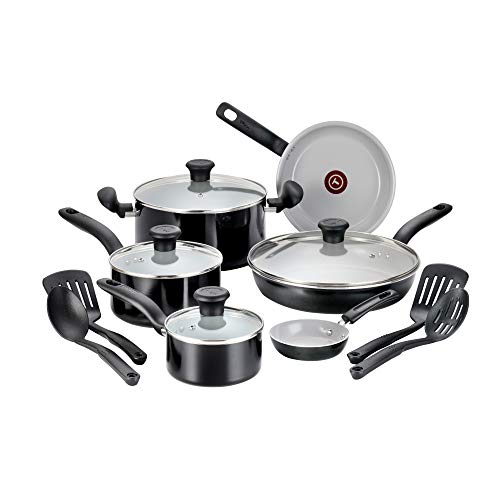
T-fal Initiatives Ceramic 14-Piece Cookware Set — Best Overall Cheapest
The Initiatives Ceramic set is what the bottom of the honest market looks like when a major maker does it properly: even-heating aluminium, a ceramic nonstick surface, and a complete starter selection. It suits first apartments, student kitchens, and anyone furnishing a kitchen from zero on the tightest sensible budget. Cooks who sear at high heat daily should stretch to the stainless pick below — ceramic rewards gentler cooking, as this guide explains.
Strengths
- Ceramic nonstick releases food easily and cleans with a wipe
- Aluminium bodies heat fast and evenly for the tier
- Complete starter selection from a maker with a long track record at this price level
Trade-offs
- Ceramic coating lifespan is finite and shortens with high heat
- Not a high-heat searing set — keep to low and medium settings
- Lightweight construction will not satisfy cooks who want heft
| Specification | Detail |
|---|---|
| Material | Ceramic nonstick on aluminium |
| Pieces | 14-piece set |
| Line | T-fal Initiatives Ceramic |
T-fal’s scale is the consumer’s friend here: a high-volume maker can put a competent ceramic surface and properly flat bases into a box at a tier where unknown brands cut exactly those corners. In daily use the set behaves — eggs slide, sauces release, pasta water boils without drama — and the pieces cover a starter kitchen’s real needs. The discipline it asks in return is heat discipline: preheat gently, cook on medium, and the coating will give you its full service life. For a first kitchen bought on a strict budget, this is the set that respects both the budget and the cook.
Best for: first kitchens and tight budgets wanting easy ceramic nonstick. / Not suited for: high-heat searing or decade-long expectations.
Check the current price on Amazon

GreenLife 12-Piece Ceramic Nonstick Cookware Set — Best Cheap Ceramic Set
GreenLife specialises in exactly this corner of the market — ceramic nonstick for everyday cooks — and the 12-piece set is its focused starter box. It suits cooks whose repertoire is eggs, vegetables, grains, soups, and sauces, and who want cheerful, light pans that clean in seconds. It is not built for steakhouse searing or for cooks who are hard on coatings; within its gentle brief, it is excellent value.
Strengths
- Slick ceramic release when fresh, with wipe-clean convenience
- Soft-grip handles and light weight suit everyday handling
- Focused 12-piece selection without novelty filler
Trade-offs
- Ceramic release fades over time, faster with high heat or metal utensils
- Colourful finishes show wear more honestly than black or steel
- Gentle-heat brief excludes serious searing
| Specification | Detail |
|---|---|
| Material | Ceramic nonstick |
| Pieces | 12-piece set |
| Colour | Pink (this listing) |
The case for this set is daily ease per dollar. Breakfast slides out of the skillet, rice releases from the saucepan, and the sink work after dinner is measured in moments. GreenLife’s ceramic surface is at its best in exactly the low-to-medium-heat cooking most weeknight meals involve, and the handles stay comfortable through it. Owners who treat it as the gentle tool it is — soft utensils, moderate heat, a soft sponge — report the longest service, which is the recurring theme of this entire guide: at the cheapest tier, your habits are the warranty.
Best for: gentle everyday cooking with the easiest cleanup. / Not suited for: high-heat cooks or anyone rough on coatings.
Check the current price on Amazon

Cuisinart Chef’s Classic Stainless 10-Piece Cookware Set — Cheapest Stainless Worth Keeping
This is the pick for the buyer who hears ‘cheapest’ and thinks in years. The Chef’s Classic 10-piece (77-10P1) is stainless, so there is nothing to wear out; its cost per year undercuts every coated set in this guide if you keep it, and most owners do. It suits cooks willing to learn the single preheat habit stainless asks for. If your cooking is built on effortless eggs every single morning and you will never preheat a pan, the ceramic picks above are your honest match.
Strengths
- No coating — the set’s lifespan is measured in decades, not coating cycles
- Solid, even-heating bases and secure, comfortable handles
- Compact selection of genuinely useful vessels
Trade-offs
- Highest upfront tier among these cheapest picks, repaid over time
- Stainless sticks for beginners until the preheat technique clicks
- Base-driven heating rather than full cladding
| Specification | Detail |
|---|---|
| Material | Stainless steel |
| Pieces | 10-piece set (77-10P1) |
| Line | Cuisinart Chef’s Classic |
Run the arithmetic the way this guide does and the 77-10P1 is arguably the cheapest set on the page: buy it once, cook on it for a decade or more, and its yearly cost falls below any coated set replaced on a two-to-three-year cycle. The cooking is honest stainless — flat bases, even enough heat, deglazing that works, and a surface that a powdered cleanser restores to bright in minutes. For a renter, a student with a long course ahead, or a household tired of rebuying pans, this is the cheapest decision that ends the rebuying.
Best for: buyers who define cheapest as lowest cost per year. / Not suited for: nonstick-only cooks who will not preheat.
Check the current price on Amazon

Rachael Ray Cucina 12-Piece Nonstick Cookware Set — Best Cheap Nonstick with Style
The Cucina set proves a cheapest-tier set can still be pleasant: grippy, comfortable handles, even-heating aluminium, and colours that make a rental kitchen feel owned. It suits everyday cooks who want nonstick ease with a little personality and mostly cook at moderate heat. Serious searers and metal-utensil households should choose stainless; nonstick of any brand asks for soft tools and sane heat.
Strengths
- Comfortable silicone-wrapped handles stay secure in the hand
- Aluminium bodies heat quickly and evenly for weeknight cooking
- Colour options — the checked listing is Agave Blue — brighten a basic kitchen
Trade-offs
- Nonstick coating is a consumable with a lifespan in years
- Silicone handle wraps cap oven use compared with all-metal handles
- Not induction-focused — check your stove type before buying
| Specification | Detail |
|---|---|
| Material | Aluminium nonstick |
| Pieces | 12-piece set |
| Colour | Agave Blue (this listing) |
What you feel first is the handles: the Cucina line’s padded grips are genuinely the most comfortable at this tier, and comfort is not trivial in pans you lift daily. The aluminium bodies do the simple things right — flat bases, quick and even heating, nonstick that handles the egg-pancake-fish rotation with ease. Like every nonstick set here, it will serve longest on medium heat with soft utensils. For the cook furnishing a first real kitchen who wants cheap, cheerful, and competent in one box, Cucina is the warm-hearted pick of this guide.
Best for: everyday nonstick cooking with comfort and colour. / Not suited for: induction owners (verify your stove) or high-heat searing.
Check the current price on Amazon

Farberware EcoAdvantage 13-Piece Cookware Set — Best Cheap Eco-Leaning Set
Farberware has furnished budget kitchens for generations, and the EcoAdvantage set is its current answer: nonstick convenience, a complete selection, and materials messaging aimed at buyers who read labels. It suits first kitchens, spare kitchens, and holiday-let or dorm cooking where honest basics matter more than heirloom ambitions. Keep expectations calibrated — this is competent budget cookware, not a premium set in disguise — and it delivers exactly what it promises.
Strengths
- Complete 13-piece starter selection from a long-running budget brand
- Nonstick convenience with easy cleanup for daily basics
- Eco-leaning positioning for label-conscious buyers
Trade-offs
- Budget construction — lighter and less refined than the stainless picks
- Coating lifespan in years, as with all nonstick at this tier
- Fewer premium touches: handles and lids are functional, not luxurious
| Specification | Detail |
|---|---|
| Material | Nonstick cookware set |
| Pieces | 13-piece set |
| Line | Farberware EcoAdvantage |
The EcoAdvantage earns its place by being the sort of set that simply works in the kitchens that need it most: the first flat, the guest house, the weekday rental. Pieces cover the basics, the nonstick handles the basics, and nothing about it demands ceremony. Its presence in this guide is also a calibration point — this is what the bottom of the honest market looks like from a known maker, and anything dramatically cheaper from an unknown name should be asked what it removed to get there. Bought with clear eyes, it is a fair tool at a fair, low tier.
Best for: first, spare, and rental kitchens needing honest basics cheaply. / Not suited for: enthusiasts or buy-it-for-life shoppers.
Check the current price on Amazon

GreenLife 16-Piece Ceramic Nonstick Cookware Set — Cheapest Complete Ceramic Kitchen
Where the 12-piece GreenLife above is the focused starter, this 16-piece set is the whole-kitchen-in-one-box version for buyers who need everything at once, cheaply. It suits new households, shared houses, and anyone equipping a kitchen from empty cupboards in a single order. The same ceramic rules apply — gentle heat, soft utensils — and cooks planning heavy searing should anchor their kitchen with the stainless pick instead and treat this as the convenience fleet.
Strengths
- Largest ceramic selection at this tier — a full kitchen in one box
- Easy-release ceramic surface and wipe-clean care throughout
- Lightweight pieces with soft-grip handles suit all cooks in a shared house
Trade-offs
- More pieces means more coating to maintain with gentle habits
- Ceramic lifespan is the shortest in this guide under hard use
- Includes lids and accessories in the count, as all makers do
| Specification | Detail |
|---|---|
| Material | Ceramic nonstick |
| Pieces | 16-piece set |
| Colour | Black (this listing) |
Completeness is this set’s argument: skillets, saucepans, stockpot, and the supporting pieces arrive together, matched, at a tier a new household can actually manage. In a shared or first kitchen, that one-box completeness prevents the classic problem of owning four pans that suit nothing you cook. The ceramic surface keeps the daily experience pleasant — food releases, washing is trivial — and the black finish is the forgiving choice cosmetically. Equip the kitchen with this, cook gently, and add one serious stainless skillet later when the budget recovers: that two-step strategy is how many good kitchens actually begin.
Best for: equipping an entire first kitchen in one cheap box. / Not suited for: high-heat cooking or maximum coating longevity.
Check the current price on Amazon
Comparison Table
| Pick | Badge | Key spec | Best for |
|---|---|---|---|
| T-fal Initiatives Ceramic 14-Piece Cookware Set | Best Overall Cheapest | Ceramic nonstick on aluminium | first kitchens and tight budgets wanting easy ceramic nonstick. |
| GreenLife 12-Piece Ceramic Nonstick Cookware Set | Best Cheap Ceramic Set | Ceramic nonstick | gentle everyday cooking with the easiest cleanup. |
| Cuisinart Chef’s Classic Stainless 10-Piece Cookware Set | Cheapest Stainless Worth Keeping | Stainless steel | buyers who define cheapest as lowest cost per year. |
| Rachael Ray Cucina 12-Piece Nonstick Cookware Set | Best Cheap Nonstick with Style | Aluminium nonstick | everyday nonstick cooking with comfort and colour. |
| Farberware EcoAdvantage 13-Piece Cookware Set | Best Cheap Eco-Leaning Set | Nonstick cookware set | first, spare, and rental kitchens needing honest basics cheaply. |
| GreenLife 16-Piece Ceramic Nonstick Cookware Set | Cheapest Complete Ceramic Kitchen | Ceramic nonstick | equipping an entire first kitchen in one cheap box. |
How to Choose the Best and Cheapest Cookware Sets Without Buying Junk
Set your floor before you shop. A set below the honest floor saves money once and costs it repeatedly: bases warp until pans spin on the burner, coatings fail within months, and handles work loose. The floor is defined by construction, not brand glamour — aluminium or stainless bodies of sensible thickness, flat bases, securely attached handles, and a coating from a maker who also sells replacements and answers for their products. Every set in this guide sits on the right side of that floor; anything dramatically cheaper should be asked, piece by piece, what it removed.
Then choose your material by your cooking temperature. If most of your cooking is gentle — eggs, vegetables, grains, sauces, reheating — ceramic nonstick at this tier is the easiest and cheapest daily experience, and its shorter coating life is an acceptable trade. If you sear meat, brown onions hard, or use metal utensils without thinking, stainless is your cheap set, because its slightly higher upfront tier buys a surface that cannot wear out. Many smart budget kitchens mix both: a stainless anchor skillet plus a cheap ceramic set for everything gentle.
Finally, count vessels, not pieces, and match sizes to your household. Lids, utensils, and bakeware inflate counts at this tier more than anywhere else. A two-person household needs a small and a large skillet, two saucepans, and a stockpot it can lift when full of water; a family needs the larger vessels and will waste money on tiny novelty pans. The cheapest set is the one whose actual vessels match your actual cooking — everything else is storage you paid for.
How to Set Up a First Kitchen Around a Cheap Cookware Set
Unbox with a plan. Wash every piece in hot soapy water before first use, dry thoroughly, and check each base sits flat on your burner — a pan that rocks on day one goes back, because rocking only gets worse. Assign storage that protects surfaces from day one: coated pans stacked with a cloth between them, or hung if you have the rail. The five minutes spent here are worth months of coating life.
Learn your set’s heat map in the first week. Boil water in each saucepan and note how your burners behave; toast a slice of bread in the dry skillet to see its hot spots — every cheap set has a personality, and knowing yours is free performance. Cook your first meals gently: eggs and vegetables teach you the release and the heat response without risking a burnt-on disaster that scars a new coating.
Set the house rules immediately, because cheap sets die by other people’s habits: soft utensils live in the jar by the stove, coated pans never sit empty on high heat, and everything gets washed gently and dried rather than left soaking. Write the rules on a note inside a cupboard door if the kitchen is shared. Followed from day one, these habits routinely double the useful life of a cheapest-tier set — the difference between a bargain and a false economy is almost always behaviour, not the box.
What Ultra-Cheap Sets Get Wrong: A Failure-Mode Tour
To understand where the honest floor sits, it helps to name the failures that live below it. The first is the warped base: thin metal, heated unevenly, gradually domes until the pan spins on a glass hob and pools oil at its edges. It begins within weeks and never reverses. The second is the hot-spot base — metal so thin that the burner’s shape prints itself into your food as a ring of scorch with raw food between. Both failures are thickness failures, and both are invisible in a product photograph, which is why this guide’s cheapest picks come from makers whose bases have a track record.
The third failure is coating chaos: unbranded nonstick of unknown composition that bubbles, flakes, or loses release within months, sometimes into food. Established makers’ coatings — T-fal’s, GreenLife’s, Rachael Ray’s — are formulated, tested, and warranted; the price difference between them and mystery coatings is small, and it is the worst saving in the category. The fourth failure is hardware: handles attached by a single screw into thin metal, loosening with thermal cycles until a saucepan of boiling water wobbles. Every pick in this guide was screened for riveted or robustly welded handles precisely because a handle failure is a safety failure, not an inconvenience.
The fifth failure is the dishonest count — a box advertising dozens of pieces that resolves into eight vessels, four lids, and a drawer of utensils you already own. It is the most legal failure and the most common. Read together, these five failures define the floor this guide shops above: adequate metal thickness, known coatings, secure handles, honest counts. The sets above the floor are cheap. The sets below it are expensive at any price, because you will buy them twice and cook badly in between.
The Two-Step Budget Kitchen: Buy Complete Now, Buy Forever Next
The smartest cheap-kitchen strategy this guide can offer is a sequence, not a set. Step one is breadth: a complete, honest cheap set — the T-fal Initiatives or GreenLife 16-piece above — that puts a working vessel on every burner from day one. Breadth matters because real cooking is simultaneous: pasta, sauce, vegetables, and protein at once. A household that buys two beautiful pans first owns two beautiful pans and a daily logistics problem.
Step two, when the budget recovers — a birthday, a tax refund, a few months of the savings the cheap set created — is depth: one durable anchor piece, most often a stainless or clad skillet like the Cuisinart tradition represented in this guide, bought open-stock. The anchor takes over the high-heat, high-abuse work that ages cheap coatings fastest: searing, browning, deglazing. The cheap set, relieved of its hardest duty, lasts noticeably longer in its gentle roles — eggs, grains, sauces, reheating — and the kitchen’s total capability jumps more than either purchase could achieve alone.
Notice what this sequence avoids: debt for a mid-tier set bought all at once, and the false economy of rebuying the cheapest set on a cycle. Total spending across five years typically lands below the mid-tier route, while cooking quality from month six onward matches or beats it. Cheap, done in the right order, is not a compromise — it is a plan, and it is how most good home kitchens were actually built.
Safety at the Cheapest Tier: What to Check and What to Avoid
Cheap cookware raises fair safety questions, and they have concrete answers. For coatings, buy from established makers whose nonstick and ceramic surfaces are formulated to current standards and sold through accountable retail channels — every coated pick in this guide qualifies. The sets to avoid are unbranded imports with no maker to name: their coatings, handle attachments, and materials have no track record and no one standing behind them. The price gap between a named maker’s cheapest set and a mystery set is small; the accountability gap is total.
For all cookware at any tier, the physical checks are the same and take a minute: bases flat, handles immovable when you grip and twist, lids seated without rocking, and no sharp unfinished edges on rims. Repeat the handle check after the first month of cooking — thermal cycling reveals weak attachments early, while returns are still easy. A handle that loosens is retired, not tightened-and-hoped, when it carries boiling water over a floor where people walk in socks.
Use adds two habits: never leave an empty coated pan on high heat — overheated coatings degrade, and the fumes from severely overheated traditional nonstick are a genuine hazard to pet birds and no one’s friend — and never plunge a hot pan into cold water, which warps cheap bases fastest. These are not reasons to fear the cheapest tier; they are the operating instructions that make the cheapest tier from honest makers a safe, rational purchase, as the picks here demonstrate daily in millions of kitchens.
Cooking Well on Cheap Pans: Technique Compensations That Work
Cheap pans ask a little more of the cook, and technique pays the difference. The first compensation is patience at preheat: thinner bases heat in streaks if rushed, so give the pan a full minute on medium and let the heat even out before food arrives — then the same pan that scorched a pancake at full blast cooks it evenly at a calmer setting. Learning your burner’s true medium is the cheapest performance upgrade in this entire guide.
The second compensation is batch discipline. Crowding a light skillet drops its temperature and steams food grey; cooking in two smaller batches keeps the pan in its competent zone and produces browning that a single crowded batch never will. The third is moisture management: pat protein dry, because a thin pan’s limited heat reserve is spent boiling surface water instead of building crust. The fourth is fat timing — oil into the hot pan, seconds before the food — which protects both the food and the coating.
None of these habits is a hardship; they are simply cooking, practised slightly more attentively, and they transfer upward forever — the cook who learns them on a T-fal Initiatives will be formidable on clad stainless later. That is the hidden dividend of the cheapest tier done honestly: it teaches the fundamentals that expensive pans forgive but never teach.
Second-Hand, Hand-Me-Downs, and the Cheapest Set of All
The genuinely cheapest cookware is the set you do not buy new: relatives’ duplicates, estate sales, and the stainless pan at a charity shop that will outlive us all. Stainless is the second-hand star precisely because it has no coating to assess — a clad or heavy stainless pan can be scrubbed back to service with a powdered cleanser, and its only fatal flaws are a warped base or a loose handle, both checkable in ten seconds with a flat counter and a firm grip.
Coated pans second-hand are a judgement call: inspect the surface in good light and decline anything scratched through, bubbled, or flaking, because a coating’s remaining life is unknowable and its best years are spent. A lightly used ceramic set from a known maker, by contrast, can be a legitimate bargain for gentle cooking. Lids, incidentally, are the great second-hand bargain — universal sizes fit across brands, and a missing lid is the easiest gap in a cheap kitchen to close for pennies.
However the kitchen is assembled — new cheapest set, second-hand stainless, hand-me-downs — the system in this guide still applies: audit the vessels against your cooking, protect surfaces in storage, and cook gently on coatings. The cheapest set is not a product; it is a method, and the method works at every budget including zero.
Energy, Time, and the Hidden Running Costs of Cheap Cookware
A cookware set’s price is paid once; its running costs are paid at every meal, in energy and minutes. Thin, warped pans waste both — poor contact with the hob means longer preheats and higher settings to achieve the same cooking, a tax levied three times a day. The flat, honest bases on this guide’s cheapest picks are therefore not just cooking quality; they are the set’s energy rating, and they repay their small premium over mystery cookware in utility bills and in evenings not spent waiting for water to boil.
Lids are the second running cost. A lid that fits holds a simmer on a lower burner setting and cooks rice and grains with a fraction of the energy of a rattling, steam-leaking mismatch. Every pick here was screened for lid fit for exactly this reason: at the cheapest tier, a good lid is the highest-return component in the box, silently saving money at every single meal for the life of the set.
Time is the third cost, and cheap sets price it through cleanup. Ceramic and nonstick surfaces that release food wash in a minute; a scorched thin pan soaks for an hour. Across a year of daily cooking, the difference between the honest cheap sets in this guide and the flimsy ones below the floor is measured in evenings. Cheap, properly understood, was never only about the number on the box.
When a Piece Fails: Repair, Replace, or Retire — a Cheap-Kitchen Protocol
Even honest cheap cookware eventually presents a failing piece, and a calm protocol saves money and fingers. A loose handle on a vessel that carries hot liquid is a retirement, not a repair project, unless the maker supplies the part and the fitting is designed for it — safety outranks thrift precisely here. A warped base on a glass or induction hob is likewise a retirement for that pan’s stovetop career, though the same pan may live on happily in the oven if its coating and handles allow.
Coating failure follows a gentler path. A nonstick skillet whose release has faded despite correct preheating has reached its designed end; replace that single piece — makers in this guide sell open-stock equivalents — rather than condemning the saucepans and stockpot that share none of its wear. This piece-by-piece honesty is how a cheap set’s total cost stays cheap across a decade: the fleet retires individually, on evidence, at the pace of actual use.
Keep the protocol written where the kitchen can find it, along with purchase dates jotted on the box or a phone note. Knowing a skillet is in year three of gentle service versus year one of abuse changes the diagnosis of every fault, and the household that tracks its pans spends the least on them — the final, fitting paradox of the cheapest tier done right.
A Word on Dignity: Cheap Kitchens Cook Serious Food
It is worth saying plainly, because cookware marketing works hard to obscure it: the price of the pan has never cooked a meal. The world’s great peasant cuisines — the braises, stir-fries, soups, and flatbreads that professional chefs study with reverence — were built on equipment humbler than anything in this guide, by cooks whose entire advantage was attention. A T-fal Initiatives set in attentive hands will outperform a flagship set in distracted ones every day of the week, and the gap is not small.
What cheap cookware honestly demands is presence: watch the heat, because the pan will not buffer your absence; season deliberately, because there is no luxury ingredient budget to hide behind; and taste as you go, because your palate is the most sophisticated instrument in any kitchen at any budget. These are not consolations. They are the actual skills of cooking, and the cheapest tier teaches them without tuition fees because it cannot afford to hide their absence.
Buy the honest cheap set, then, without a whisper of apology — to guests, to family, or to yourself. Spend the savings where they change the food: fresher ingredients, better staples, a knife that gets sharpened. The cooks who internalise this ordering of priorities are recognisable at the table long before anyone sees their pans, and their kitchens — however cheap the cookware — are the ones people ask to be invited back to.
The Cheapest Set Is the One You Never Regret at the Stove
Regret at the stove has a specific flavour: it is the warped pan spinning while you hold it with one hand and stir with the other, the coating that gave up in month four, the stockpot too small for the soup you actually make. Every pick in this guide was screened to keep that flavour out of your kitchen — flat bases, known coatings, secure handles, honest counts — because at the cheapest tier the difference between a bargain and a regret is decided entirely by those unglamorous details.
Buy with the floor in mind, cook with the gentle habits this guide describes, and let the two-step plan carry your kitchen from complete-now to complete-forever at the pace your budget allows. That is the whole philosophy of the cheapest tier done right: no drama, no rebuying, no apology — just dinner, cooked properly, on pans that cost less than the ingredients passing through them this month.
Common Buying Mistakes
Chasing the absolute lowest number. Below the honest construction floor, a set is a short rental. Cheap means lowest cost for cookware that works — not the smallest figure on a box.
Counting pieces instead of vessels. At this tier counts are padded hardest. List the actual pots and pans, with sizes, before comparing any two sets.
Burning the first meal into a new coating. New ceramic and nonstick deserve a gentle first week. One scorched, scrubbed disaster can age a coating by a year.
Using metal utensils because they are handy. One metal spatula habit ends nonstick early. Keep soft utensils at the stove and metal ones for stainless and serving.
Expecting one cheap set to do everything forever. Plan the two-step kitchen: a complete cheap set now, one durable anchor pan later. That is how real budget kitchens become good kitchens.
Final Recommendation
For a single cheapest recommendation, the T-fal Initiatives Ceramic 14-Piece is the best and cheapest cookware sets pick for most first kitchens — complete, competent, and from a maker that stands behind the tier. Ceramic fans wanting more pieces should take the GreenLife 16-Piece, or its tidier 12-Piece sibling for smaller households. Buyers who think in cost per year should stretch once to the Cuisinart Chef’s Classic stainless set and stop rebuying. The Rachael Ray Cucina adds comfort and colour, and the Farberware EcoAdvantage covers spare and rental kitchens honestly. Whichever you choose, treat heat gently and utensils kindly, and a cheap set will repay you far beyond its tier. Compare the neighbouring guides before you decide: Best Cookware Sets, Best And Affordable Cookware Sets, Best American Made Cookware Sets, Best Nonstick Cookware Sets, and Best Ceramic Cookware Sets.
One last encouragement for the cheapest-tier buyer: every experienced cook you admire started on equipment at or below this level, and many of their favourite pans still come from it. Skill is the only cookware upgrade that cannot be bought, and the honest cheap sets in this guide are unusually good teachers precisely because they respond plainly to heat, timing, and care. Buy the set, cook relentlessly, and let the compliments at your table — not the price tag in your cupboard — be the measure of the kitchen you have built.
Frequently Asked Questions
What is the cheapest cookware set that is still worth buying?
The sets in this guide mark the floor: established makers, flat even-heating bases, secure handles, and known coatings. The T-fal Initiatives Ceramic set is our benchmark — below its level, sets typically fail on warping, coatings, or handles within the first year.
Is stainless or nonstick cheaper in the long run?
Stainless, if you keep it: a set like the Cuisinart Chef’s Classic has no coating to replace and can serve for decades, so its cost per year undercuts coated sets replaced every few years. Nonstick is cheaper upfront and easier daily — the trade is lifespan.
How long will a cheap ceramic set last?
With gentle heat, soft utensils, and hand washing, expect a few years of good release, fading gradually. High heat and metal utensils shorten that dramatically. When release fades despite correct preheating, the coating has reached the end of its service.
Why do cheap sets advertise so many pieces?
Because lids, utensils, and sometimes bakeware all count as pieces. A 16-piece set may hold eight vessels. Always compare the actual pots and pans and their sizes — that is the cookware you are buying.
Can cheap cookware go in the oven?
Many pieces can within limits, but silicone-wrapped handles and nonstick coatings cap temperatures, and limits vary by set. Check the specific listing for the set you choose and treat the lowest-rated component — usually the handle or coating — as the ceiling.
What is the smartest way to build a kitchen on a tiny budget?
Buy one complete, honest cheap set for breadth — the T-fal or GreenLife here — then add a single durable stainless skillet when you can. You get a working kitchen immediately and a lifetime anchor piece soon after, for less total than a mid-tier set bought on credit.

