Disclosure: airfryerkitchensupply.com is reader-supported. When you buy through links on our site, we may earn an affiliate commission at no extra cost to you.
Where to buy
Affordable only counts if the set still cooks well in year three, so every set below was confirmed through Amazon’s product data and chosen for construction, not just a low headline number. You will find clad stainless, honest hard-anodized nonstick, and ceramic nonstick options — follow the link for the exact set named, confirm the piece list matches your needs, and check price on Amazon, since affordable sets are the most heavily discounted and prices move often.
- Cuisinart Chef’s Classic Stainless 11-Piece Cookware Set (77-11G) — check price on Amazon
- Tramontina Tri-Ply Clad Stainless Steel 10-Piece Cookware Set — check price on Amazon
- T-fal Ultimate Hard Anodized Nonstick 17-Piece Cookware Set — check price on Amazon
- GreenLife 16-Piece Ceramic Nonstick Cookware Set — check price on Amazon
- Calphalon Classic Stainless Steel 10-Piece Cookware Set — check price on Amazon
- Cuisinart Chef’s Classic Stainless 10-Piece Cookware Set — check price on Amazon
Finding the best and affordable cookware sets is a balancing act, because the cheapest box on the shelf is usually the most expensive mistake: thin bases warp, coatings tire within a couple of years, and handles loosen just as you have learned the set’s quirks. Affordable done right means something different — real construction, honestly sized pieces, and materials matched to how you cook, at the accessible end of the market. Every set in this guide clears that bar, and several of them cook far above what their tier suggests.
The strategy that works at this level is to decide your material first. Fully clad or well-made stainless, like the Cuisinart and Tramontina sets below, costs a little more upfront but has no coating to wear out — it is the value pick for a decade, not a season. Hard-anodized nonstick from T-fal trades ultimate lifespan for effortless eggs and easy cleanup at a very accessible tier. Ceramic nonstick from GreenLife is the choice for cooks who want a coating-free nonstick experience and mostly cook gently. None of these is a wrong answer; they are answers to different kitchens.
A final note on piece counts at this tier: affordable sets pad counts with lids and utensils, so this guide compares the actual vessels. An affordable set whose skillet, two saucepans, and stockpot match your household will serve you better than a giant box of pieces in sizes nobody uses. The picks below were chosen vessel by vessel, and the buying guide later in this article shows you how to run the same audit on any set you are considering.
In this guide
Quick Picks
Cuisinart Chef’s Classic Stainless 11-Piece Cookware Set (77-11G) — Best Overall Affordable. Induction-ready stainless with cool-grip handles and a complete, sensible piece mix at an accessible tier. The affordable set most likely to still be your daily set in ten years. Check the current price on Amazon
Tramontina Tri-Ply Clad Stainless Steel 10-Piece Cookware Set — Best Value Clad Stainless. True tri-ply clad construction — heat up the walls, not just the base — at an affordable-tier price. The performance-per-dollar champion of this guide. Check the current price on Amazon
T-fal Ultimate Hard Anodized Nonstick 17-Piece Cookware Set — Best Affordable Nonstick. Hard-anodized bodies with T-fal’s durable nonstick and thermo-spot indicators across a big, family-sized selection. The affordable nonstick set to buy if nonstick is your priority. Check the current price on Amazon
GreenLife 16-Piece Ceramic Nonstick Cookware Set — Best Affordable Ceramic Nonstick. Ceramic nonstick across a generous 16-piece selection, with soft-grip handles and an easy-clean ethos. For cooks who want nonstick convenience without a traditional coating. Check the current price on Amazon
Calphalon Classic Stainless Steel 10-Piece Cookware Set — Best Affordable Stainless Upgrade. Impact-bonded aluminium bases, stay-cool handles, and Calphalon’s tidy fit and finish at an affordable tier. The polished step up from basic stainless. Check the current price on Amazon
Cuisinart Chef’s Classic Stainless 10-Piece Cookware Set — Best Affordable for Small Kitchens. The long-running Chef’s Classic 10-piece (77-10P1): the same durable stainless formula in a compact selection that suits apartments and smaller households. Check the current price on Amazon
How These Picks Were Chosen
We confirmed each candidate set through Amazon’s product data, then filtered hard on construction: no unbonded single-ply stainless that scorches, no mystery coatings, no sets whose useful vessels were outnumbered by filler. Remaining sets were ranked on heat evenness for their class, handle and lid quality, induction compatibility where offered, oven limits, and — decisively at this tier — the real-world piece mix: the skillet sizes, saucepan sizes, and stockpot capacity a household actually uses weekly. Value was judged as cost against expected years of service, which is why durable stainless sets rank alongside cheaper nonstick ones rather than below them.
The 6 Best And Affordable Cookware Sets

Cuisinart Chef’s Classic Stainless 11-Piece Cookware Set (77-11G) — Best Overall Affordable
The Chef’s Classic 11-piece is the set this guide hands to anyone who asks for affordable cookware that will not need replacing. It suits everyday cooks who want stainless durability, induction compatibility, and stay-cool handles without entering premium territory. It asks for basic stainless technique — preheat, then oil — so committed nonstick-only cooks should look at the T-fal or GreenLife picks below instead.
Strengths
- Stainless construction with no coating to wear out — the lifespan argument wins at this tier
- Induction compatible and oven safe, with cool-grip handles that genuinely stay comfortable
- Complete, practical piece mix covering daily cooking for most households
Trade-offs
- Not fully clad — heat is driven by the base, so sidewall scorching is possible with careless heat
- Stainless surface needs the preheat technique for eggs and delicate fish
- Polished finish shows water spots unless dried after washing
| Specification | Detail |
|---|---|
| Material | Stainless steel |
| Pieces | 11-piece set (77-11G) |
| Compatibility | Induction compatible |
| Handles | Cool-grip handles |
What makes this set the value benchmark is how few compromises show up in daily use. The bases are substantial enough to sit flat and heat evenly for weeknight cooking, the handles are among the most comfortable in the affordable class, and the lids fit well enough to hold a proper simmer. Because there is no coating, the set tolerates metal utensils, high-heat searing, and the occasional dishwasher cycle without a countdown clock on its life. Cuisinart’s listing describes it as non-toxic, PFAS-free stainless — the simple, durable end of cookware chemistry. If your budget stretches to exactly one set and you want it to last, this is where the money goes.
Best for: most households wanting affordable stainless that lasts. / Not suited for: cooks who refuse to learn basic stainless preheating.
Check the current price on Amazon

Tramontina Tri-Ply Clad Stainless Steel 10-Piece Cookware Set — Best Value Clad Stainless
Tramontina’s Tri-Ply Clad line has embarrassed far more expensive sets in kitchen tests for years, and the 10-piece is its sweet spot. It suits cooks who sear, deglaze, and build pan sauces — techniques that reward clad construction — on an affordable budget. Like all stainless, it will not coddle a fried egg the way nonstick does, and it is the pick for cooks willing to learn the one preheat habit that fixes that.
Strengths
- Genuine tri-ply clad body heats evenly across the base and up the sidewalls
- Searing and deglazing performance close to premium clad sets
- Oven-safe, broiler-friendly stainless with no coating lifespan to manage
Trade-offs
- Mirror finish demands a little upkeep to stay pretty
- Handles are functional rather than luxurious
- Stainless learning curve applies in full
| Specification | Detail |
|---|---|
| Construction | Tri-ply clad stainless steel |
| Pieces | 10-piece set |
| Material | Stainless steel, aluminium core |
Clad construction at this tier changes what weeknight cooking feels like: onions brown evenly instead of in a ring, a pan sauce reduces without a scorched crescent at the edge, and a skillet of chicken skin crisps uniformly. Tramontina achieves it by bonding aluminium between stainless layers across the whole pan, the same architecture as premium sets, while trimming cost in finish and branding rather than in the pan itself. For an ambitious home cook on a budget, no other affordable set buys this much real cooking performance — it is the set most likely to make you better at cooking, because it responds the way cookbooks assume your pan responds.
Best for: ambitious cooks wanting clad performance on an affordable budget. / Not suited for: nonstick devotees or anyone who hates hand-washing.
Check the current price on Amazon

T-fal Ultimate Hard Anodized Nonstick 17-Piece Cookware Set — Best Affordable Nonstick
Some kitchens simply run on nonstick — eggs before school, fish on Fridays, sauces that must not weld themselves to the pan — and this T-fal set serves them at the most accessible tier in this guide. It suits busy families who value release and fast cleanup over decades-long lifespan. Cooks who sear hard at high heat daily will wear any nonstick faster and should consider the stainless picks instead.
Strengths
- Hard-anodized aluminium bodies heat quickly and evenly for the class
- Thermo-spot heat indicator takes the guesswork out of preheating
- Large 17-piece selection covers family cooking, including the big vessels smaller sets skip
Trade-offs
- Nonstick is a consumable — expect years, not decades, from the coating
- Not the set for ripping-hot searing or metal utensils
- Piece count includes lids and accessories, as always at this tier
| Specification | Detail |
|---|---|
| Material | Hard-anodized aluminium, nonstick |
| Pieces | 17-piece set |
| Brand line | T-fal Ultimate Hard Anodized |
T-fal’s advantage is experience: its hard-anodized nonstick is among the most proven at the affordable tier, releasing eggs cleanly and surviving the family rotation of pancakes, stir-fries, and reheated everything. The thermo-spot — the pattern in the pan centre that turns solid when the pan is preheated — sounds like a gimmick and behaves like a genuinely useful teacher, especially for younger cooks. Treat the set kindly — medium heat, soft utensils, hand washing when you can — and it returns several years of effortless service, which at this tier is the honest bargain nonstick offers.
Best for: families who cook on nonstick daily and want maximum coverage affordably. / Not suited for: high-heat searing devotees or buy-it-for-life shoppers.
Check the current price on Amazon

GreenLife 16-Piece Ceramic Nonstick Cookware Set — Best Affordable Ceramic Nonstick
GreenLife built its name on ceramic nonstick at accessible prices, and this 16-piece set is its full-kitchen statement. It suits gentle-to-medium-heat cooks — eggs, vegetables, grains, sauces — who want easy release and easier cleanup in cheerful, lightweight pans. It is not the set for high-heat searing or for cooks who are rough on coatings; ceramic rewards a gentler hand, as the care section below explains.
Strengths
- Ceramic nonstick releases food easily and wipes clean with minimal effort
- Lightweight bodies and soft-grip handles are friendly for everyday handling
- Generous piece count covers a full starter kitchen in one box
Trade-offs
- Ceramic coatings wear faster than hard-anodized nonstick under high heat
- Best kept to low and medium heat — not a searing set
- Lightweight feel will not suit cooks who equate heft with quality
| Specification | Detail |
|---|---|
| Material | Ceramic nonstick |
| Pieces | 16-piece set |
| Colour | Black (this listing) |
The honest way to frame ceramic nonstick is as a comfort technology: nothing releases quite as slickly when the coating is fresh, cleanup is a wipe rather than a scrub, and the pans are light enough for anyone to handle comfortably. The trade is lifespan — ceramic surfaces gradually lose release, faster if overheated — so this set makes most sense for cooks whose style is naturally gentle and who value the daily ease over a ten-year horizon. Cooked within its limits, the GreenLife 16-piece delivers the easiest weeknight experience in this guide, at a genuinely affordable tier.
Best for: gentle-heat cooks who prize easy release and cleanup. / Not suited for: high-heat searing or maximum coating lifespan.
Check the current price on Amazon
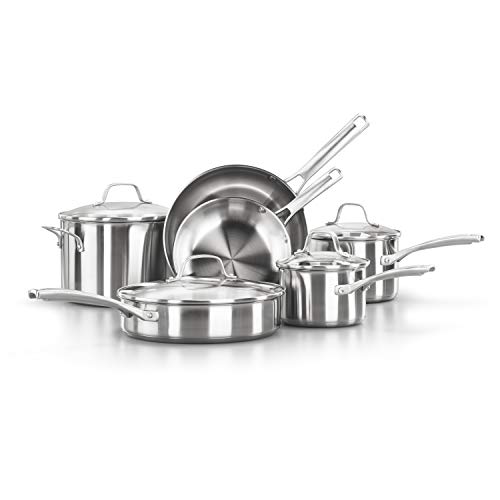
Calphalon Classic Stainless Steel 10-Piece Cookware Set — Best Affordable Stainless Upgrade
Calphalon’s Classic stainless set is the affordable pick for cooks who notice details: handles that stay cool, lids that sit properly, and bases engineered for even heating. It suits households upgrading from a first cheap set who want stainless durability with a more refined daily feel. Oven work is capped lower than some rivals, as the specs note, so dedicated high-heat oven cooks should check the Tramontina above.
Strengths
- Impact-bonded aluminium base spreads heat evenly and resists warping
- Stay-cool handles and well-fitting lids elevate daily use
- Stainless durability with no coating to replace
Trade-offs
- Base-driven heating rather than full cladding — sidewalls run cooler
- Oven safe to 450°F per the listing, lower than some stainless rivals
- Stainless technique required for delicate foods
| Specification | Detail |
|---|---|
| Construction | Stainless with impact-bonded aluminium base |
| Pieces | 10-piece set |
| Oven safe | 450°F |
| Handles | Stay-cool handles |
Calphalon spends its budget where you feel it every day: balance in the hand, handles that do not demand a towel, and bases that heat without a scorched centre. The impact-bonded base is a proven affordable-tier architecture — an aluminium plate fused to the pan bottom where the burner actually delivers heat — and in saucepans and stockpots, which do most of their work through the base, performance is close to clad. Skillets ask a touch more care with heat management. As an affordable stainless upgrade that will serve a decade of family cooking, it is a composed, well-judged set.
Best for: households upgrading to durable stainless with refined handling. / Not suited for: cooks needing the highest oven limits or full cladding.
Check the current price on Amazon

Cuisinart Chef’s Classic Stainless 10-Piece Cookware Set — Best Affordable for Small Kitchens
The 77-10P1 is one of the longest-running affordable stainless sets on the market, and its compact ten-piece selection is sized for real small kitchens rather than showroom kitchens. It suits apartment cooks, couples, and anyone whose storage is a single cabinet. Larger families should take the 11-piece sibling above or the T-fal’s bigger spread; this set’s virtue is that everything in it earns its shelf space.
Strengths
- Proven, durable stainless construction at an accessible tier
- Compact selection with no filler — every piece is a weekly piece
- Same cool-handle, easy-care Chef’s Classic formula as its larger sibling
Trade-offs
- Capacity tops out sooner — big-batch cooks will feel the stockpot size
- Base-driven heating, not full cladding
- Stainless preheat technique still applies
| Specification | Detail |
|---|---|
| Material | Stainless steel |
| Pieces | 10-piece set (77-10P1) |
| Line | Cuisinart Chef’s Classic |
Longevity in the catalogue is itself evidence: sets that disappoint disappear, and the 77-10P1 has served starter kitchens for years because its basics are right — flat, even-heating bases, secure handles, lids that fit, and stainless that cleans back to bright with a powdered cleanser. In a small kitchen, its discipline is the feature: two skillets you will use daily, saucepans in the sizes sauces actually come in, and a stockpot scaled to a couple’s soup rather than a banquet. Buy it as the foundation, cook on it for years, and add single pieces only when your cooking proves it needs them.
Best for: apartments, couples, and first serious kitchens. / Not suited for: large families or big-batch cooking.
Check the current price on Amazon
Comparison Table
| Pick | Badge | Key spec | Best for |
|---|---|---|---|
| Cuisinart Chef’s Classic Stainless 11-Piece Cookware Set (77-11G) | Best Overall Affordable | Stainless steel | most households wanting affordable stainless that lasts. |
| Tramontina Tri-Ply Clad Stainless Steel 10-Piece Cookware Set | Best Value Clad Stainless | Tri-ply clad stainless steel | ambitious cooks wanting clad performance on an affordable budget. |
| T-fal Ultimate Hard Anodized Nonstick 17-Piece Cookware Set | Best Affordable Nonstick | Hard-anodized aluminium, nonstick | families who cook on nonstick daily and want maximum coverage affordably. |
| GreenLife 16-Piece Ceramic Nonstick Cookware Set | Best Affordable Ceramic Nonstick | Ceramic nonstick | gentle-heat cooks who prize easy release and cleanup. |
| Calphalon Classic Stainless Steel 10-Piece Cookware Set | Best Affordable Stainless Upgrade | Stainless with impact-bonded aluminium base | households upgrading to durable stainless with refined handling. |
| Cuisinart Chef’s Classic Stainless 10-Piece Cookware Set | Best Affordable for Small Kitchens | Stainless steel | apartments, couples, and first serious kitchens. |
How to Choose the Best and Affordable Cookware Sets Without Buying Twice
The golden rule of affordable cookware is to buy for the replacement cycle you can accept. Stainless sets like the Cuisinart, Tramontina, and Calphalon above have no coating, so their lifespan is measured in decades and their cost per year is the lowest in this guide even though their shelf tier is not the absolute lowest. Nonstick — hard-anodized or ceramic — buys daily convenience with a lifespan of years. Neither is wrong; buying nonstick while expecting stainless longevity is the mistake that makes people buy twice.
Judge construction before brand. For stainless, look for an aluminium core or an impact-bonded base — bare thin stainless scorches and warps. For nonstick, hard-anodized aluminium bodies outlast and out-cook plain aluminium. Check handles for a secure, preferably riveted or firmly welded attachment and a shape your hand likes, because you will lift a full saucepan hundreds of times a year. Confirm induction compatibility if there is any chance of an induction stove in your future; it costs nothing at this tier on the sets that offer it and greatly extends a set’s useful life.
Finally, audit the pieces, not the count. Write down your five most-cooked meals and check the set contains the vessels they need, in the sizes they need. A set missing your daily skillet but including a novelty pan is not a bargain at any price. Remember that lids count as pieces in every maker’s arithmetic — compare vessel to vessel, and let the set whose working pieces match your cooking win.
How to Make Affordable Cookware Last: Heat, Utensils and Cleaning Habits
Affordable cookware dies from habits, not birthdays, and three habits matter most. First, heat discipline: preheat on medium, cook mostly on medium, and reserve high heat for boiling water and brief searing in stainless. Nonstick and ceramic coatings degrade fastest when run empty and hot — a pan heating while you chop is a pan aging. Second, utensils: wood, silicone, and nylon in coated pans, every time; metal is fine in stainless and is one of stainless’s great conveniences.
Third, cleaning without cruelty. Let a hot pan cool before it meets water to avoid warping, then wash in hot soapy water — most days that is all any set here needs. Stainless that picks up heat tint or cooked-on film responds to a paste of powdered stainless cleanser; coated pans respond to a soft sponge and patience, never an abrasive pad. Dishwashers are tolerated by most of these sets but hand washing is kinder to coatings and finishes alike.
Storage finishes the job: stacking pans with a cloth or paper towel between surfaces prevents the scratches that start coating failure and keep stainless looking new. Follow these habits and the affordable sets in this guide deliver the top of their lifespan range — which is the whole secret of affordable cookware that stays affordable.
Stainless vs Nonstick vs Ceramic: The Three-Year Cost Picture
Affordability is a timeline, so consider what each material in this guide costs across three years of daily cooking. Stainless — the Cuisinart, Tramontina, and Calphalon sets — asks the most care in technique and the least in money after purchase: there is no surface to replace, no special utensil drawer, and no performance cliff. A stainless set’s third year cooks exactly like its first, provided it is washed and occasionally polished. For a household that cooks daily, that flat cost curve is why stainless dominates the top of this guide despite not being the cheapest shelf option.
Hard-anodized nonstick, represented by the T-fal Ultimate, front-loads convenience: eggs, fish, and sauces behave from day one with almost no technique. Its cost curve is a gentle slope — the coating gradually loses slickness across years of use, fastest under high heat and metal utensils, slowest under the care habits described in this guide. Budget honestly for eventual replacement of the hardest-used skillet first; the saucepans, living gentler lives, typically serve far longer than the frypans, which is why many households replace one pan rather than the whole set.
Ceramic nonstick, the GreenLife route, offers the slickest fresh release and the simplest cleaning, with the steepest performance slope: its surface is at its best early and rewards gentle heat throughout. Across three years, a gentle household may notice little decline, while a high-heat household will. None of these curves makes a material ‘bad’ — they make the match between material and household the real affordability decision. Choose the curve that fits your cooking temperature and your tolerance for technique, and the affordable set you buy will still feel affordable in year three.
The Vessels That Matter: A Piece-by-Piece Audit for Affordable Sets
Before comparing any two affordable sets, list the vessels — not pieces — in this order of daily importance. First, the large skillet: it is the most-used pan in most kitchens, and its diameter decides whether four chicken thighs brown or steam. Second, the medium saucepan, home of grains, sauces, and reheating; then the large stockpot, whose capacity should match your household’s soup and pasta habits rather than a showroom ideal. A set strong in these three vessels is a strong set, whatever its total count says.
Next come the supporting vessels: a small skillet for eggs and single servings, a second saucepan for the two-sauce dinners, and a sauté pan or Dutch-oven-style vessel for braises. Affordable sets often substitute novelty here — a steamer insert you will use twice, a novelty pan shaped for a holiday — so weigh substitutions honestly. Lids matter within this audit too: a lid that fits two vessels is worth more than two lids that each fit one, and glass lids trade durability for the convenience of watching a simmer, while stainless lids trade the view for a lifetime of indifference to drops.
Run this audit on the six picks and their different shapes explain themselves: the Cuisinart sets concentrate on the core vessels in stainless, the Tramontina invests in clad versions of them, the T-fal spreads widest for family volume, and the GreenLife covers the same map in ceramic. There is no universal winner — there is the set whose vessel list matches your five most-cooked meals. Write those meals down, audit against them, and the affordable market suddenly becomes easy to read.
Oven Use, Broilers, and Stovetop Compatibility in Depth
Affordable sets meet every kind of stove, so compatibility deserves more than a checkbox. On gas, all six picks behave well; the clad and bonded-base stainless sets reward the cook most because their bases spread a small burner’s flame pattern into even heat. On electric coil and glass-ceramic, flatness is everything — a pan that rocks steals contact and creates hot spots — and the stainless picks here sit properly flat. On induction, only suitably magnetic cookware works at all: the Cuisinart Chef’s Classic sets in this guide are induction compatible, and buyers with induction hobs should verify each other set’s listing explicitly before ordering, because nonstick aluminium lines vary by model.
Oven use divides the field by handles and coatings. All-metal stainless sets tolerate the highest oven temperatures and broiler work — the Calphalon Classic’s listing rates it to 450°F, and the Tramontina’s clad stainless is built for oven finishing as a matter of course. Nonstick sets cap lower, and silicone-wrapped or phenolic handles, where fitted, set the real ceiling regardless of the pan body’s tolerance. The rule is to treat the listing’s stated limit as the set’s limit, full stop.
None of this should frighten an affordable buyer; it should route them. A household with an induction hob and a love of oven-finished steaks has, in this guide, one clear family of answers — the stainless picks. A gas-stove household that rarely uses the oven can choose freely across all six. Compatibility is not a premium feature; it is a matching exercise, and matching is free.
Handles, Lids, and Balance: The Handling Test Nobody Publishes
Cookware is lifted, tilted, and carried thousands of times, so handling deserves the same scrutiny as heating. The test that matters is the full-pan lift: a saucepan of water weighs what a saucepan of soup will, and a handle that feels fine on an empty pan can become a wrist-straining lever when full. The stainless picks here use long, stay-cool handles shaped for a full grip — Cuisinart’s cool-grip design is a particular affordable-tier strength — while the nonstick sets trade some heat tolerance for lighter, often wrapped grips that suit smaller hands and lighter loads.
Lids are handling too. A well-fitting lid holds a simmer with the burner lower, saving energy and attention; a sloppy lid rattles, spits, and steams the stovetop. Glass lids, where fitted, let you watch rice and sauces without lifting — each lift costs a minute of recovered simmer — while stainless lids shrug off drops and thermal shock. Neither is superior; they serve different cooks, and at the affordable tier you choose the set whose lid style matches your patience.
Balance finishes the test: a skillet should sit flat when empty, pour from either side without a wrist twist, and feel neutral rather than nose-heavy when loaded. You cannot run these tests from a listing, which is why this guide’s picks come from lines with long retail histories and consistent owner reports of good handling. When in doubt between two affordable sets, choose the one your hand would thank — your hand is the critic who reviews the set every single day.
When One Piece Deserves an Upgrade: Spending Unevenly on Purpose
The mature affordable strategy is deliberately uneven spending. A set covers breadth; then experience identifies the single vessel your cooking leans on hardest — for most households the large skillet, for sauce-driven cooks the workhorse saucepan — and that vessel, alone, earns an upgrade to the best version you can justify while the rest of the set continues in honourable service. One great pan amid a good set transforms more dinners than a marginally better set would.
The trigger for the upgrade is evidence, not desire: you wash the same pan mid-meal to reuse it; you work around its size weekly; its coating is the first to fade because it works the hardest. Any of these, sustained for a season, is the pan nominating itself. Because the sets in this guide come from makers with open-stock lines, the upgrade can even stay within the family — a clad Tramontina skillet joining a Cuisinart set is a normal, happy kitchen, not a mismatch to apologise for.
This philosophy also protects against the opposite error: replacing an entire affordable set the moment one piece tires. Coatings fade pan by pan, hardest-used first; stainless sets tire almost nowhere. Replace the piece, keep the fleet, and let the set’s total cost stay where affordable cookware belongs — low, spread across years, and always matched to the cooking you actually do.
A Care Calendar for Affordable Cookware: Daily, Weekly, Seasonally
Affordable cookware rewards rhythm over effort, and a simple calendar keeps every set in this guide at the top of its lifespan range. Daily care is thirty seconds: wash in hot soapy water or load the dishwasher where the maker allows, dry stainless to prevent water spots, and return coated pans to storage with their protective cloth if they stack. Nothing here requires products beyond dish soap and a soft sponge, which is itself an affordability feature.
Weekly care is one honest look. Check handles for the first hint of movement — caught early, a handle issue is a warranty conversation; ignored, it becomes a hazard. Look at coatings in good light for the scratches that say utensils have been straying, and move the metal spatula out of the stove-side jar if they have. Stainless gets its glow restored with a powdered cleanser paste when heat tint and cooked-on film accumulate, a five-minute job that returns it to showroom brightness.
Seasonally, run the audit from this guide’s buying section against your actual cooking: which vessels earned their space, which piece is tiring, which single upgrade has nominated itself. Affordable kitchens improve by these small, evidence-based steps rather than by wholesale replacement, and a set maintained on this calendar routinely surprises its owners by simply refusing to wear out on schedule.
Cooking for One, Two, or Six on the Same Affordable Set
Household size changes which affordable set is ‘best’ more than any spec does, and the picks divide cleanly once size is admitted. Cooking for one or two rewards the compact Cuisinart 10-piece: its vessels match small-batch reality, its stockpot is liftable when full, and nothing in it exists to impress a dinner party that never happens. The set’s discipline — every piece a weekly piece — is worth more to a small household than capacity it would use twice a year.
Family cooking inverts the values. The T-fal Ultimate’s breadth and the larger vessels in the 11-piece Cuisinart and Calphalon sets absorb the reality of simultaneous pots: pasta, sauce, vegetables, and a protein, with a skillet big enough that dinner browns instead of steaming. For families, the costliest affordable mistake is a set that is too small, because undersized vessels degrade every meal quietly and completely.
The bridge strategy for households in transition — a couple expecting to become a family, a shared house that cooks communally on weekends — is the mid-sized stainless route: the Tramontina 10-piece or Calphalon Classic now, with open-stock capacity added when life demands it. Affordable sets are not a life sentence; matched to your household’s present size and bought in materials that last, they are simply the correct tool for the household you actually feed.
What Affordable Cookware Teaches You About Cooking Itself
There is an underappreciated virtue in cookware that does not hide your technique: affordable stainless and honest nonstick show you cause and effect. The fond that forms — or burns — reports your heat honestly. The egg that sticks reports your preheat honestly. Expensive pans forgive more, which is pleasant, but forgiveness is a slow teacher. Cooks who spend their first years on the sets in this guide develop instincts about heat, timing, and moisture that transfer to every pan they will ever touch afterward.
This is also why the affordable tier pairs so well with learning to cook from recipes that assume competence: the Tramontina’s clad response matches what cookbook authors picture, the Cuisinart’s bases behave predictably enough to build timing on, and even the nonstick sets teach the preheat-and-patience rhythm through their thermo-spot and their release. Skill compounds like interest, and it compounds fastest on honest equipment.
So frame the purchase correctly: an affordable set is not the compromise you endure before real cooking begins. It is the classroom where real cooking begins, priced so that the lessons are the only expensive thing on offer — and they are optional, refundable in better dinners for the rest of your life. The households that understand this stop apologising for their cookware remarkably quickly, usually around the time their food starts outperforming the neighbours’ premium-equipped efforts.
A Final Word on Value: What ‘Affordable’ Should Mean in Your Kitchen
Affordable should mean that the money you saved stays saved — that the set does not tax you later in replacements, in scorched dinners, in handles that fail mid-service. Every pick in this guide was chosen against that definition, which is why durable stainless anchors the ranking and why the nonstick picks come from makers whose coatings have earned their reputations over years of family use. The cheapest afternoon in cookware is the one where you buy the right affordable set once.
Hold any future set to the same standard this guide applied: construction you can name, vessels that match your meals, a material whose lifespan you have honestly accepted, and a maker who will still exist when you need a lid in five years. Affordable cookware chosen that way is not a compromise category at all — it is simply cookware, priced with sense, and it will cook your family’s food with complete competence for as long as you ask it to.
Common Buying Mistakes
Buying the biggest box. Piece counts are inflated with lids and utensils at this tier. Compare actual vessels and sizes against your cooking, not the number on the box.
Expecting nonstick to last forever. Every nonstick coating is a consumable surface. Budget its replacement in years, or buy stainless if you want a decade-plus set.
Running coated pans on high heat. High, empty heat is the fastest way to kill ceramic and traditional nonstick. Preheat gently and let the pan’s mass do the work.
Ignoring induction until you move. A stove change can orphan a non-induction set. Choosing induction-ready affordable stainless now protects the purchase later.
Judging by weight alone. Heft can mean a good clad core or just thick, slow metal. Construction — clad, bonded base, hard-anodized — predicts cooking better than weight.
Final Recommendation
If you want one recommendation, take the Cuisinart Chef’s Classic 11-Piece: it is the best and affordable cookware sets pick for most kitchens because stainless durability at this tier means you buy once. Performance chasers should take the Tramontina Tri-Ply Clad, whose clad construction cooks like sets far above its tier, while nonstick households are best served by the T-fal Ultimate for hard-anodized durability or the GreenLife for ceramic ease. Smaller kitchens should choose the compact Chef’s Classic 10-Piece, and detail lovers the Calphalon Classic. Any of the six will cook honestly for years if you treat heat and utensils with the care described above. Keep exploring with the companion guides: Best Cookware Sets, Best And Cheapest Cookware Sets, Best American Made Cookware Sets, Best Stainless Steel Cookware Sets, and Best Nonstick Cookware Sets.
One last encouragement for the affordable buyer: the distance between an affordable set and a premium set is measured mostly in refinement — finish, heft, and heritage — and only partly in the food. A sauce does not know what its pan cost; it knows temperature, surface, and timing, and every set in this guide gives you honest control of all three. Spend the difference on ingredients, on a good knife, on the meals themselves, and let the cookware be the quiet, competent stage rather than the star. That is what affordable, chosen well, actually buys.
Frequently Asked Questions
What is the best affordable cookware material?
Stainless steel with an aluminium core or bonded base gives the longest life per dollar, because there is no coating to wear out. Hard-anodized nonstick is the best affordable convenience option, and ceramic nonstick suits gentle cooking — both should be budgeted as lasting years rather than decades.
Is clad stainless worth it at an affordable price?
Yes — the Tramontina Tri-Ply Clad set in this guide shows why. Full cladding heats up the sidewalls as well as the base, so sauces and sears behave like they do in premium pans. It is the single construction upgrade most worth paying for at this tier.
How long should an affordable nonstick set last?
With medium heat, soft utensils, and hand washing, a good hard-anodized set serves for several years of daily use; ceramic nonstick typically gives a shorter run of peak release. When eggs start sticking despite correct preheating, the coating — not your technique — is done.
Do affordable cookware sets work on induction?
Some do — the Cuisinart Chef’s Classic sets in this guide are induction compatible, for example. Always confirm on the specific listing, because induction requires a magnetic base and not every affordable set includes one.
Should I buy a big set or a few open-stock pieces?
For most households a right-sized set is cheaper per useful piece. If you cook a narrow repertoire, two or three excellent open-stock pans can beat a set — but for a general kitchen, the sets here are audited so every vessel earns its place.
How do I keep stainless pans looking new?
Wash in hot soapy water, dry to prevent water spots, and use a powdered stainless cleanser when heat tint or cooked-on film appears. Avoid sudden cold water on a hot pan, and store pieces with a cloth between them if stacked.

