Disclosure: airfryerkitchensupply.com is reader-supported. When you buy through links on our site, we may earn an affiliate commission at no extra cost to you.
Where to buy
The six vacuums below span the three formats that can honestly claim ‘all around’ — cordless sticks, lightweight uprights and a bagged canister — and every one is a complete vacuum confirmed in Amazon listing data. A replacement battery pack that appeared in the raw data was excluded: parts are not vacuums. Runtime and suction figures printed below are exactly the ones the listings state.
- Tineco A30S Cordless Vacuum Cleaner (Best Overall): Check the current price on Amazon
- Shark Pet Cordless Stick Vacuum IX141 (Best Trusted Stick): Check the current price on Amazon
- Levoit Cordless Vacuum Cleaner (Best Flexible Stick): Check the current price on Amazon
- Eureka Airspeed Ultra-Lightweight Upright NEU10AE5 (Best Light Upright): Check the current price on Amazon
- Oreck HEPA Upright Vacuum Cleaner (Best Bagged Upright): Check the current price on Amazon
- Bissell Zing Bagged Canister Vacuum 2154A (Best Canister): Check the current price on Amazon
The best all around lightweight vacuums are the ones that stop being a weekly event and become a two-minute habit: light enough to carry between floors without thinking, capable enough to be the home’s only vacuum, and quick enough to deploy that crumbs get cleaned when they happen. The six here cover the format spectrum — three cordless sticks (Shark, Tineco, Levoit) for grab-and-go cleaning, two light uprights (a 7.7 lb Eureka and an Oreck with HEPA Media filtration) for carpet homes that want corded certainty, and a Bissell bagged canister for stairs, upholstery and hard floors. All-around means no format is allowed to hide from the comparison.
Weight is the search’s promise, so this guide is strict about it: where a listing states a weight — the Eureka’s 7.7 lb — it is printed; where it does not, the vacuum earns its place through its format’s inherent lightness (sticks and canisters split their weight between hand and floor) rather than through an invented number. Suction figures are likewise printed only as stated: the Tineco A30S’s 200AW is in its listing title, and no equivalent figure is guessed for the others.
The cordless-versus-corded decision runs through every review. Cordless sticks trade a runtime clock — 40 minutes for the Shark, 60 for the Tineco, up to 50 for the Levoit, all as stated — for total freedom of movement. The corded uprights and canister never run out mid-room and never need charging, at the price of a cable. Neither answer is wrong; the right one depends on your floors, your home’s size and your patience, and the guide sections below work through that honestly.
Key Takeaways
- All-around means format choice: cordless sticks for speed and stairs, light uprights for carpet certainty, a canister for upholstery and hard floors.
- Stated runtimes: Shark 40 minutes, Tineco A30S 60 minutes, Levoit up to 50 minutes — printed as listed, and always shorter on maximum power.
- The Eureka Airspeed states the standout weight figure here: 7.7 lb for a full upright.
- Filtration language is kept exact: the Oreck uses HEPA Media filtration — not the same claim as a sealed Certified HEPA system, and this guide does not upgrade it.
- A replacement battery is not a vacuum: parts and accessories were excluded from these picks.
In this guide
Quick Picks
Tineco A30S Cordless Vacuum Cleaner — Best Overall. A cordless stick stating the strongest numbers here — 200AW suction, 60-minute runtime, a 1L dustbin and an anti-tangle brush — for pet hair, carpet and hard floors. — check price on Amazon
Shark Pet Cordless Stick Vacuum IX141 — Best Trusted Stick. Shark’s pet cordless stick: 40-minute stated runtime, XL dust cup, LED headlights and a removable handheld unit — the mainstream all-rounder. — check price on Amazon
Levoit Cordless Vacuum Cleaner — Best Flexible Stick. A lightweight cordless stick with anti-tangle pet-hair design, up to 50 minutes stated runtime and a 180° lay-flat reach for under-furniture cleaning. — check price on Amazon
Eureka Airspeed Ultra-Lightweight Upright NEU10AE5 — Best Light Upright. A full upright vacuum at a stated 7.7 lb — corded, bagless, with brush and crevice tools and a washable filter. The lightest complete vacuum figure in this guide. — check price on Amazon
Oreck HEPA Upright Vacuum Cleaner — Best Bagged Upright. A lightweight bagged upright with HEPA Media filtration and two-speed control — the tidy-emptying, carpet-household classic, with filtration wording kept exactly as listed. — check price on Amazon
Bissell Zing Bagged Canister Vacuum 2154A — Best Canister. A lightweight bagged canister in purple — the format that follows you on its wheels while the light wand does stairs, upholstery, curtains and hard floors. — check price on Amazon
How These Picks Were Chosen
Candidates were complete vacuums confirmed, then filtered for the search’s two claims. ‘Lightweight’ removed full-size heavy uprights and shop vacuums; ‘all around’ removed specialists — car vacuums, handheld-only units, robot vacuums and wet-dry machines were excluded, because a vacuum that only does one job cannot be the home’s all-rounder, however light it is. One battery replacement pack surfaced by the data was excluded as a part, not a product.
The surviving six were chosen to represent the format decision fairly: three cordless sticks with stated runtimes, two corded uprights including the lightest stated weight in the data, and one bagged canister. Specifications — runtime, suction in AW where stated, dustbin size, filtration wording — are reproduced exactly as listings give them, including keeping ‘HEPA Media’ as HEPA Media rather than rounding it up to a certification it does not claim.
The 6 Best All Around Lightweight Vacuums

Tineco A30S Cordless Vacuum Cleaner — Best Overall
Check the current price on Amazon
The A30S leads this guide because its stated specification answers the three cordless objections in order. Runtime anxiety: 60 minutes as listed. Suction doubt: 200AW as listed, the only AW figure in this roundup. Emptying frequency: a 1-litre dustbin, large for a stick. Add the ZeroTangle brush — aimed at the hair-wrap problem that plagues pet homes — and PureCyclone separation, and the paper case for an all-rounder is complete before the stick ever leaves its dock.
Strengths
- Stated 200AW suction and 60-minute runtime — the strongest cordless numbers here
- 1L dustbin means fewer mid-clean emptying trips
- ZeroTangle brush targets pet and human hair wrap, the stick vacuum’s weekly annoyance
Trade-offs
- Stated runtime is at standard power — maximum suction shortens it substantially, as with all cordless sticks
- Stick format concentrates weight in the hand; long sessions tire wrists more than an upright
- Premium tier within this roundup
| Specification | Detail |
|---|---|
| Suction | 200AW (stated) |
| Runtime | 60 minutes (stated) |
| Dustbin | 1L |
| Brush | ZeroTangle, with PureCyclone separation |
Specification honesty cuts both ways, and this review applies it to its own top pick: 200AW and 60 minutes are the listing’s figures, achieved in the modes the maker chose to measure, and real homes use mixed modes on mixed floors. What survives that discounting is still the most capable cordless package here — the large bin genuinely changes cleaning rhythm (whole-home sessions without an emptying break), and an anti-tangle brush is the rare feature whose value grows weekly, because every hair not wound around a brushroll is a maintenance job deleted. For pet homes and mixed floors, the A30S is the stick that most plausibly replaces a corded vacuum outright. Keep the filter clean — cyclone systems lose suction through clogged filters long before motors tire — and it will hold that position for years.
Best for: Pet homes, mixed floors, buyers wanting one cordless vacuum to do everything / Not suited for: Anyone who dislikes hand-carried weight, or wants bagged filtration

Shark Pet Cordless Stick Vacuum IX141 — Best Trusted Stick
Check the current price on Amazon
The Shark IX141 is the cordless stick for buyers who value a proven mainstream design: a stated 40-minute runtime, an XL dust cup for a stick, LED headlights that reveal the dust line along skirting boards, and a wand that releases into a handheld for stairs, upholstery and the car. Its pet positioning is in the name, and the format — stick plus handheld in one tool — is the all-around argument in miniature.
Strengths
- Removable handheld converts for stairs, sofas and car interiors
- LED headlights show up dust and hair on hard floors that room light hides
- XL dust cup for a stick format; Shark’s mainstream parts and support ecosystem
Trade-offs
- 40 stated minutes is the shortest runtime of the three sticks here
- Handheld conversion still leaves a stick’s weight in the hand for long jobs
- Runtime and suction figures are the maker’s stated values, as with all picks
| Specification | Detail |
|---|---|
| Runtime | 40 minutes (stated) |
| Format | Cordless stick with removable handheld |
| Dust cup | XL (per listing) |
| Extras | LED headlights |
The IX141’s virtues are the unglamorous ones that decide ownership satisfaction in year two: a dust cup that does not need emptying mid-flat, headlights that end the ‘I thought it was clean’ discovery when the sun moves, and a handheld mode that makes the stairs a two-minute job instead of a reason to fetch a second machine. Shark’s scale also matters — filters, batteries and brushes for mainstream models stay available, which is the difference between a vacuum that ages and one that gets replaced. The honest limit is the 40-minute clock: right for flats and average houses in standard mode, tight for large homes cleaned in one pass on high power. If your home fits inside that clock, this is the lowest-drama cordless purchase in the guide; if it does not, the Tineco’s stated hour is the step up.
Best for: Flats and average houses, pet owners, buyers who value mainstream support / Not suited for: Large homes needing long max-power sessions on one charge
Levoit Cordless Vacuum Cleaner — Best Flexible Stick
Check the current price on Amazon
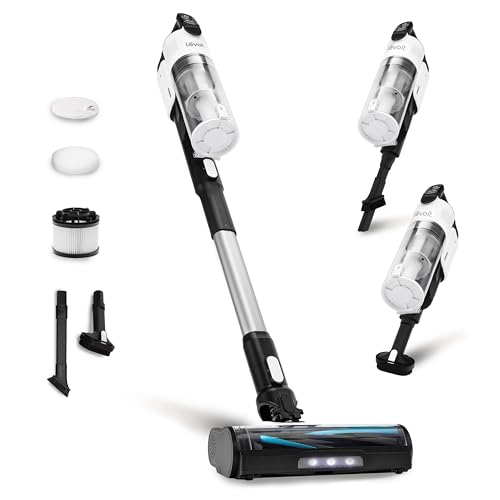
Levoit’s stick competes on versatility: anti-tangle brush design for pet hair, a stated runtime of up to 50 minutes, suitability across carpets and hard floors, and the party trick in its truncated-but-readable listing — a 180° lay-flat body that slides under sofas and beds without the user kneeling or the furniture moving. For homes where most dirt lives under things, that geometry is worth more than raw specification.
Strengths
- 180° lay-flat reach — cleans under low furniture without moving it
- Anti-tangle design for pet hair, up to 50 stated minutes of runtime
- Lightweight stick format across carpet and hard floor
Trade-offs
- “Up to” 50 minutes is the gentlest mode’s figure — working runtime will be less
- Lay-flat reach helps only if your furniture clearance matches; very low pieces still block it
- Listing title is truncated in confirmed data; nothing beyond the printed text is claimed
| Specification | Detail |
|---|---|
| Runtime | Up to 50 minutes (stated) |
| Format | Cordless stick, 180° lay-flat |
| Brush | Anti-tangle (per listing) |
| Floors | Carpet and hard floors |
Under-furniture dust is the reservoir that reseeds a home’s floors daily, and most vacuums — uprights especially — simply cannot reach it. The Levoit’s lay-flat design treats that reservoir as the main job, and for allergy-conscious households and pet homes, weekly access to it changes how clean the home stays between deep cleans. The rest of the package is sensibly mainstream: anti-tangle brush, mixed-floor competence, a runtime figure in the competitive band. Read “up to 50 minutes” the way this guide reads all runtime claims — as the ceiling, not the expectation — and plan on standard mode for whole-home work. Against the Shark it trades brand scale for reach; against the Tineco it trades specification for geometry. If your rooms are furnished low and heavy, geometry wins, and this is your stick.
Best for: Homes with low sofas and beds, pet owners, hard-floor-heavy layouts / Not suited for: Buyers who want the longest stated runtime or the biggest brand ecosystem

Eureka Airspeed Ultra-Lightweight Upright NEU10AE5 — Best Light Upright
Check the current price on Amazon
Seven point seven pounds is the number this whole keyword exists for, and the Eureka Airspeed states it for a complete upright — not a stick, not a handheld, a real carpet-capable upright that many adults can carry upstairs one-handed. Its listing calls it senior-friendly, and the logic is plain: corded power with no runtime clock, bagless emptying, a washable filter, and tools for the edges, in a machine that does not need a strong arm to own.
Strengths
- Stated 7.7 lb — a true upright at stick-vacuum weight
- Corded: unlimited runtime, consistent suction, no charging discipline
- Washable filter and included brush and crevice tools keep running costs minimal
Trade-offs
- Corded means cord management and outlet-hopping between rooms
- Upright format does not go under low furniture like the lay-flat Levoit
- Bagless emptying is dustier than the bagged canister pick
| Specification | Detail |
|---|---|
| Weight | 7.7 lb (stated) |
| Format | Corded bagless upright |
| Tools | Brush and crevice tool (per listing) |
| Filter | Washable (per listing) |
The Airspeed makes the corded case at its strongest: for a smaller home, a bungalow, or any household where the vacuum lives on one floor, a 7.7 lb upright removes every cordless compromise — no clock, no battery ageing, no suction drop-off — while keeping the weight that made cordless attractive. The washable filter and bagless design hold lifetime costs near zero, and the listing’s senior-friendly positioning is earned by the specification rather than the marketing: light to carry, simple to empty, nothing to charge or forget. Its limits are the format’s: a cord to trail and coil, an upright’s turning circle, and no access under low furniture. Paired with a cheap handheld for crumbs — or chosen by a household that simply wants the lightest real vacuum — it is the value anchor of this guide and the pick most likely to still be working, unchanged, in a decade.
Best for: Smaller homes, one-floor living, seniors, corded-power loyalists / Not suited for: Multi-floor homes where carrying and cords compound, or bagged-filtration households

Oreck HEPA Upright Vacuum Cleaner — Best Bagged Upright
Check the current price on Amazon
Oreck built its reputation on uprights light enough to carry room to room in hotels, and this model brings that formula home: a lightweight bagged upright with two-speed control. The bag is the point for many buyers — dirt leaves the house sealed inside it, with no dust cup cloud — and the listing’s filtration claim is HEPA Media, which this guide prints precisely, because HEPA Media filtration and a sealed Certified HEPA system are different claims and only one of them is made here.
Strengths
- Bagged emptying: dirt exits sealed, no dust-cup plume
- Lightweight upright format with two-speed control for floor types
- HEPA Media filtration per the listing — fine filtration in a bagged system
Trade-offs
- Bags are a running cost the bagless picks do not have
- Corded, upright-format limits: cords, turning circle, no under-furniture reach
- Filtration is HEPA Media, not a sealed Certified HEPA claim — allergy-critical buyers should note the distinction
| Specification | Detail |
|---|---|
| Format | Corded bagged upright, lightweight |
| Filtration | HEPA Media (per listing) |
| Speeds | Two-speed control |
| Emptying | Disposable bags |
The bagged-versus-bagless argument is usually fought on cost, but for many households it is really about the emptying moment: tipping a dust cup into a bin re-aerosolises a fraction of what you just cleaned, while a sealed bag does not. Oreck’s lightweight chassis then removes the traditional bagged penalty — the heavy machine — leaving a vacuum that crosses a house easily and parks in a cupboard without a fight. Two speeds let it calm down for hard floors and rugs rather than scattering or grabbing. The filtration sentence deserves its precision: HEPA Media means the filtration material meets HEPA media standards; it is a real and useful claim, and it is not the same as certifying the whole sealed system — buyers managing serious allergies should weigh that difference with open eyes, and for everyone else, bagged HEPA Media in a light upright is a thoroughly sensible combination.
Best for: Carpet homes, dust-sensitive households that prefer sealed bag disposal / Not suited for: Buyers who refuse running costs, or need a sealed Certified HEPA system specifically
Bissell Zing Bagged Canister Vacuum 2154A — Best Canister
Check the current price on Amazon
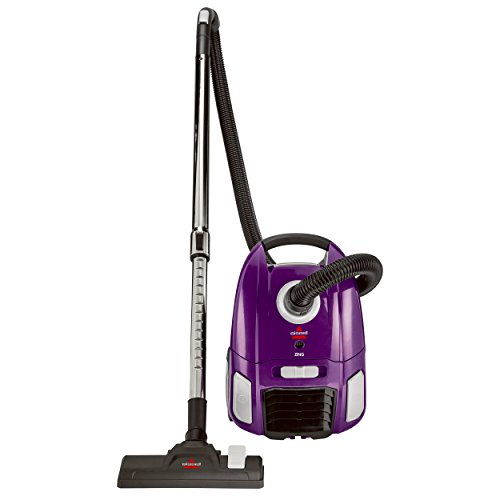
The Zing is the format answer the sticks and uprights cannot give. A canister puts the motor and bag in a body that trails behind on wheels, leaving only a light wand in your hand — which is why canisters own stairs, upholstery, car interiors and hard-floor homes. The Zing is Bissell’s lightweight, bagged version of that idea, in purple, and its listing is admirably free of inflated claims: this guide prints the format virtues it verifiably has, and invents no figures for it.
Strengths
- Wand-weight in hand is minimal — the easiest format on stairs and above-floor cleaning
- Bagged, like the Oreck: sealed, tidy emptying
- Canister reach handles upholstery, curtains, skirting and car interiors that uprights cannot
Trade-offs
- Trailing body needs managing around furniture and doorways — the canister learning curve
- No stated runtime, suction or weight figures in the confirmed listing — judged here on format, not figures
- Bags are an ongoing purchase
| Specification | Detail |
|---|---|
| Format | Corded bagged canister |
| Model | 2154A |
| Colour | Purple |
| Stated figures | None in confirmed listing — format pick |
Every format in this guide hides a household it fits perfectly, and the Zing’s household has stairs, hard floors and furniture worth cleaning above floor level. The wand reaches ceiling corners and curtain tops without lifting a motor; the head glides across hard floors that upright brushes can scatter debris on; and the whole machine stores smaller than an upright. The canister compromise is choreography — the body follows, occasionally catches a chair leg, and must be carried (lightly, but carried) between floors. Buyers cross-shopping figures should note this listing states none, and this guide respects that silence: the Zing is recommended for what a lightweight bagged canister inherently does, demonstrated by decades of the format, not for numbers nobody published. For the hard-floor, stair-heavy home, it may be the most all-around machine here precisely because its weight is never in your hand.
Best for: Stairs, hard floors, upholstery and above-floor cleaning / Not suited for: Buyers who want specification figures before purchase, or hate trailing cords and bodies
Comparison Table
| Pick | Badge | Key spec | Best for |
|---|---|---|---|
| Tineco A30S Cordless Vacuum Cleaner | Best Overall | 200AW (stated) | Pet homes, mixed floors, buyers wanting one cordless vacuum to do everything |
| Shark Pet Cordless Stick Vacuum IX141 | Best Trusted Stick | 40 minutes (stated) | Flats and average houses, pet owners, buyers who value mainstream support |
| Levoit Cordless Vacuum Cleaner | Best Flexible Stick | Up to 50 minutes (stated) | Homes with low sofas and beds, pet owners, hard-floor-heavy layouts |
| Eureka Airspeed Ultra-Lightweight Upright NEU10AE5 | Best Light Upright | 7.7 lb (stated) | Smaller homes, one-floor living, seniors, corded-power loyalists |
| Oreck HEPA Upright Vacuum Cleaner | Best Bagged Upright | Corded bagged upright, lightweight | Carpet homes, dust-sensitive households that prefer sealed bag disposal |
| Bissell Zing Bagged Canister Vacuum 2154A | Best Canister | Corded bagged canister | Stairs, hard floors, upholstery and above-floor cleaning |
Matching the Vacuum to the Household: Five Common Homes
The young family home — hard floors downstairs, carpet up, crumbs as a weather system — is the cordless stick’s natural habitat, with the Shark’s handheld conversion earning its keep on highchairs, stairs and the car seat archaeology that parenthood involves. Runtime should be sized to the whole house in standard mode, because a vacuum that dies at the last bedroom teaches everyone to stop bothering.
The pet home adds hair to every calculation: anti-tangle brushes (Tineco, Levoit) stop being features and become the product, bins need the capacity the A30S states, and the under-furniture reservoir matters because hair migrates there and re-seeds the rooms daily. The senior’s home inverts the priorities: the stated 7.7 lb Eureka or the wand-light Zing, corded certainty over battery management, and nothing that requires an app, a dock ritual or a strong wrist.
The flat or apartment rewards the quiet, compact end — sticks store in a cupboard corner and clean in minutes — while the large multi-storey house is where honesty bites: either accept a two-vacuum system (an upright for depth, a stick for frequency) or choose the longest stated runtime and clean by floors, not by whole-house sessions. The allergy-managed home shops the filtration paragraph first and the format second, reading HEPA wording with the precision the guide section above insists on.
Accessories and Attachments: What Is Actually Worth Using
Every vacuum here ships with more plastic than its owner will ever use, and the honest triage is short. The crevice tool is essential — edges, skirting and the sofa’s lost world are where visible dirt survives a floorhead. A small brush or upholstery tool earns its place in homes with fabric sofas, curtains or stairs. Everything beyond those two is situational, and tools that live in a drawer in another room are tools that do not exist; keep the two essentials clipped to the machine or in the room it serves.
For sticks, the wall dock is the accessory that changes behaviour: a vacuum with a home gets returned to it, charged and ready, while a vacuum stored in a tangle under the stairs gets used weekly instead of daily. If your stick offers a dock, mount it near the kitchen or entry — the daily zones — not near the bedrooms it visits least.
Replacement consumables deserve a budget line in the purchase decision: bags for the Oreck and the Zing, filters for everything, a battery eventually for the cordless three. None is expensive; all are cheaper bought before the urgent moment. The mainstream brands in this guide keep these parts available for years, which is an unglamorous but decisive argument for buying names you recognise when the machine must last.
Second Vacuums, Borrowed Vacuums and When One Is Not Enough
This guide is built around one all-around machine, but honesty requires the exceptions. Homes over roughly three floors of living space, homes with both deep-pile carpet and extensive hard floors, and homes where two adults clean simultaneously on a Saturday will each strain a single vacuum of any format — not because the machine is inadequate, but because geography and simultaneity are not specifications a product can meet. In those homes the rational second purchase is the format that covers the first machine’s stated weakness: a stick beside an upright, a canister beside a stick, bought cheap and cheerful because its job is narrow.
Borrowing is the underused test in this category. A neighbour’s stick for a weekend teaches more about hand weight, noise and dock habits than any specification table — including this guide’s. If you are torn between the cordless life and corded certainty, live with a borrowed cordless through one whole-house clean and one crumb emergency before deciding; the format that suits your patience will announce itself clearly in forty-eight hours.
And when the single vacuum truly is enough — most flats, most average houses, most of the households this search serves — resist the upgrade itch that marketing cultivates. A maintained lightweight vacuum with clean filters and a healthy brushroll outperforms a neglected flagship every Saturday of the year. The routine in the how-to section, followed, is worth more than the next model up, whichever model you started from.
Noise, Storage and the Small Print of Ownership
Lightweight vacuums are bought on weight and judged on everything else, and two ownership factors deserve print before purchase. The first is noise: small motors spin fast and many sticks and light uprights are louder, pitch for pitch, than the heavy machines they replace — a real consideration in flats with sleeping children, thin walls or noise-sensitive pets. None of the listings here states a decibel figure this guide can print, so the honest advice is procedural: if noise decides your purchase, hear the machine — a shop demo or a borrowed weekend — before the return window becomes your testing programme.
Storage is the second factor, and it is where lightweight machines quietly win or lose the year. A stick that must be assembled from a cupboard tangle will be used weekly; the same stick on a wall dock by the kitchen will be used daily, and the difference in a home’s cleanliness is larger than any suction gap in this guide. Uprights need a cupboard with their full height; canisters coil into the smallest footprint of the three formats, one more unglamorous point for the Zing in small homes. Measure the storage before the machine arrives, decide where the dock or cupboard is, and the vacuum you bought is the vacuum you will actually live with.
Cordless Stick, Light Upright or Canister: Choosing Your Format
The format decision precedes every brand decision, because each format fails differently. Cordless sticks fail on time — a battery clock over every clean — and on hand weight during long sessions. In exchange they offer the highest cleaning frequency of any format: a vacuum that is always ready gets used daily, and daily two-minute cleans beat weekly twenty-minute ones for how a home actually feels.
Lightweight uprights fail on reach — under furniture, up stairs with tools, above floor level — and win on certainty: full power, unlimited time, deep carpet agitation, and (in the Eureka’s case) a stated weight that embarrasses many sticks. Canisters fail on choreography, trailing a body that must be managed, and win on versatility per gram in the hand: stairs, upholstery, curtains, cars and hard floors all suit the wand.
Most homes honestly need one main vacuum and the honesty to match it to the dominant floor and layout: carpeted single-floor — the uprights; mixed floors and busy lives — the sticks; stairs and hard floors — the canister. The second vacuum, if any, should cover the main one’s failure mode, which is why the classic pairing is an upright plus a stick, one for depth and one for frequency.
Reading Vacuum Specifications Without Being Fooled
Runtime figures are ceilings measured in the gentlest mode; a stick that states 60 minutes will give a fraction of that on maximum power. Treat stated runtime as a comparison index between models, not a promise about your Saturday clean, and size the battery to your home with headroom. Suction units vary — AW (air watts, as the Tineco states) is the most meaningful consumer figure; where a listing states no figure, this guide prints none rather than translating marketing adjectives into numbers.
Weight needs the same scepticism: a stick’s total weight sits in your hand at the end of a lever, while a canister’s sits on the floor — identical kilograms, completely different effort. The only fully comparable weight here is the Eureka’s stated 7.7 lb upright, a format whose weight mostly rests on its wheels while you guide it.
Filtration wording is the third trap. ‘HEPA Media’ (the Oreck’s claim) certifies the filter material; ‘Certified HEPA’ or ‘True HEPA’ systems certify the sealed machine’s output; ‘HEPA-style’ and ‘HEPA-type’ certify nothing in particular. This guide preserves each listing’s exact wording and upgrades none of them — and buyers with clinical filtration needs should shop for the sealed-system wording specifically.
Keeping a Lightweight Vacuum Performing
Lightweight vacuums have smaller motors, bins and filters than heavy machines, which makes maintenance the difference between a five-year vacuum and a disappointing one. Filters are the first discipline: wash or replace them on the maker’s rhythm, because a clogged filter strangles suction long before anything breaks, and most ‘my vacuum died’ stories are filter stories.
Brushrolls are the second: anti-tangle designs (Tineco, Levoit) reduce but do not abolish hair wrap — check monthly and cut away what accumulates, because a bound brushroll strains the motor and stops agitating carpet. Bins should be emptied at the fill line, not beyond it; cyclones separate poorly when overfilled, and the dust migrates to the filter you just cleaned.
Batteries, for the cordless three, age by heat and habit: store the vacuum out of hot garages and direct sun, avoid leaving it on maximum power as a default, and expect gradual runtime decline across years rather than sudden failure. Bagged owners (Oreck, Zing) have the simplest discipline of all — change the bag when it is two-thirds full, because a stuffed bag is a clogged filter by another name.
How to Set Up a Whole-Home Cleaning Routine Around One Light Vacuum
An all-around vacuum earns the title through routine, not specification. This is the pattern that keeps a home clean on fifteen minutes a week of actual effort.
- Zone the home by dirt rate: entryways, kitchen and pet areas are daily zones; living areas are twice-weekly; bedrooms and studies are weekly. Your vacuum’s home base should be nearest the daily zones.
- Run the daily zones on the quick setting — five minutes maximum, timed. Frequency beats depth for visible cleanliness, and a light vacuum’s whole advantage is that this costs almost nothing.
- Do one weekly full pass at thorough pace: edges with the crevice tool, under furniture as far as your format reaches, and one above-floor surface (sofa, stairs or curtains) on rotation.
- Empty the bin or check the bag at the same weekly session, and glance at the brushroll while you are there. Maintenance attached to an existing habit actually happens.
- Monthly: wash or change filters per the maker, check the brushroll properly, and wipe the sensors and headlights (the Shark’s LEDs clean noticeably better for ten seconds of effort).
- Seasonally, deep-clean one room completely — moving furniture, doing the reservoir zones under sofas and beds — rotating through the home across the year.
If the routine keeps failing at the same place — stairs undone, under-sofa dust untouched — that is format information, not laziness: it tells you which second format (canister for stairs, lay-flat stick for under furniture) your home is asking for.
Before the first clean, spend four minutes on the setup that decides whether the machine’s next year goes well: charge cordless models fully before first use, wash or seat the filters exactly as the manual directs, photograph the model and serial plate with your phone, and put the purchase date in the same note. That photograph is the warranty claim, the parts order and the manual search, all in one image, and it costs less time than one bin-emptying. Register the product if the maker offers it, keep the crevice tool clipped to the machine rather than in a drawer, and decide now where the vacuum lives when it is not working — the decision made once, deliberately, instead of nightly, in a hallway, with an armful of laundry.
Common Buying Mistakes
Buying a specialist for an all-around job
Car vacuums, handhelds and robots all appeared in the data for this search and were excluded for a reason: each does one job. An all-around vacuum must handle floors, edges, stairs and spills in one machine — check the format covers your whole home before the features seduce you.
Believing the runtime on the box is your runtime
Stated runtimes are best-mode ceilings. A large home bought against a 40-minute sticker will be cleaned in two charges and mounting frustration. Size the battery to the home with generous headroom, or choose corded certainty.
Upgrading filtration language in your head
HEPA Media is not Certified HEPA, and ‘HEPA-style’ is neither. If filtration is a health-driven requirement, buy the exact wording your clinician’s advice calls for — the listings in this guide are quoted precisely so you can.
Never cleaning the filter
The number one cause of ‘weak suction’ in lightweight vacuums is a clogged filter, not a dying motor. Washable filters (Eureka) still need washing; cyclones still need their filters serviced. Put it in the weekly routine.
Ignoring the under-furniture reservoir
Dust and pet hair accumulate where vacuums cannot reach and migrate out daily. If your format cannot go under the sofa, move the sofa monthly — or choose the lay-flat design that treats that zone as its home ground.
Final Recommendation
For one vacuum to do everything in a mixed-floor, pet-owning home, the Tineco A30S states the strongest case — suction, runtime, bin size and an anti-tangle brush. The Shark IX141 is the mainstream alternative with the handheld conversion and the support ecosystem; the Levoit wins homes furnished low, where its lay-flat reach cleans what others cannot touch. If cords do not frighten you, the 7.7 lb Eureka is the lightest honest upright here and the Oreck adds sealed bagged emptying with HEPA Media filtration; and for stairs and hard floors, the Bissell Zing’s canister format keeps the weight on the floor where it belongs. Match the format to the house first — the model choices above then make themselves.
Whichever format you land on, buy it for the home you have this year, not the renovation you are planning for next: floor plans change more slowly than brochures suggest, and a vacuum matched to today’s rooms will still be earning its keep if the plans slip — as plans do. And keep the box for the first month. Returns of large appliances are a chore made far easier by the original packaging, and the first month is when format regrets honestly declare themselves; a vacuum that has lived in its box’s shadow for four weeks and still feels wrong is telling you something worth hearing.
Choose the format honestly, maintain it on the weekly rhythm, and a lightweight vacuum will quietly outperform heavier machines that are owned less carefully — which is, in the end, what all-around actually means in a real home.
It is a modest standard, and the six machines above all meet it.
Start with the Tineco A30S Cordless Vacuum Cleaner if you want the safest all-round choice, and check price on Amazon before ordering.
Best Lightweight Powerful Vacuums
Best Lightweight Bagless Upright Vacuums
Best Lightweight Shark Vacuums
Frequently Asked Questions
What type of vacuum is most all-around?
For most mixed-floor homes, a cordless stick with a handheld conversion covers the widest range of jobs quickly. Carpet-heavy single-floor homes are better served by a lightweight upright, and stair-heavy, hard-floor homes by a canister. All-around is a match between format and house, not a single winning design.
How much runtime do I actually need from a cordless vacuum?
Enough to clean your home in standard mode with headroom — stated runtimes are best-mode ceilings, and maximum power cuts them sharply. Average homes sit comfortably inside the Shark’s stated 40 minutes; larger homes should look at the Tineco’s stated 60.
Is a 7.7 lb upright really as light as a stick vacuum?
The Eureka Airspeed’s stated 7.7 lb is in stick-vacuum territory, with a difference in feel: an upright’s weight rests largely on its wheels while you guide it, whereas a stick’s weight is carried in your hand. For long sessions, many people find the upright less tiring despite similar numbers.
What is the difference between HEPA Media and Certified HEPA?
HEPA Media — the Oreck’s stated claim — means the filter material meets HEPA media standards. A Certified or True HEPA system certifies that the sealed machine’s exhaust meets the standard. Both filter well; they are different claims, and this guide prints each listing’s wording exactly.
Bagged or bagless for a lightweight vacuum?
Bagless saves running costs and suits frequent emptying; bagged (Oreck, Bissell Zing) empties more tidily because dirt leaves sealed in the bag — a real consideration for dust-sensitive households. Both appear here because all-around homes differ on exactly this preference.
Why was a robot vacuum not included?
Because all-around means one machine for every job, and a robot cannot do stairs, upholstery, edges on demand or spill response. Robots are excellent second vacuums for maintenance between real cleans; they are not the home’s only vacuum, which is the job this search describes.


