Disclosure: airfryerkitchensupply.com is reader-supported. When you buy through links on our site, we may earn an affiliate commission at no extra cost to you.
Where to buy
If you are shopping for the best airpurifier for smokers households, buy through Amazon and confirm the exact model on the listing — purifier lines reuse names across sizes, and the coverage figure in the title is the product. Start with the Austin Air HealthMate Plus if smoke odor is the main complaint, because its deep carbon bed is built for exactly that job, and work down the list by room size from there.
- Austin Air HealthMate Plus — check the current price on Amazon and confirm the exact configuration on the listing before you order.
- WINIX 5510 — check the current price on Amazon and confirm the exact configuration on the listing before you order.
- Medify MA-50 V3.0 — check the current price on Amazon and confirm the exact configuration on the listing before you order.
- COWAY Airmega 400 — check the current price on Amazon and confirm the exact configuration on the listing before you order.
- Rabbit Air MinusA2 SPA-780A — check the current price on Amazon and confirm the exact configuration on the listing before you order.
- BLUEAIR Blue 211i Max — check the current price on Amazon and confirm the exact configuration on the listing before you order.
An air purifier in a smoker’s home has two different enemies, and most buying mistakes come from confusing them. The first is particles: smoke is a dense aerosol of fine particulate that a true HEPA filter captures very effectively — this is the straightforward half. The second is odor and gas-phase chemicals: the smell that settles into a room and its fabrics is carried by volatile compounds that pass straight through HEPA media and are only adsorbed by substantial activated carbon — pounds of it, ideally blended with zeolite or similar media for smoke compounds. A purifier with a thin carbon sheet will clear visible haze and leave the room still smelling of smoke, and its owner will conclude that purifiers do not work.
This guide is therefore organized by carbon honesty. The picks with deep carbon beds — Austin Air’s HealthMate Plus above all, and the Winix 5510’s deodorization carbon — are the smoke specialists. The strong all-rounders — Medify, Coway, Blueair, Rabbit Air — balance particle performance, coverage, noise and running cost for homes where smoke is one pollutant among several (pets, cooking, dust, pollen) rather than the sole enemy. Every pick states which job it is actually for.
Two framing notes, stated plainly. First, no purifier makes indoor smoking harmless: these machines reduce particles and odor in a room — a comfort and consideration measure for the household — and this guide makes no health claims beyond that. Second, source habits beat machinery: a purifier placed near where smoking happens, run continuously on auto, outperforms a larger purifier across the room run occasionally. Placement and runtime advice appears in the how-to section, because with smoke it matters as much as the model.
All six picks were verified as current Amazon listings on 2026-11-20. This guide prints no prices; check the current price on Amazon under the full model name, and budget honestly for replacement filters, which are the real cost of ownership.
In this guide
Quick Picks
- Best Overall for Smoke Odor — Austin Air HealthMate Plus: the smoke specialist: a deep activated-carbon-and-zeolite bed, four-stage filtration and a filter rated in years, for rooms up to 1,500 sq ft per its listing.
- Best Smart All-Rounder — WINIX 5510: true HEPA plus a high-deodorization carbon filter, auto mode and app support for large rooms — the modern, set-and-forget smoke-room machine.
- Best for Large Rooms — Medify MA-50 V3.0: big-room coverage rated to 2,640 sq ft with HEPA filtration aimed at smoke and odors — the open-plan and great-room pick.
- Best Premium for Whole Rooms — COWAY Airmega 400: a flagship tower with dual-sided intake, coverage to 3,120 sq ft, air-quality monitoring and a long warranty — the design-conscious premium pick.
- Best Quiet and Wall-Mountable — Rabbit Air MinusA2 SPA-780A: an ultra-quiet, wall-mountable purifier with a dedicated odor-remover filter option — for bedrooms and media rooms where noise is the dealbreaker.
- Best Fast and Simple — BLUEAIR Blue 211i Max: HEPASilent filtration with very high air delivery, auto mode and Wi-Fi — the fastest particle clearer here, for smoke as part of a busy home’s air.
How These Picks Were Chosen
Screening for smokers’ homes applied a smoke-specific order of priorities. Carbon capacity first: deep granular carbon beds and dedicated deodorization filters outranked thin carbon pre-filters regardless of other features. Particle capture second: true HEPA or equivalent high-efficiency filtration, sized so the unit can cycle a real room’s air several times an hour — coverage figures in the listing titles were used as the sizing reference. Third, continuous-use practicality: auto mode with a responsive sensor, a sleep mode quiet enough for bedrooms, and filter life long enough that running costs stay sane.
Excluded were ozone-generating “purifiers” (ozone is itself an irritant and has no place in this category), ionizer-first gadgets with negligible carbon, and any model whose smoke marketing rested on a carbon-dusted pre-filter. The six survivors are all legitimate machines; they differ in how much of their design budget went to the gas-phase war that smoke households are actually fighting.
The 6 Best Air Purifiers for Smokers

Austin Air HealthMate Plus — Best Overall for Smoke Odor
The HealthMate Plus is built around the pollutant other purifiers treat as an afterthought. Its filter is a deep bed of activated carbon blended with zeolite — the mineral media used specifically because it adsorbs the chemical compounds in smoke that carbon alone handles less completely — wrapped in particle filtration stages. In a smoking household, that bed is the product: it is why a room can stop smelling stale between cigarettes rather than merely during them, and its rated filter life is measured in years, which transforms the running-cost math of the whole category.
The machine around the filter is deliberately plain: a steel cabinet, a simple speed dial, no app, no light show. Coverage is rated to 1,500 square feet in its listing, it runs quietly enough for living rooms and bedrooms, and its five-year filter horizon means the household buys the machine once and then mostly forgets it — the ownership experience smoke households, who run purifiers harder than anyone, value most.
Strengths
- Deep carbon-and-zeolite bed: the strongest odor and smoke-chemical weapon in this guide
- Filter life rated in years slashes the true cost of continuous running
- Simple, durable steel construction with no fragile smart features to fail
Trade-offs
- No app, no air-quality display, no auto mode — you set a speed and it works
- Heavy and utilitarian in appearance; it looks like equipment, because it is
- Premium purchase tier, repaid over years of filter savings rather than on day one
| Specification | Detail |
|---|---|
| Filtration | 4-stage: particle stages + activated carbon and zeolite bed |
| Coverage | Up to 1,500 sq ft (per Amazon title) |
| Filter life | Rated up to 5 years (per Amazon title) |
| Controls | Manual speed dial |
Place the HealthMate Plus in the room where smoking actually happens, give it clearance on all sides, and run it continuously at the highest speed the room’s activity tolerates. Its bed rewards constancy: carbon that is always working keeps background odor from ever establishing in soft furnishings, which is a battle no amount of weekend deep-running fully reverses.
Best for: homes where tobacco odor is the primary complaint and the purifier will live in the smoking room / Not suited for: buyers wanting smart features, app control or a sleek tower — this is a steel box that does one war well
Check the current price on Amazon for the Austin Air HealthMate Plus.

WINIX 5510 — Best Smart All-Rounder
The Winix 5510 is the current generation of a beloved smoke-room lineage, and its specification reads like it was written from this guide’s screening list: true HEPA for the particles, a dedicated high-deodorization carbon filter — a real adsorptive stage, not a scented sheet — for the odor, an auto mode driven by air-quality sensing, and coverage rated to 1,881 square feet in an hour in its listing. App support joins the generation, for households that want scheduling and filter status on a phone.
In daily life its virtue is autonomy. Smoke events spike the sensor and the fan answers immediately, then settles back to a quiet cruise that keeps background air moving through the carbon continuously — precisely the duty cycle smoke households need and rarely sustain manually. For a main living space where smoking is one of several air burdens, the 5510 is the balanced modern answer.
Strengths
- Dedicated deodorization carbon stage, not a token pre-filter
- Responsive auto mode handles smoke events without human intervention
- Large-room coverage with app control and quiet cruising speeds
Trade-offs
- Carbon capacity is strong but not in the Austin Air bed’s class for entrenched odor
- Replacement filter cadence is shorter than the Austin’s years-long filter
- PlasmaWave-style features divide households; it can be switched off, and many smoke homes do
| Specification | Detail |
|---|---|
| Filtration | True HEPA + high-deodorization carbon filter |
| Coverage | Up to 1,881 sq ft in 1 hr (per Amazon title) |
| Modes | Auto, sleep, app control |
| Targets | Smoke, pet allergens, dust, odor (per Amazon title) |
Run the 5510 on auto permanently and resist the urge to switch it off between smoke events: the carbon stage does its quiet background work exactly when nothing seems to be happening, and that background work is what keeps a smoking room from developing the permanent stale note guests notice at the door.
Best for: large living rooms where smoke mixes with pets, cooking and dust and the purifier must run itself / Not suited for: the heaviest dedicated smoking dens — the Austin Air’s deeper bed is the specialist tool
Check the current price on Amazon for the WINIX 5510.

Medify MA-50 V3.0 — Best for Large Rooms
The MA-50 V3.0 competes on air volume: coverage rated to 2,640 square feet in an hour in its listing, with HEPA filtration specified for smoke, wildfire events, odors, pollen and pets, and particle removal to 0.3 microns. In a large open space — the floor plan where smoke drifts furthest and lingers longest — air changes per hour are the whole game, and this is the guide’s high-volume player at a mid tier.
Medify’s filter architecture pairs its HEPA stage with carbon treatment in the filter cartridge, and the V3.0 generation refines controls and noise behavior for continuous living-room duty. It is a machine for the household whose smoking room is effectively the whole ground floor: sized honestly for that job, it keeps the entire volume in slow, constant circulation through filtration instead of chasing smoke room by room.
Strengths
- Highest coverage rating in this guide — built for open-plan volumes
- Smoke and odor are named design targets, not marketing garnish
- Quiet operation for its air volume at cruising speeds
Trade-offs
- Large-room power is wasted in a small bedroom; size the machine to the room
- Carbon depth is cartridge-class, below the Austin Air’s bed for pure odor warfare
- Replacement cartridges for a big machine are a real annual line item
| Specification | Detail |
|---|---|
| Filtration | HEPA filter system with carbon treatment |
| Coverage | 2,640 sq ft in 1 hr (per Amazon title) |
| Removal | Particles to 0.3 microns (per Amazon title) |
| Use case | Smoke, wildfires, odors, pollen, pets |
In open plans, placement is strategy: put the MA-50 between the smoking seat and the rest of the home’s circulation path, so drifting smoke crosses the intake before it crosses the house. One correctly placed large machine outperforms two small ones wandering the same floor — a sizing truth this guide wishes more households heard before their second purchase.
Best for: open-plan homes, great rooms and basements where one machine must move a lot of air / Not suited for: small bedrooms — its smaller sibling class fits better and runs quieter at pillow distance
Check the current price on Amazon for the Medify MA-50 V3.0.
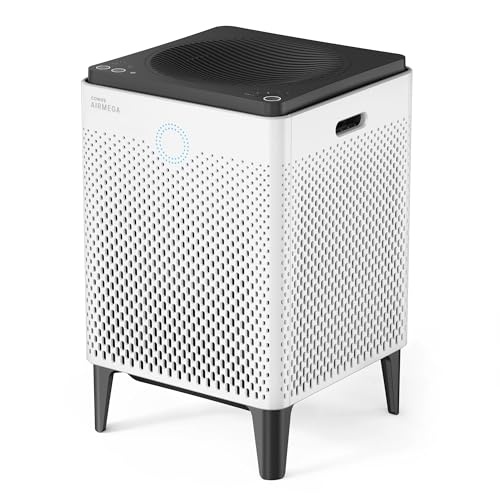
COWAY Airmega 400 — Best Premium for Whole Rooms
The Airmega 400 is the flagship approach to the same problem: dual-sided intakes pulling room air through washable pre-filters and a HEPA system rated for smoke, allergens, dander and odor, coverage to 3,120 square feet in its listing, an air-quality monitor that shows the room’s state and drives auto and eco modes, and a warranty whose length signals how Coway expects the machine to age. It is the purifier for a main living room that is also the home’s showcase — performance that does not ask the décor to apologize for it.
For smoke specifically, its strength is throughput with manners: high clean-air delivery at conversation-compatible noise, a sensor loop that answers smoke events promptly, and filtration stages a household can maintain (the washable pre-filter genuinely reduces consumable costs). Its carbon stage is competent rather than class-defining; households whose odor problem is severe should compare it honestly against the HealthMate Plus before paying the premium for design and coverage.
Strengths
- Enormous coverage with dual intakes and a real AQI display
- Washable pre-filter trims running costs; long warranty backs the build
- Auto and eco modes make continuous running effortless and quiet
Trade-offs
- Premium tier purchase and flagship-sized replacement filters
- Carbon stage is all-rounder class, not a deep odor bed
- Its size and presence suit main rooms, not discreet corners
| Specification | Detail |
|---|---|
| Coverage | Up to 3,120 sq ft (per Amazon title) |
| Filtration | Washable pre-filter + HEPA system |
| Monitoring | Air-quality monitor, auto and eco modes |
| Warranty | 5 years (per Amazon title) |
The Airmega 400 earns its place in a smokers’ guide as the household compromise that is not a compromise on particles or coverage: when the smoking member shares the home’s grandest room with everyone and everything, this is the machine that keeps that room’s air honest at scale, beautifully, and with its status visible at a glance.
Best for: large primary living spaces wanting premium build, monitoring and quiet power / Not suited for: budget buyers and anyone whose sole war is entrenched tobacco odor — the Austin bed is cheaper per victory there
Check the current price on Amazon for the COWAY Airmega 400.
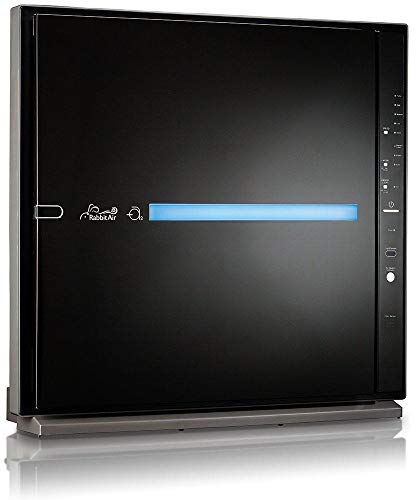
Rabbit Air MinusA2 SPA-780A — Best Quiet and Wall-Mountable
The MinusA2’s design brief is silence and disappearance: an ultra-quiet fan, a slim profile that can stand or mount on a wall, and a filter system Rabbit Air lets buyers configure — including an odor-remover specialization aimed at smoke and household smells — behind HEPA-grade particle capture. In a bedroom, where a purifier runs eight hours at pillow distance, those virtues outrank raw coverage, because the quietest machine is the one that stays switched on all night.
Its longevity in the market is its own credential: the MinusA2 has served smoke-sensitive households for years with a customizable filter strategy — choose the odor-focused configuration for a smoking household — and a light footprint that suits rooms where floor space is furniture’s, not appliances’. It will not clear a great room; it was never meant to. In its room, it is close to perfect.
Strengths
- Genuinely quiet at sleep speeds — the bedroom-class leader here
- Wall-mountable slim design disappears into a room
- Configurable filters let you weight the system toward odor removal
Trade-offs
- Single-room coverage; open plans need a larger pick
- Configured filter sets are a premium consumable
- No app-era extras; its intelligence is in its acoustics and filters
| Specification | Detail |
|---|---|
| Filtration | HEPA system with customizable filter options incl. odor remover |
| Noise | Ultra-quiet operation (per Amazon title) |
| Mounting | Floor or wall-mountable |
| Design | Slim profile, black finish |
For a smoker’s bedroom specifically, the MinusA2 pattern is the one to copy even if you buy another model: continuous low-speed running all night beats heroic purification for an hour before bed. Air that is always moving through filtration never gets the chance to settle into bedding — the fabric reservoir where smoke odor lives longest.
Best for: bedrooms, nurseries-adjacent adult rooms and media rooms where the purifier must be heard as little as possible / Not suited for: large open spaces — its coverage class is the single room
Check the current price on Amazon for the Rabbit Air MinusA2 SPA-780A.

BLUEAIR Blue 211i Max — Best Fast and Simple
Blueair’s HEPASilent approach pairs electrostatic and mechanical filtration to move a great deal of air quietly — coverage rated to 3,235 square feet in its listing, with auto mode, Wi-Fi control and a washable pre-filter catching the coarse load. For visible smoke and fine particles it is the fastest clearer in this guide: a room’s haze after a smoking session is drawn down promptly, and its low cruising noise keeps it running in family spaces without negotiation.
The honest limit is the gas phase. Blueair’s carbon provision is lighter than the deep-bed and deodorization-carbon picks above, so persistent tobacco odor — the smell in the room at breakfast — is this machine’s weakest front. Households where odor is the headline complaint should start at the Austin Air or Winix; households where smoke is an occasional event in an otherwise pet-and-pollen home will find the 211i Max the most livable machine here.
Strengths
- Exceptional air delivery for its noise — clears particle events fast
- Auto mode, Wi-Fi and a washable pre-filter make ownership nearly thoughtless
- AHAM-verified performance figures in its listing
Trade-offs
- Lightest carbon capacity in this guide; odor is not its war
- Large-room sizing is overkill for a small den
- Filter replacements are proprietary and should be budgeted
| Specification | Detail |
|---|---|
| Filtration | HEPASilent (electrostatic + mechanical), pre-filter |
| Coverage | Up to 3,235 sq ft (per Amazon title) |
| Noise | Quiet, 23dB low (per Amazon title) |
| Controls | Auto mode, Wi-Fi app |
Use the 211i Max as the fast-response unit in a two-machine strategy many smoking households end up adopting: Blueair-class speed for particles in the living area, a deep-carbon specialist where odor matters most. If only one machine is possible and odor leads the complaint list, this guide’s order stands — carbon first, speed second.
Best for: busy family rooms where smoke is one of several air burdens and speed plus simplicity rule / Not suited for: odor-first households — its carbon capacity is the lightest of this guide’s specialists
Check the current price on Amazon for the BLUEAIR Blue 211i Max.
Comparison Table
| Pick | Badge | Key spec | Best for |
|---|---|---|---|
| Austin Air HealthMate Plus | Best Overall for Smoke Odor | Carbon + zeolite bed, 1,500 sq ft, long filter life | homes where tobacco odor is the primary complaint and the purifier will live in the smoking room |
| WINIX 5510 | Best Smart All-Rounder | True HEPA, deodorization carbon, 1,881 sq ft, auto | large living rooms where smoke mixes with pets, cooking and dust and the purifier must run itself |
| Medify MA-50 V3.0 | Best for Large Rooms | HEPA, 2,640 sq ft coverage, smoke and odor focus | open-plan homes, great rooms and basements where one machine must move a lot of air |
| COWAY Airmega 400 | Best Premium for Whole Rooms | Dual intake, 3,120 sq ft, AQI monitor, 5yr warranty | large primary living spaces wanting premium build, monitoring and quiet power |
| Rabbit Air MinusA2 SPA-780A | Best Quiet and Wall-Mountable | Ultra-quiet, wall-mountable, odor filter option | bedrooms, nurseries-adjacent adult rooms and media rooms where the purifier must be heard as little as possible |
| BLUEAIR Blue 211i Max | Best Fast and Simple | HEPASilent, 3,235 sq ft, auto, Wi-Fi | busy family rooms where smoke is one of several air burdens and speed plus simplicity rule |
How to Choose the Best Airpurifier for Smokers in Your Home
Split your complaint in two and rank the halves. If the room smells of smoke when nobody is smoking — in the curtains, the sofa, the morning air — your enemy is gas-phase odor, and carbon capacity is your first specification: the Austin Air’s carbon-zeolite bed, then the Winix 5510’s deodorization carbon. If the complaint is visible haze and dust-like fallout during and after smoking, your enemy is particles, and HEPA performance plus air volume (Medify, Blueair, Coway) leads. Most smoking households have both complaints; rank them honestly, because no mid-priced machine maximizes both.
Size by the room where smoking happens, not the whole home, and favor a machine that can cycle that room’s air several times an hour at a speed you can live with — the highest speed’s coverage figure is a laboratory number if its noise banishes the machine to a closet. Auto mode with a good sensor is worth real money in this category because smoke is episodic: the machine should surge when needed and cruise (through its carbon) the rest of the day without being managed.
- Carbon: granular beds and named deodorization filters count; carbon-dusted pre-filters do not.
- Filter economics: multiply the replacement filter’s cadence by your years of ownership — the Austin’s years-long filter rewrites its premium price.
- Noise at sleep speed decides bedroom success; check the quiet-mode figure, not the marketing adjective.
- Sensors: a responsive particle sensor drives useful auto behavior; odor (VOC) sensing, where fitted, is a bonus for smoke homes.
- No ozone: avoid any device marketing ozone or heavy ionization as its cleaning mechanism in an occupied home.
Budget framing: the value tier buys honest HEPA with light carbon — adequate for occasional smoke. The mid tier (Winix, Medify class) buys deodorization carbon and auto intelligence for regular smoking households. The specialist tier (Austin Air) buys the deep bed and the multi-year filter, and for a daily-smoking home it is frequently the cheapest five-year answer in this guide despite the highest day-one number.
Placement and Habits That Matter as Much as the Machine
Put the purifier in the smoking room, on the floor or stand as designed, with clear space around its intakes — not behind the sofa, not in the hallway hoping to serve three rooms. Air follows paths; smoke should meet the intake within the room where it is made. Run the machine continuously: auto mode for responsiveness, or a fixed quiet speed in bedrooms. Carbon beds and HEPA both do their background work between cigarettes, and that background work — preventing odor from lodging in fabrics — is the difference between a smoking room and a room that smells smoked-in.
Support the machine with source habits that cost nothing: smoke in the one room the purifier serves rather than throughout the home, keep that room’s door closed while the machine works, and wash the room’s textiles on a real schedule — curtains and cushion covers are odor reservoirs no purifier can launder. The purifier handles the air; the household handles the rest, and together they are genuinely effective.
Secondhand Smoke, Guests and the Social Contract of a Smoking Home
Most purifier purchases in smoking homes are not really about the smoker; they are about everyone else — the partner who does not smoke, the children whose rooms must stay clean, the guests who should not leave smelling of an ashtray. That social reality should steer the purchase: the machine belongs in the smoking room as a boundary device, its job is containment as much as cleaning, and the household’s agreement about where smoking happens is a more powerful air-quality intervention than any upgrade from one pick in this guide to another. A mid-tier purifier in a disciplined one-room smoking home outperforms a flagship scattered across a whole-house smoking habit, every week of the year.
Extend the boundary thinking to the rest of the home’s air system. If the house has central HVAC, its filter is the second front: a quality pleated filter with carbon treatment where the system accepts one catches what escapes the smoking room, and the furnace fan’s circulation setting can be an ally rather than a distributor when the filter is up to the job. The purifier remains the primary weapon — it is the only device whose carbon is sized for smoke duty — but a smoking household that coordinates both fronts notices the difference at the front door, which is where the household’s reputation with guests is decided.
Wildfire Smoke, Cooking Smoke and the Purifier’s Other Lives
A machine bought for tobacco duty earns its keep across the calendar. Wildfire season turns the same HEPA stage into the household’s defense against outdoor particulate events, and the deep-carbon picks adsorb a share of the accompanying odor compounds that make wildfire smoke so pervasive indoors. Heavy cooking — searing, frying, the wok’s beautiful violence — presents the same two-front problem in miniature, and the auto modes in this guide answer a kitchen event with the same surge-and-settle pattern they apply to a cigarette.
This versatility matters to the purchase justification, and it is worth stating to a household debating the specialist tier: the Austin Air’s bed or the Winix’s deodorization carbon will serve every smoke the home ever makes, not only the kind in the search. Buy the machine for the household’s whole air life, place it for the tobacco duty that is daily, and let its other talents be the dividend rather than the reason — dividends compound quietly, in lungs and curtains alike, though this guide makes no medical promises beyond cleaner, better-smelling air.
Filters, Saturation and the Replacement Discipline That Decides Everything
A purifier’s second year is decided entirely by its filters, and smoking homes live this truth faster than any other. Particle stages load visibly and announce themselves through reduced airflow and rising noise as the machine works harder; carbon stages fail silently, adsorbing until they can adsorb no more and then simply passing odor through a machine that sounds perfectly healthy. The household’s only reliable instruments are the calendar and the nose: mark the maker’s replacement interval as the outer limit, and treat the return of morning odor — noticed fresh from outdoor air — as the carbon’s own resignation letter, whichever arrives first.
Two disciplines extend every filter’s honest life. Keep the pre-filter clean on a monthly rhythm, because a choked pre-filter starves the stages behind it and shortens their effective service. And run the machine continuously at modest speed rather than in heroic bursts: carbon adsorbs best in steady, unhurried contact with room air, and HEPA stages prefer the same constancy. The Austin Air’s multi-year bed is the extreme expression of this economics, but the principle governs every pick in this guide — in this category, maintenance is not the fine print of performance; it is the performance.
Children, Pets and the Rooms Around the Smoking Room
A smoking household’s air plan has a geography: the smoking room is the front line, and the rooms where children sleep and pets live are the territory the plan exists to protect. The purifier strategy that respects that geography is layered and unglamorous — the deep-carbon machine holding the smoking room, doors kept closed as the household’s standing rule, and, where budget allows, a smaller HEPA-focused unit in the most sensitive bedroom running continuously at sleep speed. The Rabbit Air pattern in this guide — quiet, wall-mountable, always on — was designed for exactly that second layer, and its discipline matters more than its size: a bedroom machine that runs every night outperforms a powerful machine that visits occasionally.
Pets add their own load to the same air — dander and litter dust joining smoke particles at the pre-filter — which is one more reason the monthly pre-filter habit in this guide’s setup section is written for smoking homes specifically. None of this requires medical claims to justify itself: a household is entitled to air that smells clean in the rooms where it sleeps, and the layered plan above is simply the engineering of that preference, executed with the machines this guide verified.
When One Room Is Not Enough: Staging a Whole-Home Plan Over Time
Few households buy the finished air plan in one order, and the sensible staging follows the smoke’s own geography. Stage one is always the smoking room’s deep-carbon machine, run continuously — the purchase that changes the home’s daily experience most. Stage two, when budget returns, is the sensitive bedroom’s quiet unit on its nightly discipline. Stage three, if the home’s layout still leaks odor, is coordination with the central system’s filter rather than a third portable machine, because by then the remaining problem is distribution, not capture. Each stage is complete in itself, which is the mark of a sane plan: no stage’s value depends on a future purchase, and the household can stop at any stage with a home that is honestly better than the one before it.
Renters, Landlords and the Deposit Conversation
For renters who smoke, the purifier carries a financial brief alongside its household one: smoke odor at move-out is among the most disputed deposit items in renting, and a documented routine — a deep-carbon purifier running continuously in the smoking room, the room discipline this guide describes — is the renter’s practical defense, reducing both the odor itself and the disagreement about it. Landlords, for their part, increasingly write the smoking-room-plus-purifier pattern into leases as the acceptable middle ground, which makes the Austin Air class of machine a lease-compliance purchase as much as a comfort one. None of this requires exaggerating what a purifier does; it requires doing, consistently, the achievable thing it actually does, in the one room the agreement names.
How to Set Up an Air Purifier in a Smoker’s Home
Twenty minutes of setup and one honest week of observation will tell you whether the placement and sizing are right.
- Unpack and remove every filter’s protective wrapping before first use — the classic first-run failure in this category is a sealed filter inside a running machine.
- Place the unit in the smoking room with clearance around intakes and outlet, away from walls and soft furnishings that block flow.
- Run it on its highest tolerable speed for the first day to pull the room’s standing load down, then switch to auto (or a fixed quiet speed in a bedroom) for continuous duty.
- If the model has an air-quality display or app, watch its behavior during a smoking session: it should react within minutes; if it does not, move the unit closer to the smoking seat.
- Set the household rule — door closed while smoking, machine always on — and put filter replacement dates in a calendar now, while motivation is high.
- After a week, judge by the morning test: enter the room fresh from outside air. If odor persists at morning, the answer is more carbon or better placement, in that order — not a second particle-focused machine.
Maintain the pre-filter monthly (wash or vacuum as the maker directs): a clogged pre-filter starves every stage behind it, and in smoking homes the pre-filter loads faster than the manual’s dust-based schedule assumes.
Common Buying Mistakes
The purifier industry profits from a predictable set of misunderstandings; in smoking homes these are the expensive ones.
- Buying HEPA alone for an odor problem: particles and smell are different pollutants, and only carbon fights the second.
- Undersizing by the whole-home fantasy: one machine serves the room it is in; plan per smoking room.
- Running the purifier only during smoking: the between-times are when odor embeds in fabrics — continuous auto running is the strategy.
- Hiding the unit behind furniture for looks, then concluding purifiers are weak.
- Ignoring filter replacement until performance collapses; a saturated carbon bed stops adsorbing and the room’s odor returns “suddenly.”
- Choosing ozone or heavy-ionization devices for an occupied home — the wrong technology for this job entirely.
Final Recommendation
For the household whose headline complaint is smoke odor, the recommendation is the Austin Air HealthMate Plus: its deep carbon-and-zeolite bed and years-long filter life are the specialist answer, and in a daily-smoking home its five-year economics are kind. For a large, mixed-burden living room that must run itself, take the WINIX 5510; for open-plan volume, the Medify MA-50; for a premium main room, the Coway Airmega 400; for a quiet bedroom, the Rabbit Air MinusA2; and for fast particle clearing in a busy family home, the Blueair Blue 211i Max — each chosen with its carbon limits stated, so match the pick to your ranked complaint.
Check the current price on Amazon under the full model name, confirm the coverage figure in the listing matches your room, and add the first replacement filter’s schedule to your calendar the day the machine arrives. In this category, the machine is half the purchase; the routine is the other half.
Start your shortlist with Austin Air HealthMate Plus, WINIX 5510, Medify MA-50 V3.0 — check the current price on Amazon for each and compare the exact configurations side by side before you decide.
Related guides in this series: Best Air Purifier For Smokers · Best Air Filter For Smokers · Best Ac Filter For Smokers · Best Air Cleaner For Smokers · Best Air Purifier For Heavy Smokers
Frequently Asked Questions
Will an air purifier remove the smell of cigarette smoke completely?
A purifier with substantial activated carbon — the Austin Air HealthMate Plus above all, and the Winix 5510’s deodorization filter — reduces smoke odor in the room’s air dramatically and prevents it from building up in furnishings when run continuously. Odor already embedded in curtains, upholstery and walls needs laundering and cleaning; the purifier stops the problem from renewing itself, which is the realistic and genuinely valuable promise.
HEPA or carbon — which matters more for smokers?
Both, for different halves of smoke. HEPA captures the fine particles that make smoke visible and that settle as dust. Activated carbon adsorbs the gas-phase compounds that make a room smell of smoke. A smokers’ purifier needs real quantities of each; a strong HEPA machine with a token carbon sheet will clear haze and leave the smell, which is the commonest disappointment in this category.
How big a purifier does a smoking room need?
Size it to cycle the smoking room’s air several times per hour at a livable noise level. Use the coverage figures in the listings as your guide — the picks here range from single-room (Rabbit Air) to several thousand square feet (Coway, Blueair) — and remember that a slightly oversized machine cruising quietly outperforms a perfectly sized machine screaming at full speed and being switched off.
Should the purifier run all the time?
Yes — on auto mode, or a fixed quiet speed in bedrooms. Smoke odor embeds in fabrics between smoking sessions, and continuous gentle filtration through the carbon stage is what prevents that. Modern machines in this guide are designed and costed for continuous duty; the Austin Air’s multi-year filter exists precisely for households that never switch off.
Are ionizers or ozone machines good for smoke?
No. This guide excluded them deliberately. Ozone is a respiratory irritant and is not a responsible choice for occupied rooms, and ionization-first devices typically carry negligible carbon — the one component smoke odor actually requires. Stick to HEPA plus substantial activated carbon.
How often do filters need replacing in a smoker’s home?
Faster than in a non-smoking home, because smoke loads both particle and carbon stages heavily. Follow the maker’s indicator or schedule as a maximum, watch for the return of morning odor as the practical signal of carbon saturation, and note the exception: the Austin Air’s bed is rated for years, which is a central reason it leads this guide for dedicated smoking households.
Will a purifier help with cigar smoke specifically?
Cigar smoke is the heavyweight case: denser particulate, stronger odor compounds and longer sessions. The same rules apply at higher intensity — favor the deepest carbon (the Austin Air HealthMate Plus), size generously for the room, and run the machine through the session and for hours after it, because cigar odor’s residence time in fabrics is the real opponent. A machine that handles cigars honestly will find cigarette duty easy; the reverse is not guaranteed.
My purifier’s air-quality light never changes. Is it broken?
Not necessarily — it may be reporting a genuinely stable room, sitting too far from the smoke source to sample events, or working with a sensor window that needs a gentle cleaning per the manual. Test it deliberately: run the machine near a cooking event or a smoking session and watch for response within minutes. If it never reacts anywhere, contact the maker; a sensor that cannot see smoke cannot drive the auto mode this guide recommends relying on.


