Disclosure: airfryerkitchensupply.com is reader-supported. When you buy through links on our site, we may earn an affiliate commission at no extra cost to you.
Where to buy
Every purifier in this guide to the best air purifiers for VOC removal is a current listing we verified through Amazon’s own catalogue data. Gas-phase purifiers are heavy, model-specific machines with filter systems that must match exactly, so buy by the full product name and model number, confirm the filter configuration on the listing page, and check price on Amazon before you order. A purifier bought one model number off can mean a filter cartridge that does not fit and a return nobody enjoys.
- IQAir GC MultiGas XE Air Purifier – check price on Amazon; choose the listing sold or shipped by Amazon or the brand store where available.
- Austin Air HealthMate Plus Air Purifier (B450, White) – check price on Amazon; choose the listing sold or shipped by Amazon or the brand store where available.
- IQAir HealthPro Plus XE Air Purifier – check price on Amazon; choose the listing sold or shipped by Amazon or the brand store where available.
- Oransi TrueCarbon 200C Carbon Air Purifier – check price on Amazon; choose the listing sold or shipped by Amazon or the brand store where available.
- WINIX 5510 Air Purifier – check price on Amazon; choose the listing sold or shipped by Amazon or the brand store where available.
- Austin Air Bedroom Machine Air Purifier (B402, Sandstone) – check price on Amazon; choose the listing sold or shipped by Amazon or the brand store where available.
Shopping for the best air purifiers for VOC removal starts with an uncomfortable truth about the category: most air purifiers are barely designed for the job. Volatile organic compounds — the gases released by fresh paint, new furniture, pressed-wood cabinets, cleaning products, adhesives, hobby materials and renovation work — are not particles. A HEPA filter, however excellent, does nothing to a gas molecule passing straight through it. VOCs are handled by adsorption, almost always onto activated carbon, and the amount of carbon is what separates a genuine VOC purifier from a dust machine wearing a thin carbon sheet as a marketing accessory. The six machines in this guide were chosen on that single axis first: pounds of real granular or pelletised carbon, ideally paired with a chemisorption medium such as potassium permanganate or zeolite for the compounds plain carbon handles poorly, with particle filtration treated as the supporting act rather than the headline.
A note on framing before the picks. This guide treats VOC removal as a home comfort and indoor-air-quality goal: reducing the chemical smells of a renovation, the off-gassing tang of new furniture, and the general background load of household solvents so a home smells and feels cleaner. An air purifier is not a substitute for ventilation, for removing a pollution source, or for following safety guidance on product labels, and no purifier makes it safe to ignore a genuine chemical hazard. Where fumes are strong — a spill, a malfunctioning appliance, symptoms that worry you — the answer is fresh air, leaving the space and professional help, in that order. With that stated plainly, a properly carbon-heavy purifier is a genuinely effective tool for the everyday VOC load of a normal home, and the differences between the best and the rest are unusually large in this category.
In this guide
Quick Picks
- Best Overall for VOCs – IQAir GC MultiGas XE: a purpose-built gas-phase machine with deep granular activated carbon cartridges, built specifically for VOCs, chemicals and odours rather than adapted from a particle purifier.
- Best for Renovation and New Furniture – Austin Air HealthMate Plus (B450): activated carbon blended with zeolite in a long-life filter rated by the brand for years of service, covering large rooms up to 1,500 sq ft.
- Best Premium All-Rounder – IQAir HealthPro Plus XE: HyperHEPA particle filtration plus a dedicated gas-phase cartridge stage, for homes fighting VOCs and fine particles at the same time.
- Best Compact Carbon Specialist – Oransi TrueCarbon 200C: 3.2 lb of treated activated carbon in a small-room unit that spends its entire budget on the carbon bed instead of particle features.
- Best Mainstream Option – WINIX 5510: a high-deodorisation carbon filter and True HEPA in a smart, app-supported large-room purifier for moderate, everyday VOC and odour loads.
- Best for Bedrooms – Austin Air Bedroom Machine (B402): five-stage filtration with activated carbon and zeolite in a quieter, bedroom-scaled steel unit with a long-life filter.
How These Picks Were Chosen
The selection method for this guide differs from a general purifier roundup in one deliberate way: carbon mass and carbon chemistry outranked everything else. We looked for machines whose listings and designs centre on granular activated carbon beds measured in pounds rather than carbon-impregnated foam sheets, and we favoured blends that add zeolite or impregnated media, because plain carbon adsorbs many common solvents well but is weaker on formaldehyde and some lighter compounds, which blended media address better. Coverage figures were read sceptically — a purifier’s particle CADR does not describe its gas performance, and VOC removal is a slower, contact-time-driven process, so we weighted real-world sizing conservatively: a serious VOC machine in the room where the source is, rather than one flagship expected to clean a whole house through doorways.
Particle filtration still counted, because real homes have both problems at once — renovation dust with renovation fumes, cooking particles with cooking gases — and every pick here handles particles credibly. Running cost counted heavily too: carbon beds saturate, and a machine whose expensive cartridge needs replacing every few months under a heavy VOC load will be abandoned by year two, while long-life designs keep working. Every product named was cross-checked against Amazon’s catalogue data for this site; only confirmed listings carry purchase links. Prices are never printed here because they change constantly — check price on Amazon when you buy.
The 6 Best Air Purifiers for VOC Removal
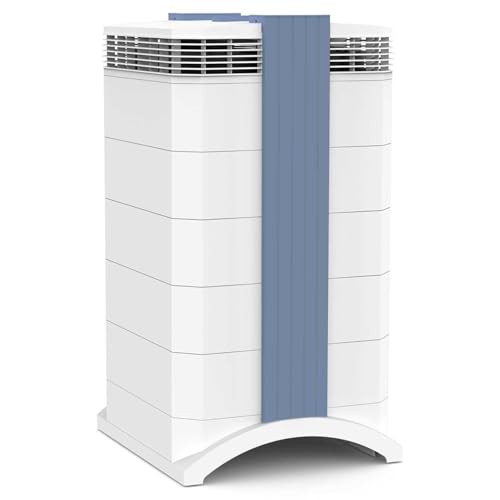
IQAir GC MultiGas XE – Best Overall for VOCs
The GC MultiGas XE is the rare purifier designed from a blank page for gases rather than adapted from a particle machine, and its listing says so outright: activated carbon filtration aimed at VOCs, chemicals and odours for rooms up to 1,125 sq ft. Instead of one mixed filter, it uses deep granular carbon cartridges — a large mass of adsorption media with the contact time gas removal actually needs — alongside particle stages, in a Swiss-made unit on wheels that can be moved to whichever room is being painted, floored or furnished. It suits renovators, new-build and new-furniture households, home workshops and anyone whose VOC problem is the main problem. It does not suit buyers whose issue is mainly dust or pet hair, who would be paying for carbon they do not need.
Strengths
- The deepest dedicated gas-phase filtration in this guide, built around granular activated carbon cartridges.
- Purpose-designed for VOCs and chemical odours rather than adapted, which shows in the cartridge architecture.
- Wheeled, movable format lets one serious machine serve the room that currently needs it.
Trade-offs
- Premium pricing, and the multi-cartridge replacement set is a significant ongoing cost when it comes due.
- Large and industrial in appearance; it looks like equipment, not furniture.
- Particle performance, while strong, is not the reason to buy it — the HealthPro Plus is the particle flagship.
The way to think about the GC MultiGas is as the difference between treating air and treating a problem. During a renovation or after a room of new flat-pack furniture arrives, VOC load is concentrated, temporary and intense, and this is the machine that meets that situation head-on: park it in the room, run it continuously on a meaningful fan speed, and the chemical edge comes off the air days faster than ventilation alone manages in still weather. Between projects it ticks over as a whole-room purifier. Buyers who understand that cycle — intense need now, background duty later — get full value from it.
Best for: renovations, new furniture off-gassing, workshops and homes where VOCs are the primary complaint. / Not suited for: dust-first buyers or small budgets.
Check the current price on Amazon

Austin Air HealthMate Plus (B450) – Best for Renovation and New Furniture
Austin Air’s HealthMate Plus is the long-standing workhorse answer to chemical air problems: a steel box containing a four-stage filter built around activated carbon blended with zeolite, covering up to 1,500 sq ft, with a filter life the brand rates at up to five years. The zeolite blend is the detail that matters for VOC shoppers — it broadens the range of gases the bed handles well beyond plain carbon — and the five-year filter economics change the ownership maths completely compared with cartridge machines. It suits large living spaces, open-plan floors, renovators and anyone who wants to install serious gas filtration and then mostly forget it. It does not suit app lovers or design-first buyers.
Strengths
- Carbon-and-zeolite blend targets a wider range of household chemicals than carbon alone.
- Filter life rated in years, not months, giving the lowest long-term running cost among the heavy-carbon picks.
- Simple, repairable steel construction with no app, no Wi-Fi and nothing to go obsolete.
Trade-offs
- Utilitarian appearance and a footprint that reads as appliance, not decor.
- No air-quality sensor, auto mode or smart features of any kind.
- Heavy; you place it once and leave it there rather than moving it room to room.
The HealthMate Plus earns its place in VOC conversations year after year because its formula matches the problem: lots of adsorption media, a chemistry blend aimed at gases, and a service interval long enough that the filter is still working in year three when lesser machines have been quietly saturating. For a household mid-renovation or furnishing a new home room by room, that set-and-forget reliability is the feature. Put it in the largest living space, run it continuously, and let time and carbon do their slow, unglamorous work.
Best for: large rooms, long renovation programmes and buyers who value filter life over features. / Not suited for: smart-home households or small bedrooms.
Check the current price on Amazon

IQAir HealthPro Plus XE – Best Premium All-Rounder
The HealthPro Plus XE is IQAir’s flagship all-rounder: HyperHEPA filtration for the finest particles, wrapped around a dedicated gas-phase cartridge stage for VOCs and odours, with Wi-Fi monitoring, covering large rooms up to 1,125 sq ft. Where the GC MultiGas specialises, this machine refuses to choose — it is the pick for homes where the renovation produced both dust and fumes, where traffic pollution brings particles and gases through the same windows, or where a buyer simply wants one premium machine that is excellent at everything. It suits demanding households and mixed-problem homes. It does not suit buyers on a budget or anyone whose only problem is a single gassy room, where the GC MultiGas is the sharper tool.
Strengths
- Best-in-guide combination of elite particle filtration and a real gas-phase stage.
- Wi-Fi app monitoring suits buyers who want visibility into their air.
- Modular filter stages can be replaced individually as each reaches its limit.
Trade-offs
- The gas cartridge is smaller than the GC MultiGas’s dedicated carbon array; under extreme VOC load it saturates sooner.
- Premium purchase price plus premium filter prices across several stages.
- Large footprint and equipment styling.
Think of the HealthPro Plus as the machine for the home that cannot yet say which problem it has. New neighbourhood construction, a busy road outside, a hobby that involves solvents, a dog — life arrives mixed, and this purifier is built for mixed. Its gas stage is a genuine cartridge rather than a token sheet, which keeps it honest in a VOC guide, while its particle side is the strongest here. If your VOC load is severe and specific, buy its sibling; if your air is a bit of everything, buy this.
Best for: mixed particle-and-gas problems and premium one-machine households. / Not suited for: extreme single-source VOC loads or tight budgets.
Check the current price on Amazon

Oransi TrueCarbon 200C – Best Compact Carbon Specialist
The TrueCarbon 200C makes an argument most purifiers are afraid to make: for a small room with a gas problem, spend everything on carbon. Its listing is unusually specific — 3.2 lb of treated activated carbon, aimed at odours, smoke smell, pet odours and VOCs, for rooms up to 375 sq ft. Treated carbon matters because impregnated media extends adsorption to compounds that plain carbon holds weakly, and 3.2 lb in a compact unit is a serious bed by small-purifier standards, where a few ounces of carbon dusting is the norm. It suits small bedrooms, nurseries being prepared (ventilate first, then maintain with the purifier), home offices with new furniture, and craft or hobby corners. It does not suit large rooms or dust-heavy homes, because carbon is nearly all it does.
Strengths
- A real, specified carbon mass — 3.2 lb of treated activated carbon — in a compact footprint.
- Focused design: no money diverted to particle features the target buyer may not need.
- Right-sized for the single-room problems where VOC complaints usually live.
Trade-offs
- Minimal particle filtration compared with the HEPA machines here; pair it with ventilation and dusting in dusty homes.
- 375 sq ft ceiling makes it a one-room answer only.
- When the carbon bed saturates, replacement is the whole running cost of the machine.
The TrueCarbon is the connoisseur’s small-room pick precisely because it refuses breadth. A new wardrobe off-gassing in a small bedroom does not need HyperHEPA; it needs carbon, contact time and a closed door. This unit provides exactly that equation at a size that fits beside a desk. Buyers graduating from a token carbon-sheet purifier that never changed the smell of anything will recognise the difference within the first day of running a real bed.
Best for: single small rooms with a defined VOC or odour source. / Not suited for: large spaces or particle-first problems.
Check the current price on Amazon

WINIX 5510 – Best Mainstream Option
The WINIX 5510, the current generation of the long-running 5500-2 line, is the mainstream machine in this guide: True HEPA plus a high-deodorisation carbon filter, app support, auto mode and coverage up to 1,881 sq ft in an hour, in a package priced and styled for ordinary living rooms. Its carbon stage is a proper deodorisation filter rather than a token sheet, which makes it genuinely useful for the moderate VOC reality of most homes — cooking gases, cleaning-product days, a freshly painted room aired out next door, the new sofa’s first month. It suits general households whose VOC load is everyday rather than industrial. It does not suit severe renovation fumes, where its carbon mass is simply outclassed by the Austin Air and IQAir machines.
Strengths
- High-deodorisation carbon filter that handles everyday household gases and odours credibly.
- Auto mode, air-quality indication and app support make it effortless to live with.
- Strong particle performance and large-room coverage cover the rest of a normal home’s air problems.
Trade-offs
- Carbon quantity is a filter panel, not a deep bed; heavy VOC loads saturate it far faster than the specialists.
- Replacement filters are an annual-style cost rather than a multi-year one.
- PlasmaWave-style ionisation features divide opinion; it can be switched off, and VOC-focused buyers can simply leave it off.
Honesty about scale is what keeps the 5510 in this guide. Most households asking about VOCs are not mid-renovation; they are bothered by the chemical smell of modern home life and want the air in the main room handled by a machine that also does dust, pollen and pet hair without fuss. For that household the WINIX is the rational buy, and the specialists are overkill. Just go in knowing where its ceiling is: if you later take on a full repaint or a room of new cabinetry, the correct move is to borrow the heavy artillery approach — a deep-carbon machine in that room — not to blame the WINIX for a job beyond its design.
Best for: everyday household VOC and odour loads in main living spaces. / Not suited for: renovation-grade fume problems.
Check the current price on Amazon

Austin Air Bedroom Machine (B402) – Best for Bedrooms
The Bedroom Machine applies Austin Air’s formula — five-stage filtration with activated carbon and zeolite in a steel cabinet with a filter rated for years — at a bedroom scale, covering up to 500 sq ft. Bedrooms are where VOC exposure is longest and most continuous: eight hours a night breathing whatever the mattress, furniture, flooring and paint are giving off, in the room where you are least able to notice smell because you adapt to it while you sleep. A long-life carbon bed running quietly all night is precisely matched to that exposure pattern. It suits master bedrooms, new-mattress and new-furniture situations, and light sleepers who need the machine present but not audible. It does not suit buyers who want sensors, apps or a machine that doubles as living-room furniture.
Strengths
- The same carbon-and-zeolite chemistry as the HealthMate Plus, scaled and quietened for bedrooms.
- Multi-year filter life suits a machine meant to run every night indefinitely.
- Steel, mechanical simplicity: no lights, apps or features competing with sleep.
Trade-offs
- No auto mode or air-quality feedback; you choose a speed and trust the process.
- Bedroom-scaled coverage only — it will not rescue a whole open-plan floor.
- Premium pricing for a deliberately feature-light machine.
The bedroom case for VOC removal is about duration, not intensity, and this machine is built for duration. Set it on a low speed before bed, let the carbon bed work through the night, and the room’s background chemical load — the new headboard, the repainted walls from spring, the flooring — is steadily drawn down instead of breathed. Buyers who tried sleeping next to a feature-rich purifier’s glowing display and fan theatrics will appreciate how completely this one disappears into the routine.
Best for: bedrooms with new furniture, mattresses or paint, and long nightly exposure. / Not suited for: whole-house coverage or feature seekers.
Check the current price on Amazon
Comparison Table
| Pick | Badge | Key spec | Best for |
|---|---|---|---|
| IQAir GC MultiGas XE | Best Overall for VOCs | Deep granular carbon cartridges, up to 1,125 sq ft | Serious, concentrated VOC problems |
| Austin Air HealthMate Plus B450 | Best for Renovation and New Furniture | Carbon + zeolite, up to 1,500 sq ft, long-life filter | Large rooms and long projects |
| IQAir HealthPro Plus XE | Best Premium All-Rounder | HyperHEPA + gas cartridge stage, Wi-Fi | Mixed particle and gas problems |
| Oransi TrueCarbon 200C | Best Compact Carbon Specialist | 3.2 lb treated activated carbon, up to 375 sq ft | Single small rooms |
| WINIX 5510 | Best Mainstream Option | True HEPA + high-deodorisation carbon, app support | Everyday household VOC loads |
| Austin Air Bedroom Machine B402 | Best for Bedrooms | 5-stage carbon + zeolite, up to 500 sq ft | Nightly bedroom exposure |
How to Choose an Air Purifier for VOC Removal
The first decision is chemical, not electronic: what is your VOC source, and is it temporary or continuous? Temporary sources — paint, varnish, new furniture, new flooring — spike hard and fade over weeks to months; they reward a deep-carbon machine run intensively in the source room, then relaxed to background duty. Continuous sources — pressed-wood cabinetry, a hobby bench, an attached garage’s fumes migrating indoors, heavy cleaning-product use — reward long-life carbon and permanent placement. Naming your source honestly also tells you when a purifier is the wrong purchase entirely: if a product in your home is emitting something that worries you beyond smell, removing or sealing the source beats filtering its output, every time.
Second, learn to read carbon claims like an engineer. The vocabulary in order of seriousness runs: carbon sheet or carbon-impregnated foam (a deodorising gesture, fine for fridge-level smells), carbon panel filter (moderate, the WINIX class), granular carbon cartridge or bed measured in pounds (the serious class, where the Oransi, Austin Air and IQAir GC live). Blends matter too: zeolite and potassium-permanganate-impregnated media exist because plain carbon is comparatively weak on formaldehyde and certain light gases, and formaldehyde from pressed wood is one of the most common household VOC concerns. A listing that specifies carbon weight and blend is a listing written by a company that expects to be checked; a listing that says only “activated carbon filter” among twelve bullet points is telling you the carbon is a garnish.
Third, size for the room and the reality of doors. VOC removal is slow chemistry: air must pass through the bed repeatedly, so a machine at its coverage limit on a low, quiet speed underperforms a smaller machine working honestly in a closed room. Buy for the room where the source is, close the door during intensive treatment, and resist the whole-house fantasy — purifiers clean the air in the room they occupy, with modest spillover. Fourth, budget the filters before the machine. Add up five years of replacement carbon at your expected load; in this category the filter schedule, not the sticker, is the true price, and it is exactly why the multi-year Austin Air filters and the cartridge economics of the IQAirs deserve the arithmetic before you fall for a cheaper box with hungry consumables.
How to Use a VOC Purifier During and After a Renovation
Sequence matters more than horsepower. First, ventilate during the work itself whenever weather and security allow — open windows and an exhaust fan move more contaminated air in an hour than any purifier, and no purifier should be your plan while paint is wet or adhesive is curing; follow the product label’s ventilation guidance as the authority. Second, once the work is done and the space is closed up, bring the purifier into the source room, shut the door, and run it continuously on a high-but-tolerable speed for the first several days: this is the intensive phase, when off-gassing is strongest and carbon contact time pays the highest return. Third, step down to a medium continuous speed for the following weeks, because off-gassing decays gradually rather than stopping, and intermittent use lets the room’s load rebuild between sessions.
Maintain the partnership between machine and building. Keep the purifier’s intake and outlet unobstructed, a hand’s width from walls and furniture, and resist placing it in a far corner of a different room from the source. Watch for the honest signal of carbon saturation: the chemical smell returning at the outlet air, or the room’s smell no longer improving despite continuous running. That signal, not the calendar alone, is when a carbon stage has given what it has. Finally, keep expectations calibrated: the goal is a home that smells neutral and feels fresh materially sooner than it would unaided — a comfort and air-quality outcome — while source control and ventilation remain the primary tools for anything beyond everyday household levels.
VOC Sources, Room by Room: Where the Load Actually Comes From
A purifier works best when it is aimed, and aiming requires knowing your home’s actual sources. The renovation family is the loudest: paints, primers, varnishes, adhesives, caulks and new flooring emit strongly at first and decay over weeks, which is why the intensive-then-background running pattern in the how-to section matches them. The furnishing family is slower and longer: pressed-wood furniture, cabinets and shelving made with urea-formaldehyde resins off-gas gently for months to years, joined by new mattresses, carpets and upholstery foams in their first season. This is the load that bedroom machines like the Austin Air Bedroom Machine exist to draw down, night after night, at low speed.
The daily-life family is the most underestimated. Cooking — especially high-heat frying and gas burners — releases a burst of gases alongside its particles. Cleaning products, air fresheners and scented candles add their own deliberate chemistry to indoor air; a household that sprays fragrance to mask cooking smells is running a small VOC exchange programme. Hobby sources concentrate in single rooms: nail products, solvents, glues, 3D printing, oil painting and workshop finishes can make one room’s load ten times the house average, which is why a movable deep-carbon machine like the GC MultiGas earns its wheels. Attached garages contribute vehicle and stored-solvent fumes that migrate through shared doors and walls. Walk your own home with this map in mind and the purifier decision usually makes itself: the room with the source gets the carbon, sized to that room, and the rest of the house gets ventilation and time.
Carbon Filter Care and the Real Cost of Ownership
Carbon is a consumable with a memory: every hour of adsorption spends capacity that does not come back, and heavy loads spend it fast. This is the economic heart of the category, and it rewards arithmetic before purchase. Deep-bed and cartridge machines carry expensive replacements but spread them over long service — Austin Air’s multi-year filter life is the extreme case — while panel-filter machines like the WINIX ask less per filter and ask more often. Under a heavy renovation load, any carbon stage saturates sooner than its nominal schedule; under background household duty, schedules are realistic. The honest five-year comparison is machine price plus the filters that period will actually consume in your home, and in VOC service that figure routinely reverses the ranking suggested by sticker prices.
Care itself is simple but specific. Keep pre-filters clean, because a clogged pre-filter starves the carbon bed of airflow and the bed cannot adsorb what never reaches it. Do not wash granular carbon or attempt home reactivation tricks; adsorption media is replaced, not laundered. Store spare cartridges sealed, since carbon adsorbs from warehouse and cupboard air too and arrives partly spent if left open. And learn your machine’s saturation signal — returning odour at the outlet — because in gas service your nose, used carefully, is a more truthful gauge than a timer. Owners who budget the filters, keep the pre-filters clean and replace carbon on evidence get the performance they paid for; owners who treat a VOC purifier as fit-and-forget own, within a year or two, a fan in a box.
Common Buying Mistakes
The category’s defining mistake is buying a particle purifier for a gas problem: a buyer reads excellent HEPA specifications, brings the machine home to a freshly painted room, and concludes purifiers do not work, when in fact the tool never addressed gases at all. The second mistake is trusting the words “activated carbon” without a quantity; a carbon-dusted foam sheet and a multi-pound granular bed share the phrase and nothing else. Third, undersizing by room and oversizing by house — one mid-tier unit expected to clean three rooms through open doorways will disappoint in all three, where the same money spent on the source room would have succeeded visibly. Fourth, ignoring filter economics until the first replacement shock, then abandoning the machine with a saturated bed that now does nothing. Fifth, using a purifier as permission to skip ventilation or source control during renovation; the purifier is the finishing tool in that workflow, not the foundation, and treating it as the foundation is how people end up breathing fumes next to an expensive box.
How to Tell Whether Your VOC Purifier Is Actually Working
Gas removal is invisible, which makes this category uniquely vulnerable to both false confidence and false disappointment, so a verification routine is worth having. The nose is the first instrument, used correctly: judge the room after being away from it — returning from outdoors or another room — because continuous exposure dulls smell within the hour, and the returning nose reads the room the way a visitor would. During an intensive treatment phase, that returning check, morning and evening, gives a truthful progress line: the chemical edge should soften day by day, fastest in the first week. The second instrument is the outlet test described earlier: air leaving the machine should smell cleaner than air entering it, and when that difference fades despite clean pre-filters, the carbon is telling you it is spent.
Consumer VOC meters exist and deserve a measured word. Inexpensive TVOC sensors respond to a broad soup of gases and drift with humidity and cooking, so their absolute numbers are not laboratory truth — but their relative readings, taken in the same room across days, can show a load rising with a new cabinet or falling under treatment, which is the question a household actually has. Treat them as trend instruments, never as safety certification. The third check is source discipline: if a room’s reading or smell refuses to improve under a correctly sized, continuously running deep-carbon machine, the likeliest explanation is not a failed purifier but an active, ongoing source stronger than the treatment — a product still curing, a spill soaked into a material, a garage door seal leaking fumes. At that point the answer returns to this guide’s first principle: find and remove, seal or ventilate the source, and let the purifier return to the finishing role it is genuinely excellent at.
Placement and Running Patterns That Decide Real-World Results
Two owners can buy the same machine and get different homes, and the difference is almost always placement and pattern. Place the purifier in the room with the source, on the floor or a low stand with clearance on all sides, away from corners that strangle airflow and away from the open window that would let it spend its life cleaning the outdoors. In a bedroom, that means the side of the room away from the door’s draught path; in a renovation room, near the new materials rather than near the door. Run it continuously during any active load period — VOC removal is cumulative chemistry, and a machine run for an hour at breakfast is fighting a source that emits for twenty-four. Speed selection follows the room’s occupation: high when the room is empty or the load is fresh, medium as the standing pattern, low overnight in bedrooms, accepting that the low speed trades removal rate for silence in the hours silence matters most.
Coordinate the machine with the building’s other air systems rather than against them. Kitchen extraction during cooking removes a VOC burst at birth that no purifier should be asked to chase through the house afterwards. Bathroom fans during and after showers and cleaning-product use do the same. Heating and cooling systems with good filters handle the particle background and let the purifier concentrate on the gas work it was bought for. And keep the machine’s own intake honest: a purifier pushed against a wall of new cabinetry it is meant to treat, with its intake blocked by the boxes it is cleaning up after, is the category’s saddest sight. Airflow, continuity and aim — the machine supplies the carbon, but the household supplies those three, and together they are the whole result.
Final Recommendation
For a serious VOC problem, buy the machine built for it: the IQAir GC MultiGas XE for concentrated loads, or the Austin Air HealthMate Plus when the room is large and the project is long. Mixed particle-and-gas homes belong with the IQAir HealthPro Plus XE. Small single rooms are the Oransi TrueCarbon 200C‘s home turf, bedrooms belong to the Austin Air Bedroom Machine, and everyday household loads are honestly served by the WINIX 5510. Whichever you choose, run it continuously in the source room and respect the ventilation-first sequence above. Related reading: Best Air Purifier For A Smokers House, Best Air Purifiers For Smoke, Best Air Purifiers For Dust, Best Air Purifiers For Large Rooms and Best Air Purifiers For Bedrooms.
VOC Strategy for Open-Plan Homes
Open-plan living defeats the closed-door logic that makes single-room treatment so effective, and it deserves its own strategy. In an open space, treat the source’s zone rather than the whole volume: the purifier belongs near the new cabinetry, the refinished floor’s edge or the kitchen’s boundary, where concentrations are highest and every pass of air through the carbon does the most work. Size up honestly — open-plan areas are the case for the large-coverage machines in this guide, the HealthMate Plus’s 1,500 square feet or the GC MultiGas’s deep cartridges run at meaningful speed — and accept a higher standing fan speed than a bedroom would tolerate, since the living zone is awake when it is working hardest. Portable partitions are an underrated ally during a renovation phase: a closed door added temporarily, even a heavy curtain across a cased opening, restores the two-zone physics that lets one machine win. When the project ends, the same machine steps down to background duty and the open plan returns to normal. The principle survives every floor plan: carbon works where the air actually goes, so arrange the air, then arrange the machine.
A final word on expectations, because this category rewards the patient. VOC removal is the slowest service an air purifier performs — particles are captured in a pass, but gases are accumulated molecule by molecule into a carbon bed across days of continuous running. Buyers who understand that tempo choose the deep-carbon machines, place them with the source, run them without interruption and judge them across a fortnight, and those buyers consistently report the outcome the category promises: a home whose air smells like nothing at all, which is the finest compliment indoor air can earn.
Households with babies, elderly relatives or anyone whose health makes them cautious should hold the same balanced line this guide opened with: a deep-carbon purifier is a sensible comfort measure for reducing the everyday chemical load of indoor air, it pairs with ventilation rather than replacing it, and any specific health question belongs to the family’s clinician, who knows the people rather than the products. Buy the machine for the air, keep the advice for the doctor, and the purchase stays exactly as honest as it should be.
Frequently Asked Questions
Does a HEPA filter remove VOCs?
No. HEPA filtration captures particles — dust, pollen, pet dander, smoke particles — and VOCs are gases that pass through it. VOC removal requires adsorption media, normally activated carbon in meaningful quantity, sometimes blended with zeolite or impregnated media for compounds plain carbon holds weakly. Many good purifiers include both systems; check which one your problem actually needs.
How much activated carbon is enough for VOCs?
More than marketing usually offers. A carbon sheet or thin panel helps with light odours and everyday gases, but a defined renovation or new-furniture problem calls for granular carbon measured in pounds — the class of the Oransi TrueCarbon’s 3.2 lb bed and the deep cartridges and beds in the IQAir and Austin Air machines in this guide.
How long does it take a purifier to clear VOCs from a painted room?
Expect improvement over days, not minutes, and a tail of weeks as materials continue to off-gas at declining rates. Ventilation during and immediately after painting does the heavy lifting; the purifier then shortens the remaining period materially when run continuously in the closed room. Any product promising instant gas removal is describing its fan, not chemistry.
Can an air purifier replace ventilation?
No. Purifiers recirculate and treat indoor air; ventilation replaces it. During painting, gluing or any strong chemical use, label guidance and fresh air come first, and purifiers take over afterwards to manage the residual load. They are partners, not substitutes.
How do I know when the carbon filter is saturated?
The practical signal is smell: chemical or sour odours returning in the air leaving the machine, or a room that stops improving despite continuous running. Follow the manufacturer’s replacement schedule as the outer bound, and treat a heavy renovation load as a reason to expect earlier saturation than the schedule assumes.
Is formaldehyde from furniture something a purifier can help with?
A carbon bed blended with zeolite or impregnated media can reduce airborne formaldehyde as part of the general VOC load, which is why blends feature in this guide’s top picks. Source control still leads: ventilate new pressed-wood furniture well, and let strong off-gassing happen in a ventilated space before the piece joins a bedroom if you can.


