Disclosure: airfryerkitchensupply.com is reader-supported. When you buy through links on our site, we may earn an affiliate commission at no extra cost to you.
Where to buy
Every purifier below was confirmed against Amazon’s catalog data before inclusion, and each link points to the exact model reviewed. With bird-safety features, check the listing carefully: some brands sell near-identical models with and without ionizer functions, and the ionizer version is not the one you want near a cage.
- Austin Air HealthMate Plus (B450) — Check the current price on Amazon
- Rabbit Air MinusA2 SPA-780A — Check the current price on Amazon
- Winix 5510 — Check the current price on Amazon
- BLUEAIR Blue 311i Max — Check the current price on Amazon
- COWAY Mighty AP-1512HH — Check the current price on Amazon
- Levoit Core 300-P — Check the current price on Amazon
The best air purifiers for birds solve two problems at once, and the second one is the reason this guide exists separately from every general purifier roundup. The first problem is yours: pet birds — especially powder-down species like cockatoos, cockatiels, and African greys — produce a constant snowfall of feather dust and dander that coats furniture, clogs sinuses, and can trigger genuine respiratory trouble in the humans who live with them. The second problem is the bird’s. A bird’s respiratory system is far more efficient than yours — air flows through its lungs and air sacs in a way that extracts far more from every breath, including whatever is floating in it. That efficiency is why canaries were carried into coal mines, and it is why a purifier technology that is merely inadvisable for people can be dangerous for a parrot.
So this guide applies a stricter filter than a normal purifier guide. Ozone-generating ionizers are excluded outright, not shortlisted with a warning. Models with ionizer or plasma features only appear if the feature can be switched off completely and left off. Beyond safety, the picks were judged on how they handle the specific load a bird room creates: fine, light, constantly replenished feather dust that demands a washable or easily cleaned pre-filter, strong airflow for large cages and aviary rooms, and fan noise low enough that the purifier can run all day near an animal that startles at sudden sound. Six purifiers passed. Each review below names the bird household it fits — and the ones it does not.
In this guide
Quick Picks
- Best Overall for Bird Rooms: Austin Air HealthMate Plus — a heavy steel unit with a huge activated carbon and zeolite filter, purely mechanical filtration, and a filter life measured in years. Check price on Amazon
- Best Customizable: Rabbit Air MinusA2 SPA-780A — slim, wall-mountable, ultra-quiet, with a filter slot you can configure for odor or toxin control. Check price on Amazon
- Best for Large Bird Rooms: Winix 5510 — strong airflow for big rooms, with its plasma feature switchable fully off for bird safety. Check price on Amazon
- Best for Dander and Fine Dust: BLUEAIR Blue 311i Max — high clean-air delivery with a washable pre-filter that shrugs off feather dust. Check price on Amazon
- Best Mid-Range All-Rounder: COWAY Mighty AP-1512HH — the proven compact tower with true HEPA, carbon, and an air-quality sensor that reacts to dust events. Check price on Amazon
- Best Budget for a Single Cage: Levoit Core 300-P — simple, quiet, true-HEPA filtration with no ionizer, sized for one cage in a bedroom or office. Check price on Amazon
How These Picks Were Chosen
All six models were verified against Amazon’s catalog. The selection criteria were then re-ordered for birds. Safety came first and was non-negotiable: no ozone-generating ionization, and any electronic air-cleaning feature had to be fully defeatable. Mechanical filtration — a fan pushing air through true HEPA media — is the baseline every pick meets, because it cleans the air without adding anything to it.
Second came dust handling. Feather dust is not ordinary household dust: it is lighter, more buoyant, and produced continuously, so it stays airborne longer and loads pre-filters faster. Purifiers with washable or vacuumable pre-filters scored heavily, because a bird owner who must buy a new pre-filter every month will simply stop maintaining the machine. Third, room coverage was matched to how birds are actually kept — a single cage in a living room is a different problem from a dedicated bird room with several large parrots. Fourth, noise: a purifier that frightens the bird or drones loudly enough to be switched off cleans nothing, so low-speed quietness mattered more than headline airflow. Finally, running cost was judged qualitatively by filter size and stated filter life, since a bird room purifier runs twenty-four hours a day and its filters are a permanent household expense.
One more screening rule deserves stating plainly, because it eliminated several popular models from contention: any purifier whose air-cleaning story depends on generating something — ozone, ions, hydroxyl radicals — was treated as guilty until proven innocent, and most could not be proven innocent to the standard a parrot’s lungs deserve. Manufacturers’ claims of “bird safe” were not accepted at face value either; what counted was the mechanism. A fan and a filter have a mechanism anyone can inspect and understand. That conservatism is deliberate, and it is why this list is shorter on fashionable features and longer on filter mass than a general-purpose roundup. In a bird room, boring is a compliment.
The 6 Best Air Purifiers for Birds

Austin Air HealthMate Plus (B450) — Best Overall for Bird Rooms
The HealthMate Plus is the purifier avian veterinarians and long-time parrot owners tend to name first, and the reasons are structural. Inside its perforated steel body sits an unusually large filter: true HEPA media wrapped around a deep bed of activated carbon blended with zeolite, a combination aimed at both particles and the gases and odors that ordinary HEPA-only machines ignore. The filtration is purely mechanical — a fan, a filter, nothing generated and nothing added to the air — which makes it the easiest safety case in this guide. Austin Air rates the filter for years of continuous use rather than months, and for a machine that must run around the clock beside a cage, that longevity changes the ownership math completely.
Strengths
- Purely mechanical filtration with no ionizer or ozone-producing technology of any kind.
- Massive carbon-and-zeolite bed handles cage odors and household chemical fumes that HEPA alone cannot touch.
- Filter life measured in years under normal use, so the always-on running cost stays low and maintenance is rare.
Trade-offs
- It is a heavy, boxy steel unit — closer to a small piece of furniture than to a sleek appliance.
- No air-quality sensor, app, or auto mode; you choose a fan speed and it simply runs.
- It sits in the premium tier, and its replacement filter, while infrequent, is a substantial purchase when it finally comes due.
In a bird room, the HealthMate Plus behaves like infrastructure. The steel case shrugs off the occasional sprayed bath water and weekly cage cleaning, the perforated wrap lets it draw air from all sides so placement is forgiving, and on its lower speeds it settles into a background hum that birds habituate to quickly. Its one behavioral demand is that you think about fan speed yourself: run it higher when you are cleaning cages and stirring dust into the air, lower overnight. Owners of multiple large parrots — the households with the worst feather-dust load — are exactly the buyers who get the most from this machine’s overbuilt filter.
Best for: dedicated bird rooms and multi-parrot households wanting the safest, longest-lived filtration. / Not suited for: buyers who want smart features, a light footprint, or a small price. Check the current price on Amazon
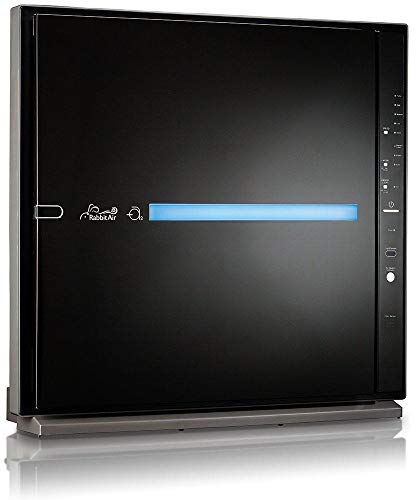
Rabbit Air MinusA2 SPA-780A — Best Customizable
The MinusA2 takes the opposite design path: it is slim enough to hang on a wall like a picture frame, quiet enough for a bedroom, and built around a customizable filter slot that lets you choose what the fourth filtration stage targets — odor control being the configuration most bird owners pick. Its HEPA stage handles the feather dust, its activated carbon stage works on cage odor, and the whole unit runs with a light-and-sensor package that dims itself at night. For bird owners whose cage lives in a finished living room or bedroom rather than a dedicated bird room, that combination of discretion and configurability is hard to beat.
Strengths
- Wall-mountable, slim profile keeps it off the floor and out of the splash zone of cage cleaning.
- Customizable filter stage lets you prioritize odor reduction, the bird-room configuration most owners choose.
- Among the quietest full-size purifiers here, with a light sensor that darkens its indicators at night.
Trade-offs
- Premium-tier pricing for its coverage class — you pay for the design and the quiet.
- Its coverage suits one room well; a large multi-cage bird room will want the Austin Air’s filter mass instead.
- Filters are brand-specific, so running costs depend on Rabbit Air’s filter pricing over the years.
The wall-mount option deserves emphasis for bird households specifically. A floor purifier beside a cage gets bumped by cage doors, rolled cages, and brooms; it also sits exactly where a bird on the floor — and many parrots do walk — can reach cords and intake grilles. Moving the MinusA2 onto the wall removes it from that traffic entirely while keeping it in the room’s air path. Choose the odor-reduction filter configuration, keep the ionizer-free setup as it ships for bird use, and let its auto mode respond to the dust cloud that cage cleaning inevitably raises.
Best for: cages in living rooms and bedrooms, design-conscious owners, and anyone who wants to tune filtration toward odor. / Not suited for: very large bird rooms or buyers watching total cost of ownership closely. Check the current price on Amazon

Winix 5510 — Best for Large Bird Rooms
The Winix 5510 is the airflow pick: a current-generation tower rated for large rooms, with true HEPA filtration, a substantial carbon filter, and an auto mode driven by its air-quality sensor. One feature requires an explicit instruction for bird owners. The 5510 includes Winix’s PlasmaWave technology, an electronic air-treatment stage — and beside a bird, it should be switched off and left off. The good news is that it can be, completely, from the control panel, and with it off the 5510 is a straightforward, powerful mechanical purifier. Treat that switch as part of setup, the same way you would remove a cage toy with a broken clasp.
Strengths
- Strong clean-air delivery for large rooms — the right scale for a multi-cage bird room or open-plan space.
- True HEPA plus a high-deodorization carbon filter covers both feather dust and cage odor.
- Auto mode and app support let the machine surge during cage cleaning and idle quietly the rest of the day; the plasma feature can be turned fully off for bird safety.
Trade-offs
- You must remember the plasma feature exists and keep it off — households where others might reset settings should weigh that.
- As a large-room tower it has a real footprint and draws real power on turbo.
- Feather dust will load its pre-filter quickly in a powder-down household; budget the few minutes to vacuum it often.
Used correctly — plasma off, auto on — the 5510 is the most convenient big-room option here. The sensor-driven surge is genuinely useful in a bird room, where dust arrives in events: morning cage cleaning, a cockatoo’s post-bath shake, a molting week. Rather than asking you to live with turbo noise all day, it idles, notices, works, and settles. For a single small cage it is more machine than you need; for a room where birds actually live in numbers, it earns its floor space.
Best for: large bird rooms and open-plan homes with several birds, with the plasma feature switched off. / Not suited for: anyone who cannot guarantee the plasma setting stays off, or single-cage small rooms. Check the current price on Amazon

BLUEAIR Blue 311i Max — Best for Dander and Fine Dust
Blueair’s Blue Max line is built around very high airflow through its HEPASilent filtration at unusually low noise, and the 311i Max applies that formula to large rooms. For feather dust specifically, two details stand out. The fabric pre-filter wraps the outside of the unit, catches the visible dust load before it reaches the main filter, and can be vacuumed or washed — exactly the maintenance pattern a powder-down household needs weekly. And the machine moves a great deal of air on its quieter settings, which matters because the purifier that runs all day on low cleans more than the loud one that gets switched off.
Strengths
- Washable fabric pre-filter is ideal for feather dust — vacuum it during cage cleaning and the main filter lasts.
- High clean-air delivery at low noise, with auto mode and app control for hands-off running.
- Simple, wipeable design with no complex intake geometry for dust to cake into.
Trade-offs
- Carbon capacity is lighter than the Austin Air’s — odor control is present but not its headline strength.
- Its filtration approach blends mechanical and electrostatic capture inside the unit; it is certified for low ozone emissions, but purist bird owners who want fan-and-filter only should choose the Austin Air or Levoit.
- The fabric pre-filter’s look is casual — it reads as a soft appliance, not furniture.
The 311i Max is the pick for the household whose complaint is specifically the white film on every surface and the sneeze that comes with it. Positioned in the bird’s room and left on auto, it steadily strips the fine fraction that settles on shelves and in human lungs alike. Keep its pre-filter on your weekly cleaning round and it will repay you with a main filter that lasts as it should.
Best for: powder-down species households battling visible feather dust and human allergies. / Not suited for: severe cage-odor problems or buyers who want strictly mechanical filtration only. Check the current price on Amazon

COWAY Mighty AP-1512HH — Best Mid-Range All-Rounder
The Coway Mighty has been a default recommendation in the purifier world for years, and it translates well to bird duty: true HEPA filtration, an activated carbon stage for odor, a washable pre-filter for the coarse dust, and an air-quality indicator with an auto mode that visibly reacts when the air gets dirty. It is sized for a single room — the cage-in-the-living-room or cage-in-the-office scenario that describes most pet birds — and its compact tower footprint fits beside a cage stand without dominating the room.
Strengths
- True HEPA plus carbon plus a washable pre-filter — the complete bird-room checklist in a compact tower.
- Air-quality sensor and auto mode respond to dust events like cage cleaning without your intervention.
- Long track record and widely available replacement filters keep ownership simple.
Trade-offs
- One-room coverage; a dedicated multi-cage bird room needs a bigger machine or two of these.
- The carbon stage is modest, so strong odor from a large cage will test it.
- Filter replacements are a recurring mid-size expense rather than the Austin Air’s rare big one.
The Mighty is what to buy when the situation is ordinary: one or two birds, one room, a human who would like to breathe easier and dust less. It asks little — rinse the pre-filter, replace the filter pack when the indicator says so — and it does not ask you to think about ionization settings at all. For first-time purifier buyers in bird households, that simplicity is a safety feature in itself.
Best for: one or two birds in a living room, bedroom, or office. / Not suited for: aviary-scale rooms or heavy odor loads. Check the current price on Amazon

Levoit Core 300-P — Best Budget for a Single Cage
The Core 300-P is the small, simple end of the market done properly: a compact cylinder with true HEPA filtration, a quiet sleep mode, and — critically for this guide — no ionizer. It is sized for a bedroom or home office holding a single cage: a budgie pair, a cockatiel, a small conure. Within that honest scope it performs well, and its low price tier means a second unit for a quarantine cage or a second room is a realistic thought rather than a stretch.
Strengths
- True HEPA filtration with no ionization — a clean safety profile at a budget tier.
- Quiet sleep mode suits a cage in a bedroom, where the purifier must run all night.
- Compact and light enough to move between rooms as the bird’s setup changes.
Trade-offs
- Coverage is one modest room; it cannot service a bird room with several large parrots.
- Minimal carbon means cage odor control is limited — this is a dust and dander machine.
- Smaller filters mean more frequent replacement under a heavy feather-dust load.
Judge the Core 300-P by the job it claims: cleaner air around one cage, quieter nights, less dust on the desk. It does that job without a single feature a bird owner needs to disable or fear, which is more than can be said for many budget purifiers that advertise ionic bells and whistles. If your flock grows, it retires gracefully to the bedroom and a bigger machine takes the bird room.
Best for: a single small-to-medium bird in a bedroom or office, and first-time buyers. / Not suited for: multiple large parrots, big rooms, or odor-heavy setups. Check the current price on Amazon
Comparison Table
| Pick | Badge | Key spec | Best for |
|---|---|---|---|
| Austin Air HealthMate Plus B450 | Best Overall for Bird Rooms | True HEPA plus deep carbon/zeolite bed, purely mechanical, years-long filter life | Dedicated bird rooms, multiple parrots |
| Rabbit Air MinusA2 SPA-780A | Best Customizable | Slim wall-mountable body, customizable filter stage, ultra-quiet | Cages in finished living spaces |
| Winix 5510 | Best for Large Bird Rooms | Large-room airflow, true HEPA, carbon, plasma feature fully switchable off | Big rooms, several birds |
| BLUEAIR Blue 311i Max | Best for Dander and Fine Dust | High airflow at low noise, washable fabric pre-filter | Powder-down dust and allergies |
| COWAY Mighty AP-1512HH | Best Mid-Range All-Rounder | True HEPA, carbon, washable pre-filter, air-quality sensor | One or two birds in one room |
| Levoit Core 300-P | Best Budget for a Single Cage | True HEPA, no ionizer, quiet sleep mode | Single cage in a bedroom or office |
How to Choose an Air Purifier for a Bird Room
The bird-specific decision starts with what to exclude. Birds are exquisitely sensitive to airborne chemicals because their respiratory system processes air so thoroughly; substances a human barely notices can injure or kill a parrot. That is why this guide excludes ozone-producing ionizers outright and why the same caution you already apply to non-stick cookware fumes, scented candles, and aerosol sprays should apply to purifier shopping. Look for true HEPA filtration — a mechanical standard with a precise meaning — and treat terms like “ionic,” “plasma,” and “ozone purification” as reasons to walk away unless, as with the Winix above, the feature can be switched off completely and permanently. Even then, weigh whether everyone in the household can be trusted to leave it off.
Next, size the machine to the dust load, not just the room. A powder-down bird — cockatoo, cockatiel, African grey — produces dander at a rate that can overwhelm a purifier rated exactly at your room’s square footage. Size up one class: choose a machine whose rated coverage comfortably exceeds the room, then run it on a lower, quieter speed. You get the same clean-air delivery with less noise and less wear, and you have headroom for molting season and cage-cleaning dust events. A washable or vacuumable pre-filter is close to mandatory in this calculation, because feather dust loads the first stage fast; the pre-filter is what stands between you and a main HEPA filter that clogs months early.
Odor is the third axis, and it separates the picks more than particle performance does. Every true-HEPA machine here handles dust and dander well; they differ in activated carbon. A thin carbon sheet freshens lightly, while the Austin Air’s deep carbon-and-zeolite bed is built for serious gas and odor work — relevant if the cage shares space with a kitchen, if you keep several birds, or if someone in the home is sensitive to the general smell of a bird room. Match the carbon to the complaint: dust complaints need airflow and pre-filters, smell complaints need carbon mass.
Finally, plan for the machine as a permanent resident. It will run twenty-four hours a day, so its lowest-speed noise, its light discipline at night, the price rhythm of its filters, and whether it restarts automatically after a power cut all matter more than any turbo-mode number. A purifier that resumes on its own after an outage is quietly one of the most valuable features in a bird room, because the days you are away are the days nobody notices it stopped.
Where to Place a Purifier Near a Cage — and How to Run It
Placement follows the airflow, not the furniture. Put the purifier in the same room as the cage, a few feet away from it — close enough that the dust drifting off the cage enters the machine’s intake path, far enough that the bird is not sitting in a constant breeze. Birds are vulnerable to drafts, and a purifier exhaust aimed at the cage is a draft with good intentions. Angle the outlet toward the room, never directly at perches, and keep the unit out of reach of a bird that spends time outside the cage: cords get chewed, grilles get explored, and a purifier is not a play stand.
Run it continuously, and let speed follow the day’s events. A quiet low or auto setting is the baseline. Turn it up — or let the sensor do it — during and for an hour after cage cleaning, when you have deliberately stirred the week’s dust into the air; that is the single highest-value hour in the machine’s week. Keep the pre-filter on the same schedule as the cage itself: when you do the weekly cage clean, vacuum or rinse the pre-filter too, and the two chores will keep each other honest. Replace main filters by the indicator or the calendar, not by appearance — HEPA media can look clean long after its fine pores are loaded, and feather dust is exactly the fine load that hides.
Two cautions complete the routine. First, a purifier is not a substitute for the basics: it does not remove the need to clean the cage, change papers, and ventilate the room with fresh air when weather allows, and it does nothing about dust already settled — wipe surfaces with a damp cloth so you are not re-launching it. Second, introduce any new machine gradually to a nervous bird: run it across the room for the first days, let the bird learn its sound at a distance, then move it to its working position. A purifier the bird fears is a stressor placed deliberately beside its home.
Common Buying Mistakes
- Buying an ionizer because the marketing sounded advanced. Ozone and ionization are the technologies bird owners must avoid, not upgrade to. Mechanical HEPA filtration is the safe standard.
- Sizing exactly to the room. Feather dust — especially from powder-down species — overwhelms a borderline machine. Size up a class and run it slower and quieter.
- Ignoring the pre-filter. Without a washable first stage, the expensive HEPA filter becomes the dust collector and clogs early. Pre-filter maintenance is the whole running-cost game in a bird room.
- Aiming the outlet at the cage. Clean air delivered as a constant draft stresses birds and can chill them. Placement a few feet away, exhaust toward the room.
- Assuming a purifier replaces cleaning. It captures what is airborne. Settled dust, cage hygiene, and fresh-air ventilation remain your job.
- Forgetting the restart question. After a power cut, does the unit resume on its own? In a bird room that runs unattended for days, the answer matters. The same logic applies to holidays and house-sitters: a machine that needs a button press after every outage will spend the year quietly off at exactly the moments nobody is watching it, and the first sign will be the dust film when you return.
Feather Dust, Dander, and What a HEPA Filter Actually Catches
It is worth understanding what you are filtering, because bird-room air carries three different loads and they behave differently. The first is the visible one: feather fragments, seed hull dust, and the general debris that cage life generates. This coarse fraction settles quickly and loads the pre-filter — it is the white-grey felt you vacuum off the Blueair’s fabric wrap or rinse from the Coway’s first stage. The second load is the fine one: dander and powder-down particles small enough to stay suspended for hours, drift between rooms, and reach deep into human lungs. This is the fraction true HEPA media exists for, and it is why the purifier must run continuously rather than in bursts — the dust is being produced continuously, and a machine that runs only when you remember it is always cleaning yesterday’s air.
The third load is invisible and is the one most purifier marketing handles dishonestly: gases and odors. HEPA filters do nothing for them at all — a particle filter cannot catch a molecule. Cage odor, cooking fumes, and the volatile compounds from cleaning products pass straight through HEPA media and are only addressed by activated carbon, in proportion to how much carbon there is and how long air spends in contact with it. That is the honest reason the picks above are ranked the way they are for different households: a dust complaint is solved by airflow and HEPA, an odor complaint is solved by carbon mass, and a household with both complaints needs both, which is precisely the Austin Air’s design brief. When a listing promises that a thin carbon sheet “eliminates odors,” read it as light freshening, not elimination.
One more distinction matters for bird owners specifically. Some purifiers advertise germicidal ultraviolet lamps or photocatalytic stages as upgrades. Whatever their merits elsewhere, they add complexity without addressing a bird room’s actual loads, and any technology that treats air by reacting with it deserves extra scrutiny around an animal that breathes as efficiently as a bird does. The boring stack — pre-filter, HEPA, carbon — remains the right answer: each stage does one comprehensible thing, adds nothing to the air, and can be maintained by hand.
Running Costs and Filter Life in a Bird Household
A bird-room purifier is a subscription you pay in filters, and the honest comparison is not the sticker on the machine but the rhythm of its consumables. At one extreme sits the Austin Air: a premium machine whose filter is designed to last for years, so the cost arrives rarely and largely. At the other, compact machines like the Levoit use small, inexpensive filters that a powder-down household will cycle through at the fast end of their stated range. Neither pattern is wrong, but they suit different budgets and different tolerances for maintenance — and the worst outcome is the middle path taken unknowingly, a mid-priced machine with pricey proprietary filters replaced often. Before choosing, look up what its replacement filter actually is and how the maker says it lasts, then mentally shorten that life if you keep a cockatoo or a grey: manufacturers rate filters against ordinary household dust, and a bird room is not ordinary.
Your own habits move these numbers more than any specification does. A pre-filter vacuumed weekly can double the useful life of the HEPA stage behind it, because the fine filter is then doing only the fine work it was designed for. Running a larger machine on a lower speed — the sizing-up strategy from the buying guide — also extends filter life while cutting noise, since the same clean-air delivery is spread over more filter area at gentler pressure. Conversely, the fastest way to burn money is a borderline machine run permanently on turbo in a dusty room: maximum wear, maximum noise, minimum filter life. Size generously, maintain the cheap stage religiously, and the expensive stage will last the way the brochure promised.
What a Purifier Will and Will Not Change in a Bird Home
Set expectations correctly and a good purifier will satisfy you for years; set them wrong and even the Austin Air will feel like a disappointment. What it will change, measurably and usually within the first week: the dust film on furniture near the cage thins dramatically, the floating motes you can see in a shaft of sunlight largely disappear, morning congestion and sneezing ease for the humans who react to dander, and the room’s background smell neutralizes if you chose enough carbon. Visitors who are mildly sensitive to birds often become comfortable in a room they previously could not sit in. These are real, quality-of-life gains, and for many households they are the difference between keeping the bird in the family’s living space and exiling the cage to a spare room — an outcome that is worse for the bird’s social life as well as yours.
What it will not change: the cage still needs its papers changed and its bars wiped, because the largest share of debris falls rather than floats. Your bird will still molt, still bathe-splash, still scatter seed. A purifier does not sterilize anything, does not make an unsafe room safe — it cannot protect a bird from cooking fumes, scented products, or cigarette smoke used in the room, it can only dilute their aftermath — and it does not replace fresh air. Think of it as a tireless assistant working one specific job, airborne particles and gases, inside a husbandry routine that remains yours. Households that understand that division of labor are the ones that report, a year later, that the machine quietly became indispensable.
A final expectation concerns the bird’s opinion. Most birds habituate to a purifier’s low hum within days and ignore it thereafter; some are initially wary of the new object, which is why the gradual introduction in the placement section matters. Watch the bird, not the brochure: a bird that eats, plays, and sleeps normally near the running machine has accepted it, and that acceptance — like the cleaner shelves and the easier breathing — is part of what you bought.
Final Recommendation
If you keep several birds or a dedicated bird room, buy the Austin Air HealthMate Plus and stop deliberating: its purely mechanical filtration, enormous carbon bed, and years-long filter life are built for exactly that life. For a cage in a finished living room or bedroom, the Rabbit Air MinusA2 gives you quiet, wall-mounted discretion with filtration you can tune toward odor. Large open spaces point to the Winix 5510 — with its plasma feature switched off at setup and left off. If visible feather dust and human allergies are the complaint, the BLUEAIR 311i Max and its washable pre-filter are the most practical answer, while the COWAY Mighty is the balanced default for the common one-cage household and the Levoit Core 300-P covers a single small bird honestly at a budget tier. Whichever you choose, run it all day, keep its pre-filter clean, and remember the hierarchy: the purifier protects the bird as much as the bird’s dust threatens you, so its safety specification is not a detail — it is the decision.
Related guides in this series: Best Air Purifiers For Dust And Pet Dander, Best Air Purifiers For Cat Dander, Best Air Purifiers For Allergies Mold And Smoke, Best Air Purifiers With Washable Filter, Best 2 Pack Air Purifiers
Related guides
Frequently Asked Questions
Are ionizer air purifiers safe for birds?
No — avoid them. Ionizers can generate ozone, and birds’ highly efficient respiratory systems make them far more vulnerable to airborne irritants than humans. Choose mechanical true-HEPA filtration instead. If a model includes an ionizer or plasma feature, only consider it when that feature can be switched off completely, and leave it off permanently.
Which birds produce the most dust?
Powder-down species produce the most: cockatoos, cockatiels, and African grey parrots coat their feathers with a fine powder that becomes airborne constantly. Other parrots, budgies, and doves produce less but still shed dander and feather fragments. The dustier the species, the more you should size the purifier up and prioritize a washable pre-filter.
Can an air purifier help a bird’s breathing, or only mine?
Both. Cleaner air reduces the dust and dander load in the bird’s own environment as well as yours, which is one reason avian-savvy owners run purifiers in the bird room rather than only in human bedrooms. It is not a medical treatment — a bird with respiratory symptoms needs an avian veterinarian — but a cleaner baseline environment supports its health as it supports yours.
How close should the purifier be to the cage?
A few feet away in the same room is the working rule: close enough to capture dust drifting off the cage, far enough that the bird never sits in the exhaust stream. Angle the outlet into the room, keep cords out of beak reach, and introduce the machine gradually if your bird is nervous around new objects.
How often will I clean or replace filters in a bird room?
Expect to vacuum or rinse the pre-filter weekly, alongside cage cleaning — feather dust loads it fast. Main HEPA and carbon filters last far longer; follow the machine’s indicator and the maker’s schedule, and expect a dustier household to sit at the shorter end of any stated range. The Austin Air is the exception, with a filter designed to last years.
Can I run a purifier in the same room where my bird sleeps?
Yes, and you should — the machine does its most valuable work across the full day, not just waking hours. Choose a model whose low speed is genuinely quiet and whose indicator lights dim or switch off, then keep it on its night setting near, but not blowing toward, the covered cage. Birds habituate to a steady low hum far more easily than to intermittent noise, which is another argument for continuous running on low rather than bursts on high.
My purifier’s air-quality reading spikes every morning. Is it broken?
Almost certainly not — it is detecting your routine. Morning cage uncovering, paper changes, feeding, and the bird’s first energetic flap of the day all launch the dust that settled overnight, and a sensor-driven machine like the Winix, Coway, or Blueair will visibly respond and surge its fan. That spike is the system working as designed. If readings never settle back down afterward, check the pre-filter first: in a bird room, a felted pre-filter is the most common cause of a purifier that seems to struggle.
Do air purifiers bother birds with their noise or lights?
A steady low hum, no — most birds habituate within days, and many owners find the consistent background sound actually settles a nervous bird by masking sudden household noises. What can bother a bird is change: a machine that cycles loudly on and off, or indicator lights that flash in a dark room. That is why the placement guidance above favors continuous low-speed running, why auto modes that surge only briefly are acceptable, and why models with dimmable or self-darkening displays — the Rabbit Air’s light sensor is the thoughtful example — earn their place in bedrooms where birds sleep.
Is one large purifier better than two small ones?
For a single bird room, one properly sized machine is simpler and usually quieter for the same clean-air delivery. Two smaller units make sense when birds live in two separate rooms, or when you want a small unit by the cage and a second where the humans sleep. Match the strategy to where the dust is actually produced and where people spend their hours.

